
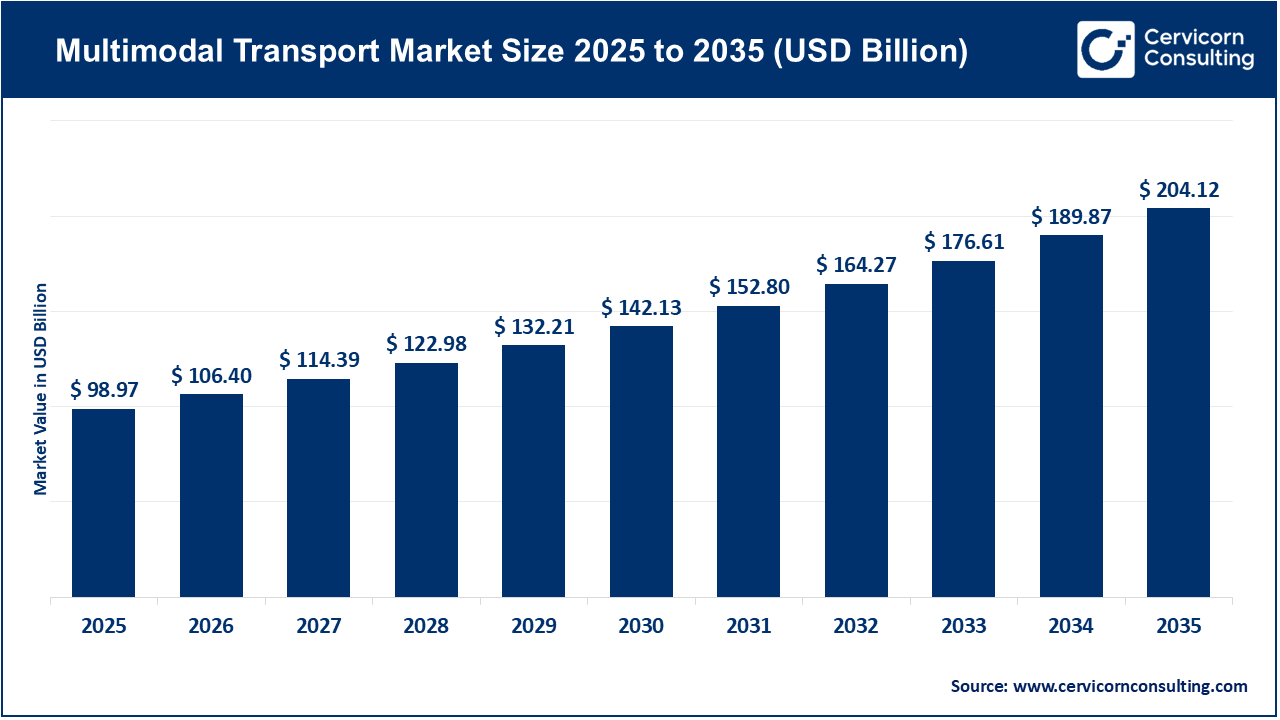
The global multimodal transport market size was valued at USD 98.97 billion in 2025 and is expected to be worth around USD 204.12 billion by 2035, exhibiting a compound annual growth rate (CAGR) of 7.5% over the forecast period from 2026 to 2035. The multimodal transport market growth is mainly driven by macroeconomic shifts and continuous investment in the development of global infrastructure. Large projects such as the International North-South Transport Corridor (INSTC) are enabling advanced logistics concepts like "synchromodality," which refers to seamless and synchronized flow of goods, allowing for changes in the transport mode in real-time based on the current state of the network. In addition, "Belt and Road"-style projects are expanding transportation corridors across Asia, Africa, and Europe. These developments are creating new multimodal integration hubs that reduce transportation times and significantly reduce administrative and regulatory barriers for international shipments.
Efficiencies in the transport industry are another significant growth factor, achieved by standardizing the units of cargo. Containerization was the first step in standardizing cargo dimensions, and the industry is now transforming to the "digital container" stage, where physical containers are inseparable from their data footprints. This allows for automated coordination between modes and less time goods spend in transit hubs. As a result, companies using digital tools to interface with multimodal transport have realized benefits such as a reduction in lead-time variability of approximately 15%, highlighting the growing importance of technology-driven logistics optimization.
Technological Integration and Digitalization in Operations Driving the Market Growth
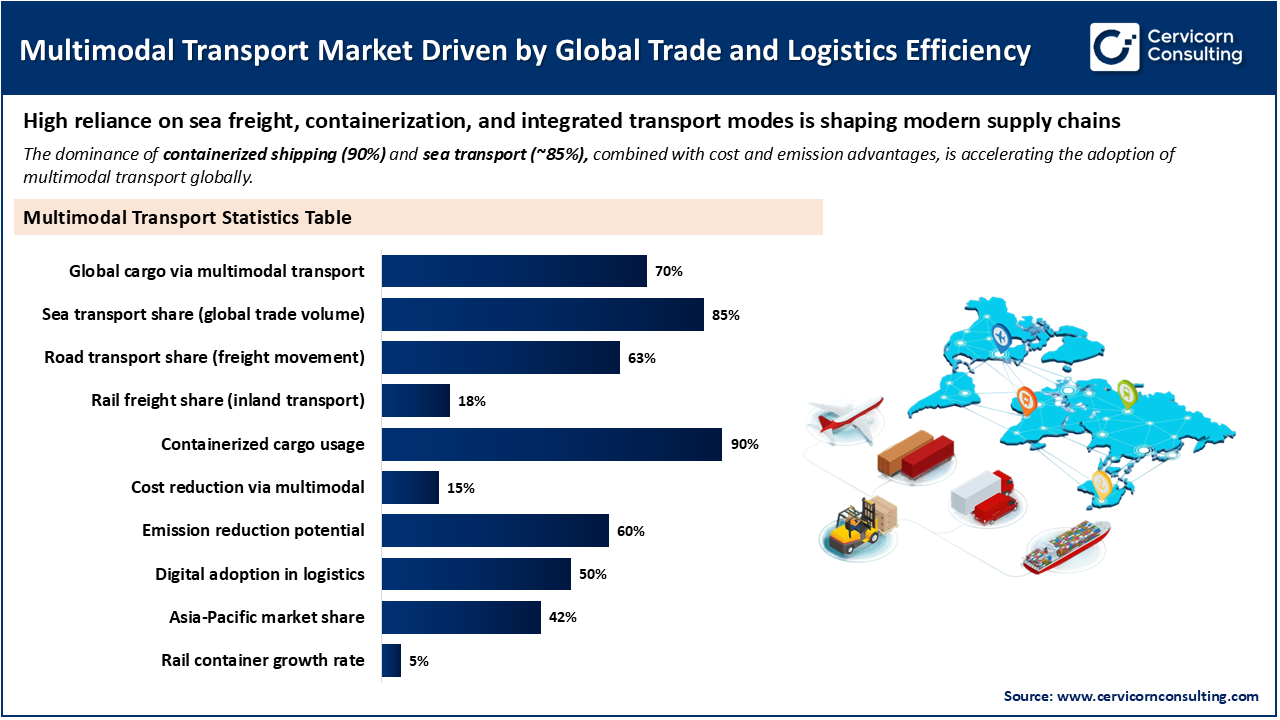
Technological Integration and Digitalisation are the main market trends because they provide advanced integrated systems. The integration of advanced technologies such as Internet of Things (IoT) and machine learning (ML) allows real-time tracking and analysis of potential trajectories, which are important for pursuing multimodal transfers’ mode. The use of trajectory prediction by warehouse management systems can yield optimal flow of goods even before they reach a transport terminal. In addition, AI and ML integrations address internal or external logistical challenges, while VGI offers an effective way to assess classification or forecasting. This technological component is significant for creating "digital twins," which are widely used to facilitate certification and regulation.
A combination of advanced technologies is enabling greater visibility, faster decision-making, and improved efficiency across complex supply chains.
What is multimodal transport, and what are its strategic advantages?
The process of moving goods from one place to another place by using two or more methods of transport, such as truck, rail, plane, ship and any combination of those. It is similar to international transport, but with a multimodal shipper, the shipper works with a single barrier, the Multimodal Transport Operator (MTO), who manages the entire journey across all modes. single-window logistics applications can save up to 20% of administrative costs versus disparate intermodal strategies.
Strategic Advantages of Market
Businesses are increasingly adopting integrated transport systems to reduce operational complexity and deliver goods on shorten time. Governments' initiatives and infrastructure investments are further accelerating adoption, especially in emerging economies.
Top 5 Trends & Technologies
Report Scope
| Area of Focus | Details |
| Market Size in 2026 | USD 106.40 Billion |
| Market Size in 2035 | USD 204.12 Billion |
| CAGR 2026 to 2035 | 7.50% |
| Dominantt Region | Asia-Pacific |
| Key Segments | Type, Transportation Mode, Service Type, Cargo Type, End-Use Industry, Region |
| Key Companies | Deutsche Post AG (DHL Group), Kuehne + Nagel, DB Schenker, A.P. Moller–Maersk, DSV A/S, CEVA Logistics, C.H. Robinson Worldwide, GEODIS, United Parcel Service (UPS), CMA CGM, Nippon Express, Expeditors International, XPO Logistics, Agility Logistics, Allcargo Logistics |
1. Government Led Infrastructure Investment and Strategic Initiatives
During 2024-2025, government infrastructure policies are a major driver of multimodal transport growth. As the place of funding, advancing structured initiatives such as "Green Shipping Corridors" and digitized trade routes are key factors. In North America, the ongoing advancement of the Infrastructure Investment and Jobs Act (IIJA) has allocated over USD 1.2 trillion, focusing on the modernization of intermodal rail yards and the electrification of port drayage systems. At the same time, the European Green Deal requires a significant modal shift, targeting a 30% transition from road to rail and inland waterways by 2030. This alignment of international policies has led to harmonized regulations and increased investment into high-tech multimodal assets such as automated gantry cranes and shore-to-ship power systems.
2. Corporations Move to Electrified Sustainable Freight Logistics
In 2024-2025, the transition toward Electrified Freight Logistics has become a major milestone in the multimodal transport model. Leading corporations are deploying electric heavy-duty vehicles, including models like the Tesla Semi and BYD’s heavy-duty electric trucks for "first and last mile" port operations, effectively closing the carbon gap in the multimodal chain. Companies are increasingly shifting toward a tradition of internal combustion engines to achieve ESG (Environmental, Social, and Governance) targets, reducing the lower total cost of ownership (TCO), which can be 15-25% lower over the vehicle lifecycle compared to diesel alternatives.
3. Technological Advancements in Intermodal Connectivity and Digitalization
Technological innovations are significantly transforming multimodal logistics, particularly through the integration of IoT and AI-powered orchestration platforms. These systems provide a "single version of truth" of cargo across various modes of transport, enhancing transparency and operational control. Technological advancements in semiconductor technologies by companies such as Infineon Technologies and STMicroelectronics have enabled low-power, high-durability sensors to be deployed that now track the conditions and location of containers in real-time, even under the most challenging maritime conditions. Additionally, predictive rerouting systems can improve delivery efficiency by 15-25%, while reducing the "dwell time" at intermodal canals, which has traditionally been the largest source of inefficiency in global logistics.
4. Statistical Growth Trends and Shifts in Market Valuations (2024 – 2025)
Recent developments highlight a strong upward trajectory in multimodal transport volumes and efficiency. The Trans-Caspian International Transport Route increased by 60% in container traffic by mid-2024, driven by infrastructure upgrades in Azerbaijan and Kazakhstan. This route has eliminated two weeks of transit time to complete the journey to Europe from China, achieving a 15-day shipping alternative to the 35-day sea route. In China, there is a year-over-year increase of 15% with its "Western Land-Sea New Corridor" in the Asia Pacific region, which allows inland provinces more direct access to markets in Southeast Asia than using traditional coastal shipping corridors.
The multimodal transport market is segmented into type, transportation mode, service type, end-use industry, cargo type, and region.
Two-Mode Transportation segment is the dominant in the market primarily due to the well-established of rail-road and sea-road networks that handle a vast majority of continent freight. These networks established by a regulatory framework and high density of intermodal terminals, which making them highly efficient for moving standard cargo and keeps it relatively low cost.
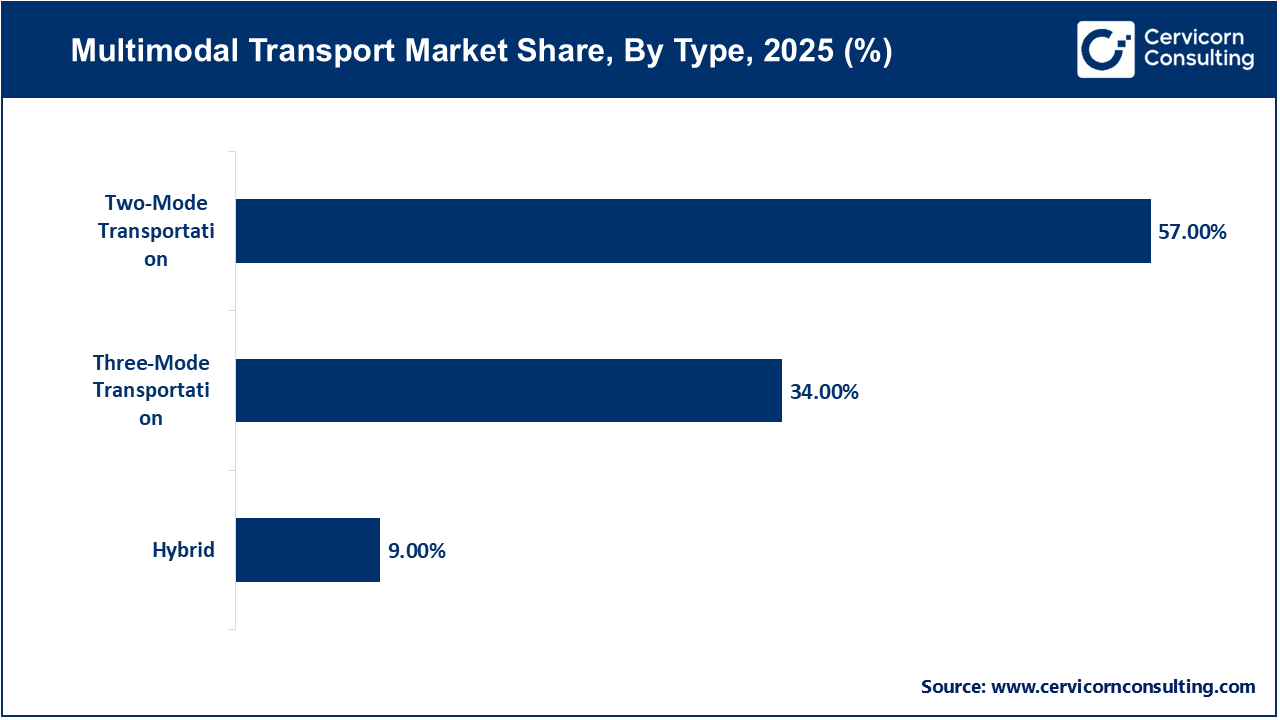
Three-Mode Transportation is the fastest growing segment of the market, because increasing expansion of globalization trade into remote and landlocked regions. As supply chains become more complex, the combining sea, rail, and road transport is increasingly essential to bridge long distances between ports and inland consumption centers. This configuration enables deeper market penetration and support access to regions where a single transshipment is no longer sufficient.
Rail–Road transportation is the leading service segment of the market, supported by the need to reduce carbon footprint and rising fuel costs. Businesses are shifting from long-haul trucking to rail–road integration to reduce carbon emissions while maintaining cost efficiency. In addition, railroad integration offers a balanced value proposition, high-volume rail transportation, and flexibility in last-mile road transportation.
Multimodal Transport Market Share, By Transportation Mode, 2025 (%)
| Transportation Mode Segment | Revenue Share, 2025 (%) |
| Rail–Road | 34% |
| Road–Water | 24% |
| Road–Air | 16% |
| Others (Rail–Water, Air–Water) | 26% |
Road–Air category is the fastest-growing in the market, primarily due to consumer demand for rapid delivery in the age of e-commerce. The combination of air transportation speed with rapid distribution to market, for high-value, time-sensitive goods. The growth of this sector is also supported by developments on the Urban Air Mobility (UAM) concepts, which aim to integrate air cargo, such as drones, to reduce congestion on ground transport in urban areas.
Cargo Consolidation & Freight Forwarding holds the largest market segment share, mainly due to its established service within the logistics sector, which batches multiple smaller shipments into a single larger load. Transportation is often more cost effective for individual shippers. These services are helpful for small and medium-sized enterprises (SMEs) that do not have enough volume to fill entire containers but still require the benefits of multi-modal service.
Multimodal Transport Market Share, By Service Type, 2025 (%)
| Service Type Segment | Revenue Share, 2025 (%) |
| Cargo Consolidation & Freight Forwarding | 38% |
| Supply Chain Management | 20% |
| Truck Load & Intermodal Transport | 16% |
| Shipping & Marine Logistics | 14% |
| Courier & Express Services | 12% |
Supply Chain Management (SCM) is the fastest growing solution type in the market, because it’s reflecting a shift from transactional logistics to strategic partnerships. Modern SCM is capitalizing on transport intelligence and supported logistics systems to accomplish end-to-end visibility, which is increasingly needed to recover from the unknown vulnerabilities exposed through the recent global disruptions.
The Retail & E-commerce sector is the dominant end-use for multimodal transportation market due to its requirement for a fast, cost-effective, and flexible supply chain for a robust multi-layer transportation strategy. Multimodal systems have advantages for E-commerce solutions, particularly for the last mile in bridging low-cost maritime transport for bulk inventory with high-speed road transport. This segment will also depend on the digital transformation of maritime ports and the integration of initiatives for inland logistics networks.
Multimodal Transport Market Share, By End-Use Industry, 2025 (%)
| End-Use Industry Segment | Revenue Share, 2025 (%) |
| Retail & E-Commerce | 28% |
| Manufacturing | 22% |
| Chemicals & Pharmaceuticals | 16% |
| Automotive | 14% |
| Food & Beverages | 12% |
| Oil & Gas | 8% |
The Chemicals & Pharmaceuticals end-use segment is the fastest growing segment of the market, mainly because of increased demand specialized, temperature-controlled logistic solution. The COVID-19 pandemic highlights the importance of cold chain infrastructure, while exposing the fragility of the pharmaceutical logistics sector, resulting in substantial demand for high-tech, temperature-controlled multimodal solutions. The transportation of vaccines and speciality chemicals in the multimodal environment requires "Cold Chain" quality at transfer points.
Containerized Cargo is dominant cargo type of the market due to it’s the most important innovation in the modern logistics context, enabling goods to be transferred between ships, trains, and trucks without unpacking the cargo. This standardization decreases labor costs, minimizes damage and theft, and significantly reduces transshipment time in ports and terminals. In addition, growth of containerized cargo is increasingly supported by "digitalization of the box", using IoT sensor to provide visibility in to the location, integrity, and environment around the container.
Multimodal Transport Market Share, By End-Use/Industry, 2025 (%)
| Cargo Type Segment | Revenue Share, 2025 (%) |
| Containerized Cargo | 48% |
| Bulk Cargo | 20% |
| Liquid & Temperature-Controlled | 18% |
| Breakbulk | 14% |
Liquid & temperature-controlled cargo represents fastest-growing segment in the market driven by the expansion of the global energy trade such as liquefied natural gas and the growing demand for fresh food and pharmaceuticals. Liquid cargo is transported in specialized ISO tank containers that are capable of moving by rail and road, while temperature controlled cargo require constant power and monitoring. Moreover, Advances in battery technology and "green" refrigeration units contribute to reducing the environmental footprint in this growing segment.
The multimodal transport market is segmented by region, including North America, Europe, Asia-Pacific, and LAMEA. Here is a brief overview of each region:
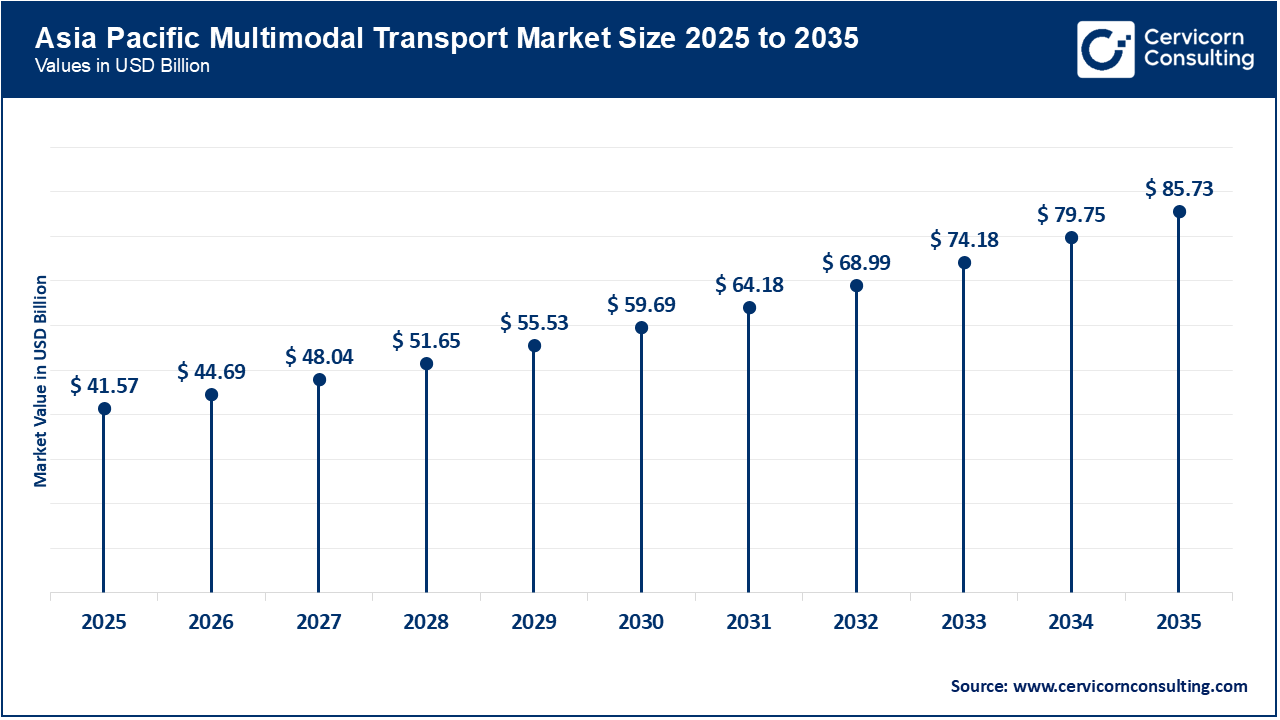
The Asia-Pacific multimodal transport market size was valued at USD 41.75 billion in 2025 and is predicted to surpass around USD 85.73 billion by 2035. The Asia Pacific region continues to dominate the global multimodal transport market due to large-scale construction development and rapid digital transformation. In China’s program, such as the "Digital Silk Road", has served to help develop international cross-border rail projects, such as the China-Laos-Thailand railway, to provide inland multimodal connections. Asia Pacific offers a unique synergy, as it is the world's largest manufacturing region and hosts leading technology providers such as BYD, Panasonic, and LG Electronics. In Southeast Asia, the priority has shifted to developing "Dry Ports", which are inland intermodal terminals that move goods from landlocked manufacturing areas, to coastal gateways.
China and India Multimodal Transport Market: Key Data Points
The North America multimodal transport market size was reached at USD 23.75 billion in 2025 and is forecasted to grow around USD 48.99 billion by 2035. North America is increasingly defined by the need for technological innovation with supply chain resilience. Recent global disruptions have exposed vulnerabilities in the traditional logistics model, prompting a strategic shift toward reshoring and investing in trade corridors focused on domestic movement. Technological advancement in North America is also focused on the electrification of the "heavy-duty" segment. The transition to electric Class 8 trucks for drayage activities at major West Coast ports is a crucial regionally-oriented part of the local air pollution mitigation and climate goals. This transition will be supported by high-power charging networks along major freight corridors, which will require logistics providers and utility companies to work closely together. The U.S logistics sector is contribute over USD 2 trillion annually, while federal infrastructure programs such as the infrastructure and jobs Act allocate USD 550 billion toward transport and logistics modernization.
U.S Multimodal Transport Market: Key Data Point
Canada Multimodal Transport Market: A Key Data Point for Supporting Communities, Businesses and Travelers
The Canadian transportation network demonstrated resiliency in 2024. It continued to support communities and businesses across the country in an efficient, safe, secure and environmentally sustainable way. Passenger volumes continued to improve, and in some cases, returned to pre-pandemic levels in 2024.
Most notably:
The Europe multimodal transport market size was estimated at USD 25.73 billion in 2025 and is predicted to hit around USD 53.07 billion by 2035. The Europe region is primarily driven by stringent regulatory framework and strong commitment to sustainability. The European Union's "Fit for 55" and Green Deal packages set ambitious emission targets for transportation, with a shift toward rail and electrified road transport. Compliance with regulations is the primary driver of innovation in European logistics. In addition, Europe has advanced the "circular economy" concept to transport equipment, which is increasing focus on carbon footprint across the lifecycle of vehicles and infrastructure improvements. Rail freight already accounts for 18-20% of inland freight transport in the EU, with targets to increase this share significantly by 2030. Investments in green logistics and sustainable infrastructure exceed USD 500 billion, positioning Europe as a leader in environmentally responsible multimodal transport.
Quantitative Insights
Multimodal Transport Market Share, By Region, 2025 (%)
| Region | Revenue Share, 2025 (%) |
| Asia Pacific | 42% |
| Europe | 26% |
| North America | 24% |
| LAMEA | 8% |
The LAMEA multimodal transport market was valued at USD 7.92 billion in 2025 and is anticipated to reach around USD 16.33 billion by 2035. The LAMEA region is experiencing growing activity in multimodal transport, largely due to economic diversification efforts and the emergence of new international trade corridors into the region. In the Middle East, countries such as Saudi Arabia and the UAE are making mass investments in logistics as key aspects of their "Vision 2030" or similar diversification initiatives. These countries are building logistic hubs, with their geographic locations being advantageous between East and West, with highly sophisticated multimodal infrastructure for global logistics. In Africa, the emphasis is placed on enhancing intra-continental trade through the African Continental Free Trade Area (AfCFTA). This necessitates the construction of “integrated transport corridors” to connect landlocked countries to major seaports. The AfCFTA is expected to boost intra-African trade by over 50%, while Middle Eastern logistics investments are projected to exceed USD 200 billion, significantly enhancing multimodal connectivity across the region.
Recent developments:
By Type
By Transportation Mode
By Service Type
By End-Use Industry
By Cargo Type
By Region
Chapter 1. Market Introduction and Overview
1.1 Market Definition and Scope
1.1.1 Overview of Multimodal Transport
1.1.2 Scope of the Study
1.1.3 Research Timeframe
1.2 Research Methodology and Approach
1.2.1 Methodology Overview
1.2.2 Data Sources and Validation
1.2.3 Key Assumptions and Limitations
Chapter 2. Executive Summary
2.1 Market Highlights and Snapshot
2.2 Key Insights by Segments
2.2.1 By Type Overview
2.2.2 By Transportation Mode Overview
2.2.3 By Service Type Overview
2.2.4 By End-Use Industry Overview
2.2.5 By Cargo Type Overview
2.3 Competitive Overview
Chapter 3. Global Impact Analysis
3.1 Russia-Ukraine Conflict: Global Market Implications
3.2 Regulatory and Policy Changes Impacting Global Markets
Chapter 4. Market Dynamics and Trends
4.1 Market Dynamics
4.1.1 Market Drivers
4.1.2 Market Restraints
4.1.3 Market Opportunities
4.1.4 Market Challenges
4.2 Market Trends
Chapter 5. Premium Insights and Analysis
5.1 Global Multimodal Transport Market Dynamics, Impact Analysis
5.2 Porter’s Five Forces Analysis
5.2.1 Bargaining Power of Suppliers
5.2.2 Bargaining Power of Buyers
5.2.3 Threat of Substitute Products
5.2.4 Rivalry among Existing Firms
5.2.5 Threat of New Entrants
5.3 PESTEL Analysis
5.4 Value Chain Analysis
5.5 Product Pricing Analysis
5.6 Vendor Landscape
5.6.1 List of Buyers
5.6.2 List of Suppliers
Chapter 6. Multimodal Transport Market, By Type
6.1 Global Multimodal Transport Market Snapshot, By Type
6.1.1 Market Revenue (($Billion) and Growth Rate (%), 2022-2035
6.1.1.1 Two-Mode Transportation
6.1.1.2 Three-Mode Transportation
6.1.1.3 Hybrid
Chapter 7. Multimodal Transport Market, By Transportation Mode
7.1 Global Multimodal Transport Market Snapshot, By Transportation Mode
7.1.1 Market Revenue (($Billion) and Growth Rate (%), 2022-2035
7.1.1.1 Rail–Road
7.1.1.2 Road–Water
7.1.1.3 Road–Air
7.1.1.4 Others
Chapter 8. Multimodal Transport Market, By Service Type
8.1 Global Multimodal Transport Market Snapshot, By Service Type
8.1.1 Market Revenue (($Billion) and Growth Rate (%), 2022-2035
8.1.1.1 Cargo Consolidation & Freight Forwarding
8.1.1.2 Supply Chain Management
8.1.1.3 Truck Load & Intermodal Transport
8.1.1.4 Shipping & Marine Logistics
8.1.1.5 Courier & Express Services
Chapter 9. Multimodal Transport Market, By End-Use Industry
9.1 Global Multimodal Transport Market Snapshot, By End-Use Industry
9.1.1 Market Revenue (($Billion) and Growth Rate (%), 2022-2035
9.1.1.1 Retail & E-Commerce
9.1.1.2 Manufacturing
9.1.1.3 Chemicals & Pharmaceuticals
9.1.1.4 Automotive
9.1.1.5 Food & Beverages
9.1.1.6 Oil & Gas
Chapter 10. Multimodal Transport Market, By Cargo Type
10.1 Global Multimodal Transport Market Snapshot, By Cargo Type
10.1.1 Market Revenue (($Billion) and Growth Rate (%), 2022-2035
10.1.1.1 Containerized Cargo
10.1.1.2 Bulk Cargo
10.1.1.3 Liquid & Temperature-Controlled
10.1.1.4 Breakbulk
Chapter 11. Multimodal Transport Market, By Region
11.1 Overview
11.2 Multimodal Transport Market Revenue Share, By Region 2024 (%)
11.3 Global Multimodal Transport Market, By Region
11.3.1 Market Size and Forecast
11.4 North America
11.4.1 North America Multimodal Transport Market Revenue, 2022-2035 ($Billion)
11.4.2 Market Size and Forecast
11.4.3 North America Multimodal Transport Market, By Country
11.4.4 U.S.
11.4.4.1 U.S. Multimodal Transport Market Revenue, 2022-2035 ($Billion)
11.4.4.2 Market Size and Forecast
11.4.4.3 U.S. Market Segmental Analysis
11.4.5 Canada
11.4.5.1 Canada Multimodal Transport Market Revenue, 2022-2035 ($Billion)
11.4.5.2 Market Size and Forecast
11.4.5.3 Canada Market Segmental Analysis
11.4.6 Mexico
11.4.6.1 Mexico Multimodal Transport Market Revenue, 2022-2035 ($Billion)
11.4.6.2 Market Size and Forecast
11.4.6.3 Mexico Market Segmental Analysis
11.5 Europe
11.5.1 Europe Multimodal Transport Market Revenue, 2022-2035 ($Billion)
11.5.2 Market Size and Forecast
11.5.3 Europe Multimodal Transport Market, By Country
11.5.4 UK
11.5.4.1 UK Multimodal Transport Market Revenue, 2022-2035 ($Billion)
11.5.4.2 Market Size and Forecast
11.5.4.3 UK Market Segmental Analysis
11.5.5 France
11.5.5.1 France Multimodal Transport Market Revenue, 2022-2035 ($Billion)
11.5.5.2 Market Size and Forecast
11.5.5.3 France Market Segmental Analysis
11.5.6 Germany
11.5.6.1 Germany Multimodal Transport Market Revenue, 2022-2035 ($Billion)
11.5.6.2 Market Size and Forecast
11.5.6.3 Germany Market Segmental Analysis
11.5.7 Rest of Europe
11.5.7.1 Rest of Europe Multimodal Transport Market Revenue, 2022-2035 ($Billion)
11.5.7.2 Market Size and Forecast
11.5.7.3 Rest of Europe Market Segmental Analysis
11.6 Asia Pacific
11.6.1 Asia Pacific Multimodal Transport Market Revenue, 2022-2035 ($Billion)
11.6.2 Market Size and Forecast
11.6.3 Asia Pacific Multimodal Transport Market, By Country
11.6.4 China
11.6.4.1 China Multimodal Transport Market Revenue, 2022-2035 ($Billion)
11.6.4.2 Market Size and Forecast
11.6.4.3 China Market Segmental Analysis
11.6.5 Japan
11.6.5.1 Japan Multimodal Transport Market Revenue, 2022-2035 ($Billion)
11.6.5.2 Market Size and Forecast
11.6.5.3 Japan Market Segmental Analysis
11.6.6 India
11.6.6.1 India Multimodal Transport Market Revenue, 2022-2035 ($Billion)
11.6.6.2 Market Size and Forecast
11.6.6.3 India Market Segmental Analysis
11.6.7 Australia
11.6.7.1 Australia Multimodal Transport Market Revenue, 2022-2035 ($Billion)
11.6.7.2 Market Size and Forecast
11.6.7.3 Australia Market Segmental Analysis
11.6.8 Rest of Asia Pacific
11.6.8.1 Rest of Asia Pacific Multimodal Transport Market Revenue, 2022-2035 ($Billion)
11.6.8.2 Market Size and Forecast
11.6.8.3 Rest of Asia Pacific Market Segmental Analysis
11.7 LAMEA
11.7.1 LAMEA Multimodal Transport Market Revenue, 2022-2035 ($Billion)
11.7.2 Market Size and Forecast
11.7.3 LAMEA Multimodal Transport Market, By Country
11.7.4 GCC
11.7.4.1 GCC Multimodal Transport Market Revenue, 2022-2035 ($Billion)
11.7.4.2 Market Size and Forecast
11.7.4.3 GCC Market Segmental Analysis
11.7.5 Africa
11.7.5.1 Africa Multimodal Transport Market Revenue, 2022-2035 ($Billion)
11.7.5.2 Market Size and Forecast
11.7.5.3 Africa Market Segmental Analysis
11.7.6 Brazil
11.7.6.1 Brazil Multimodal Transport Market Revenue, 2022-2035 ($Billion)
11.7.6.2 Market Size and Forecast
11.7.6.3 Brazil Market Segmental Analysis
11.7.7 Rest of LAMEA
11.7.7.1 Rest of LAMEA Multimodal Transport Market Revenue, 2022-2035 ($Billion)
11.7.7.2 Market Size and Forecast
11.7.7.3 Rest of LAMEA Market Segmental Analysis
Chapter 12. Competitive Landscape
12.1 Competitor Strategic Analysis
12.1.1 Top Player Positioning/Market Share Analysis
12.1.2 Top Winning Strategies, By Company, 2022-2024
12.1.3 Competitive Analysis By Revenue, 2022-2024
12.2 Recent Developments by the Market Contributors (2024)
Chapter 13. Company Profiles
13.1 Deutsche Post AG (DHL Group)
13.1.1 Company Snapshot
13.1.2 Company and Business Overview
13.1.3 Financial KPIs
13.1.4 Product/Service Portfolio
13.1.5 Strategic Growth
13.1.6 Global Footprints
13.1.7 Recent Development
13.1.8 SWOT Analysis
13.2 Kuehne + Nagel
13.3 DB Schenker
13.4 A.P. Moller–Maersk
13.5 DSV A/S
13.6 CEVA Logistics
13.7 C.H. Robinson Worldwide
13.8 GEODIS
13.9 United Parcel Service (UPS)
13.10 CMA CGM
13.11 Nippon Express
13.12 Expeditors International
13.13 XPO Logistics
13.14 Agility Logistics
13.15 Allcargo Logistics