
The global life science market size was valued at USD 99.03 billion in 2025 and is expected to surpass around USD 304.84 billion by 2035, exhibiting a compound annual growth rate (CAGR) of 11.9% over the forecast period from 2026 to 2035. Life science encompasses the scientific study of living organisms, including humans, animals, plants, and microorganisms. It involves disciplines such as biology, biotechnology, genetics, molecular biology, and pharmaceuticals, which focus on understanding the mechanisms of life and developing solutions to improve health and sustainability. Life sciences drive innovations in areas like drug discovery, gene therapy, precision medicine, agricultural biotechnology, and diagnostics. These advancements not only improve healthcare but also address global challenges such as food security and environmental sustainability.
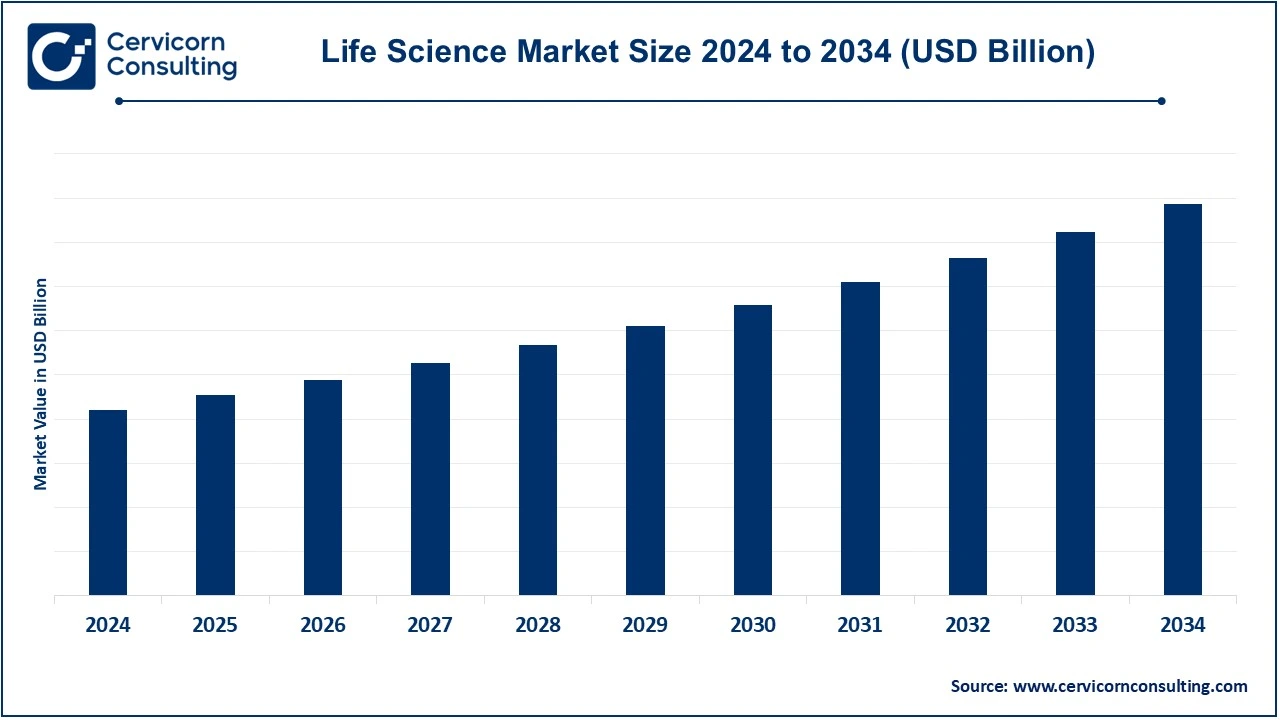
The life sciences industry plays a pivotal role in shaping the future of healthcare and technology. With the rapid adoption of technologies like artificial intelligence (AI), CRISPR gene editing, and next-generation sequencing (NGS), the sector is advancing at an unprecedented pace. Post-pandemic, the focus on personalized medicine, early diagnostics, and preventive healthcare has surged, boosting the demand for life sciences applications globally.
The life sciences market is driven by several key factors, including advancements in biotechnology, the growing prevalence of chronic and infectious diseases, and the increasing demand for personalized medicine and biologics. The rise of innovative technologies, such as gene editing tools like CRISPR, next-generation sequencing, and artificial intelligence in drug discovery, is accelerating breakthroughs in research and development. Furthermore, increased government funding, private investments, and partnerships between academia and industry are fostering innovation, while the global aging population and the need for advanced healthcare solutions continue to propel growth in the sector.
Key insights beneficial for the life science market:
AI & Automation
The overall pharma sector has already invested millions of dollars in hyper-productivity in order to boost the innovation and optimize the development of sophisticated drugs. Currently, 65-85% of life science companies are deploying AI to support drug discovery and clinical research and development.
Number of biopharma companies across the globe are adopting digital twins to boost the production lines and to improve operator integration. On an average 85% of biopharma firms are seen implementing digital initiatives in 2025, whereas 78% of them have already leverage cloud computing solutions.
In 2025, a survey of 143 life sciences manufacturing executives was done by Rockwell Automation. The firm aimed to understand production efficiency, digital transformation of pharma sector and regulatory compliances. Following are the key findings from the survey report:
The life science market is evolving rapidly, driven by a combination of technological innovations, shifting demographics, and increased demand for personalized healthcare solutions. Below are some key trends currently shaping the life science sector:
Technological Advancements and Digital Transformation
Personalized Medicine and Biotechnology
Growth of Digital Health and Remote Monitoring
Expansion in Emerging Markets
Regulatory Developments and Investment Growth
| Area of Focus | Details |
| Market Size in 2026 | USD 110.82 Billion |
| Market Size by 2035 | USD 304.84 Billion |
| Market CAGR 2026 to 2035 | 11.9% |
| Dominant Region | North America |
| Fastest Growing Region | Asia Pacific |
| Key Segments | Type, Therapeutic Areas, Application, End User, Region |
| Key Companies | Thermo Fisher Scientific Inc., Danaher Corporation, Roche Holding AG, Merck KGaA (MilliporeSigma), Pfizer Inc., Johnson & Johnson, Agilent Technologies Inc., Illumina, Inc., Becton, Dickinson and Company (BD), Bio-Rad Laboratories, Inc., Abbott Laboratories, GE HealthCare |
Technological Advancements
Aging Global Population
Growth in Chronic Diseases
Expansion of Personalized Medicine
High R&D and Production Costs
Regulatory Challenges
Intellectual Property (IP) Issues
The life science market is segmented into several key regions: North America, Europe, Asia-Pacific, and LAMEA (Latin America, Middle East, and Africa).
North America, particularly the United States, dominates the global life science industry due to its advanced healthcare infrastructure, high levels of investment in biotechnology, and the presence of leading pharmaceutical and biotechnology companies. The U.S. is home to numerous research institutions, universities, and healthcare providers that contribute to the development of life science technologies and innovations. The increasing demand for healthcare services, especially in areas like oncology, cardiovascular diseases, and diabetes, has bolstered the market. Moreover, the U.S. government’s continuous investment in biomedical research, through organizations like the National Institutes of Health (NIH), supports innovation in the sector. Furthermore, the rising demand for personalized medicine, gene therapies, and cell-based therapies is driving growth in North America. The adoption of advanced technologies such as AI, machine learning, and precision medicine also plays a critical role in the region's leadership.
The presence of major pharmaceutical companies like Pfizer, Johnson & Johnson, and Merck, along with increasing venture capital funding in the biotechnology sector, has made North America a hub for life science research and product development. However, the region faces challenges like high healthcare costs, regulatory complexities, and the threat of generic drugs after patent expirations. Despite these challenges, the market's growth remains strong due to continuous innovation and the expanding healthcare needs of an aging population. In fact, the U.S. Food and Drug Administration (FDA) is expected to approve over 50 new drugs annually, further fueling market expansion.
The Asia Pacific region is emerging as one of the fastest-growing markets in the life science sector. The region’s growth is driven by countries like China, India, Japan, and South Korea, which have large populations, expanding healthcare access, and growing middle-class demand for advanced healthcare services. The Asia Pacific life science market is projected to grow at a CAGR of 12-15% from 2026 to 2036. China's rapid advancements in biotechnology and its robust pharmaceutical industry, including companies like Sinovac and Shanghai Pharmaceuticals, have positioned it as a global leader in life science research and production.
India is also witnessing significant growth in the biotechnology and pharmaceutical sectors, supported by its large and young population, as well as its growing healthcare needs. India is known as the "pharmacy of the world," providing generic drugs to many parts of the globe. The Indian life sciences market is driven by increased investment in research and development. Japan and South Korea are also investing heavily in biotechnology, with Japan focusing on regenerative medicine and stem cell research. The region faces challenges such as varying healthcare standards, regulatory issues, and infrastructure disparities, but its potential for growth is substantial due to an increasingly affluent population and rising healthcare needs.
The biotechnology segment led the life science market in 2025, driven by growing investment in the fields of biologics, gene therapies, cell therapies, synthetic biology, and personalized medicine. Companies in biotechnology sector continue to play a pivotal role in drug discovery, vaccine development, genomics research and advanced therapy development. Increased adoption of CRISPR-based gene-editing technology, mRNA platform technology and personalized medicine technology has created a wide range of applications of biotechnology sector.
The AI in life sciences segment is going to grow fastest among all segments. AI is having a transformative effect on drug discovery, clinical development, diagnostics and decision making within health care. AI algorithms are expediting drug discovery and development, helping in better target identification, clinical trial design and predictive analysis. Cloud based AI platform and health informatics tools are increasingly being deployed by pharma companies, research organizations and health organizations to handle enormous biological data.
Life science market was led by drug discovery and development segment in 2025 as companies across the industry increase their pharmaceutical R&D spending to support growing demand for innovative therapies to treat cancer, neurological diseases, autoimmune disorders, and rare diseases. Biopharmaceutical companies are significantly investing in novel drug candidates, biologics, biosimilars, and novel therapies. Advanced technologies like genomics, bioinformatics, AI aided drug designing, and high-throughput screening has helped increase research productivity and development pipelines.
The fastest growing segment will be the clinical trials, during the forecast period, owing to increased number of activities regarding drug development and increasing demand for therapies supported by evidence. More extensive and multi-centric clinical trials are being carried out by pharmaceutical companies, to obtain regulatory approval and market access of new drugs. Decentralized clinical trials, AI powered patient recruitment, remote patient monitoring with digital health tools, and real world evidence are becoming a core focus in this segment.
The oncology segment was dominant in 2025 as the burden of cancer is growing worldwide. Significant investments were made to develop drugs for cancer treatment, which makes it the dominant segment by revenue. Cancer is the major cause of mortality worldwide, therefore significant amount of money are being spent on research to develop advanced therapies by governments, pharmaceuticals and research organizations. Research in area like immunotherapy, targeted therapy, CAR-T cell therapy, antibody drug conjugates and precision oncology have changed the way cancer treatment works today.
Neurology is the fastest growing therapeutic area expected owing to the increase in prevalent rates of neurological diseases like alzheimer's disease, parkinson's disease, multiple sclerosis, epilepsy, neurodegenerative disease etc. With the rising age of world population, the research expenditure is expected to rise on an global level and new opportunities are opening with advanced research on neurogenomics, biomarkers, precision medicine and neurodiagnostics using artificial intelligence.
Pharmaceuticals segment accounted for a major share of life sciences market value, owing to their huge R & D investments in drug discovery, development of biologics, clinical trials, regulatory approval and commercialization. Pharmaceuticals also constitute a major portion of life sciences expenditure as they keep looking for novel therapies to cater unmet medical needs. However, increasing R&D spending, lengthening drug pipelines, rise in biologics development, and increasing use of novel research technologies are likely to drive the growth.
Biotechnology is expected to witness the highest growth rate during the forecast period, driven by its growing contribution to the development of next-generation therapies such as gene therapy, cell therapy, mRNA based therapies, and personalized medicine. Venture capital investment, strategic collaborations, and various government initiatives have driven significant growth in the biotechnology segment. Biotechnology firms have increasingly become an indispensable part of pharmaceutical pipelines especially in the fields of oncology, rare diseases, immunology, and regenerative medicine.
Life Science Companies Landscape
The life sciences market is highly competitive and innovation-driven, with companies focusing on advancing healthcare, diagnostics, and biotechnology. The landscape is characterized by intense research and development (R&D) efforts, strategic collaborations, and acquisitions to expand product portfolios and global reach. Major players invest heavily in genomics, proteomics, cell therapies, and artificial intelligence to address growing healthcare demands.
The adoption of personalized medicine, gene editing (like CRISPR), and advanced diagnostic tools has intensified competition. Emerging startups and established giants are driving progress in areas such as immunotherapy, vaccine development, and biomanufacturing. Companies are also focusing on automation and digitalization for lab processes, which enhance efficiency and accuracy.
Thermo Fisher Scientific
Danaher Corporation
Roche Holding AG
Pfizer Inc.
Illumina, Inc.
By Type
By Applications
By Therapeutic Areas
By End-User
By Geography
Chapter 1. Market Introduction and Overview
1.1 Market Definition and Scope
1.1.1 Overview of Life Science
1.1.2 Scope of the Study
1.1.3 Research Timeframe
1.2 Research Methodology and Approach
1.2.1 Methodology Overview
1.2.2 Data Sources and Validation
1.2.3 Key Assumptions and Limitations
Chapter 2. Executive Summary
2.1 Market Highlights and Snapshot
2.2 Key Insights by Segments
2.2.1 By Type Overview
2.2.2 By Therapeutic Areas Overview
2.2.3 By Application Overview
2.2.4 By End User Overview
2.3 Competitive Overview
Chapter 3. Global Impact Analysis
3.1 COVID 19 Impact on Life Science Market
3.1.1 COVID-19 Landscape: Pre and Post COVID Analysis
3.1.2 COVID 19 Impact: Global Major Government Policy
3.1.3 Market Trends and Opportunities in the COVID-19 Landscape
3.2 Russia-Ukraine Conflict: Global Market Implications
3.3 Regulatory and Policy Changes Impacting Global Markets
Chapter 4. Market Dynamics and Trends
4.1 Market Dynamics
4.1.1 Market Drivers
4.1.1.1 Technological Advancements
4.1.1.2 Aging Global Population
4.1.1.3 Growth in Chronic Diseases
4.1.1.4 Expansion of Personalized Medicine
4.1.2 Market Restraints
4.1.2.1 High R&D and Production Costs
4.1.2.2 Regulatory Challenges
4.1.2.3 Intellectual Property (IP) Issues
4.2 Market Trends
Chapter 5. Premium Insights and Analysis
5.1 Global Life Science Market Dynamics, Impact Analysis
5.2 Porter’s Five Forces Analysis
5.2.1 Bargaining Power of Suppliers
5.2.2 Bargaining Power of Buyers
5.2.3 Threat of Substitute Products
5.2.4 Rivalry among Existing Firms
5.2.5 Threat of New Entrants
5.3 PESTEL Analysis
5.4 Value Chain Analysis
5.5 Product Pricing Analysis
5.6 Vendor Landscape
5.6.1 List of Buyers
5.6.2 List of Suppliers
Chapter 6. Life Science Market, By Type
6.1 Global Life Science Market Snapshot, By Type
6.1.1 Market Revenue (($Billion) and Growth Rate (%), 2024-2035
6.1.1.1 Biotechnology
6.1.1.2 Pharmaceuticals
6.1.1.3 Medical Devices
6.1.1.4 Life Science Tools
6.1.1.5 Digital Health Solutions
Chapter 7. Life Science Market, By Applications
7.1 Global Life Science Market Snapshot, By Applications
7.1.1 Market Revenue (($Billion) and Growth Rate (%), 2024-2035
7.1.1.1 Drug Discovery and Development
7.1.1.2 Diagnostics
7.1.1.3 Therapeutics
7.1.1.4 Clinical Trials
7.1.1.5 Research & Development
Chapter 8. Life Science Market, By Therapeutic Areas
8.1 Global Life Science Market Snapshot, By Therapeutic Areas
8.1.1 Market Revenue (($Billion) and Growth Rate (%), 2024-2035
8.1.1.1 Oncology
8.1.1.2 Cardiology
8.1.1.3 Neurology
8.1.1.4 Immunology
8.1.1.5 Rare Diseases
8.1.1.6 Infectious Diseases
8.1.1.7 Others
Chapter 9. Life Science Market, By End User
9.1 Global Life Science Market Snapshot, By End User
9.1.1 Market Revenue (($Billion) and Growth Rate (%), 2024-2035
9.1.1.1 Pharmaceutical Companies
9.1.1.2 Biotechnology Companies
9.1.1.3 Academic & Research Institutions
9.1.1.4 Hospitals & Clinics
9.1.1.5 Others
Chapter 10. Life Science Market, By Region
10.1 Overview
10.2 Life Science Market Revenue Share, By Region 2025 (%)
10.3 Global Life Science Market, By Region
10.3.1 Market Size and Forecast
10.4 North America
10.4.1 North America Life Science Market Revenue, 2024-2035 ($Billion)
10.4.2 Market Size and Forecast
10.4.3 North America Life Science Market, By Country
10.4.4 U.S.
10.4.4.1 U.S. Life Science Market Revenue, 2024-2035 ($Billion)
10.4.4.2 Market Size and Forecast
10.4.4.3 U.S. Market Segmental Analysis
10.4.5 Canada
10.4.5.1 Canada Life Science Market Revenue, 2024-2035 ($Billion)
10.4.5.2 Market Size and Forecast
10.4.5.3 Canada Market Segmental Analysis
10.4.6 Mexico
10.4.6.1 Mexico Life Science Market Revenue, 2024-2035 ($Billion)
10.4.6.2 Market Size and Forecast
10.4.6.3 Mexico Market Segmental Analysis
10.5 Europe
10.5.1 Europe Life Science Market Revenue, 2024-2035 ($Billion)
10.5.2 Market Size and Forecast
10.5.3 Europe Life Science Market, By Country
10.5.4 UK
10.5.4.1 UK Life Science Market Revenue, 2024-2035 ($Billion)
10.5.4.2 Market Size and Forecast
10.5.4.3 UKMarket Segmental Analysis
10.5.5 France
10.5.5.1 France Life Science Market Revenue, 2024-2035 ($Billion)
10.5.5.2 Market Size and Forecast
10.5.5.3 FranceMarket Segmental Analysis
10.5.6 Germany
10.5.6.1 Germany Life Science Market Revenue, 2024-2035 ($Billion)
10.5.6.2 Market Size and Forecast
10.5.6.3 GermanyMarket Segmental Analysis
10.5.7 Rest of Europe
10.5.7.1 Rest of Europe Life Science Market Revenue, 2024-2035 ($Billion)
10.5.7.2 Market Size and Forecast
10.5.7.3 Rest of EuropeMarket Segmental Analysis
10.6 Asia Pacific
10.6.1 Asia Pacific Life Science Market Revenue, 2024-2035 ($Billion)
10.6.2 Market Size and Forecast
10.6.3 Asia Pacific Life Science Market, By Country
10.6.4 China
10.6.4.1 China Life Science Market Revenue, 2024-2035 ($Billion)
10.6.4.2 Market Size and Forecast
10.6.4.3 ChinaMarket Segmental Analysis
10.6.5 Japan
10.6.5.1 Japan Life Science Market Revenue, 2024-2035 ($Billion)
10.6.5.2 Market Size and Forecast
10.6.5.3 JapanMarket Segmental Analysis
10.6.6 India
10.6.6.1 India Life Science Market Revenue, 2024-2035 ($Billion)
10.6.6.2 Market Size and Forecast
10.6.6.3 IndiaMarket Segmental Analysis
10.6.7 Australia
10.6.7.1 Australia Life Science Market Revenue, 2024-2035 ($Billion)
10.6.7.2 Market Size and Forecast
10.6.7.3 AustraliaMarket Segmental Analysis
10.6.8 Rest of Asia Pacific
10.6.8.1 Rest of Asia Pacific Life Science Market Revenue, 2024-2035 ($Billion)
10.6.8.2 Market Size and Forecast
10.6.8.3 Rest of Asia PacificMarket Segmental Analysis
10.7 LAMEA
10.7.1 LAMEA Life Science Market Revenue, 2024-2035 ($Billion)
10.7.2 Market Size and Forecast
10.7.3 LAMEA Life Science Market, By Country
10.7.4 GCC
10.7.4.1 GCC Life Science Market Revenue, 2024-2035 ($Billion)
10.7.4.2 Market Size and Forecast
10.7.4.3 GCCMarket Segmental Analysis
10.7.5 Africa
10.7.5.1 Africa Life Science Market Revenue, 2024-2035 ($Billion)
10.7.5.2 Market Size and Forecast
10.7.5.3 AfricaMarket Segmental Analysis
10.7.6 Brazil
10.7.6.1 Brazil Life Science Market Revenue, 2024-2035 ($Billion)
10.7.6.2 Market Size and Forecast
10.7.6.3 BrazilMarket Segmental Analysis
10.7.7 Rest of LAMEA
10.7.7.1 Rest of LAMEA Life Science Market Revenue, 2024-2035 ($Billion)
10.7.7.2 Market Size and Forecast
10.7.7.3 Rest of LAMEAMarket Segmental Analysis
Chapter 11. Competitive Landscape
11.1 Competitor Strategic Analysis
11.1.1 Top Player Positioning/Market Share Analysis
11.1.2 Top Winning Strategies, By Company, 2024-2025
11.1.3 Competitive Analysis, By Revenue, 2024-2025
11.2 Recent Developments by the Market Contributors (2025)
Chapter 12. Company Profiles
12.1 Thermo Fisher Scientific Inc.
12.1.1 Company Snapshot
12.1.2 Company and Business Overview
12.1.3 Financial KPIs
12.1.4 Product/Service Portfolio
12.1.5 Strategic Growth
12.1.6 Global Footprints
12.1.7 Recent Development
12.1.8 SWOT Analysis
12.2 Danaher Corporation
12.3 Roche Holding AG
12.4 Merck KGaA (MilliporeSigma)
12.5 Pfizer Inc.
12.6 Johnson & Johnson
12.7 Agilent Technologies Inc.
12.8 Illumina, Inc.
12.9 Becton, Dickinson and Company (BD)
12.10 Bio-Rad Laboratories, Inc.
12.11 Abbott Laboratories
12.12 GE HealthCare