
The global healthcare cloud computing market size was reached at USD 61.79 billion in 2025 and is expected to exceed around USD 219.42 billion by 2035, growing at a compound annual growth rate (CAGR) of 13.51% during the forecast period 2026 to 2035.
The healthcare cloud computing market is experiencing significant growth due to increasing digital transformation in the healthcare industry. Factors such as rising demand for telehealth, AI-driven diagnostics, and the need for cost-efficient healthcare solutions are driving cloud adoption. The shift from traditional data storage to cloud-based solutions ensures better scalability, security, and interoperability among healthcare systems. Additionally, government initiatives promoting EHR adoption and the growing use of IoT devices in healthcare further accelerate market expansion. Advancements in big data analytics and AI-driven healthcare applications are further fueling growth, enabling predictive analytics and personalized medicine.
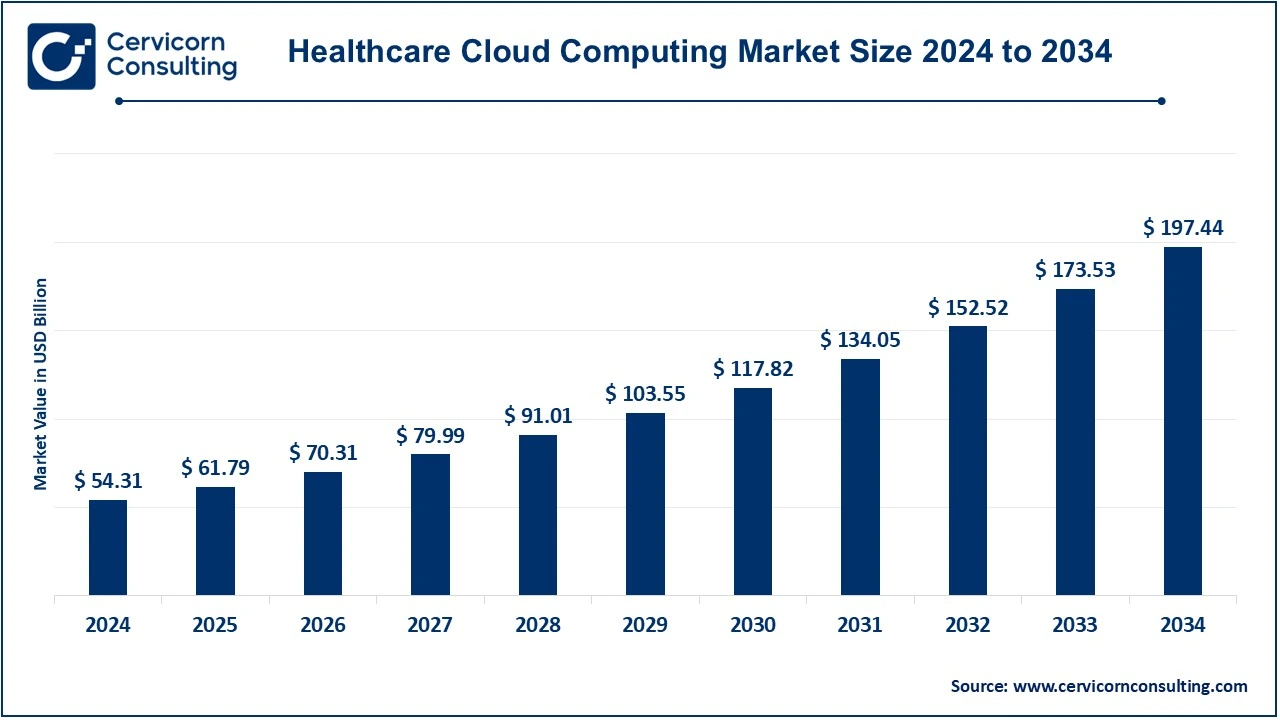
Robust growth in the healthcare cloud computing market due to growing demand from healthcare providers, hospitals, and clinics toward cost-effective, scalable, and secure solutions to manage patient data and streamline operations while ensuring proper collaboration. Growing EHR, telemedicine, and data analytics are nudging healthcare organizations toward patient care improvements and compliance with regulations while achieving optimal operational efficiency. The ever-increasing demand for telemedicine solutions post-pandemic to access medical information and services properly is pushing the transition to cloud platforms.
What is a Healthcare Cloud Computing?
Healthcare cloud computing is the use of remote servers hosted on the internet to store, manage, and process healthcare-related data. It enables healthcare providers to securely store patient records, improve data accessibility, and streamline medical workflows. Cloud solutions support electronic health records (EHRs), telemedicine, remote patient monitoring, and AI-driven diagnostics, making healthcare services more efficient and scalable. With enhanced data security, compliance with regulations like HIPAA, and cost-effective infrastructure, healthcare organizations can reduce IT maintenance while improving patient care. Cloud computing also facilitates real-time collaboration among doctors and specialists, leading to faster decision-making and better treatment outcomes.
Key Insights
CEO Statements
Matt Garman, CEO of Amazon Web Services, Inc.
Mark D. Benjamin, CEO of Nuance Communications
Hadi Chaudhry, CEO of CareCloud Inc.
Report Scope
| Area of Focus | Details |
| Market Size in 2026 | USD 70.31 Billion |
| Expected Market Size in 2035 | USD 219.42 Billion |
| Estimated CAGR 2026 to 2035 | 13.51% |
| Prime Region | North America |
| Booming Region | Asia-Pacific |
| Key Segments | Type, Deployment Model, Service Model, Pricing Model, End User, Region |
| Key Companies | Amazon Web Services, Inc., CareCloud, Inc., Nuance Communications, Cerner Corporation, Merge Healthcare Inc, Carestream Corporation, Oracle Corporation, Clear Data Networks Inc., Siemens Healthcare Private Limited, Microsoft, Dell Inc., IBM Corporation, Google LLC, CLEARDATA, Koninklijke Philips NV |
The healthcare cloud computing market is segmented into several key regions: North America, Europe, Asia-Pacific, and LAMEA (Latin America, Middle East, and Africa). Here’s an in-depth look at each region
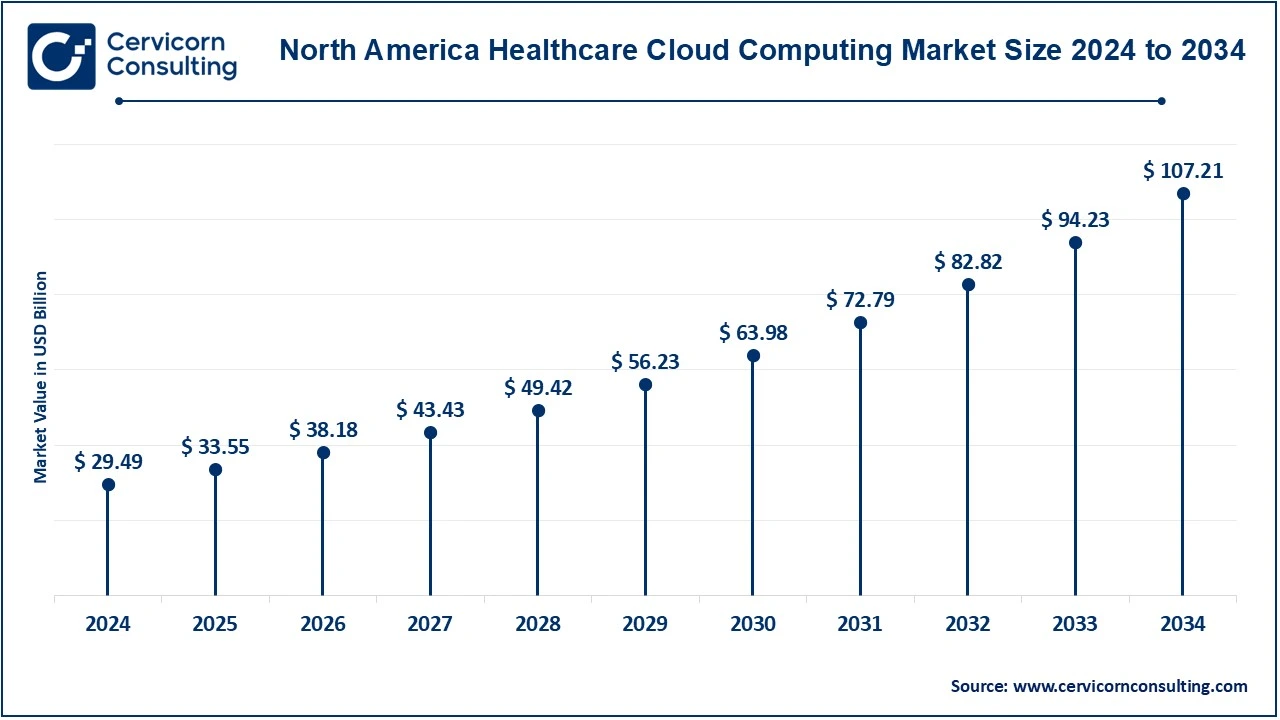
The North America healthcare cloud computing market size was valued at USD 33.55 billion in 2025 and is expected to reach around USD 119.14 billion by 2035. North America is one of the key regions for the global market. Advanced healthcare systems and a high adoption rate of cloud technologies, along with significant investments in health IT infrastructure, characterize this region. The United States is the leading player in this region since a majority of healthcare providers and insurance companies, as well as government initiatives, are driving cloud-based solutions. Importantly, Canada is also an important market, where all the emphasis is on digital health solutions, and government initiatives are on the rise and increasing healthcare access and delivery through technology. For instance, advanced diagnostic imaging devices in the medical technology market are slowly gaining demand in the Canadian market as it has an increasing aging population; diagnosis and treatment are required to be accurate and timely. North America has also thrown in a well-established regulatory environment that encourages the usage of cloud technology in healthcare, with full-fledged data privacy and security.
The Europe healthcare cloud computing market size was estimated at USD 13.35 billion in 2025 and is projected to hit around USD 47.39 billion by 2035. The Europe led by the adopters: Germany, the United Kingdom, France, Italy, and Spain. In Europe, the health sector has moved toward digital health solutions by increasing government-backed initiatives and regulations associated with data privacy in the cloud environment. Germany has been pretty ahead in bringing digitalized health care, particularly through programs like the eHealth Act, under which an e-health record has been legislated as a mandate. The UK is now considering cloud technology for operational streamlining and better care for patients. France is also taking national-level actions toward the development of the health data repository. An example is that in March 2024, France established a fast lane to market access for digital health applications and telemonitoring systems. The German template on regulation through DiGA considers about 60 million citizens of France in obligatory health insurance whom it aims to make have digital therapeutics.
The Asia-Pacific healthcare cloud computing market size was accounted for USD 12.17 billion in 2025 and is predicted to surpass around USD 43.23 billion by 2035. France is also taking national-level measures towards the establishment of a repository of health data. For instance, France has recently made a fast lane for access to the market of digital health applications and telemonitoring systems as well. The German template on regulation through DiGA considers about 60 million citizens of France in obligatory health insurance whom it aspires to make have digital therapeutics. Public expenditure on health rose in India: from 1.6% of GDP in FY21 to 2.2% in FY22 and further to 2.1% in FY23, according to the Economic Survey 2022-23; however, still, the Health Ministry target is 2.5% in FY25. In the meantime, the healthcare sector in India is booming fast as private equity and venture capital investments crossed USD 1 billion during the first five months of 2024; it has shown an increased level of 220% in the year 2024. Japan and South Korea are outperforming on the curve of adoption of technology and an ever-increasing number of these are using cloud platforms to handle healthcare data and improve collaborative efforts between different healthcare givers.
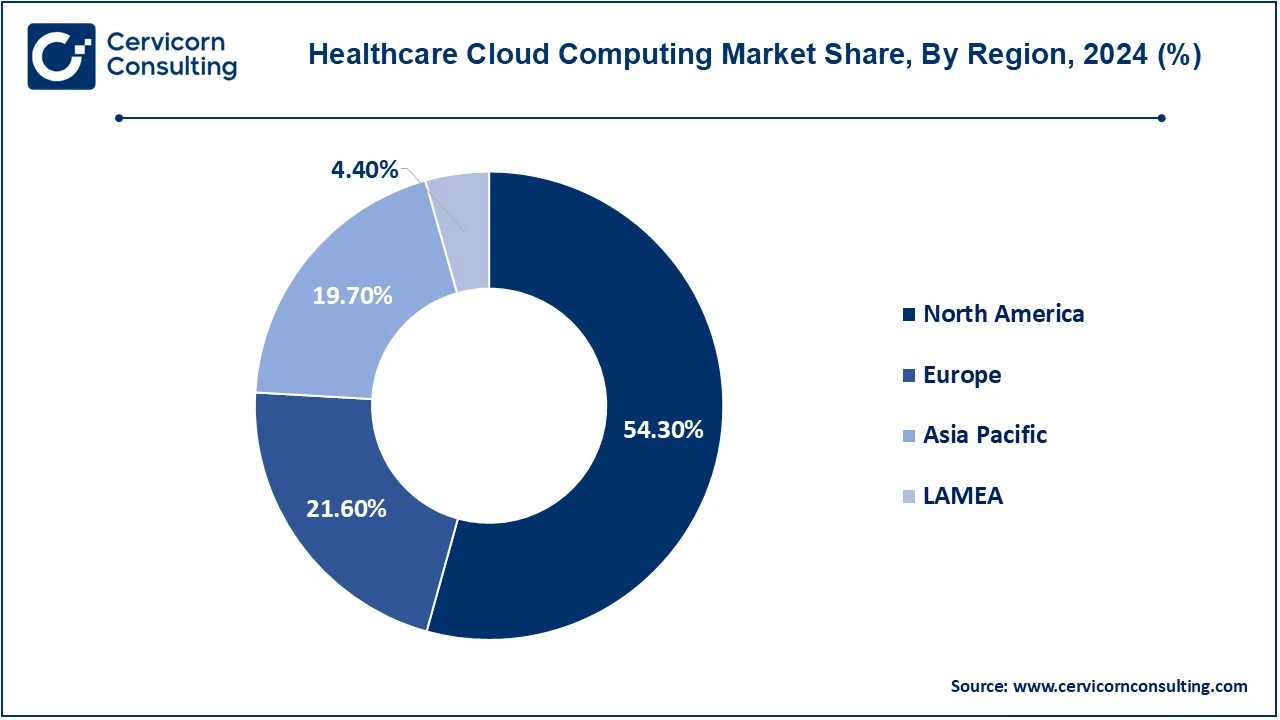
The LAMEA healthcare cloud computing market was valued at USD 2.72 billion in 2025 and is anticipated to reach around USD 9.65 billion by 2035. The adoption of cloud computing in healthcare is different in the LAMEA region, which has Latin America, the Middle East, and Africa. However, new regional demands cultivate the adoption of cloud computing in healthcare differently in the LAMEA region, as special needs differ on regional lines. Latin America embraces cloud solutions from the countries of Brazil, and Argentina as they recognize the ability of cloud solutions to enhance access to healthcare, making it cheaper, and even effectively and properly manage public health data. Countries like Saudi Arabia, the UAE, and Qatar are investing in cloud technology through wider smart city initiatives to enhance health care in the Middle East. In Africa, adoption is slower; however, evidence exists of South Africa, Kenya, and Nigeria's move toward cloud solutions to help alleviate limited infrastructure issues and help cloud computing achieve greater scalability and accessibility for health services in the region at large. More importantly, in the creation of these variant markets, digital health would be focused much more on partnerships local and global partnerships.
The healthcare cloud computing market is segmented into type, deployment model, service model, pricing model, end user and region. Based on type, the market is classified into clinical information systems, and nonclinical information systems. Based on deployment model, the market is classified into public cloud, private cloud, and hybrid cloud. Based on service model, the market is classified into software as a service (SaaS), platform as a service (PaaS), and infrastructure as a service (IaaS). Based on pricing model, the market is classified into pay-as-you-go, and spot pricing. Based on end user, the market is classified into healthcare providers, hospitals, pharmacies, diagnostic and imaging centers, ambulatory centers.
Public Cloud in Healthcare: The public cloud segment has dominated the market in 2025. The public cloud provides scalable, cost-effective solutions where hosting will be from third-party vendors, ideal for small healthcare organizations. Shared clouds, as they might be termed, benefit from flexible storage and services for applications like telemedicine or EHRs. They benefit those organizations that have a low-cost entry point but need secure and compliant solutions for patient data.
Healthcare Cloud Computing Market Revenue Share, By Deployment Model, 2025 (%)
| Deployment Model | Revenue Share, 2025 (%) |
| Public Cloud | 52.90% |
| Private Cloud | 36.40% |
| Hybrid Cloud | 10.70% |
Private Cloud in Healthcare: A private cloud is a dedicated environment for one healthcare organization. It is so secure, having control and customization, that it would be a very good choice for large-scale healthcare providers who require stricter data privacy. Normally, sensitive patient data or mission-critical application storage is done via private clouds; this gives full control over compliance and security standards.
Hybrid Cloud in Healthcare: The hybrid cloud segment is projected to grow significantly over the forecast period. A hybrid cloud combines all the elements of public and private clouds, thus making them even more flexible for healthcare organizations. For instance, sensitive information can remain private while less sensitive applications or workloads utilize the scaling power of a public cloud. In such a manner, organizations can have a balance between security and cost; hence, the hybrid cloud will be suitable for large institutions that need to have privacy and scalability at the same time.
Software as a Service in Healthcare: The SaaS segment has dominated the market in 2025. SaaS provides health organizations with pre-standardized software applications, such as EHR systems, patient management tools, and telemedicine platforms, in the cloud. Health organizations benefit from SaaS with ease of access, automated updates, and lower initial costs. The benefits oblige the healthcare provider to assume no liability for maintenance and compliance because SaaS will update and manage software for the healthcare provider.
Platform as a Service (PaaS) in Healthcare: The developers get a system wherein they can develop, deploy, and manage custom healthcare applications without having to manage the underlying infrastructure with PaaS. Then, the health organizations start creating personalized patient care apps or analytics tools on PaaS - this approach is flexible while simplifying the complexity of IT infrastructure maintenance.
Healthcare Cloud Computing Market Revenue Share, By Service Model, 2025 (%)
| Service Model | Revenue Share, 2025 (%) |
| Software as a Service (SaaS) | 47.90% |
| Platform as a Service (PaaS) | 30.40% |
| Infrastructure as a Service (IaaS) | 21.70% |
Infrastructure as a Service (IaaS) in Healthcare: The IaaS segment is anticipated to grow significantly over the forecast period. IaaS has enabled user accessibility to computing resources for virtual machines, storage, and networks that can be ordered on-demand. Organizations in the health sector are using IaaS to host huge datasets run applications or back up important data. This provides a scalable and flexible pay-for-use model where there is no need to maintain physical servers and hardware.
Providers: Healthcare providers, for example the doctors and clinics, utilize cloud computing to enhance patient data management. For example, through EHR in the cloud, providers receive real-time information about patients so that they can make appropriate decisions on further delivery of care. Cloud supports telemedicine and allows remote consultation, further improving patient access to care.
Hospitals: Hospitals benefit from cloud computing in that it centralizes the data of a patient and thus makes operational efficiency better. Cloud platforms help resource management as well as reduce costs while providing for better interdepartmental collaboration. They also help the hospitals scale their IT infrastructure according to the needs of patients and enhance data security, as well as HIPAA, and other regulations.
Pharmacies: Pharmacy chains use the cloud for inventory management, prescription tracking and dispensing of medication. They enhance communication with healthcare providers and offer personalized services such as reminding patients to refill their medication in addition to ensuring safe storage of prescription data for patients and supporting compliance with regulations.
Diagnostic and Imaging Centers: It aids diagnostic and imaging centers to hold large medical imaging files securely and access them from anywhere. It further aids in enhancing the speed of diagnosis and collaboration among health providers. Its integration with electronic health records is also possible so that patients' health is viewed more comprehensively.
Ambulatory Centers: Ambulatory centers have truly utilized cloud computing in enhancing service delivery in handling patient records and billing appointments. Such systems enable the sharing of real-time data to enhance the coordination of care services with other healthcare providers. It also enables the support of telemedicine services through the provision of flexible, remote care options and enhancing service delivery as a whole.
Healthcare cloud computing companies take it to the next level of action by using the latest advanced technologies, artificial intelligence, machine learning, and big data analytics, in areas such as better patient care; operational efficiencies; and innovation in clinical and administrative workflows. Using strategic collaboration and product launches, Amazon Web Services, Inc., CareCloud Inc., Nuance Communications, Cerner Corporation, Merge Healthcare Inc., and Carestream Corporation are driving cloud-based solutions that bring healthcare providers smooth integration, real-time access to data, and scalable infrastructure. This in return brings better treatment with higher accuracy and detail but also helps healthcare management get better global healthcare delivery and reduced cost.
By Type
By Deployment Model
By Service Model
By Pricing Model
By End User
By Region
Chapter 1 Market Introduction and Overview
1.1 Market Definition and Scope
1.1.1 Overview of Healthcare cloud computing market
1.1.2 Scope of the Study
1.1.3 Research Timeframe
1.2 Research Methodology and Approach
1.2.1 Methodology Overview
1.2.2 Data Sources and Validation
1.2.3 Key Assumptions and Limitations
Chapter 2 Executive Summary
2.1 Market Highlights and Snapshot
2.2 Key Insights by Segments
2.2.1 By Type Overview
2.2.2 By Deployment Model Overview
2.2.3 By Service Model Overview
2.2.4 By Pricing Model Overview
2.2.5 By End User Overview
2.3 Competitive Overview
Chapter 3 Global Impact Analysis
3.1 Russia-Ukraine Conflict: Global Market Implications
3.2 Regulatory and Policy Changes Impacting Global Markets
Chapter 4 Market Dynamics and Trends
4.1 Market Dynamics
4.1.1 Market Drivers
4.1.1.1 Data security and privacy
4.1.1.2 Regulatory Compliance
4.1.1.3 Need for Remote Access
4.1.2 Market Restraints
4.1.2.1 High Upfront Costs
4.1.2.2 Issues with Cloud Downtime
4.1.2.3 Cost of Cloud Services
4.1.3 Market Challenges
4.1.3.1 Scalability of Cloud Solutions
4.1.3.2 User Adoption and Training
4.1.3.3 Monitoring and Managing Cloud Performance
4.1.4 Market Opportunities
4.1.4.1 Increased Storage and Security of Data
4.1.4.2 Improved Coordinating and Communicating
4.1.4.3 Patient Engagement and Access
4.2 Market Trends
Chapter 5 Premium Insights and Analysis
5.1 Global Healthcare cloud computing market Market Dynamics, Impact Analysis
5.2 Porter’s Five Forces Analysis
5.2.1 Bargaining Power of Suppliers
5.2.2 Bargaining Power of Buyers
5.2.3 Threat of Substitute Products
5.2.4 Rivalry among Existing Firms
5.2.5 Threat of New Entrants
5.3 PESTEL Analysis
5.4 Value Chain Analysis
5.5 Product Pricing Analysis
5.6 Vendor Landscape
5.6.1 List of Buyers
5.6.2 List of Suppliers
Chapter 6 Healthcare cloud computing market Market, By Type
6.1 Global Healthcare cloud computing market Market Snapshot, By Type
6.1.1 Market Revenue (($Billion) and Growth Rate (%), 2022-2034
6.1.1.1 Clinical Information Systems
6.1.1.2 Nonclinical Information Systems
Chapter 7 Healthcare cloud computing market Market, By Deployment Model
7.1 Global Healthcare cloud computing market Market Snapshot, By Deployment Model
7.1.1 Market Revenue (($Billion) and Growth Rate (%), 2022-2034
7.1.1.1 Public Cloud
7.1.1.2 Private Cloud
7.1.1.3 Hybrid Cloud
Chapter 8 Healthcare cloud computing market Market, By Service Model
8.1 Global Healthcare cloud computing market Market Snapshot, By Service Model
8.1.1 Market Revenue (($Billion) and Growth Rate (%), 2022-2034
8.1.1.1 Software as a Service (SaaS)
8.1.1.2 Platform as a Service (PaaS)
8.1.1.3 Infrastructure as a Service (IaaS)
Chapter 9 Healthcare cloud computing market Market, By Pricing Model
9.1 Global Healthcare cloud computing market Market Snapshot, By Pricing Model
9.1.1 Market Revenue (($Billion) and Growth Rate (%), 2022-2034
9.1.1.1 Pay-as-you-go
9.1.1.2 Spot pricing
Chapter 10 Healthcare cloud computing market Market, By End User
10.1 Global Healthcare cloud computing market Market Snapshot, By End User
10.1.1 Market Revenue (($Billion) and Growth Rate (%), 2022-2034
10.1.1.1 Healthcare Providers
10.1.1.2 Hospitals
10.1.1.3 Pharmacies
10.1.1.4 Diagnostic and Imaging Centers
10.1.1.5 Ambulatory Centers
Chapter 11 Healthcare cloud computing market Market, By Region
11.1 Overview
11.2 Healthcare cloud computing market Market Revenue Share, By Region 2024 (%)
11.3 Global Healthcare cloud computing market Market, By Region
11.3.1 Market Size and Forecast
11.4 North America
11.4.1 North America Healthcare cloud computing market Market Revenue, 2022-2034 ($Billion)
11.4.2 Market Size and Forecast
11.4.3 North America Healthcare cloud computing market Market, By Country
11.4.4 U.S.
11.4.4.1 U.S. Healthcare cloud computing market Market Revenue, 2022-2034 ($Billion)
11.4.4.2 Market Size and Forecast
11.4.4.3 U.S. Market Segmental Analysis
11.4.5 Canada
11.4.5.1 Canada Healthcare cloud computing market Market Revenue, 2022-2034 ($Billion)
11.4.5.2 Market Size and Forecast
11.4.5.3 Canada Market Segmental Analysis
11.4.6 Mexico
11.4.6.1 Mexico Healthcare cloud computing market Market Revenue, 2022-2034 ($Billion)
11.4.6.2 Market Size and Forecast
11.4.6.3 Mexico Market Segmental Analysis
11.5 Europe
11.5.1 Europe Healthcare cloud computing market Market Revenue, 2022-2034 ($Billion)
11.5.2 Market Size and Forecast
11.5.3 Europe Healthcare cloud computing market Market, By Country
11.5.4 UK
11.5.4.1 UK Healthcare cloud computing market Market Revenue, 2022-2034 ($Billion)
11.5.4.2 Market Size and Forecast
11.5.4.3 UKMarket Segmental Analysis
11.5.5 France
11.5.5.1 France Healthcare cloud computing market Market Revenue, 2022-2034 ($Billion)
11.5.5.2 Market Size and Forecast
11.5.5.3 FranceMarket Segmental Analysis
11.5.6 Germany
11.5.6.1 Germany Healthcare cloud computing market Market Revenue, 2022-2034 ($Billion)
11.5.6.2 Market Size and Forecast
11.5.6.3 GermanyMarket Segmental Analysis
11.5.7 Rest of Europe
11.5.7.1 Rest of Europe Healthcare cloud computing market Market Revenue, 2022-2034 ($Billion)
11.5.7.2 Market Size and Forecast
11.5.7.3 Rest of EuropeMarket Segmental Analysis
11.6 Asia Pacific
11.6.1 Asia Pacific Healthcare cloud computing market Market Revenue, 2022-2034 ($Billion)
11.6.2 Market Size and Forecast
11.6.3 Asia Pacific Healthcare cloud computing market Market, By Country
11.6.4 China
11.6.4.1 China Healthcare cloud computing market Market Revenue, 2022-2034 ($Billion)
11.6.4.2 Market Size and Forecast
11.6.4.3 ChinaMarket Segmental Analysis
11.6.5 Japan
11.6.5.1 Japan Healthcare cloud computing market Market Revenue, 2022-2034 ($Billion)
11.6.5.2 Market Size and Forecast
11.6.5.3 JapanMarket Segmental Analysis
11.6.6 India
11.6.6.1 India Healthcare cloud computing market Market Revenue, 2022-2034 ($Billion)
11.6.6.2 Market Size and Forecast
11.6.6.3 IndiaMarket Segmental Analysis
11.6.7 Australia
11.6.7.1 Australia Healthcare cloud computing market Market Revenue, 2022-2034 ($Billion)
11.6.7.2 Market Size and Forecast
11.6.7.3 AustraliaMarket Segmental Analysis
11.6.8 Rest of Asia Pacific
11.6.8.1 Rest of Asia Pacific Healthcare cloud computing market Market Revenue, 2022-2034 ($Billion)
11.6.8.2 Market Size and Forecast
11.6.8.3 Rest of Asia PacificMarket Segmental Analysis
11.7 LAMEA
11.7.1 LAMEA Healthcare cloud computing market Market Revenue, 2022-2034 ($Billion)
11.7.2 Market Size and Forecast
11.7.3 LAMEA Healthcare cloud computing market Market, By Country
11.7.4 GCC
11.7.4.1 GCC Healthcare cloud computing market Market Revenue, 2022-2034 ($Billion)
11.7.4.2 Market Size and Forecast
11.7.4.3 GCCMarket Segmental Analysis
11.7.5 Africa
11.7.5.1 Africa Healthcare cloud computing market Market Revenue, 2022-2034 ($Billion)
11.7.5.2 Market Size and Forecast
11.7.5.3 AfricaMarket Segmental Analysis
11.7.6 Brazil
11.7.6.1 Brazil Healthcare cloud computing market Market Revenue, 2022-2034 ($Billion)
11.7.6.2 Market Size and Forecast
11.7.6.3 BrazilMarket Segmental Analysis
11.7.7 Rest of LAMEA
11.7.7.1 Rest of LAMEA Healthcare cloud computing market Market Revenue, 2022-2034 ($Billion)
11.7.7.2 Market Size and Forecast
11.7.7.3 Rest of LAMEAMarket Segmental Analysis
Chapter 12 Competitive Landscape
12.1 Competitor Strategic Analysis
12.1.1 Top Player Positioning/Market Share Analysis
12.1.2 Top Winning Strategies, By Company, 2022-2024
12.1.3 Competitive Analysis By Revenue, 2022-2024
12.2 Recent Developments by the Market Contributors (2024)
Chapter 13 Company Profiles
13.1 Amazon Web Services, Inc.
13.1.1 Company Snapshot
13.1.2 Company and Business Overview
13.1.3 Financial KPIs
13.1.4 Product/Service Portfolio
13.1.5 Strategic Growth
13.1.6 Global Footprints
13.1.7 Recent Development
13.1.8 SWOT Analysis
13.2 CareCloud, Inc.
13.3 Nuance Communications
13.4 Cerner Corporation
13.5 Merge Healthcare Inc
13.6 Carestream Corporation
13.7 Oracle Corporation
13.8 Clear Data Networks Inc.
13.9 Siemens Healthcare Private Limited
13.10 Microsoft