Thermal Systems Market Size and Forecast 2026 to 2035
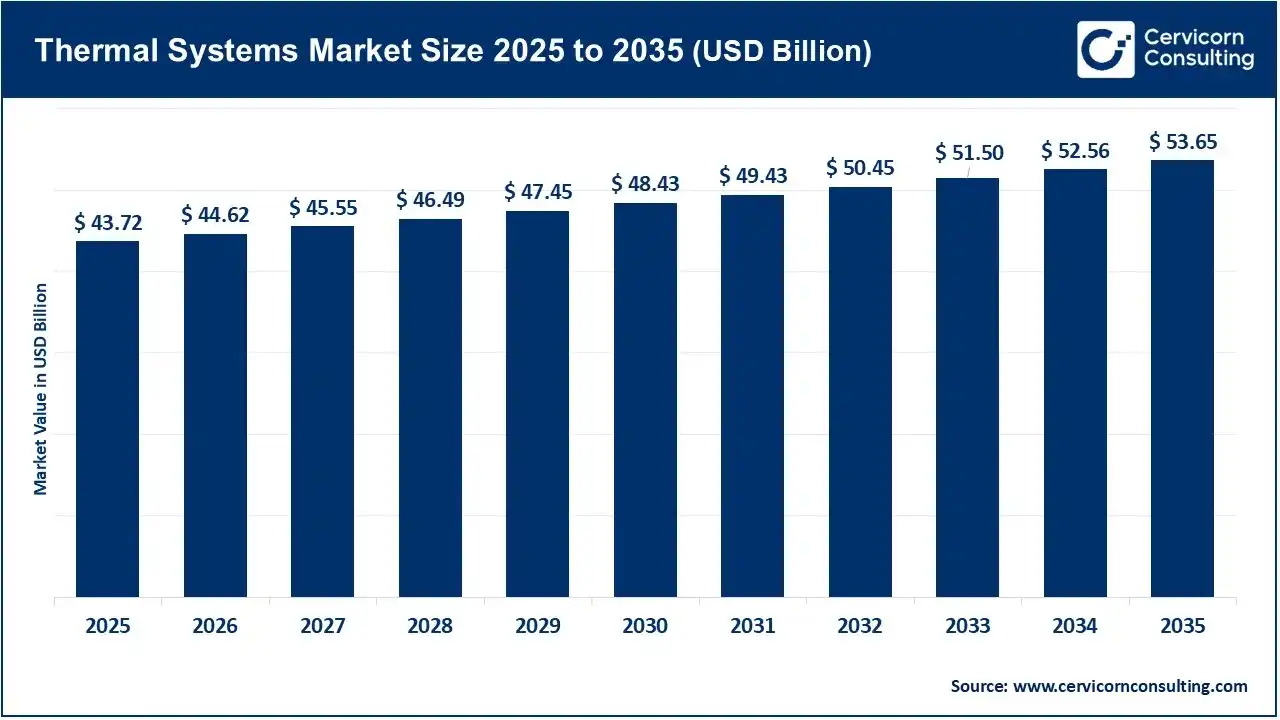
The global thermal systems market size was valued at USD 43.72 billion in 2025 and is projected to grow from USD 44.62 billion in 2026 to nearly USD 53.65 billion by 2035, registering a CAGR of 2.1% over the forecast period 2026 to 2035. The market is growing due to rising demand for efficient thermal management, energy optimization, and advanced heating and cooling technologies.
Report Highlights
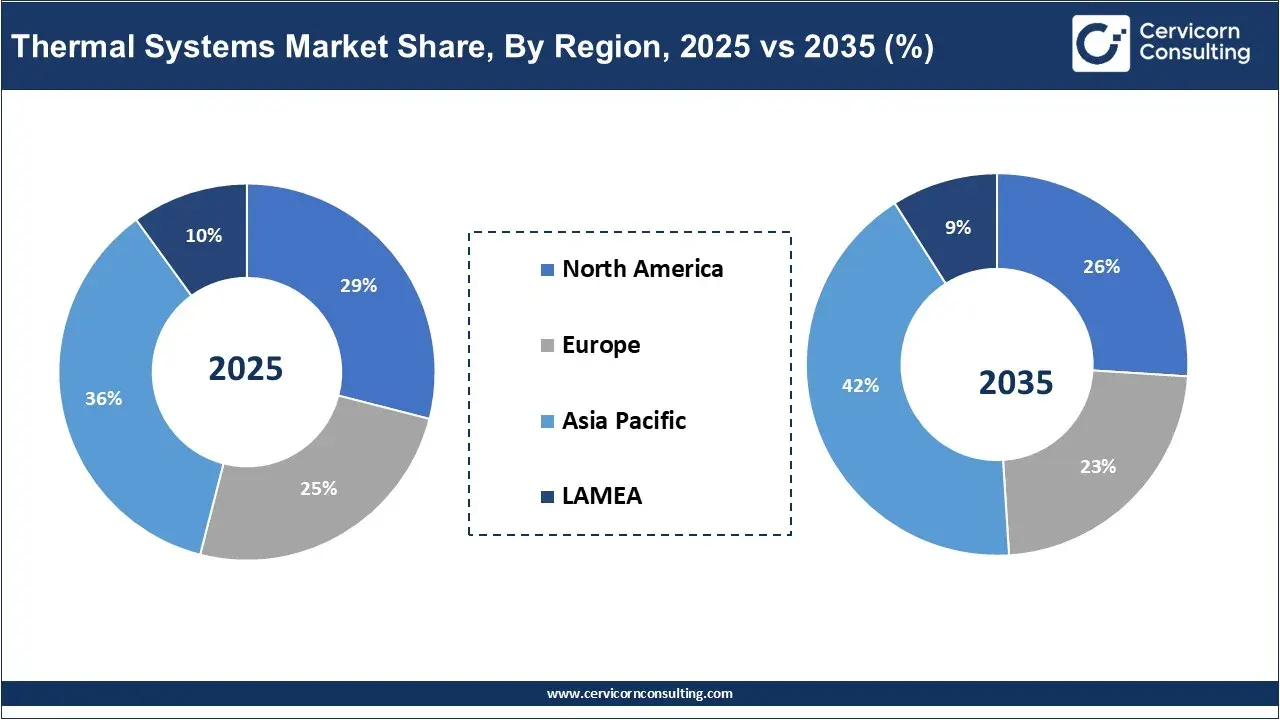
- By region: Asia-Pacific accounted for a revenue share of 36% in 2025, supported by a strong automotive manufacturing base and growing adoption of electric and hybrid vehicles
- By thermal system type: Powertrain thermal management systems dominated the market with revenue share of 30%, supported by the widespread use of thermal management technologies across conventional and hybrid vehicles.
- By component: Compressors generated highest revenue share of 18% in 2025, supported by their essential role in refrigeration, air conditioning, and vehicle thermal management systems.
- By technology: Liquid-based coolant systems dominated the market and generated 35% revenue share in 2025, supported by efficient heat transfer and increasing demand for effective battery and powertrain cooling.
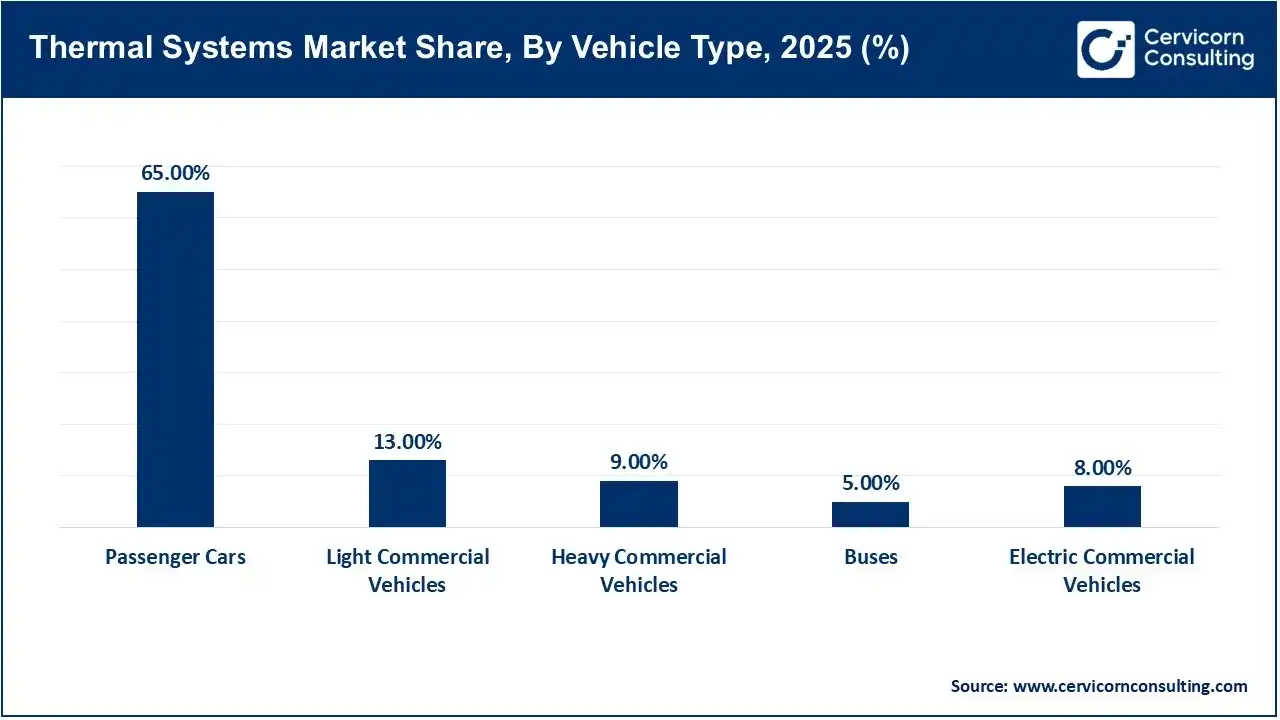
- By vehicle type: Passenger cars dominated the market with 65% of the revenue share in 2025, supported by the large vehicle base and growing adoption of advanced thermal management technologies.
What is Driving the Growth of the Thermal Systems Market?
The thermal systems market is growing due to the growing demand for effective thermal management, energy optimization, and innovative heating and cooling technologies in automotive, industrial, electronics, and energy applications. The growing usage of electrification, automation, and energy-efficient technologies is driving market expansion. The increasing requirement to manage operational temperatures and increase system performance is driving the use of advanced thermal solutions. Continuous technological improvements in thermal management systems are also opening up new prospects in a variety of industries.
Key Trends
- Advancement in Thermal Management Technologies: The continuous development of sophisticated heat exchangers, cooling systems, thermal sensors, and heat management solutions enhances system performance. Manufacturers are concentrating on creating compact, dependable, and effective thermal solutions for modern applications. These developments are broadening the applications of thermal systems in the automotive, electronics, industrial, and energy sectors.
- Rising Electrification and Electric Mobility: The increasing use of electric vehicles and electrified systems necessitates good battery and powertrain temperature management. Thermal systems aid in the maintenance of appropriate operating temperatures while also improving the safety and performance of electric components. Continued investment in electric mobility is projected to open up new prospects for thermal system makers.
- Increasing Industrial Automation: Growing industrial automation creates a need for dependable thermal management technologies that can maintain equipment performance and prevent overheating. Automated thermal systems can help maintain constant temperature control across complicated industrial operations. The rise of smart manufacturing and advanced production facilities is fueling market growth.
Technology Landscape
- Advanced Heat Exchangers: Advanced heat exchangers are increasingly being employed to boost heat transfer efficiency in industrial, automotive, and energy applications. These solutions improve thermal performance while lowering energy losses and enabling smaller system designs. Continuous advances in materials and heat transfer technologies improve their efficiency and dependability.
- Liquid Cooling Systems: Liquid cooling solutions are becoming increasingly popular in applications that need efficient heat removal and precise temperature control. These systems can efficiently cool electric vehicles, batteries, data centers, and high-performance electronic components. The growing demand for high-performance computing and electrification is driving the usage of liquid cooling technologies.
- Thermal Energy Storage: Thermal energy storage methods allow excess thermal energy to be stored and used as needed, increasing total energy efficiency. These technologies are becoming increasingly popular for renewable energy integration, industrial operations, and heating and cooling applications. The growing emphasis on energy efficiency and grid flexibility opens up new potential for improved thermal storage systems.
Market Dynamics
Growth Drivers
- Growing Demand for Energy Efficiency: The growing emphasis on lowering energy usage and operational costs is encouraging the use of efficient thermal systems. Industries are looking for innovative solutions to increase heat management and overall system efficiency. The increased emphasis on sustainable operations is fueling market uptake. Rising energy costs are also prompting firms to invest in more efficient thermal technologies. The need to reduce energy losses in industrial and commercial operations is driving up demand for innovative thermal solutions.
- Rising Electric Vehicle Adoption: The growing popularity of electric vehicles is creating a high demand for battery and powertrain temperature management solutions. Effective temperature regulation enhances battery performance, safety, and lifespan. Continued investment in electric mobility is likely to boost demand for sophisticated thermal technologies. Battery manufacturers and automakers are increasingly focused on effective heat management technologies. The development of fast-charging and high-performance electric vehicles emphasizes the need for thermal control.
- Expansion of Data Centers: Growing digitization and the need for data storage and computing infrastructure necessitate the use of more efficient cooling systems. Thermal management technologies assist in preventing overheating and ensuring the reliability of data center operations. The growth of high-performance computing is creating more opportunities for better cooling methods. The increasing use of artificial intelligence and cloud computing is creating new heat-management requirements. Data center operators are increasingly turning to efficient cooling systems to boost reliability and reduce energy use.
Restraints
- High Initial Investment: Advanced thermal systems may necessitate large investments in equipment, installation, and support infrastructure. High initial expenses may deter adoption among small and medium-sized organizations. Longer payback periods may further limit investment in innovative solutions. Additional costs may result from system customization and integration with existing equipment. Cost-conscious end users may continue to use traditional heat management systems.
- Complex System Integration: Integrating thermal systems into existing equipment and control infrastructure can be difficult. Compatibility concerns may lead to longer installation times and higher implementation costs. The requirement for specialized skills might also pose challenges for end consumers. Different industrial applications may necessitate unique setups and control systems. Integration issues can cause delays in implementation and reduce the overall efficiency of thermal solutions.
- Maintenance Requirements: To function properly, thermal systems must be inspected, serviced, and components replaced on a regular basis. Maintenance efforts can raise operational costs and system downtime. This may limit acceptance among budget-conscious users. Complex systems may also necessitate specialist technicians and diagnostic equipment. Unexpected component failures can drive up maintenance costs while disrupting ongoing operations.
Key Opportunities
- Development of Advanced Cooling Technologies: The growing demand for high-performance cooling opens up new prospects for sophisticated liquid cooling, heat exchangers, and thermal management solutions. Manufacturers are creating more compact and efficient technologies for demanding applications. These advancements have the potential to increase the use of thermal systems across a wide range of sectors. The growing demand for high-density computing and electrification is generating new uses for sophisticated cooling. Thermal material and system design improvements can help to improve cooling performance even more.
- Growth of Electric Mobility: The growth of electric vehicles presents enormous prospects for battery temperature management and related technologies. The growing demand for faster charging and greater battery performance is driving the development of new thermal solutions. Continued EV infrastructure development can help to drive industry growth. Manufacturers are focused on thermal systems that can maintain consistent battery temperatures under a variety of operating circumstances. The expanding number of electric commercial vehicles is opening up new prospects for thermal management technologies.
- Integration of Smart Technologies: The integration of sensors, automation, artificial intelligence, and digital monitoring opens up new possibilities for intelligent thermal systems. Smart technologies allow for real-time temperature monitoring, automated control, and predictive maintenance. These skills have the potential to increase system efficiency and dependability. Connected thermal systems can also assist operators in spotting performance issues before they cause equipment failures. The increasing usage of industrial IoT technology is projected to bolster smart thermal management.
Challenges
- Technological Complexity: Thermal systems are becoming increasingly complicated, necessitating advanced engineering, control technology, and specialized knowledge. It can be difficult to develop solutions that are both efficient and reliable. Manufacturers must continue to spend on research and development. Rapid technological advancements might also raise the requirement for regular system upgrades. The compatibility of modern thermal technologies with current infrastructure remains a significant concern.
- Need for Skilled Professionals: Advanced thermal systems must be installed, operated, and maintained by trained personnel. A shortage of experienced specialists can impair system operation and make maintenance more complex. Continuous workforce training is becoming more crucial. As thermal technologies become more automated, professionals must grasp mechanical and digital systems. Limited availability of specialized skills might raise installation and maintenance expenses.
- Environmental Regulations: Stricter environmental rules encourage firms to minimize emissions and increase energy efficiency. Meeting shifting regulatory standards might lead to higher development and compliance costs. Companies must continuously change their thermal technologies to meet changing standards. Manufacturers may be forced to alter existing systems due to restrictions on specific refrigerants and other materials. Compliance with various geographical requirements can also lead to increased operational complexity.
Regional Analysis
Asia-Pacific dominated the thermal systems market
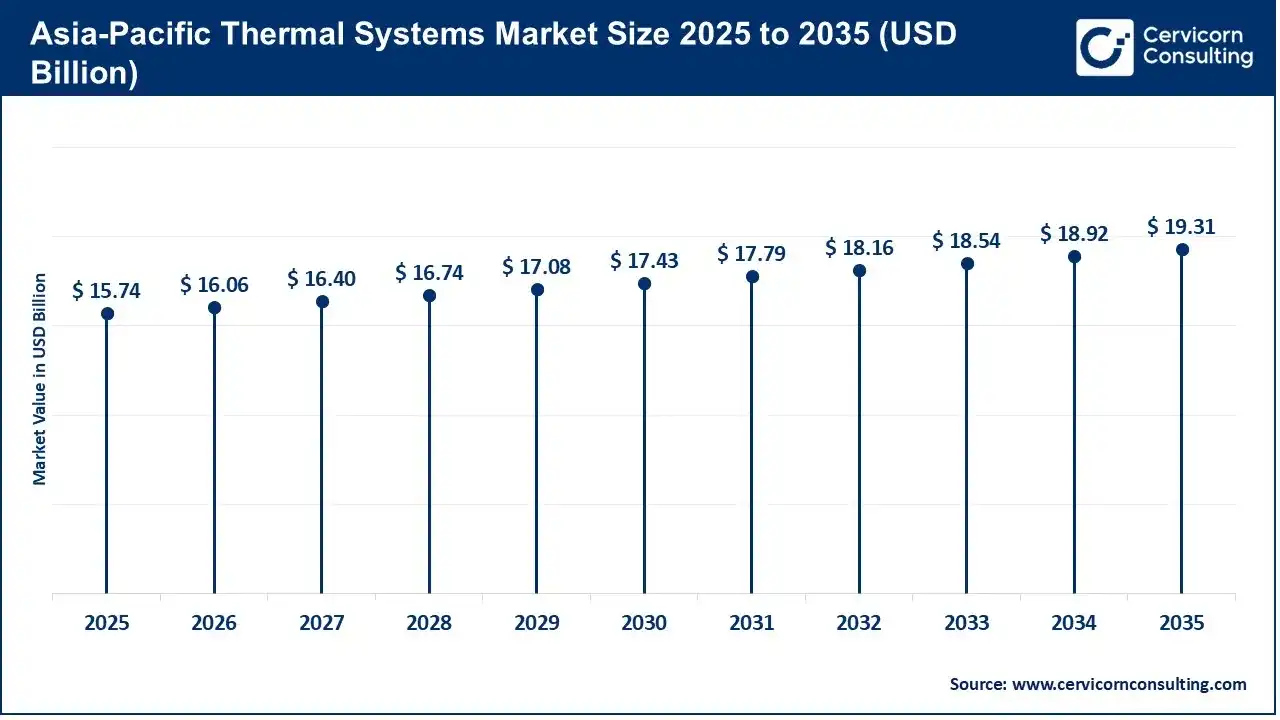
The Asia-Pacific thermal systems market size was valued at USD 15.74 billion in 2025 and is expected to reach USD 19.31 billion by 2035. Asia-Pacific dominated the market in 2025, motivated by a strong automotive manufacturing base and rising use of electric and hybrid vehicles throughout the region. Increased investment in vehicle production, battery manufacture, and sophisticated mobility technologies is driving increased demand for heat management systems. The presence of major car manufacturers, as well as the expansion of electric vehicle infrastructure, is boosting the area market. Continued increase in car production and electrification are likely to keep the region's leadership position.
North America is expected to be the fastest-growing regional market
The North America thermal systems market size was estimated at USD 12.68 billion in 2025 and is projected to surpass USD 15.56 billion by 2035. North America is expected to be the fastest-growing regional market during 2026–2035, driven by rising electric car use, investments in battery manufacturing, and the development of innovative automotive technology. The growing demand for effective battery and powertrain thermal management is driving regional expansion. Increasing investments in electric transportation and automotive electrification are offering more opportunities. Continued technical breakthroughs and infrastructure development are likely to drive regional growth.
Europe represents an emerging regional segment in the thermal systems market
The Europe thermal systems market size was accounted for USD 10.93 billion in 2025 and is anticipated to reach USD 13.41 billion by 2035. Europe represents an emerging regional segment, supported by increased car electrification and a significant emphasis on energy efficiency and sustainable mobility. Automotive firms in the region are investing in cutting-edge heat management systems for electric and hybrid vehicles. The growing demand for efficient battery cooling and heat pump systems is driving adoption. The further development of electric mobility and advanced vehicle technologies is likely to generate new business prospects.
Segmental Analysis
Thermal System Type Analysis
Powertrain Thermal Management Systems: Powertrain thermal management systems dominated the thermal systems market in 2025, motivated by the increased necessity to maintain optimal operating temperatures for engines, transmissions, and other powertrain components. These systems enhance vehicle performance, efficiency, and component dependability by effectively regulating surplus heat. Thermal management technologies are increasingly being used in conventional and hybrid vehicles, which is helping to boost the industry. It is expected that continuing developments in vehicle thermal management would contribute to the segment's leadership position.
Thermal Systems Market Share, By Thermal System Type, 2025 (%)
| Thermal System Type |
Revenue Share, 2025 (%) |
| Powertrain Thermal Management Systems |
30% |
| Battery Thermal Management Systems |
26% |
| Cabin HVAC Thermal Systems |
23% |
| Integrated/Centralized Thermal Management Systems |
12% |
| Waste Heat Recovery Systems |
9% |
Battery Thermal Management Systems: Battery thermal management systems are expected to be the fastest-growing segment in the thermal systems market during 2026–2035, driven by the rising popularity of electric vehicles and the growing necessity for effective battery temperature control. These systems contribute to ideal battery temperatures, increased safety, and improved battery performance and durability. Rising investments in electric mobility and battery technologies are accelerating segment expansion. The segment is expected to grow as better cooling and heating technologies are developed further.
Cabin HVAC Thermal Systems: Cabin HVAC thermal systems represent an emerging segment in the thermal systems market, supported by increasing demand for effective passenger comfort and temperature management solutions. These systems provide heating, ventilation, and air conditioning while also promoting increased energy economy within automobiles. Consumer demand for sophisticated cabin comfort amenities is increasing, which is driving adoption even further. Continuous advances in heat pump and climate control technology are projected to drive segment growth.
Component Analysis
Compressors: Compressors dominated the thermal systems market in 2025, motivated by their critical function in refrigeration, air conditioning, and automotive thermal management systems. Compressors help circulate refrigerants and support efficient heat transfer in a variety of thermal applications. Growing demand for energy-efficient HVAC and vehicle cooling systems is helping to boost the category. Continued developments in compressor efficiency and compact design are projected to keep it in the lead.
Valves & Manifolds: Valves & manifolds are expected to be the fastest-growing component segment during 2026–2035, driven by the growing requirement for precise thermal-fluid control in sophisticated vehicle thermal management systems. These components contribute to the regulation of coolant, refrigerant, and fluid flow across numerous thermal circuits. The growing use of integrated thermal management architectures is fueling segment growth. Continued development of electronically controlled valves and improved manifolds is projected to open up new prospects.
Thermal Modules & Control Units: Thermal modules & control units represent an emerging component segment, supported by the growing integration of diverse thermal management functions into centralized systems. These technologies contribute to the monitoring and management of temperature conditions in batteries, powertrains, and cabin systems. The growing electrification of vehicles is driving up the demand for intelligent thermal control. Further integration of sensors, electronics, and software is likely to help the market grow.
Technology Analysis
Liquid-Based Coolant Systems: Liquid-based coolant systems dominated the thermal systems market in 2025, motivated by their ubiquitous use in engine, battery, and electronic thermal management applications. Under difficult working conditions, liquid cooling allows for efficient heat transmission and excellent temperature management. Increasing vehicle electrification and the growing demand for dependable thermal management are also helping to boost the industry. Coolant technologies and thermal circuit design are projected to improve further, allowing it to keep its advantage.
Refrigerant-Based Cooling Systems: Refrigerant-based cooling systems are expected to be the fastest-growing technology segment during 2026–2035, driven by the rising need for effective cooling and improved thermal management in electric and hybrid vehicles. These systems can effectively control the temperature of batteries, cabins, and other vehicle components. The growing deployment of integrated thermal management and heat pump technologies is driving segment growth. Continued advances in refrigerant technologies and system efficiency are projected to open up new opportunities.
Thermal Systems Market Share, By Technology, 2025 (%)
| Technology |
Revenue Share, 2025 (%) |
| Air-Based Thermal Management |
24% |
| Liquid-Based Coolant Systems |
35% |
| Refrigerant-Based Cooling Systems |
21% |
| Phase Change Material-Based Systems |
5% |
| Heat Pump-Based Thermal Management |
11% |
| Others |
4% |
Heat Pump-Based Thermal Management: Heat pump-based thermal management represents an emerging technology segment, supported by an increased emphasis on energy-efficient heating and cooling in electric vehicles. Heat pumps can heat and cool cabins while using less energy than traditional heating methods. The growing desire for longer driving ranges and greater energy efficiency is increasing adoption. Ongoing advances in heat pump performance and system integration are likely to help the segment grow.
Vehicle Type Analysis
Passenger Cars: Passenger cars dominated the thermal systems market in 2025, motivated by the enormous global vehicle fleet and broad adoption of thermal management technology in passenger vehicles. Thermal systems are increasingly being employed to boost engine efficiency, passenger comfort, battery performance, and overall vehicle reliability. Consumer demand for innovative automotive technologies is increasing, further strengthening the segment. Continued electrification and integration of sophisticated thermal systems are projected to keep it in the lead.
Electric Commercial Vehicles: Electric commercial vehicles are expected to be the fastest-growing vehicle type segment during 2026–2035, driven by increased electrification of buses, delivery vehicles, trucks, and other modes of commercial transportation. These vehicles require efficient battery and powertrain thermal management to maintain performance, safety, and operating efficiency. Growing expenditures in electric commercial fleets and charging infrastructure are accelerating uptake. The continued development of high-capacity batteries and enhanced thermal technologies is projected to drive market growth.
Light Commercial Vehicles: Light commercial vehicles represent an emerging vehicle type segment, supported by rising need for effective heat control in delivery, logistics, and commercial transportation applications. The growing electrification of vans and light-duty business fleets raises the demand for battery and powertrain temperature control. Fleet operators are increasingly prioritizing vehicle efficiency and dependability. Increased adoption of electric light commercial vehicles is likely to open up new prospects for thermal system vendors.
Recent Developments
- In September 2026, Mitsubishi Electric Corporation announced the development of a new plate heat exchanger for heat pump cooling and heating equipment, designed to deliver higher heat-transfer performance while reducing refrigerant requirements. The development supports more efficient thermal management in heating and cooling applications.
- In September 2026, Trane Technologies announced two new high-density AI factory reference designs based on the NVIDIA DSX AI Factory platform, featuring advanced thermal management architectures designed for high energy efficiency and zero-water-consumption cooling. The solutions are intended to address increasing thermal management requirements in AI infrastructure.
- In August 2026, SLB announced an agreement to acquire Kelvion, strengthening its thermal management and heat-exchange technology portfolio for data centers and industrial applications. The acquisition is expected to expand SLB's capabilities in advanced heat-transfer and cooling solutions.
Government Initiatives
- In September 2025, the Government of India notified the National Policy on Geothermal Energy (2025) to promote research, innovation, and development of geothermal energy. The policy supports applications such as district heating, space cooling and heating, and ground-source heat pumps, creating opportunities for advanced thermal technologies.
- In February 2025, the Ministry of New and Renewable Energy issued guidelines for Solar Cold Storage with Thermal Energy Storage Backup, covering design specifications, performance guidelines, and testing procedures. The initiative supports the development and adoption of thermal energy storage solutions for efficient cooling applications.
- In February 2025, the Ministry of Power and the Bureau of Energy Efficiency organized a national conference on Sustainable Cooling and Doubling the Rate of Energy Efficiency Improvement, focusing on energy-efficient cooling technologies and sustainable thermal management.
Top Companies
Segments Covered
By Thermal System Type
- Powertrain Thermal Management Systems
- Battery Thermal Management Systems
- Cabin HVAC Thermal Systems
- Integrated/Centralized Thermal Management Systems
- Waste Heat Recovery Systems
By Component
- Compressors
- Heat Exchangers
- Pumps
- Valves & Manifolds
- Radiators
- Condensers & Evaporators
- Fans
- Thermal Modules & Control Units
- Others
By Technology
- Air-Based Thermal Management
- Liquid-Based Coolant Systems
- Refrigerant-Based Cooling Systems
- Phase Change Material-Based Systems
- Heat Pump-Based Thermal Management
- Others
By Vehicle Type
- Passenger Cars
- Light Commercial Vehicles
- Heavy Commercial Vehicles
- Buses
- Electric Commercial Vehicles
By Region
- North America
- Europe
- Asia-Pacific
- Latin America
- Middle East & Africa
