Specialty Fertilizer Market Size, Growth, Forecast 2026 to 2035
The global specialty fertilizer market size was recorded at USD 31.84 billion in 2025 and is expected to be worth around USD 58.39 billion by 2035, exhibiting a compound annual growth rate (CAGR) of 6.25% over the forecast period from 2026 to 2035.
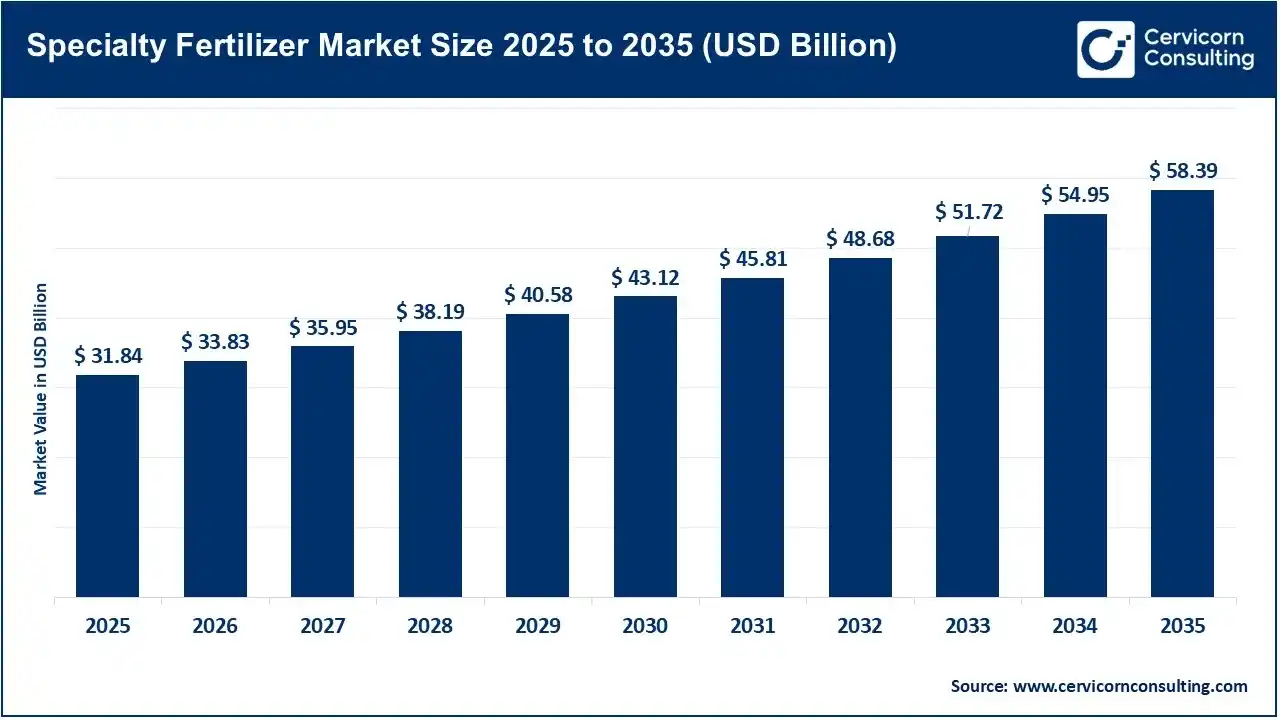
The specialty fertilizer market is primarily driven by the growing need to maximize agricultural productivity while improving nutrient-use efficiency amid shrinking arable land and rising global food demand. Specialty fertilizers, including water-soluble, controlled-release, and micronutrient formulations, provide targeted nutrient delivery, reduce nutrient losses through leaching and volatilization, and support precision farming practices. According to the FAO, global agricultural use of inorganic fertilizers increased from 142 million tonnes in 2002 to 190 million tonnes in 2023, representing a 34% increase, while nitrogen application rates rose from 54 kg/ha to 68 kg/ha during the same period. This increasing intensity of fertilizer use is encouraging farmers to adopt high-efficiency specialty fertilizers that improve crop yields while minimizing environmental impact.
Another major growth factor is the rapid expansion of high-value horticultural crops, greenhouse cultivation, micro-irrigation systems, and precision agriculture, all of which require efficient nutrient management solutions. Water-soluble fertilizers are witnessing particularly strong demand due to their compatibility with fertigation and drip irrigation systems. According to the International Fertilizer Association (IFA), the global specialty fertilizer market reached approximately 18.8 million tonnes in 2024, growing 5% year-over-year, with water-soluble fertilizers recording the fastest growth at 12%, while controlled-release and stabilized nitrogen fertilizers each grew by around 3%. Additionally, governments worldwide are promoting nutrient-use efficiency and sustainable farming practices to reduce nutrient runoff and greenhouse gas emissions, further accelerating the adoption of specialty fertilizer products.
Report Highlights
- Asia-Pacific accounted for approximately 31.8% of the global specialty fertilizer market, making it the leading regional market, supported by large-scale agriculture, rising food demand, and increasing adoption of precision farming technologies.
- Water-soluble fertilizers held the largest product type share at around 31.6%, driven by their extensive use in fertigation systems, greenhouse cultivation, and high-value horticultural crop production.
- Fruits & vegetables represented the dominant crop type with nearly 38.2% market share, owing to the high nutrient requirements of horticultural crops and increasing global demand for premium-quality fresh produce.
- Fertigation emerged as the leading application method, capturing approximately 46.3% of the market, supported by expanding drip irrigation infrastructure and the need for efficient nutrient delivery.
- Dry specialty fertilizers accounted for about 63.8% of the global market, primarily due to their longer shelf life, easier storage and transportation, and widespread adoption in commercial agriculture.
What is a Specialty Fertilizer?
Specialty fertilizer is a high-performance plant nutrient product specifically formulated to improve nutrient-use efficiency, enhance crop productivity, and minimize nutrient losses compared with conventional fertilizers. These fertilizers include controlled-release, slow-release, water-soluble, liquid, stabilized, and micronutrient-enriched formulations that deliver nutrients in a precise and crop-specific manner. Specialty fertilizers are widely used in precision agriculture, fertigation, greenhouse cultivation, horticulture, and high-value crops, helping farmers improve yield, crop quality, soil health, and environmental sustainability by reducing nutrient leaching, volatilization, and runoff.
Recent Milestones
| Date |
Company |
Recent Milestone |
Market Impact |
| April 2025 |
Wastech Group & Pursell Agri-Tech |
Announced a partnership to establish a controlled-release fertilizer manufacturing facility in Malaysia for Southeast Asian agriculture. |
Expanded regional production capacity and increased availability of advanced controlled-release fertilizers. |
| March 2025 |
Yara International |
Introduced a new range of water-soluble NPK fertilizers designed specifically for fertigation systems. |
Enhanced nutrient-use efficiency and supported precision irrigation practices. |
| February 2025 |
Nutrien |
Launched a next-generation controlled-release water-soluble NPK fertilizer with gradual nutrient release technology. |
Improved nutrient retention, reduced leaching losses, and supported sustainable crop production. |
Specialty Fertilizer Market Dynamics
Market Drivers
1. Rising Adoption of Precision Agriculture and Fertigation Systems
The increasing adoption of precision agriculture, drip irrigation, and fertigation systems is significantly driving demand for specialty fertilizers because these products deliver nutrients accurately with minimal wastage. Water-soluble and controlled-release fertilizers improve nutrient-use efficiency while supporting higher crop productivity. According to the International Commission on Irrigation and Drainage (ICID), more than 380 million hectares of land worldwide are equipped for irrigation, creating substantial opportunities for fertigation-compatible fertilizers. Additionally, OECD highlights precision agriculture as a key solution for reducing fertilizer losses and improving productivity through targeted nutrient application.
2. Expanding High-Value Horticulture and Protected Cultivation
Growing cultivation of fruits, vegetables, flowers, and greenhouse crops is accelerating specialty fertilizer demand because these crops require precise nutrient management for superior quality and higher yields. Controlled-environment agriculture depends heavily on water-soluble fertilizers and micronutrients to optimize crop performance. According to FAO, global fruit production exceeded 930 million tonnes and vegetable production surpassed 1.2 billion tonnes in 2023, reflecting expanding high-value crop cultivation that increasingly relies on advanced fertilizer solutions to maximize productivity, improve quality, and enhance export competitiveness.
Market Restraints
1. High Product Cost Compared with Conventional Fertilizers
The premium pricing of specialty fertilizers remains a major restraint, particularly for small and medium-scale farmers in developing economies where affordability influences purchasing decisions. Controlled-release coatings, chelated micronutrients, and customized formulations increase manufacturing costs. Fertilizer affordability also remains vulnerable to energy and raw-material price fluctuations. The OECD reported that the 2021–2022 fertilizer price shock prompted numerous governments to revise fertilizer policies, highlighting the market's exposure to volatile input costs and supply disruptions that continue to affect purchasing behavior.
2. Dependence on Imported Raw Materials and Supply Chain Risks
Specialty fertilizer manufacturers rely heavily on imported raw materials such as potash, phosphate rock, sulfur, and coating polymers, making the market vulnerable to geopolitical disruptions and trade restrictions. According to FAO, in 2022 the top five exporting countries accounted for 82% of global potash exports and 76% of phosphorus exports, illustrating the high concentration of global supply. Such dependence increases procurement risks, production costs, and pricing uncertainty for specialty fertilizer manufacturers.
Market Opportunities
1. Growing Focus on Sustainable Agriculture and Nutrient-Use Efficiency
Increasing emphasis on sustainable farming practices presents significant opportunities for specialty fertilizers because these products reduce nutrient losses, improve soil health, and lower greenhouse gas emissions. Governments and agricultural organizations are promoting efficient nutrient management to meet environmental targets. According to FAO, global inorganic fertilizer production reached 208 million tonnes in 2023, while policymakers are increasingly encouraging technologies that enhance nutrient-use efficiency rather than simply increasing fertilizer consumption, creating favorable conditions for advanced specialty fertilizer adoption.
2. Rising Government Investments in Smart Farming Technologies
Government support for digital agriculture, precision farming, and efficient irrigation infrastructure is creating long-term opportunities for specialty fertilizer suppliers. Smart farming technologies require fertilizers compatible with variable-rate application, fertigation, and sensor-based nutrient management. OECD-FAO scenario analysis indicates that a 20% fertilizer supply reduction could significantly impact crop yields and food prices, emphasizing the importance of precision technologies that optimize fertilizer utilization and encourage adoption of high-efficiency specialty fertilizers.
Market Challenges
1. Limited Farmer Awareness and Technical Knowledge
Despite their agronomic benefits, specialty fertilizers require proper application methods, dosage, and timing to achieve optimal performance. Limited technical knowledge among farmers, particularly in developing economies, slows product adoption and reduces return on investment. OECD reports that adoption of advanced agricultural technologies remains constrained by high initial costs, limited access to finance, insufficient policy incentives, and inadequate technical support, restricting widespread implementation of precision nutrient management practices.
2. Regulatory Pressure on Nutrient Management and Environmental Compliance
Manufacturers face increasing pressure to comply with stringent environmental regulations governing nutrient runoff, greenhouse gas emissions, and fertilizer efficiency standards. Product registration, testing, and environmental certification increase development costs and extend commercialization timelines. FAO's cropland nutrient balance analysis highlights nutrient-use efficiency as a critical indicator because both nutrient deficiency and excessive fertilizer application contribute to soil degradation, water pollution, and greenhouse gas emissions, requiring continuous innovation from specialty fertilizer producers.
Regional Analysis
The specialty fertilizer market is segmented by region into North America, Europe, Asia-Pacific, Latin America, and LAMEA. Here is a brief overview of each region:
What are the driving factors of North America specialty fertilizer market?
The North America specialty fertilizer market size was estimated at USD 9.04 billion in 2025 and is projected to surpass around USD 16.58 billion by 2035. North America is driving the market owing to its highly mechanized agricultural sector, extensive adoption of precision farming technologies, and increasing cultivation of high-value fruits, vegetables, and specialty crops. The region benefits from widespread use of drip irrigation, fertigation systems, GPS-guided farm equipment, and digital agriculture platforms that require efficient nutrient management solutions. Strong environmental regulations promoting nutrient-use efficiency, combined with increasing investments in controlled-release, water-soluble, and micronutrient fertilizers, continue to accelerate market growth. Additionally, leading fertilizer manufacturers, robust agricultural research institutions, and government programs encouraging sustainable farming practices and soil health management further strengthen North America's leadership in the global specialty fertilizer market.
United States: Precision Agriculture Leadership, Advanced Irrigation Technologies, and Sustainable Nutrient Management Drive Market Growth
- According to the USDA Census of Agriculture 2022, the United States operates approximately 880 million acres of farmland, creating substantial demand for specialty fertilizers that improve nutrient-use efficiency and maximize agricultural productivity across diverse crop systems.
- The U.S. Environmental Protection Agency (EPA) continues promoting nutrient stewardship through its National Nutrient Strategy, encouraging the adoption of enhanced-efficiency fertilizers and precision nutrient management practices that reduce nitrogen and phosphorus losses while improving water quality.
Canada: Sustainable Agriculture Policies, Expanding Precision Farming, and High Fertilizer Efficiency Support Market Expansion
- According to Statistics Canada, Canadian farmers seeded approximately 67 million acres of wheat, canola, barley, oats, and pulse crops in 2025, increasing demand for specialty fertilizers that enhance nutrient efficiency, crop quality, and yield while supporting sustainable agricultural practices.
- The Government of Canada's Sustainable Canadian Agricultural Partnership (Sustainable CAP) continues investing in precision agriculture, soil health improvement, climate-smart farming, and nutrient management initiatives, encouraging wider adoption of enhanced-efficiency specialty fertilizers across commercial farming operations.
Why has Asia-Pacific (APAC) dominated the specialty fertilizer market?
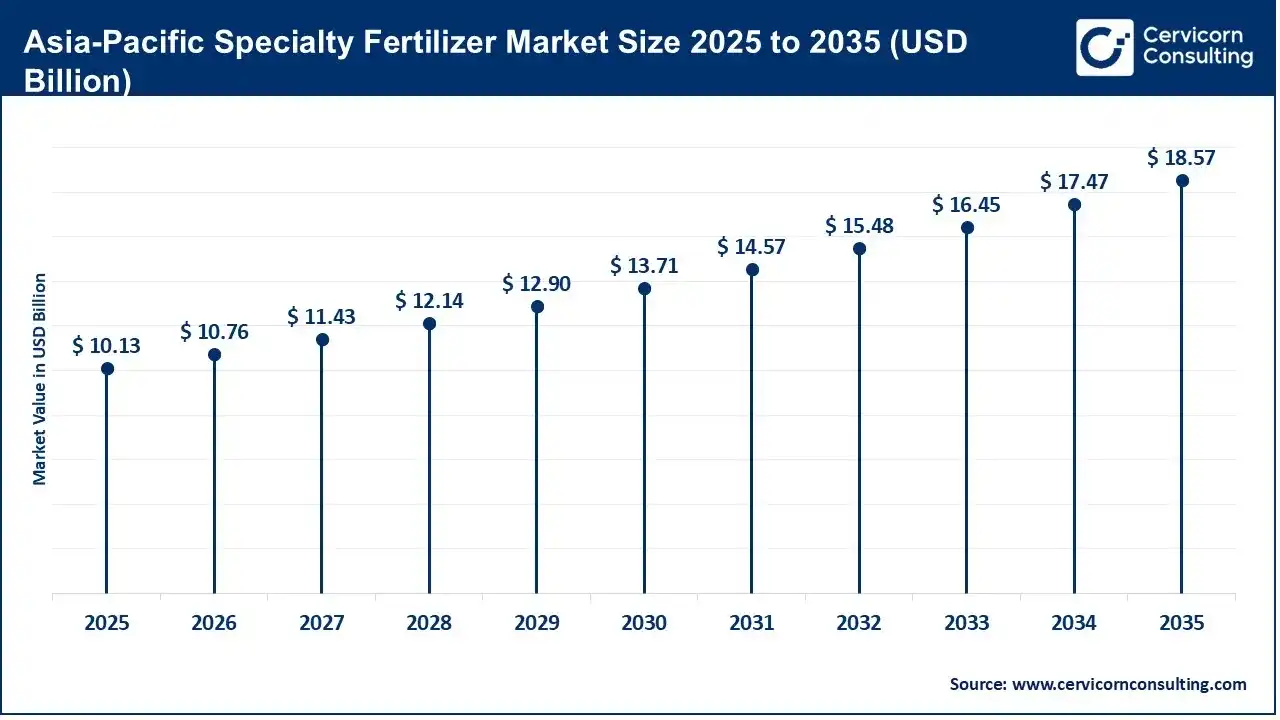
The Asia-Pacific specialty fertilizer market size was valued at USD 10.13 billion in 2025 and is projected to hit USD 18.57 billion by 2035. Asia-Pacific is the fastest-growing region, owing to its vast agricultural base, increasing food demand driven by rapid population growth, and expanding cultivation of high-value fruits, vegetables, and plantation crops. The region is witnessing rapid adoption of precision agriculture, drip irrigation, fertigation, and greenhouse cultivation, particularly in China, India, Japan, Australia, and Southeast Asia. Government initiatives promoting balanced nutrient management, sustainable farming, and efficient fertilizer utilization are accelerating the adoption of controlled-release, water-soluble, micronutrient, and inhibitor-based fertilizers. Rising concerns over soil nutrient depletion, declining arable land per capita, and increasing investments in modern agricultural technologies continue to strengthen Asia-Pacific's position as the fastest-growing regional market.
China: Modern Agricultural Transformation, High Fertilizer Consumption, and Government Nutrient Efficiency Programs Drive Market Growth
- According to the National Bureau of Statistics of China, the country produced approximately 706.5 million tonnes of grain in 2024, increasing the need for high-efficiency specialty fertilizers that improve nutrient-use efficiency while maintaining high agricultural productivity.
- China's Zero Growth Action Plan for Fertilizer Use continues encouraging balanced fertilization, precision nutrient management, and adoption of enhanced-efficiency fertilizers, supporting greater utilization of controlled-release and stabilized fertilizer technologies across major crop-producing provinces.
India: Expanding Horticulture Production, Government Subsidy Programs, and Precision Farming Initiatives Accelerate Market Expansion
- According to the Ministry of Agriculture & Farmers Welfare, India produced approximately 366 million tonnes of horticultural crops during 2023–24, exceeding food grain production and significantly increasing demand for specialty fertilizers used in fruits, vegetables, spices, and plantation crops.
- The Pradhan Mantri Krishi Sinchayee Yojana (PMKSY) and the Per Drop More Crop initiative continue expanding drip and sprinkler irrigation infrastructure, encouraging widespread adoption of water-soluble fertilizers and fertigation practices for efficient nutrient application.
Why Europe represents a significant stake in the specialty fertilizer market?
The Europe specialty fertilizer market size was valued at USD 7.83 billion in 2025 and is forecasted to surge USD 14.36 billion by 2035. Europe represents a significant market owing to its strong focus on sustainable agriculture, stringent environmental regulations, and widespread adoption of precision farming technologies. The region is actively promoting nutrient-use efficiency through controlled-release, inhibitor-based, and micronutrient fertilizers to reduce nutrient runoff and greenhouse gas emissions. The European Union's Green Deal, Farm to Fork Strategy, and Common Agricultural Policy (CAP) encourage balanced fertilization and environmentally responsible farming practices. Additionally, Europe's advanced greenhouse horticulture sector, high-value crop production, and continuous investments in digital agriculture and precision nutrient management technologies continue to support steady market expansion.
Germany: Sustainable Farming Leadership, Precision Agriculture Adoption, and Advanced Nutrient Management Drive Market Growth
- Germany is Europe's largest agricultural economy, cultivating approximately 16.6 million hectares of agricultural land, creating sustained demand for specialty fertilizers that improve nutrient-use efficiency while complying with strict environmental regulations.
- Germany continues implementing the Fertiliser Ordinance (Düngeverordnung), which enforces tighter nitrogen and phosphorus application standards under the EU Nitrates Directive, accelerating adoption of controlled-release fertilizers, nitrification inhibitors, and precision nutrient management technologies.
Netherlands: World-Leading Greenhouse Horticulture, High-Value Crop Production, and Circular Agriculture Initiatives Support Market Expansion
- The Netherlands is one of the world's largest exporters of agricultural products and operates more than 10,000 hectares of greenhouse horticulture, creating substantial demand for water-soluble fertilizers, micronutrients, and fertigation-compatible nutrient solutions.
- The Dutch government continues promoting Circular Agriculture by encouraging efficient nutrient utilization, lower fertilizer emissions, and sustainable soil management, supporting increased adoption of enhanced-efficiency specialty fertilizers across commercial farming systems.
Specialty Fertilizer Market Share, By Region, 2025 (%)
| Region |
Revenue Share, 2025 (%) |
| North America |
28.4% |
| Europe |
24.6% |
| Asia-Pacific |
31.8% |
| LAMEA |
15.2% |
LAMEA Specialty Fertilizer Market is Experiencing Steady Growth
The LAMEA specialty fertilizer market was recorded at USD 4.84 billion in 2025 and is anticipated to reach around USD 8.88 billion by 2035. The LAMEA region is experiencing steady growth due to expanding commercial agriculture, increasing investments in irrigation infrastructure, and growing demand for high-value export crops such as fruits, vegetables, coffee, sugarcane, cocoa, and horticultural products. Governments across the region are promoting sustainable agriculture, efficient nutrient management, and improved agricultural productivity to strengthen food security and optimize limited natural resources. The adoption of fertigation, controlled-release fertilizers, micronutrients, and water-soluble fertilizers is increasing, particularly in water-scarce regions and intensive farming systems. Rising private-sector investments, modern farming technologies, and precision agriculture initiatives continue to create significant growth opportunities across the LAMEA specialty fertilizer market.
Brazil: Large-Scale Commercial Agriculture, Expanding Export Crops, and Precision Farming Drive Market Growth
- According to the Brazilian Institute of Geography and Statistics (IBGE), Brazil harvested a record 328.4 million tonnes of cereals, legumes, and oilseeds in 2024, creating strong demand for specialty fertilizers that improve nutrient-use efficiency and maximize crop productivity across large-scale farming operations.
- Brazil is one of the world's largest producers and exporters of soybeans, sugarcane, coffee, maize, and citrus, driving increasing adoption of micronutrient fertilizers, controlled-release fertilizers, and inhibitor-based nutrient technologies to enhance crop quality and export competitiveness.
Saudi Arabia: Water-Efficient Agriculture, Greenhouse Expansion, and Food Security Programs Support Market Expansion
- Under Saudi Vision 2030, the government continues investing in protected agriculture, greenhouse farming, and advanced irrigation technologies, increasing demand for water-soluble fertilizers and fertigation-compatible nutrient solutions that maximize productivity while conserving water resources.
- Saudi Arabia is rapidly expanding the use of drip irrigation and controlled-environment agriculture to improve domestic production of vegetables, fruits, and horticultural crops, supporting greater adoption of specialty fertilizers designed for precision nutrient management.
Segmental Analysis
The specialty fertilizer market is segmented into product type, crop type, application method, form, and geography.
Product Type Analysis
Water-soluble fertilizers dominate the specialty fertilizer market owing to their widespread use in fertigation, greenhouse cultivation, and high-value horticultural crops. These fertilizers dissolve completely in water, enabling precise nutrient delivery and higher nutrient-use efficiency while minimizing losses. Their compatibility with drip and sprinkler irrigation systems has driven strong adoption in regions facing water scarcity. Additionally, increasing investments in precision agriculture and protected cultivation have strengthened demand, making water-soluble fertilizers the preferred product type across commercial farming operations.
Specialty Fertilizer Market Share, By Product Type, 2025 (%)
| Product Type |
Revenue Share, 2025 (%) |
| Water-Soluble Fertilizers |
31.6% |
| Micronutrient Fertilizers |
20.4% |
| Controlled-Release Fertilizers (CRF) |
18.1% |
| Slow-Release Fertilizers (SRF) |
12.8% |
| Inhibitor-Based Fertilizers (Urease & Nitrification) |
8.7% |
| Liquid Fertilizers |
8.4% |
Controlled-release fertilizers (CRF) represent the fastest-growing product segment due to their ability to release nutrients gradually, reducing leaching, volatilization, and multiple fertilizer applications. Growing environmental regulations, rising labor costs, and the need for sustainable farming practices are accelerating CRF adoption across field crops and horticulture. Advances in biodegradable coating technologies and polymer encapsulation further enhance nutrient efficiency and crop productivity, encouraging farmers to shift from conventional fertilizers toward controlled-release nutrient management solutions.
Crop Type Analysis
Fruits and vegetables account for the largest share of the specialty fertilizer market because these high-value crops require balanced nutrition to maximize yield, quality, shelf life, and appearance. Specialty fertilizers provide precise nutrient management that improves fruit size, color, and overall crop quality while reducing nutrient deficiencies. Expanding greenhouse production, increasing global consumption of fresh produce, and rising exports of premium horticultural products continue to reinforce the dominance of this crop segment in specialty fertilizer consumption.
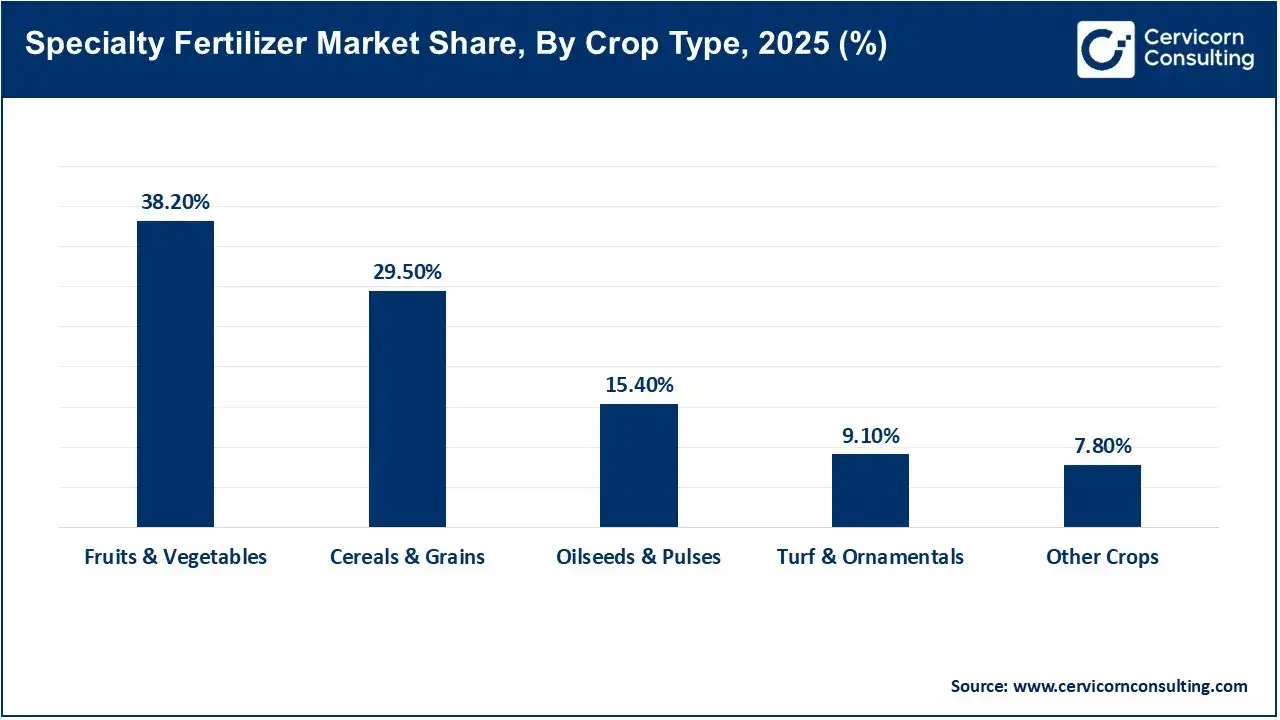
Oilseeds and pulses are the fastest-growing crop segment due to increasing global demand for vegetable oils, plant-based proteins, and sustainable crop rotations. Farmers are increasingly adopting specialty fertilizers to improve nutrient uptake, enhance seed quality, and increase productivity under varying soil conditions. Government initiatives promoting pulse production and oilseed self-sufficiency, particularly in emerging economies, are further supporting higher adoption of micronutrients, controlled-release fertilizers, and inhibitor-based nutrient products across these crops.
Application Method Analysis
Fertigation dominates the specialty fertilizer market because it combines irrigation and fertilization into a single efficient process, ensuring uniform nutrient distribution and minimizing fertilizer wastage. The method is extensively used in drip and sprinkler irrigation systems for fruits, vegetables, and greenhouse crops, where precise nutrient application is essential. Growing investments in micro-irrigation infrastructure, water conservation initiatives, and precision farming technologies continue to strengthen fertigation's leadership position in modern agricultural practices worldwide.
Specialty Fertilizer Market, By Application Method, 2025 (%)
| Application Method |
Revenue Share, 2025 (%) |
| Fertigation |
46.3% |
| Foliar Application |
30.7% |
| Soil Application |
23.0% |
Foliar application is emerging as the fastest-growing application method because it enables rapid nutrient absorption through plant leaves, providing quick correction of micronutrient deficiencies during critical growth stages. Farmers increasingly prefer foliar fertilizers to improve crop quality and minimize nutrient losses caused by unfavorable soil conditions. Rising adoption in horticulture, specialty crops, and precision agriculture, coupled with advancements in liquid nutrient formulations and spray technologies, continues to accelerate growth in this application segment.
Form Analysis
Dry specialty fertilizers dominate the market owing to their ease of storage, longer shelf life, cost-effectiveness, and suitability for large-scale agricultural operations. Granular and crystalline formulations are widely used in controlled-release, slow-release, and micronutrient fertilizer products because they simplify transportation and field application. Their compatibility with conventional fertilizer equipment and extensive use across cereals, grains, and commercial farming operations continue to make dry formulations the preferred choice among growers worldwide.
Specialty Fertilizer Market, By Form, 2025 (%)
| Form Segment |
Revenue Share, 2025 (%) |
| Dry |
63.8% |
| Liquid |
36.2% |
Liquid fertilizers are the fastest-growing form due to their excellent compatibility with fertigation systems, foliar spraying, and precision nutrient management practices. They offer rapid nutrient availability, uniform application, and improved nutrient absorption, making them particularly suitable for greenhouse cultivation and high-value crops. The increasing adoption of precision agriculture, automated irrigation systems, and digital farming technologies is driving demand for liquid specialty fertilizers as farmers seek higher efficiency and improved crop performance.
Specialty Fertilizer Market Top Companies
Segments Covered
By Product Type
- Water-Soluble Fertilizers
- Micronutrient Fertilizers
- Controlled-Release Fertilizers (CRF)
- Slow-Release Fertilizers (SRF)
- Inhibitor-Based Fertilizers (Urease & Nitrification)
- Liquid Fertilizers
By Crop Type
- Fruits & Vegetables
- Cereals & Grains
- Oilseeds & Pulses
- Turf & Ornamentals
- Other Crops
By Application Method
- Fertigation
- Foliar Application
- Soil Application
- By Form
- Dry
- Liquid
By Geography
- North America
- Europe
- Asia-Pacific
- LAMEA