
Content
Stem Cell Therapy Market to Expand with Advances in Personalized and Regenerative Medicine


Stem Cell Therapy Market Insights
The global stem cell therapy market size is calculated at USD 0.68 billion in 2026 and is forecasted to reach USD 3.78 billion by 2035, increasing at a CAGR of 21% during the projected period of 2026-2035.
North America led the market in 2025, supported by its advanced research infrastructure hub, whereas Asia-Pacific is projected to be the fastest-growing region during 2026-2035, due to the expanding regenerative medicine research sector.
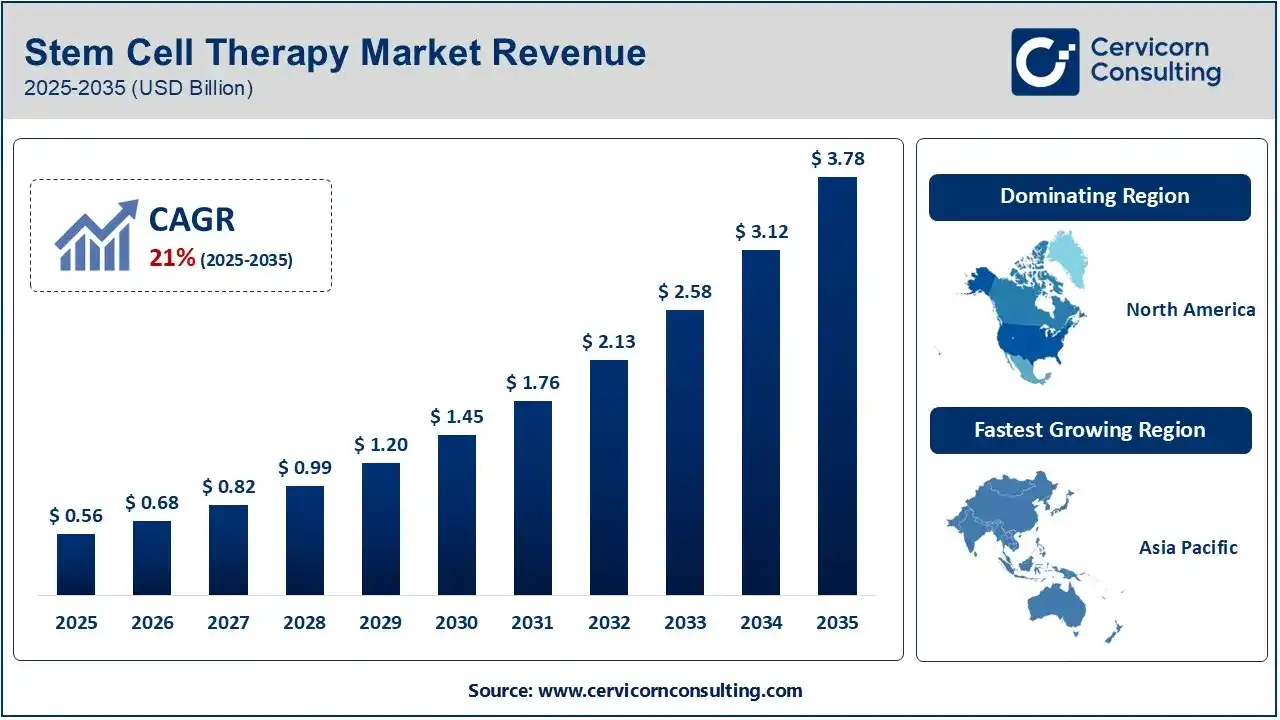
Stem Cell Therapy Market Overview
The development of diverse stem cell therapy is widely leverages stem cells or cells obtained from them to boost the repair, restoration, or replacement of concerned, dysfunctional, or injured tissue. These stem cell therapies have broader applications across regenerative medicine, orthopaedics, CVD, neurological concerns, diabetes, and advanced cancer drug delivery solutions.
Consistent progression of the market is primarily fueled by a rise in global cases of cancer, cardiovascular diseases, autoimmune diseases, and others, with a massive surge in geriatric populations, driving demand for tissue repair and advanced medicine. Many more approaches are fostering CRISPR and patient-specific iPSCs, enabling researchers to reprogram cells, reducing ethical issues connected with embryonic sources and lowering the risk of immune rejection.
Broader AI Advances
Nowadays, numerous worldwide biotech leaders and scientists are looking for the widespread adoption of machine learning to assess larger datasets, screen donor sources, and verify the production of cell therapies, such as CAR-T, cutting expenses and accelerating patient accessibility. AI-powered breakthroughs across the stem cell therapy industry are promoting basic models to forecast and manage how stem cells mature into specialized tissues, like muscle or nerve cells, that overcome historical consistency and quality-control limitations.
Execution of sophisticated machine learning and deep learning models assists in improving the design of nanobiological materials to enhance stem cell survival rates, direct targeted tissue delivery, control drug release, and support post-transplant prognosis management.
Regional Outlook
North America Was Dominant in the Market in 2025
North America accounted for the largest share of the stem cell therapy market in 2025, driven by expansive investment in biotech and the presence of well-developed research center. Along with a focus on the regulatory landscape, recently, BioRestorative Therapies received FDA Fast Track designation for BRTX-100, an autologous MSC therapy intended for chronic lumbar disc disease. In addition, the region explored innovative iPSC-based programs to expand into clinical testing, such as OpCT-001 for retinal diseases and patient-specific autologous iPSC-derived dopamine neuron trials at institutions.
Moreover, Canadian hospitals and specialized transplant centers bolstered the consistent expansion of protocols utilizing MSCs and hematopoietic stem cells for graft-versus-host disease, degenerative joint issues, and blood cancers.
Asia-Pacific is forecasted to grow rapidly
Asia-Pacific is forecasted to grow rapidly in the market during 2026-2035, led by a highly supportive research sector and steps into transforming healthcare infrastructure. Besides this, Singapore, Thailand, and Malaysia are shifting from late-stage manufacturing outsourcing areas into regional research and commercialization hubs for cell and gene therapy (CGT). In 2026, India’s clinics and research centers are broadly using AI to monitor stem cell culture quality, estimate therapeutic efficacy, and tailor protocols based on disease progression. Recently, Beijing’s 301 Hospital introduced a large-scale, multicenter, randomized controlled trial enrolling nearly 2,000 adults aged 50 and older to analyze cord tissue-derived stem cells for upgrading healthy ageing.
Segmental Outlook
| Market Segment | Leading Segment | Key Growth Catalyst |
| By Cell Type | Adult stem cells | Driven by clinical applications and the expansive use of hematopoietic and other adult stem cells in therapeutic procedures. |
| By Therapy Type | Autologous stem cell therapy | As it employs a patient's own cells and lowers the risk of immune rejection. |
| By Application | Cancer and Hematological Disorders | Supported by the widespread stem cell transplantation indications in selected blood cancers and hematological conditions. |
| By End User | Hospitals and Specialty Clinics | Due to their pivotal role in stem cell transplantation, patient treatment, and specialized clinical care. |
Developing Shifts
- Emphasis on iPSCs: Eventual advances in the market cover induced pluripotent stem cells (iPSCs) via demonstration of clinical trials for intricate issues, such as heart failure, Parkinson’s disease, age-related macular degeneration, and hematologic malignancies with minimal challenges of immune rejection.
- Spotlighting Diabetes Solutions: Ongoing progression of stem cell therapies is further broadening their beta cell therapies under late-stage trials, i.e. phase III, to facilitate functional insulin-producing replacement cells for diabetes patients.
- Combined Approaches: Novelty and the latest research activities across the stem cell therapy industry are promoting a combination of stem cells with 3D-printed or engineered biomedical scaffolds, drastically enhancing structural and functional repair for bone, cartilage, and cardiac tissue.
Key Companies
- Mesoblast Ltd. develops allogeneic cellular medicines for inflammatory diseases and other serious medical conditions.
- Vericel Corporation specializes in autologous cell therapies for cartilage repair and severe burn treatment.
- MEDIPOST Co., Ltd. develops stem cell-based regenerative therapies for degenerative and orthopedic conditions.
- JCR Pharmaceuticals Co., Ltd. develops specialized biologic treatments and regenerative medicine products, including stem cell-based therapies.
- Astellas Pharma Inc. invests in regenerative medicine and cell therapy research targeting diseases with significant unmet medical needs.
- Takeda Pharmaceutical Company Limited participates in cell therapy research and advanced treatment development across selected therapeutic areas.
- Fujifilm Holdings Corporation supports the cell therapy sector through regenerative medicine research, biomanufacturing, and advanced cell production capabilities.
- Thermo Fisher Scientific Inc. supplies cell culture media, reagents, instruments, and manufacturing solutions used in stem cell research and therapy development.
- Lonza Group AG provides development and manufacturing services that support the production of cellular therapies.
- Takara Bio Inc. offers cell engineering technologies, research reagents, and manufacturing-related solutions for cell therapy development.
Future Outlook
In the coming era, the stem cell therapy market will have a major goal of resolving neurological disorders, spinal cord injuries, osteoarthritis, diabetes, and CVD via significant clinical and research activities. In terms of technological steps, the leading firms will bolster sophisticated technologies, like AI in cell modelling and iPSCs, which are simplifying cellular reprogramming and tissue engineering.
Upcoming landmark events, such as the ISSCR 2027 Annual Meeting in San Francisco and unique forums, such as STEMCELL-2027 in Milan, underline a quarter-century of progress shifting from lab discovery to clinical impact. To reinforce the overall market progression during 2026-2035, rigorous FDA and international clinical trial requirements will continuously expand regenerative stem cell applications, with long-term safety and affordability.
Segments Covered
By Cell Type
- Adult Stem Cells
- Mesenchymal Stem Cells (MSCs)
- Hematopoietic Stem Cells (HSCs)
- Embryonic Stem Cells
- Induced Pluripotent Stem Cells (iPSCs)
By Therapy Type
- Autologous Stem Cell Therapy
- Allogeneic Stem Cell Therapy
By Application
- Regenerative Medicine
- Musculoskeletal Disorders
- Cancer and Hematological Disorders
- Cardiovascular Diseases
- Neurological Disorders
- Wound Healing and Tissue Repair
- Other Applications
By End User
- Hospitals and Specialty Clinics
- Research and Academic Institutes
- Pharmaceutical and Biotechnology Companies
- Cell Banks and Processing Facilities
By Region
- North America
- Europe
- Asia-Pacific
- Latin America
- Middle East and Africa
Empower your strategy with expert insights, purchase this premium research@ https://www.cervicornconsulting.com/buy-now/3064
Ask here for more details@ sales@cervicornconsulting.com