
Content
Pharmaceutical Excipients Market to Reach USD 16.33 Billion by 2035


Pharmaceutical Excipients Market Overview
The global pharmaceutical excipients market size was accounted for USD 10.17 billion in 2025 and is projected to reach USD 16.33 billion by 2035, growing at a CAGR of 4.89% from 2026 to 2035. The increasing demand for advanced drug formulations, rising adoption of biologics and biosimilars, and growing need for improved drug stability, bioavailability, and controlled release mechanisms are driving the expansion of the pharmaceutical excipients market.
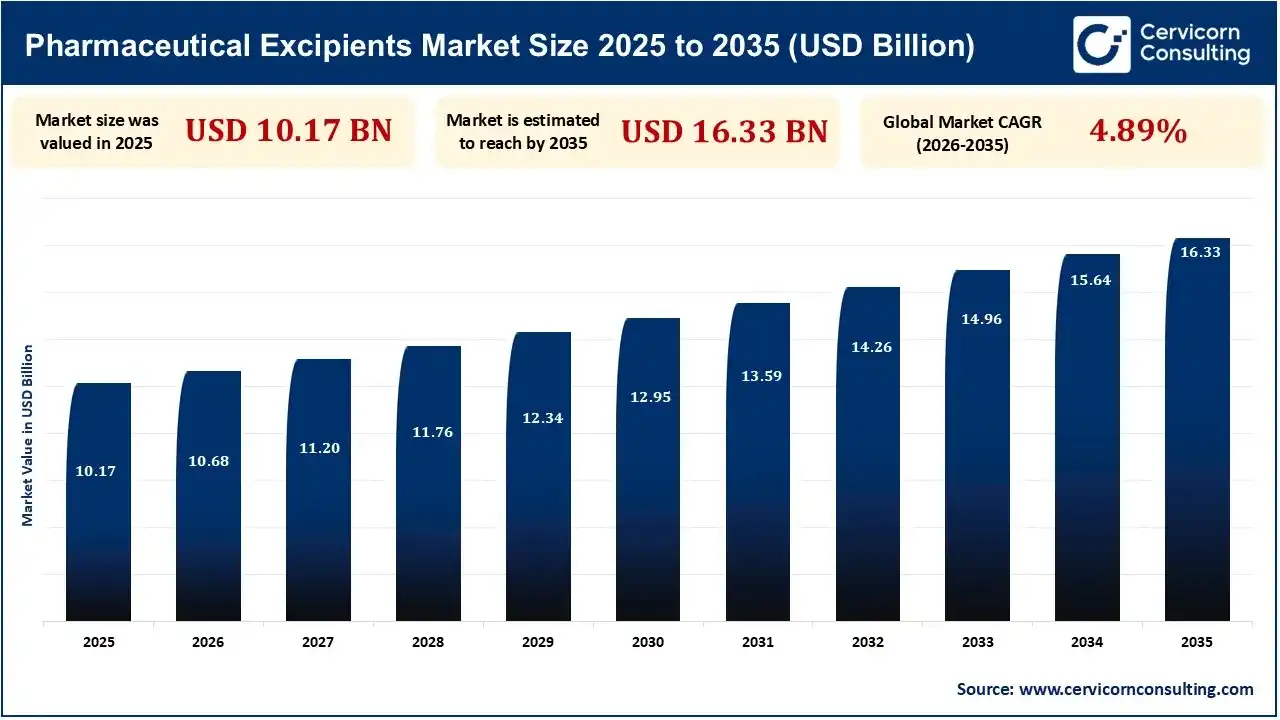
Overview of the global pharmaceutical excipients market comprises an extensive assortment of inert substances that accompany the active pharmaceutical substances (APIs). It supports formulation of tablets, capsules, oral solutions/suspensions, topical and parenteral solutions/suspensions/emulsions for improving physical and chemical stability, shelf life, bioavailibility and therapeutic action.
Increasing expenditure on pharmaceutical production, widening spread of generic drugs, growing emphasis of specialty drug therapies, increasing use of novel drug delivery systems and development of new biopharmaceutical products have contributed significantly to this burgeoning sector.
Key Takeaways
- By Region, North America accounted for a revenue share of 39.3% in 2025.
- By Region, Europe captured a revenue share of 28.1% in 2025.
- By type, the organic chemicals segment has held the largest market share of 57% in 2025
- By functionality, the fillers and diluents segment generated highest revenue share in 2025.
- By formulation, the oral drug formulation segment captured highest market share in 2025.
Why Are Pharmaceutical Excipients Becoming Critical for Next-Generation Drug Development?
Strengthening Drug Stability for the Coming Advanced Therapies - The increased adoption of novel biologicals, vaccines, peptides, and gene therapies require novel excipients that protect susceptible active pharmaceutical ingredients (APIs) from physical and chemical degradation during storage and transportation. Sugars, surfactants and amino acids, among others, are commonly used as stabilizing excipients for biologics (e.g. Stabilizing monoclonal antibodies).
Augmenting Bioavailability for Sparsely Soluble Drugs - A large number of newly discovered drug candidates are sparsely soluble in water, making it difficult to reach effective therapeutic concentrations. Solubilizing excipients like other alcohols, lipid-based carriers, absorption enhancing polymers and others are gaining traction in facilitating solubility enhancement of drug compounds. An array of excipients based on lipid nanoparticles (LNPs) is an important factor behind the efficiency of novel gene-based therapies, such as mRNA therapeutic vaccines.
Driving Biosimilars and Biologics Supply - The quick rise in market share of biologics including recombinant protein, monoclonal antibodies and cell and gene therapies demand specialized excipients that ensure product quality, stability, enhance its usability and extend its shelf-life. Manufacturers of biologic treatments are depending on functional and customizable excipient compositions for formulation of their biological medicines while tackling issues like protein aggregation and temperature instability.
Global Pharmaceutical Excipient Supply Chain Overview
- Production of Excipients: Chemical manufacturing facilities or excipient manufacturers process and purifies raw material to create refined, modified and blended excipients of pharmaceutical grade.
- Quality Testing & Regulatory Compliance: Drug manufacturers also carry out test of these produced excipients to ensure its purity, Stability, microbiological safety, functionalities and compatibilities with APIs.
- Packing and Storage of Excipients: Pharmaceutical excipients need to be packed in quality packaging that protect from moisture, degradation and any source of contaminations.
- Supply Chain & Logistics: Raw excipients manufacturers either supply products through distributors or specialized chemical suppliers or provide it directly to the pharmaceutical manufacturers.
- Incorporation in Drug Products by Drug Manufacturer: Drug makers combine the manufactured excipients and APIs during the process of developing drug formulation and producing its commercial batch.
What Will Define the Future of Pharmaceutical Excipients?
The future of pharmaceutical excipients hinges on the increasing need for sophisticated drug delivery systems, complicated biologics, customizable medicines, and multifunctional excipients that offer more than merely their traditional role as inert components. As pharmaceutical innovation advances toward applications such as mRNA vaccines, gene therapies, cell-based therapies, and targeted drug delivery platforms, the significance of excipients in enhancing stability, absorption, bioavailability, and therapeutic efficacy will continue to mount.
Newer excipients with specific characteristics and attributes will emerge to help manufacturers address the formulation challenges that can arise with sensitive molecules and convoluted therapies. For example, lipid nanoparticles that encapsulate mRNA vaccines made by Pfizer-BioNTech and Moderna to protect their genetic material from degradation and to allow them to enter cell structures illustrated the pivotal function of advanced lipid-based excipients.
Pharmaceutical Excipients Market Regional Outlook
Why is North America leading the pharmaceutical excipients market?
The North American pharmaceutical excipients market is one of the leading markets globally owing to the well-established pharmaceutical manufacturing ecosystem in the region, presence of many international drug producers, and significant investment in innovative drug development. North America represented the largest market share for pharmaceutical excipients. Rise in output of biologics, specialized therapies, and generic medicines drives demand.
Food and Drug Administration (FDA) in North America promotes the adoption of specialized, multifuncitonal, and high-purity pharmaceutical excipients. Global pharma players are adopting latest excipients for mRNA-vaccines, controlled-release medicines, parenteral solutions & biologics to enhances efficiency and prolong shelf life. Increasing funding in contract development and manufacturing organization (CDMO’s), as well as research and development activities on new drug delivery systems is boosting the market for pharma excipients in the region.
Why is Asia Pacific expected to grow at the highest rate?
The pharmaceutical excipients market in the Asia–Pacific region is expected to grow at the highest rate among the other regions owing to the fact that pharmaceutical production has been expanding rapidly in the APAC region, healthcare expenditure is increasing, and there is also a rising demand for generic drugs and biosimilars. The APAC region is witnessing the higher production of pharmaceutical ingredients and excipients due to low-cost manufacturing, ready availability of raw materials, and increasing presence of domestic pharmaceutical companies in the market.
Further, countries like Japan and South Korea are investing continuously on developing new types of pharmaceutical formulations, biologics and newer technologies of drug delivery which have a positive impact on the demand of specialty excipients.
Countries like India are gaining the reputation of becoming the world's third largest supplier of generic medicines and China is continuously investing in making these countries self-sufficient in pharmaceuticals which motivate the excipient companies to update their capacity, which in turn leads to growth in the region.
Which Companies Are Leading the Development of Advanced Pharmaceutical Excipients?
The pharmaceutical excipients market is highly competitive, with leading manufacturers focusing on multifunctional excipients, biologic-compatible ingredients, controlled-release technologies, and innovative drug delivery solutions. Major companies including Ashland Global Holdings Inc., BASF SE, Evonik Industries AG, Roquette Frères, Croda International Plc, DuPont, Lubrizol Corporation, Kerry Group plc, Avantor, Inc., Archer Daniels Midland Company (ADM), Colorcon Inc., SPI Pharma, DFE Pharma, MEGGLE GmbH & Co. KG, and Associated British Foods plc (ABF Ingredients) are continuously expanding their product portfolios through research, strategic collaborations, manufacturing expansions, and acquisitions.
These companies are investing heavily in high-performance excipients designed to improve drug stability, solubility, bioavailability, and patient compliance across oral solid dosage forms, injectables, biologics, and advanced therapies. For instance, Evonik Industries has strengthened its position in lipid-based drug delivery by expanding its portfolio of pharmaceutical lipids used in mRNA therapeutics and parenteral formulations, while Roquette continues to develop plant-based excipients and functional ingredients for oral and biologic formulations.
Empower your strategy with expert insights, purchase this premium research@ https://www.cervicornconsulting.com/buy-now/2453
Ask here for more details@ sales@cervicornconsulting.com