
Content
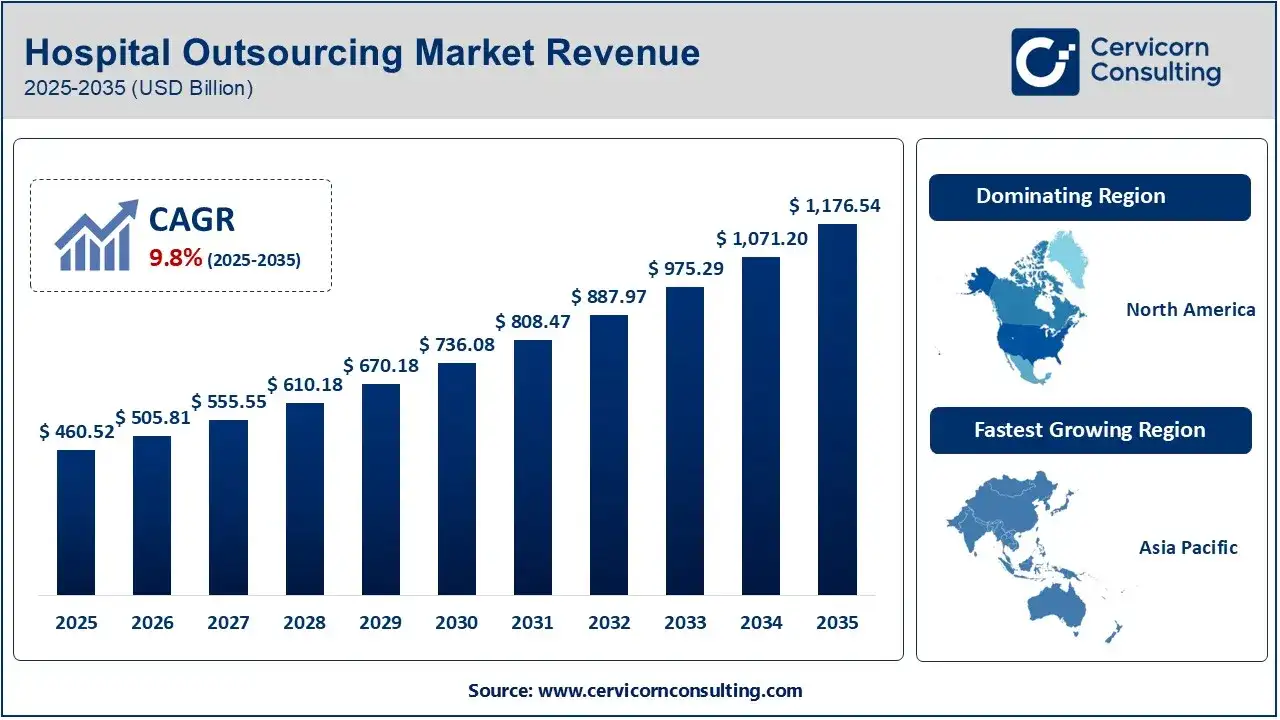
Hospital Outsourcing Market Size to Reach $1,176.54 Billion by 2035


Hospital Outsourcing Market Size and Growth Outlook 2026 to 2035
The global hospital outsourcing market size accounted for USD 505.81 billion in 2026 and is expected to reach USD 1176.54 billion by 2035, growing at a CAGR of 9.8% during the forecast period of 2026-2035.
North America led the market in 2025, driven by expanded outsourcing providers and widespread adoption of outsourced administrative and operational services, while Asia Pacific is estimated to grow rapidly in the coming years due to its healthcare infrastructure expansion and growing demand for outsourced support services.
Hospital Outsourcing Market Overview
Primarily, healthcare outsourcing covers assigning non-core, administrative, operational or unique clinical functions to third-party providers by healthcare facilities rather than in-house approaches. These offerings further enable hospitals to reduce capital expenses, control labour limitations, and focus internal resources on DTP. One of the key catalysts is a substantial rise in budget challenges and surging delivery costs, forcing hospitals to outsource to reduce expenses and boost operational activities. Moreover, the implementation of outsourcing supports hospital management and clinical staff in fragmenting workloads and redirecting internal resources toward primary medical care, etc. In addition, many eminent hospitals are seeking omnichannel patient communication and virtual care centres to enhance patient satisfaction and retention.
AI Impact
How is AI Governing the Hospital Outsourcing Market in 2026?
AI solutions have prominent importance across the industry, including the outsourcing of generative AI-driven tools, mainly in RCM and billing cycles. This further enables automated claim scrubbing, real-time denial management, fraud detection, and predictive expense projection. On the other hand, some leading outsourced vendors are pairing rule-based RPA with AI intelligence to manage repetitive, time-consuming administrative tasks, like medical coding, data entry, insurance verification, and patient outreach. In terms of supply chain, AI-enabled analytics assist outsourcing logistics and IT management companies in estimating pharmaceutical and equipment demand, mitigating inventory constraints, and handling predictive maintenance for critical hospital machinery before downtime appears.
Regional Outlook
North America Registered Dominance in the Market in 2025
North America captured a major share of 39% of the hospital outsourcing market in 2025, supported by enforcement of stringent HIPAA and ICD-10 coding requirements and developing billing rules. However, many U.S. health systems shifted their complete administrative and billing divisions to external partners instead of handling them as piecemeal tasks. Recently, Health Canada evolved stronger assumptions by uncovering its Pre-market Guidance for Machine-Learning Enabled Medical Devices that covers rigorous visibility, real-world monitoring, and lifecycle safety benchmarks.
Asia Pacific is anticipated to witness rapid expansion
Asia Pacific is anticipated to witness rapid expansion during the forecast period, led by rising demand for cost improvement and highly efficient clinical administrative operations. Developing nations, like China and India, are stepping up to push digital transformation that offers outsourced electronic health record (EHR) enhancement, cloud migration, and tele-ICU or teleradiology services to specialized tech and clinical partners to overcome local staffing shortages. Alongside this, South Korea introduced the world's first Digital Medical Products Act, which simplifies the regulatory and compliance pathway for digital therapeutics, AI-powered diagnostic software, and outsourced digital health products.
Hospital Outsourcing Market Segmental Outlook
| Market Segment | Dominated Segment | Market Share in 2025 | Key Growth Catalyst |
| By Service Type | Facilities Management | 29% | Supported by hospitals' recurring requirements for cleaning, maintenance, security, and other nonclinical operations. |
| By Outsourcing Model | Partial or Functional Outsourcing | 34% | Driven by growing hospitals' preference for outsourcing selected functions while retaining control of core operations. |
| By Hospital Type | Private Hospitals | 42% | Led by their focus on operational efficiency, service quality, and cost management. |
| By Application | Facilities and Infrastructure Management | 27% | Propelled by the frequent operational needs of hospitals and healthcare campuses. |
Emerging Trends
- Concentrating on IT and Platform Approaches: Many global hospitals are widely providing offshore IT infrastructure to external partners who clear spending across several clients and carry deep expertise in significant platforms, such as Epic, Oracle Health, and Meditech.
- Regulatory Compliance: Nowadays, regulatory examination is pushing outsourced billing and documentation partners to be assessed on consistent compliance monitoring, audit readiness, and data security.
- Seeking Unique Non-Core Aspects: Day by day, the market is surpassing specialised hospital outsourcing that ranges across laboratory testing, radiology, pharmacy management, and facilities, which continues to advance as organizations look to secure scarce internal clinical capacity.
Future Outlook
The hospital outsourcing market is witnessing notable growth in 2026, and it will bolster several AI-enhanced clinical documentation and scribing solutions that reduce charting time and eliminate administrative burdens. Moreover, the future will see significance in robotic process automation (RPA) and AI-enabled coding that standardize operating procedures, lower claim denials, automate eligibility verification, and compress multi-hour wait times. Another key opportunity is integration of healthcare IT, like electronic health record (EHR) optimization, cloud migration, and continuous cybersecurity resilience. Meanwhile, outsourcing approaches are developing past rigid per-task billing into risk-sharing, long-term alliances bound to financing performance, patient outcomes, and compliance features. The market will also promote focused appointment scheduling, omnichannel outreach, and digital patient navigation, particularly for specialized customer experience (CX) and health-tech teams.
Segments Covered
By Service Type
- Medical and Clinical Services
- Laboratory and Diagnostic Services
- Information Technology and Revenue Cycle Management
- Facilities Management
- Supply Chain and Other Administrative Services
By Outsourcing Model
- Full-Service Outsourcing
- Partial or Functional Outsourcing
- Managed Services
- Business Process Outsourcing
By Hospital Type
- Public Hospitals
- Private Hospitals
- Specialty Hospitals
- Academic and Teaching Hospitals
By Application
- Clinical Operations
- Administrative and Revenue Cycle Operations
- Facilities and Infrastructure Management
- Information Technology Management
- Procurement and Supply Chain Management
By Region
- North America
- Europe
- Asia-Pacific
- Latin America
- Middle East and Africa
Empower your strategy with expert insights, purchase this premium research@ https://www.cervicornconsulting.com/buy-now/3076
Ask here for more details@ sales@cervicornconsulting.com