
Content
Healthcare Supply Chain Management Market is set to Accelerate at a 10.2% CAGR


Healthcare Supply Chain Management Market Insights
The global healthcare supply chain management market size accounted at $5.16 billion in 2026 and is projected to reach at $12.37 billion by 2035, growing at a CAGR of 10.2% during the forecast period of 2026-2035. North America accounted for a revenue share of 39% in 2025, supported by well-established healthcare infrastructure and wider adoption of digital supply chain technologies, while Asia-Pacific is predicted to witness rapid expansion in the coming years, due to advancing healthcare systems and surging demand for stronger medical supply distribution.
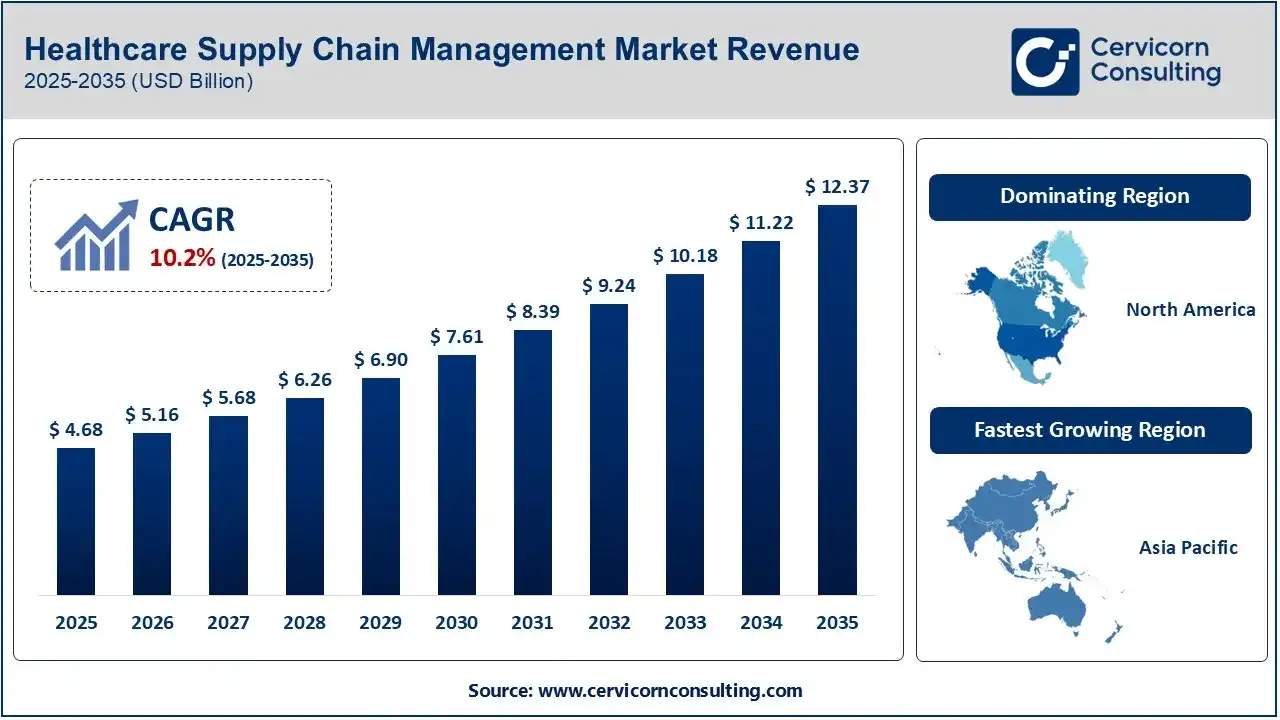
Healthcare Supply Chain Management Market Outlook
Primarily, the market tracks synchronisation and supervision of the complete lifecycle of medical solutions, pharmaceuticals, equipment, and services, mainly from raw material production and manufacturing to delivery and usage by patients. This expansion is rigorously driven by the execution of stringent standards, like the DSCSA and medical device guidelines, with a rise in pressure for cost control and financial efficiency. Moreover, the globe is seeking elevation in patient safety and care quality via enhancement in real-time transparency.
A side-by-side emphasis on emerging trends includes: the development and progression of AI and predictive analytics to study generated data and demand patterns, adoption of IoT sensors, RFID, NFC and QR codes to spur tracking of medical products, equipment, and pharmaceuticals. Moreover, leading firms are shifting towards greater implementation of robotic process automation (RPA) and warehouse robots, streamlining the overall workflows across the sectors.
AI Overview
AI Fosters Expansive Assistance in Demand Projection and Inventory Management
In 2026, the healthcare supply chain management market is actively looking for diversified and robust AI solutions that support the analysis of historical admissions, seasonal illness trends and forecasting upcoming needs. This results in a nearly 40% to 50% reduction in receiving and storage expenses. In addition, ML has a pivotal role in detecting regional, weather, or supplier challenges early, with developing alignment among procurement and clinical care.
Day by day, global healthcare systems are shifting towards the use of continuous, multi-variable demand projection, with ML models improving inventory management by lowering stockouts by roughly 35% and overstock circumstances by nearly 25%. However, the adoption of computer vision and IoT gives approximately 99% accuracy in tracing entities throughout supply rooms and surgical suites via elimination of human interference in barcode scanning.
Regional Outlook
North America Dominated the Market in 2025
In 2025, the healthcare supply chain management market in North America held a major share as leading firms shifted towards smart cloud connectivity, progression of digitalization, and rigorous regulatory frameworks. Along with significant initiatives for hospitals, the region has explored modern AI platforms, like Global Healthcare Exchange, across numerous regional hospitals and suppliers to predict disruptions, automate inventory tracking, and control premium implementable products.
Asia-Pacific is expected to expand at a rapid rate during 2026-2035
Asia-Pacific is expected to expand at a rapid rate during 2026-2035, supported by continuous breakthroughs in digital health and massive investments in infrastructure. Besides this, the fastest growth is mainly propelled by the steps taken by logistics providers to empower specialised infrastructure that assists innovative temperature-sensitive and high-precision medical candidates. On the other hand, countries like India and China are highlighted as key nations for volume-based procurement, where China has implemented the VBP model and regional trade compliance structures. These frameworks will transform pricing, production footprints, and risk management areas.
The international level of the market took the progression of the latest visibility tools, like digital twins and centralized control towers, that enable MNC producers to mimic route disruptions, monitor live freight, and proactively reallocate critical medical inventory.
Healthcare Supply Chain Management Market Segmental Outlook
| Market Segment | Leading Segment | Key Growth Factor |
| By Component | Software | Accelerating demand for procurement automation, inventory improvement, demand prediction, and supply chain visibility. |
| By Function | Procurement and Purchasing Management | An expanding focus on purchasing effectiveness, supplier coordination, and cost control by healthcare leaders. |
| By Deployment Mode | Cloud-Based | A surge in demand for scalable platforms, consolidated data access, and coordination across healthcare settings. |
| By End User | Healthcare Providers | Global massive procurement, inventory, and materials management requirements, primarily across hospitals and health systems. |
Evolving Shifts in the Healthcare Supply Chain Management Market
- Wider Use of Cloud-Based Solutions: Nowadays, worldwide healthcare systems are transitioning towards scale-up or expansive adoption of cloud-based supply chain management platforms to integrate siloed data throughout clinical and non-clinical departments.
- Decentralized Approaches: The era has been promoting advanced measures, like the handling of isolated, patient-focused delivery models, especially across ambulatory surgical centers, specialty clinics, retail pharmacies, and home-based care.
- Spurring Green Incentives: The market is widely branding sustainability, which highlights recyclable or biodegradable medical packaging, energy-saving cold-chain logistics and authenticated sourcing.
Future Outlook
During the prospective period, the healthcare supply chain management industry will have vast upgrades and modernisation in the IT sector. Meanwhile, inclusion platforms, such as CloudSuite Healthcare, are replacing legacy materials management information systems (MMIS) to combine finance, procurement, and clinical processes. Besides this, the globe is experiencing increased demand for smart logistics management for a variety of temperature-sensitive biologics, such as monoclonal antibodies, GLP-1 injectables, vaccines, and cell and gene therapies. Moreover, many leading and eminent players are emphasizing narrow temperature settings and automated compliance tracking to mitigate expensive product write-offs.
Gradual technological breakthroughs will create greater opportunities for RFID (Radio Frequency Identification), GPS tracking, and smart sensors to elevate complete transparency across cold-chain logistics, sterile processing, and premium medical instruments. Another effort involves robotics, like Milo X Robotics and automated-assisted vehicles, to deliver supplies, medications, and linens, reducing the workload for nursing and support staff for direct patient care. Certain systems are increasingly inclining towards the placement of unique device identification (UDI) initiatives and blockchain to tackle counterfeit drugs and guarantee product provenance.
Segments Covered
By Component
- Software
- Hardware
- Services
By Function
- Procurement and Purchasing Management
- Inventory and Materials Management
- Order and Contract Management
- Demand Planning and Forecasting
- Logistics and Transportation Management
By Deployment Mode
- Cloud-Based
- On-Premises
By End User
- Healthcare Providers, including Hospitals, Clinics, and Health Systems
- Pharmaceutical and Biotechnology Companies
- Medical Device Manufacturers
- Distributors and Logistics Providers
- Other Healthcare Organizations
By Region
- North America
- Europe
- Asia-Pacific
- Latin America
- Middle East and Africa
Empower your strategy with expert insights, purchase this premium research@ https://www.cervicornconsulting.com/buy-now/3063
Ask here for more details@ sales@cervicornconsulting.com