
Content
Document AI Market Growth Driven by Generative AI and Intelligent Automation


Document AI Market Insights
The global document AI market size is calculated at USD 19.44 billion in 2026 and is expected to reach USD 169.49 billion by 2035, growing at a CAGR of 27.2% during the forecast period of 2026-2035.
North America led the market in 2025 due to massive and robust cloud facilities and rigorous regulatory frameworks, while Asia Pacific is expected to be the fastest-growing region, supported by government-powered digital leadership and workforce limitations.
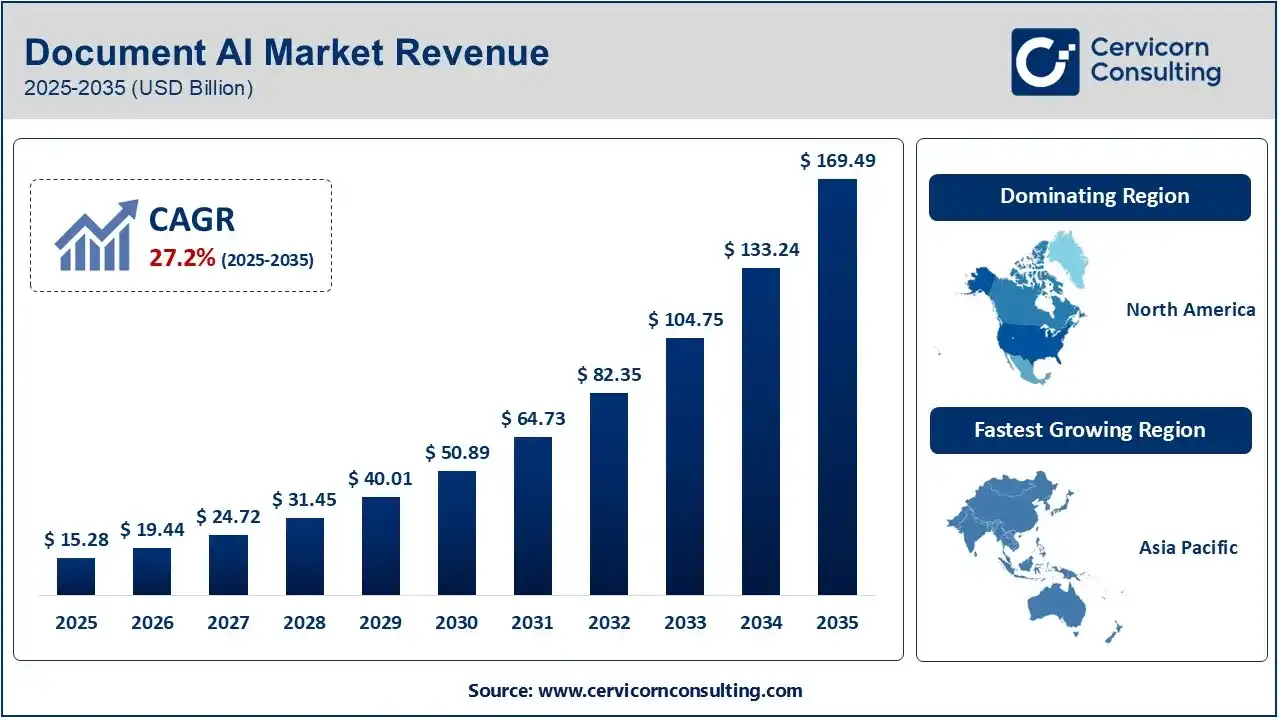
Document AI Market Overview
The global industry is also considered document intelligence that employs artificial intelligence, such as machine learning, natural language processing, and optical character recognition, to read, categorize, and obtain structured data from unorganized or semi-structured files. Specific applications of deep learning and neural networks assist in the analysis of intricate document layouts, fonts, and multilingual structures. Execution of advanced computer vision models, like CNNs and Transformer architectures, is also driving the management of layout assessment, spatial positioning of text, tables, and visual elements. Eventually, the global market is fostering NLP and LLMs that control entity extraction and recognise contextual meanings between words.
Many global trends and breakthroughs are pushing exploration of AI agents to interpret complete case files, examine related contracts, and implement end-to-end operational tasks in finance, legal, and compliance. However, the latest structure-augmented generation (SAG) is securing document hierarchy, headers, and cross-document ties, enabling downstream enterprise tools to reason over true context.
Recent Alliances
- October 2026: Google Cloud & CaixaBank joined to use Gemini Enterprise to deploy specialized AI agents and simplify document management, classification, and complex content summarization to accelerate internal corporate decision-making.
- October 2026: Many players are strengthening their 20-year relationship by developing the Accenture Dell Business Group to support enterprises in scaling private AI infrastructure, especially facilitating the performance and data controls required to unveil enterprise-grade agentic AI workloads.
- October 2026: Santander AI Lab partnered with NVIDIA infrastructure and software to evolve expanded capabilities to assess, select, and efficiently deploy unique AI models and autonomous agents for complex banking applications.
Regional Overview
North America Registered Dominance in the Market in 2025.
The document AI market in North America held a dominant share of 40% in 2025, led by massive enterprise digitization, stringent regulatory compliance mandates, and well-established cloud and AI facilities. According to some studies, the U.S. private sector recently supported roughly 2,000 newly funded AI startups, which increasingly sped up the development of native multimodal document-understanding solutions from hyperscalers. Moreover, Shared Services Canada (SSC) rolled out a local multilingual chatbot to control document drafting, editing, summarizing, and data management by ensuring data remained stored within Canadian borders.
Asia Pacific is forecasted to witness rapid expansion
Meanwhile, Asia Pacific is forecasted to witness rapid expansion in the coming years, supported by government-powered e-governance initiatives, advancing fintech and digital payment settings, and the urgent requirement for multilingual OCR. Across recent launches, China explored hybrid attention mechanisms, managing 1-million-token contexts by lowering inference expenses by nearly 92% and reducing enterprise document-base setup costs substantially. However, India’s breakthroughs are widely promoting processes across multilingual Indian enterprise documents, cooperating with local compliance, legal landscapes, and regional public infrastructure integration.
Segmental Outlook
| Market Segment | Leading Segment | Key Growth Catalyst |
| By Component | Software and Platforms | Driven by their main capabilities for document classification, extraction, understanding, and workflow automation. |
| By Technology | Optical Character Recognition (OCR) | Led by its advanced role in converting scanned and image-based documents into machine-readable data. |
| By Application | Data Extraction and Validation | Supported by broader use in digitizing structured and unstructured business documents. |
| By Deployment Mode | Cloud-Based | Propelled by its scalability, accessibility, and integration with enterprise software. |
| By End-Use Industry | BFSI | Fueled by document-heavy operations involving forms, invoices, loan applications, claims, and compliance records. |
Ongoing Shifts
- Public Steps in Digital Area: Specific consideration of key initiatives, such as the Digital India Land Records Modernization Programme (DILRMP), which consists of millions of historical property mutations, sale deeds, and revenue records written in Hindi, Marathi, and Telugu that bolster regional Document AI projects.
- Controlling Complex Tasks: Current implementations of multimodal vision-language models regularly process highly unstructured inputs, like logistics bills of lading, customs paperwork, and insurance claims packages, entirely with stamps, overlapping signatures, and handwritten notes.
- Security Solutions: Most of the geographical AI innovations are enforcing security ecosystems that mandate rigorous, isolated ‘human-in-the-loop’ validations and deterministic guardrails before document actions activate external enterprise APIs.
Future Outlook
In the prospective era, the industry will have several prominent opportunities, specifically across autonomous AI agents that will handle end-to-end document lifecycles and overcome missing invoice discrepancies, negotiate contract terms, and trigger downstream ERP actions without human interference. Furthermore, the market leaders can promote financial document pipelines, along with predictive approaches that project cash flow, address compliance anomalies and optimize vendor terms. In addition, major applications of AI algorithms will support the implementation of stringent regulatory landscapes that will provide auditable data lineage, anti-hallucination guardrails, and visible decision-tracking for core enterprise purchasing essentials.
Segment Covered
By Component
- Software and Platforms
- Services
By Technology
- Optical Character Recognition (OCR)
- Natural Language Processing (NLP)
- Machine Learning and Deep Learning
- Computer Vision
- Generative AI and Large Language Models
By Application
- Document Classification and Routing
- Data Extraction and Validation
- Document Summarization
- Contract and Compliance Analysis
- Invoice and Claims Processing
By Deployment Mode
- Cloud-Based
- On-Premises
- Hybrid
By End-Use Industry
- Banking, Financial Services, and Insurance (BFSI)
- Healthcare and Life Sciences
- IT and Telecommunications
- Retail and E-commerce
- Government and Public Sector
- Manufacturing and Other Industries
By Region
- Asia-Pacific
- North America
- Europe
- Latin America
- Middle East and Africa
Empower your strategy with expert insights, purchase this premium research@ https://www.cervicornconsulting.com/buy-now/3067
Ask here for more details@ sales@cervicornconsulting.com