Document AI Market Size and Forecast 2026 to 2035
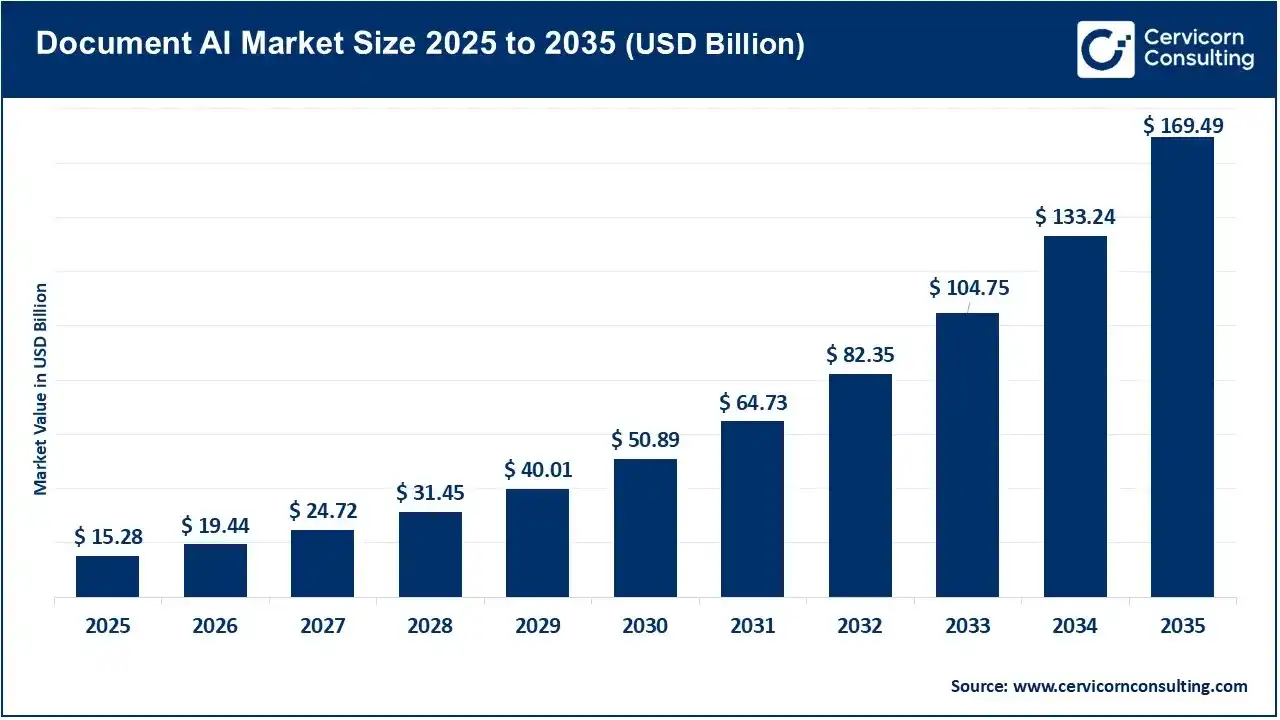
The global document AI market size was valued at USD 15.28 billion in 2025 and is expected to reach USD 169.49 billion by 2035, growing at a CAGR of 27.2% during the forecast period of 2026-2035. The global BFSI, healthcare, and real estate sectors are experiencing a massive rise in unstructured data and a surging need for advanced gen AI solutions. This has been transforming innovative approaches in LLMs, NLP, and gen AI tools to push reading, interpreting, and extracting data.
- Base Year Market Size (2025): $15.28 billion
- Current Year Market Size (2026): $19.44 billion
- Estimated Year Market Size (2035): $169.49 billion
- Forecast Period CAGR (2026-2035): 27.2%
Report Highlights
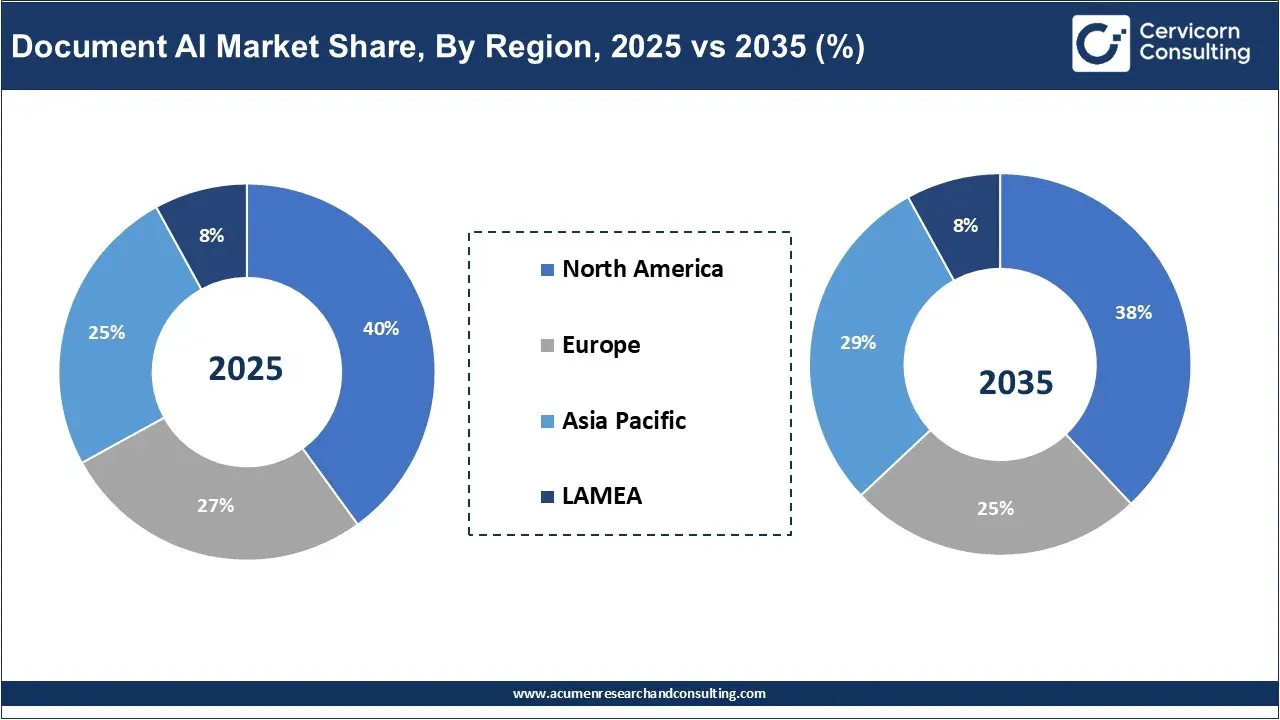
- By region: North America registered largest revenue share of 40% market in 2025, driven by huge and mature cloud facilities, expanded enterprise digitalization, and strict regulatory guidelines.
- By component: Software and platforms led the market with revenue share of 68% in 2025, due to their core capabilities for document classification, extraction, understanding, and workflow automation.
- By technology: Optical Character Recognition (OCR) captured 28% revenue share in 2025, supported by its well-developed role in converting scanned and image-based documents into machine-readable data.
- By application: Data extraction and validation has generated revenue share of 28% in 2025, fueled by expansive use in digitizing structured and unstructured business documents.
- By deployment mode: Cloud-based garnered revenue share of 57% in 2025, due to its scalability, accessibility, and integration with enterprise software.
- By end-use industry: Banking, Financial Services, and Insurance (BFSI) led the market in 2025 (revenue share 26%), supported by document-heavy operations involving forms, invoices, loan applications, claims, and compliance records.
What is the Document AI Market and Its Core Areas in 2026?
Specific adoption of document AI, i.e. also known as Document Intelligence or Intelligent Document Processing (IDP), which leverages machine learning, Natural Language Processing (NLP), and Vision Language Models (VLMs) to read, classify, interpret, and obtain structured data from unstructured or semi-structured documents. Along with VLMs, execution of automated engines pushes reading document structures, identifying document types, and routing them to proper enterprise workflows. However, the latest NLP and machine learning extract particular entities, table rows, totals, and signatures while ensuring data integrity.
Investment, Funding and M&A Intelligence
| Date |
Company / Transaction |
Disclosed investment or deal value |
Strategic significance |
| October 2025 |
Reducto Series B funding |
$75 million |
Supports development of AI-powered document intelligence using OCR and vision-language models. Total funding reached $108 million following the round. |
| May 2026 |
Coupa acquires Rossum |
Not disclosed |
Integrates intelligent document processing into spend management and invoice automation workflows. |
| May 2026 |
HorizonAI funding announcement |
$3 million |
Supports enterprise document intelligence, security capabilities, and expansion into financial and legal workflows. |
| July 2026 |
DCM acquires Octacom |
$54 million |
Expands AI-enabled document processing and digital transformation services for regulated industries. |
| September 2026 |
Stakk acquires ParaScript |
$63 million |
Combines AI-powered document recognition with digital identity and fraud prevention capabilities. |
Recent Trends
- Shift Towards Multi-Modal & VLMs: Ongoing projects currently manage mixed-content documents, like tables, with high direct processing rates and also replace weak conventional extraction templates.
- Push for Agentic Operations: Day by day, enterprise clusters are seeking autonomous AI agents, which read, authenticate, rectify, and implement multi-step operational tasks, like KYC, mortgage underwriting, and claims processing.
- Innovative Approaches: The latest APIs, including advanced platforms in ABBYY Vantage or Google Document AI, are focusing on automatic arrangements of multi-page legal or financial files into logical field groups, which transmit low-confidence sections to human-in-the-loop reviewers.
Market Dynamics
Market Drivers
- Proliferation of Unorganized Data: By considering newly generated enterprise data, nearly 85% is unstructured data, and it expands 3x faster than structured data. Hence, this boosts the need for advanced AI solutions that convert it into a well-organized form and overcome manual limitations.
- Unveiling of AI and ML Measures: This era’s Document AI emphasizes adoption of Generative AI, Large Language Models (LLMs), and Computer Vision to recognize context, handwriting, and intricate multi-page structures.
- Execution of Regulations & Scalability: Many industries, including BFSI, legal and healthcare systems, need to follow rigorous compliance mandates, where automated solutions guarantee continuous risk management and expedited review cycles. This also fosters the integration of Document AI into core business tools to elevate scalability.
Market Restraints
- Technical Hurdles: The use of online processing solutions imposes stricter limits, such as a maximum of 15 to 30 pages per document and a 40 MB file size limit, and Custom Document Extractors show limitations in the data schema to a maximum of 150 entity labels.
- Lack in Document Writes: Especially, an LLM-based agent indicates an inability in native demonstration of critical downstream document alterations, like pixel-accurate PDF rendering, cryptographic digital signatures, or irreversible legal redaction.
- Novel Phenomena Issue: Several standard text parsers don’t possess a unified, multi-layered OCR step that will interpret flat files as empty. Meanwhile, the AI will recur fail to notify the user, mutely omitting that data from its knowledge base.
Market Opportunities
- Industry-Centric Advancements: In the coming era, the document AI market will shift away from an all-in-one basic model approach toward the development of concise, highly accurate, domain-customized models, especially for regulated areas, including healthcare, banking, and law.
- Promoting Gen AI & Other: Nowadays, the market has been bolstering novelty across tools, such as Google’s Document AI Workbench, which employs underlying models to gain data from difficult free-form text, multi-page contracts, bills of lading, and dense tables with less training data.
- Revealing No-Code Workflows: With a goal of user convenience, some leaders are looking for interfaces that enable non-technical business teams to establish, tweak, and handle tailored categorisation and extraction pipelines alone.
Market Challenges
- Limiting Handwriting & Scan: Certainly, poor scans, folds, coffee stains, or irregular handwriting styles result in substantial degradation of extraction accuracy and necessitate unique neural networks.
- Illusion Concerns: The adoption of vision-language models can develop plausible but entirely wrong data, generating high operational and legal limitations for sensitive sectors, such as healthcare, finance, and legal compliance.
- Data Privacy Risks: Most of the time, the management of confidential medical, personal, or financial information involves massive regulatory barriers around data residency, retention, and the issues of exposing proprietary data to public APIs.
Key Governance Priorities for Document AI Vendors & Buyers
- Data privacy and lawful processing: Organizations need to determine whether documents contain personal or sensitive information and establish an appropriate legal basis for processing where required.
- Data residency and sovereignty: Enterprises may require documents to remain within specific geographic jurisdictions, particularly in financial services, healthcare, and government.
- Access control and permission management: AI systems should respect existing document permissions and prevent users from retrieving information they are not authorized to access.
- Data retention and deletion: Businesses need policies governing how long source documents, extracted text, embeddings, logs, and derived data are retained.
- Model training and data reuse: Customers should understand whether uploaded documents may be used to train or improve models and what contractual or technical controls apply.
- Accuracy, traceability and auditability: Systems should preserve links between extracted information and its original source, record relevant processing activity, and support human verification where errors could have significant consequences.
- Bias and document interpretation risks: Handwriting, scanned images, languages, document layouts, and low-quality source files can produce inconsistent results. Testing across representative document types is therefore important.
- Human oversight: Financial decisions, medical workflows, legal reviews, and identity verification may require additional checks instead of relying entirely on automated extraction or classification.
- Third-party and model-provider risk: Enterprises must assess the security practices, subprocessors, contractual terms, and incident-response arrangements of external AI providers.
- Regulatory monitoring: Compliance teams should monitor applicable changes in privacy, AI governance, cybersecurity, and sector-specific rules rather than assuming every Document AI application has the same regulatory classification.
Document AI Market Regional Analysis
How did North America Dominate the Market in 2025?
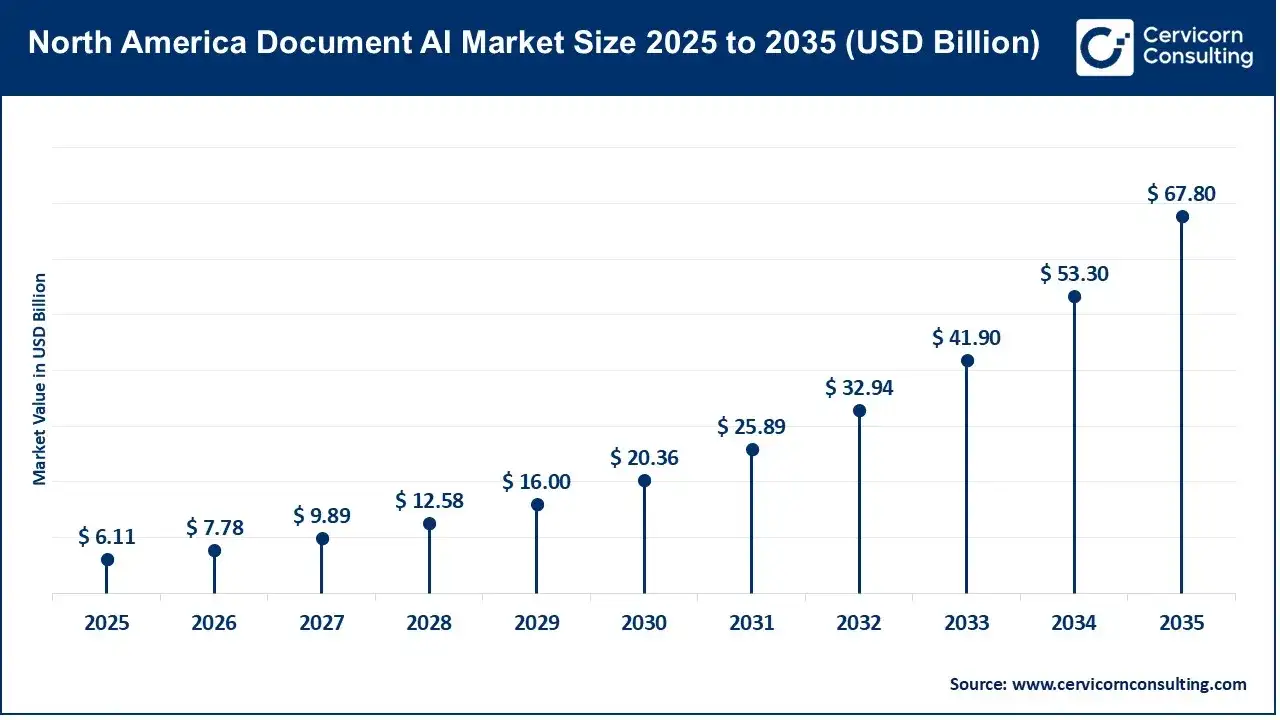
The North America document AI market size was valued at USD 6.11 billion in 2025 and is projected to surpass USD 67.80 billion by 2035. North America registered dominance in the market in 2025, due to the revolution of enterprise digital and automation solutions and expanded integration of gen AI and machine learning. Along with advanced digitalised hubs, many Canadian enterprises and public sector institutions follow stringent local mandates, such as Quebec's Law 25 and Canada's Digital Charter, and ultimately restrict document data from crossing into the U.S.
United States Market
- The U.S. in the document AI market held a dominant share in 2025, as its leading players showed interest in cost reduction, elevated operational effectiveness, and robust capital funding. A more specific explanation is a study from the Association for Intelligent Information Management (AIIM), which revealed that nearly 78% of firms successfully deployed AI document technology.
Why is the Asia Pacific Projected to Grow Rapidly in the Document AI Market?
The Asia-Pacific document AI market size was valued at USD 3.82 billion in 2025 and is expected to reach USD 42.37 billion by 2035. In the future, the Asia Pacific is estimated to be the fastest-growing region in the market, as nations uncover government-supported digital leadership, workforce shortages, and broadening local cloud-based solutions. Recent publications show that Asia and the Pacific (ESCAP) and the Asian Development Bank (ADB) reported that AI is massively integrated into customs, shipping document verification, and cross-border trade facilitation. However, South Korea’s milestone Basic Act on the Development of Artificial Intelligence set a regional precedent for joining AI and algorithmic accountability laws to control data processing tools and data.
China Market
- Along with regulations issued by the Cyberspace Administration of China (CAC) and partner agencies, China officially explored ciyuan as the standard term for ‘token’. Meanwhile, Beijing rolled out innovative provincial-level policies for ‘token factories' to record and scale enterprise AI usage.
Document AI Market Segmentation Analysis
Component Analysis
Software and Platforms: The software and platforms segment captured a dominant share of 68% of the market in 2025, due to higher potential in document extraction and surged automated workflows. An effort into VLMs and Retrieval-Augmented Generation (RAG) has expanded platforms, including LlamaIndex, unified assistance for novel frontier models with automatic orientation/skew correction and cost-benefit parsing modes.
Document AI Market Share, By Component, 2025 (%)
| Component |
Revenue Share, 2025 (%) |
| Software and Platforms |
68% |
| Services |
32% |
Services: The services segment is projected to be the fastest-growing during 2026-2035, driven by a rise in demand for implementation, integration, customization, and continuous AI system management. Enforcement of rigorous guidelines, like GDPR, CCPA, and HIPAA, pushes firms to implement specialised document services that support ensuring data residency, auditability, and hybrid onshore or offshore SLA.
Technology Analysis
Optical Character Recognition (OCR): The Optical Character Recognition (OCR) segment led with 28% share of the document AI market in 2025, supported by a key role in converting scanned documents, wider search efficiency, and low resource footprint. 2025’s breakthroughs, like LLM-powered OCR systems, gain roughly 99% accuracy on standard printed documents and improve recognition on low-quality, blurry documents by 20% to 30%.
The natural language processing (NLP) segment is anticipated to witness notable growth in the predicted timeframe, as it offers advanced cognitive reasoning and eliminates hallucinations, with impressive multimodal understanding. Huge dependency on NLP by legal, real estate, insurance, and finance provides automated contract evaluation, loan document verification, policy extraction, invoice classification, and claim automation.
Generative AI and Large Language Models: The generative AI and large language models segment is projected to grow fastest during the forecast period, led by document reasoning, contextual extraction, summarization, and conversational document processing. Eventually, genAI document processing is explored as a landmark to reconcile instrument tags from Piping and Instrumentation Diagrams (P&IDs) and validate hazard safety data.
Application Analysis
Data Extraction and Validation: The data extraction and validation segment accounted for a major share of 28% of the market in 2025, driven by massive digitalisation efforts and broader use of AI exploring preservation of spatial context. 2025’s well-known platforms, including Salesforce Data Cloud Document AI, rolled out native, GA (Generally Available) extraction capabilities to scrutinize unstructured PDFs, verify ID numbers, compare addresses, and activate automated downstream actions.
The invoice and claims processing segment registered significant growth in 2025, due to a surge in the cost and difficulty of human AP and seeking reduction in duplicate payments, approval risks, and purchase order (PO) variations. Execution of some open-source ETL pipelines reveal unified automated database cross-checking fosters validation of payment terms and forces clean JSON data straight into PostgreSQL or enterprise ERP systems.
Contract and Compliance Analysis: The contract and compliance analysis segment is forecasted to grow rapidly during 2026-2035, fueled by rising demand for automated review of complex documents and regulatory records. Gradually developing landscapes across compliance analysis, such as the EU AI Act, need the development of model visibility, training dataset documentation, human oversight trails, and risk classifications directly into custom AI and vendor procurement processes.
Deployment Mode Analysis
Cloud-Based: The cloud-based segment captured a dominant share of 57% of the market in 2025 and is predicted to expand fastest in the coming years because of its broader scalability, the availability of scalable generative AI services and demand for rapid deployment across distributed teams. Certain specific cloud solutions, like Kofile’s Kleio for public records, consolidate document classification and extraction with conversational search, automated compliance, and multi-step agent actions.
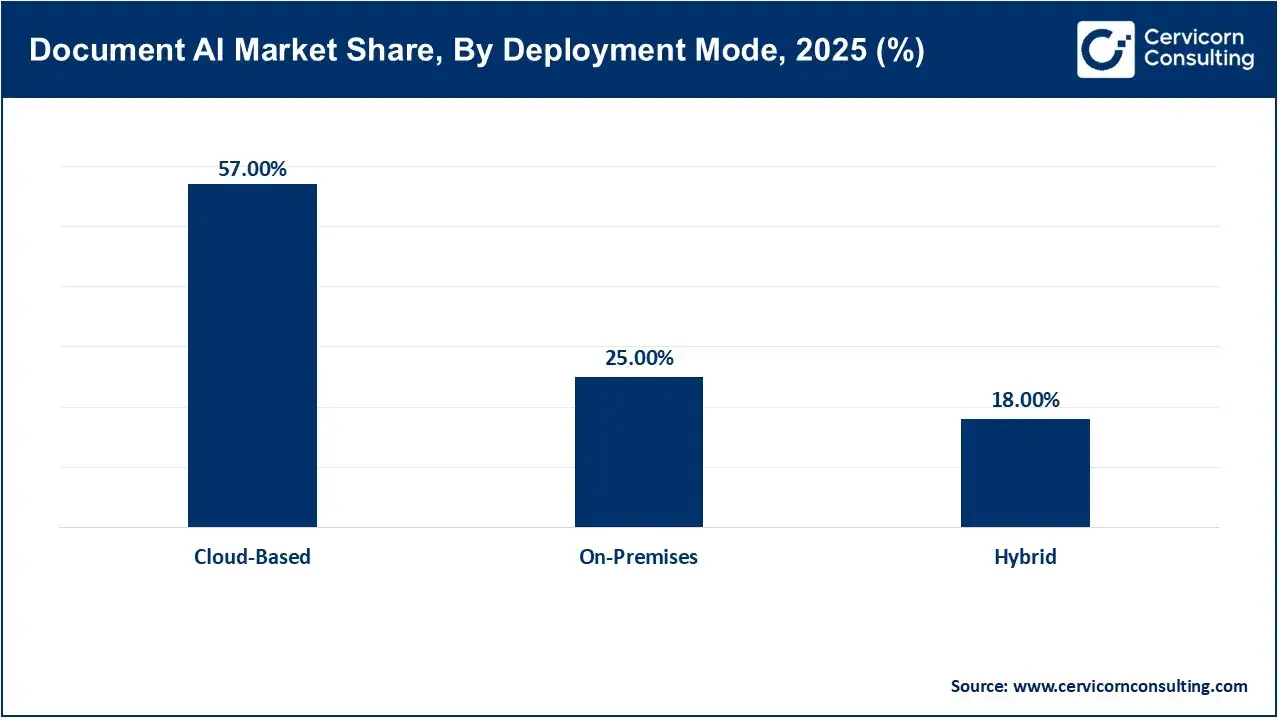
The hybrid segment is expected to witness a lucrative expansion during the forecast period, as it covers both hybrid system architectures and hybrid cloud or on-premises deployments. Specifically, Microsoft's Azure AI Foundry and hybrid cloud launches from IBM treat local edge hardware and cloud inference as one integrated pipeline.
End-Use Industry Analysis
Banking, Financial Services, and Insurance (BFSI): The Banking, Financial Services, and Insurance (BFSI) segment accounted for a major share of 26% in 2025, supported by massive document volumes and rigorous regulatory compliance. However, financial institutions are stepping toward fine-tuned Large Language Models (LLMs) and agentic workflows to execute autonomous reading, interpreting, cross-verification, and acting on unorganized documents.
The IT and telecommunications segment is projected to grow at a notable rate in the coming years, driven by broader use in unstructured billing inquiries, service logs, and contract disputes and wider moves in agentic AI solutions. Across some countries, governments are fostering national AI programs, like India’s DoT and MeitY heavily force the diffusion of subsidized AI compute to promote local companies and telecom sectors.
Document AI Market Share, By End-Use Industry, 2025 (%)
| End-Use Industry |
Revenue Share, 2025 (%) |
| BFSI |
28% |
| Healthcare and Life Sciences |
18% |
| IT and Telecommunications |
14% |
| Retail and E-commerce |
12% |
| Government and Public Sector |
11% |
| Manufacturing |
10% |
| Others |
9% |
Healthcare and Life Sciences: The healthcare and life sciences segment is estimated to be the fastest-growing during 2026-2035, led by demand to process clinical records, insurance claims, medical forms, and regulatory documentation. However, recent advances have transformed NLP for clinical documentation, especially for organizing clinical notes, pathology reports, and imaging archives to surface critical details immediately.
Recent Developments
- October 2026: Extend launched an autonomous document extraction agent to provide state-of-the-art (SotA) accuracy on highly risky extraction operations.
- October 2026: AKASA unveiled its autonomous AI platform for the mid-cycle, which broadened from AI-driven pre-bill review into autonomy for both inpatient medical coding and clinical documentation integrity (CDI).
- October 2026: DocuWare rolled out a new version of its document management platform, which combines a redesigned interface, an advanced AI assistant and an upgraded document processing tool.
- September 2026: Sarvam AI introduced Vision 2.1, an advanced model to read documents, forms, and tables, with a focus on converting production-ready data with outstanding Indic OCR accuracy.
- September 2026: Collaboration of the Digital India BHASHINI Division (DIBD) with the Office of the Comptroller and Auditor General of India (CAG) rolled out CAG-BHASHINI Anuvaad in New Delhi, as an AI-powered document translation solution to spur the translation of official CAG documents and audit-related reports.
Key Companies
Segment Covered in the Report
By Component
- Software and Platforms
- Services
By Technology
- Optical Character Recognition (OCR)
- Natural Language Processing (NLP)
- Machine Learning and Deep Learning
- Computer Vision
- Generative AI and Large Language Models
By Application
- Document Classification and Routing
- Data Extraction and Validation
- Document Summarization
- Contract and Compliance Analysis
- Invoice and Claims Processing
By Deployment Mode
- Cloud-Based
- On-Premises
- Hybrid
By End-Use Industry
- Banking, Financial Services, and Insurance (BFSI)
- Healthcare and Life Sciences
- IT and Telecommunications
- Retail and E-commerce
- Government and Public Sector
- Manufacturing and Other Industries
By Region
- Asia-Pacific
- North America
- Europe
- Latin America
- Middle East and Africa
