
Content
Cold Chain Logistics Market Size to Surge USD 1194.52 Billion by 2035


Cold Chain Logistics Market Size and Growth Insights 2026 To 2035
The cold chain logistics market size calculated at USD 414.91 billion in 2026 and is expected to surge USD 1194.52 billion by 2035, growing at a CAGR of 12.5% during the forecast period of 2026-2035.
North America registered dominance in the market in 2025, supported by surging demand for biopharmaceuticals, specialized logistics, and stricter food regulations, while Asia-Pacific is anticipated to be the fastest-growing region in the upcoming years, propelled by accelerating local biopharmaceuticals and growing consumer priorities.
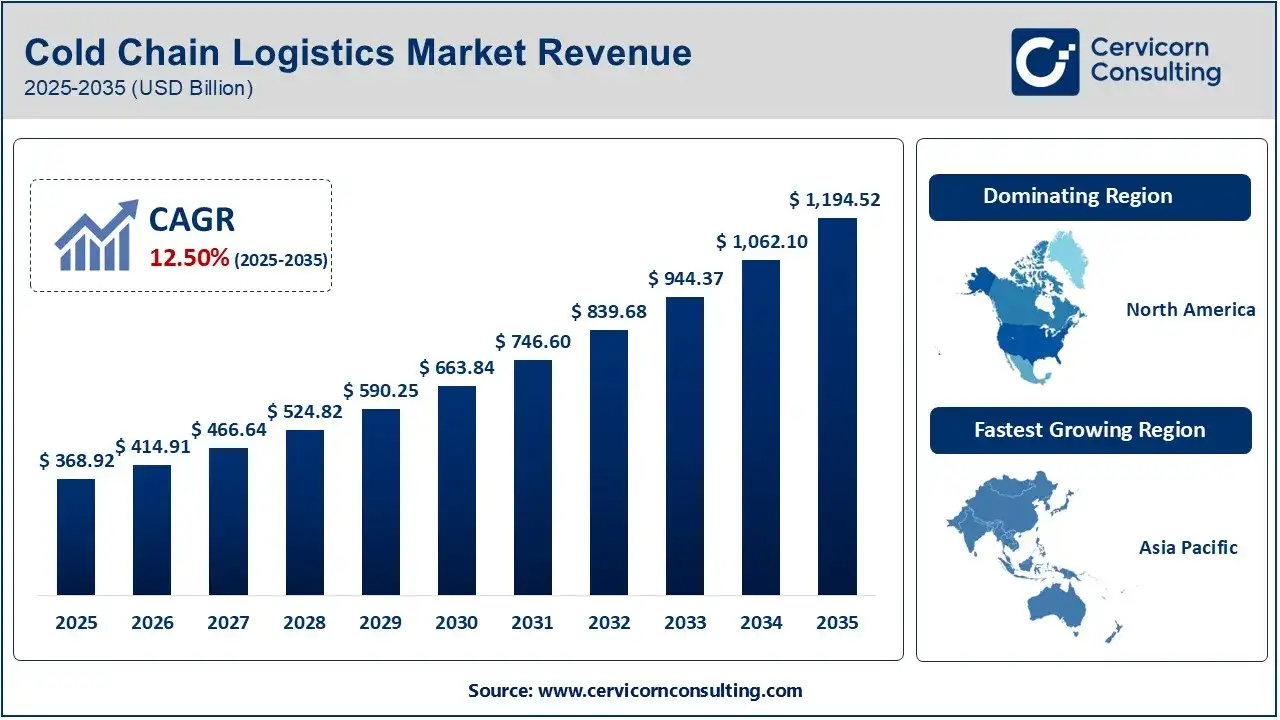
Cold Chain Logistics Market Glimpse
This market includes the temperature-controlled storage, handling, and transfer of perishable or temperature-sensitive goods, which maintains products within rigorous temperature ranges to keep them safe, fresh, and efficient. Gradually rising demand for temperature-sensitive medicines, vaccines, and expanding clinical trial candidates is demanding stricter thermal management. In addition, broadening urbanization is elevating demand for fresh dairy, meat, seafood, and frozen foods, which increasingly require mitigation to reduce degradation and extend shelf life. 2026’s trends are strongly promoting solar-driven cold storage, energy-efficient refrigeration, and reusable insulation. Worldwide, advancing grocery and perishable delivery facilities are primarily dependent on intense cold storage, part-truckload consolidation, and suburban micro-hubs combined with smaller electric refrigerated vehicles.
AI Advances
AI algorithms have immense applications across the global industry, as they support detecting temperature fluctuations related to door openings, outside weather, dwell time, and refrigeration unit health to differentiate normal tasks from true spoilage concerns. However, the widespread exploration of machine learning is projecting geographical demand and container requirements for upcoming weeks. On the other hand, modern computer vision on drones, forklifts, and autonomous mobile robots (AMRs) is enabling automated inventory scanning and pallet movement in sub-zero freezers, eliminating human intervention to higher cold. Furthermore, AI solutions also assist in adjusting transport routes and schedules in real time by leveraging live traffic, weather predictions, port congestion, and regional transitions.
Regional Insights
North America Led the Market in 2025
North America held the largest share of the cold chain logistics market in 2025, driven by advanced pharma and healthcare centers, the expansion of online platforms, and enforced regulatory and traceability frameworks. In 2025, United States Cold Storage strengthened with substantial automated growth in Tulare, California, whereas EVERSANA inaugurated a 358,000-square-foot cGDP-certified healthcare facility in Memphis with AI-powered robotic fulfilment. With an emphasis on transforming intermodal & port-connected facilities, Americold Realty Trust announced strategies to establish its first Canadian cold storage import-export hub at Port Saint John in New Brunswick that connects maritime, rail, and warehouse logistics.
Asia-Pacific is estimated to expand rapidly
Asia-Pacific is estimated to expand rapidly in the upcoming years, due to a huge demand for innovative biopharmaceuticals and a substantial surge in national infrastructure and policy support. Emerging breakthroughs across the Indian market include battery-operated refrigerated boxes on electric three-wheelers that are tracked via centralized telematics to lower engine reliance and reduce last-mile emissions. As a Digital Hub, China is empowering the deployment of smart logistics systems employing AI, big data, 5G, and IoT sensors that control real-time temperature tracking, predictive maintenance on refrigeration units, progressive routing, and automated warehouse sorting.
Cold Chain Logistics Market Segmental Outlook
| Market Segment | Dominated Segment | Key Growth Catalyst |
| By Service Type | Temperature-Controlled Storage | Fueled by its broader advantages, including protecting sensitive materials, extending shelf life, and minimising bacterial growth. |
| By Temperature Type | Chilled and Refrigerated | Supported by secured nutritional quality, rising demand for fresh foods and greater use in modern biologics and pharmaceuticals. |
| By Application | Food and Beverages | Due to increasing regional demand for processed and frozen food, advancing online grocery delivery solutions, and innovations in warehouses. |
| By Transportation Mode | Refrigerated Road Transportation | Driven by its broadened last-mile connectivity and massive investments in electric, hybrid, and optional-fuel refrigeration units. |
Developing Trends
- Aiming at Eco-Friendly Solutions: The eventual rise in energy expenses and carbon rules are enhancing the use of highly advanced cooling systems, solar-based or renewable energy integration, backup power for grid disruptions, and outstanding facility insulation.
- Unveiling Smart Warehousing: Industry players are seeking demonstrations of Robotics, automated storage and retrieval, and AI inventory management that highlight labour limitations, optimize space utilization, and minimize energy draw in cold rooms.
- Resolving Gaps Among Port Hubs: Numerous firms are strengthening the development of capacity closer to substantial consumption entities, Tier-II cities, and port/airport export gateways to shrink transit times, dwell times, and trade-related uncertainty.
Future Roadmap
A primary target of the cold chain logistics market in 2026 is wider use of electric refrigerated vehicles that eliminate emissions and comply with net-zero goals. Consistent innovations across the cold chain sector foster reusable packaging that leverages phase-change materials (PCM) and vacuum-insulated panels (VIPs) to support curbing waste, with protected temperature-sensitive cargo. Gradual growth in blockchain ledgers, RFID, and automated quality logs is emphasising the need to meet regulatory traceability mandates and Good Distribution Practice (GDP) demands, specifically for biologics, vaccines, and perishable exports. Under strong initiatives, including PM Gati Shakti and the National Logistics Policy, the market is looking to advance connected long-haul and urban distribution networks.
Segments Covered in the Report
By Service Type
- Temperature-Controlled Storage
- Refrigerated Transportation
- Packaging and Handling
- Monitoring and Tracking
- Value-Added Services
By Temperature Type
- Chilled and Refrigerated
- Frozen
- Deep-Frozen and Ultra-Low Temperature
- Controlled Room Temperature
By Application
- Food and Beverages
- Pharmaceuticals and Healthcare
- Chemicals and Specialty Materials
- Biotechnology and Clinical Trial Supplies
- Other Applications
By Transportation Mode
- Refrigerated Road Transportation
- Refrigerated Rail Transportation
- Air Freight
- Refrigerated Sea Transportation
By Region
- North America
- Europe
- Asia-Pacific
- Latin America
- Middle East and Africa
Empower your strategy with expert insights, purchase this premium research@ https://www.cervicornconsulting.com/buy-now/3096
Ask here for more details@ sales@cervicornconsulting.com