Cold Chain Logistics Market Overview and Insights 2026 to 2035
The global cold chain logistics market size was valued at USD 368.92 billion in 2025 and is expected to reach USD 1,194.52 billion by 2035, growing at a CAGR of 12.5% during the forecast period of 2026-2035. Gradually increasing demand for advanced pharmaceuticals and biologics, expanding e-commerce, online grocery, and changing consumer preferences are driving global market growth. Major efforts by leading firms are fostering integrated real-time IoT sensors, GPS tracking, RFID management, and AI-powered routing.
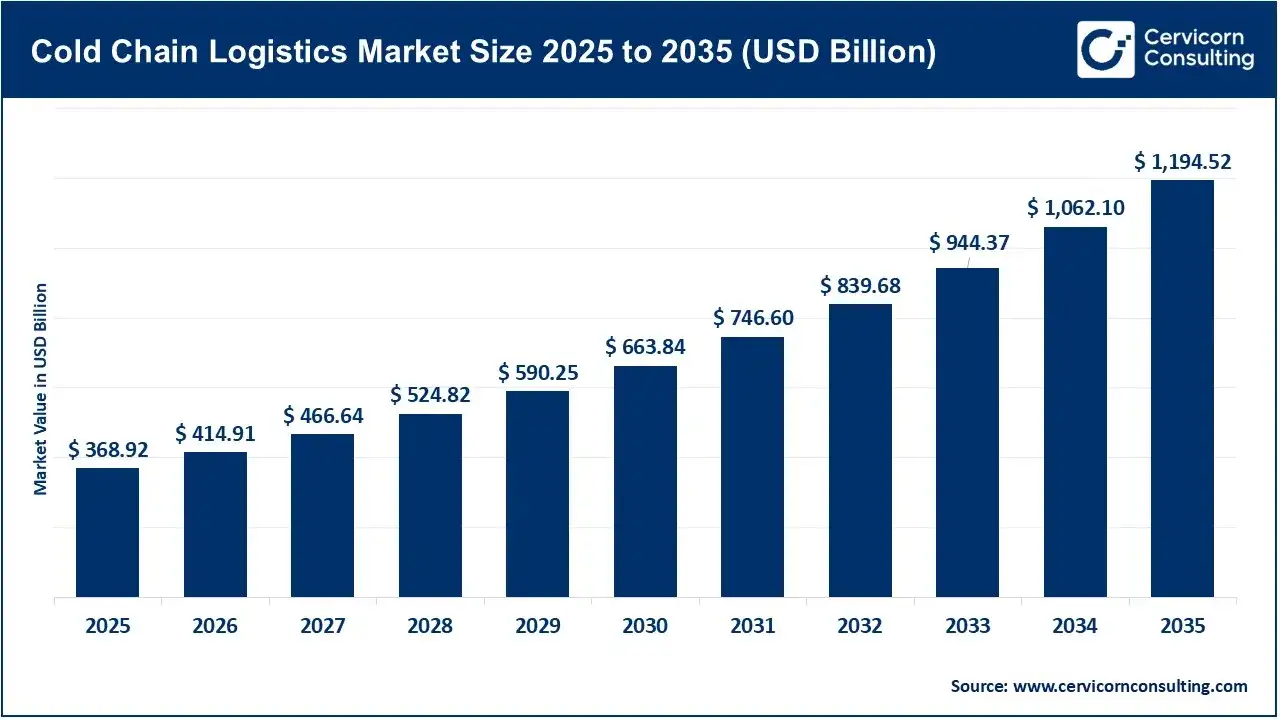
Cold Chain Logistics Market Size & Forecast
- Base Year Market Size (2025): $368.92 billion
- Current Year Market Size (2026): $414.91 billion
- Estimated Year Market Size (2035): $1,194.52 billion
- Forecast Period CAGR (2026-2035): 12.5%
Report Highlights
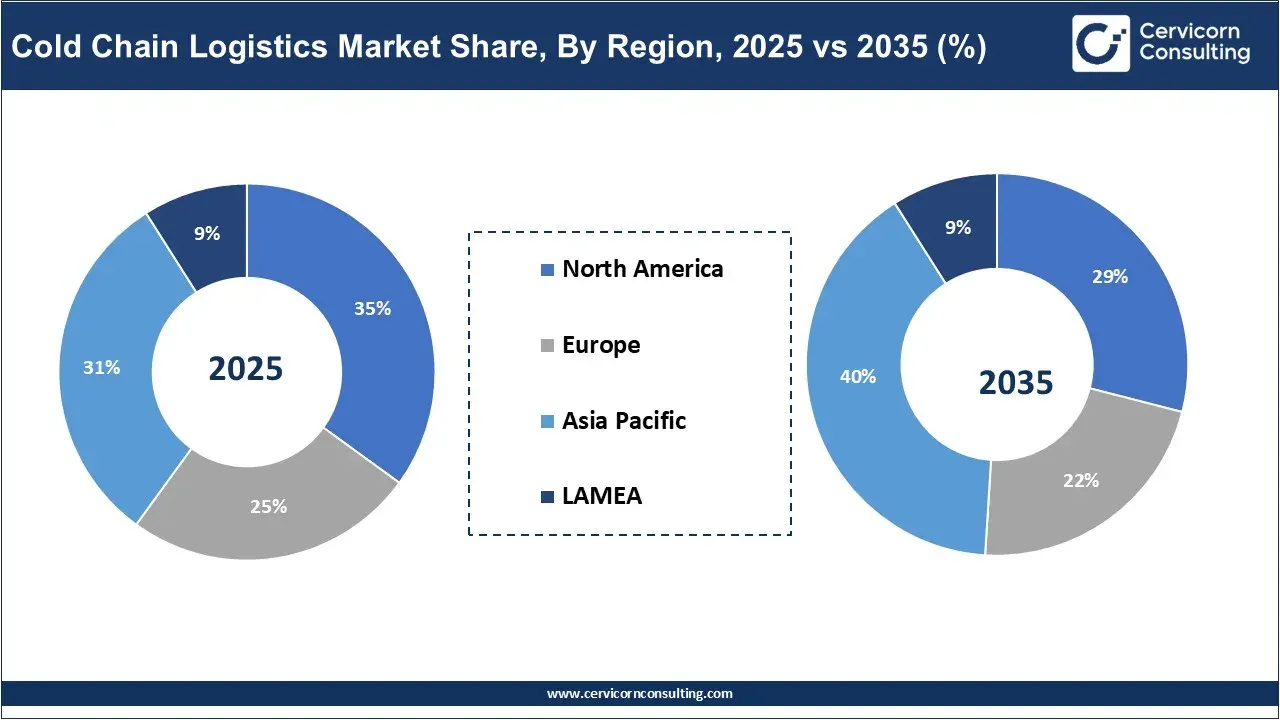
- By region, North America led the market in 2025 with revenue share of 35%, due to accelerating demand for biopharmaceuticals, specialized logistics, and enforced rigorous food regulations.
- By service type, temperature-controlled storage dominated the market in 2025 (revenue share 47%), fueled by a massive demand for temperature-sensitive drugs, vaccines, insulin, and biologics.
- By temperature type, chilled and refrigerated registered dominance in the market in 2025 with revenue share of 42%, propelled by growing fresh food consumption and expanding distribution of vaccines, biologics, and temperature-sensitive medicines.
- By application, food and beverages led the market in 2025 with revenue share of 68%, fueled by changing lifestyles, well-developed retail, and QSRs.
- By transportation mode, refrigerated road transportation dominated the market with revenue share of 60% in 2025, driven by broadening demand for pharma leaders and rising investment in infrastructure and cold storage approaches.
How is Cold Chain Logistics Advancing Across the Globe?
The cold chain logistics market refers to a temperature-controlled supply chain that stores, controls, and shifts perishable or heat-sensitive goods through a seamless sequence of refrigerated production, storage, and transport. However, this rapidly growing industry is mainly propelled by the worldwide accelerating demand for fresh fruits, vegetables, dairy, meat, seafood, and frozen products, and the spectacular progression in pharmaceutical and healthcare areas. Ongoing breakthroughs have been promoting AI-enabled predictive systems that project equipment failures and improve delivery routes to mitigate thermal susceptibility.
Recent Announcements
- October 2026: DHL Supply Chain Türkiye and Biogen Türkiye joined with a focus on temperature-controlled storage, active distribution services, and value-added services.
- September 2026: The Department for Promotion of Industry and Internal Trade (DPIIT) collaborated with the Asian Development Bank to establish grading and rating standards for warehouses and cold chains.
- September 2026: PHY Wireless partnered with Surfact to enhance tracking frequency, elevate battery life, and improve transparency across cold-chain and food transportation operations.
- August 2026: The U.S. Department of Agriculture (USDA) announced $7.5 million in grant funding available through the Cold Chain Grants for Emergency Food Assistance Program (CCG) to strengthen cold chain equipment investments & and support food assistance entities to temporarily store, effectively package, and distribute fresh, frozen, and minimally processed foods.
- August 2026: DP World developed a new temperature-controlled logistics hub in the Port of Antwerp with an initial investment of EUR 48 million, assisting customers in healthcare, pharmaceuticals, perishables, and other industries who need specialist cold chain logistics.
- July 2026: Gyre Energy raised $1.3m to bolster its cooling technology into vast cold-storage and industrial facilities.
- July 2026: Peli BioThermal and PAXAFE joined to combine cold chain packaging with AI-driven digital monitoring and predictive analytics.
Market Dynamics
Growth Drivers
- Surging Pharmaceuticals & Biologics: Nowadays, the global market is experiencing a huge rise in biologics, vaccines, clinical trials, and temperature-sensitive drugs, which require stringent cold-storage and cold-transit measures.
- Emergence of Rigorous Frameworks: In industrial developments, governments and international agencies are enforcing stricter safety, hygiene, and traceability benchmarks for food handling and drug distribution (such as GDP and HACCP guidelines, which promote innovation across the cold chain logistics market.
- Growth in E-Commerce & Technological Advances: Eventual breakthroughs in the market are fostering modern e-commerce solutions and expansive use of Internet of Things (IoT) sensors, cloud-based tracking, radio-frequency identification (RFID), and AI-assisted telemetry, enabling real-time visibility of temperature metrics, lowering spoilage and product loss.
Market Restraints
- High Fuel Consumption & Price Fluctuation: The operation of refrigerated warehouses and storage entities requires lighting and cooling systems, further raising electricity consumption. Alongside this, transportation of goods via refrigerated vehicles faces highly volatile diesel and fuel costs.
- Uncertainty in Infrastructure: Many cold chain buildings are highly separated, privately owned, and inconsistently distributed, resulting in capacity differences. Additionally, reefer trucks and mobile cooling units face increased wear-and-tear and mechanical failures, leading to product spoilage and inventory losses.
Key Opportunities
- Focusing on Sustainability: The enforcement of stricter global eco-friendly rules is escalating chances for energy-efficient refrigerated units, solar-assisted cold storage, and circular, green packaging materials that reduce long-term operating expenses.
- Maturity in Quick Commerce Approaches: The worldwide expansion of same-day and quick-commerce dark stores necessitates micro-fulfilment cold infrastructure and hyper-local refrigerated last-mile delivery and will support ensured freshness for online dairy, meat, seafood, and ready-to-eat meals.
- Revolutionising Digitalisation: Along with advanced IoT sensors and cloud solutions, the market leaders are pioneering robotics and automated warehouse management to eliminate spoilage and labor friction, and predictive analysis will enable proactive prevention of thermal excursions before goods are spoiled.
Market Challenges
- Deficient Infrastructure: A number of the existing cold storage capacities are single-commodity-centered instead of versatile enough for multi-temperature pharmaceuticals or frozen foods.
- Restricted Real-Time Visibility and Tracking: Major differences in tracking capabilities across the supply chain; fleet owners and shippers often face a shortage of live data on reefer status or cargo temperature.
Cold Chain Logistics Market Regional Analysis
Why did North America Dominate the Market in 2025?
The North America cold chain logistics market size was valued at USD 129.12 billion in 2025 and is projected to surpass USD 418.08 billion by 2035. North America captured a major share of the market in 2025 due to well-developed pharma and healthcare hubs, widely proliferated online platforms, and the inclusion of rigorous regulatory and traceability guidelines. With the robust presence of Health Canada, the region is heavily invested in stronger exports of Canadian meat, dairy, seafood, and integration with federal intermodal and trade-corridor infrastructure developments. Several developing digital industries are linking shippers with underutilized, domestic cold-storage capacity, offering flexible network elasticity during demand spikes.
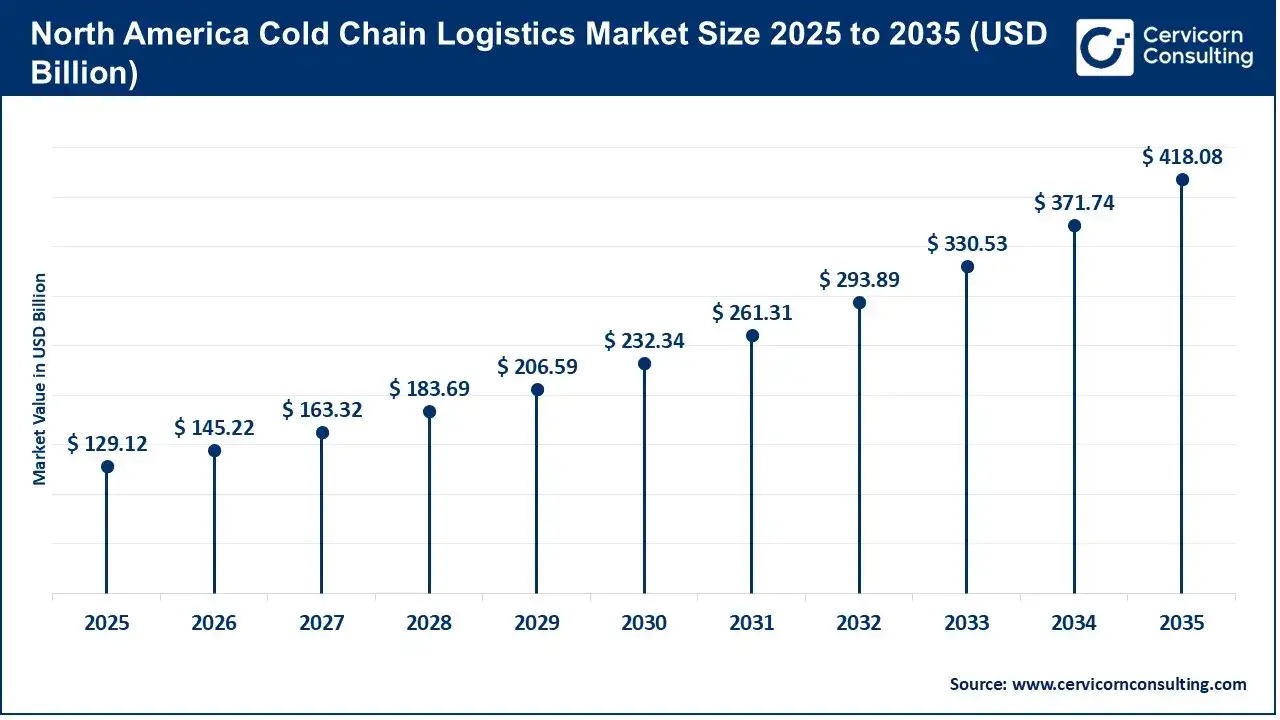
United States Market
- The U.S. industry has strengthened the development of cell and gene therapies and emphasized preferences for direct-to-consumer grocery delivery, meal kits, and quick-commerce models. Meanwhile, national technological trends pushed core temperature prediction approaches, larger automation, and smart warehousing solutions. The recently introduced FDA's FSMA Section 204 Food Traceability Rule consistently fuels a movement toward digital twin technology and electronic record-keeping for high-risk foods.
Why is Asia-Pacific Considered to be the Fastest-Growing Region in the Market?
The Asia-Pacific cold chain logistics market size was estimated at USD 114.37 billion in 2025 and is expected to reach USD 370.30 billion by 2035. Asia-Pacific is projected to expand rapidly, driven by a wider focus on domestic biopharmaceuticals, vaccine demand, and elevating consumer preferences. However, a notable rise in national infrastructure and policy support, along with substantial laws for dietary products and growing biologics & vaccines exports, is expected. Specifically, Indian initiatives, such as the Pradhan Mantri Kisan SAMPADA Yojana (PMKSY), covering the Integrated Cold Chain and Value Addition Infrastructure (ICCVAI) component, are propelling the persistence of channel public and private capital into the network.
China Market
- As a rapidly growing nation, China’s total cold storage capacity has grown to roughly 277 million cubic meters, which is strengthening by nearly 5% annually as regional centers in Henan, Hunan, and Sichuan resolve historical distribution differences. Along with the integration of blockchain, cloud platforms, and IoT-enabled sensors, China is spurring new energy reefer trucks, like electric, hybrid, and hydrogen/natural gas vehicles, to meet China VI emission standards and high energy pressures.
Cold Chain Logistics Market Segmentation Analysis
Service Type Analysis
Temperature-Controlled Storage: The temperature-controlled storage segment held a dominant share of the market in 2025, supported by its expansive benefits, like preservation of product integrity, shelf life, and reduced bacterial growth. Booming demand for vaccines, biologics, and clinical drugs and advancing online e-commerce solutions pushed this service. Along with ASRS & AMRs, the industry aimed at natural, low-Global Warming Potential (GWP) options.
Cold Chain Logistics Market Share, By Service Type, 2025 (%)
| Service Type |
Revenue Share, 2025 (%) |
| Temperature-Controlled Storage |
47% |
| Refrigerated Transportation |
34% |
| Packaging and Handling |
8% |
| Monitoring and Tracking |
5% |
| Value-Added Services |
6% |
Value-Added Services: The value-added services segment is projected to be the fastest-growing during the forecast period, fueled by global expansion of the pharma sector and accelerating consumer and retail demand. As they allow regulatory fulfilment, cold storage providers are widely using kitting, specialized labeling, and custom thermal packaging by integrating them directly into the warehouse footprint.
Temperature Type Analysis
Chilled and Refrigerated: The chilled and refrigerated segment captured the largest share of the market in 2025, motivated by global pivotal demand for fresh foods and larger empowerment in modern biologics and temperature-sensitive pharmaceuticals. This type offers higher shelf life and protected nutritional quality, coupled with broader use of advanced phase change materials, specialized gel packs, and intelligent indicators on packaging that show reported cumulative temperature exposure across shifts.
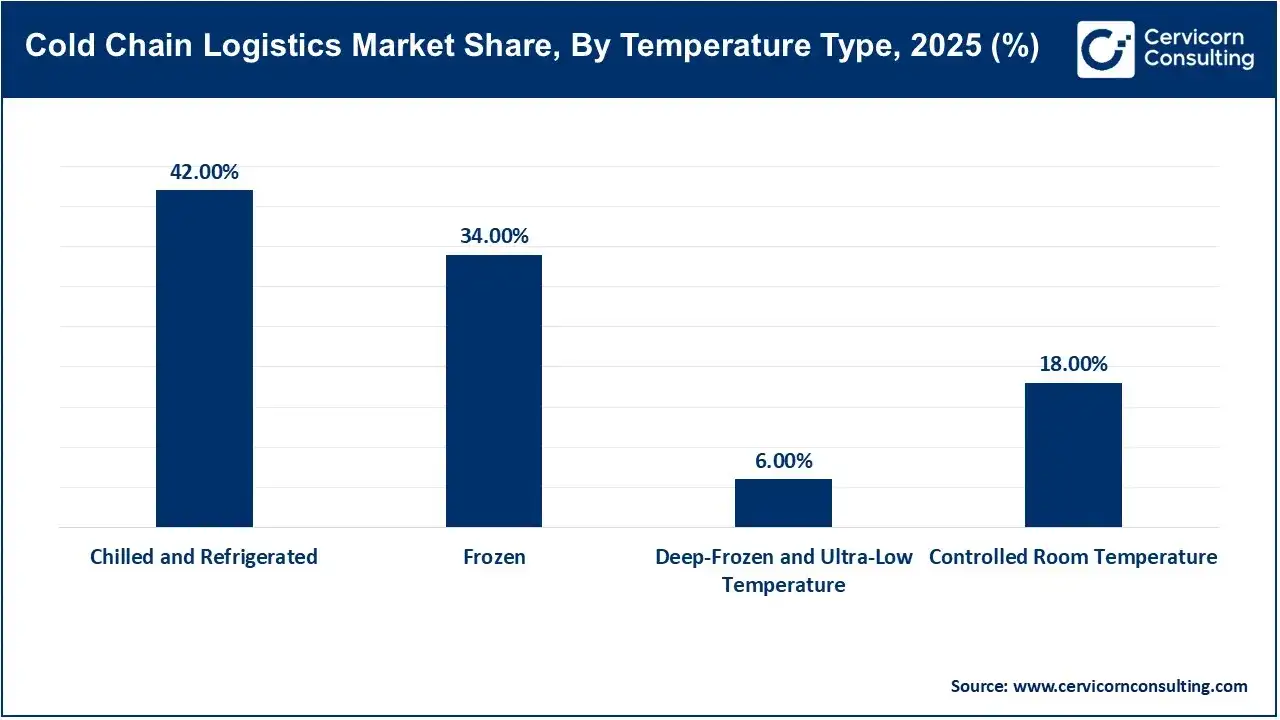
Deep-Frozen and Ultra-Low Temperature: The deep-frozen and ultra-low temperature segment is predicted to grow rapidly, propelled by growing biologics, mRNA platforms, and its major role in mitigating denaturation and degradation. Ongoing innovations are forcing sophisticated dry shippers to maintain exceptional temperatures as low as –196 °C, leveraging unique materials that absorb liquid nitrogen and guarantee safe global transit for sensitive cell/gene products and pharmaceuticals.
Application Analysis
Food and Beverages: The food and beverages segment dominated with a dominant share of the market in 2025, driven by accelerating demand for processed and frozen food and broadened online grocery delivery platforms. Eventually, cold storage operators have scaled up solar-powered warehouses and low Global Warming Potential (GWP) refrigerant systems to comply with aspiring corporate ESG (Environmental, Social, and Governance) goals.
Cold Chain Logistics Market Share, By Application, 2025 (%)
| Application |
Revenue Share, 2025 (%) |
| Food and Beverages |
68% |
| Pharmaceuticals and Healthcare |
21% |
| Chemicals and Specialty Materials |
4% |
| Biotechnology and Clinical Trial Supplies |
5% |
| Others |
2% |
Pharmaceuticals and Healthcare: The pharmaceuticals and healthcare segment is expected to expand fastest during 2026-2035 because of a notable rise in specialty medicine and an expansive focus on patient safety and public health protection. Continuous innovations have fostered phase-change materials (PCMs) and encouraged merging of healthcare end-to-end 3PL alliances into single-provider unified ecosystems.
Transportation Mode Analysis
Refrigerated Road Transportation: The refrigerated road transportation segment was dominant in the market in 2025, supported by its expanded last-mile connectivity and constant investments in electric, hybrid, and alternative-fuel refrigeration units. The latest road-to-rail and unified activities have assisted in overcoming barriers between rural production hubs and urban quick-commerce dark stores.
Cold Chain Logistics Market Share, By Transportation Mode, 2025 (%)
| Transportation Mode |
Revenue Share, 2025 (%) |
| Refrigerated Road Transportation |
60% |
| Refrigerated Rail Transportation |
7% |
| Air Freight |
18% |
| Refrigerated Sea Transportation |
15% |
Air Freight: The air freight segment is predicted to grow at the fastest rate in the coming years, motivated by its shortened delivery period, reduced handling, and breakthroughs in on-aircraft and container technology. According to Cervicorn experts, many airports and handlers are closing the most susceptible link in the chain, i.e., the ship between terminal storage and the aircraft, coupled with specialized refrigerated airside vehicles.
Recent Developments
- October 2026: IFS rolled out Fulfillment Flow from IFS Softeon, an innovative AI solution to uncover context-aware intelligence directly into warehouse fulfillment operations.
- October 2026: FedEx Europe unveiled a new data platform to allow pharmaceutical and life sciences leaders to book and handle temperature-controlled shipments.
- September 2026: DSV started a new temperature controlled Air ThermoDirect facility at Incheon in South Korea, bringing more than 2,000 square metres of refrigerated storage.
- September 2026: China’s new Pinglu Canal introduced a direct river-sea freight connection with Vietnam’s Mekong Delta that carries nearly 500 twenty-foot equivalent units (TEUs), with refrigerated containers assumed to hold around 25 per cent of capacity.
- August 2026: ColdStar Logistics introduced a new corporate brand film that indicates the scale of its operations, technology-driven capabilities, and expertise in controlling complex cold chain logistics across India.
- July 2026: Cold Chain Technologies rolled out the EcoFlex XS, a three-liter payload capacity especially suited to applications like clinical trial sample shipments, pharmaceutical product sampling, blood and diagnostic sample transportation, and other small-volume temperature-sensitive shipments.
- July 2026: Maersk (Maersk) unveiled an integrated cold chain solution that joins origin operations in Chile with ocean transport, U.S. port handling, fumigation, inland logistics, and cold storage, also creating a scalable model for regulated produce shifting into the U.S. Mid-Atlantic and Southeast.
Leading Companies
Segments Covered
By Service Type
- Temperature-Controlled Storage
- Refrigerated Transportation
- Packaging and Handling
- Monitoring and Tracking
- Value-Added Services
By Temperature Type
- Chilled and Refrigerated
- Frozen
- Deep-Frozen and Ultra-Low Temperature
- Controlled Room Temperature
By Application
- Food and Beverages
- Pharmaceuticals and Healthcare
- Chemicals and Specialty Materials
- Biotechnology and Clinical Trial Supplies
- Other Applications
By Transportation Mode
- Refrigerated Road Transportation
- Refrigerated Rail Transportation
- Air Freight
- Refrigerated Sea Transportation
By Region
- North America
- Europe
- Asia-Pacific
- Latin America
- Middle East and Africa
