
Content
Cell Therapy Technologies Market Projected to Exceed $24.56 Billion by 2035


Cell Therapy Technologies Market Insights
The global cell therapy technologies market size calculated at USD 8.17 billion in 2026 and is expected to surpass USD 24.56 billion by 2035, growing at a CAGR of 13.1% during the forecast period of 2026-2035.
North America registered dominance in the market in 2025, fueled by a stronger regulatory landscape and increasing private and public investments in gene editing solutions, whereas Asia Pacific is anticipated to expand fastest in the upcoming years due to an accelerating geriatric population, chronic conditions, and innovative gene editing solutions.
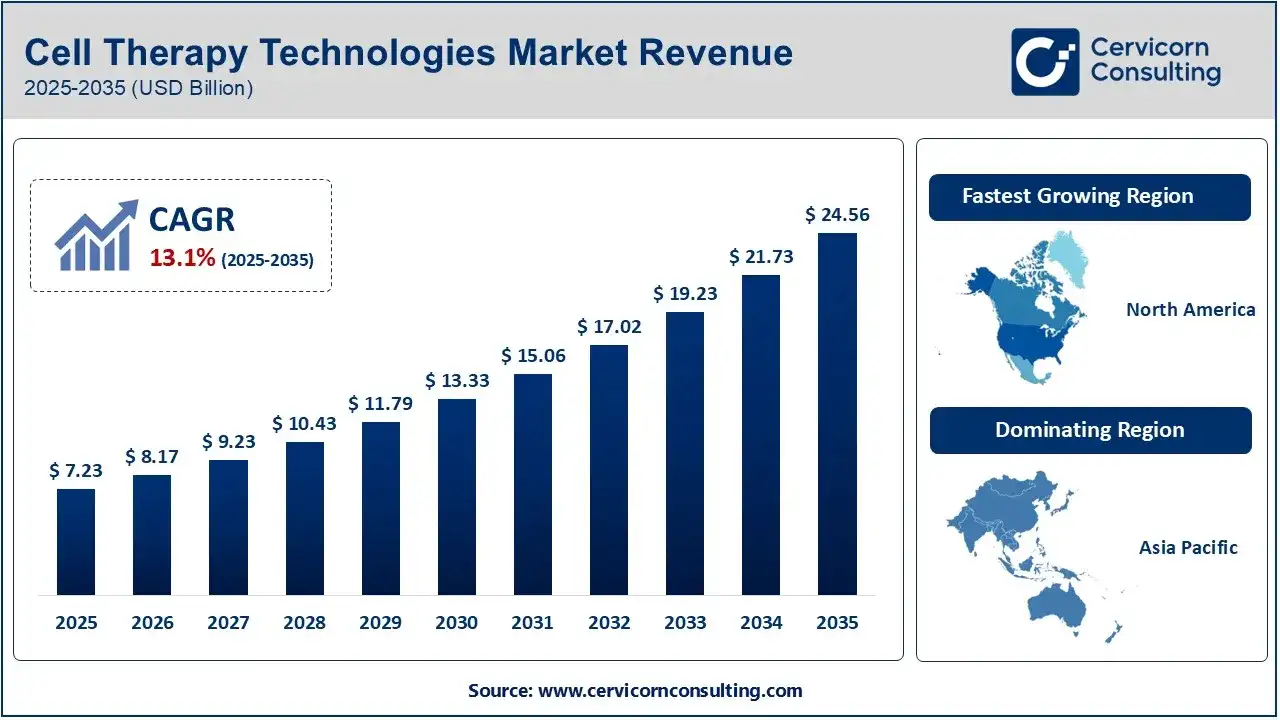
Cell Therapy Technologies Market Overview
The market widely uses diverse technologies that actively enable the selection, isolation, manipulation, and administration of living cells into a patient, which gives repair, replace, or regulate damaged tissues and immune functions. However, the global industry is experiencing steady growth due to a rise in approved commercial cell and gene therapies and major R&D investments, with key alliances among private and public bodies. Numerous ongoing breakthroughs are fostering in vivo generation and targeted delivery, led by advanced lipid nanoparticles (LNPs) and engineered adeno-associated viruses (AAVs). Upcoming innovations across the market will increasingly unveil measures to lower electrical seizures in epilepsy, as well as in rising oncology cases worldwide.
How is AI Assisting the Growth of the Cell Therapy Technologies Market?
Day by day, AI algorithms are supporting the prominent progression, including the development of CAR-T and engineered cell therapies, specifically in complex solid tumors and autoimmune disorders. To resolve scale-up and continuity barriers, thousands of producers are forcing the adoption of combined machine learning, machine vision, and robotics via automated complete cell generation. Additionally, novel robotic systems are utilizing AI to automate the immune-protecting cell generation from one blood sample. Certainly, the market leaders are stepping into the enforcement of generative AI and modern analytics to enhance patient selection, refine eligibility criteria, and optimise trial protocols.
Regional Outlook
North America Dominated the Market in 2025
North America held a dominant share of the cell therapy technologies market in 2025, led by immense and significant funding, with rapid regulatory approvals. Along with this, the region has simplified pathways controlled by key bodies, such as the FDA in the U.S. and Health Canada’s Biologic and Radiopharmaceutical Drugs Directorate (BRD), joined with compact academic-industry alliance networks. Meanwhile, Canadian researchers focused on local production infrastructure and, crucially, on broadening the progression of CLIC-1901, a CD19-targeting CAR-T cell therapy via a closed, automated, point-of-care-compatible manufacturing approach.
Asia Pacific is Expected to Grow Rapidly During 2026-2035
Asia Pacific is predicted to expand at a rapid rate in the upcoming years, supported by the expansion of new gene editing solutions and the empowerment of CGT commercialisation. On the other hand, regional key players, such as AstraZeneca, have committed to transforming Chinese manufacturing and research infrastructure by 2030. With a broad range of applications, the Indian Council of Medical Research (ICMR) and the Central Drugs Standard Control Organization (CDSCO) are consistently forming translational frameworks and bolstering stem cell and gene therapies towards evidence-based clinical protocols.
Cell Therapy Technologies Market Segmental Outlook
| Market Segment | Leading Segment | Key Growth Factor |
| By Offering | Media and Reagents | Driven by recurring consumption throughout cell therapy development and manufacturing. |
| By Workflow | Cell Expansion and Culture | Led by its core role in producing sufficient quantities of cells for therapeutic use. |
| By Cell Type | T Cells | Due to expanded engineered T-cell therapy development and production requirements. |
| By Scale of Operation | Clinical Manufacturing | Propelled by the need to supply cell therapy candidates for clinical trials. |
| By End User | Pharmaceutical and Biotechnology Companies | Supported by expansive investment in cell therapy pipelines and manufacturing progression. |
Cell Therapy Technologies Market Developing Shifts
- Growth in Decentralized Production: Gradually, the key market players are transitioning from firm, one-size-fits-all manufacturing models to specialized, digitally powered, and geographically adaptive settings, such as point-of-care production and modern processing to reduce the cost of goods (COGS).
- AI-Assisted Scale-Up Efforts: With the use of advanced AI solutions, scientists are promoting simplified research ecosystems, enhanced consistency and reproducibility, with minimal development spending. Also, AI supports finding therapeutic efficacy, screening custom genetic components, and managing cell quality control.
- Innovative Closed Solutions: Many global leaders are currently enforcing good manufacturing practice (GMP) production by employing automated, closed, and single-use systems, including alliances with platforms to overcome contamination risks and validate output.
Future Outlook
During 2026-2035, the cell therapy technologies market will explore several opportunities to strengthen the global progression and advances across the industry. In particular, the well-developed CAR-T therapies are advancing their uses in solid tumors, neurological conditions, CVD, and immune-mediated autoimmune disorders. Along with allogeneic therapies transformation, the industry will look ahead to next-generation cellular tools, such as T cell receptor-engineered T (TCR-T) cells, Tumor-infiltrating lymphocytes (TILs), CAR-natural killer (CAR-NK) cells, and CAR-macrophages (CAR-Ms). Furthermore, worldwide advances are mainly gaining traction in using gene-editing tools, such as CRISPR and non-viral delivery platforms, to enhance the safety, personalization, and genetic control of engineered cells.
Segments Covered
By Offering
- Instruments and Automation Technologies
- Single-Use Assemblies
- Media and Reagents
- Quality Control and Analytics Technologies
- Software and Digital Platforms
By Workflow
- Cell Collection
- Cell Isolation and Selection
- Cell Activation and Engineering
- Cell Expansion and Culture
- Cell Harvesting, Formulation, and Preservation
- Quality Control and Release Testing
By Cell Type
- T Cells, Including CAR-T and TCR-T Cells
- Tumor-Infiltrating Lymphocytes (TILs)
- Natural Killer (NK) Cells
- Stem Cells
- Induced Pluripotent Stem Cell-Derived Cells
By Scale of Operation
- Research and Discovery
- Process Development
- Preclinical Development
- Clinical Manufacturing
- Commercial Manufacturing
By End User
- Pharmaceutical and Biotechnology Companies
- Contract Research Organizations (CROs)
- Contract Development and Manufacturing Organizations (CDMOs)
- Academic and Research Institutes
- Hospitals and Specialized Cell Therapy Centers
By Region
- Asia-Pacific
- North America
- Europe
- Latin America
- Middle East and Africa
Empower your strategy with expert insights, purchase this premium research@ https://www.cervicornconsulting.com/buy-now/3075
Ask here for more details@ sales@cervicornconsulting.com