Cell Therapy Technologies Market Size and Forecast 2026 to 2035
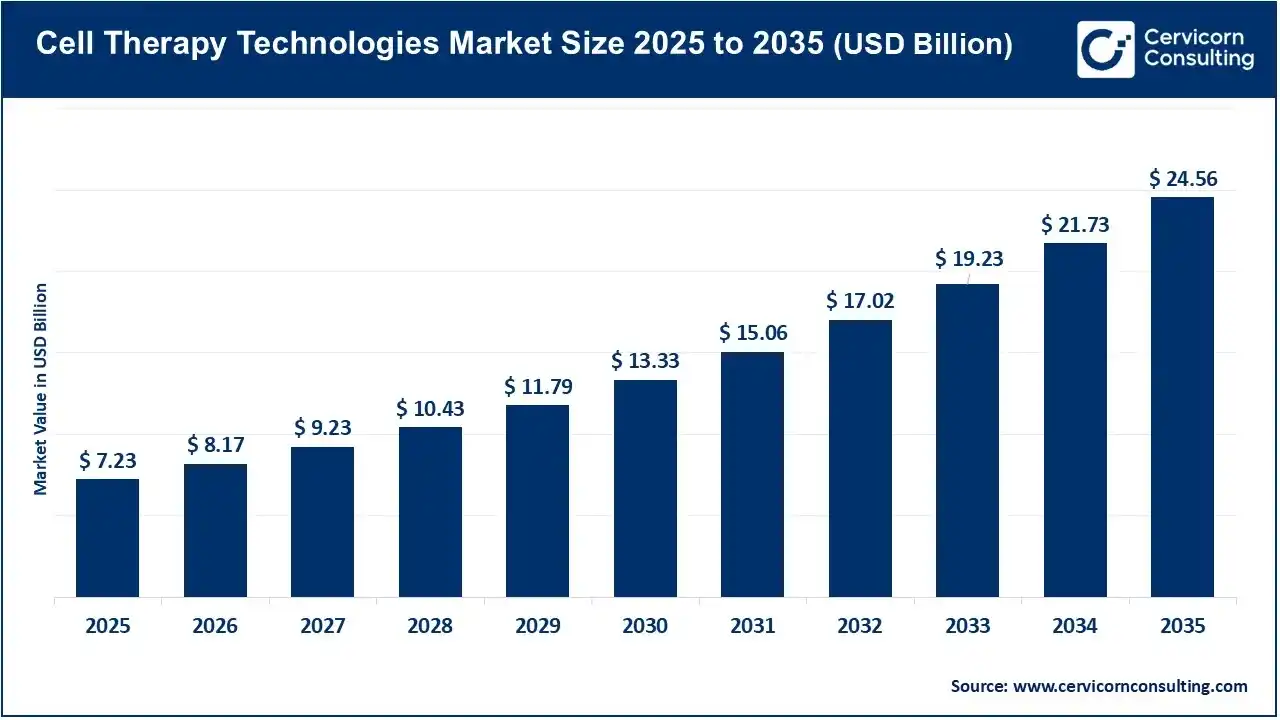
The global cell therapy technologies market size was valued at USD 7.23 billion in 2025 and is expected to exceed around USD 24.56 billion by 2035, growing at a CAGR of 13.1% during the forecast period from 2026 to 2035. The global market growth is mainly driven by a surge in the number of approved CGTs and clinical pipelines. Besides this, the industry is expanding advances in gene-editing tools, especially CRISPR and TALEN.
- Base Year Market Size (2025): $7.23 billion
- Current Year Market Size (2026): $8.17 billion
- Estimated Year Market Size (2035): $24.56 billion
- Forecast Period CAGR (2026-2035): 13.1%
Report Highlight
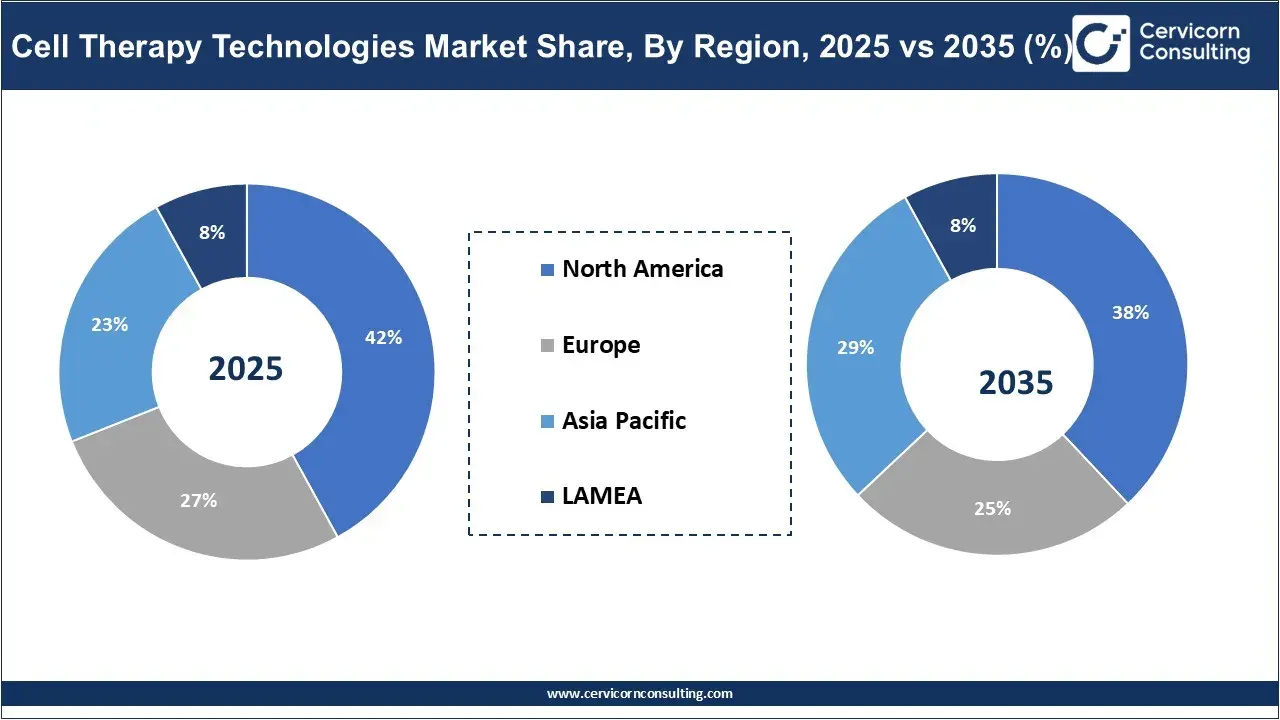
- By region: North America accounted for a revenue share of 42% in 2025, due to a robust regulatory framework and rising private and public investments in gene editing solutions.
- By offering: Media and reagents led the market in 2025, fueled by recurring consumption throughout cell therapy development and manufacturing.
- By workflow: Cell expansion and culture was dominant in the market in 2025 garnered revenue share of 25%, supported by its central role in producing sufficient quantities of cells for therapeutic use.
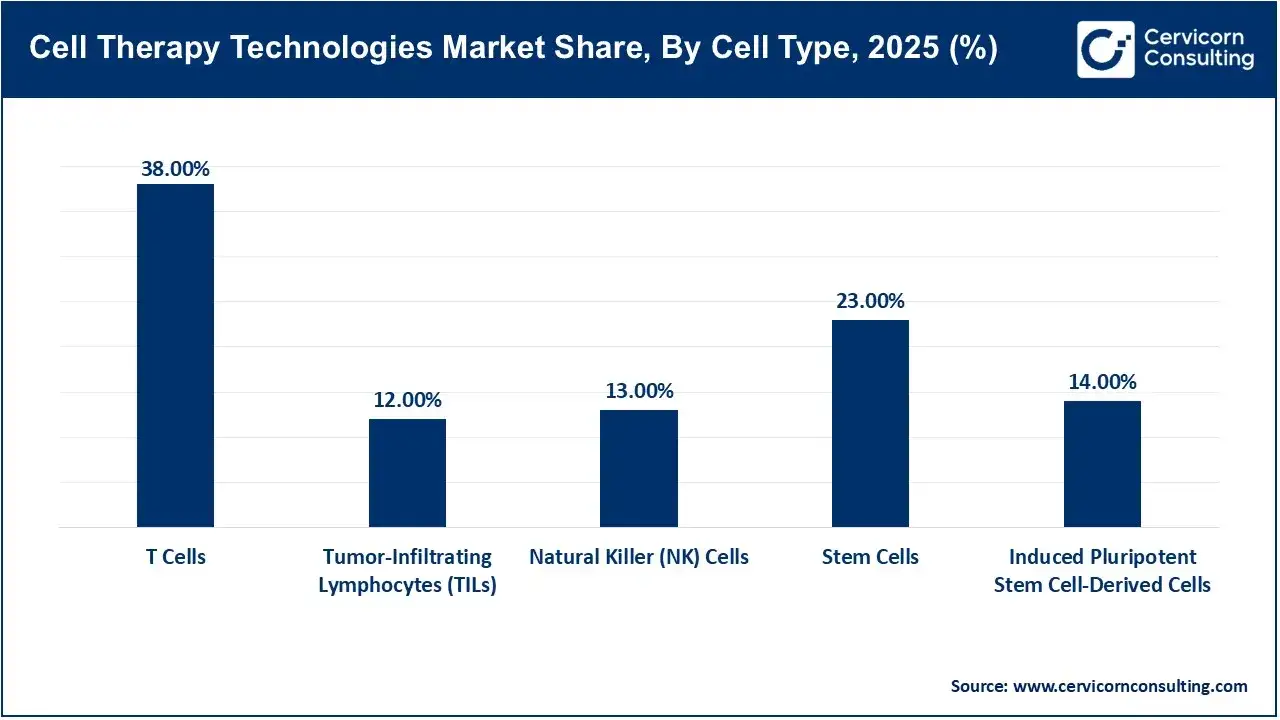
- By cell type: T cells dominated the market in 2025 with revenue share of 38%, propelled by advanced engineered T-cell therapy development and manufacturing requirements.
- By scale of operation: Clinical manufacturing registered led the market in 2025 with revenue share of 27%, led by the need to supply cell therapy candidates for clinical trials.
- By end user: Pharmaceutical and biotechnology companies dominated the market in 2025 (revenue share of 35%), due to broader investment in cell therapy pipelines and production development.
What are Ongoing Advances in the Cell Therapy Technologies Market?
The adoption of modern cell therapy technologies is widely leveraging living cells to treat, mitigate, or cure diseases via replacement, repair, or reprogramming of damaged tissues and immune functions. To address the continuous burden of growing demand for advanced therapies in rising chronic conditions, researchers are mainly focusing on solid tumors and autoimmune diseases. For such concerns, groundbreaking efforts foster CAR-Treg cells to defeat harmful immune responses. On the other hand, novelty, including CRISPR-Cas9 and next-generation site-specific gene control systems, enables editing of cell chromosomes with greater precision and adds protective armoring genes to counter immunosuppressive tumor microenvironments or program cells.
Recent Initiatives
- October 2026: The Advanced Research Projects Agency for Health, (ARPA-H) announced to offer up to $87 million across the four-year program, to establish novel methods for producing, storing, and transporting cell-based biologic medicines at room temperature.
- September 2026: Basecamp Research raised $140m to promote AI-assisted cell therapy toward the clinic.
- June 2026: Syntax Bio and Applied StemCell Corp. (ASC) joined to support unveiling the next generation of regenerative medicine by assessing ASC’s iPSC and hypoimmune cell lines employing Syntax Bio’s proprietary Cellgorithm™ platform.
- February 2026: Cellares announced a successful $257 million Series D financing round to improve the global manufacturing of cell therapies through advanced automation.
- February 2026: Johnson & Johnson expanded U.S. footprint with more than $1 billion investment in a next-generation cell therapy manufacturing facility in Pennsylvania.
Market Dynamics
Growth Drivers
- Progressive CGT Base: Nowadays, the cell therapy technologies market is experiencing a rise in commercial approvals for cell and gene therapies (CGTs) and a growing pipeline of early- and late-stage clinical trials. This fuels massive demand for scalable production platforms, specialized consumables, and analytical testing tools.
- Growth in R&D Investments: Globally accelerating significant funding, especially from public and private sectors, venture capital, and strategic alliances between biotech companies and academic research institutions that speeds up innovation across the market.
- Breakthroughs in Medicines: The worldwide rise in prevalence of cancer, autoimmune disorders, genetic conditions, and neurodegenerative or orthopaedic diseases promotes the adoption and development of regenerative and cell-based treatments.
Market Restraints
- Expensive Therapy: To explore innovative cell products, there is a need for well-established facilities, complex multi-step processes, & strict QC, ultimately elevating the cost of the therapies.
- Scalability Concerns: Many producers are facing limitations in sustaining batch-to-batch consistency, rigorous sterility, and precise control over cell expansion and differentiation.
- Emerging Regulatory Standards: The current era is characterised by complex global regulatory landscapes, like meeting Good Manufacturing Practices (GMP) and mandatory release testing, making product approval and commercialization time-consuming and resource-intensive.
Key Opportunities
- Standardized Production for Autologous Therapies: The cell therapy technologies market will see advances in reference, configurable, closed, and semi-automated modules for cell isolation, activation, and expansion that reduce manual labor, shorten tech transfer times, and enable pioneers to boost patient-specific treatments.
- Promoting In Vivo Cell Engineering: In the coming era, developing technologies will enable genetic instructions or mRNA to be delivered directly to immune cells inside the patient's body via viral vectors or nanoparticles.
- Empowering Production Automation: To bolster manufacturing scale-up, specifically focused on closed, automated processing systems and also fostering the development of Contract Development and Manufacturing Organizations (CDMOs) via support to producers by streamlining compliance and lowering the cost of goods sold (COGS).
Market Challenges
- Limited Infrastructure & Staff: Accelerating growth in cellular and gene therapies (CGTs) is facing restricted specialized clinical infrastructure and trained hospital or manufacturing personnel.
- Achieving Essential Properties: To overcome chronic toxicities or immune-mediated cell exhaustion, demanding modern engineering while maintaining a safe therapeutic index is highlighted as a key issue during expansion into lower-risk autoimmune and chronic disease populations.
- Strict Regulatory Landscape: Globally developing advanced regulatory guidelines demand stringent long-term follow-up data, whereas many agencies and innovators are facing burden in harmonising evidence quality and real-world safety tracking.
Cell Therapy Technologies Market Regional Analysis
Why did North America Dominate the Market in 2025?
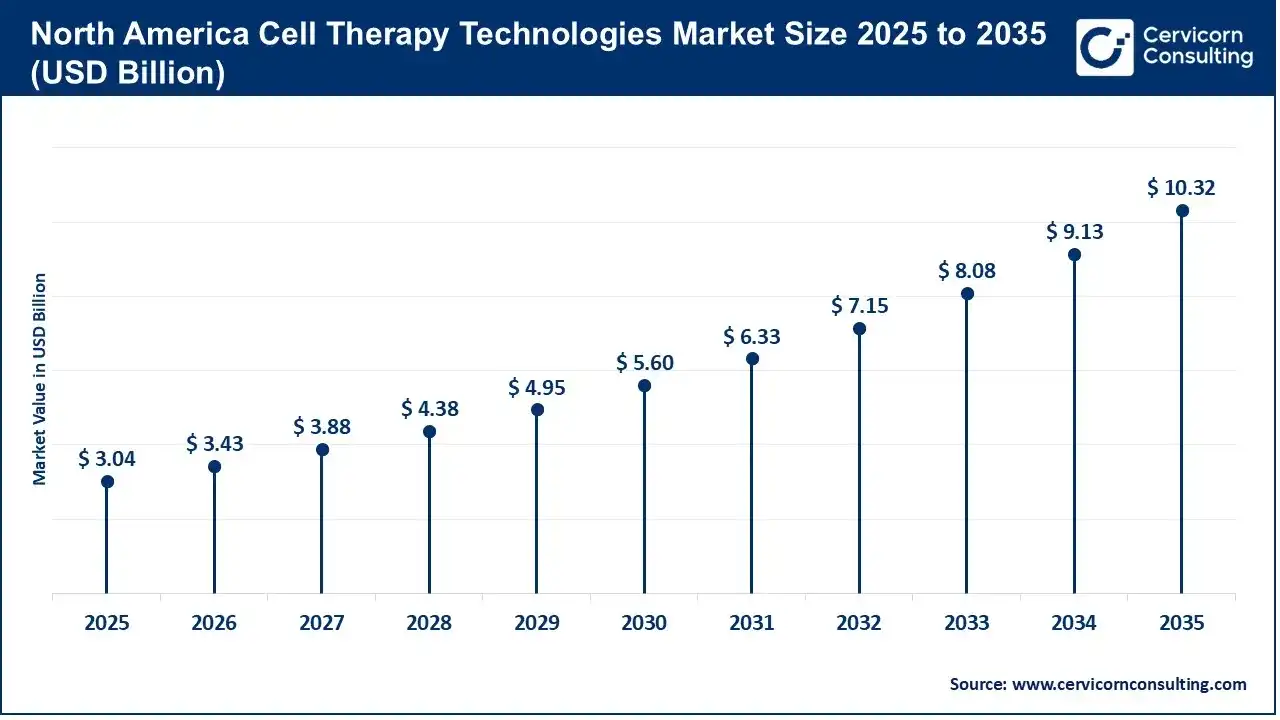
The North America cell therapy technologies market size was valued at USD 3.04 billion in 2025 and is expected to exceed around USD 10.32 billion by 2035. North America dominated with 42% share of the market in 2025, led by accelerating regulatory approvals and massive investment in novel therapies. Many regional federal and provincial funding agencies, like the Canadian Institutes of Health Research (CIHR), the Natural Sciences and Engineering Research Council (NSERC), and many more, are pushing translational research from discovery to early-phase trials. North America’s players are focusing on logistical challenges of patient-specific therapies and strengthening the adoption of closed, automated, and digitally connected production solutions.
United States Market
- The U.S. market captured a dominant position, as the US FDA approved 5 new cell and gene therapies in 2025. According to some major studies, U.S. researchers are moving towards non-genetically modified and stem cell therapies, with an emphasis on non-oncology applications, indicating the importance of new clinical trial activity. Meanwhile, regulatory approvals unveiled encapsulated engineered human cell implants, such as Neurotech's Encelto for macular telangiectasia type 2.
Why is Asia Pacific Considered To Be the Fastest-Growing Region in the Upcoming Years?
The Asia Pacific cell therapy technologies market size was valued at USD 1.66 billion in 2025 and is expected to exceed around USD 5.65 billion by 2035. Asia Pacific is expected to expand at a rapid rate during the forecast period because of massive growth in the geriatric population and chronic conditions that highly demand advanced therapies and new gene editing approaches. China is emerging as a well-known hub of CGT commercialisation, while South Korea is boosting robust biologic production and CDMO capabilities. Meanwhile, India has expanded an alliance between Bharat Biotech's Nucelion Therapeutics and VeGen Bio, focusing on the local production of the CAR-T therapy VL-2511 at affordable prices.
China Market
- China is expected to grow fastest in the coming years, as it is known as a center for production and research activities of diverse CGT products. Recently, the Ministry of Commerce (MOFCOM) and Ministry of Science and Technology (MOST) published new export restrictions and interim pre-registration guidelines for cell and gene therapy (CGT) technology platforms and innovative target discovery technologies.
Cell Therapy Technologies Market Segmentation Analysis
Offering Analysis
Media and Reagents: The media and reagents segment led the market in 2025, due to their rising need throughout cell therapy development and production, with dependency on certified GMP-Grade Reagents. Along with AI-driven media formulations, developers are seeking serum-containing media in favor of fully defined, GMP-compliant formulations to reduce pathogen contamination risks and enhance batch-to-batch consistency.
Instruments and Automation Technologies: The instruments and automation technologies segment is predicted to be the fastest-growing during 2026-2035, supported by demand for scalable, reproducible, and automated cell processing. Most of the time, breakthroughs shift towards AI-powered and machine-vision robotic systems to automate complete cell generation cycles, coupled with enabling predictive production optimization and real-time viability monitoring.
Workflow Analysis
Cell Expansion and Culture: The cell expansion and culture segment held a dominant share of 25% of the market in 2025, driven by its key role in producing sufficient quantities of cells for therapeutic application and the shift toward automated closed-loop systems. Recently, the market has demonstrated the integration of the LiCellGrow expansion system with particular biomanufacturing protocols to stabilize growth rates and quality in patient-derived primary T-cells.
Cell Activation and Engineering: The cell activation and engineering segment is projected to expand rapidly during the forecast period, strengthened by advances in engineered cell therapies and increasingly modern manufacturing processes. However, worldwide research activities are broadly employing prime editing and engineered signaling cascades to evolve switchable, controllable T-cell activities.
Cell Type Analysis
T Cells: The T cells segment accounted for the largest share of 38% of the cell therapy technologies market in 2025, propelled by well-nurtured engineered T-cell therapy development, production essentials and broader demand for CAR-T and regulatory T cell (Treg) therapies. To compress production times, the industry has implemented automated labs and optimized 3D fibrous growth scaffolds, with the use of gentle recovery enzymes that harvest lab-grown T cells.
Natural Killer (NK) Cells: The Natural Killer (NK) cells segment is anticipated to witness the fastest growth in the predicted timeframe, fueled by transforming allogeneic cell therapies and optional approaches to cancer treatment, coupled with innovative CAR-NK design. Recently, scientists have generated tissue-resident natural killer cells to penetrate dense solid tumors and keep activity inside the tumor microenvironment (TME).
Scale of Operation Analysis
Clinical Manufacturing: The clinical manufacturing segment captured a major share of 27% in 2025, driven by the need to supply cell therapy candidates for clinical trials and expansion of clinical pipelines and CAR-T progression. Many leading firms are increasingly using integrated, closed systems, especially engineered for delicate cellular products, like CAR-T, TCR-T, and iPSC-derived lines, to resolve contamination risks and batch diversity.
Cell Therapy Technologies Market Share, By Scale of Operation, 2025 (%)
| Scale of Operation |
Revenue Share, 2025 (%) |
| Research and Discovery |
22% |
| Process Development |
20% |
| Preclinical Development |
13% |
| Clinical Manufacturing |
27% |
| Commercial Manufacturing |
18% |
Commercial Manufacturing: The commercial manufacturing segment is forecasted to grow rapidly during 2026-2035, supported by a surge in approved cell therapies and investment in scalable production capacity. Specifically, eminent players, like Danaher (Cytiva), Miltenyi Biotec, Thermo Fisher Scientific, and others are rolling out commercial innovations with new platforms, including AI-enabled bioprocess software, automated closed systems, non-viral editing reagents, and decentralized Cocoon nodes.
End User Analysis
Pharmaceutical and Biotechnology Companies: The pharmaceutical and biotechnology companies segment led with 38% share of the market in 2025 because of increasing investment in cell therapy pipelines and notable growth in commercial products. Moreover, recently Hitachi, Ltd. explored its DesignCell platform that leverages generative AI and high-throughput screening to boost cell sequence design from tens to 100,000 cells annually.
Cell Therapy Technologies Market Share, By End User, 2025 (%)
| End User |
Revenue Share, 2025 (%) |
| Pharmaceutical and Biotechnology Companies |
22% |
| Contract Research Organizations (CROs) |
20% |
| CDMOs |
13% |
| Academic and Research Institutes |
27% |
| Hospitals and Specialized Cell Therapy Centers |
18% |
Contract Development and Manufacturing Organizations (CDMOs): The Contract Development and Manufacturing Organizations (CDMOs) segment is estimated to be the fastest-growing during 2026-2035, propelled by growing demand for specialized manufacturing capacity and outsourced process development. Nowadays, CDMOs are forcing the execution of digital-first business models, real-time process analytics, and AI-enabled process improvement to expedite tech transfer and compliance with rigorous regulatory standards.
Major Launches
- September 2026: Bracco Imaging strengthened its BubbleGen cell selection portfolio with the rollout of the BubbleGen CD3+ T Cell Selection Kit, allowing a highly scalable and affordable approach to manufacturing CAR-T cell therapies.
- September 2026: Glidepath Health emerged from stealth to unveil an AI-enabled technology platform that organises the complex logistics behind cell and gene therapy delivery.
- January 2026: Cellistic launched three new GMP manufacturing platforms to advance iPSC-derived cell therapies across immuno-oncology and regenerative medicine.
Key Players
Segments Covered
By Offering
- Instruments and Automation Technologies
- Single-Use Assemblies
- Media and Reagents
- Quality Control and Analytics Technologies
- Software and Digital Platforms
By Workflow
- Cell Collection
- Cell Isolation and Selection
- Cell Activation and Engineering
- Cell Expansion and Culture
- Cell Harvesting, Formulation, and Preservation
- Quality Control and Release Testing
By Cell Type
- T Cells, Including CAR-T and TCR-T Cells
- Tumor-Infiltrating Lymphocytes (TILs)
- Natural Killer (NK) Cells
- Stem Cells
- Induced Pluripotent Stem Cell-Derived Cells
By Scale of Operation
- Research and Discovery
- Process Development
- Preclinical Development
- Clinical Manufacturing
- Commercial Manufacturing
By End User
- Pharmaceutical and Biotechnology Companies
- Contract Research Organizations (CROs)
- Contract Development and Manufacturing Organizations (CDMOs)
- Academic and Research Institutes
- Hospitals and Specialized Cell Therapy Centers
By Region
- North America
- Asia-Pacific
- Europe
- LAMEA
