Precision Farming Market Size, Growth, Forecast 2026 to 2035
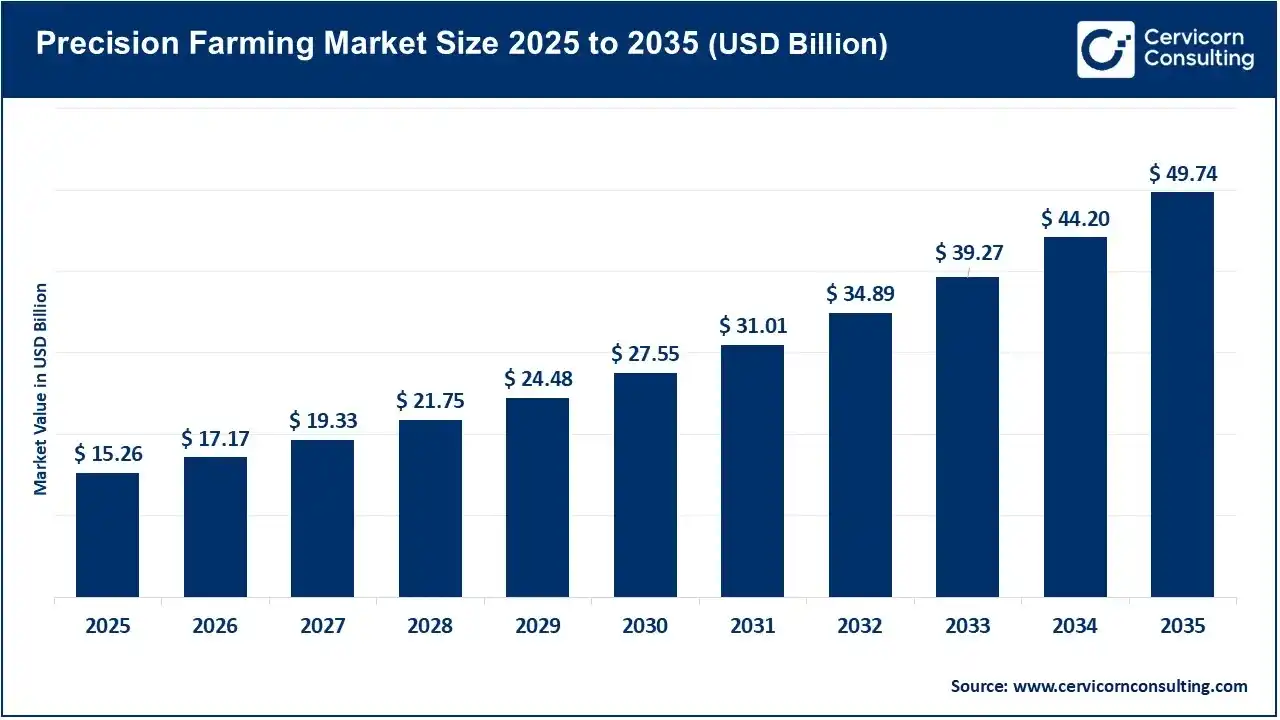
The global precision farming market size was valued at USD 15.26 billion in 2025 and is projected to grow from USD 17.17 billion in 2026 to nearly USD 49.74 billion by 2035, registering a CAGR of 12.5% over the 2026 to 2035 period. The precision farming market is growing due to the expanding adoption of smart agricultural technologies, increasing demand for improved crop output, and the growing requirement for efficient use of water, fertilizers, and other farming resources. Farmers are able to monitor crops, manage field operations, and make data-driven decisions thanks to the combination of GPS, sensors, drones, IoT devices, and data analytics. Precision farming solutions are becoming more popular as people become more conscious of sustainable agricultural methods and the need to lower operating expenses.
Report Highlights
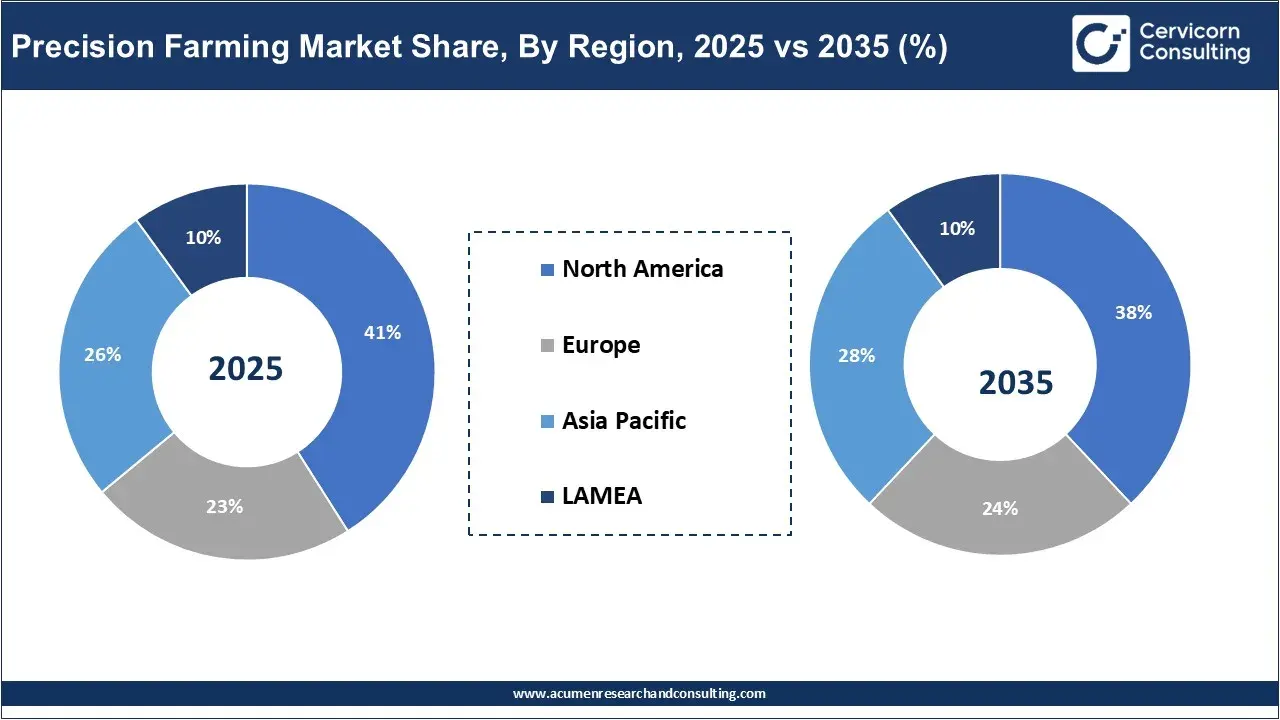
- By region: North America accounted for a revenue share of 41% in 2025, supported by advanced farming technologies, large-scale agricultural operations, and strong smart farming adoption.
- By technology: Guidance Technology dominated the market with revenue share of 25% in 2025, supported by increasing use of GPS and GNSS for accurate field navigation and machinery operations.
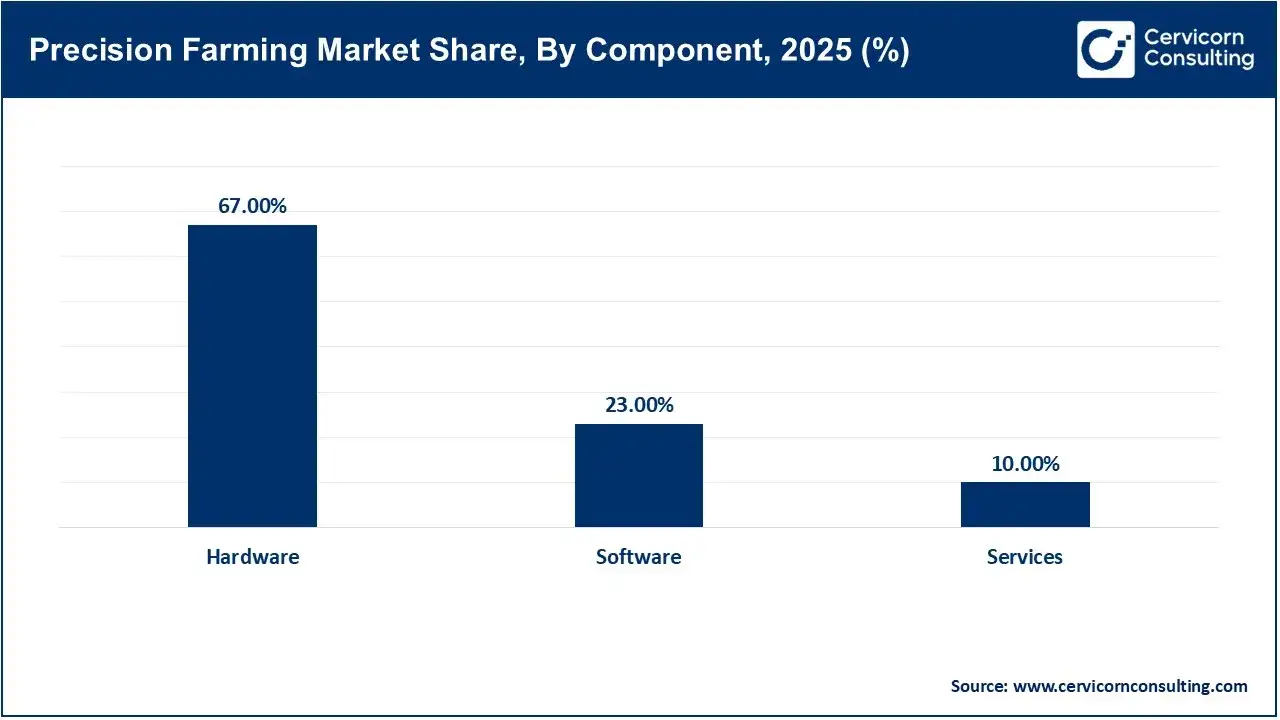
- By component: Hardware has generated 67% revenue share in 2025, supported by growing deployment of sensors, GPS devices, drones, and precision farming equipment.
- By application: Yield Monitoring dominated the market, supported by the growing need to track crop performance and improve farm productivity.
- By farm size: Large Farms has captured largest revenue share of 47% in 2025, supported by higher investment capacity for advanced agricultural technologies and automated equipment.
Recent Trends
- Adoption of Smart Farming Technologies: The increased deployment of GPS, sensors, drones, IoT devices, and automated farming equipment is aiding the expansion of precision farming. Farmers can monitor field conditions and increase farming productivity with the use of these technologies. Farmers can more immediately detect changes in soil and crop conditions thanks to real-time data from linked equipment. Adoption by farms of all sizes is also being encouraged by the growing availability of reasonably priced smart farming technologies.
- Integration of AI and Data Analytics: Crop, soil, and weather data are increasingly being analyzed using AI and data analytics. This makes it possible for farmers to enhance crop management, optimize farming operations, and make well-informed decisions. Advanced analytics can assist in finding possible crop health issues and supporting timely intervention. Forecasting, field planning, and general farm management are all being enhanced by the incorporation of AI-based solutions.
- Growing Focus on Resource Efficiency: Rising demand for efficient use of water, fertilizers, pesticides, and other agricultural inputs is encouraging the adoption of precision farming solutions. Targeted application of resources can help reduce waste and improve farm productivity. Precision technologies allow farmers to apply inputs according to specific field conditions and crop requirements. This approach is supporting sustainable agricultural practices while helping farmers manage operating costs more effectively.
Technology Landscape
- Artificial Intelligence and Data Analytics: By processing massive amounts of field, meteorological, and agricultural data, AI and data analytics are revolutionizing precision farming. Crop monitoring, yield estimation, disease detection, and predictive farm management can all be supported by AI-based systems. These tools are assisting farmers in making better decisions and streamlining their farming processes.
- Drones and Remote Sensing: Agricultural drones outfitted with cameras and sensors are being utilized for aerial imaging, crop monitoring, field mapping, and targeted spraying. Technologies for remote sensing offer comprehensive data regarding field variability and crop health. Their increasing use is assisting farmers in more effectively managing vast agricultural fields and spotting possible issues early.
- Automation and Robotics: Automation and robotics are gaining relevance in precision farming for activities such as planting, weeding, harvesting, and crop monitoring. Robotic technologies and autonomous tractors can decrease reliance on physical labor while increasing operational consistency. The application of agricultural robots is anticipated to grow as machine vision, navigation, and control systems continue to progress.
- Cloud Computing and Farm Management Platforms: Cloud-based platforms enable farmers to store, process, and access agricultural data from multiple connected devices and equipment. These platforms can integrate information related to crops, soil, machinery, weather, and farm operations. The increasing use of cloud-based farm management solutions is supporting centralized monitoring and data-driven agricultural planning.
Market Dynamics
Drivers
- Rising Demand for Higher Agricultural Productivity: The adoption of precision farming solutions is being driven by the growing demand to boost crop yields from available farmland. Precision technologies help farmers understand field variability and optimize farming activities according to crop requirements. Data-driven field management can improve productivity while supporting better utilization of available agricultural resources.
- Growing Need for Resource Optimization: Farmers are adopting technologies that allow for accurate application of agricultural inputs due to growing worries about energy, water, fertilizer, and pesticide usage. Precision farming allows resources to be allocated according to specific crop and soil requirements. This can assist in enhancing overall agricultural input efficiency.
- Growing Use of AI and Data Analytics: AI and data analytics are helping farmers process historical and real-time agricultural data to support more accurate crop planning and field management. These technologies can assist with predictive maintenance, yield estimation, and early detection of crop-related issues. Growing development of AI-based agricultural solutions is expected to create further opportunities for precision farming.
Restraints
- High Initial Investment: Small and medium-sized farms may find it difficult to embrace precision agricultural equipment, sensors, drones, GPS systems, and software due to their high cost. Before they can reap the rewards of new technology, farmers may have to pay hefty upfront costs. Investments in cutting-edge agricultural solutions may be further constrained by a lack of capital.
- Limited Connectivity in Rural Areas: Reliable internet and communication infrastructure is crucial for connected precision farming systems. In rural agricultural areas, poor connectivity might restrict access to cloud-based platforms and real-time data transfer. Therefore, in underprivileged areas, the adoption of connected farming technology may be slowed by infrastructure deficiencies.
- Limited Technical Expertise: Users of precision farming technologies must comprehend connected agricultural equipment, digital tools, and data interpretation. Some farmers may find it challenging to efficiently operate and manage these systems due to a lack of technical expertise. The total cost of adopting new technology may rise due to the requirement for technical assistance and training.
Opportunities
- Integration of AI and Machine Learning: By enabling sophisticated crop monitoring, predictive analytics, and automated decision-making, the integration of AI and machine learning offers substantial prospects for precision farming. Large amounts of field and environmental data can be processed by these technologies to find trends and possible hazards. The spectrum of precision farming applications is anticipated to increase with the development of AI-based agricultural systems.
- Growth of Autonomous Farming Equipment: New market prospects are being created by the development of robotic systems, automated agricultural gear, and autonomous tractors. Planting, spraying, harvesting, and other field operations can be supported by these systems with little assistance from humans. Automation in agricultural activities can be further increased by ongoing advancements in robotics, machine vision, and navigation.
- Expansion of Precision Farming in Emerging Markets: Opportunities for market expansion are being created by growing agricultural modernization and rising awareness of smart farming technology in emerging markets. The adoption of digital infrastructure and the availability of inexpensive digital infrastructure can support market expansion. The addressable market can be expanded even more with localized solutions made for small and medium-sized farms.
Challenges
- Data Privacy and Security Concerns: Precision farming systems collect large volumes of information related to farms, crops, soil, machinery, and field operations. Concerns regarding data ownership, privacy, and unauthorized access can affect farmer confidence in connected platforms. Companies therefore need to strengthen data protection and cybersecurity measures.
- Integration of Multiple Technologies: Precision farming often involves the integration of equipment, sensors, software platforms, drones, and data management systems from different providers. Compatibility issues can make it difficult to establish a seamless technology ecosystem. Farmers may also face additional costs when upgrading existing equipment to support newer solutions.
- Dependence on Weather and Environmental Conditions: The performance of precision farming technologies can be affected by weather, terrain, soil conditions, and other environmental factors. Heavy rainfall, extreme temperatures, or poor field conditions can limit the effectiveness of certain sensors, drones, and automated equipment. These factors can create operational difficulties and affect the reliability of technology-driven farming activities.
Regional Analysis
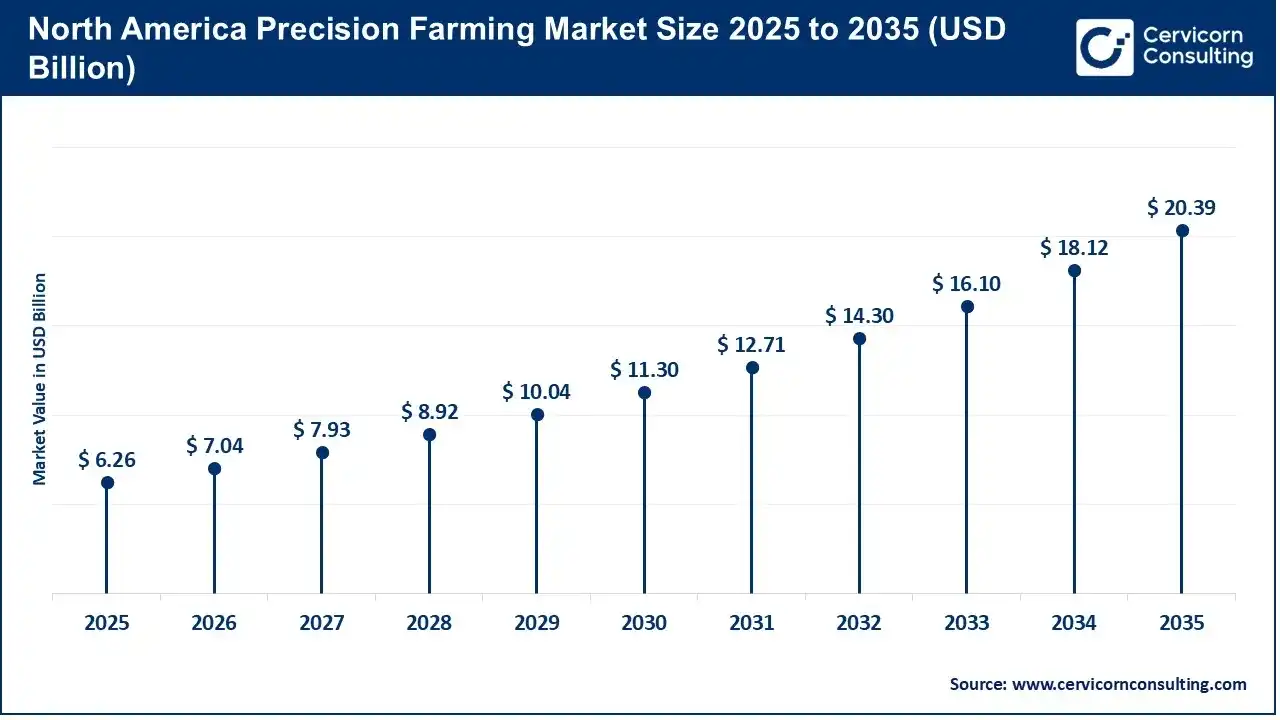
North America: The North America precision farming market size was valued at USD 6.26 billion in 2025 and is projected to reach USD 20.39 billion by 2035. North America dominated the market in 2025, propelled by the extensive use of GPS systems, sensors, drones, sophisticated agricultural equipment, and farm management technologies. Precision agriculture solutions are being supported by robust technical infrastructure and large-scale commercial farming. Regional expansion is also being aided by the growing use of automation and data-driven farming. The region's standing is anticipated to be maintained via ongoing investment in agricultural technologies.
Asia-Pacific: The Asia-Pacific precision farming market size was estimated at USD 3.97 billion in 2025 and is expected to surpass USD 12.93 billion by 2035. Asia-Pacific is growing rapidly in the market, driven by sophisticated agricultural technologies. Digital transformation in farming operations is being supported more by governments, agricultural companies, and technology suppliers. Adoption is being further boosted by the growing usage of drones, sensors, AI, and mobile-based agriculture platforms. It is anticipated that sustained investment in agricultural technology would spur regional expansion.
Europe: The Europe precision farming market size was accounted for USD 3.51 billion in 2025 and is anticipated to hit USD 11.44 billion by 2035. Europe represents an emerging region in the market, driven by increasing focus on sustainable agriculture, resource efficiency, and digital farming technologies. Farmers are adopting precision solutions to optimize the use of water, fertilizers, pesticides, and other inputs. Growing development of smart agricultural machinery and connected farming platforms is supporting adoption. Continued emphasis on sustainable agricultural practices is expected to support regional growth.
Segmental Analysis
Technology Analysis
Guidance Technology: Guidance technology dominated the precision farming market in 2025, motivated by the growing use of GPS and GNSS-based systems for precise field navigation and the operation of agricultural equipment. Farmers may increase the accuracy of their planting, spraying, and harvesting operations with the use of these technologies. Growing demand for automated agricultural equipment and the use of connected equipment are further supporting the segment. It is anticipated that the segment's position would be maintained by ongoing deployment of precision guidance systems.
Variable-Rate Technology: Variable-Rate Technology is growing rapidly in the precision farming market, motivated by the growing demand for accurate application of herbicides, fertilizers, seeds, and other agricultural inputs. Farmers can modify input application based on crop requirements and field conditions thanks to these technologies. Adoption is also being aided by the growing emphasis on sustainable farming and resource efficiency. Segment growth is anticipated to be accelerated by further integration with GPS, sensors, and farm management platforms.
Precision Farming Market Share, By Technology, 2025 (%)
| Technology |
Revenue Share, 2025 (%) |
| Guidance Technology |
25% |
| Remote Sensing Technology |
20% |
| Variable-Rate Technology |
19% |
| Yield Monitoring Technology |
14% |
| Soil Monitoring & Mapping |
12% |
| Weather Tracking & Forecasting |
10% |
Remote Sensing Technology: Remote Sensing Technology represents an emerging segment in the precision farming market, driven by the growing need for field, soil, and crop conditions to be monitored in real time. Farmers can obtain comprehensive information for improved field management through satellite images, aerial imaging, and sensor-based systems. The use of remote sensing solutions is being further supported by the increasing acceptance of digital agriculture. It is anticipated that segment expansion will be supported by ongoing advancements in imaging and sensing technology.
Component Analysis
Hardware: Hardware dominated the precision farming market in 2025, driven by increased deployment of sensors, GPS devices, drones, guidance systems, and precision agricultural machines. These tangible technologies serve as the basis for gathering field data and carrying out precision farming operations. Growing mechanization and use of linked farm equipment are further supporting demand. The segment's position is anticipated to be sustained by ongoing investments in contemporary agricultural infrastructure.
Software: Software is growing rapidly in the precision farming market, driven by increasing demand for platforms that analyze agricultural data and support farm management decisions. Software solutions integrate information from sensors, machinery, weather systems, and field monitoring technologies. Growing adoption of AI and cloud-based agriculture platforms is further increasing demand. Continued development of data-driven farming solutions is expected to accelerate segment growth.
Services: Services represent an emerging segment in the precision farming market, motivated by the growing demand for data management, installation, technical support, consultancy, and maintenance. Farmers and agricultural businesses require specialist help to efficiently deploy and manage precision farming technologies. Professional services are becoming more and more in demand as technology becomes more complicated. It is anticipated that increased use of precision farming will sustain segment growth.
Application Analysis
Yield Monitoring: Yield monitoring dominated the precision farming market in 2025, driven by the growing need to evaluate agricultural performance and improve harvesting decisions. Using field-level data from yield monitoring devices, farmers can identify differences in productivity. Adoption is being aided by the growing use of data-driven agriculture.
Variable-Rate Application: Variable-Rate Application is growing rapidly in the precision farming market, motivated by the growing requirement to administer herbicides, fertilizers, seeds, and other inputs in accordance with particular field conditions. Farmers can increase operating efficiency and maximize input use with this strategy. Adoption is being further stimulated by the increased emphasis on minimizing resource waste.
Crop Scouting: Crop Scouting represents an emerging segment in the precision farming market, driven by the growing need for prompt detection of diseases, pests, crop health problems, and field variability. Digital scouting tools, drones, and image technologies enable farmers to monitor broad agricultural fields more efficiently. The application is being further supported by the increasing use of remote monitoring. It is anticipated that further opportunities would arise from ongoing integration with AI and analytics.
Farm Size Analysis
Large Farms: Large Farms dominated the precision farming market in 2025, motivated by their increased ability to purchase cutting-edge agricultural machinery and technologies. GPS, automated equipment, drones, sensors, and farm management platforms can all help large-scale operations in vast agricultural regions. Adoption is being aided by the need to manage huge fields and increase operating efficiency. The segment's position is anticipated to be maintained by ongoing investment in agricultural automation.
Precision Farming Market Share, By Farm Size, 2025 (%)
| Farm Size |
Revenue Share, 2025 (%) |
| Small Farms |
22% |
| Medium-Sized Farms |
31% |
| Large Farms |
47% |
Small Farms: Small Farms are growing rapidly in the precision farming market, motivated by the growing accessibility of accessible, scalable, and user-friendly agriculture technologies. Precision farming is becoming more accessible to smaller farming enterprises thanks to mobile applications, inexpensive sensors, drones, and cloud-based platforms. Growing knowledge of resource efficiency is further promoting adoption. It is anticipated that segment expansion will be accelerated by ongoing development of affordable solutions.
Medium-Sized Farms: Medium-Sized Farms represent an emerging segment in the precision farming market, motivated by growing initiatives to boost output and maximize the utilization of agricultural resources. These farms are progressively implementing data-based management solutions, connected equipment, and digital tools. Growing availability of adaptable precision farming technologies is supporting adoption. It is anticipated that more opportunities will arise as farming processes continue to be modernized.
Recent Developments
- In July 2026, Sabanto announced an oversubscribed Series B financing round led by Leaps by Bayer to scale its autonomous agricultural technology. The funding is aimed at expanding commercialization, increasing adoption of autonomous farming solutions, and further developing retrofit autonomy kits for row-crop farming.
- In June 2026, Sabanto and Verdant Robotics announced the technical integration of Sabanto’s autonomous tractor system with Verdant Robotics’ SharpShooter precision application technology. The integrated solution enables autonomous field navigation and plant-level application, supporting targeted input use and reducing the need for operator intervention.
Government Initiatives
- In April 2025, Government of India: Digital Farmer Identities. Under the Digital Agriculture Mission, the government targeted the creation of Farmer IDs and nationwide digital crop surveys. The initiative is designed to connect farmer, land, and crop information and improve access to agricultural services and technology-enabled advisories.
- In July 2025, Ministry of Agriculture & Farmers’ Welfare: AI and IoT-Based Agriculture. The government highlighted the use of AI and IoT-enabled technologies to improve crop productivity and sustainability. Initiatives such as the National Pest Surveillance System use AI and machine learning to identify pest infestations and support timely intervention.
Top Companies
Segments Covered
By Technology
- Guidance Technology
- Remote Sensing Technology
- Variable-Rate Technology
- Yield Monitoring Technology
- Soil Monitoring & Mapping
- Weather Tracking & Forecasting
By Component
- Hardware
- Software
- Services
By Application
- Yield Monitoring
- Crop Scouting
- Field Mapping
- Variable-Rate Application
- Precision Irrigation
- Soil Monitoring
- Weather Tracking & Forecasting
- Inventory Management
- Farm Labor Management
- Financial Management
By Farm Size
- Small Farms
- Medium-Sized Farms
- Large Farms
By Region
- North America
- Europe
- Asia-Pacific
- Latin America
- Middle East & Africa
