Pollution Free Construction Market Size and Growth 2026 to 2035
The global pollution free construction market size was valued at USD 378 billion in 2025 and is expected to be worth around USD 1,314 billion by 2035, exhibiting at a compound annual growth rate (CAGR) of 13.2% over the forecast period form 2026 to 2035.
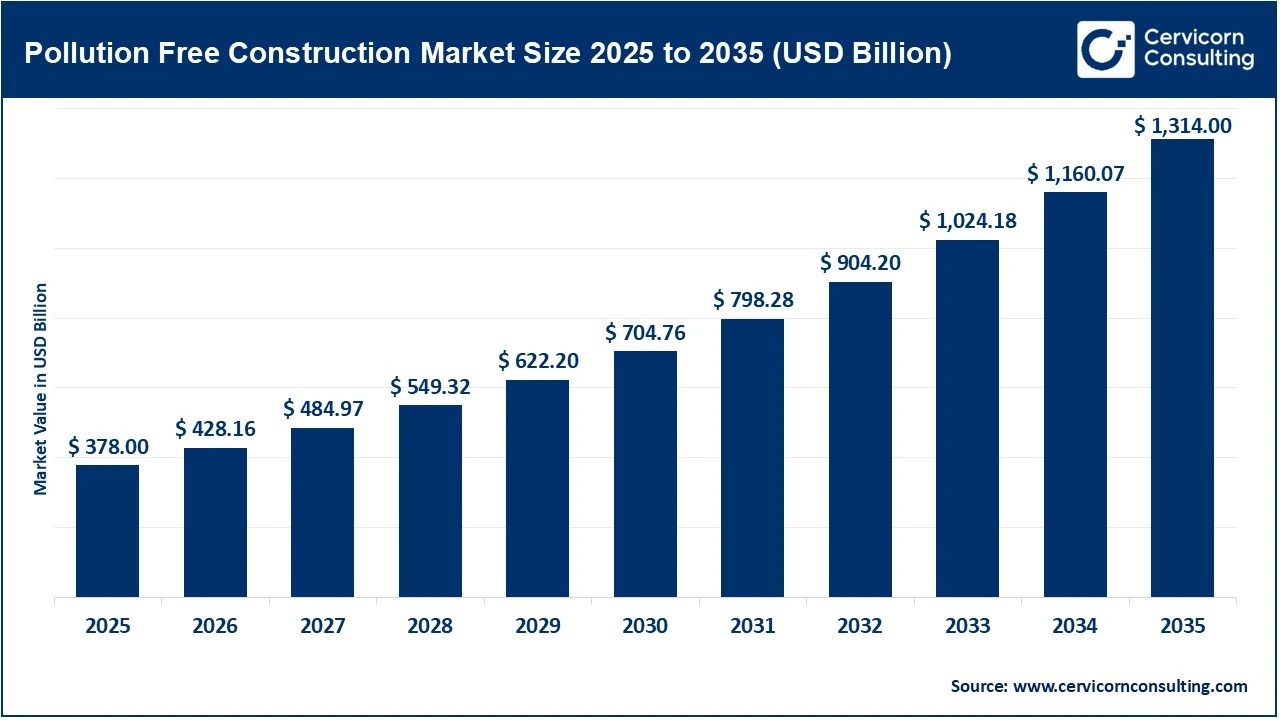
The expansion of the pollution-free (green) construction market is significantly influenced by the increasing need to minimize the environmental impact of buildings, which are responsible for a considerable portion of global emissions and energy consumption. Governments and regulatory bodies are implementing stricter sustainability policies, carbon reduction targets, and green building certifications, which is accelerating the adoption of sustainable construction practices. Recent data indicates that there are more than 195,000 LEED-certified buildings across 186 countries, reflecting strong institutional support for green construction. Furthermore, since buildings and construction account for nearly 39% of global energy-related emissions, both public and private sectors are being driven to adopt low-pollution construction methods. Rapid urbanization, particularly in developing countries such as India, is also contributing to the rising demand for sustainable infrastructure as cities grow and work to achieve climate objectives.
Report Highlights
- By Region, North America leads the pollution-free construction market with about 36.2% share, driven by strong environmental regulations and early adoption of green building technologies.
- By Construction Type, the commercial construction dominates the segment with nearly 34.9% share, due to high demand for sustainable offices, hospitals, and retail infrastructure.
- By Material Type, the low-carbon cement & concrete holds around 38.5% share, supported by increasing focus on reducing emissions from traditional construction materials.
- By Technology, the green building design accounts for about 41.6% share, as it serves as the foundation for energy-efficient and sustainable construction practices.
- By Energy & Resource Systems, the energy-efficient systems represent nearly 47.8% share, driven by the need to reduce building energy consumption and operational costs.
- By Certification, the LEED certification leads with around 44.3% share, reflecting its widespread global adoption and strong presence in commercial construction projects.
Economic Benefits and Rising Adoption Driving Pollution-Free Construction
The economic and operational advantages of pollution-free construction are playing a significant role in accelerating the adoption of green buildings. These buildings are capable of delivering annual energy savings ranging from 8% to 57%, while also reducing long-term operating costs. In addition, green buildings can lower water consumption by 20% to 30% and decrease CO₂ emissions by up to 35%, particularly in markets such as India. Productivity improvements are also evident, as occupants in green buildings have been found to be 16% more productive. The adoption rate is increasing rapidly, with India registering over 19,000 green building projects that cover 15.7 billion square feet. In some regions, green buildings now account for 10% to 12% of new construction projects. Furthermore, the cost difference between green and conventional construction has narrowed considerably, with the additional cost now as low as 2% to 3% and a quick payback period. These factors are making sustainable construction a more practical and appealing option for both developers and investors.
What is Pollution-Free Construction?
Pollution-free construction, which is also referred to as green or sustainable construction, involves the design, construction, and operation of buildings with the objective of minimizing environmental impact and reducing pollution across the entire lifecycle of the structure. This method emphasizes the adoption of energy-efficient designs, the use of environmentally friendly materials, the implementation of water conservation systems, and the integration of low-emission technologies. By focusing on these aspects, pollution-free construction seeks to optimize the use of resources such as energy, water, and materials, while at the same time improving indoor air quality and reducing the generation of waste.
Furthermore, this approach incorporates renewable energy sources, recycled materials, and advanced construction practices to ensure that buildings maintain a lower carbon footprint and exert minimal negative effects on surrounding ecosystems. The primary objective extends beyond reducing pollution during the construction phase, as it also encompasses the operational and maintenance stages. As a result, buildings constructed under these principles are expected to achieve greater sustainability throughout their entire lifespan.
Accelerating Adoption of Pollution-Free Construction Outpaces Industry Growth
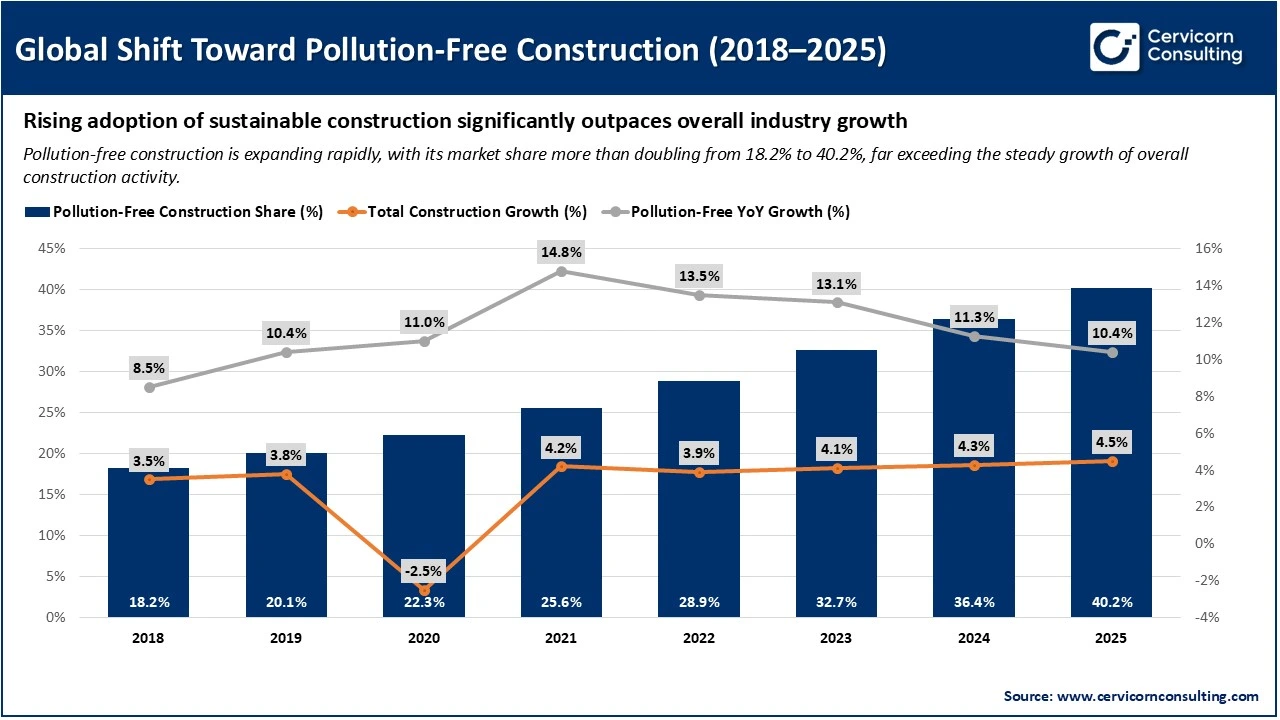
The data indicates a significant increase in the share of pollution-free construction, rising from 18.2% in 2018 to 40.2% projected for 2025. This trend demonstrates that the industry is rapidly adopting sustainable building practices. Although the overall construction sector is experiencing stable growth rates of approximately 3.5% to 4.5%, the pollution-free segment is expanding much more quickly, with year-on-year growth reaching as high as 14.8%. This accelerated growth can be attributed to several factors, including stricter regulations, the pursuit of cost efficiency, and growing environmental awareness. As a result, the construction industry is expected to continue shifting toward methods that minimize environmental impact, presenting new opportunities for companies that focus on sustainable solutions.
Recent Trends
Rapid adoption by construction companies
- Around 47% of construction firms reported that over 60% of their projects are green (up from 27% in 2018)
High environmental impact driving transition
- Buildings contribute about 39% of global CO₂ emissions and 36% of energy use, pushing demand for low-pollution construction
Growth in green building certifications
- Over 195,000 LEED-certified buildings worldwide across 186 countries
- More than 600,000 buildings certified under BREEAM globally
Shift toward low-carbon and energy-efficient buildings
- Green construction could reduce emissions in the construction value chain by up to 23% by 2035
Adoption of advanced energy-efficient standards
- Over 47,000 Passive House units globally with ultra-low energy usage
Cost and efficiency benefits increasing adoption
- Green buildings can reduce operating costs by 10–20% and improve long-term asset value
Technological shift toward zero-emission construction site
- Cities like Oslo achieved 98% fossil-fuel-free municipal construction sites using electric equipment
Recent Major Milestones
1. Oslo’s Near Zero-Emission Construction Sites (2023–2025)
The adoption of low-emission construction practices in Oslo has positioned the city as a global leader in sustainable urban development. By 2023, 98% of municipal construction sites in Oslo operated without fossil fuels, and by 2024, two-thirds of machine hours were powered by electric equipment. This achievement is important because construction equipment contributes significantly to urban air pollution. Oslo’s progress shows that large-scale electrification of construction sites is possible. As more cities implement similar policies, equipment manufacturers are being encouraged to develop and expand electric construction machinery. This trend is expected to accelerate the shift toward pollution-free construction worldwide.
2. India’s National Clean Air Programme (NCAP) Impact on Construction Regulation
The National Clean Air Programme initiated by the Indian government aims to achieve a 40% reduction in particulate matter pollution by 2025–26. Recent data indicates that a 20% reduction has already been accomplished in 55 cities, while 23 cities have reached a 40% reduction. As construction dust remains a significant source of urban air pollution, authorities are implementing stricter monitoring, dust-control requirements, and compliance systems at construction sites. These measures are compelling developers to integrate pollution-control technologies, including dust suppression systems, green coverings, and low-emission construction practices. As a result, the demand for sustainable construction solutions is expected to increase in the coming years.
3. Release of LEED v5 Green Building Certification (2025)
The introduction of LEED v5 in 2025 represents a significant step forward for global green building standards. With decarbonization now accounting for 50% of the scoring, there is a clear shift toward improved environmental performance. At present, more than 195,000 buildings in 186 countries have achieved LEED certification, which shows the widespread adoption of these standards. The updated framework is important because it encourages developers to meet stricter sustainability requirements, which affects their choices in materials, energy efficiency, and emissions control. As these certifications become more demanding, they are expected to drive the market by setting higher standards and increasing the need for advanced, pollution-free construction technologies and materials.
4. Expansion of Zero-Energy Building (ZEB) Mandates (2023–2025)
The implementation of zero-energy building (ZEB) standards in countries like South Korea is having a significant impact on the construction industry. By requiring all public buildings to meet these standards by 2024, and planning to extend them to private buildings from 2025 onwards, these policies are making energy-efficient construction a necessity. ZEBs are designed to achieve between 20% and 80% energy independence, which leads to a considerable reduction in operational emissions. As a result, the market is witnessing a shift where sustainable and pollution-free construction is becoming mandatory. These developments are encouraging the use of renewable energy systems, advanced insulation, and smart building technologies. It is expected that such measures will drive further innovation and investment in the sustainable construction sector.
Report Scope
| Area of Focus |
Details |
| Market Size in 2026 |
USD 428.16 Billion |
| Market Size in 2035 |
USD 1,314 Billion |
| CAGR 2026 to 2035 |
13.20% |
| Dominant Region |
North America |
| Fastest Growing Region |
Asia-Pacific |
| Key Segments |
Construction Type, Material Type, Technology, Energy & Resource Systems, Certification, Region |
| Key Companies |
Tata Projects, Mace, Skanska, Turner Construction, ACCIONA, Besix, Lendlease, VINCI, Bouygues, Bechtel, AECOM, Larsen & Toubro |
Pollution Free Construction Market Regional Analysis
The pollution free construction market is segmented by region, including North America, Europe, Asia-Pacific, and LAMEA. Here is a brief overview of each region:
Why does North America dominates in the pollution free construction market?
The North America pollution free construction market size was valued at USD 136.84 billion in 2025 and is predicted to attain around USD 475.67 billion by 2035.
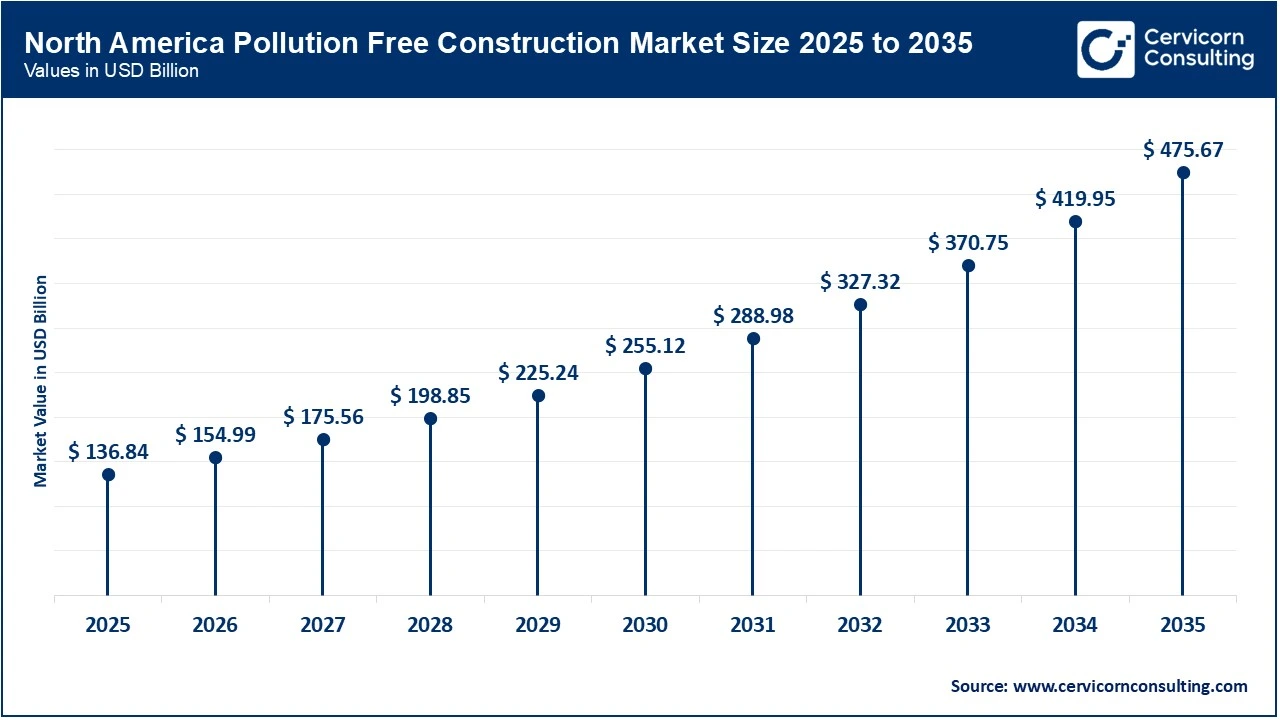
The North America is among the most advanced worldwide. This is mainly due to strict regulatory frameworks, high levels of environmental awareness, and the early use of green building technologies. North America holds a large share of global green building activity, supported by strong building codes, corporate ESG goals, and significant investment in sustainable infrastructure. The United States is leading the region’s growth, with widespread adoption of green certifications, energy-efficient systems, and smart building technologies. Buildings in North America account for almost 40% of total energy consumption, which is pushing the shift toward more sustainable construction practices.
Collaboration between government agencies, developers, and technology providers in North America is supporting innovation in energy-efficient design, low-carbon materials, and smart building systems. The growing focus on net-zero buildings and the electrification of construction equipment is also expected to drive further growth in the market.
United States to Lead Regional Green Construction Adoption
The United States represents the largest contributor to the North American pollution-free construction market, supported by high adoption of sustainable building practices and certifications.
- The U.S. accounts for the largest share of LEED-certified buildings globally, contributing significantly to over 195,000 certified projects worldwide.
- Buildings generate nearly 40% of national CO₂ emissions, driving adoption of low-emission construction.
- Strong corporate demand for ESG-compliant buildings is accelerating green construction investments.
- Presence of leading construction and engineering firms enhances innovation and adoption.
Canada to Strengthen Sustainable Building Infrastructure
Canada is witnessing steady growth in pollution-free construction due to strong government policies and sustainability targets.
- Over 5,000 LEED-certified projects across the country
- Increasing adoption of net-zero homes and green commercial buildings.
- Government initiatives promoting carbon-neutral construction by 2050.
Why is Asia-Pacific witnessing the fastest growth in the pollution free construction market?
The Asia-Pacific pollution free construction market size was accounted for USD 119.83 billion in 2025 and is forecasted to surpass around USD 416.54 billion by 2035. The Asia-Pacific region is witnessing the fastest growth globally and accounts for a significant share of new construction activities. The region represents around 30% to 35% of global green building development, mainly driven by rapid urbanization, expansion of infrastructure, and government initiatives focused on sustainability. Major countries including China, India, Japan, and Australia are increasing their investments in green construction to minimize environmental impact. The rising demand for smart cities, energy-efficient housing, and low-carbon infrastructure is further supporting the growth of the market in this region.
The governments in Asia-Pacific are implementing strict environmental regulations and offering incentives, which is encouraging the adoption of green materials, renewable energy systems, and sustainable design practices. The presence of a large-scale construction pipeline in the region is expected to be a major factor driving the future expansion of the pollution-free construction market.
China to Act as a Major Green Construction Hub
China represents the largest construction market globally and is rapidly expanding its pollution-free construction initiatives.
- Accounts for over 50% of global construction activity.
- Strong government push toward green buildings and eco-city development.
- Increasing adoption of low-carbon materials and energy-efficient systems.
India to Emerge as a High-Growth Market
India’s pollution-free construction market is expanding rapidly due to urbanization and policy support.
- Over 19,000 registered green building projects covering 15.7 billion sq. ft.
- Target of 40% emission reduction under national climate goals.
- Rising demand for green residential and smart city projects.
What are the driving factors of Europe pollution free construction market?
The Europe pollution free construction market size was estimated at USD 85.43 billion in 2025 and is projected to hit around USD 296.96 billion by 2035. Europe holds a leading position, representing about 20% to 25% of the global market. This growth is largely supported by strict environmental regulations and ambitious climate goals. Initiatives like the European Green Deal and energy performance directives have encouraged the adoption of sustainable construction methods across the region. There is a strong emphasis on developing zero-carbon buildings, renovating existing infrastructure, and implementing circular construction practices.
United Kingdom to Lead Green Building Adoption
The United Kingdom is one of the largest markets for sustainable construction in Europe.
- Over 600,000 buildings certified under BREEAM globally, with strong UK contribution.
- Government mandates promoting net-zero buildings by 2050.
- High adoption in commercial and public infrastructure projects.
Germany to Strengthen Energy-Efficient Construction
Germany’s market is driven by strong industrial and environmental policies.
- Nearly 40% of buildings meet energy-efficient standards.
- Leading adoption of passive house and low-energy buildings.
- Government incentives for sustainable construction and renovation.
Pollution Free Construction Market Share, By Region, 2025 (%)
| Region |
Revenue Share, 2025 (%) |
| North America |
36.2% |
| Asia-Pacific |
31.7% |
| Europe |
22.6% |
| LAMEA |
9.5% |
Why is LAMEA currently emerging in the pollution free construction market?
The LAMEA pollution free construction market was valued at USD 35.91 billion in 2025 and is expected to reach around USD 124.83 billion by 2035. The LAMEA region is currently emerging, representing about 10% of global activity. This growth is mainly attributed to increasing urbanization, ongoing infrastructure projects, and a rising emphasis on sustainability. Governments across these regions are now prioritizing green construction methods to minimize environmental impact and achieve their long-term development objectives.
UAE and Saudi Arabia to Drive Middle East Growth
The Middle East is a key growth hub due to large-scale sustainable infrastructure projects.
- UAE has over 1,800+ LEED-certified projects.
- Saudi Arabia’s Vision 2030 promotes sustainable and green infrastructure.
- Increasing focus on smart cities such as NEOM.
Pollution Free Construction Market Segmental Analysis
The pollution free construction market is segmented into construction type, material type, technology, energy & resource systems, certification, and region.
Construction Type Analysis
The commercial segment holds a leading position in the pollution-free construction market. This is mainly because corporations and institutions are strongly adopting green building certifications and setting sustainability targets. Offices, hospitals, hotels, and retail spaces are now being constructed with energy-efficient systems and low-emission materials, which helps reduce operational costs and supports the achievement of ESG goals. It is observed that commercial buildings represent a major share of certified projects worldwide, with office and institutional buildings contributing a significant portion of LEED-certified floor space. Furthermore, businesses are able to achieve 10% to 20% lower operating costs and see improvements in employee productivity, which makes green commercial construction an attractive option.
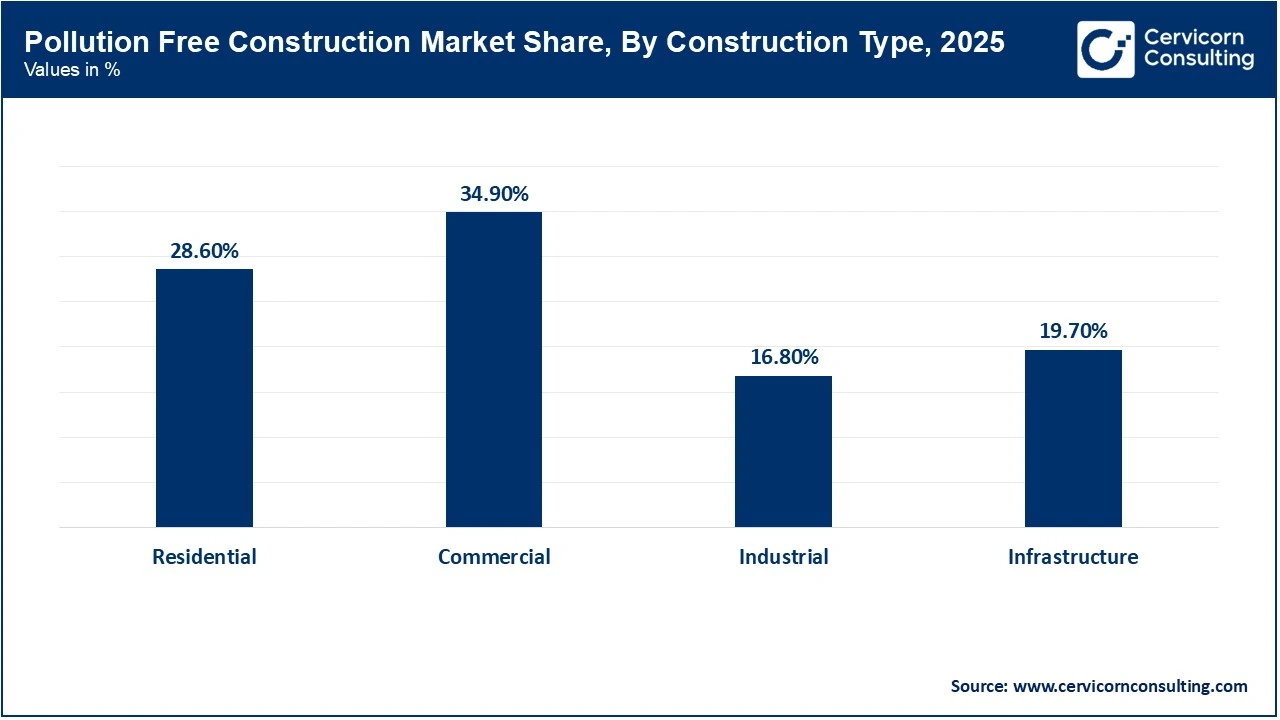
The residential segment is currently experiencing the fastest growth in the pollution-free construction market. This trend is mainly driven by rapid urbanization, greater environmental awareness, and government incentives that encourage green housing. There is a rising demand for energy-efficient homes, smart housing, and net-zero residences, which is accelerating the adoption of sustainable construction practices. For example, in countries such as India, green residential projects are expanding quickly and have contributed to more than 15.7 billion square feet of registered green building space. Consumers are now placing higher importance on lower utility bills and healthier living environments, which is further supporting strong growth in this segment.
Material Type Analysis
Low-carbon cement and concrete are now widely used in the construction industry as they are essential for most construction projects and have a major impact on the environment. Cement production is estimated to account for around 7% to 8% of global CO₂ emissions, which has pushed the industry to look for alternatives like fly-ash concrete and geopolymer cement. As a result, large infrastructure and commercial projects are increasingly using these materials to meet emission reduction targets. This has made the low-carbon cement and concrete segment the largest in the sustainable materials market.
Pollution Free Construction Market Share, By Material Type, 2025 (%)
| Material Type |
Revenue Share, 2025 (%) |
| Low-carbon cement & concrete |
38.5% |
| Recycled materials |
21.7% |
| Sustainable wood & bamboo |
14.6% |
| Green insulation materials |
13.2% |
| Low-VOC paints & coatings |
12.0% |
Recycled materials are the fastest growing segment in the construction industry due to the rising focus on circular economy practices and the need to reduce waste. Materials such as recycled steel, aggregates, and plastic-based construction products are being used more often, as construction and demolition waste is estimated to make up over 30% of global solid waste. Governments and developers are promoting the reuse and recycling of materials to reduce landfill pressure and lower material costs. These initiatives are expected to drive the adoption of recycled materials in the next few years.
Technology Analysis
Green building design is a key factor in reducing pollution from construction activities. The use of passive design strategies, energy-efficient layouts, and climate-responsive architecture is becoming standard across various building types. These methods can lower energy consumption by 20% to 40% before advanced technologies are introduced, making them a cost-effective and widely adopted solution in the global construction industry.
Pollution Free Construction Market Share, By Technology, 2025 (%)
| Technology |
Revenue Share, 2025 (%) |
| Prefabrication / Modular Construction |
27.4% |
| 3D Printing Construction |
9.8% |
| Green Building Design |
41.6% |
| Smart Construction Technologies |
21.2% |
Prefabrication and modular construction technologies are experiencing rapid growth because they can reduce material waste by 30% to 50% and decrease on-site pollution. Off-site manufacturing increases efficiency, shortens construction timelines, and helps to minimize dust and emissions at project locations. The rising demand for faster and cleaner construction methods is driving the global expansion of this segment.
Energy & Resource Systems Analysis
The dominance of energy-efficient systems in buildings is primarily driven by their immediate impact on reducing both emissions and operational costs. The widespread adoption of technologies such as smart HVAC, LED lighting, and automation systems has significantly reduced energy consumption, with potential savings of up to 30%. As energy use remains the largest contributor to building emissions, the implementation of these systems continues to be the most prominent trend in the sector.
Pollution Free Construction Market Share, By Energy & Resource Systems, 2025 (%)
| Energy & Resource Systems |
Revenue Share, 2025 (%) |
| Renewable Energy Systems |
33.5% |
| Water Management Systems |
18.7% |
| Energy-efficient Systems |
47.8% |
The rapid growth of renewable energy systems in buildings is fueled by the increasing integration of solar panels, solar roofs, and other clean energy solutions. The ongoing push toward net-zero energy buildings, along with the significant decline in solar installation costs, plays a crucial role in this trend. Over the past decade, the cost of solar adoption in buildings has dropped by more than 80%, which has made renewable energy solutions more accessible and scalable across the sector.
Certification Analysis
The LEED certification system currently dominates the market, primarily because of its global recognition and extensive adoption. With more than 195,000 certified projects in 186 countries, LEED has become the preferred choice for commercial developers and multinational corporations seeking to meet sustainability standards and increase asset value. As a result, it is considered the most influential certification system in the industry.
Pollution Free Construction Market Share, By Certification, 2025 (%)
| Certification |
Revenue Share, 2025 (%) |
| LEED |
44.3% |
| BREEAM |
26.5% |
| IGBC |
11.2% |
| Net-Zero Buildings |
12.8% |
| Passive House |
5.2% |
Currently, net-zero buildings represent the fastest growing segment in the market, as governments and organizations increasingly pursue strict decarbonization goals. These buildings are designed to generate as much energy as they consume, which leads to a significant reduction in emissions. As global climate targets become more prominent, many countries are introducing mandates or incentives for net-zero construction. This trend is expected to drive substantial growth in the segment in the coming years.
Pollution Free Construction Market Top Companies
Recent Developments by Major Companies
- In March 2026, Skanska announced multiple sustainable infrastructure contracts, including a USD 191 million data center project in the U.S. and low-energy residential developments in Europe, reinforcing its focus on energy-efficient construction and green urban development.
- In February 2026, Larsen & Toubro (L&T) partnered with global technology firms to develop AI-enabled, energy-efficient data centers and green infrastructure projects in India, supporting sustainable digital and industrial ecosystems.
- In January 2026, VINCI expanded its low-carbon construction portfolio by increasing investments in recycled materials, green mobility infrastructure, and energy-efficient transport systems across Europe.
Market Segmentation
By Construction Type
- Residential
- Commercial
- Industrial
- Infrastructure
By Material Type
- Low-carbon Cement & Concrete
- Recycled Materials
- Sustainable Wood & Bamboo
- Green Insulation Materials
- Low-VOC Paints & Coatings
By Technology
- Prefabrication / Modular construction
- 3D Printing Construction
- Green Building Design
- Smart Construction Technologies
By Energy & Resource Systems
- Renewable Energy Systems
- Water Management Systems
- Energy-efficient Systems
By Certification
- LEED
- BREEAM
- IGBC
- Net-Zero Buildings
- Passive House
By Region
- North America
- APAC
- Europe
- LAMEA