Physical AI in Automotive Market Size, Growth, Forecast 2026 to 2035
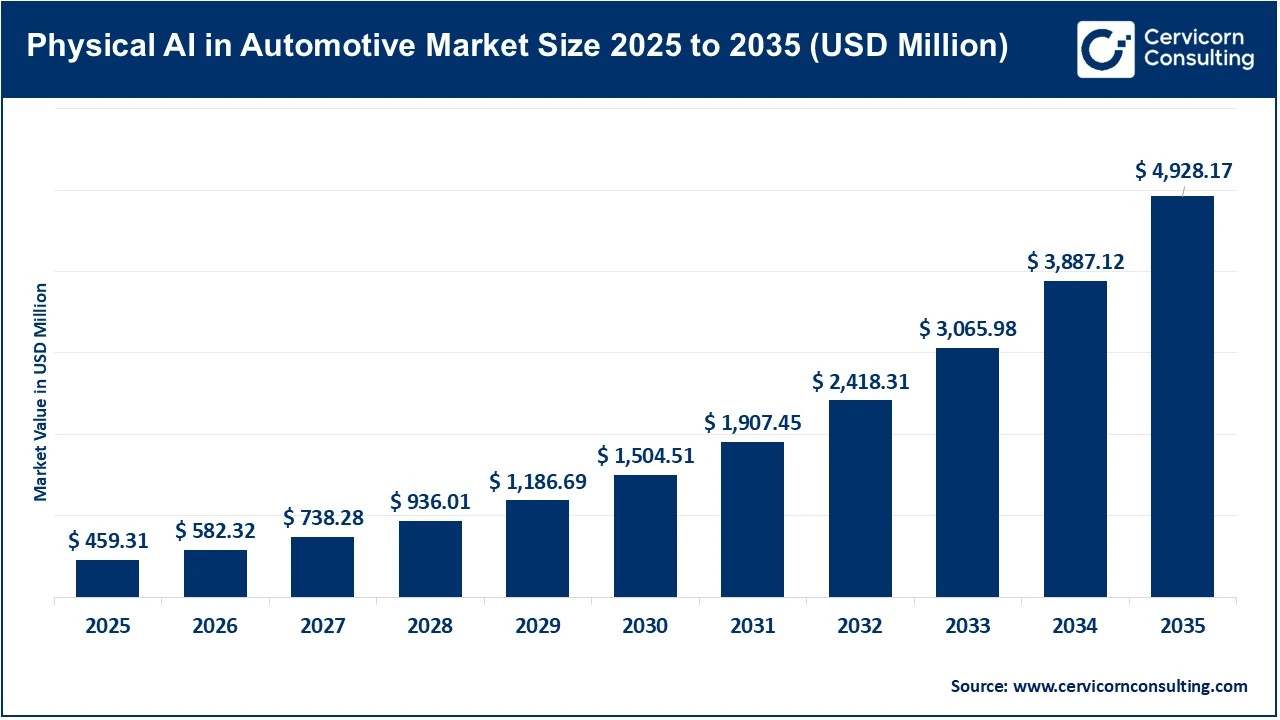
The global physical AI in automotive market size was valued at USD 459.31 million in 2025 and is expected to be worth around USD 4,928.17 million by 2035, exhibiting a compound annual growth rate (CAGR) of 26.8% over the forecast period from 2026 to 2035. The increasing deployment of AI-powered autonomous driving platforms and intelligent sensing technologies is a major driver of the physical AI in automotive market. Modern vehicles integrate cameras, LiDAR, radar, ultrasonic sensors, and edge AI processors to perceive their surroundings and make real-time driving decisions. According to the International Organization of Motor Vehicle Manufacturers (OICA), global vehicle production reached 96.4 million units in 2025, creating a large installed base for AI-enabled automotive technologies. At the same time, automakers are accelerating investments in centralized computing architectures and AI-defined vehicles to enhance safety, automation, and user experience.
Another key growth factor is the rapid adoption of software-defined vehicles (SDVs), digital twins, and AI-driven smart manufacturing. Automotive manufacturers are increasingly using Physical AI to optimize factory robotics, predictive maintenance, virtual vehicle testing, and production quality. The International Energy Agency (IEA) highlights that the transition toward software-defined vehicles has accelerated significantly with the rise of electric vehicles, with leading OEMs such as Tesla, Toyota, BYD, BMW, and General Motors investing heavily in in-house software platforms and AI partnerships. Additionally, the European automotive industry invested approximately EUR 85 billion in research and development in 2023, underscoring the industry's strong commitment to AI, automation, and next-generation mobility technologies.
Report Highlights
- North America dominated the market with an estimated 36.8% share, supported by autonomous driving leadership, AI chip innovation, and software-defined vehicles.
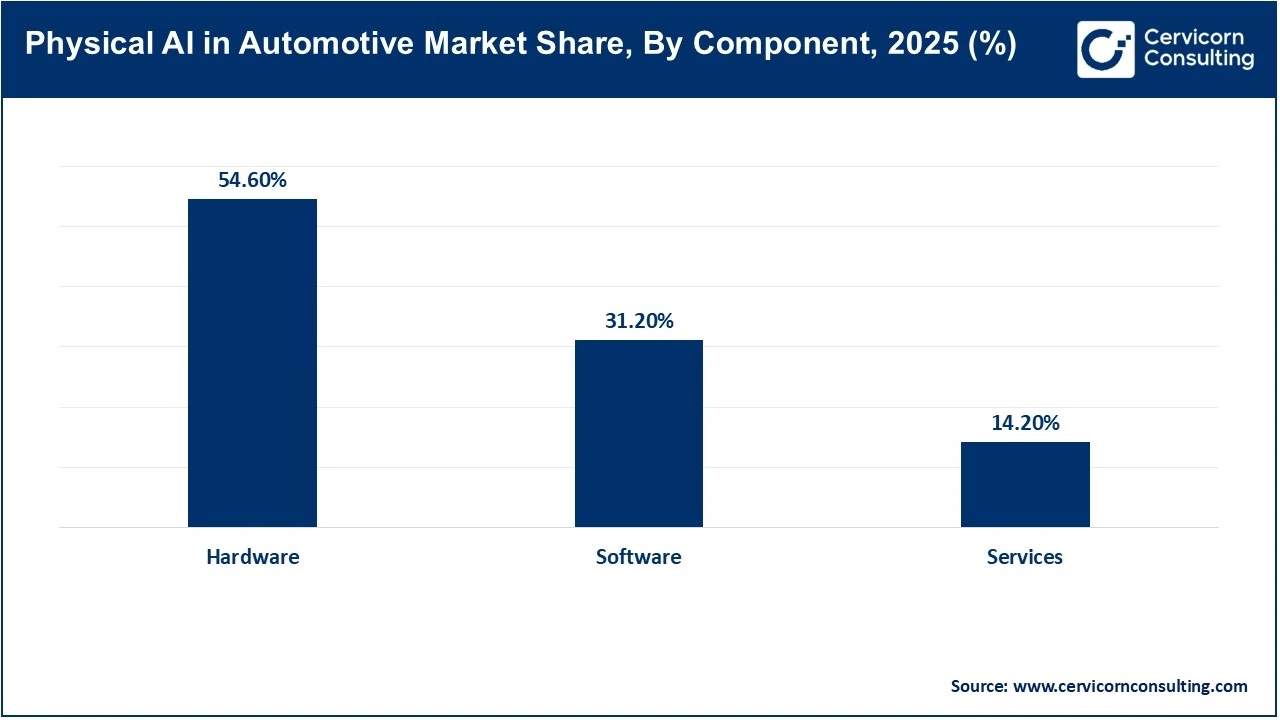
- Hardware held the largest 54.6% component share, driven by growing deployment of AI processors, cameras, LiDAR, radar, and edge computing platforms.
- Computer Vision accounted for the highest 39.8% technology share, owing to its widespread use in perception, object detection, lane recognition, and ADAS applications.
- On-Vehicle (Edge AI) captured 61.5% of the deployment market, as real-time processing is essential for autonomous driving and vehicle safety functions.
- Automotive OEMs represented the largest 47.9% end-user share, reflecting substantial investments in AI-enabled vehicles, manufacturing automation, and intelligent mobility technologies.
What is Physical AI in Automotive?
Physical AI in the automotive market refers to the integration of artificial intelligence with physical vehicle systems, enabling automobiles and manufacturing equipment to perceive, reason, and act autonomously in real-world environments. It combines technologies such as computer vision, sensor fusion, edge AI, robotics, LiDAR, radar, and digital twins to power autonomous driving, advanced driver assistance systems (ADAS), intelligent manufacturing, predictive maintenance, and software-defined vehicles. Unlike conventional AI that primarily analyzes data, Physical AI continuously interacts with the physical world by processing sensor inputs and executing real-time decisions, helping automakers improve vehicle safety, operational efficiency, production automation, and overall driving intelligence.
Recent Developments in the Physical AI in Automotive Market
| Month & Year |
Recent Development |
| March 2026 |
Hyundai Motor Group expanded its strategic partnership with NVIDIA to accelerate Physical AI adoption by integrating NVIDIA's AI platforms, data infrastructure, and unified learning pipeline for autonomous driving and smart factory applications. |
| June 2026 |
Hyundai announced the development of an NVIDIA Blackwell-powered AI factory that leverages Omniverse digital twins to support autonomous driving model training, robotics, and intelligent manufacturing. |
| July 2026 |
Wayve advanced commercialization of its end-to-end AI driving technology through deployment plans with Stellantis for robotaxis and expanded collaborations with global automakers, strengthening Physical AI capabilities in autonomous vehicles. |
| July 2026 |
NVIDIA highlighted the industry's transition from software-defined to AI-defined vehicles through its end-to-end autonomous driving platform, combining AI models, simulation, safety frameworks, and centralized vehicle computing for next-generation automotive intelligence. |
Physical AI in Automotive Market Dynamics
Market Drivers
1. Rising Adoption of Autonomous Driving and ADAS
The growing deployment of autonomous driving technologies and Advanced Driver Assistance Systems (ADAS) is a major driver for the Physical AI in automotive market. Automakers are integrating AI-powered perception, sensor fusion, and real-time decision-making to improve vehicle safety and driving efficiency. Increasing consumer demand for adaptive cruise control, automatic emergency braking, lane-keeping assistance, and autonomous parking is accelerating AI adoption. Regulatory agencies are also promoting advanced vehicle safety features, encouraging OEMs to invest in Physical AI platforms that enable higher levels of driving automation.
Global Adoption of Autonomous Driving & ADAS in New Vehicles
| Year |
New Vehicles Sold Globally (Million Units) |
Vehicles Equipped with ADAS/Autonomous Features (Million Units) |
Penetration Rate |
| 2024 |
89.8 |
54.1 |
60.2% |
| 2025 |
91.5 |
60.0 |
65.6% |
| 2026E |
93.2 |
66.5 |
71.4% |
| 2027E |
95.0 |
72.9 |
76.7% |
| 2028E |
96.8 |
79.8 |
82.4% |
| 2029E |
98.5 |
86.8 |
88.1% |
| 2030E |
100.2 |
93.7 |
93.5% |
2. Expansion of Software-Defined Vehicles (SDVs)
The transition toward software-defined vehicles is significantly driving the adoption of Physical AI across the automotive industry. Modern vehicles increasingly rely on centralized computing, over-the-air software updates, and AI-enabled control systems instead of traditional hardware-based architectures. Physical AI enhances vehicle intelligence by enabling continuous learning, predictive maintenance, digital twins, and intelligent in-cabin experiences. Growing investments by global automakers in AI chips, edge computing, and cloud connectivity are further accelerating the deployment of Physical AI technologies throughout vehicle lifecycles.
Market Restraints
1. High Development and Integration Costs
The implementation of Physical AI requires substantial investment in AI processors, sensors, LiDAR, radar, high-performance computing platforms, and advanced software development. Developing autonomous driving algorithms also involves extensive testing, validation, and simulation under diverse driving conditions. These high costs create financial challenges, particularly for smaller automakers and suppliers. Additionally, integrating Physical AI into existing vehicle platforms often requires redesigning electronic architectures, increasing production complexity and delaying commercialization for cost-sensitive vehicle segments.
2. Safety, Regulatory, and Liability Concerns
Despite technological progress, regulatory uncertainty and safety concerns remain significant barriers to widespread Physical AI adoption. Autonomous driving systems must comply with evolving regional safety regulations and rigorous certification requirements before commercial deployment. Determining legal liability in AI-related vehicle accidents remains complex, while cybersecurity risks and data privacy issues further increase regulatory scrutiny. Variations in regulations across different countries also complicate global product development and slow international deployment of AI-powered automotive solutions.
Market Opportunities
1. AI-Powered Smart Manufacturing and Robotics
Automotive manufacturers are increasingly deploying Physical AI in smart factories to improve operational efficiency, quality control, and production flexibility. AI-powered robots, machine vision systems, autonomous mobile robots, and predictive maintenance solutions help reduce production downtime while enhancing manufacturing precision. Digital twins enable manufacturers to simulate production processes before implementation, lowering operational risks and improving productivity. As Industry 4.0 adoption expands globally, Physical AI is expected to create substantial opportunities across automotive manufacturing facilities.
2. Growth of Connected Mobility and Robotaxi Services
The rapid expansion of connected vehicles and autonomous mobility services presents significant growth opportunities for Physical AI providers. AI-powered robotaxis, autonomous delivery vehicles, and mobility-as-a-service platforms require advanced perception, navigation, and decision-making capabilities. Increasing investments by automotive OEMs, technology companies, and mobility operators are accelerating commercialization of these solutions. Improvements in 5G connectivity, vehicle-to-everything (V2X) communication, and cloud-based AI infrastructure will further support next-generation autonomous transportation ecosystems.
Market Challenges
1. Real-Time Decision Accuracy in Complex Driving Environments
One of the biggest challenges for Physical AI is ensuring reliable real-time decision-making under unpredictable driving conditions. Vehicles must accurately recognize pedestrians, cyclists, road signs, adverse weather, construction zones, and unexpected obstacles while making safe driving decisions within milliseconds. Achieving consistent performance across diverse geographic regions and traffic environments requires enormous volumes of training data, continuous software updates, and highly sophisticated AI models capable of handling rare edge-case scenarios.
2. Shortage of High-Quality Training Data and AI Talent
Developing robust Physical AI systems requires massive amounts of accurately labeled driving data collected from diverse road environments. Acquiring, processing, and validating such datasets is expensive and time-consuming. Additionally, the automotive industry faces a shortage of professionals with expertise in artificial intelligence, robotics, computer vision, embedded software, and autonomous systems engineering. Limited availability of skilled talent can delay product development, increase research costs, and slow innovation across the Physical AI in automotive market.
Physical AI in Automotive Market Regional Analysis
The physical AI in automotive market is segmented by region into North America, Europe, Asia-Pacific, Latin America, and LAMEA. Here is a brief overview of each region:
Why does North America dominates the physical AI in automotive market?
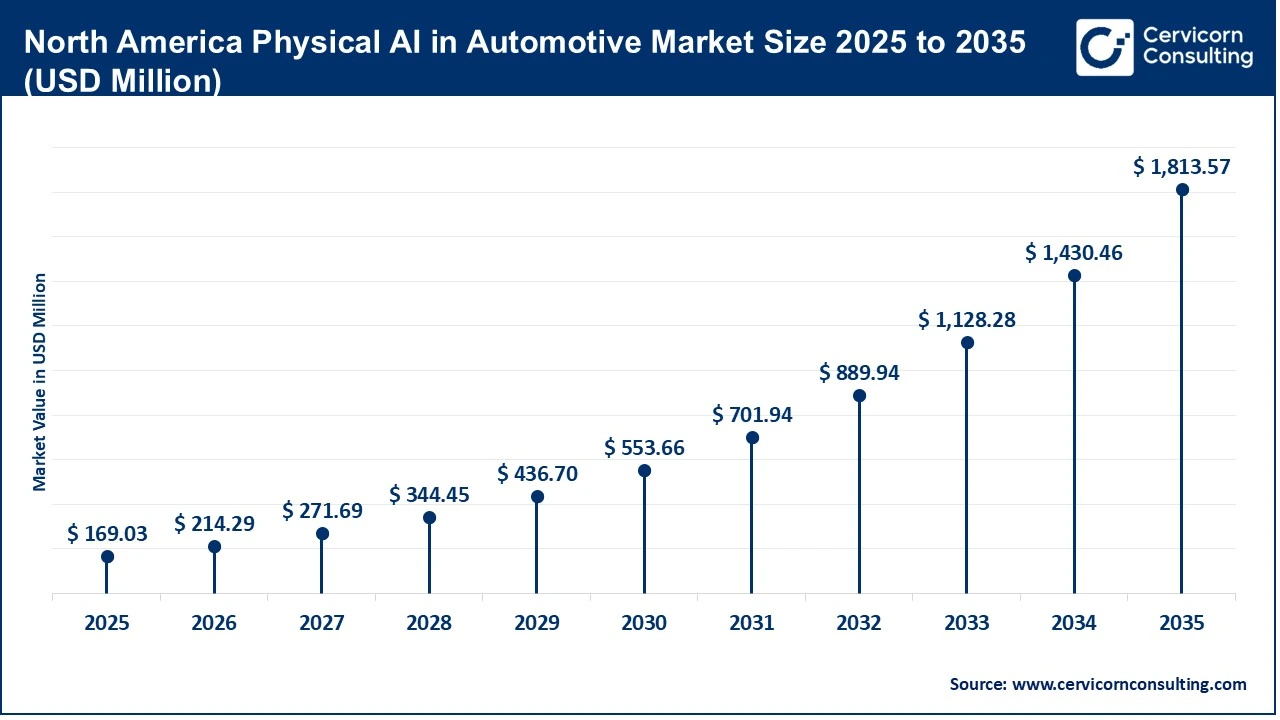
The North America physical AI in automotive market size was valued at USD 169.03 million in 2025 and is predicted to hit around USD 1,813.57 million by 2035. North America dominates the market owing to its leadership in autonomous driving technologies, AI semiconductor innovation, software-defined vehicles (SDVs), and intelligent automotive manufacturing. The region benefits from a well-established ecosystem comprising leading automakers, AI chip developers, cloud providers, robotics companies, and autonomous vehicle startups. Growing investments in edge AI, digital twins, robotics, and AI-powered manufacturing are accelerating the commercialization of next-generation mobility solutions. Supportive regulatory initiatives for automated vehicle testing, increasing adoption of centralized vehicle computing, and continuous advancements in AI-enabled perception systems further strengthen North America's position as the global hub for Physical AI innovation in the automotive industry.
United States: Autonomous Vehicle Leadership, AI Computing, and Large-Scale Technology Investments Drive Market Growth
- The United States is home to leading Physical AI innovators including Tesla, NVIDIA, Waymo, Qualcomm, Intel (Mobileye), General Motors, and Ford, creating one of the world's strongest automotive AI ecosystems.
- According to NHTSA's AV TEST Initiative, dozens of companies are actively testing automated driving systems across more than 30 U.S. states, making the country the global leader in real-world autonomous vehicle validation.
- Waymo has surpassed 100 million fully autonomous miles on public roads and reports more than a 10-fold reduction in serious-injury crashes compared with human drivers, demonstrating the rapid maturity of Physical AI technologies.
Canada: AI Research Excellence, Smart Mobility Programs, and Advanced Automotive Manufacturing Support Market Expansion
- Canada is recognized as a global leader in artificial intelligence research, supported by internationally renowned AI institutes in Toronto, Montréal, and Edmonton, fostering innovation in autonomous mobility and robotics.
- The country provides year-round testing environments across four distinct seasons, enabling autonomous vehicle developers to validate Physical AI systems under snow, ice, rain, and varying road conditions.
- Ontario accounts for more than 90% of Canada's vehicle production, making it the country's primary hub for AI-enabled automotive manufacturing, intelligent robotics, and software-defined vehicle development.
Why is Asia-Pacific fastest-growing regional market?
The Asia-Pacific physical AI in automotive market size was estimated at USD 128.15 million in 2025 and is projected to surpass around USD 1,374.96 million by 2035. Asia-Pacific is the fastest-growing region, driven by its position as the world's largest automotive manufacturing hub and rapid adoption of electric vehicles, autonomous driving technologies, and software-defined vehicles. Countries including China, Japan, South Korea, and India are investing heavily in AI-powered mobility, intelligent manufacturing, robotics, and smart transportation infrastructure. Strong government support for connected and autonomous vehicles, increasing deployment of AI-enabled factories, and the presence of leading automotive OEMs and semiconductor companies are accelerating Physical AI adoption. Growing investments in digital twins, edge AI computing, computer vision, and industrial automation are further strengthening Asia-Pacific's position as a global innovation hub for AI-powered automotive technologies.
China: World's Largest Automotive Market and AI Investment Leader Drive Physical AI Adoption
- China produced 31.28 million vehicles in 2024, accounting for approximately 34% of global vehicle production, making it the world's largest automotive manufacturing base and a major adopter of Physical AI technologies.
- The country sold over 12.8 million New Energy Vehicles (NEVs) in 2024, creating strong demand for AI-enabled autonomous driving, intelligent cockpits, and software-defined vehicle platforms.
Japan: Robotics Leadership and Advanced Automotive Innovation Support Market Growth
- Japan remains one of the global leaders in automotive robotics, with the highest robot density in the automotive manufacturing industry, exceeding 1,500 industrial robots per 10,000 manufacturing employees, according to the International Federation of Robotics (IFR).
- Major automakers including Toyota, Honda, Nissan, and Subaru are integrating Physical AI into autonomous driving, intelligent manufacturing, predictive maintenance, and digital twin-based vehicle development.
- Japan's government continues to promote connected and automated mobility through public-private initiatives supporting autonomous driving demonstrations, AI-based transportation systems, and smart city development.
What are the driving factors of Europe physical AI in automotive market?
The Europe physical AI in automotive market is growing from USD 130.44 million in 2025 to over USD 1,399.60 million by 2035. Europe is a major market, supported by its strong automotive manufacturing base, leadership in vehicle safety technologies, and increasing investments in autonomous mobility and software-defined vehicles. The region is home to globally recognized automakers and Tier-1 suppliers that are integrating AI-powered perception systems, digital twins, robotics, and edge computing into both vehicle production and autonomous driving platforms. The European Union's emphasis on road safety, vehicle automation, AI regulation, and sustainable mobility is accelerating the deployment of Physical AI technologies. Additionally, the rapid adoption of Industry 4.0, intelligent manufacturing, and AI-enabled quality inspection across automotive production facilities continues to strengthen Europe's position in the global Physical AI automotive ecosystem.
Germany: Europe's Automotive Innovation Hub Drives Physical AI Adoption
- Germany produced approximately 4.1 million passenger cars in 2024, making it the largest automobile manufacturing country in Europe, according to the European Automobile Manufacturers' Association (ACEA).
- The country is home to leading automotive companies including Volkswagen Group, Mercedes-Benz, BMW, Porsche, Bosch, Continental, and ZF Friedrichshafen, which are investing heavily in AI-powered autonomous driving, robotics, and software-defined vehicle platforms.
France: AI Strategy, Smart Mobility, and Connected Vehicle Development Support Market Growth
- France is strengthening its position through its National AI Strategy, which has allocated more than EUR 2.5 billion to accelerate artificial intelligence research, industrial innovation, and commercialization across strategic sectors, including automotive.
- Leading companies such as Renault Group, Valeo, Stellantis, and Forvia are investing in AI-enabled ADAS, autonomous driving software, intelligent manufacturing, and next-generation mobility solutions.
Physical AI in Automotive Market Share, By Region, 2025 (%)
| Region |
Revenue Share, 2025 (%) |
| North America |
36.8% |
| Europe |
28.4% |
| Asia-Pacific |
27.9% |
| LAMEA |
6.9% |
LAMEA Physical AI in Automotive Market Trends
The LAMEA physical AI in automotive market was valued at USD 31.69 million in 2025 and is anticipated to reach around USD 340.04 million by 2035. The LAMEA region is emerging as a promising market, supported by growing investments in smart mobility, connected vehicles, intelligent manufacturing, and digital transformation. Governments across the region are promoting electric mobility, AI innovation, and Industry 4.0 to modernize automotive production and transportation infrastructure. Increasing deployment of AI-powered robotics, predictive maintenance, computer vision, and autonomous vehicle pilot programs is encouraging Physical AI adoption. The expansion of automotive manufacturing facilities, rising demand for advanced driver assistance systems (ADAS), and collaborations between global automakers and regional technology providers are expected to accelerate market growth throughout the region.
Brazil: Largest Automotive Manufacturing Base in Latin America Drives Physical AI Adoption
- Brazil produced approximately 2.55 million vehicles in 2024, accounting for over 60% of Latin America's total vehicle production, making it the region's largest automotive manufacturing hub.
- Major automakers including Volkswagen, Stellantis, General Motors, Toyota, Hyundai, and Renault are expanding investments in smart factories, AI-enabled robotics, predictive maintenance, and digital manufacturing technologies.
- Brazil's "Mover" (Green Mobility and Innovation Program) encourages investments in vehicle electrification, intelligent manufacturing, and advanced automotive technologies, supporting wider adoption of Physical AI solutions
Saudi Arabia: Smart City Projects, EV Manufacturing, and AI Investments Accelerate Market Growth
- Saudi Arabia's Public Investment Fund (PIF) has committed over US$40 billion toward artificial intelligence initiatives through strategic investment programs, supporting AI adoption across industries, including mobility and manufacturing.
- The Kingdom aims to produce 500,000 electric vehicles annually by 2030, supported by investments in Ceer Motors and Lucid Motors, creating significant opportunities for Physical AI integration in vehicle production and autonomous mobility.
Physical AI in Automotive Market Segmental Analysis
The physical AI in automotive market is segmented into component, technology, deployment, end user, and geography.
Component Analysis
Hardware dominates the Physical AI in Automotive Market because AI-enabled vehicles rely heavily on high-performance processors, cameras, LiDAR, radar, ultrasonic sensors, and edge computing platforms to perceive and interact with the physical environment. Autonomous driving and ADAS systems require powerful onboard computing capable of processing vast sensor data with minimal latency. The increasing deployment of centralized vehicle architectures, software-defined vehicles, and AI accelerators has further strengthened demand for advanced automotive hardware, making it the largest revenue-generating component across passenger and commercial vehicles.
Software is expected to be the fastest-growing component as automakers increasingly shift toward software-defined vehicles that rely on AI algorithms rather than hardware upgrades alone. Continuous over-the-air updates, perception software, digital twins, autonomous driving models, and predictive maintenance platforms are becoming essential for enhancing vehicle functionality throughout its lifecycle. Generative AI, foundation models, and reinforcement learning are accelerating software innovation, while growing investments in AI development platforms and cloud-based model training continue to expand the software ecosystem across the automotive industry.
Technology Analysis
Computer vision holds the largest share of the physical AI in automotive market because it serves as the foundation for autonomous driving, ADAS, intelligent parking, lane detection, traffic sign recognition, and obstacle identification. Modern vehicles depend on multiple cameras integrated with AI algorithms to accurately interpret road conditions and surrounding environments in real time. The widespread deployment of camera-based safety systems, combined with sensor fusion technologies, has established computer vision as the most extensively adopted AI technology across automotive applications.
Physical AI in Automotive Market, By Technology, 2025 (%)
| Technology |
Revenue Share, 2025 (%) |
| Computer Vision |
39.8% |
| Speech / NLP |
17.3% |
| Gesture / Movement Recognition |
12.4% |
| Reinforcement Learning & Control Systems |
20.7% |
| Others |
9.8% |
Reinforcement Learning and Control Systems are expected to witness the fastest growth due to their ability to improve autonomous driving decisions through continuous learning and real-world adaptation. These AI models optimize vehicle navigation, path planning, energy management, and dynamic control by learning from driving experiences instead of relying solely on predefined rules. Increasing investments in self-driving technologies, robotics, simulation platforms, and digital twins are accelerating the adoption of reinforcement learning for next-generation intelligent vehicles and autonomous mobility solutions.
Deployment Analysis
On-Vehicle (Edge AI) dominates the deployment segment because autonomous driving and safety-critical applications require instant decision-making without relying on cloud connectivity. Edge AI enables vehicles to process sensor data locally with extremely low latency, ensuring rapid responses during emergency braking, collision avoidance, lane keeping, and pedestrian detection. Growing adoption of AI chips, centralized vehicle computers, and advanced driver assistance systems has significantly increased demand for onboard intelligence capable of delivering reliable real-time vehicle performance under all driving conditions.
Physical AI in Automotive Market, By Deployment, 2025 (%)
| Deployment |
Revenue Share, 2025 (%) |
| On-Vehicle (Edge AI) |
61.5% |
| Cloud-Based |
14.8% |
| Hybrid |
23.7% |
Hybrid deployment is projected to be the fastest-growing segment because it combines the advantages of onboard edge computing with cloud-based AI capabilities. Vehicles perform safety-critical operations locally while leveraging the cloud for large-scale model training, fleet learning, software updates, predictive analytics, and digital twin simulations. As connected vehicles and software-defined architectures become more common, hybrid deployment enables continuous AI improvement while maintaining real-time operational reliability, making it increasingly attractive for automotive manufacturers and mobility providers.
End User Analysis
Automotive OEMs represent the largest end-user segment because they are responsible for designing, manufacturing, and integrating Physical AI technologies directly into vehicles. Leading manufacturers are investing heavily in autonomous driving platforms, AI-enabled safety systems, software-defined vehicle architectures, and intelligent cockpit solutions to enhance product competitiveness. Their extensive research and development activities, strategic partnerships with AI technology providers, and growing focus on electrification and automation position OEMs as the primary adopters of Physical AI across the automotive value chain.
Physical AI in Automotive Market, By End User, 2025 (%)
| End User |
Revenue Share, 2025 (%) |
| Automotive OEMs |
47.9% |
| Tier-1 Suppliers |
24.3% |
| Automotive Manufacturing Plants |
17.1% |
| Mobility-as-a-Service (MaaS) Providers |
7.2% |
| Others |
3.5% |
Mobility-as-a-Service (MaaS) providers are anticipated to experience the fastest growth due to increasing investments in autonomous ride-hailing, robotaxis, shared mobility, and intelligent fleet operations. Physical AI enables these providers to improve route optimization, vehicle autonomy, predictive maintenance, passenger safety, and operational efficiency while reducing dependence on human drivers. As urban mobility evolves and autonomous transportation services expand globally, MaaS operators are expected to become major adopters of AI-powered vehicle technologies over the coming decade.
Physical AI in Automotive Market Top Companies
Recent Developments
- In March 2026, NVIDIA Corporation expanded adoption of its DRIVE Hyperion autonomous driving platform, with BYD, Geely, Isuzu, and Nissan selecting it to develop Level 4-ready vehicles, while introducing Halos OS and Omniverse AI tools to accelerate Physical AI development for autonomous mobility.
- In June 2025, Tesla, Inc. launched its first commercial Robotaxi service in Austin, Texas, marking a major milestone in deploying AI-powered autonomous vehicles and expanding real-world applications of Physical AI for driverless ride-hailing services.
- In March 2026, Mobileye Global Inc. secured a major production program with a leading U.S. automaker to integrate its EyeQ6L-based Driver Monitoring System (DMS) across millions of future vehicles, strengthening AI-powered in-cabin safety and autonomous driving capabilities.
- In April 2025, Alphabet Inc. (Waymo) partnered with Toyota Motor Corporation to explore the deployment of autonomous driving technology in personally owned vehicles, expanding the commercialization of Physical AI beyond robotaxi fleets.
Market Segmentation
By Component
- Hardware
- Software
- Services
By Technology
- Computer Vision
- Speech / NLP
- Gesture / Movement Recognition
- Reinforcement Learning & Control Systems
- Others (multi-modal AI, biomimetic robotics)
By Deployment
- On-Vehicle (Edge AI)
- Cloud-Based
- Hybrid
By End User
- Automotive OEMs
- Tier-1 Suppliers
- Automotive Manufacturing Plants
- Mobility-as-a-Service (MaaS) Providers
- Others
By Geography
- North America
- Europe
- Asia-Pacific
- LAMEA