Pharmacy Benefit Management Market Size, Growth, Forecast 2026 to 2035
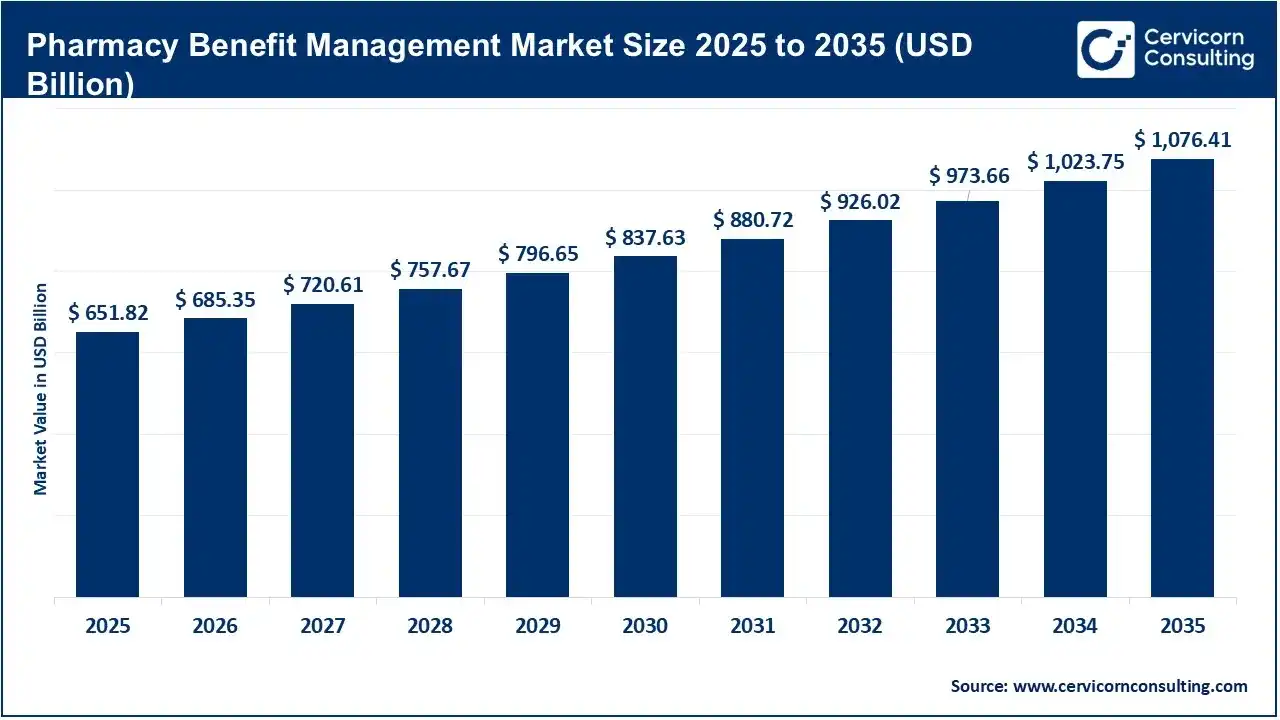
The global pharmacy benefit management market size reached USD 651.82 billion in 2025 and is expected to reach around USD 1,076.41 billion by 2035, exhibiting a compound annual growth rate (CAGR) of 5.1% over the forecast period 2026 to 2035. Rising prescription drug utilization and the increasing prevalence of chronic diseases are major drivers for pharmacy benefit management (PBM) adoption, as payers seek stronger cost control, formulary optimization, utilization management, and medication adherence solutions.
In 2023, approximately 76.4% of U.S. adults reported at least one chronic condition, while 51.4% reported multiple chronic conditions, creating sustained demand for prescription therapies and ongoing medication management. Medicare Part D also recorded 50.8 million utilizing beneficiaries and 1.6 billion prescription drug events in 2023, highlighting the substantial volume of prescription transactions requiring efficient claims processing, benefit administration, and cost-management services.
The rapid expansion of specialty medicines, increasing pharmaceutical costs, and greater demand for value-based drug management are further supporting PBM market growth. Specialty drug expenditures in the U.S. reached USD 485.4 billion in 2025, representing 53.0% of total prescription expenditures, while specialty spending increased 15.2% compared with 2024, intensifying the need for specialty pharmacy management, prior authorization, formulary controls, and rebate negotiation. Additionally, Medicare Part D reforms, including the USD 2,000 annual out-of-pocket cap introduced in 2025, are increasing the importance of benefit design and prescription-cost management for health plans and beneficiaries. Regulatory scrutiny and changing reimbursement structures are also encouraging PBMs to improve pricing transparency, pharmacy-network management, and value-based contracting.
Report Highlights
- North America dominated the regional market with approximately 44.8% share in 2025, supported by mature insurance systems, high prescription utilization, and established PBM infrastructure.
- Specialty pharmacy services dominated the service segment with a 33.4% market share in 2025, driven by increasing specialty-drug utilization and complex medication-management requirements.
- Employer-Sponsored Programs accounted for the largest business-model share at 45.3% in 2025, supported by employers' growing focus on prescription-cost containment and benefit optimization.
- Pharmacy Benefit Management Organizations and Retail Pharmacies collectively represented approximately 42.8% of the end-use segment in 2025, reflecting their central role in prescription administration and distribution.
- Mail-Order Pharmacies are projected to be the fastest-growing end-use segment, with an estimated 7.6% CAGR through 2031, supported by convenient medication delivery and recurring-prescription services.
- Government Health Programs are projected to be among the fastest-growing business models, with approximately 6.4% CAGR through 2031, driven by expanding government prescription-benefit programs.
What is Pharmacy Benefit Management (PBM)?
Pharmacy Benefit Management (PBM) refers to the services and organizations that manage prescription-drug benefits on behalf of health insurers, employers, government programs, and other payers. PBMs negotiate drug prices and rebates with manufacturers, develop and manage formularies, process pharmacy claims, build pharmacy networks, conduct utilization management, and support specialty and mail-order pharmacy services, with the overall objective of controlling prescription-drug costs while maintaining patient access.
Recent Milestones
| Date |
Organization |
Milestone |
| January 2025 |
Federal Trade Commission (FTC) |
FTC released a report alleging that major PBMs applied significant markups on specialty generic medicines, intensifying regulatory scrutiny of PBM pricing practices. |
| February 2026 |
Express Scripts |
Express Scripts reached an FTC settlement requiring changes to its pricing and rebate practices, with the FTC estimating potential consumer savings of up to USD 7 billion over 10 years. |
| February 2026 |
CVS Caremark |
Caremark announced preferred-formulary changes favoring biosimilar and generic alternatives for certain treatments, with CVS expecting prescription-cost reductions of more than 50% for affected therapies. |
| March 2026 |
CVS Health / Caremark |
CVS Health reached a proposed settlement with the FTC concerning insulin pricing practices and agreed to implement greater pricing transparency. |
| July 2026 |
FTC & CVS Caremark |
FTC finalized a major Caremark settlement that could provide up to USD 8.5 billion in consumer savings over 10 years and up to USD 4.5 billion in additional point-of-sale rebate savings. |
| August 2026 |
Employer PBM Market |
A 2026 survey found 46% of employers were using PBMs outside the Big Three, up from 37% in 2025, indicating growing demand for alternative PBM models. |
Pharmacy Benefit Management Market Dynamics
Market Drivers
1. Rising Specialty Drug Utilization
Increasing adoption of high-cost specialty medicines is driving demand for PBM services that manage formularies, prior authorization, specialty networks, and medication utilization. Specialty medications represented only about 2% of drugs sold in 2025 but accounted for approximately 52% of net prescription spending, highlighting the need for sophisticated cost-management strategies. PBMs are increasingly using utilization controls, biosimilar substitution, and specialty pharmacy programs to manage these expensive therapies while maintaining patient access.
2. Growing Demand for Prescription Cost Optimization
Employers and health plans are increasingly seeking PBMs to negotiate prices, encourage lower-cost alternatives, and improve pharmacy benefit efficiency amid continued prescription spending pressures. Generic and biosimilar medicines generated approximately USD 467 billion in U.S. healthcare savings during 2024, demonstrating the substantial economic value associated with effective generic substitution and formulary management. PBMs can capture additional savings through network optimization, utilization management, rebate negotiation, and data-driven benefit design, strengthening demand for their services.
Market Restraints
1. Regulatory Scrutiny and Compliance Costs
Increasing government scrutiny of PBM pricing, rebates, compensation, and pharmacy contracting practices is creating operational complexity and potentially increasing compliance expenses. In 2026, federal reforms introduced additional requirements involving transparency, rebates, compensation, pharmacy participation, and enforcement, requiring PBMs and plan sponsors to adapt contracts, reporting systems, and financial processes. These regulatory changes can constrain traditional revenue models and increase administrative costs, particularly for large PBMs operating across multiple health-plan segments.
2. Market Concentration and Limited Competition
High concentration among major PBMs can create challenges related to competition, contracting flexibility, and stakeholder trust, potentially limiting opportunities for smaller providers. The three largest PBMs, CVS Caremark, Express Scripts, and OptumRx, managed approximately 79% of U.S. prescription drug claims in 2023. Such concentration has attracted regulatory attention and encourages employers and policymakers to examine network access, pricing arrangements, reimbursement practices, and the competitive effects of vertically integrated PBM models.
Market Opportunities
1. Expansion of Transparent and Alternative PBM Models
Growing employer demand for clearer pricing and rebate structures is creating opportunities for independent PBMs and transparent cost-plus models. A 2026 survey found that more than 90% of employers believed rebate-free PBM models could improve prescription-price transparency, while 90% said they could improve employee satisfaction and medication affordability. This environment creates opportunities for PBMs offering pass-through rebates, transparent administrative fees, direct contracting, and clearly defined pharmacy reimbursement methodologies.
2. AI and Advanced Analytics Integration
Artificial intelligence and advanced analytics provide opportunities for PBMs to improve fraud detection, medication adherence, clinical intervention, formulary optimization, and specialty-drug management. The opportunity is expanding as pharmacy organizations invest directly in AI-enabled operations; for example, Cigna announced a USD 100 million investment in its Pharmacy Forward program to improve efficiency at Accredo specialty pharmacy. Similar technologies can help PBMs analyze claims and clinical data more effectively while identifying inappropriate utilization and opportunities for lower-cost therapies.
Market Challenges
1. Maintaining Affordability While Managing Complex Therapies
PBMs face the difficult challenge of controlling costs while ensuring patients can access increasingly complex and expensive medicines. Specialty drug spending exceeded USD 400 billion in 2025, while specialty medicines represented only a small fraction of prescriptions, creating significant cost concentration. PBMs must therefore balance formulary restrictions, prior authorization, manufacturer negotiations, biosimilar adoption, and patient affordability without creating excessive barriers to clinically appropriate treatment.
2. Employer Migration Toward Smaller PBMs
Increasing employer scrutiny of traditional PBM arrangements is intensifying competitive pressure on established providers. A 2026 survey of 408 employers found that 46% were using PBMs outside the three largest providers, compared with 37% in the previous year. This shift indicates growing demand for alternative contracting models, greater data access, and transparent pricing. Established PBMs consequently face the challenge of retaining clients while adapting business models to changing employer expectations and regulatory requirements.
Regional Analysis
The pharmacy benefit management market is segmented by region into North America, Europe, Asia-Pacific, Latin America, and LAMEA. Here is a brief overview of each region:
North America Pharmacy Benefit Management Market: Driven by High Prescription Drug Utilization, Rising Specialty Medicine Spending, Employer-Sponsored Coverage, and Increasing Demand for Prescription Cost Management
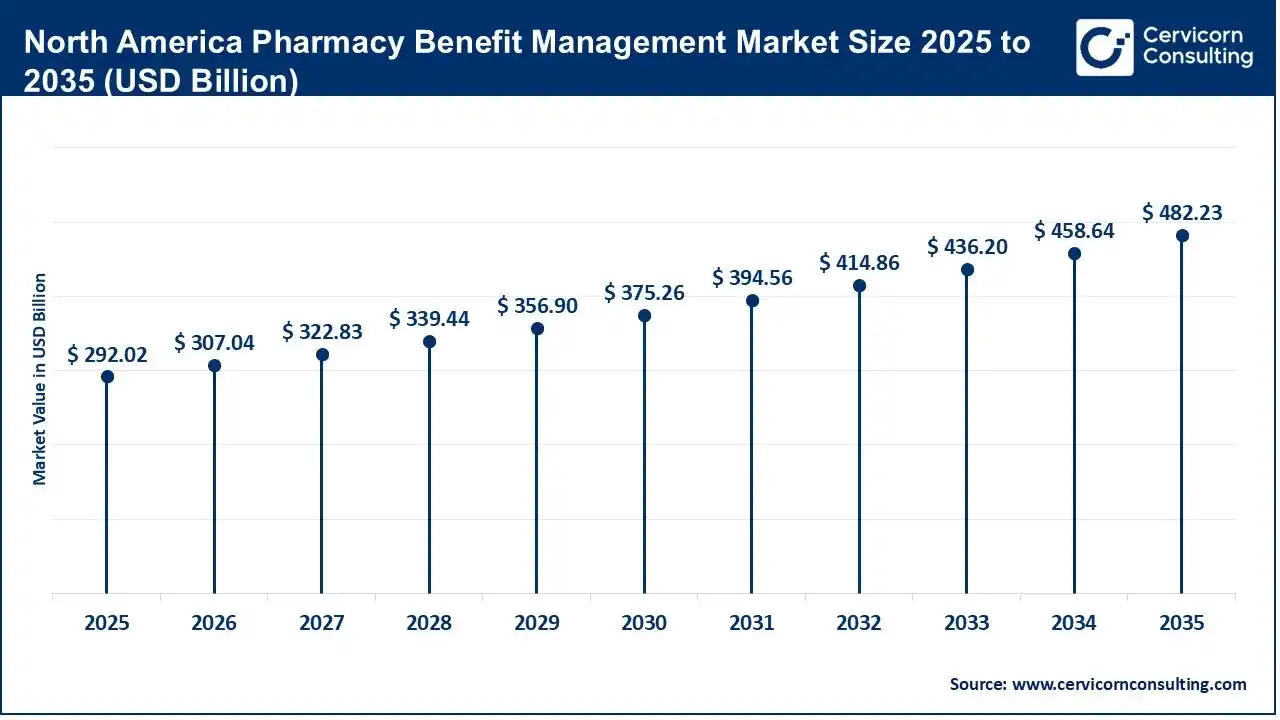
The North America pharmacy benefit management market size was valued at USD 292.02 billion in 2025 and is expected to surge USD 482.23 billion by 2035. North America dominates the market owing to its highly developed healthcare infrastructure, extensive prescription drug coverage, large employer-sponsored insurance base, and strong presence of leading PBM organizations. The United States represents the region's primary market, supported by widespread use of commercial health insurance, Medicare, and Medicaid pharmacy benefits. Increasing specialty-drug utilization, complex formulary requirements, rising demand for generic and biosimilar substitution, and growing emphasis on healthcare cost containment are strengthening PBM adoption. In addition, regulatory reforms targeting drug pricing transparency, rebate arrangements, pharmacy reimbursement, and patient affordability are encouraging PBMs to enhance analytics, utilization management, and benefit-design capabilities. The established presence of major organizations such as CVS Caremark, Express Scripts, and Optum Rx further reinforces North America's leadership in the global PBM market.
United States: High Prescription Drug Spending, Expanding Specialty Medicines, and Employer-Sponsored Coverage Drive Market Growth
- According to the U.S. Centers for Medicare & Medicaid Services (CMS), U.S. national health expenditures reached approximately USD 5.3 trillion in 2024, creating significant opportunities for healthcare cost-management solutions, including PBM services.
- The KFF reports that approximately 90% of Americans have health coverage, with employer-sponsored insurance remaining the largest source of coverage for the nonelderly population, supporting substantial demand for pharmacy benefit administration and prescription-cost optimization.
Canada: Universal Prescription Coverage Expansion, Digital Pharmacy Adoption, and Pharmaceutical Cost Management Support Market Expansion
- Canada's Canadian Institute for Health Information (CIHI) estimates that prescription medicines represented approximately 13% of total Canadian health spending, highlighting the importance of effective drug-benefit administration and pharmaceutical cost management.
- Canada's National Pharmacare initiatives are expanding federal and provincial efforts to improve access to essential medicines, creating opportunities for PBM-like benefit administration, formulary management, claims processing, and pharmacy-network optimization services.
Europe Pharmacy Benefit Management Market: Driven by Universal Healthcare Coverage, High Prescription Medicine Utilization, Strong Public Pharmaceutical Financing, and Increasing Demand for Cost-Effective Drug Management
The Europe pharmacy benefit management market size was estimated at USD 164.91 billion in 2025 and is projected to surpass USD 273.33 billion by 2035. Europe represents a significant share, supported by mature healthcare systems, extensive public and compulsory insurance coverage, rising pharmaceutical expenditure, and a growing emphasis on controlling prescription drug costs. European healthcare systems increasingly require sophisticated formulary management, reimbursement administration, utilization review, generic substitution, and medication-adherence solutions to manage pharmaceutical spending efficiently. According to the OECD, EU countries spent an average of EUR 510 per capita on retail pharmaceuticals in 2023, while retail medicines represented approximately 13% of total health expenditure.
Germany: High Pharmaceutical Spending, Strong Statutory Insurance, and Increasing Cost-Containment Requirements Drive Market Growth
- Germany recorded the highest pharmaceutical spending per capita in the EU at EUR 721, demonstrating substantial demand for prescription-drug management, reimbursement administration, and pharmaceutical cost-control solutions.
- Germany's statutory health insurance system provides extensive pharmaceutical coverage, encouraging insurers and healthcare organizations to strengthen formulary management, generic substitution, claims administration, and medication utilization controls.
United Kingdom: Large Publicly Funded Healthcare System, Centralized Drug Procurement, and Digital Prescription Adoption Support Market Expansion
- The UK's total pharmaceutical expenditure reached GBP 35.7 billion in 2024, with 54.0% associated with community-prescribed medicines, creating substantial demand for prescription management and reimbursement solutions.
- The NHS uses centralized approaches to medicines assessment, procurement, pricing, and reimbursement, encouraging efficient formulary management, prescribing optimization, and pharmaceutical expenditure control.
Asia-Pacific (APAC) Pharmacy Benefit Management Market: Driven by Expanding Healthcare Coverage, Rising Pharmaceutical Expenditure, Growing Chronic Disease Burden, and Accelerating Digital Health Adoption
The Asia-Pacific pharmacy benefit management market size was accounted for USD 117.98 billion in 2025 and is forecasted to hit USD 194.83 billion by 2035. Asia-Pacific is the fastest-growing region, supported by expanding healthcare access, rising prescription medicine consumption, increasing prevalence of chronic diseases, and government initiatives to improve drug affordability. Countries across the region are investing heavily in pharmaceutical reimbursement systems, digital health infrastructure, electronic prescribing, and medication management programs to control healthcare costs and improve patient outcomes. The growing middle-class population, aging demographics, and increasing demand for specialty medicines are creating opportunities for formulary management, claims administration, medication adherence programs, and pharmacy-network optimization. Additionally, the region's rapid healthcare modernization and increasing focus on value-based care are encouraging the adoption of advanced pharmacy benefit management solutions.
Japan: Aging Population, Rising Prescription Drug Utilization, and Healthcare Cost Containment Initiatives Drive Market Growth
- Japan has one of the world's oldest populations, increasing demand for long-term medication management, chronic disease therapies, and prescription benefit optimization services.
- The country is increasingly adopting pharmacy benefit management solutions to improve prescription-cost efficiency, enhance formulary management, and support healthcare insurers in controlling pharmaceutical expenditures. The Japanese PBM market is being driven by the growing need for cost-effective prescription drug management and increasing integration of AI and machine learning technologies.
Australia: Strong Pharmaceutical Reimbursement Framework, Rising Prescription Volumes, and Government Drug Subsidies Support Market Expansion
- Australia's Pharmaceutical Benefits Scheme (PBS) remains one of the world's most comprehensive prescription drug reimbursement systems, supporting affordable access to medicines and creating opportunities for advanced pharmacy benefit administration.
- According to the Australian Institute of Health and Welfare, total spending on PBS and RPBS medicines reached AUD 23.1 billion in 2024–25, covering approximately 335.1 million prescriptions, highlighting the scale of pharmaceutical benefit management activities in the country.
Pharmacy Benefit Management Market Share, By Region, 2025 (%)
| Region |
Revenue Share, 2025 (%) |
| North America |
44.8% |
| Europe |
25.3% |
| Asia-Pacific |
18.1% |
| LAMEA |
11.8% |
LAMEA Pharmacy Benefit Management Market: Driven by Expanding Health Insurance Coverage, Rising Pharmaceutical Expenditure, Healthcare Digitization, and Increasing Focus on Medication Affordability
The LAMEA pharmacy benefit management market was valued at USD 76.91 billion in 2025 and is anticipated to reach around USD 127.02 billion by 2035. LAMEA is emerging as an attractive PBM market, supported by increasing healthcare expenditure, expanding private insurance coverage, rising prescription-drug utilization, and government initiatives to improve pharmaceutical access. Latin American countries are strengthening reimbursement and medication-management systems, while Middle Eastern markets are investing heavily in healthcare modernization, insurance expansion, centralized procurement, and digital health infrastructure. Africa is gradually adopting technology-enabled pharmacy and claims-management solutions as private healthcare coverage expands.
Latin America: Expanding Pharmaceutical Expenditure, Insurance Penetration, and Government Drug-Access Programs Support Market Growth
- Brazil is a leading Latin American market, with approximately 6.07 billion medicine packages sold in 2024, demonstrating the substantial prescription and pharmaceutical-distribution volume available for benefit-management solutions.
- Brazil's pharmaceutical-assistance investment increased substantially, reaching BRL 21.9 billion in 2024, supporting broader access to essential medicines and creating opportunities for formulary management, procurement optimization, claims administration, and medication-utilization programs.
Middle East & Africa: Healthcare Modernization, Insurance Expansion, and Centralized Pharmaceutical Procurement Drive Market Development
- Saudi Arabia allocated approximately SAR 214 billion (USD 57.1 billion) to healthcare in 2024, representing around 17% of its total government budget, highlighting substantial investment in healthcare infrastructure and pharmaceutical services.
- In Africa, South Africa provides an important opportunity because its private healthcare sector accounts for approximately 50% of healthcare spending, supporting demand for structured pharmacy-benefit administration, medication-cost management, and digital pharmacy services.
Segmental Analysis
The pharmacy benefit management market is segmented into service type, business model, end use, and geography.
Service Analysis
Specialty pharmacy services dominate the PBM market because expensive biologics, oncology medicines, rare-disease therapies, and complex specialty treatments require intensive utilization and cost management. PBMs provide prior authorization, specialty formularies, adherence programs, patient support, and pharmacy-network management for these therapies. Industry estimates place specialty pharmacy services at 33.4% of market revenue, making it the leading service segment. Increasing specialty-drug complexity and payer focus on managing high-cost therapies continue strengthening the segment's position.
Pharmacy Benefit Management Market Share, By Service, 2025 (%)
| Service |
Revenue Share, 2025 (%) |
| Specialty Pharmacy Services |
33.4% |
| Drug Formulary Management |
24.8% |
| Retail Pharmacy Services |
16.9% |
| Benefit Plan Design and Consultation |
13.6% |
| Disease Management Services |
6.2% |
| Others |
5.1% |
Drug formulary management is expected to experience strong growth as payers increasingly require sophisticated strategies to control prescription costs while maintaining appropriate treatment access. PBMs continuously adjust formularies according to clinical effectiveness, generic availability, biosimilar competition, negotiated rebates, and therapeutic alternatives. In 2025, 50% of PBM respondents identified formulary and utilization management as their primary specialty-drug cost-containment focus, demonstrating the growing importance of this function.
Business Model Analysis
Employer-Sponsored Programs represent the leading business-model segment because companies increasingly use PBMs to control employee prescription expenses while providing comprehensive pharmacy benefits. Employers rely on PBMs for formulary design, pharmacy-network management, rebate negotiations, utilization controls, and specialty-drug management. Industry estimates indicate that employer-sponsored programs accounted for approximately 45.3% of PBM market revenue in 2025. Continued employer attention toward healthcare affordability, benefit customization, and workforce retention is expected to maintain this segment's leadership.
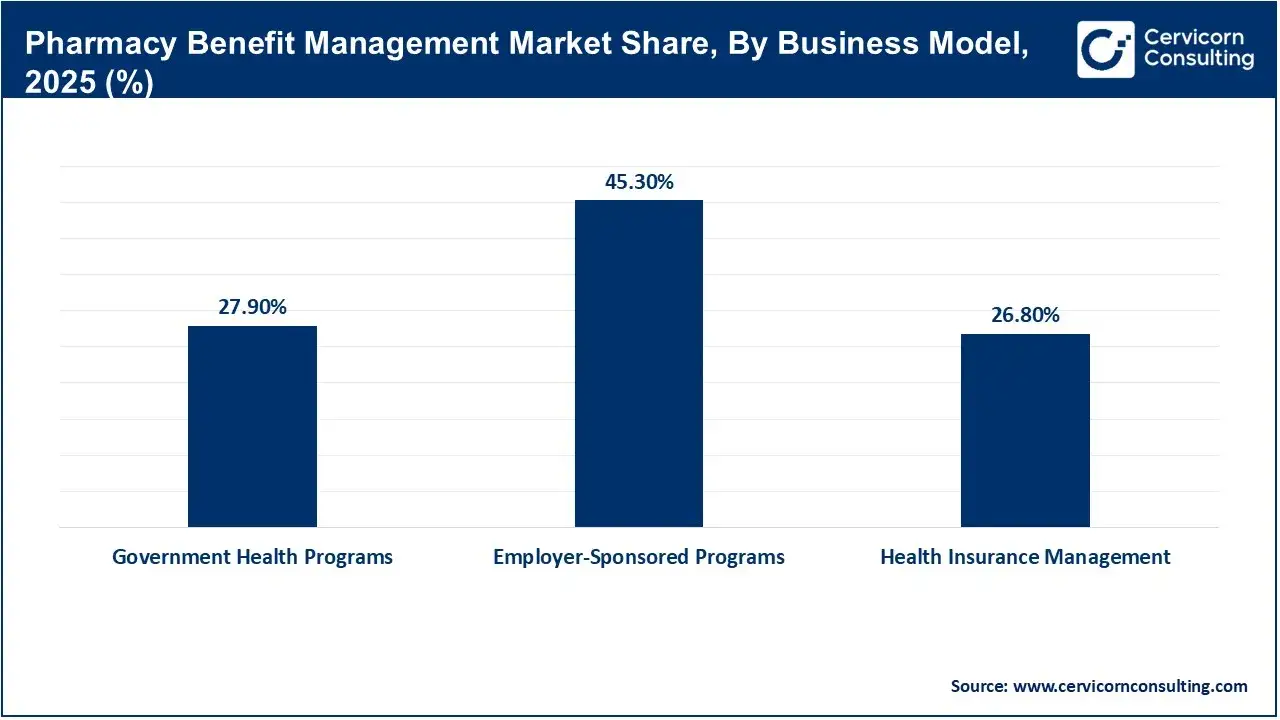
Government health programs are projected to be the fastest-growing business model, supported by expanding prescription coverage, medicare and medicaid participation, and increasing government efforts to manage pharmaceutical expenditures. Government programs increasingly require PBMs to administer formularies, negotiate discounts, process claims, and implement utilization-management strategies. Regulatory reforms are also increasing reporting and transparency requirements; CMS requires PBMs serving qualified health plans to report information covering rebates, discounts, prescription volumes, and pharmacy utilization, supporting continued demand for sophisticated government-focused PBM services.
End Use Analysis
Pharmacy benefit management organizations remain a dominant end-use segment because they directly perform core functions including claims adjudication, formulary administration, rebate negotiation, pharmacy-network management, and utilization review. The concentration of PBM operations among major organizations reinforces their market position; in 2023, the four largest national PBMs collectively provided 67% of rebate-negotiation services. Their extensive payer, pharmacy, and manufacturer relationships provide scale advantages that support continued dominance across the PBM ecosystem.
Pharmacy Benefit Management Market, By End Use, 2025 (%)
| End Use |
Revenue Share, 2025 (%) |
| Pharmacy Benefit Management Organizations |
42.8% |
| Retail Pharmacies |
32.2% |
| Mail-Order Pharmacies |
8.6% |
| Inpatient Pharmacies |
5.1% |
| Outpatient Pharmacies |
4.2% |
| Healthcare Providers |
4.3% |
| Others |
2.8% |
Mail-order pharmacies are expected to record the fastest growth as patients and payers increasingly favor convenient prescription delivery, recurring-refill programs, and cost-efficient medication distribution. PBMs are expanding mail-order capabilities to improve adherence and reduce dispensing costs for maintenance medications, particularly among patients requiring long-term therapies. Industry estimates indicate mail-order pharmacies could achieve approximately 7.6% growth through 2031, supported by chronic disease management, digital prescription platforms, home delivery adoption, and increasing preference for convenient pharmacy services.
Pharmacy Benefit Management Market Top Companies
Segments Covered
By Service
- Specialty Pharmacy Services
- Drug Formulary Management
- Retail Pharmacy Services
- Benefit Plan Design and Consultation
- Disease Management Services
- Others
By Business Model
- Government Health Programs
- Employer-Sponsored Programs
- Health Insurance Management
By End Use
- Pharmacy Benefit Management Organizations
- Retail Pharmacies
- Mail-Order Pharmacies
- Inpatient Pharmacies
- Outpatient Pharmacies
- Healthcare Providers
- Others
By Geography
- North America
- Europe
- Asia-Pacific
- LAMEA