Personal Radiation Detector Market Size, Growth, Forecast 2026 To 2035
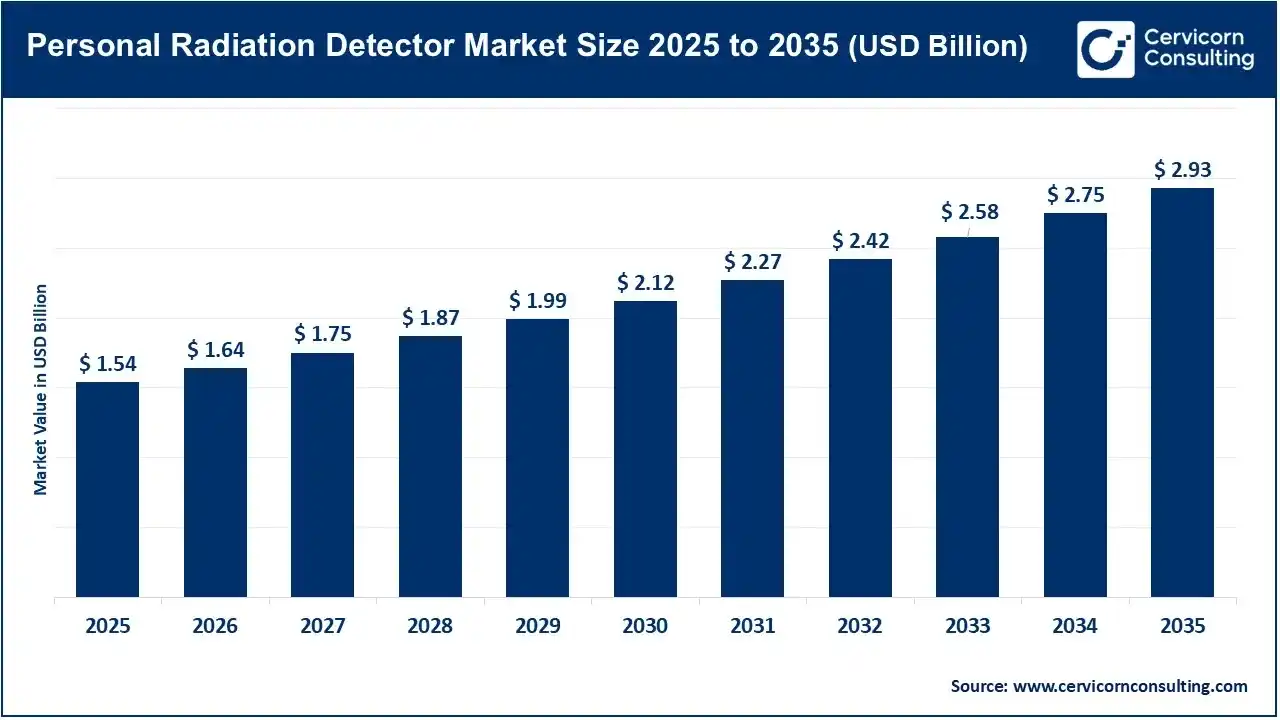
The global personal radiation detector market size was valued at USD 1.54 billion in 2025 and is expected to be worth around USD 2.93 billion by 2035, exhibiting a compound annual growth rate (CAGR) of 6.6% over the forecast period 2026 to 2035. The growing number of workers exposed to ionizing radiation is a major demand driver for personal radiation detectors across nuclear power, healthcare, industrial, defense, and research applications. UNSCEAR estimates that approximately 24 million workers worldwide were exposed to natural and human-made sources of ionizing radiation during 2010–2014, with around 48% exposed to human-made sources.
Increasing emphasis on occupational safety, dose monitoring, and regulatory compliance is encouraging organizations to deploy compact, real-time personal detectors. Meanwhile, the nuclear sector continues to provide a substantial addressable user base, with 417 nuclear reactors operating across 31 countries at the end of 2024 and another 62 reactors under construction, supporting demand for radiation-monitoring equipment among plant personnel, contractors, and emergency-response teams.
Expansion of radiation-based medical procedures and advances in wearable detection technologies are further supporting market growth. UNSCEAR estimates that approximately 4.2 billion medical radiological examinations were conducted annually during 2009–2018, including about 403 million CT examinations, while CT contributed approximately 61.6% of collective effective dose despite representing only 9.6% of procedures. This increasing use of diagnostic imaging, nuclear medicine, and interventional procedures is raising awareness of occupational exposure among healthcare professionals. At the same time, manufacturers are integrating Bluetooth, wireless connectivity, GPS, smartphone applications, miniaturized sensors, and real-time alarming into personal radiation detectors, enabling continuous dose tracking and centralized safety management. These developments are expanding adoption beyond traditional nuclear and defense environments into hospitals, laboratories, emergency services, industrial inspection, and environmental monitoring.
Report Highlights
- North America represented approximately 38.2% regional share, supported by nuclear infrastructure, healthcare applications, defense spending, and stringent safety regulations.
- Europe accounted for approximately 28.7% share, supported by nuclear operations, radiation-safety regulations, healthcare monitoring, and extensive nuclear decommissioning activities.
- Handheld personal radiation detectors dominated with 42.5% share, supported by portability, rapid screening, reliability, and extensive field applications.
- Geiger-Müller counters accounted for 39.5% share, benefiting from affordability, established reliability, simple operation, and rapid radiation detection capabilities.
- Nuclear power plants accounted for 29.8% application share, driven by worker monitoring, maintenance activities, emergency preparedness, and regulatory compliance.
What is a Personal Radiation Detector?
A personal radiation detector (PRD) is a compact, portable electronic device designed to detect and alert users to the presence of ionizing radiation, typically including gamma, beta, alpha, and sometimes neutron radiation. PRDs continuously monitor radiation levels and can provide audible, visual, or vibration alarms when exposure exceeds predefined thresholds, helping personnel identify potential radiation hazards in environments such as nuclear facilities, hospitals, laboratories, industrial sites, military operations, border security, and emergency response. Modern devices increasingly incorporate digital displays, data logging, wireless connectivity, GPS, and real-time monitoring, improving situational awareness and enabling faster response to radiological threats.
Personal Radiation Detector Market Recent Milestones
| Year |
Company |
Milestone |
| 2019 |
Mirion Technologies |
Launched AccuRad, a personal radiation detector designed for emergency responders and field operations. |
| 2021 |
AMETEK |
Introduced the RADEAGLET-R, a rugged, portable radioisotope identification device targeted at military, first responders, customs, and intelligence organizations. |
| 2024 |
Thermo Fisher Scientific |
Launched Thermo Scientific NetDose Pro, a connected wearable digital dosimeter enabling real-time radiation monitoring and wireless data transmission. |
| 2025 |
Mirion Technologies |
Agreed to acquire Paragon Energy Solutions for approximately USD 585 million, strengthening its position in nuclear instrumentation and related radiation-monitoring applications. |
| 2025 |
SPC Doza |
Launched a dedicated SMR monitoring suite incorporating continuous air and environmental radiation sensors for small modular reactor applications. |
| 2026 |
Radiation Detection Company |
Introduced Radiant real-time dosimetry, integrating continuous radiation-exposure awareness, intelligent feedback, and actionable monitoring insights. |
Personal Radiation Detector Market Dynamics
Market Drivers
1. Increasing nuclear security and emergency-response requirements
Governments are strengthening capabilities to detect unauthorized radioactive materials at borders, critical infrastructure, and public events, creating demand for portable personal radiation detectors. Radiation detection is increasingly integrated into broader homeland-security and emergency-preparedness programs, particularly for first responders and law-enforcement personnel. In 2025, homeland security represented approximately 17.8% of personal radiation detector application revenues, highlighting the importance of security-related deployments.
2. Growing adoption of advanced medical radiation technologies
Increasing utilization of CT, PET, nuclear medicine, radiotherapy, and interventional procedures is strengthening demand for accurate personnel exposure monitoring. Personal dosimeters accounted for approximately 66.0% of the medical radiation detection product segment in 2025, demonstrating the importance of individual monitoring in healthcare environments. Hospitals represented about 71.7% of medical radiation detection end-use revenues, supported by growing radiation-safety requirements and increasing numbers of radiation-producing systems.
Market Restraints
1. High calibration and lifecycle-maintenance requirements
Personal radiation detectors require periodic calibration, accuracy verification, testing, and maintenance to ensure reliable dose measurements. These requirements increase the total cost of ownership and can discourage smaller industrial facilities or organizations with limited safety budgets from replacing conventional monitoring equipment. Regulatory frameworks also require appropriate monitoring and recordkeeping of occupational exposure, while individual-monitoring and calibration providers may require formal authorization. Such compliance obligations can lengthen procurement cycles and increase operational expenditure.
2. Limited awareness and adoption in developing markets
Radiation-monitoring adoption remains constrained in regions where organizations have limited awareness of occupational radiation risks, insufficient safety infrastructure, or restricted budgets for specialized detection equipment. This is particularly relevant among smaller industrial operators and healthcare facilities. At the same time, technology selection can be complicated by differences in detector capabilities and certification requirements. For example, semiconductor detectors are forecast to expand at approximately 7.9% annually through 2035, increasing competition between conventional and advanced detection technologies.
Market Opportunities
1. Integration of connected and cloud-based monitoring
Wireless connectivity, cloud platforms, mobile applications, and real-time analytics are creating opportunities to transform personal radiation detectors from standalone alarms into connected safety-management systems. These solutions can allow radiation-safety officers to remotely monitor worker exposure, generate automated records, and identify abnormal exposure patterns. The medical radiation sector is increasingly shifting toward connected real-time dosimetry, while the broader market is moving toward digital connectivity, predictive analytics, and cloud-native architectures.
2. Expansion of nuclear energy and advanced reactor projects
New nuclear construction, reactor modernization, and emerging small modular reactor projects are creating opportunities for compact and rugged radiation-monitoring technologies. Demand can extend beyond permanent plant employees to contractors, maintenance teams, emergency responders, and inspection personnel. The Asia-Pacific radiation detection market is particularly attractive, with the region expected to expand at approximately 8.3% annually through 2035, supported by nuclear development, healthcare investment, and industrial safety requirements.
Market Challenges
1. Balancing detection sensitivity with device size and battery life
Manufacturers must achieve high radiation-detection sensitivity while keeping personal devices lightweight, wearable, durable, and energy efficient. Adding features such as isotope identification, wireless communication, GPS, continuous monitoring, and digital displays can increase power consumption and hardware complexity. This creates engineering challenges because users increasingly expect compact devices capable of operating reliably in demanding field environments without frequent charging, while maintaining measurement accuracy and minimizing false alarms.
2. Complex regulatory and certification requirements across countries
Personal radiation detectors must satisfy radiation-safety, electromagnetic compatibility, performance, calibration, and procurement requirements that can differ between jurisdictions and end-use sectors. These requirements create barriers for manufacturers attempting to commercialize products internationally and can increase testing and certification costs. Furthermore, radiation-monitoring programs require traceable measurements and documented exposure records; therefore, suppliers must provide not only reliable hardware but also calibration, software, servicing, and technical-support capabilities throughout the product lifecycle.
Regional Analysis
The personal radiation detector market is segmented by region into North America, Europe, Asia-Pacific, Latin America, and LAMEA. Here is a brief overview of each region:
North America Personal Radiation Detector Market: Driven by Homeland Security, Nuclear Infrastructure, Healthcare Radiation Safety, Defense Modernization, and Advanced Detection Technologies
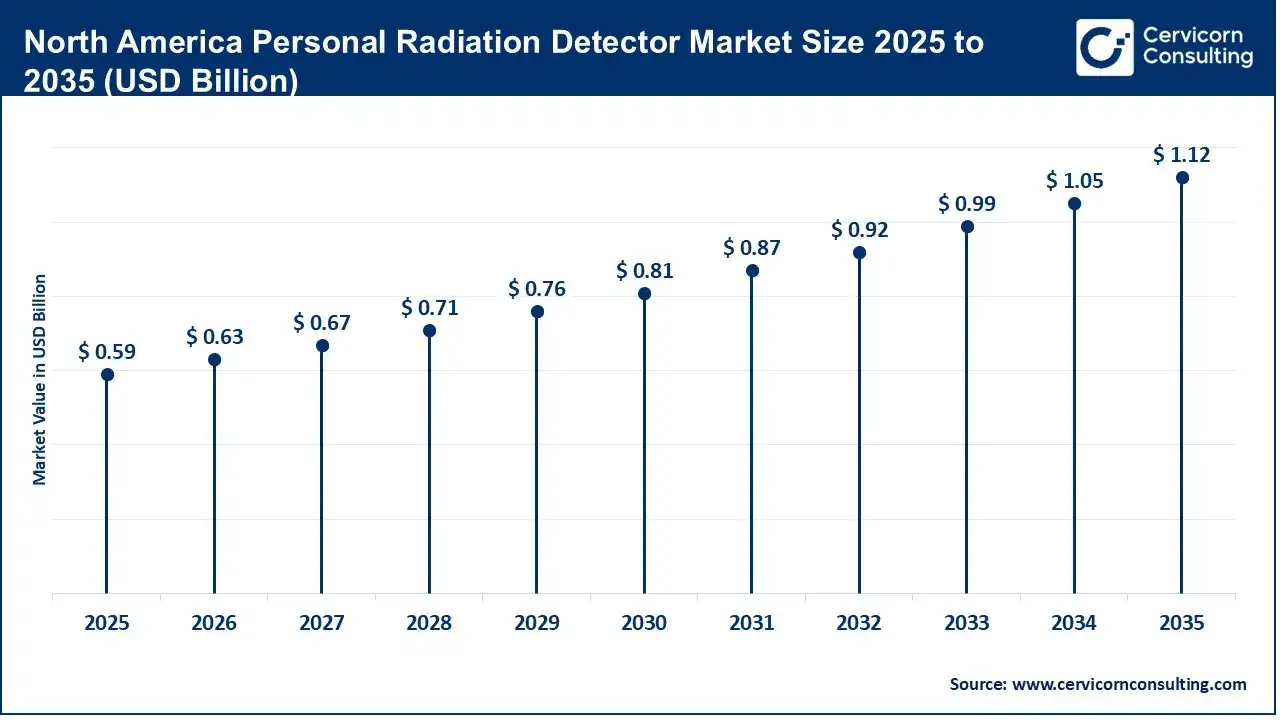
The North America personal radiation detector market size was valued at USD 0.59 billion in 2025 and is forecasted to grow USD 1.12 billion by 2035. North America is a leading and technologically advanced region, supported by stringent occupational radiation-safety requirements, extensive nuclear infrastructure, defense modernization, homeland-security investments, and increasing use of radiation-based medical technologies. The United States dominates regional demand, supported by federal agencies, nuclear power operators, hospitals, emergency responders, and defense organizations, while Canada contributes through its nuclear-energy and healthcare sectors. The region also benefits from strong presence of major radiation-detection manufacturers, accelerating adoption of connected, wearable, spectroscopic, and semiconductor-based personal detection systems.
United States: Homeland Security, Nuclear Power, Defense Spending, and Medical Radiation Monitoring Drive Market Demand
- The United States operates 94 commercial nuclear reactors, making nuclear facilities an important end-use base for personal radiation detectors among plant workers, contractors, maintenance personnel, and emergency teams.
- The U.S. Nuclear Regulatory Commission regulates approximately 3,300 radioactive-material licensees, creating a broad institutional requirement for radiation monitoring, worker protection, and compliance.
- The country conducted approximately 1.1 billion diagnostic imaging procedures annually, including X-rays, CT, and nuclear medicine examinations, supporting continued demand for occupational radiation monitoring among healthcare professionals.
Canada: Nuclear Energy, Healthcare Radiation Safety, and Emergency Preparedness Support Market Development
- Canada has 17 operating nuclear reactors, concentrated primarily at Ontario's nuclear facilities, creating sustained demand for personal radiation monitoring among nuclear workers and contractors.
- The country has approximately 200,000 licensed nuclear-energy and radiation workers, reflecting a substantial occupational user base requiring radiation-protection measures and monitoring.
Asia-Pacific (APAC) Personal Radiation Detector Market: Driven by Nuclear Expansion, Healthcare Modernization, Industrialization, Defense Preparedness, and Radiation-Safety Regulations
The Asia-Pacific personal radiation detector market size was estimated at USD 0.37 billion in 2025 and is expected to surpass USD 0.71 billion by 2035. Asia-Pacific is a high-growth and strategically important region, supported by expanding nuclear-power programs, rapid healthcare infrastructure development, industrialization, defense modernization, and strengthening radiation-safety regulations. China, Japan, South Korea, and India represent major demand centers because of their nuclear-energy infrastructure, large healthcare systems, industrial bases, and government investments in radiological security. The region's broader radiation-detection market is projected to expand at approximately 8.3% annually through 2035, reflecting increasing adoption of advanced monitoring technologies.
China: Nuclear Expansion, Industrial Development, Healthcare Growth, and Homeland Security Support Market Demand
- China operates 60 commercial nuclear power reactors, with additional reactors under construction, creating a substantial installed base for worker radiation monitoring.
- China had approximately 39 nuclear power reactors under construction, representing one of the world's largest nuclear construction pipelines and creating long-term demand for radiation-safety equipment.
- The country accounts for a significant share of global nuclear construction activity, increasing requirements for personal detectors among plant workers, maintenance teams, contractors, and emergency-response personnel.
Japan: Nuclear Safety, Reactor Restarts, Healthcare Applications, and Disaster Preparedness Drive Demand
- Japan has 33 reactors classified as operable, although only a portion are currently generating electricity, providing a substantial long-term market base as reactor operations resume.
- The country has restarted multiple nuclear reactors following post-Fukushima safety upgrades, increasing requirements for worker monitoring and radiation-protection equipment.
Europe Personal Radiation Detector Market: Driven by Nuclear Fleet Modernization, Strict Radiation-Safety Regulations, Healthcare Applications, Industrial Monitoring, and Emergency Preparedness
The Europe personal radiation detector market size was valued at USD 0.44 billion in 2025 and is projected to hit USD 0.84 billion by 2035. Europe is a mature and technologically advanced market, supported by stringent occupational-safety regulations, an established nuclear-power fleet, sophisticated healthcare infrastructure, industrial applications, and strong emergency-preparedness programs. The European Union had 101 operating nuclear reactors across 12 member states at the end of 2024, with combined net capacity of 98 GWe, while nuclear power generated 22.8% of EU electricity in 2023. The region's regulatory environment further supports demand through comprehensive requirements for occupational and medical radiation protection.
France: Large Nuclear Fleet, Worker Safety, Nuclear Medicine, and Reactor Modernization Support Market Demand
- France operates 57 nuclear reactors, giving it one of Europe's largest installed nuclear fleets and creating sustained requirements for personal radiation monitoring.
- Nuclear power generated approximately 67% of France's electricity in 2024, reinforcing the country's dependence on nuclear infrastructure and associated radiation-safety equipment.
- Extensive reactor maintenance, modernization, inspection, and lifetime-extension programs create recurring demand for radiation detectors among workers and contractors.
Germany: Nuclear Decommissioning, Medical Radiation Applications, Industrial Safety, and Research Support Demand
- Germany completed its nuclear power phase-out in 2023, but decommissioning activities at multiple nuclear facilities continue to require radiation monitoring for workers, contractors, and specialized service providers.
- Germany's extensive industrial base creates additional applications in non-destructive testing, research, laboratories, and radiation-based industrial processes.
Personal Radiation Detector Market Share, By Region, 2025 (%)
| Region |
Revenue Share, 2025 (%) |
| North America |
38.2% |
| Europe |
28.7% |
| Asia-Pacific |
24.2% |
| LAMEA |
8.9% |
LAMEA Personal Radiation Detector Market: Driven by Nuclear Energy Development, Healthcare Expansion, Industrial Radiography, Homeland Security, and Strengthening Radiation-Safety Infrastructure
The LAMEA personal radiation detector market was valued at USD 0.14 billion in 2025 and is anticipated to reach USD 0.26 billion by 2035. LAMEA is an emerging market, characterized by significant differences in adoption between Latin America, the Middle East, and Africa. Demand is being supported by nuclear-power development, expanding medical imaging and radiotherapy infrastructure, industrial radiography, mining, defense, and radiological-security programs. Brazil and Mexico represent important Latin American markets, while the UAE, Saudi Arabia, and Egypt are key Middle Eastern demand centers. Africa remains comparatively underpenetrated, but nuclear development and international radiation-safety programs are creating substantial long-term opportunities.
Latin America: Healthcare Expansion, Nuclear Generation, Industrial Radiography, and Radiation-Safety Programs Support Market Demand
- Brazil is the leading market in Latin America, supported by its two operating nuclear reactors at Angra and ongoing development of the Angra 3 project.
- Brazil's industrial radiography, healthcare, research, and nuclear sectors create recurring requirements for personal dosimeters and portable radiation detectors.
- Mexico represents another important market, with expanding healthcare infrastructure and industrial radiography applications supporting demand for radiation-monitoring equipment.
Middle East: Nuclear Power Development, Healthcare Modernization, Homeland Security, and Infrastructure Investment Drive Growth
- The UAE, Saudi Arabia, and Egypt are emerging as major regional demand centers because of nuclear-energy development and investments in radiological safety infrastructure.
- The UAE's Barakah Nuclear Energy Plant has four operating units, creating an established requirement for worker dosimetry, radiation monitoring, and emergency-response equipment.
- Egypt is constructing four large nuclear reactors, creating substantial future demand for personal radiation detectors during construction, commissioning, operation, and maintenance activities.
Segmental Analysis
The personal radiation detector market is segmented into product type, detection technology, application, and geography.
Product Type Analysis
Handheld detectors are expected to dominate the product-type segment because they combine portability, immediate readings, operational flexibility, and broad applicability across nuclear facilities, healthcare, industrial inspection, and emergency response. A recent industry assessment indicates handheld detectors accounted for approximately 42.5% of the portable personal radiation detector market in 2025. Their ability to support rapid area surveys and secondary inspections makes them particularly valuable for first responders and radiation-safety personnel.
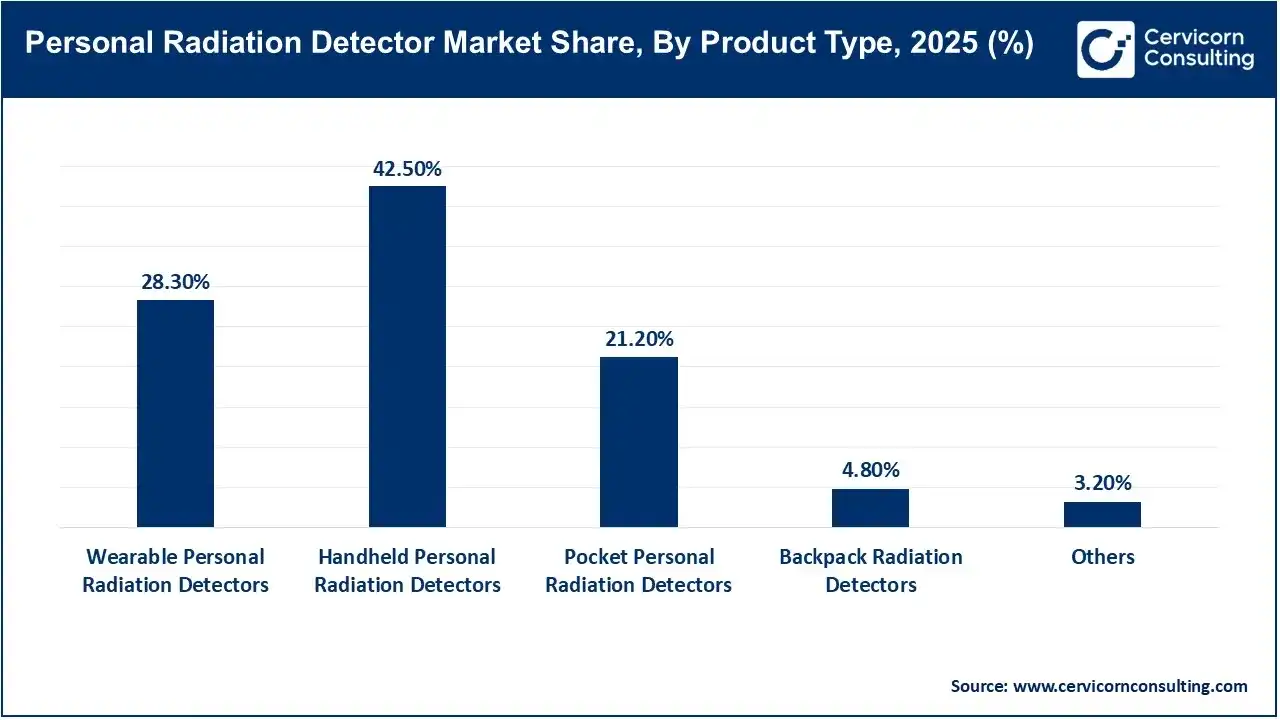
Wearable detectors are projected to be the fastest-growing product segment as organizations increasingly prioritize continuous, hands-free radiation monitoring. Industry estimates indicate the wearable segment could expand at approximately 10.2% CAGR, supported by miniaturization, wireless connectivity, mobile applications, and real-time exposure alerts. Unlike handheld devices, wearables allow personnel to monitor radiation while performing routine tasks without interrupting workflow. Growing adoption among healthcare workers, nuclear-plant personnel, emergency responders, and security officers is therefore strengthening demand for connected wearable formats.
Detection Technology Analysis
Geiger-Müller counters are expected to maintain a leading position because of their established reliability, relatively low cost, simple operation, and rapid radiation detection capabilities. They remain particularly suitable for personal monitoring, emergency response, field operations, and routine radiation-safety applications where immediate alarm functionality is more important than detailed isotope identification. Industry analysis identifies Geiger-based systems as among the most widely used technologies in personal radiation detection, supported by extensive installed infrastructure and recurring replacement demand across nuclear and industrial environments.
Personal Radiation Detector Market, By Detection Technology, 2025 (%)
| Detection Technology |
Revenue Share, 2025 (%) |
| Geiger-Müller Counters |
39.5% |
| Scintillation Detectors |
25.8% |
| Semiconductor Detectors |
19.7% |
| Ionization Chamber Detectors |
8.6% |
| Spectroscopic Detectors |
4.1% |
| Others |
2.3% |
Semiconductor detectors represent the fastest-growing technology segment as manufacturers increasingly prioritize miniaturized devices offering higher energy resolution, improved accuracy, and digital integration. The broader radiation detection market projects semiconductor technology to expand at approximately 7.9% annually through 2035, driven by advances in CZT and other solid-state materials. Their ability to support precise isotope identification and integration with connected monitoring platforms is particularly attractive for homeland security, defense, advanced medical applications, and high-performance personal detection equipment.
Application Analysis
Nuclear power plants are expected to remain the leading application segment because radiation monitoring is integral to worker protection, plant operations, maintenance, inspection, and emergency preparedness. One recent market assessment estimates nuclear power plants represented approximately 29.8% of global personal radiation detector revenues in 2025. The segment benefits from mandatory radiation-monitoring programs, reactor maintenance and refurbishment, new nuclear construction, and decommissioning activities, all of which require reliable personal detection equipment for workers and contractors operating in controlled areas.
Personal Radiation Detector Market, By Application, 2025 (%)
| Application |
Revenue Share, 2025 (%) |
| Nuclear Power Plants |
29.8% |
| Healthcare & Medical |
27.4% |
| Homeland Security |
17.8% |
| Military & Defense |
11.6% |
| Industrial |
7.4% |
| Emergency Response |
4.6% |
| Others |
1.4% |
Homeland security is expected to be among the fastest-growing application segments as governments strengthen capabilities for detecting illicit radioactive materials, radiological threats, and nuclear-security incidents. Demand is increasing across border checkpoints, ports, airports, law-enforcement operations, and major public-event security. Industry data indicates homeland security and defense applications in the broader radiation-detection market are projected to grow at approximately 7.3% annually, supported by modernization of detection networks and increasing deployment of portable and personal systems for frontline personnel and secondary screening operations.
Personal Radiation Detector Market Top Companies
Segments Covered
By Product Type
- Wearable Personal Radiation Detectors
- Handheld Personal Radiation Detectors
- Pocket Personal Radiation Detectors
- Backpack Radiation Detectors
- Others
By Detection Technology
- Geiger-Müller Counters
- Scintillation Detectors
- Semiconductor Detectors
- Ionization Chamber Detectors
- Spectroscopic Detectors
- Others
By Application
- Homeland Security
- Military & Defense
- Nuclear Power Plants
- Healthcare & Medical
- Industrial
- Emergency Response
- Others
By Geography
- North America
- Europe
- Asia-Pacific
- LAMEA