Paper Bottles Market Size and Growth 2026 to 2035
The global paper bottles market size was valued at USD 72.97 million in 2025 and is expected to reach around USD 129.43 million by 2035, exhibiting at a compound annual growth rate (CAGR) of 5.95% over the forecast period from 2026 to 2035. The rise in environmental awareness and stricter laws regarding the reduction of single-use plastics are two factors contributors to the growth of the paper bottle market. In Europe and parts of North America, numerous government programs, such as bans, taxes, and Extended Producer Responsibility (EPR) programs, have created incentives to develop new products that are recyclable and compostable. Many consumers are demanding sustainable, low-carbon package options, and as a result, beverage, personal care, and household product brands are moving to use paper bottles in place of standard plastic bottles. Strong ESG commitments made by many large global brands and retailers are creating additional incentives for organizations to pursue paper bottle alternatives to traditional plastic bottling.
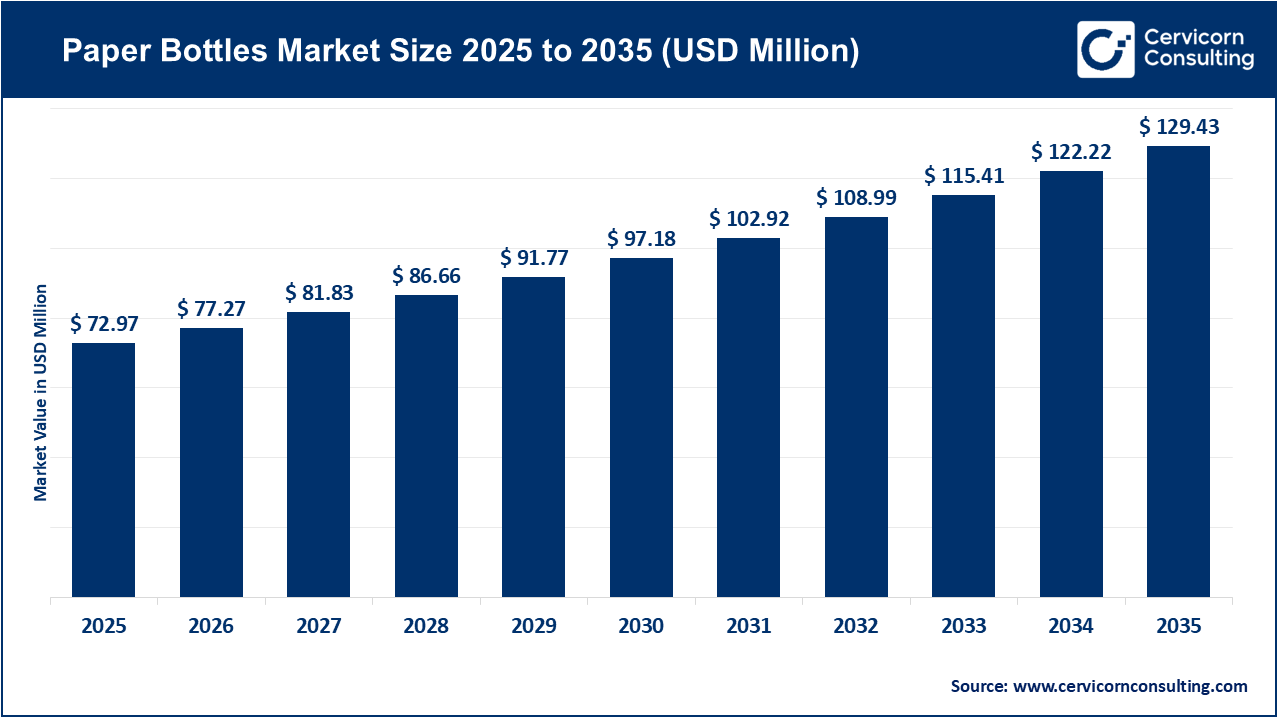
Technological advancements in paper-based packaging and barrier coatings are also driving substantial growth in the paper bottle market. Many of these new technologies have improved the strength, durability, and liquid-holding capabilities of paper bottles. The adoption of innovative technologies, such as molded fiber technology, water-resistant lining systems, and recyclable bio-barriers, continues to expand the commercial scope of paper bottles while maintaining the integrity of the product in terms of safety and shelf life. In addition, increasing demand for paper-based bottles from North America as a result of growing awareness regarding sustainability and rapid growth in the Asia-Pacific region driven by urbanization, an expanding middle-class consumer base, and government support for green packaging. All of these factors have positioned paper bottles as a viable long-term alternative to plastic packaging.
Report Highlights
- Europe leads the paper bottles market with a 37% share, driven by early AI adoption, hyperscale cloud infrastructure, and strong enterprise investment.
- Medium-capacity paper bottles (101–500 ml) dominate the capacity segment with a 50% share, driven by widespread use in water, beverages, and personal care products requiring convenient, everyday packaging sizes.
- Everyday usage accounts for the largest primary usage share at 55%, supported by daily consumption of bottled water, personal care items, and household products shifting toward eco-friendly packaging formats.
- Beverages represent the leading end-use segment with a 30% share, driven by rapid replacement of plastic bottles in water, juice, and ready-to-drink products to meet sustainability targets.
Government Regulations and Plastic Bans Driving the Shift toward Paper Bottles
The market for paper bottles is being driven in large part by government investments and bans on single-use plastics, as lawmakers around the globe have increased the amount of regulation on reducing plastic waste and carbon emissions. Regulations such as plastic bottle taxes, outright bans on specific types of plastic packaging, mandatory targets for using recycled materials, and EPR (Extended Producer Responsibility) programs are motivating manufacturers to adopt sustainable alternatives. Europe is leading the way with stringent EU Packaging Directives. However, North America & Asia-Pacific are working to develop similar regulatory roadmaps to reduce dependence on plastics. These new policies have increased bot h the cost and compliance burdens associated with using plastic packaging and have provided strong motivation for new product development and commercialization of paper bottles, thus accelerating the acceptance of this type of product in various industries such as beverage, personal care & household.
Rising Ocean Plastic Pollution Accelerating the Shift to Paper Bottles
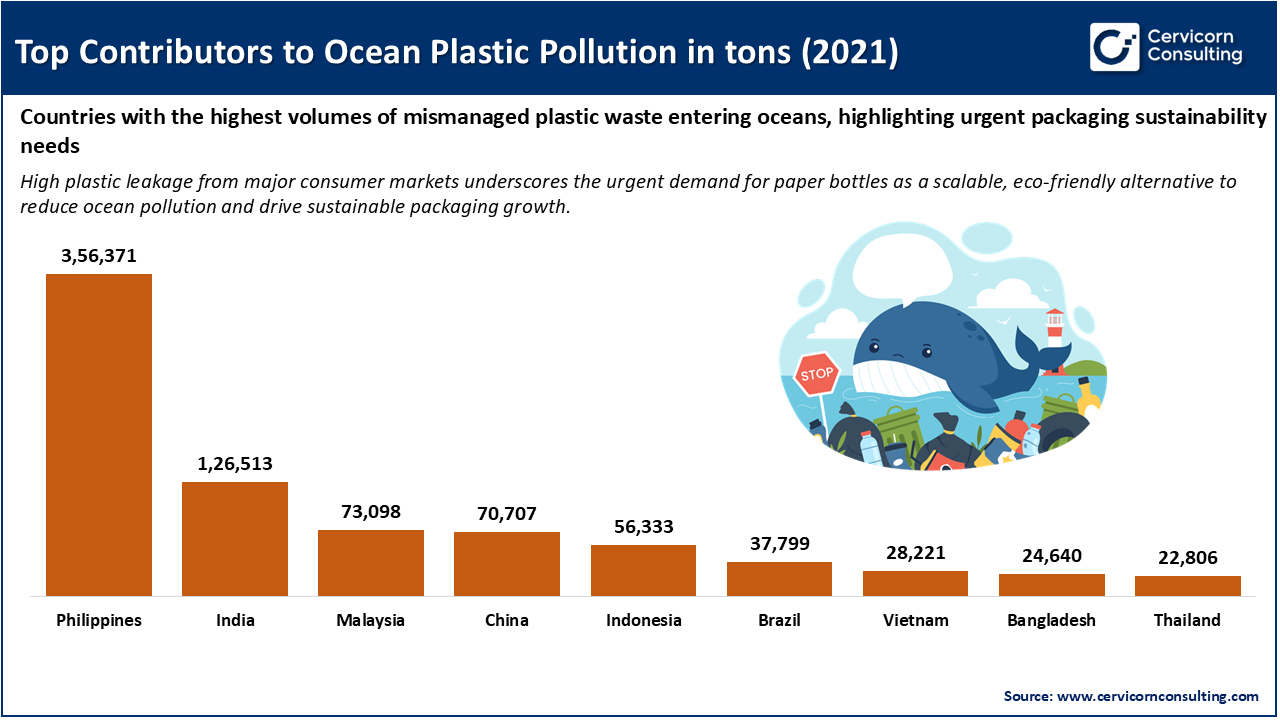
Ocean plastic pollution data highlights the urgent need for sustainable packaging alternatives. In 2021, the Philippines alone released over 356,000 tons of plastic waste into the ocean, while India contributed more than 126,000 tons, with several other Asian countries adding tens of thousands of tons each year. Globally, around 11 million tons of plastic enter the oceans annually, and packaging accounts for over 40% of total plastic use. These figures are driving stricter regulations and corporate commitments to cut plastic consumption, accelerating the adoption of paper bottles as a recyclable, lower-impact alternative and supporting the growth of the paper bottle market.
Recent Major Milestones
1: Large-Scale Capital Investment in Advanced Manufacturing Facilities
The paper bottle company (Paboco) was honored by the successful launch of their first commercial-scale production line, moving from experimental pilots to large-volume manufacturing. The launch of a next-generation fiber-forming technology designed to produce millions of paper bottles per year with much lower plastic liner content was the major impetus driving this effort with the global brand. Owners are facing targets for sustainability, coinciding with compliance with the European Union's Packaging and Packaging Waste Regulation (PPWR) initiative requiring all member states to increase overall recyclability. This investment validates market optimism that fiber-based liquid packaging can meet high durability and barrier performance requirements of high market distribution, with a much lower carbon footprint compared to traditional PET or glass containers.
2: National Policy Frameworks Enabling Renewable Packaging Solutions
The European Union implemented the packaging and packaging waste regulation, making a significant government-driven milestone that changed the market's trajectory. Government initiatives are a major driver, mandating recycled content requirements and requiring all packaging sold in the EU to be fully recyclable. For the paper bottle category, this regulation has expedited the transition to mono-material fiber options and moved manufacturers through the early phases of eliminating multi-material laminates that are impossible to recycle. Designing for recycling has now become a legal requirement. This regulatory certainty is allowing investors to finance capital investments in new paper bottle technologies, as sustainability is no longer simply corporate citizenship but a requirement to participate in the market.
3: Collaborative R&D for Bio-based Material Development
In 2025, a large investment was made in Pulpex, a leader in moulded fibre, to establish paper bottle manufacturing regions in both North America and Asia Pacific. This process reflects the global driver of supply chain resilience and producing sustainable packaging closer to consumers to reduce scope. The government also supported favorable policy frameworks such as the Executive Order on Advancing Biotechnology and Biomanufacturing Innovation and provided funding for investment to produce renewable materials. This unprecedented capital access provides for the expansion of R&D centers on advanced bio-based liners and will ensure future products can yield more robust quality paper bottles that can contain, for example, carbonated beverages and beer, which has historically presented major technical challenges for fiber-based structures.
4: Government-Supported Infrastructure for Circular Supply Chain Resilience
In 2025, the Ministry of Industry and Information Technology (MIIT) in China start Initiative such as the National Green Packaging, a comprehensive subsidy program to accelerate bio-based packaging. This initiative has become the strong growth for the paper bottle market in Asia, with a targeted focus on personal care and cosmetics. The Chinese government is supporting companies that use fiber-based bottles for daily use with a subsidy to initiate domestic manufacturing. This type of government action is necessary to address the global plastic waste epidemic in the most populated market and intends to position China as a leader in green chemistry. The initiative will ensure that the proper infrastructure is scaled to produce and recycle bio-based materials and create a robust circular supply chain.
Market Dynamics
Market Drivers
- Growing Consumer Preference for Biodegradable Packaging: The modern consumer is moving from eco-conscious to eco-visible, a major driver of the market. Consumers are increasingly utilizing eco-visible, societal-based visibilities as influencers in their purchasing decisions based on packaging sustainability. Regardless of functional recyclability, consumers are paying attention to visually and tactilely natural materials like paper and molded fiber. Brands are using these aspects to support their Environmental, Social, and Governance (ESG) stories. The distinct difference in packaging materials is that recycled plastics will look indistinguishable from virgin, while paper bottles are a clear indicator of one decision to be a sustainable company. The benefits of the paper bottle market are most effective with consumer packaged goods (CPG) products in the beverage and personal care sectors, where packaging is often the first consumer touchpoint.
- Government regulations and mandates on plastic reduction are increasing: Governmental intervention is the most influential agent of change in the packaging market. Increasingly, globally regulated frameworks are targeting the single-use plastics (SUPs) market through bans, taxes, and recycled content requirements. For example, the European Union's new Single-Use Plastics Directive, along with the upcoming Packaging and Packaging Waste Regulation (PPWR), proposes serious accountability for circularity and waste reduction. In North America and Europe, policy movements have evolved from a focus on recycling rates and targets to comprehensively framed mandates that include extended producer responsibility (EPR) based on target SUP use and minimum recycled content. Similarly, the regulations dictating the need to authorize particular substances in plastic food packaging, which depend on compliance costs, ultimately facilitate attractiveness for alternatives like paper.
Market Restraints
- Technical Limitations in Barrier Coating and Liquid Containment: The advanced technologies for paper bottles have a strong market pull for products that need alternative packaging. Natural paper products, being absorbent, do not have inherent barrier properties that would preclude liquids or degradation over long periods without leaking. Solution-based manufacturers, typically paper and molding, have used barrier coatings or liners that potentially introduce complicated chemical additives that will help with biodegradability and performance. However, a primary challenge is that the barrier must provide sufficient protection for the product while using a thinner coating to enhance recovery during recycling. Research into cellulose-based food packaging materials indicates a barrier to performance will be required to protect food, shelf life, and management in the waste stream. For many products with high moisture or acidity, existing bio-based coatings do not provide the same oxygen and moisture protection as traditional PET plastic.
- High Production Costs and Supply Chain Maturity Gaps: High production costs and supply chain maturity gaps currently constrain the economic viability of paper bottles. Molded fiber container manufacturing is much more energy intensive and slower than high-speed blow molding of PET bottles. While traditional packaging producers have the luxury of optimizing for cost and functionality, transitioning to sustainable alternatives involves, in most cases, a green premium, which many brands would rather not absorb for the mass market. In addition, any transition requires significant capital expenditure (CAPEX) to modify filling and labeling lines. The material handling and transportation equipment are designed for rigid plastic or glass; the novel geometry and material properties of paper bottles will require specialized equipment.
Market Opportunities
- Integration of Bio-Based Materials and Circular Economy Initiatives: The greatest opportunity for growth in the paper bottle market is replacing existing polymer liners with bio-based alternatives, such as polyhydroxyalkanoates (PHAs) or seaweed-based coatings. These solutions make the entire bottle compostable or a recyclable component in typical paper streams, helping to eliminate the current composite stigma with product recycling. The transition towards a circular economy has also driven the adoption of smart packaging technologies. Digital solutions such as QR codes or NFC tags would aid brand owners and consumers in verifying recycling instructions to activate the closed loop of materials. Furthermore, bio-based polymers can aid the future of packaging materials to meet environmental expectations while maintaining the safety standards within food and pharma facilities.
- Expansion in the premium beverage and personal care verticals: High-margin sectors such as better spirits and excellent personal care could be ideal for entering the paper bottle market. These segments are typically less price sensitive than mass-market commodities; they offer unique brand and consumer experiences. When marketing plastic-free products, the increased unit price of a paper bottle is often not considered, as the marketing of plastic-free products is often framed in terms of value. High-quality digital printing and embossments on fiber surfaces allow brands to recreate aesthetics that plastic cannot replicate. As luxury brands pursue carbon-neutral commitments, the decision to use paper for packaging is driven by the lower carbon footprint of paper compared to the total carbon footprint assessed over its life cycle.
Market Challenges
- Owning Structural Integrity and Shelf-Life Stability: Many companies explore commercializing paper bottles a key challenge to widespread adoption is maintaining structural integrity across varying global supply chains. Unlike plastic, fiber is hygroscopic, which means it absorbs moisture from the surrounding environment. Areas with higher humidity or fluctuating temperatures may weaken the bottle's structural shell, leading to soggy packaging and higher spoilage rates. Additionally, packaging must accomplish a primary job of providing food safety and prolonging shelf life. Many shelf-stable products require packaging that will withstand certain industrial processes such as retorting or high-pressure processing, both of which currently pose challenges with fiber-based composites.
- Fragmentation of Global Recycling Infrastructure: The long-term sustainability of the paper bottle market will be threatened by varying global recycling infrastructures that are not standardized. Even if a bottle is technically recyclable, its end-of-life viability will depend on the local Material Recovery Facility (MRF). Many current recycling streams lack the capacity to manage the composite layering, which combines paper with internal liners. Furthermore, this fragmentation creates a risk of green washing, whereby brands may assert their recyclability, yet their claims remain unrealized. Some progress can be seen in regions such as Europe, where guidelines prepared by unfortunately named organizations such as CEPI are working to standardize paper-based packaging requirements. The market risks being inundated with low-quality composites if not approached in a unified, global manner, thereby harming the entire category's reputation and the transition to a truly circular economy.
Paper Bottles Market Regional Analysis
The paper bottles market is segmented into various regions, including North America, Europe, Asia-Pacific, and LAMEA. Here is a brief overview of each region:
Europe Paper Bottles Market: Driven by Strict Plastic Regulations Prompting Sustainable Packaging adoptions
The Europe paper bottles market size was estimated at USD 21.16 million in 2025 and is projected to surge around USD 37.53 million by 2035. Europe is an advanced and established market for paper bottles largely due to strong regulations that penalize plastic waste and incentivize circular economy structures. Major policies and initiatives such as the Single-Use Plastics Directive and Extended Producer Responsibility (EPR) schemes have created a legal structure whereby manufacturers are incentivized or potentially compelled to seek alternatives that are sustainable packaging solutions. In addition, EU consumers are environmentally aware and, in fact, are willing to pay a premium for sustainable packaging. Additionally, Europe has become a global hub for paper bottles, featuring many of the world's leading and most disruptive packaging startups and global research initiatives.
Recent Developments:
- Pulpex Ltd. entered for collaborating with major beverage brands in the UK and Europe to commercialize fiber-based paper bottles at scale.
- BillerudKorsnäs continusly support to paper bottle material innovation through collaborations under the Paper Bottle Company (Paboco) initiative.
Asia-Pacific Paper Bottles Market: Driven by Rapid Urbanization and Industrialization Driving Paper Bottles
The Asia-Pacific paper bottles market size was reached at USD 17.51 million in 2025 and is forecasted to surpass around USD 31.06 million by 2035. Asia-Pacific region is the fastest-growing market, driven by the rapid growth of urbanization, the emergence of a growing middle class, and the expansion of the largest e-commerce market. The across many cities, such as in China, India, and Southeast Asia, expands the need for packaged consumer goods while overall consumer awareness about plastic pollution is growing. Paper bottles provide an alternative that is still lightweight and durable for e-commerce delivery consumption, which is a major consumer driver in this region. Many Asian governments are developing new waste management policies aimed at preventing ocean plastic pollution, which is beneficial for the growth of the paper packaging industry.
Recent Developments:
- Kagzi Bottles and Shruti Agro are both seeking expanded paper bottle manufacturing capacity in India to serve domestic and export demand.
- In Asia, Regional beverage brands increase the adoption of paper-based bottles for aligns with government sustainability goals and consumer preferences.
North America Paper Bottles Market: Driven by Consumer Preference for Green Alternatives Fueling New Market Expansion
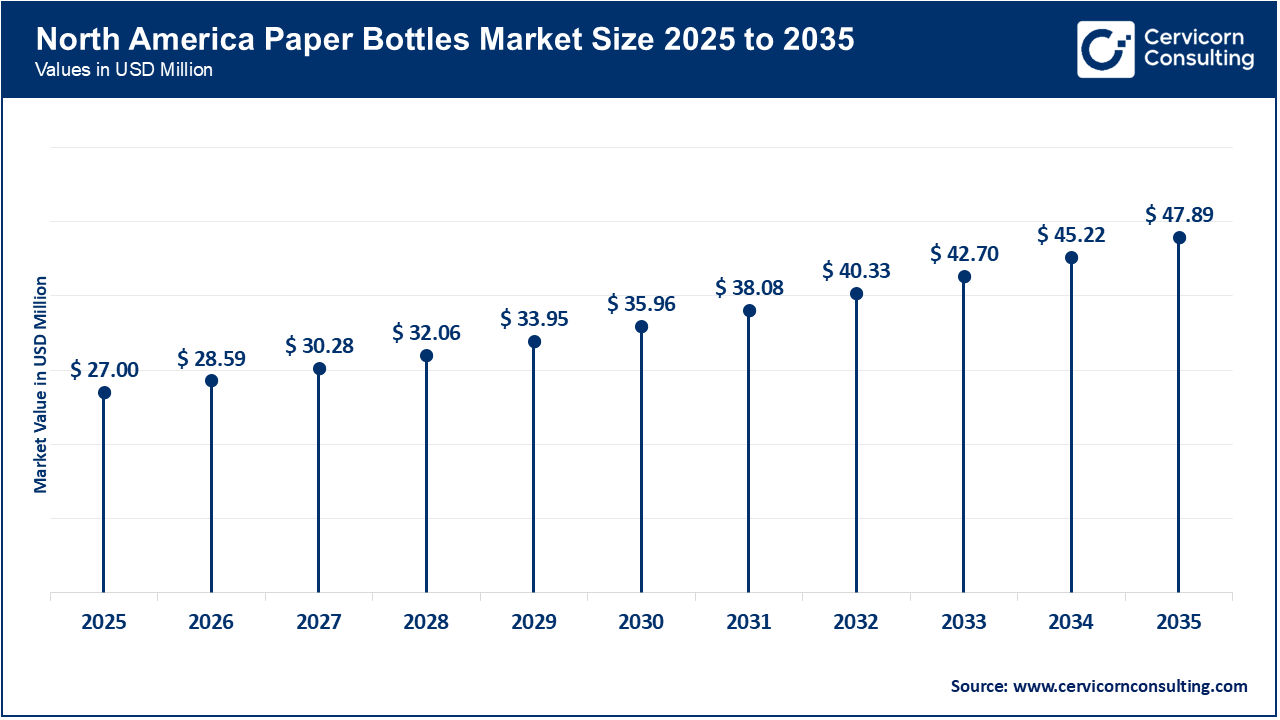
The North America paper bottles market size was estimated at USD 27 million in 2025 and is expected to hit around USD 47.89 million by 2035. The North America region has primarily benefitted from strong consumer preference for sustainable products as well as voluntary sustainability guidelines from retailers. In the U.S., the federal rules are not as stringent as they are in Europe but The Environmental, Social, and Governance (ESG) practices of large retailers like Walmart and Target is likely putting pressure on their suppliers to cut down their plastic footprints. In North America, the lack of plastic has created greater attention related to convenience items that consumers can responsibly purchase for guilt-free consumption, which is driving the need for paper bottles. In addition, North America has significant venture capital and material science expertise to help commercialize new barrier technologies, which, together, will accelerate the chances of broad paper bottle acceptance and limited product launches in paper format.
Recent Developments:
- Just Water expanded its paper-based bottle portfolio across the U.S. retail market, reinforcing its sustainability-led brand positioning.
- Major beverage and FMCG brands in the U.S. and Canada increased pilot projects and trials for paper bottle packaging to meet internal plastic-reduction targets.
Paper Bottles Market Share, By Region, 2025 (%)
| Region |
Revenue Share, 2025 (%) |
| North America |
37% |
| Europe |
29% |
| Asia-Pacific |
24% |
| LAMEA |
10% |
LAMEA Paper Bottles Market: Driven by Environmental Awareness and Improve Waste Management
The LAMEA paper bottles market was valued at USD 7.30 million in 2025 and is anticipated to reach around USD 12.94 million by 2035. In Latin America and the Middle East & Africa, the regions are not connected with the underlining societal and economic issues that feed the waste of plastic packaging. Rather, the new opportunities include the sense of environmental awareness and a few ways to improve waste management. In many areas of the region, the recycling infrastructure for plastics is limited, making biodegradable and compostable paper bottles a more attractive option than traditional plastic bottles. The green packaging would align well with the luxury tourism industry, providing effective methods to preserve the pristine images of natural tourist environments. Thus, new and exciting opportunities for expanded green packaging solutions have emerged due to the growing international conditions that require a decrease in plastic waste.
Recent Developments:
- International packaging companies began introducing paper bottle solutions through partnerships and pilot projects in Brazil, the UAE, and South Africa.
- Global beverage brands expanded sustainable packaging trials in Latin America and MEA to align with global ESG and plastic-reduction commitments.
Paper Bottles Market Segmental Analysis
The paper bottles market is segmented into capacity, primary usage, end use, and region.
Capacity Analysis
The 101 ml to 500 ml (medium) segment is the dominant segment of the global paper bottling market, as it most closely reflects consumers' existing consumption patterns. This size range matches the existing bottled size of bottled waters, single-serve drinks, and staples in a consumer's day-to-day consumption. From a production perspective, 101 ml to 500 ml bottles offer a solid development in structural integrity and use of materials, as the hydrostatic pressures produced by the liquid are low enough for overall hydrostatic pressure to be managed with existing fiber-based barrier technology. Additionally, humanely, from a standard retail perspective, medium-capacity bottles almost stand alone with existing shelf placements in standard vending machines and shelving spaces for existing PET bottled beverages.
Paper Bottles Market Share, By Capacity, 2025 (%)
| Capacity |
Revenue Share, 2025 (%) |
| 101 ml to 500 ml (Medium) |
50% |
| Above 500 ml (Large) |
30% |
| 15 ml to 100 ml (Small) |
20% |
The above 500 ml segment is expected to be the fastest-growing capacity segment due to the need for more sustainable packaging for home-sized products. As consumers become more conscious of the environment and seek alternatives for bulk-sized grocery products such as milk, cleaning products, and family-sized beverages. The advancement in bio-based products and the development of reinforced paper structures has allowed manufacturers to create larger bottles that can hold their shape and stay leakproof longer compared to existing products. Larger formats represent a strategic turn for the market to accelerate the bulk plastic for waste generated by household goods.
Primary Usage Analysis
The everyday segment dominates the market due to consistent consumption of water, juices, and dairy products. It holds the highest volume of sales from the common need for convenient, portable hydration and nutrition. Large beverage companies are also starting to incorporate paper bottles in their everyday product portfolios to reduce plastic use, as well as appeal to the conscious consumer. The good-looking products in supermarkets and convenience stores are given in paper bottles, therefore maximizing their product visibility and providing a marketing platform for advancing brand sustainability. As paper bottles scale production, the cost per unit will decrease the price for everyday usage
Paper Bottles Market Share, By Primary Usage, 2025 (%)
| Primary Usage |
Revenue Share, 2025 (%) |
| Everyday |
55% |
| Sports |
25% |
| Others |
20% |
Sports segment is the fastest growing of the market, at the intersection of health conscious lifestyle and active environmentalists. In particular, athletes and fitness enthusiasts are a prime audience for sustainable packaging, as they typically pay extra for good quality products that align with their personal wellness and environmental values. Manufacturers will create ruggedized paper bottles that are built with ergonomic grips and easy-close lids for use in gyms and outdoor activities. Furthermore, this segment does allow for premium branding and prices, since sports-related products typically at higher price points as high-performing lifestyle accessories. In addition, sporting events are increasing their sponsorships and partnerships by highlighting their commitment to eliminating single-use plastics in their venues.
End Use Insights
Beverages are the largest segment for the paper bottles market because they contribute to global plastic packaging waste. Research has shown that this segment will consistently have the largest market share as companies come under immense pressure to find alternatives to PET bottles. The beverage industry has the largest market share because it generates the largest amount of plastic waste and therefore has the greatest need to innovate and the research and development spending of global beverage companies continues to support the paper bottle space in everything from mineral water to carbonated soft drinks. Beverage brand transition is also consumer-driven as a proactive strategy to mitigate the risk of plastic taxes and bans.
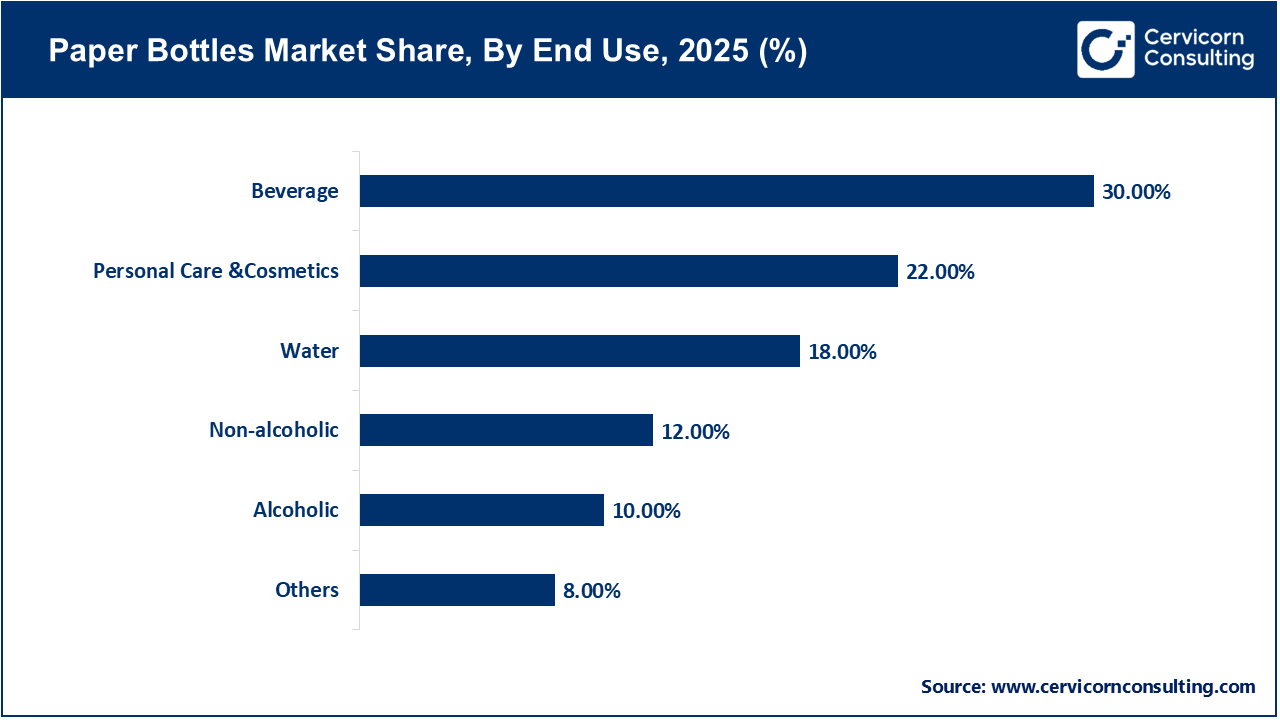
The personal care and cosmetics segment is growing the fastest because products have the material compatibility with fiber-based packaging. Many cosmetic formulations, such as creams, lotions, and powders, are less chemically aggressive than carbonated beverages. This makes it easier to house them in paper-based composites. The beauty industry also values tactile and aesthetic appeal by nature. The natural and premium feel of a paper bottle fits perfectly into the branding of clean and organic beauty products. The beauty industry can also absorb higher packaging costs by premium pricing, facilitating early adoption of new paper bottle packaging designs.
Paper Bottles Market Top Companies
Recent Developments by Major Companies
- In Oct 2025, Frugalpac partnered with Rhea Distilleries and ICT to introduced India's First Paper Bottle for Fidalgo Premium Cashew Feni, marking a major entry into the South Asian spirits market and demonstrating practical use of sustainable bottles beyond wine.
- In Sep 2025, PAPACLS Sales launched an advance paper-based bottle for dry and liquid packaging using fiber processes, supporting broader sustainable packaging solutions suitable for different product categories.
- In January 2025, Paboco collaborative with Blue Ocean Closures for launching the first market to create ready paper bottle and a complementary fiber-based cap, which are expected to reach consumers' hand.
Market Segmentation
By Capacity
- 15 ml to 100 ml (Small)
- 101 ml to 500 ml (Medium)
- Above 500 ml (Large)
By Primary Usage
- Everyday
- Sports
- Others (Travel, etc.)
By End Use
- Water
- Beverage
- Alcoholic
- Non-alcoholic
- Personal Care &Cosmetics
- Others (Homecare & Toiletries, etc.)
By Region
- North America
- APAC
- Europe
- LAMEA