Orthopedic Devices Market Size, Growth, Forecast 2026 to 2035
The global orthopedic devices market size was recorded at USD 63.41 billion in 2025 and is expected to be worth around USD 97.53 billion by 2035, growing at a compound annual growth rate (CAGR) of 4.4% over the forecast period from 2026 to 2035. The rising burden of musculoskeletal disorders is a major driver of orthopedic device demand. The WHO estimates that approximately 1.71 billion people globally live with musculoskeletal conditions, while 528 million had osteoarthritis in 2019. Osteoarthritis prevalence has increased 113% since 1990, with around 73% of affected individuals older than 55, strengthening demand for joint replacement, spinal, trauma, and orthopedic support devices.
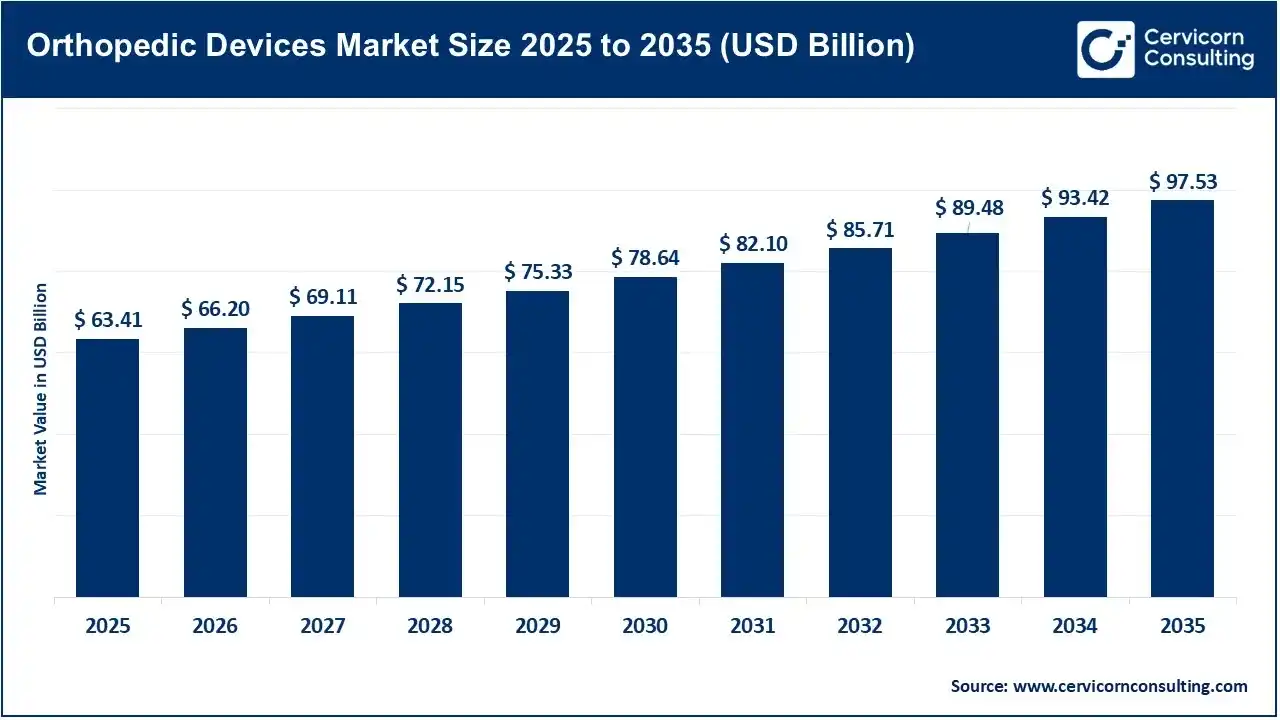
The aging population, obesity, sports injuries, road accidents, and technological advances are further supporting market growth. Globally, 178 million new fractures occurred in 2019, representing a 33.4% increase since 1990, creating sustained demand for trauma fixation devices and implants. Meanwhile, minimally invasive procedures, robotic-assisted surgery, patient-specific implants, 3D-printed orthopedic products, and advanced biomaterials are improving surgical precision and recovery, encouraging adoption of technologically advanced orthopedic devices.
Report Highlights
- By Region, North America held 54.9% of global market revenue in 2025, supported by advanced healthcare infrastructure, high procedure volumes, and strong adoption of orthopedic technologies.
- By Region, Asia-Pacific is projected to be the fastest-growing region, with an estimated 7.6% CAGR through 2035, driven by expanding healthcare capacity and increasing orthopedic procedure volumes.
- By Product Type, the joint reconstruction devices dominated with 35.8% market share in 2025, supported by strong demand for knee, hip, and shoulder replacement implants.
- By Product Type, the orthobiologics represent the fastest-growing product segment, projected to expand at an 8.1% CAGR through 2035, driven by increasing adoption in spinal fusion and trauma procedures.
- By End User, the hospitals accounted for 55.2% of the market in 2025, maintaining leadership because of their ability to handle complex orthopedic surgeries, trauma cases, and revision procedures.
- By End User, the ambulatory surgical centers are the fastest-growing end-user segment, projected to grow at a 7.9% CAGR through 2035 as more orthopedic procedures shift toward outpatient settings.
What are Orthopaedic Devices?
Orthopaedic devices are medical products designed to diagnose, treat, repair, replace, or support the musculoskeletal system, including bones, joints, ligaments, tendons, and the spine. They include joint replacement implants, fracture fixation plates and screws, spinal implants, arthroscopy devices, orthopedic braces, prosthetics, and orthobiologics. Increasing adoption of minimally invasive procedures, robotic-assisted surgery, advanced biomaterials, and patient-specific implants is improving surgical precision and expanding the application of these devices.
Recent Milestones
| Year |
Company |
Milestone |
Market Significance |
| March 2025 |
Monogram Technologies |
FDA approved a semi-autonomous robotic system for knee replacement procedures. |
Strengthened the development of robotic and increasingly autonomous orthopedic surgery. |
| July 2025 |
Zimmer Biomet |
Announced acquisition of Monogram Technologies for approximately USD 177 million. |
Expanded Zimmer Biomet's robotic orthopedic surgery portfolio and autonomous technology capabilities. |
| August 2025 |
Biomet |
FDA approved new cemented and cementless tibial components for the Oxford Partial Knee System. |
Expanded implant configuration options for partial knee replacement procedures. |
| November 2025 |
Zimmer CAS |
FDA cleared the ROSA Knee System through the 510(k) pathway. |
Supported continued adoption of computer-assisted and robotic technologies in knee surgery. |
| January 2026 |
Biomet |
FDA approved a manufacturing-process modification for the Oxford Partial Knee System to improve component inspection. |
Demonstrated continued emphasis on implant manufacturing quality and safety. |
| February 2026 |
Medtronic |
FDA expanded labeling for Infuse Bone Graft with compatible spinal fusion devices for TLIF procedures from L2–S1. |
Broadened clinical application of bone graft technology in spinal fusion. |
| February 2026 |
Stryker Orthopaedics |
FDA cleared the Triathlon X3 Medial Stabilized Tibial Bearing Insert. |
Expanded Stryker's knee replacement product portfolio. |
| February 2026 |
CritiCare Asia Hospitals / Smith+Nephew |
CritiCare launched the CORI Robotic System for knee and hip replacement procedures in Mumbai. |
Highlights growing adoption of robotic-assisted orthopedic surgery in India. |
| May 2026 |
Biomet |
FDA approved new meniscal-bearing components for the Oxford Partial Knee System. |
Further expanded the implant's component portfolio and configuration options. |
Orthopedic Devices Market Dynamics
Market Drivers
1. Rising Burden of Spinal and Musculoskeletal Disorders
The increasing prevalence of spinal disorders is creating sustained demand for orthopedic implants, spinal fixation systems, and rehabilitation devices. The WHO estimates that low back pain affected 619 million people globally in 2020, while cases are projected to reach 843 million by 2050. Additionally, low back pain represents approximately 8% of all global years lived with disability, reinforcing the need for diagnosis, surgical intervention, and long-term orthopedic management.
2. Increasing Demand for Joint Replacement Procedures
Growing demand for joint reconstruction is supporting orthopedic device adoption, particularly for hip and knee implants. A U.S. projection estimated that primary total hip arthroplasty procedures could reach 635,000 by 2030, representing a 71% increase, while primary total knee arthroplasty could reach 1.26 million, an 85% increase from the 2014 baseline. Increasing procedure volumes are encouraging manufacturers to develop longer-lasting implants and advanced surgical technologies.
Market Restraints
1. High Cost of Advanced Orthopedic Procedures
High costs associated with orthopedic implants, robotic-assisted surgery, specialized instruments, and postoperative rehabilitation can restrict adoption, particularly in price-sensitive healthcare systems. Advanced orthopedic procedures often require expensive capital equipment and highly trained surgical teams, increasing overall treatment expenditure. Furthermore, inconsistent reimbursement policies can create affordability challenges for patients and healthcare providers, potentially delaying elective procedures and limiting adoption of premium implants, technologically advanced navigation systems, and innovative orthopedic solutions.
2. Shortage of Skilled Orthopedic Professionals
Limited availability of specialized orthopedic surgeons and trained surgical personnel can constrain the utilization of sophisticated orthopedic devices. The challenge is particularly important as procedure complexity increases with robotic-assisted surgery, minimally invasive techniques, and technologically advanced implants. One analysis projects that an orthopedic surgeon could perform approximately 90.1 total joint arthroplasty procedures annually by 2030, compared with substantially lower historical volumes, highlighting the growing requirement for specialized surgical capacity and training.
Market Opportunities
1. Expansion of Robotic and AI-Assisted Orthopedic Surgery
The growing integration of robotics, computer-assisted navigation, artificial intelligence and digital surgical planning creates significant opportunities for orthopedic device manufacturers. These technologies can support more precise implant positioning, personalized surgical planning, and potentially improved procedural consistency. Industry analysis identifies AI-driven surgical planning and robotics as an important growth driver, while manufacturers increasingly combine implants with digital technologies, navigation platforms, and data-driven surgical workflows to differentiate products and expand clinical adoption.
2. Growth of Orthopedic Devices in Emerging Markets
Emerging economies offer substantial opportunities because expanding healthcare infrastructure, improving surgical capabilities, and increasing access to specialized treatment are broadening the addressable patient population. WHO data indicate that the South-East Asia Region alone accounts for approximately 369 million people living with musculoskeletal conditions, creating considerable unmet treatment requirements. Manufacturers can capitalize through localized production, cost-effective implants, distributor networks, training programs, and minimally invasive technologies designed for resource-constrained healthcare environments.
Market Challenges
1. Product Safety, Clinical Evidence, and Regulatory Complexity
Orthopedic device manufacturers face stringent regulatory requirements because implants can remain inside patients for many years and failures may require revision surgery. Regulatory expectations increasingly involve clinical evidence, manufacturing controls, post-market surveillance, and long-term safety monitoring. Market analysis notes that manufacturers may need multicenter clinical studies and post-market surveillance systems, creating substantial financial and operational burdens, particularly for smaller innovators attempting to commercialize novel implants and orthopedic technologies.
2. Implant Failure and Revision Surgery Risks
Implant longevity, wear, loosening, infection, alignment issues, and other complications remain important challenges for orthopedic device manufacturers and healthcare providers. Revision procedures can increase healthcare costs and require additional surgical intervention, creating pressure for improved implant durability and patient outcomes. The increasing number of orthopedic procedures also expands the future pool of patients requiring revisions, making advanced biomaterials, improved fixation technologies, personalized implants, and long-term clinical monitoring increasingly important for reducing complications.
Regional Analysis
The orthopedic devices market is segmented by region into North America, Europe, Asia-Pacific, Latin America, and LAMEA. Here is a brief overview of each region:
North America Orthopedic Devices Market: Driven by High Joint Replacement Volumes, Advanced Orthopedic Technologies, Aging Population, Strong Healthcare Infrastructure, and Increasing Outpatient Surgery
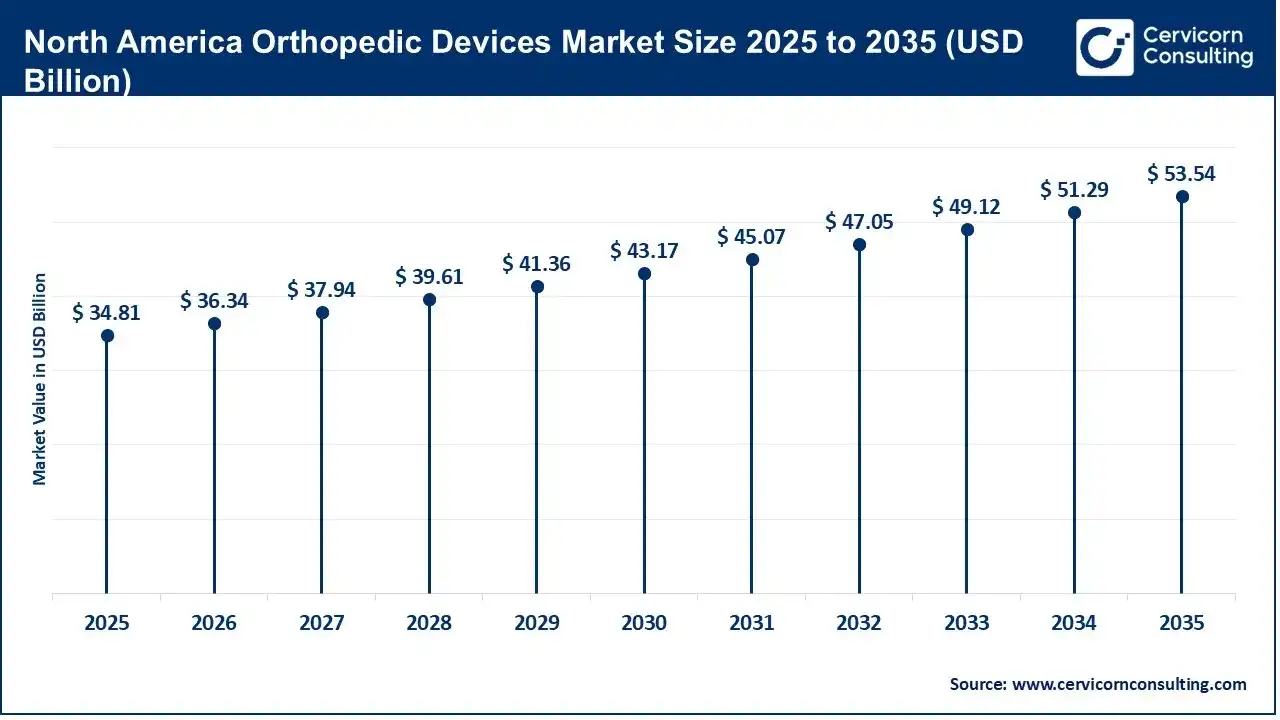
The North America orthopedic devices market size was valued at USD 34.81 billion in 2025 and is projected to surge USD 53.54 billion by 2035. North America dominates the market owing to its advanced healthcare infrastructure, high orthopedic procedure volumes, strong presence of leading device manufacturers, favorable reimbursement systems, and rapid adoption of robotic-assisted and minimally invasive surgery. The United States represents the major regional contributor, supported by extensive utilization of joint reconstruction, spinal, trauma fixation, and arthroscopy devices. The American Academy of Orthopaedic Surgeons’ 2025 American Joint Replacement Registry analyzed more than 4.4 million hip and knee arthroplasty procedures collected from 2012–2024 across all 50 states, demonstrating the region's substantial procedure base.
United States: High Arthroplasty Volumes, Advanced Surgical Technology, and Strong Orthopedic Care Infrastructure Drive Market Growth
- The American Joint Replacement Registry (AJRR) analyzed more than 4.4 million hip and knee arthroplasty procedures through 2024, with its database covering all 50 states, Washington, D.C., and Puerto Rico, supporting substantial demand for orthopedic implants.
- The 2025 AJRR report recorded an 8.8% increase in reported procedures compared with the previous year, reflecting continued expansion of orthopedic procedure data and increasing utilization of joint replacement technologies in the United States.
Canada: Rising Joint Replacement Volumes, Increasing Outpatient Procedures, and Growing Robotic-Assisted Surgery Support Market Expansion
- According to the Canadian Institute for Health Information (CIHI), Canada performed 175,242 hip and knee replacements in 2024–2025, representing a 5.3% increase from the previous year and a 26.5% increase from 2019–2020.
- Outpatient orthopedic procedures are expanding rapidly, with 35.8% of hip replacements and 31.1% of knee replacements for osteoarthritis performed as day surgeries during 2024–2025, supporting demand for efficient implants and minimally invasive orthopedic technologies.
Asia-Pacific (APAC) Orthopedic Devices Market: Driven by Rapid Healthcare Infrastructure Development, Aging Populations, Rising Orthopedic Procedure Volumes, Medical Tourism, and Increasing Adoption of Advanced Surgical Technologies
The Asia-Pacific orthopedic devices market size was estimated at USD 10.46 billion in 2025 and is expected to hit USD 16.09 billion by 2035. Asia-Pacific is emerging as one of the fastest-growing regions, supported by expanding healthcare infrastructure, increasing orthopedic disease burden, rising healthcare expenditure, improving access to specialized surgery, and growing adoption of minimally invasive and robotic-assisted procedures. China currently represents the largest regional market, while India is among the fastest-growing major markets. The region also benefits from expanding domestic medical-device manufacturing and medical tourism in countries such as India, Thailand, Singapore, and Malaysia. Asia-Pacific accounted for 16.5% of global orthopedic implant revenues in 2025, highlighting its increasing importance in the global orthopedic industry.
China: Large Aging Population, High Osteoarthritis Burden, Domestic Manufacturing, and Expanding Joint Replacement Procedures Drive Market Growth
- China reported approximately 152.85 million prevalent osteoarthritis cases in 2021, creating substantial demand for knee, hip, and other joint reconstruction devices.
- A nationwide study covering 361,546 total knee and hip arthroplasty patients found that the proportion of knee replacement patients aged over 60 increased to 85.6%, highlighting the influence of population aging on orthopedic demand.
India: Expanding Healthcare Access, Rising Joint Disorders, Robotic Surgery Adoption, and Growing Domestic Manufacturing Support Market Expansion
- India is projected to be among the fastest-growing major orthopedic implant markets in Asia-Pacific, supported by increasing orthopedic surgeries, improving healthcare infrastructure, and expanding access to advanced treatment.
- As of September 2024, approximately 290 robotic orthopedic systems had been installed across India, demonstrating accelerating adoption of robotic-assisted joint replacement technologies.
Europe Orthopedic Devices Market: Driven by Aging Population, High Joint Replacement Volumes, Advanced Healthcare Infrastructure, Strong Reimbursement Systems, and Increasing Adoption of Innovative Orthopedic Technologies
The Europe orthopedic devices market size reached at USD 13.19 billion in 2025 and is expected to surpass around USD 20.29 billion by 2035. Europe represents a major market, supported by its rapidly aging population, high prevalence of degenerative joint conditions, sophisticated healthcare infrastructure, and strong demand for joint reconstruction and trauma-management technologies. On January 1, 2025, approximately 99 million people aged 65 years and above lived in the EU, representing 22% of the total population, while people aged 80 and above accounted for another 6%. These demographic trends are increasing demand for joint replacement, spinal implants, fracture fixation, and other orthopedic solutions.
Germany: High Orthopedic Procedure Volumes, Advanced Healthcare Infrastructure, and Strong Implant Adoption Drive Market Growth
- Germany recorded approximately 299 hip replacements and 200 knee replacements per 100,000 population in 2021, substantially exceeding the corresponding EU averages of approximately 180 and 110 procedures, respectively.
- Germany accounted for approximately 23.15% of Europe's orthopedic devices market in 2025, making it the region's largest national market, supported by its extensive healthcare system and high orthopedic procedure volumes.
France: Aging Demographics, Rising Joint Disorders, and Expanding Orthopedic Treatment Demand Support Market Development
- France had approximately 14.7 million people aged 65 and above in 2024, representing 21.5% of its population, creating a large demographic base susceptible to osteoarthritis, osteoporosis, fractures, and degenerative joint conditions.
- EU countries performed nearly 1 million hip replacements and 680,000 knee replacements in 2022, demonstrating the substantial regional demand for joint reconstruction devices and supporting opportunities for French orthopedic device providers.
Orthopedic Devices Market Share, By Region, 2025 (%)
| Region |
Revenue Share, 2025 (%) |
| North America |
54.9% |
| Europe |
20.8% |
| Asia-Pacific |
16.5% |
| LAMEA |
7.8% |
LAMEA (Latin America, Middle East & Africa) Orthopedic Devices Market: Driven by Rising Musculoskeletal Disorders, Expanding Healthcare Infrastructure, Increasing Trauma Cases, Growing Medical Tourism, and Adoption of Advanced Orthopedic Technologies
The LAMEA orthopedic devices market was valued at USD 4.95 billion in 2025 and is anticipated to reach USD 7.61 billion by 2035. LAMEA is emerging as an important growth region, supported by increasing musculoskeletal disorders, population aging, road traffic injuries, sports-related trauma, improving healthcare infrastructure, and expanding access to specialized orthopedic procedures. Brazil represents a major market within Latin America, while Saudi Arabia, the UAE, and South Africa are important markets across the Middle East and Africa. The region is also witnessing increasing adoption of robotic-assisted surgery, minimally invasive procedures, navigation systems, advanced implants, and orthobiologics. Joint replacement and orthopedic implants represented 42% of the MEA orthopedic devices market in 2025, demonstrating strong demand for reconstruction technologies.
Brazil: Large Healthcare System, Rising Joint Replacement Demand, Aging Population, and Expanding Advanced Orthopedic Care Support Market Growth
- Brazil is the dominant country in several LAMEA orthopedic technology segments, including orthopedic navigation systems, reflecting its relatively developed healthcare infrastructure and large patient population.
- Brazil's healthcare expenditure reached approximately 9.47% of GDP, equivalent to around USD 161 billion, creating a substantial healthcare ecosystem for orthopedic procedures and medical-device adoption.
Saudi Arabia: Healthcare Modernization, High Musculoskeletal Disorder Burden, and Investment in Advanced Surgical Technologies Drive Market Expansion
- Saudi Arabia accounted for approximately 31.52% of the Middle East orthopedic devices market in 2024, making it the region's leading national market, supported by healthcare modernization and increasing demand for orthopedic treatment.
- A systematic review involving 1,469 nurses across eight Saudi studies reported work-related musculoskeletal disorder prevalence ranging from 61.7% to 100%, indicating a substantial musculoskeletal health burden.
Orthopedic Devices Market Segmental Analysis
The orthopedic devices market is segmented into product type, end user, and geography.
Product Type Analysis
Joint reconstruction devices represent the leading product segment, supported by high volumes of hip, knee, and shoulder replacement procedures. The segment accounted for approximately 35.8% of the global market in 2025, according to recent industry estimates. Demand is reinforced by degenerative joint conditions, improved implant durability, minimally invasive techniques, and increasing availability of robotic-assisted joint replacement systems. Strong reimbursement and established clinical pathways further encourage adoption, particularly for knee and hip reconstruction procedures across developed healthcare systems.
Orthopedic Devices Market Share, By Product Type, 2025 (%)
| Product Type |
Revenue Share, 2025 (%) |
| Joint Reconstruction Devices |
35.8% |
| Spinal Devices |
19.6% |
| Trauma Fixation Devices |
15.9% |
| Arthroscopy Devices |
9.8% |
| Orthobiologics |
7.9% |
| Orthopedic Braces & Supports |
4.2% |
| Orthopedic Prosthetics |
2.9% |
| Orthopedic Instruments & Accessories |
2.5% |
| Others |
1.4% |
Orthobiologics is emerging as one of the fastest-growing product categories as clinicians increasingly seek biological approaches that support bone healing, tissue regeneration, and spinal fusion. Products including bone graft substitutes, growth factors, and regenerative materials are gaining adoption across trauma, spine, and sports medicine applications. Increasing interest in personalized treatment, advanced biomaterials, and regenerative medicine is supporting segment expansion. Recent market analyses identify orthobiologics as a particularly high-growth category as manufacturers introduce innovative biologic products and expand their clinical applications.
End User Analysis
Hospitals remain the dominant end-user segment because they possess advanced operating rooms, specialized orthopedic surgeons, imaging systems, rehabilitation infrastructure, and capabilities for complex procedures. Hospitals accounted for approximately 55.2% of the global orthopedic devices market in 2025 in one recent estimate. Joint replacements, spinal surgeries, trauma fixation, and complex revision procedures are frequently performed within hospital settings. Favorable reimbursement, multidisciplinary care, and the ability to manage high-risk patients further strengthen hospitals' position as the primary procurement channel for orthopedic devices.
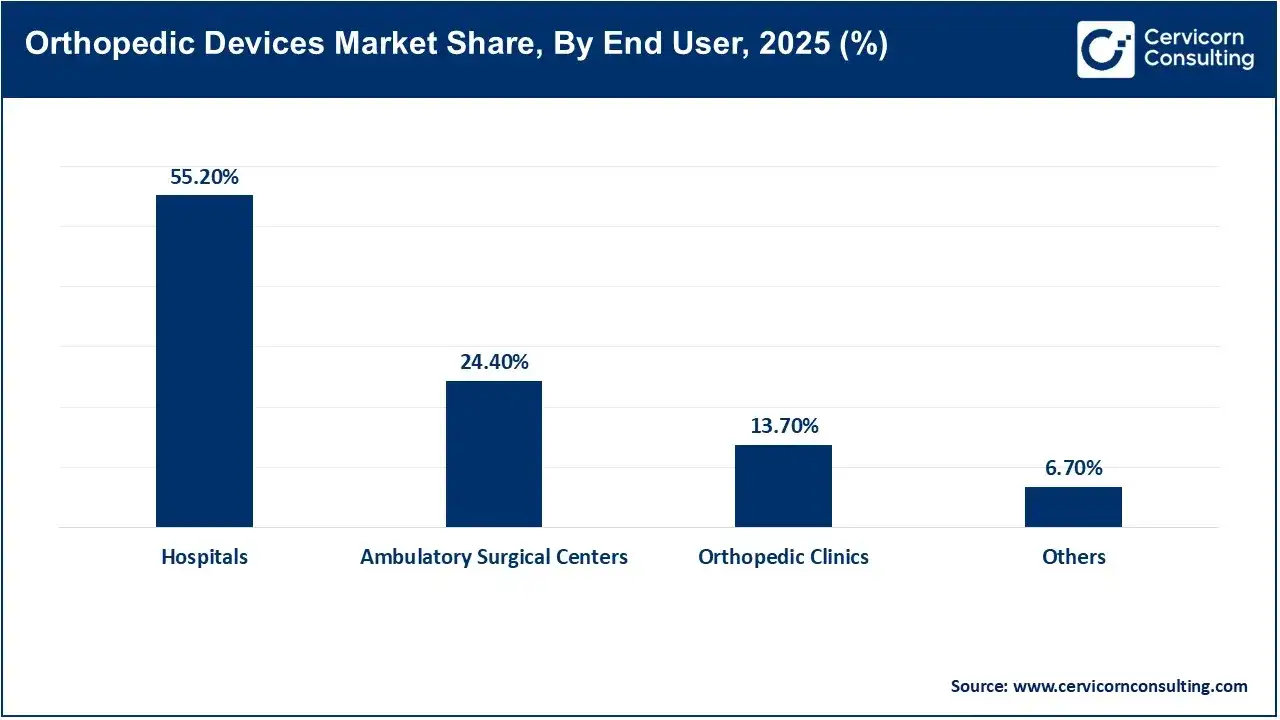
Ambulatory surgical centers are the fastest-growing end-user segment as orthopedic care increasingly shifts toward minimally invasive and outpatient procedures. ASCs provide shorter hospital stays, faster patient discharge, streamlined workflows, and lower procedural costs, making them increasingly attractive for suitable orthopedic interventions. Growth is particularly supported by arthroscopy, sports medicine, and selected joint replacement procedures that can be safely performed on an outpatient basis. Industry analyses consistently identify ASCs as the fastest-growing channel as healthcare providers prioritize cost efficiency and convenient patient-centered surgical models.
Orthopedic Devices Market Top Companies
Market Segmentation
By Product Type
- Joint Reconstruction Devices
- Knee Implants
- Hip Implants
- Shoulder Implants
- Elbow Implants
- Hand & Wrist Implants
- Foot & Ankle Implants
- Spinal Devices
- Spinal Fusion Devices
- Non-Fusion Devices
- Interbody Cages
- Spinal Fixation Devices
- Trauma Fixation Devices
- Plates
- Screws
- Nails
- Pins & Wires
- External Fixators
- Arthroscopy Devices
- Arthroscopes
- Arthroscopy Implants
- Surgical Instruments
- Orthobiologics
- Bone Graft Substitutes
- Demineralized Bone Matrix
- Bone Morphogenetic Proteins
- Viscosupplementation
- Stem Cell-Based Products
- Orthopedic Braces & Supports
- Orthopedic Prosthetics
- Orthopedic Instruments & Accessories
- Others
By End User
- Hospitals
- Ambulatory Surgical Centers
- Orthopedic Clinics
- Others
By Geography
- North America
- Europe
- Asia-Pacific
- LAMEA