Organic Starch Market Size, Growth, Forecast 2026 to 2035
The global organic starch market size valued at USD 1.43 billion in 2025 and is expected to be worth around USD 2.72 billion by 2035, exhibiting at a compound annual growth rate (CAGR) of 6.6% over the forecast period 2026 to 2035. The organic starch market is experiencing rapid growth as more consumers are seeking clean-label and naturally occurring ingredients. As the preference for food without synthetic additives continues to rise, companies are increasingly using organic starch to provide a natural thickening and stabilizing agent as part of their formulations. Food manufacturers also find it advantageous to use organic starch, because it allows for greater health-related claims and it provides a competitive edge in the increasingly competitive organic snack market, organic bakery market and organic baby food products. Increased regulatory scrutiny of chemical additives in foods has also caused companies to look to organic alternatives for their formulation.
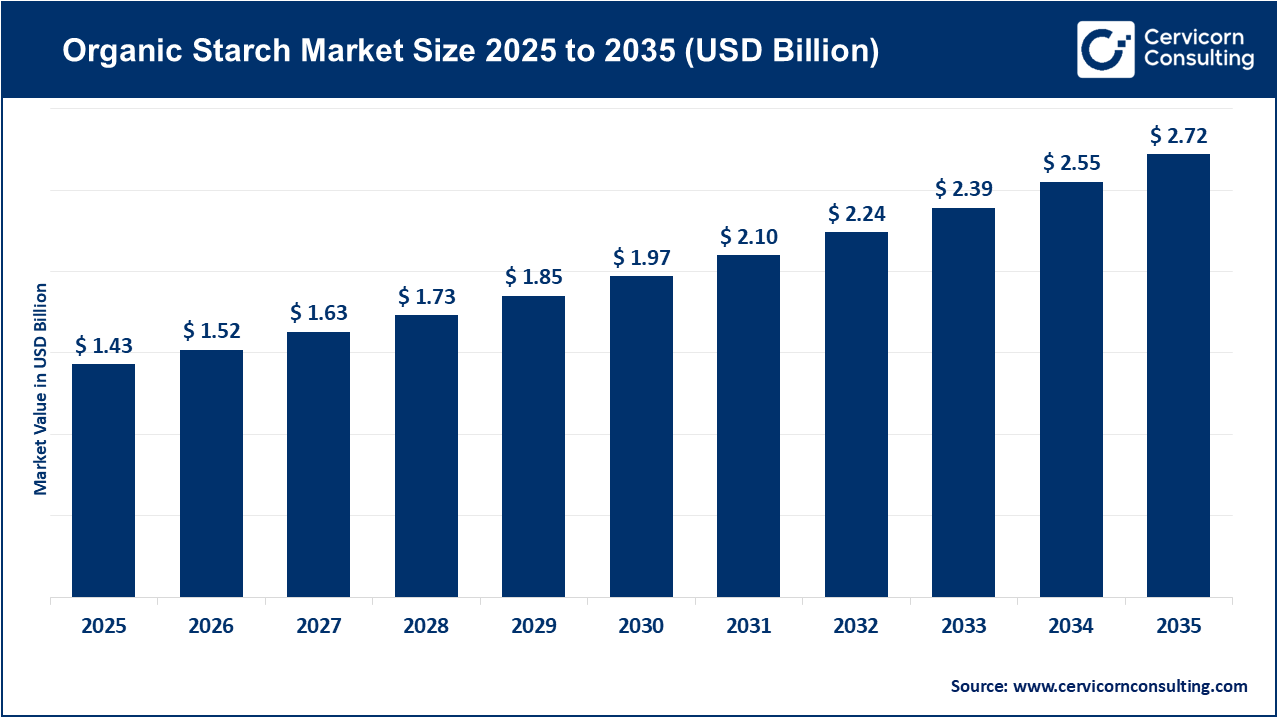
With the increasing availability of organic starches has come a parallel growth in organic farming and improved supply chain systems. Additionally, brands emphasising sustainability are well-positioned by the increasing demand for organic products that are derived from environmentally friendly farming practices. The continued growth of disposable incomes in emerging markets has also resulted in greater demand for premium organic products. Further, growth in industries such as pharmaceuticals, cosmetics and biodegradable packaging will continue to increase the overall usage of organic starch and drive overall expansion opportunities in the organic starch market.
Report Highlights
- By region, North America held the largest share of 37.4% in 2025 due to the strong demand for clean-label food ingredients, rising organic food consumption, and the presence of advanced food processing industries in the region.
- By source, the corn segment dominated the organic starch market with the largest share of 35% in 2025 owing to its abundant availability, cost efficiency, high starch yield, and extensive application in organic food and beverage products.
- By source, the cassava segment is expected to grow at the fastest rate during the forecast period due to increasing demand for gluten-free, non-GMO, and allergen-free starch ingredients in food and industrial applications.
- By product type, the native starch segment accounted for the largest share of 55% in 2025 because of its minimal processing, clean-label appeal, and growing consumer preference for natural and organic ingredients.
- By end use, the food industry dominated the market with the largest share of 70% in 2025 driven by the rising consumption of organic processed foods, bakery products, dairy items, sauces, and convenience foods globally.
- By end use, the pharmaceutical industry is projected to grow at the fastest rate during the forecast period owing to the increasing use of organic starch in tablet formulations, drug delivery systems, and natural excipient applications.
Growing Consumer Awareness of Organic and Natural Ingredients
The increase in consumer awareness of organic and natural ingredients is a key factor driving the organic starch market. More consumers are aware of the advantages of clean-label products and prefer to purchase food products that do not contain chemicals, pesticides, and artificial additives. This change in attitude toward cleaning label products is one of the most significant factors driving the growth of the organic starch market. Consumers associate organic ingredients with improved health, transparency, and sustainability, and therefore, the market has seen an increase in the number of companies reformulating their products to use organic starches to align with consumer expectations. The growing public awareness continues to augment the growth of the organic starch market and further motivate manufacturers to create new organic product lines.
Global Organic Corn, Cassava, and Potato Production Statistics
- Corn production for the 2025/26 crop year was predicted to be at close to 1.74 billion tonnes due to the increase in corn production for USA, Argentina and Ukraine.
- Corn is still the primary raw material for starch manufacturing worldwide, owing to its high starch concentration, affordable cost, and broad industrial use.
- Production for the 2025 crop year has been expected to hit between 390-395 million tonnes, which would be a record level, boosted by yield gains and cultivation technology advancements.
- China was expected to be the largest potato producer in the world with more than 93 million tonnes, followed by India with more than 60 million tonnes.
- World yields for potatoes had risen to close to 22.9 tonnes/hectare for 2025 due to precision farming techniques, better seeds, and improved irrigation systems.
Asian Countries - Organic Starch Initiatives and Investments
| Country |
Public Initiatives |
Private Investments & Industry Focus |
| India |
Government support for organic farming under schemes such as Paramparagat Krishi Vikas Yojana (PKVY), increasing promotion of sustainable agriculture and organic certification programs. |
Rising investments in organic packaged foods, clean-label ingredients, and cassava-based starch processing facilities driven by growing health-conscious consumers and export demand. |
| China |
Expansion of food safety regulations and sustainable agriculture initiatives supporting organic ingredient production and traceability systems. |
Strong investments in food processing infrastructure, biodegradable materials, and specialty starch manufacturing for functional foods and pharmaceuticals. |
| Thailand |
Thailand’s Ministry of Higher Education and NSTDA supported the Global Cassava Sustainability Forum 2025 to strengthen sustainable cassava value chains and international collaboration. |
Thailand continues investing heavily in cassava processing technologies and starch export capabilities due to its position as one of the world’s largest cassava exporters. |
| Indonesia |
Government initiatives are promoting agricultural diversification and food security are increasing cassava cultivation and starch crop production. |
Private players are investing in tapioca starch production and organic food ingredient exports to meet rising Asia Pacific demand. |
| Japan |
Policies promoting clean-label foods, sustainable agriculture, and food ingredient traceability are supporting organic ingredient adoption. |
Japanese food manufacturers are increasingly utilizing specialty starches in functional foods, nutraceuticals, and elderly nutrition products. |
| Vietnam |
Agricultural modernization policies and export-focused organic farming initiatives are supporting cassava cultivation growth. |
Increasing foreign investments in cassava starch processing plants and export-oriented food ingredient manufacturing. |
| South Korea |
Government support for eco-friendly food systems and sustainable food processing technologies is boosting organic ingredient demand. |
Growing investments in premium clean-label foods, plant-based products, and specialty food ingredients including organic starches. |
Recent Major Milestones
1. Clean-label regulation pushing shift toward organic starch
The clean labels regulation, effective 1 January 2024, will be implemented to push food manufacturers to reduce their use of non-organic agricultural ingredients which means that the majority of producers will have to reformulate their recipes by replacing conventional starches with certified organic starches. This forced transition by many manufacturers has created a significant increase in the demand for organic starch, and in turn accelerated the growth of the organic starch market.
2. Rising adoption by food & beverage developers for additive-free formulations
A recent report shows that 33% of food and beverage developers have adopted organic starch as their preferred ingredient because of its purity and functional versatility. The growing trend towards additive-free clean label foods has increased the use of organic starch in sauces, baked goods, ready-to-eat meals, and dairy products. The result of the increased adoption by the food and beverage development industry has correspondingly increased the growth of the organic starch market.
3. Expansion of starch sources beyond corn - rise of specialty starches from peas, cassava, potato, bean
The organic starch market has expanded well beyond the traditional corn starch product. Producers are now using alternative sources of starch. These alternative sources include such items as peas, cassava, potatoes, and beans. This has created a wide variety of functional starch properties that meet specific dietary needs (e.g., gluten-free, allergen-free), and as a result, the number of applications for organic starch has dramatically increased. Increasing the number of applications for organic starch has made organic starch much more appealing as a product and is driving organic starch’s growth as a market.
4. Innovation in processing and product offerings by major food-ingredient companies
Leading food ingredient suppliers have introduced new clean-label organic starch products and starch-based solutions. The new clean-label organic starch products and starch-based solutions allow food processors to eliminate synthetic additives from their products, as they provide an opportunity for food producers to respond to changing consumer preferences. As a consequence, there will be an increase in the availability of organic starch products and a greater functionality of organic starch in the marketplace, which will ultimately increase the overall market for organic starches.
Report Scope
| Area of Focus |
Details |
| Market Size in 2026 |
USD 1.52 Billion |
| Estimated Market Size in 2035 |
USD 2.72 Billion |
| Projected CAGR 2026 to 2035 |
6.60% |
| Dominant Region |
North America |
| Fastest Growing Region |
Asia-Pacific |
| Key Segments |
Source, Product Type, End Use, Region |
| Key Companies |
Cargill Incorporated, Beneo GmbH, Ingredion Incorporated, AGRANA Beteiligungs-AG, ORGANICWAY Food Ingredients Inc., NutriPea, SACCHETTO S.p.A., Herba Ingredients BV, American Key Food Products, Gujarat Ambuja Exports Limited (GAEL), A&B Ingredients, Ettlinger Corporation, Roquette Frères, Medikonda Nutrients, PURIS, Archer Daniels Midland Company |
Market Dynamics
Market Drivers
- Rising demand for clean-label and natural ingredients: The growing preference by consumers for clean label and natural ingredients drives the use of organic starch as a safe and clean-label thickener in food and beverages. Companies are reformulating their products with organic starch to satisfy health-oriented preferences of consumers. This is helping support continued growth of the organic starch market.
- Expansion of organic farming and supply availability: The expanding adoption of organic farming practices among farmers leads to increased supply of organic corn, potato, cassava, and other sources of starch. This greater supply gives food manufacturers the opportunity to use organic starch across many product categories, which will further drive the growth of the organic starch market and provide the opportunity for greater industry adoption.
Market Restraints
- Higher production and certification costs: Producing organic starch involves adhering to strict farming practices and obtaining certification, which makes the cost of producing organic starch much higher than conventional starch. The high cost associated with organic starch can be a hindrance to many smaller manufacturers and price-sensitive markets. As a result, the high cost of organic starch has slowed the growth of the organic starch market.
- Limited processing facilities for organic products: There are significantly fewer certified organic processing facilities than conventional processing facilities, which creates bottlenecks in the supply chain and limits the ability to produce large amounts of organic starch. This also contributes to an inconsistent supply of organic starch for food manufacturers, which limits the speed of market growth for organic starch.
Market Opportunities
- Growing use in pharmaceuticals and cosmetics: Organic starch has become more commonly used within both the pharmaceutical industry and the personal care industry. The fact that it is a naturally occurring and non-toxic product makes it an ideal ingredient for "clean label" cosmetics. As demand increases within these two categories, additional applications will emerge, which will provide new growth opportunities for organic starch.
- Rising demand for sustainable and biodegradable packaging: Organic starch can function as the primary ingredient in environmentally friendly film biodegradable packaging. With a growing trend toward sustainable packaging options, many companies have begun moving away from using plastic materials, thereby opening a wide variety of new uses for organically manufactured starch. As such, this movement has the potential for significant long-term growth for those who develop and market organic starch products.
Market Challenges
- Supply chain instability and raw material fluctuations: The agricultural sector relies heavily upon the climate and natural conditions of each growing season for organic farming. This results in variability regarding how much organic raw material is available to be processed into starch. This inconsistency creates issues for producers regarding how to price and produce their starch. The volatility within the supply chain presents on-going concerns to the organic starch industry.
- Competition from cheaper conventional starch alternatives: Conventional starch is available from a wide range of sources and at significantly less cost than organic starch. As a result, many supplier companies are currently using conventional starch to produce their products at much lower costs than they would if they were using organic starch. This creates a situation of pricing competition where pricing is significantly lower for conventional starch compared to organic starch, which is a significant barrier to expanding the total amount of organic starch that is produced in North America.
Regional Analysis
The organic starch market is segmented into various regions, including North America, Europe, Asia-Pacific, and LAMEA. Here is a brief overview of each region:
North America Organic Starch Market: Rising demand for clean-label & natural foods
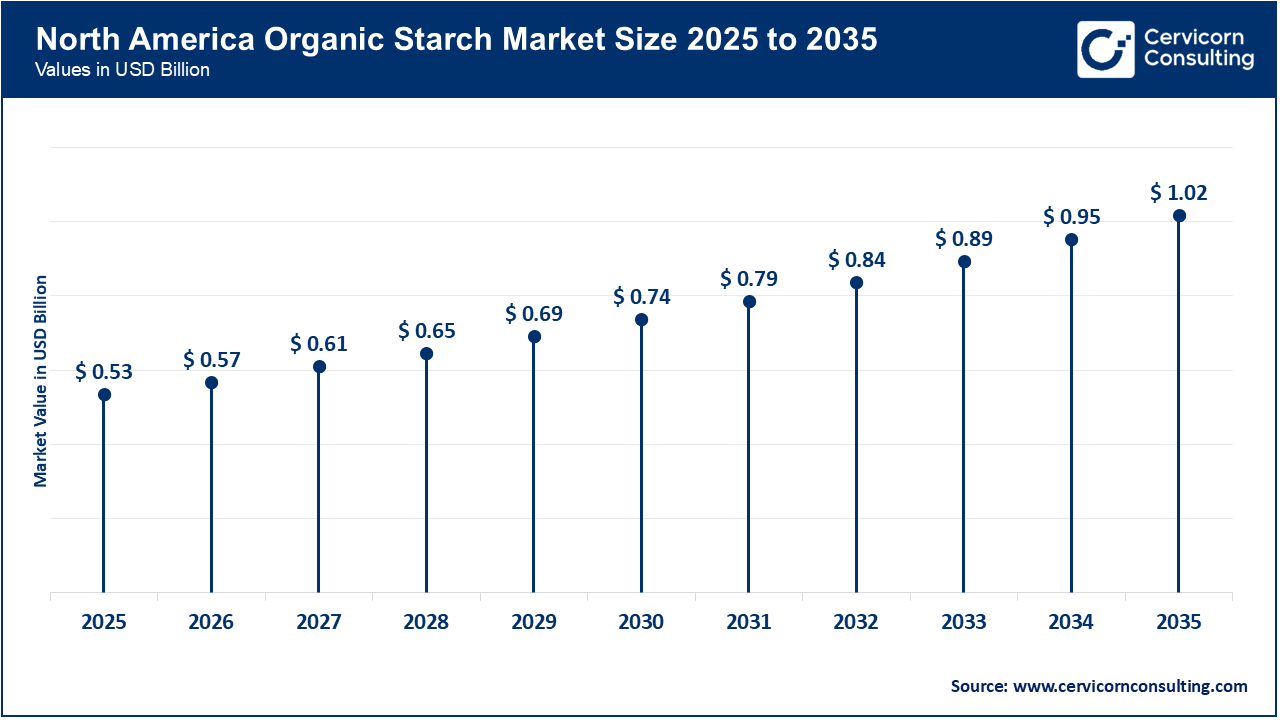
The North America organic starch market size valued at USD 0.53 billion in 2025 and is predicted to reach around USD 1.02 billion by 2035. The North America has been fueled by the increased consumer demand for clean label, organic, and non-GMO food products. Consumers are becoming increasingly aware of health and nutrition as well as avoiding synthetics, so there is a high demand for natural thickeners and stabilizers. In light of consumer preferences, and to meet the requirements of various regulations, food manufacturers in the USA and Canada continue to use more organic starch in lieu of conventional starch.
Recent Developments:
- In North America, large ingredient companies recently launched new functional native organic starches that can withstand extreme processing conditions.
- The growing demand for organic baby food products and ready-to-eat/ready-to-cook meals are also contributing to the consistent growth in demand for organic starch.
U.S. Organic Starch Market Analysis
- One of the biggest markets for organic starch, the United States enjoys growing consumption based on clean-label, non-GMO and organic demands on food ingredients. Increasing demand of gluten-free, plant-based foods, organic baby foods, and lightly processed ingredients have driven the demand for organic corn, cassava and potato starches across the food and beverage sectors.
- On organic agricultural infrastructures, there was tremendous development in the U.S. with a near 79% growth to 3.6 million acres in certified organic cropland and an increased percentage of more than 90 percent in certified organic farming operations over the past ten years. In addition, government support continued to bolster the industry structure.
- The U.S. Department of Agriculture (USDA) was awarding almost USD 121 million in funding for specialty crops research and organic agriculture production and other programs aimed at incentivizing farmers to switch to certified organic farming systems and enhance the organic supply chain.
Asia-Pacific Organic Starch Market: Growing population, disposable income & rising organic food demand
The Asia-Pacific organic starch market size estimated at USD 0.47 billion in 2025 and is forecasted to surpass around USD 0.89 billion by 2035. The Asia Pacific region is experiencing growth as a result of fast-paced urbanisation, rapidly rising disposable income, and a greater desire for healthy/natural & clean label food products among consumers. Additionally, manufacturers are providing organic starches for clean label, plant-based, and gluten-free formulations due to the increase of food service establishments serving convenience foods and modern diets, which is leading to an all-time demand for organic starches in the Asia Pacific region.
Recent Developments:
- The Asia-Pacific region's contribution to the market of organic cassava starch is currently significant due to increasing regional production and consumption of cassava starch.
- Growing demand for gluten free and alternative grain products, there has been an increase in use of starches from non-traditional sources (which include cassava) within the organic food manufacturing industry.
Europe Organic Starch Market: Strong clean-label & plant-based food trend
The Europe organic starch market size reached at USD 0.33 billion in 2025 and is projected to hit around USD 0.62 billion by 2035. Growing consumer awareness regarding health, natural ingredients, and clean label foods is a major driving force in developing the European organic starch market. For many European consumers, plant-based, additive-free, and organic-certified products are the preferred choice in the bakery, sauces, dairy, and meat-alternative segments. This growing awareness among European consumers is thus creating demand for organic starch as a natural ingredient.
Recent Developments:
- The clean-label starch manufacturers in Europe are also expanding their Production and Distribution Infrastructure to meet the Regional Demand.
- The increasing usage of organic starch within plant-based and meat-alternative formulations, as well as the current trend among European companies to diversify their product offerings towards Vegan and Healthier Food Options.
Organic Starch Market Share, By Region, 2025 (%)
| Region |
Revenue Share, 2025 (%) |
| North America |
37.40% |
| Europe |
22.80% |
| Asia-Pacific |
32.60% |
| LAMEA |
7.20% |
LAMEA Organic Starch Market: Emerging awareness & export-led organic agriculture
The LAMEA organic starch market size valued at USD 0.10 billion in 2025 and is anticipated to reach around USD 0.20 billion by 2035. The LAMEA region is experiencing growth due to increasing consumer awareness of organic and natural products and the potential for growth in agriculture and export markets. As more producers enter into the organic supply chain due to the expansion of organic farming, the demand for organic starch will also increase. This is especially true for export markets and regional food industries that seek out clean-label and sustainable ingredients.
Recent Developments:
- Countries that harvest and grow root crops such as cassava/tapioca have seen an increase in interest for value-added products such as organic starch intended for domestic consumption as well as export.
- In certain countries of LAMEA, there is increasing interest and investment being made in building organic starch production facilities to capitalize on the growing demand from around the world for clean-label and natural starches.
Segmental Analysis
The organic starch market is segmented into source, product type, end use, and region.
Source Analysis
Corn is the dominating segment of the organic starch market because it can be easily obtained, processed and is cost-effective. Organic corn production is well established in many parts of the world, providing manufacturers with a reliable supply chain. Corn starch is heavily used in a variety of products including bakery goods, snacks, sauces, and confectionery. Consequently, there is a high demand for corn starch throughout the food industry, due to its functionality and positive global production rates.
Organic Starch Market Share, By Source, 2025 (%)
| Source |
Revenue Share, 2025 (%) |
| Corn |
35% |
| Rice |
10% |
| Potato |
12% |
| Cassava |
20% |
| Tapioca |
5% |
| Pea |
8% |
| Wheat |
6% |
| Others |
4% |
Cassava is the fastest-growing segment of the market, which has gained momentum because it contains gluten-free, clean label and hypoallergenic qualities. Cassava is heavily sought after in a number of applications, including bakery products, dairy substitutes and gluten-free products where manufacturers value both a neutral flavor as well as a smooth texture in cassava starch. Furthermore, organic cassava production is increasing in Asia, Africa, and South America, resulting in a larger supply available for manufacturers. This will make cassava starch one of the fastest-growing choices in the organic starch market.
Product Type Analysis
Native starch is the leading product in the market as it is the most natural and least processed product. As a result, food manufacturers utilize native starch as a thickening agent, stabilizing agent, and moisture-binding agent in many foods, including sauces, soups, baked goods, and ready-made meals. This product's clean label quality aligns with consumer preferences for simple, familiar ingredients, contributing to a wider range of uses and, thus, enabling native starch to remain the dominant product type in this market.
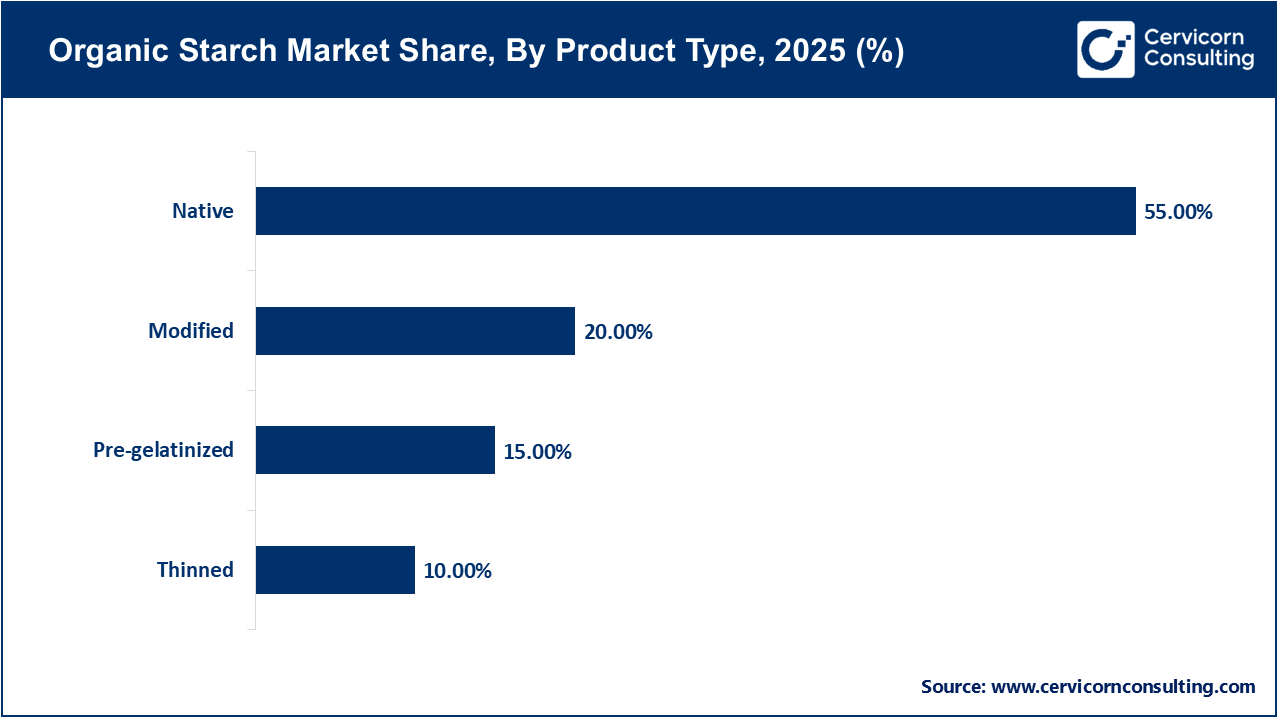
Pre-gelatinized starch is the fastest-growing segment, due to the fact that it offers instant dissolvability and easy processing capabilities. Pre-gelatinized starches are suitable for injected food products, instant dry mixes and cakes, as well as for medicinal purposes. The increasing consumer demand for convenience food products is creating a strong preference among manufacturers for starches that increase texture with short cooking times. The flexibility to use pre-gelatinised starches will continue to contribute to rapid growth within the organic starch market.
End Use Analysis
The food industry is a dominant segment of the market as it utilizes more organic starch than any other segment for purposes such as being a natural thickening agent, binder, or stabilizer. Organic starches are a vital ingredient within the bakery, snack, baby food, sauce, and beverage industries. Currently, the growing demand from consumers for organic products and the presence of clean-label ingredients supports this segment of organic starches, making the food industry the leading consumer of organic starches.
Organic Starch Market Share, By End Use, 2025 (%)
| End Use |
Revenue Share, 2025 (%) |
| Food Industry |
70% |
| Paper Industry |
8% |
| Chemical Industry |
7% |
| Textile Industry |
5% |
| Pharmaceutical Industry |
10% |
The pharmaceutical industry is the fastest growing segment, due to the ever-increasing use of organic starches for tablet, capsule, and coating applications. Organic starches are used as a natural binder and disintegrant in pharmaceutical formulations; therefore, they are well-suited for clean-label pharmaceutical formulations. As a result of the trend towards natural and safe excipients within the healthcare sector, there is an increasing demand for organic starches, making them the fastest growing end-use segment of the overall organic starch market.
Organic Starch Market Top Companies
Recent Development
- Cargill Incorporated: Cargill announced the expansion in August 2025 of its BioPlus™ line of clean label ingredients by introducing an organic multi functional starch for high shear and high heat processing. This product will create better texture stability in sauces, bakery fillings, and shelf ready meals, thereby helping Food Manufacturers develop organic and Non-Genetically Modified (non-GMO) Reformulated Products.
- Beneo GmbH: The launch of Beneo’s first fully organic rice starch system specifically for plant based-dairy and dessert applications took place in March 2025. This rice starch system is a result of improved rice processing technologies utilized at Beneo's Belgian manufacturing operation. This launch reinforces Beneo’s position within the natural and allergen-free ingredient markets.
- Ingredion Incorporated: The introduction of NOVATION® Organic UltraClear, an advanced organic corn starch providing superior clarity and transparency for beverages, sauces, dressings, and other clear sauces was made by Ingredion in July 2025. This development was the result of an increase in consumer interest and consumer demand for premium quality clean label products that deliver great visual and taste appeal without utilizing any synthetic stabilizers.
Market Segmentation
By Source
- Corn
- Rice
- Potato
- Cassava
- Tapioca
- Pea
- Wheat
- Others
By Product Type
- Native
- Thinned
- Modified
- Pre-gelatinized
By End Use
- Food Industry
- Paper Industry
- Chemical Industry
- Textile Industry
- Pharmaceutical Industry
By Region
- North America
- APAC
- Europe
- LAMEA