Oral Care Market Size, Growth, Forecast 2026 to 2035
The global oral care market size was estimated at USD 41.68 billion in 2025 and is expected to be worth around USD 82.97 billion by 2035, exhibiting a compound annual growth rate (CAGR) of 7.1% over the forecast period from 2026 to 2035.
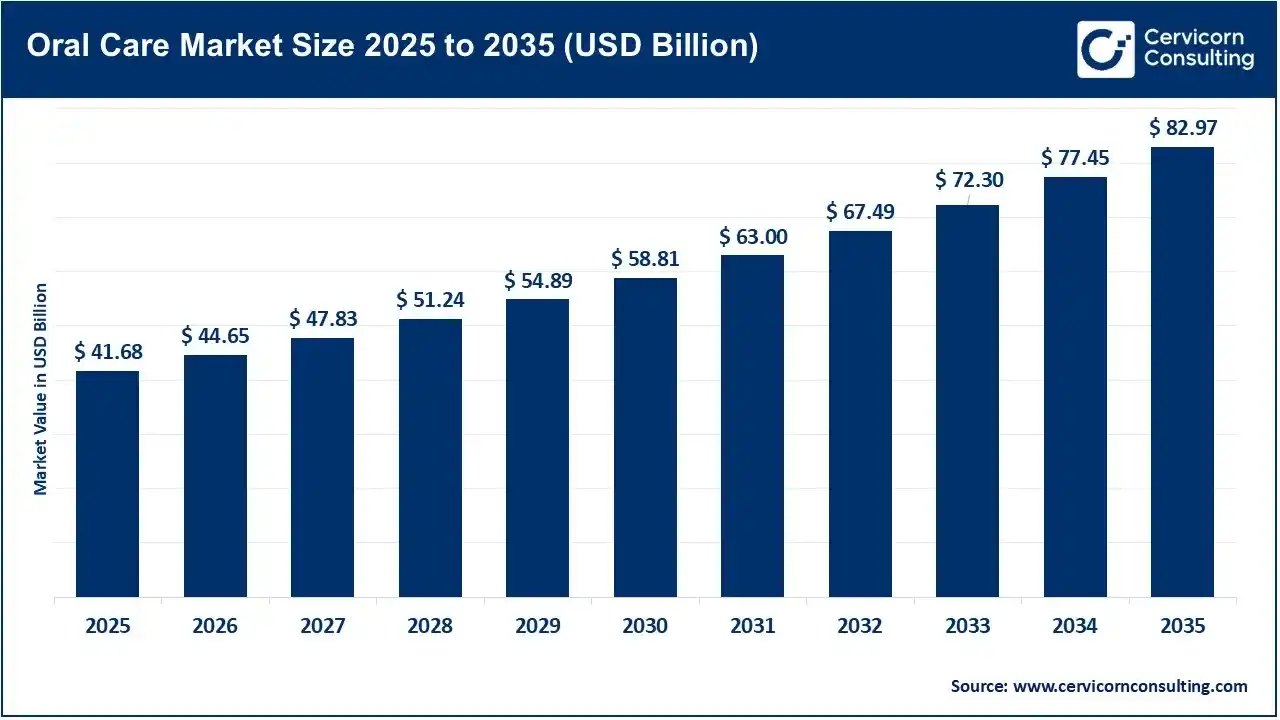
The oral care market is primarily driven by the growing global burden of dental diseases and increasing awareness of preventive oral hygiene. According to the World Health Organization (WHO), oral diseases affect approximately 3.7 billion people worldwide, while untreated dental caries in permanent teeth remains the most common health condition globally. In addition, severe periodontal disease affects more than 1 billion people, creating sustained demand for toothpaste, mouthwash, toothbrushes, interdental cleaning products, and professional oral care solutions. Governments, dental associations, and healthcare providers are also promoting twice-daily brushing with fluoride toothpaste and regular preventive dental check-ups, further accelerating product adoption across both developed and emerging economies.
Another major growth factor is the increasing consumer preference for premium, technologically advanced, and natural oral care products. Rising disposable incomes, rapid urbanization, expanding e-commerce penetration, and growing awareness of cosmetic dentistry are boosting demand for electric toothbrushes, water flossers, teeth whitening products, and herbal formulations. WHO estimates that dental caries affects around 2.5 billion people, while oral diseases account for approximately USD 387 billion in direct global healthcare expenditure and USD 323 billion in productivity losses annually, highlighting the significant economic burden and the need for effective preventive oral care products. These trends continue to encourage innovation and product diversification by leading manufacturers worldwide.
Report Highlights
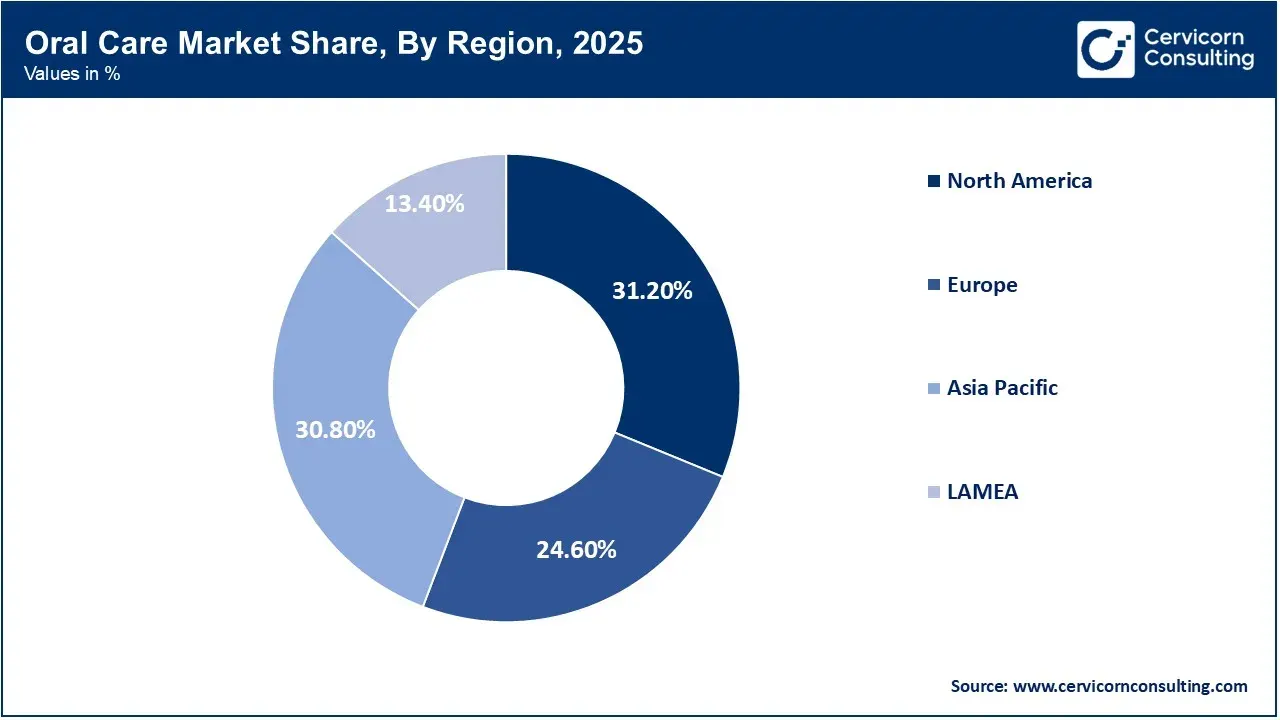
- North America dominated the global oral care market with 31.2% market share, supported by advanced dental care infrastructure, high oral hygiene awareness, and premium product adoption.
- Asia-Pacific accounted for approximately 30.8% of the market and is the fastest-growing regional market, driven by urbanization, rising disposable incomes, and expanding preventive dental care.
- Toothpaste remained the leading product segment, capturing approximately 36.6% of the global market, owing to its universal daily usage and continuous innovation in therapeutic formulations.
- Toothbrushes emerged as the fastest-growing product category, fueled by increasing adoption of electric and smart toothbrushes with AI-enabled brushing technologies.
- Supermarkets & Hypermarkets held the largest distribution channel share at approximately 40.8%, benefiting from extensive product availability, promotional pricing, and high consumer footfall.
- Online Retail/E-commerce is witnessing the fastest growth, driven by digital shopping convenience, subscription services, and expanding direct-to-consumer oral care brands.
What is Oral Care?
Oral care refers to the practice of maintaining the health and hygiene of the teeth, gums, tongue, and entire oral cavity to prevent dental diseases such as tooth decay, gum disease, bad breath, and oral infections. It includes the daily use of products such as toothpaste, toothbrushes, mouthwash, dental floss, tongue cleaners, and oral irrigators, along with regular dental check-ups and professional treatments. Modern oral care also encompasses preventive, cosmetic, and therapeutic solutions, including teeth whitening, sensitivity relief, gum care, and smart connected oral hygiene devices, aimed at improving overall oral and systemic health.
Recent Milestones
| Date |
Company |
Recent Milestone |
Market Impact |
| March 2025 |
Procter & Gamble (Oral-B) |
Expanded the Oral-B iO smart toothbrush portfolio with next-generation AI-powered brushing guidance and enhanced plaque detection. |
Strengthened the premium smart oral care device segment and personalized oral hygiene. |
| April 2025 |
Hismile |
Introduced a limited-edition flavored toothpaste collaboration, expanding its innovative oral care portfolio. |
Increased consumer engagement and premium toothpaste adoption among younger demographics. |
| April 2025 |
Henry Schein |
Science Based Targets initiative (SBTi) validated the company's net-zero emissions targets across its healthcare and dental operations. |
Reinforced sustainability initiatives within the dental and oral care supply chain. |
| August 2026 |
Frida |
Launched a 32-product hygiene collection for children, including dedicated oral care products designed to encourage independent brushing habits. |
Expanded the children's oral care category with age-specific, engagement-focused products. |
Oral Care Market Dynamics
Market Drivers
1. Rising Burden of Sugar Consumption and Dental Caries
The increasing consumption of sugary foods and beverages is significantly driving demand for preventive oral care products worldwide. The WHO recommends limiting free sugar intake to less than 10% of total daily energy intake, yet excessive sugar consumption remains a major contributor to tooth decay. Growing awareness of cavity prevention is boosting the adoption of fluoride toothpaste, mouthwash, and interdental cleaning products, while governments are strengthening public health campaigns promoting daily oral hygiene and preventive dental care.
2. Growing Aging Population and Tooth Retention
The expanding elderly population is creating sustained demand for advanced oral care products, as more people retain their natural teeth into old age. According to the WHO, the global population aged 60 years and above is projected to reach 2.1 billion by 2050, increasing the prevalence of gum disease, tooth sensitivity, dry mouth, and denture-related issues. This demographic shift is driving demand for specialized toothpaste, denture care products, electric toothbrushes, and professional oral hygiene solutions.
Market Restraints
1. Limited Access to Affordable Dental Care
Limited access to professional dental services continues to restrict oral care adoption, particularly in low- and middle-income countries. The WHO reports that prevention and treatment of oral diseases are often excluded from universal health coverage, while the unequal distribution of dental professionals further reduces access to routine care. Consequently, many consumers seek treatment only after severe dental problems develop, reducing consistent demand for preventive oral care products.
2. High Out-of-Pocket Dental Expenditure
High treatment costs discourage routine dental visits and preventive care, especially among lower-income populations. OECD data show that unmet dental care needs increased from 3.8% in 2019 to 4.1% in 2024 across member countries, with waiting times and affordability remaining key barriers. These financial constraints reduce regular consumer engagement with preventive oral healthcare and limit the adoption of premium oral care products in many regions.
Market Opportunities
1. Expansion of Digital and Smart Oral Care Technologies
Rapid advances in connected healthcare devices are creating opportunities for AI-enabled toothbrushes, smart oral monitoring, and tele-dentistry solutions. The WHO highlights digital technologies as a strategic opportunity to improve oral health literacy, enable early disease detection, strengthen workforce training, and enhance national oral health surveillance. Integration of mobile applications and connected oral care devices is expected to accelerate personalized preventive care and improve long-term consumer engagement.
2. Increasing Government Focus on Preventive Oral Health Policies
Government initiatives promoting healthier diets and preventive oral care present significant opportunities for manufacturers. WHO regional assessments indicate that 40% of countries in one assessment had not yet implemented sugar-sweetened beverage taxes, leaving substantial scope for future policy adoption. Expanding fluoride availability, nutrition labeling, sugar reduction programs, and school-based oral health campaigns are expected to increase preventive oral care product consumption globally.
Market Challenges
1. Low Oral Health Awareness in Developing Regions
Despite growing awareness in developed markets, inadequate oral hygiene education remains a major challenge across many developing economies. The WHO notes that oral diseases disproportionately affect socially disadvantaged populations due to poor oral hygiene practices, limited fluoride exposure, and inadequate preventive education. These knowledge gaps delay early intervention, reduce routine product usage, and increase the long-term burden of untreated oral diseases, constraining overall market penetration.
2. Affordability and Availability of Essential Oral Care Products
Ensuring access to affordable fluoride toothpaste and preventive products remains a persistent challenge across several regions. WHO regional assessments indicate that fluoride toothpaste remains unaffordable in multiple lower-income countries despite its inclusion in the WHO Model List of Essential Medicines. Limited affordability and inconsistent product availability continue to hinder widespread adoption of evidence-based oral care practices, particularly among vulnerable populations.
Regional Analysis
The oral care market is segmented by region into North America, Europe, Asia-Pacific, Latin America, and LAMEA. Here is a brief overview of each region:
North America Oral Care Market: Driven by High Oral Health Awareness, Strong Preventive Dental Care Adoption, Premium Oral Care Products, and Advanced Retail & Healthcare Infrastructure
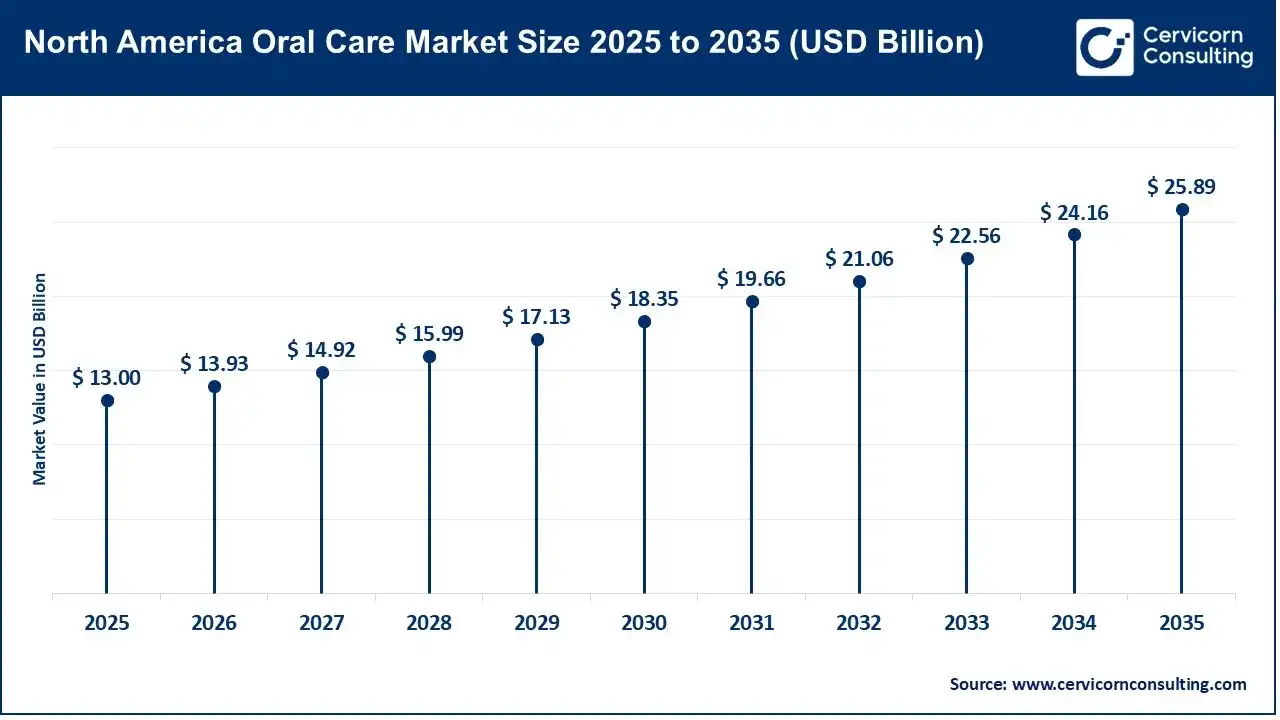
North America dominates the market owing to its high consumer awareness of oral hygiene, well-established dental healthcare infrastructure, widespread adoption of preventive dental practices, and strong purchasing power. The region benefits from extensive availability of premium oral care products, including electric toothbrushes, water flossers, whitening products, therapeutic toothpaste, and AI-enabled smart oral care devices. Strong recommendations from dental professionals, widespread dental insurance coverage, and the presence of leading manufacturers continue to drive product innovation and consumer adoption. In addition, robust retail and e-commerce networks, increasing demand for natural and sustainable oral care products, and continuous investments in research and development reinforce North America's leadership in the global oral care market.
United States: High Dental Care Expenditure, Strong Preventive Oral Health Programs, and Rapid Adoption of Premium Oral Care Products Drive Market Growth
- According to the CDC, 65.5% of adults aged 18 years and older visited a dentist in 2023, reflecting strong preventive dental care adoption and sustained demand for oral care products.
- The CDC reports that 1 in 5 adults (21%) aged 20–64 years has at least one untreated cavity, driving continued demand for fluoride toothpaste, mouthwash, and preventive dental treatments.
- By age 9, nearly 50% of U.S. children have experienced cavities in either primary or permanent teeth, supporting the growing market for pediatric oral care products.
Canada: Universal Preventive Oral Health Initiatives, Expanding Public Dental Coverage, and Growing Consumer Awareness Support Market Expansion
- The Canadian Dental Care Plan (CDCP) is expected to provide dental coverage to up to 9 million uninsured Canadians, significantly improving access to preventive and restorative dental care.
- One in four Canadians (24%) avoided visiting an oral health professional because of treatment costs, highlighting substantial growth opportunities for publicly supported oral healthcare.
- Statistics Canada reported that approximately 28% of Canadians aged 12 years and older did not visit an oral health professional during the previous 12 months, indicating considerable scope for expanding preventive dental care services.
Asia-Pacific (APAC) Oral Care Market: Driven by Rising Oral Health Awareness, Expanding Middle-Class Population, Increasing Government Oral Health Initiatives, and Growing Demand for Premium & Herbal Oral Care Products
Asia-Pacific is the fastest-growing region in the market due to its large population base, increasing disposable incomes, expanding middle-class population, and improving awareness of preventive oral hygiene. Rapid urbanization, greater access to organized retail and e-commerce platforms, and growing consumer preference for premium, herbal, and technologically advanced oral care products are accelerating market growth. Governments across the region are strengthening oral health policies, school-based dental programs, and universal healthcare initiatives to improve preventive dental care. In addition, rising incidences of dental caries, periodontal diseases, and oral cancer, coupled with increasing adoption of electric toothbrushes, whitening products, and therapeutic oral care solutions, continue to support long-term market expansion across Asia-Pacific.
China: Healthy China Initiative, Expanding Middle-Class Consumption, and Rising Preventive Dental Care Drive Market Growth
- China's Healthy China 2030 initiative prioritizes disease prevention and improved oral health, encouraging greater adoption of preventive dental care and oral hygiene products.
- Rising disposable incomes and rapid urbanization are accelerating demand for premium toothpaste, electric toothbrushes, mouthwash, and teeth whitening products across urban households.
India: High Burden of Oral Diseases, Government Oral Health Programs, and Growing Preventive Awareness Support Market Expansion
- WHO estimates that the South-East Asia Region recorded over 900 million cases of untreated dental caries, severe periodontal disease, and edentulism in 2019, with India representing a significant share due to its large population.
- The National Oral Health Programme (NOHP) continues expanding preventive oral healthcare, early diagnosis, and oral health awareness through integration with public health services.
Europe Oral Care Market: Driven by Strong Preventive Dental Care Systems, High Consumer Awareness, Aging Population, and Growing Demand for Premium & Sustainable Oral Care Products
Europe represents a mature market supported by well-established dental healthcare systems, high awareness of preventive oral hygiene, and widespread use of premium oral care products. The region is witnessing growing demand for electric toothbrushes, therapeutic toothpaste, whitening products, and natural or sustainable oral care formulations. An aging population, increasing focus on preventive dentistry, and continuous innovation from leading oral care manufacturers further support market expansion. Despite strong healthcare infrastructure, affordability and unequal dental coverage remain challenges across several countries. According to WHO Europe, the region had the highest prevalence of major oral diseases globally, affecting 50.1% of the adult population.
Germany: Strong Preventive Dental Culture, Comprehensive Dental Insurance, and High Adoption of Premium Oral Care Products Drive Market Growth
- Germany has one of Europe's most developed dental care systems, supported by statutory health insurance and a dense network of dental professionals, encouraging routine preventive dental visits.
- Germany recorded only 0.9% unmet dental care needs in 2024, among the lowest in the European Union, reflecting excellent access to preventive and restorative dental services.
United Kingdom: Preventive Oral Health Awareness, NHS Dental Services, and Growing Premium Oral Care Demand Support Market Expansion
- According to the Adult Oral Health Survey 2023, 65% of adults visited a dentist at least once within a two-year period, demonstrating strong awareness of preventive oral healthcare.
- Around 29% of adults received exclusively private dental care during their most recent visit, supporting growing demand for premium oral care products and cosmetic dentistry services.
LAMEA Oral Care Market: Driven by Rising Oral Health Awareness, Government Preventive Health Initiatives, and Growing Demand for Premium Oral Care Products
The LAMEA region is witnessing steady growth due to increasing awareness of preventive oral hygiene, improving access to dental care, rapid urbanization, and rising disposable incomes. Governments across several countries are strengthening public oral health campaigns and expanding access to preventive dental services, while modern retail and e-commerce channels are improving product availability. Demand for herbal toothpaste, therapeutic mouthwash, whitening products, and electric toothbrushes is increasing, particularly in urban centers. In the Middle East and Africa, toothpaste remains the largest product category, while toothbrushes are experiencing the fastest growth. Saudi Arabia is projected to be one of the fastest-growing country markets, supported by national health awareness initiatives and expanding private dental care infrastructure.
Brazil: Large Consumer Base, Expanding Preventive Oral Care Awareness, and Strong FMCG Distribution Drive Market Growth
- Brazil is the largest oral care market in Latin America, supported by its large population, well-developed consumer goods industry, and widespread availability of oral care products through supermarkets, pharmacies, and e-commerce platforms.
- Government oral health initiatives under the National Oral Health Policy (Brasil Sorridente) continue improving access to preventive and restorative dental services, encouraging greater adoption of daily oral hygiene products.
Saudi Arabia: Vision 2030 Healthcare Reforms, Preventive Dental Programs, and Premium Oral Care Adoption Support Market Expansion
- Saudi Arabia is expected to register the highest growth within the Middle East & Africa oral care market, supported by preventive healthcare initiatives under Saudi Vision 2030 and expanding private dental services.
- Government-led school oral health programs and nationwide awareness campaigns are encouraging regular brushing habits and preventive dental check-ups, increasing demand for toothpaste, mouthwash, and electric toothbrushes.
Oral Care Market Segmental Analysis
The oral care market is segmented into product type, distribution channel, and geography.
Product Type Analysis
Toothpaste dominates the oral care market due to its essential role in everyday oral hygiene and its universal adoption across all age groups. Consumers use toothpaste multiple times daily, making it the highest-frequency purchase within the category. The availability of specialized formulations for cavity protection, whitening, gum care, sensitivity relief, herbal ingredients, and children's oral health has further strengthened demand. Continuous product innovation, strong brand loyalty, and widespread retail availability ensure toothpaste remains the leading revenue-generating product segment globally.
Oral Care Market Share, By Product Type, 2025 (%)
| Product Type |
Revenue Share, 2025 (%) |
| Toothpaste |
36.6% |
| Toothbrushes |
22.8% |
| Mouthwash/Rinses |
13.7% |
| Dental Floss & Interdental Cleaners |
6.4% |
| Denture Care Products |
4.9% |
| Teeth Whitening Products |
6.3% |
| Tongue Cleaners |
2.4% |
| Oral Irrigators (Water Flossers) |
3.2% |
| Others |
3.7% |
Toothbrushes are the fastest-growing product segment, driven by increasing consumer preference for electric, sonic, and smart toothbrushes featuring pressure sensors, timers, Bluetooth connectivity, and AI-powered brushing guidance. Rising awareness of preventive oral healthcare, growing disposable incomes, and dentist recommendations are accelerating premium product adoption. Manufacturers are also introducing eco-friendly bamboo toothbrushes and subscription-based replacement programs, while innovations in smart oral hygiene devices continue to expand the segment across developed and emerging markets.
Distribution Channel Analysis
Supermarkets and hypermarkets dominate the oral care market because they offer consumers convenient access to a comprehensive range of oral hygiene products under one roof. These retail outlets attract shoppers through attractive discounts, bundled offers, loyalty programs, and strong product visibility. Their extensive shelf space enables leading brands to showcase multiple product variants, encouraging impulse purchases and brand switching. Well-established retail networks and high consumer footfall continue to reinforce their leadership in global oral care distribution.
Oral Care Market, By Distribution Channel, 2025 (%)
| Distribution Channel |
Revenue Share, 2025 (%) |
| Supermarkets & Hypermarkets |
40.8% |
| Pharmacies & Drug Stores |
21.7% |
| Convenience Stores |
10.3% |
| Online Retail/E-commerce |
15.4% |
| Specialty Stores |
6.2% |
| Dental Clinics |
2.9% |
| Others |
2.7% |
Online retail is the fastest-growing distribution channel owing to the rapid expansion of digital commerce and changing consumer shopping behavior. E-commerce platforms provide convenient home delivery, competitive pricing, subscription-based replenishment services, extensive product comparisons, and access to premium and niche oral care brands. Digital marketing, influencer promotions, customer reviews, and direct-to-consumer business models further support online sales growth, making e-commerce an increasingly important channel for oral care manufacturers seeking broader market reach.
Oral Care Market Top Companies
Segments Covered
By Product Type
- Toothpaste
- Toothbrushes
- Manual Toothbrushes
- Electric Toothbrushes
- Mouthwash/Rinses
- Dental Floss & Interdental Cleaners
- Denture Care Products
- Teeth Whitening Products
- Tongue Cleaners
- Oral Irrigators (Water Flossers)
- Others
By Distribution Channel
- Supermarkets & Hypermarkets
- Pharmacies & Drug Stores
- Convenience Stores
- Online Retail/E-commerce
- Specialty Stores
- Dental Clinics
- Others
By Geography
- North America
- Europe
- Asia-Pacific
- LAMEA