Optical Transceiver Market Overview
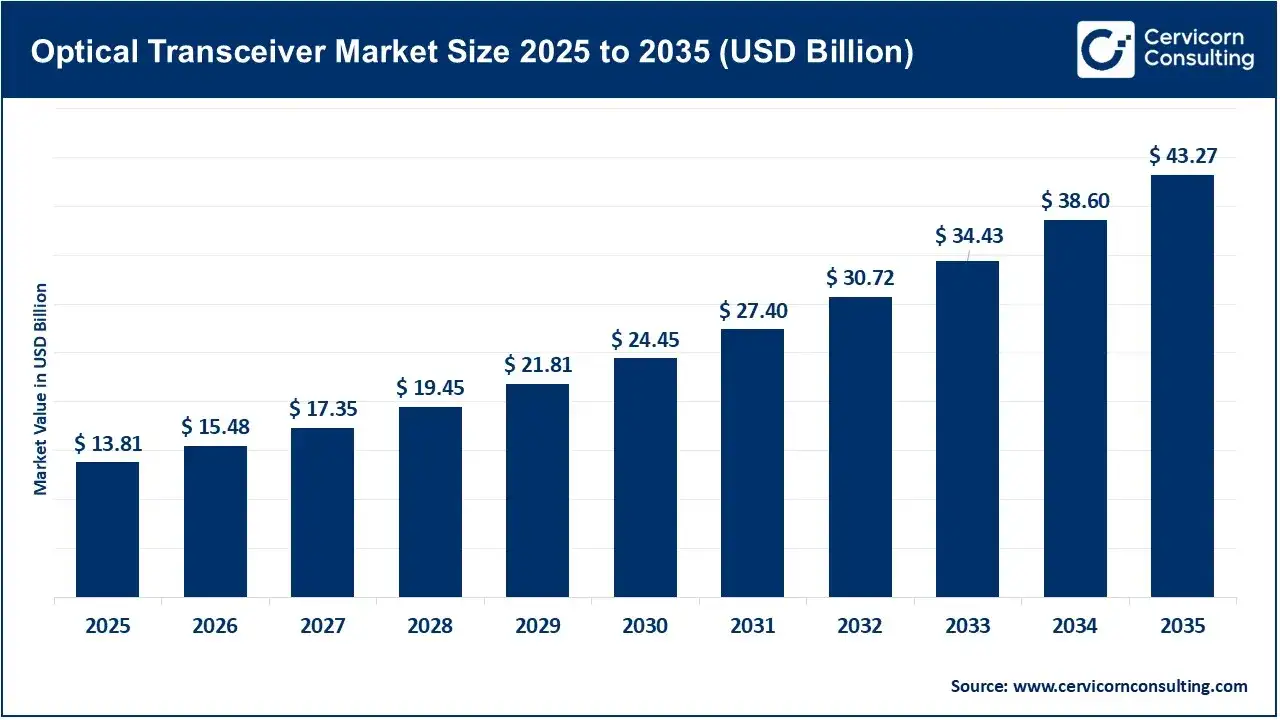
The optical transceiver market size was valued at USD 13.81 billion in 2025 and is projected to grow from USD 15.48 billion in 2026 to nearly USD 43.27 billion by 2035 registering a CAGR of 12.1% over the forecast period 2026 to 2035. The optical transceiver market is expanding since companies and network operators need data communication that is quicker, more dependable, and has greater capacity. Advanced optical connectivity is becoming more necessary as cloud services, AI applications, 5G networks, and data centers are used more frequently. Organizations are being encouraged to upgrade their communication infrastructure with next-generation optical transceivers due to the trend toward faster networks and an increase in data traffic.
In September 2026, Coherent Corp. introduced an expansion to its pluggable optical line systems portfolio to support 800G ZR/ZR+ digital coherent optics. The solution is designed to address the increasing bandwidth requirements of AI-driven data center networks, reflecting the industry's move toward higher-capacity optical communication technologies.
Optical Transceiver Market Size and Forecast
- Base Year Market Size (2025): $13.81 billion
- Current Year Market Size (2026): $15.48 billion
- Estimated Year Market Size (2035): $43.27 billion
- Forecast Period CAGR (2026-2035): 12.1%
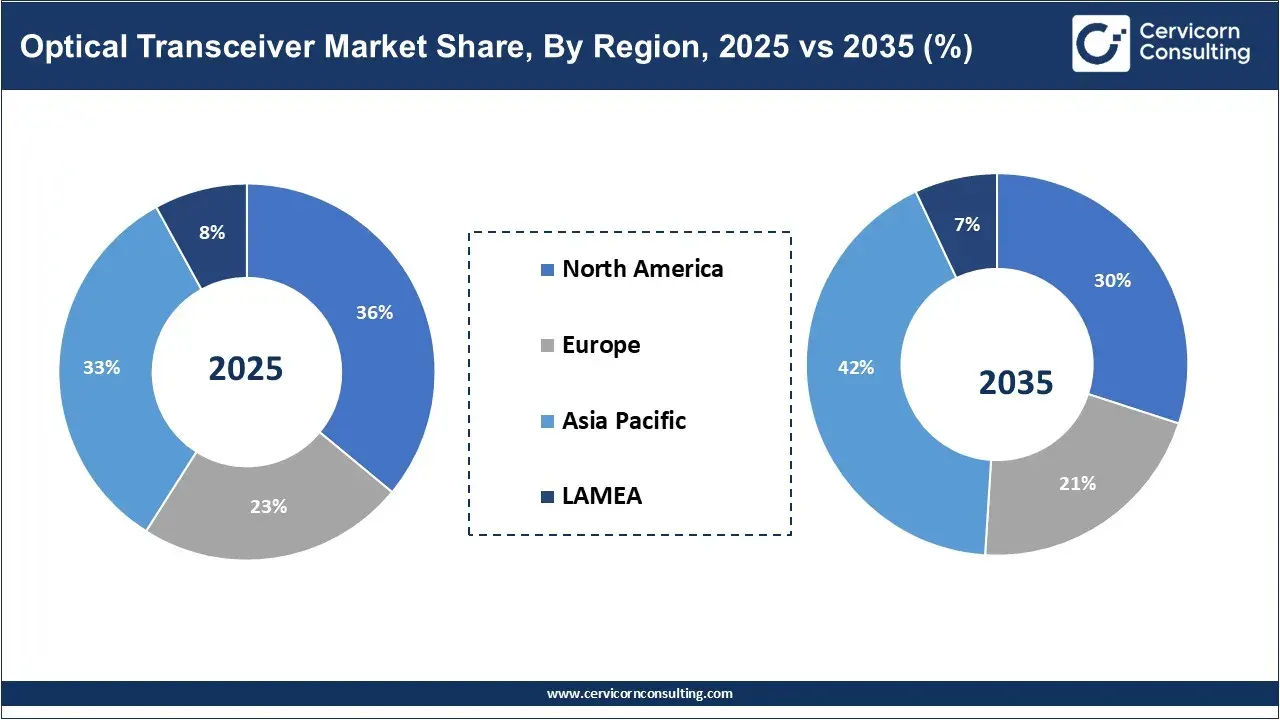
- Leading Region: North America (revenue share 36%)
Report Highlights
- By region, North America led the market in 2025, supported by strong data center, cloud, and high-speed networking infrastructure.
- By region, Asia Pacific is expected to grow rapidly through 2035, driven by data center expansion, 5g deployment, AI adoption, and digital infrastructure investments.
- By data rate, the 100–400 GBPS segment led the market in 2025, supported by widespread use in data centers, telecom, and enterprise networks.
- By data rate, 800 GBPS and 1.6t are expected to grow rapidly, driven by ai workloads, hyperscale data centers, and rising bandwidth requirements.
- By form factor, the GSFP family led the market in 2025 due to its widespread use in high-density data center networks.
- By form factor, GSFP is expected to grow rapidly through 2035, supported by rising adoption of 800g and higher-speed connectivity.
- By optical technology, EML led the market in 2025, supported by its established use in high-speed optical communication.
- By optical technology, silicon photonics is expected to grow rapidly, driven by demand for efficient, compact, and high-bandwidth connectivity.
- By application, data centers led the market in 2025, supported by cloud expansion, rising data traffic, and network upgrades.
- By application, ai infrastructure and data centers are expected to grow rapidly due to increasing demand for high-bandwidth, low-latency connections.
- By end user, cloud service providers and hyperscale data center operators led the market in 2025, supported by large-scale infrastructure deployment.
- By end user, ai-focused hyperscale operators are expected to grow rapidly as GPU clusters and high-capacity optical interconnect requirements expand.
Major Trends
- Higher-Speed Transceivers: Growing AI and data center workloads are increasing demand for 800G and next-generation optical transceivers.
- AI Data Center Connectivity: The expansion of AI data centers is creating greater demand for high-bandwidth connections between GPUs, servers, switches, and storage systems.
- Silicon Photonics Adoption: Silicon photonics is gaining traction as data center operators seek faster, compact, and energy-efficient connectivity solutions.
- Rise of 1.6T Transceivers: The shift toward 1.6T technology is emerging as data centers require greater bandwidth to support large-scale AI workloads.
- Focus on Energy Efficiency: Increasing power consumption in data centers is encouraging the development of optical transceivers that deliver higher performance with lower energy use.
- Advanced Optical Technologies: Technologies such as co-packaged optics and linear-drive optics are gaining attention as network speeds and data processing requirements continue to increase.
- Expansion of Data Center Networks: The growth of cloud services, 5G, and AI applications is encouraging operators to upgrade network infrastructure with higher-capacity optical connections.
- Growing Demand for Compact Solutions: Data center operators are increasingly adopting smaller and more efficient optical modules to improve space utilization and support high-density network environments.
Market Dynamics
Driver: Rising Demand for High-Speed Data Connectivity
Faster and higher-capacity network connections are becoming more and more necessary as the use of AI, cloud computing, 5G, and data-intensive applications grows. High-speed data transmission between servers, switches, storage systems, and data centers is made possible by optical transceivers, which are becoming more and more crucial as network traffic and bandwidth needs increase. The need for dependable, low-latency connections within data center networks is also being driven by the growing deployment of AI workloads. It is anticipated that businesses will require more sophisticated optical communication solutions as they modernize their digital infrastructure.
- In March 2026, Applied Optoelectronics, Inc. (AOI) announced its first volume order for 1.6T data center transceivers from a major hyperscale customer to support higher network bandwidth for AI workloads. The development reflects the increasing shift toward higher-speed optical connectivity in AI data centers.
Restraint: High Power Consumption and Thermal Management
In densely populated data centers, high-speed optical transceivers may result in higher power consumption and heat production. Operators must optimize power and manage heat effectively as data rates rise in order to sustain dependable network performance. Particularly in large AI-focused data centers, these requirements may increase the complexity of the infrastructure and running costs. Careful system design and sophisticated cooling solutions may also be necessary to control heat in high-density networking environments. The total cost of implementing and running next-generation optical networking infrastructure may rise as a result of these extra requirements.
- In March 2026, ADTRAN introduced its LiteWave800 800G optical module, designed to reduce power consumption and thermal requirements for high-density AI data center connectivity. The development highlights the industry's focus on addressing power and cooling challenges associated with high-speed optical networking.
Opportunity: Expansion of 1.6T and Next-Generation Optical Connectivity
The shift to 800G, 1. 6T, and other higher-speed optical technologies is giving manufacturers the chance to create products with more bandwidth, reduced latency, and enhanced energy efficiency. The need for sophisticated optical connectivity solutions is anticipated to rise as AI clusters and hyperscale data centers grow. Data center operators are being encouraged to implement technologies that can manage higher data volumes without significantly expanding their infrastructure footprint due to an increase in network traffic. The growth of high-speed networking throughout data centers and telecom networks may be further aided by the creation of more effective optical solutions.
- In March 2026, Marvell Technology expanded its 1.6T optical DSP portfolio to support the industry's transition from 800G to next-generation connectivity for AI data centers. The company highlighted the role of advanced optical technologies in scaling AI infrastructure.
Regional Analysis
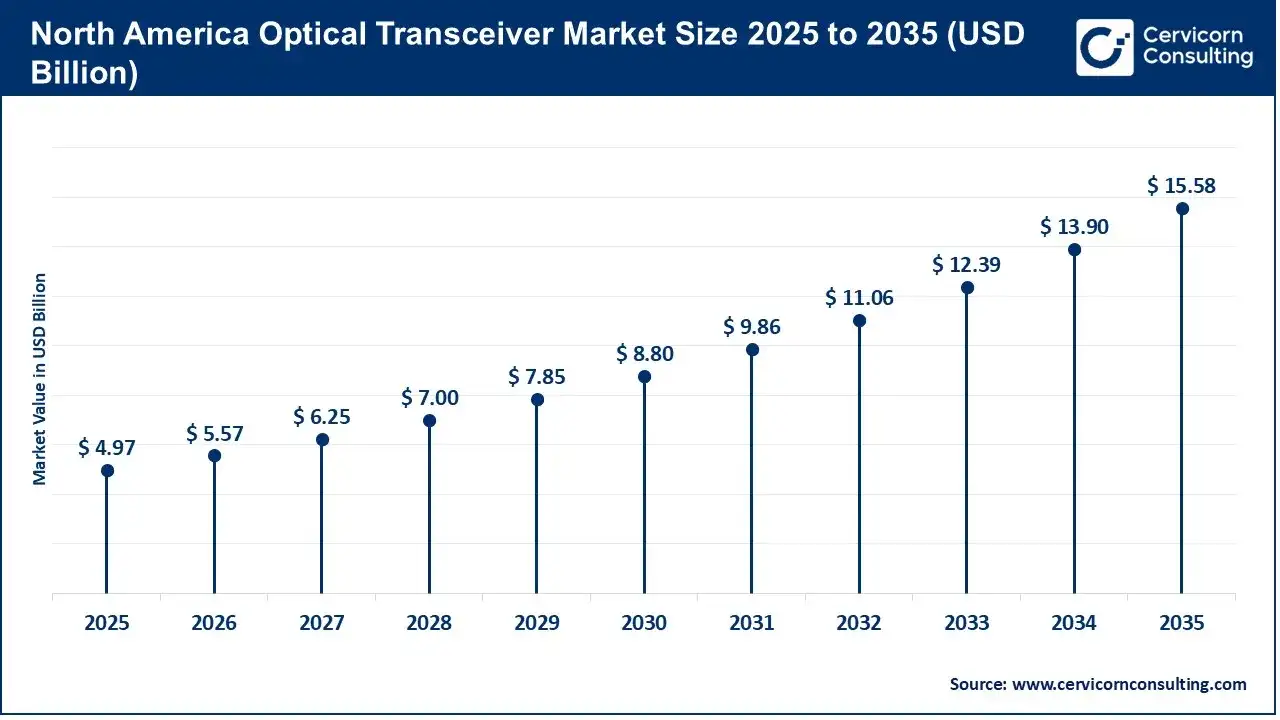
The North America optical transceiver market size was estimated at USD 4.97 billion in 2025 and is projected to hit around USD 15.58 billion by 2035. North America dominated the market in 2025, backed by its high-speed networking investments, cloud infrastructure, and well-established hyperscale data center ecosystem. The existence of significant networking and technology firms benefits the area as well. The ongoing implementation of enhanced optical connectivity is being supported by significant investment from cloud and data center operators. The region's market position is also influenced by its early adoption of high-speed networking technology and AI infrastructure.
The Asia-Pacific optical transceiver market size was valued at USD 4.56 billion in 2025 and is expected to reach around USD 14.28 billion by 2035. Asia Pacific is expected to record the fastest growth through 2035, fueled by increased digital infrastructure, 5G deployment, telecommunications investment, and data center capacity expansion. Regional demand is also being supported by growing AI usage and infrastructure development in markets like China and India. High-speed optical networking is becoming more and more necessary as cloud services and hyperscale facilities grow. The regional market is anticipated to be further strengthened by increasing investments in digital connectivity and next-generation communication infrastructure.
Segmental Analysis
Data Rate Analysis
The 100–400 Gbps segment held the leading position in the optical transceiver market in 2025, backed by its extensive implementation in telecom networks, data centers, and corporate infrastructure. Network upgrades and the growing need for faster data transmission continue to benefit this segment. Adoption is further supported by its well-established ecosystem, compatibility with current networking hardware, and reasonably developed supply chain. The demand for these transceivers is also being maintained by rising cloud traffic and the development of high-capacity network infrastructure.
Optical Transceiver Market Share, By Data Rate, 2025 (%)
| Data Rate |
Revenue Share, 2025 (%) |
| Below 10 Gbps |
6% |
| 10–40 Gbps |
10% |
| 41–100 Gbps |
20% |
| 101–200 Gbps |
13% |
| 201–400 Gbps |
22% |
| 401–800 Gbps |
19% |
| Above 800 Gbps |
10% |
The 800 Gbps and 1.6T segment is expected to witness the fastest growth through 2035 as hyperscale data centers and AI workloads require more bandwidth and quicker connections. Next-generation optical transceivers are becoming more popular due to the move toward faster switching architectures. As GPU cluster sizes increase, servers, switches, and storage systems must communicate more. It is anticipated that the advancement of sophisticated networking platforms and faster optical components will help this market even more.
Form Factor Analysis
The QSFP family, including QSFP28 and QSFP-DD, dominated the market in 2025 due to its widespread use in high-density networking and data center environments. Because of its scalability and capacity to facilitate high-speed connectivity, it is a crucial component of contemporary network infrastructure. Additionally, QSFP-based solutions are appealing for network upgrades and replacement demand due to their established installed base. Their position is further strengthened across data center environments by their compatibility with widely used switching platforms.
OSFP is expected to be the fastest-growing form factor through 2035, primarily because it is appropriate for next-generation data center infrastructure and high-speed applications like 800G. It can handle more power and heat, which makes it appropriate for demanding high-bandwidth applications. Manufacturers are being further motivated to create OSFP-based solutions by the expanding use of AI-focused networking platforms. More opportunities for this form factor are anticipated as 800G and emerging 1. 6T technologies become more widely used.
Optical Technology Analysis
EML technology is expected to maintain a strong position in 2026 because of its well-established application in fast optical communication systems. It is appropriate for demanding telecom and data networking applications due to its capacity to facilitate dependable, high-performance data transmission. A well-established manufacturing ecosystem and the technology's application in high-speed single-mode optical modules are advantages. It is anticipated that the demand for EML-based solutions will continue as long as high-capacity network infrastructure is deployed.
Silicon photonics is expected to experience rapid growth through 2035 as the industry searches for high-bandwidth connectivity solutions that are more compact, effective, and scalable. Higher bandwidth density and better system integration may be supported by its integration of optical components onto photonic integrated circuits. Solutions that can effectively manage bandwidth and power requirements are becoming more and more popular as AI data center deployments increase. Additionally, the technology is becoming more popular for emerging co-packaged optical architectures and next-generation pluggable optics.
Application Analysis
Data centers led the market in 2025, backed by the growth of cloud services, rising data volume, and ongoing improvements to high-speed network infrastructure. In these facilities, servers, switches, storage systems, and other networking equipment must be connected via optical transceivers. Higher-capacity optical connections are in constant demand due to the fast growth of hyperscale and cloud data centers. Operators are also being motivated to upgrade their optical networking infrastructure by growing demands for dependable and low-latency data transmission.
AI infrastructure and data centers are expected to record the fastest growth through 2035 since high-bandwidth and low-latency communication between GPUs, servers, switches, and storage devices is necessary for AI training and inference. The demand for improved optical connectivity is therefore rising due to the quick growth of AI-focused computing facilities. Greater internal network capacity is needed for larger AI clusters, which opens up possibilities for 800G and faster transceivers. The shift to next-generation optical networking technologies is anticipated to be accelerated by the ongoing development of AI computing infrastructure.
End User Analysis
Cloud service providers and hyperscale data center operators heled the largest share of the market in 2025 due to their extensive use of optical networking technology. The demand for high-speed optical transceivers is being supported by their ongoing development of cloud and data center infrastructure. As they increase processing and storage capacity, these operators are often among the first to adopt faster networking technology. Their need for optical connectivity is being further supported by an increase in data flow from digital platforms, cloud apps, and AI services.
AI-focused hyperscale operators are expected to experience strong growth through 2035 as AI workloads are supported by the expansion of huge computing clusters. Optical transceiver use is anticipated to rise throughout these facilities due to the requirement for high-capacity connections across networking and computing systems. Dense interconnects that can process massive amounts of data with little latency are necessary for AI infrastructure. The need for sophisticated optical modules is anticipated to rise in tandem with hyperscalers ongoing expansion of GPU-based computing environments.
Government Initiatives
- In August 2026, the Department of Telecommunications (DoT) and the Centre for Development of Telematics (C-DOT) signed a five-year agreement to establish an End-to-End Optical Network Test Bed in New Delhi. The test bed will support the development, testing, validation, skill development, and commercialization of indigenous optical communication technologies developed by Indian startups and industry players.
- In January 2025, C-DOT and IIT Bombay signed an agreement under the Telecom Technology Development Fund (TTDF) to develop an optical transceiver chipset for high-bandwidth 6G wireless links. The project focuses on high-bandwidth coherent optical links for 6G applications, including high-speed connectivity in remote and difficult-to-reach areas.
- In February 2024, C-DOT and IIT Kharagpur signed an agreement under the TTDF scheme to develop prototypes of 10-Gigabit-capable XGS-PON Optical Line Terminals (OLT) and Optical Network Units (ONU). The initiative aims to support the development and commercialization of high-speed optical access network technology for broadband connectivity.
- In June 2026, C-DOT signed an MoU with IIT Hyderabad to establish a Centre of Excellence in Advanced Communication Technologies. The centre will support research, innovation, prototype development, and capacity building in next-generation communication technologies, including 5G Advanced and 6G systems.
- In July 2026, C-DOT signed an agreement with the Indian Institute of Science (IISc), Bengaluru, and the Foundation for Science Innovation and Development (FSID) to establish another Centre of Excellence for advanced telecom research and development. The initiative is designed to strengthen indigenous telecom innovation through collaborative research and technology development.
Recent Developments
- In September 2026, Gemtek and Dixon expanded their strategic collaboration through their Indian joint venture to manufacture optical transceivers, BOSA modules, and other high-speed optical connectivity products for broadband, telecom, cloud, data center, and AI infrastructure applications.
- In September 2026, GoPro and Starman Optical entered into a definitive merger agreement that is expected to add Starman's U.S.-made optical transceiver business to GoPro's portfolio and expand its presence in AI infrastructure, government, defense, and aerospace applications.
- In April 2026, Credo agreed to acquire DustPhotonics to bring silicon photonics photonic integrated circuit technology into its portfolio and strengthen its optical connectivity capabilities across next-generation AI infrastructure.
- In March 2026, Semtech acquired HieFo Corporation, adding high-efficiency indium phosphide optoelectronic devices, including lasers and gain chips used in optical transceivers for data center interconnects.
- In 2026, The companies announced a joint development program for a 1.6T 2×DR4 optical transceiver designed for next-generation AI clusters and hyperscale data center networks.
Top Companies
Segments Covered
By Data Rate
- Below 10 Gbps
- 10–40 Gbps
- 41–100 Gbps
- 101–200 Gbps
- 201–400 Gbps
- 401–800 Gbps
- Above 800 Gbps
By Form Factor
- SFP / SFP+
- SFP28
- SFP-DD
- QSFP+
- QSFP28
- QSFP-DD
- OSFP
- CFP / CFP2 / CFP4 / CFP8
- Co-Packaged Optics
- Embedded / On-Board Optics
- Others
By Optical Technology
- VCSEL
- DFB Laser
- EML
- Silicon Photonics
- CWDM / DWDM
- Coherent Optical Technology
- Linear Pluggable Optics (LPO)
- Co-Packaged Optics (CPO)
- Others
By Application
- Data Centers
- Telecommunications
- Enterprise Networking
- Cloud Computing
- High-Performance Computing
- AI Infrastructure
- 5G / 5G-Advanced
- Metro Networks
- Long-Haul Networks
- Access Networks
- Fiber-to-the-Home (FTTH)
- Cable Broadband
- Data Center Interconnect (DCI)
- Others
By End User
- Cloud Service Providers
- Hyperscale Data Center Operators
- Colocation Providers
- Telecom Operators
- Enterprises
- Internet Service Providers
- Government
- Research & Academic Institutions
- Cable Operators
- Industrial Enterprises
By Region
- North America
- Europe
- Asia Pacific
- Latin America
- Middle East & Africa
