The global metal recycling market size was accounted for USD 594.54 billion in 2025 and is expected to be worth around USD 1,132.41 billion by 2035, exhibiting a compound annual growth rate (CAGR) of 6.71% over the forecast period from 2026 to 2035. The expansion of the metal recycling market is largely driven by rising demand for sustainable materials and the need to reduce energy consumption in production. The growing amount of scrap generated by industries such as construction, automotive, and e-waste is also a major factor.
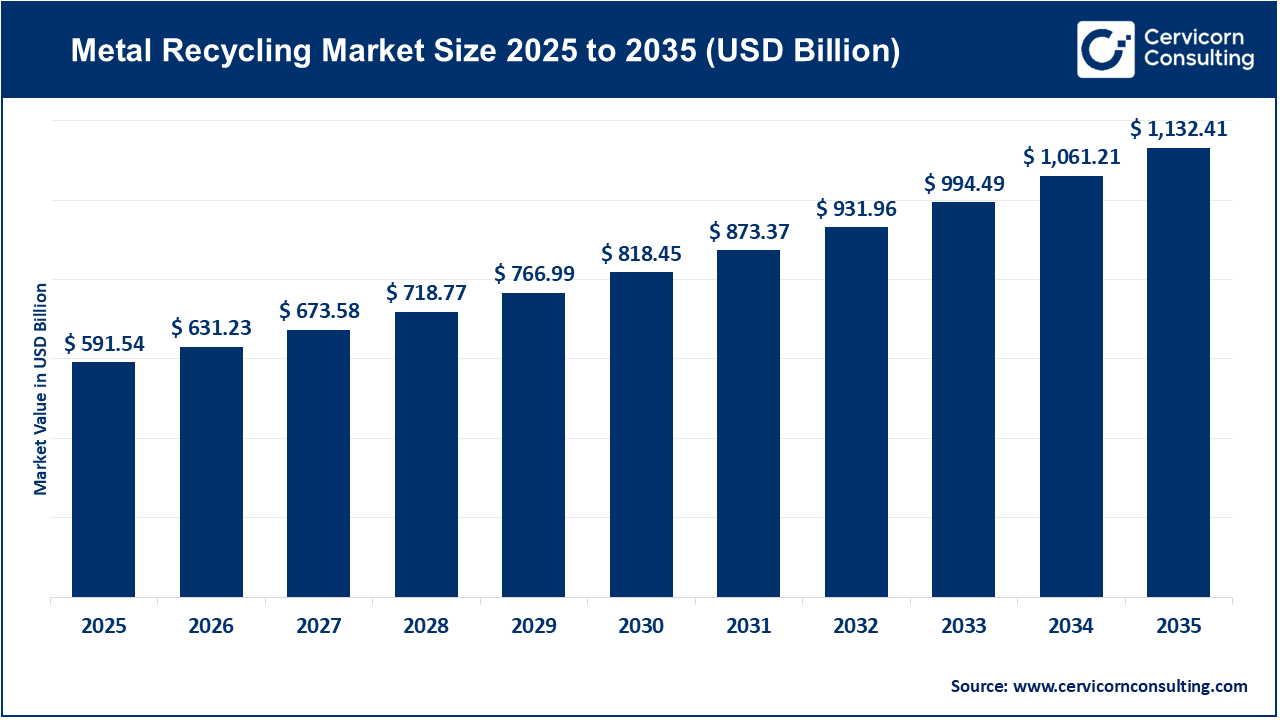
Globally, more than 400 to 650 million tons of scrap metal are processed each year. Steel recycling alone accounts for over 650 million tons annually, while aluminum recycling can save up to 95% of the energy required for primary production. These trends are significantly contributing to market growth. It is projected that the metal recycling market will experience steady growth in volume, rising from approximately 550 million tons in 2026 to nearly 750 million tons by 2030. This growth is expected to be driven by the increasing electrification of industries, the expansion of renewable energy, and the adoption of circular economy policies. The ongoing demand for recycled metals such as copper, aluminum, and steel, combined with stricter environmental regulations and a shift toward low-carbon production methods, is likely to support the long-term expansion of the market.
Report Highlights
- Asia-Pacific led the metal recycling market in 2025 with a market share of 51%, the dominance is supported by strong industrial production, rapid urbanization, and high demand from construction and manufacturing sectors in China and India.
- By metal type, the ferrous metals segment dominated the market with a share of 72% in 2025, owing to its extensive use in steel production and large-scale construction applications.
- By metal type, the non-ferrous metals segment is expected to grow at the fastest rate, driven by rising demand for aluminum, copper, and nickel in EVs, renewable energy, and electronics industries.
- By scrap source, the industrial scrap segment held the largest share of 45% in 2025, due to consistent availability of high-quality scrap from manufacturing processes.
- By scrap source, the electronic waste (e-waste) segment is projected to grow at the fastest rate, supported by increasing digitalization and rising recovery of high-value metals like gold and copper.
- By end-use industry, the construction & infrastructure segment led the market with a 38% share in 2025, driven by high demand for recycled steel and metals in urban development projects.
- By end-use industry, the electrical & electronics segment is expected to grow rapidly, due to increasing e-waste generation and rising demand for recycled metals in EVs and renewable energy systems.
Metal Recycling Market Trends, Key Applications, and Investment Landscape
The metal recycling industry is undergoing significant transformation, driven by increasing focus on sustainability and active involvement from both corporations and governments. One of the main trends is the adoption of circular economy principles and ESG commitments, which has led companies to use more recycled metals in order to lower emissions and reduce costs. Recycling metals is highly effective in reducing greenhouse gas emissions, with reductions ranging from 60% to 95%, and it also results in substantial energy savings. For example, recycling aluminum can save up to 95% of the energy required for primary production. As a result, industries are finding recycled metals increasingly attractive. At the same time, global competition for scrap materials is intensifying, since recycled metals are becoming essential inputs for manufacturing and clean energy applications.
Key Trends & Data Points
- Corporate adoption rising: Many large manufacturers now source 30–70% of raw materials from recycled inputs (especially steel, aluminum, copper).
- Energy & emission benefits: Recycling prevents 500 million tons of CO₂ emissions annually.
- Copper demand from recycling: Around 32% of global copper demand is met via recycled sources.
- Electrification trend: Non-ferrous metals (copper, aluminum) are growing faster due to EVs and renewable energy demand.
- Low recycling gap: Only 6.9% of total global materials come from recycled sources, showing massive untapped potential
Government & Company Initiatives / Investments
The increasing focus on securing raw materials and achieving climate goals has led governments and corporations to invest in recycling infrastructure and introduce supportive policies. Initiatives like the EU Carbon Border Adjustment Mechanism, the U.S. Inflation Reduction Act, and India’s PLI schemes are driving the adoption of low-carbon recycled metals. In response, companies are expanding recycling capacity and working to reduce reliance on traditional mining activities.
Investment & Policy Highlights
- Aurubis (Germany): Around USD 800 million invested in a U.S. recycling plant processing 180,000 tons/year of complex scrap.
- JX Advanced Metals (Japan): USD 47 million investment to increase recycling processing capacity by 50% by 2027.
- India growth: Secondary lead supply doubled in 5 years, aluminum up 30%, copper up ~25%.
- Construction recycling push: Companies like Holcim aim for 20 million tons/year recycling capacity by 2030.
- Policy-driven demand: Scrap demand in some regions expected to rise 70% by 2027 due to low-carbon steel transition.
Recycled metals play a significant role across various industries, particularly in areas where cost efficiency and sustainability are essential. The construction and infrastructure sectors represent the largest application for recycled metals, while the automotive, electronics, and energy industries also make considerable use of these materials. As electrification and urbanization continue to rise, the range of applications for recycled metals is expected to expand further.
Major Applications
- Construction: 37–40% of recycled metal usage (largest segment)
- Steel production: Over 650 million tons of steel recycled annually
- Electrical & electronics: Fastest-growing segment due to e-waste and EV demand
- Automotive: High use in vehicles and EV battery metals (aluminum, copper, nickel)
- Energy sector: Renewable systems (solar, wind) heavily depend on recycled copper & aluminum
- E-waste recovery: Less than 20% of global e-waste is recycled, indicating huge future opportunity
Report Scope
| Area of Focus |
Details |
| Market Size in 2026 |
USD 631.23 Billion |
| Market Size in 2035 |
USD 1,132.41 Billion |
| CAGR 2026 to 2035 |
6.71% |
| Dominant Region |
Asia-Pacific |
| Key Segments |
Metal Type, Scrap Source, End-Use Industry, Region |
| Key Companies |
Sims Limited, ArcelorMittal, Nucor Corporation, Aurubis AG, European Metal Recycling (EMR), Commercial Metals Company, OmniSource LLC, SA Recycling LLC, Kuusakoski Group, Dowa Holdings Co., Ltd., Gerdau S.A., CMR Green Technologies Ltd. |
Recent Major Milestones
1. Aurubis U.S. Advanced Recycling Facility Launch (2025)
Aurubis has established a recycling plant in Georgia, USA, with an investment of USD 740–800 million. This facility is designed to process approximately 180,000 tons per year of complex scrap, including electronic waste and multi-metal materials.
This development represents a significant advancement in high-tech, large-scale recycling of complex and low-grade scrap that was previously challenging to process. By enabling the recovery of copper, precious metals, and rare elements from electronic waste, the plant increases the availability of usable scrap materials. The project is expected to enhance supply chain resilience in North America by reducing reliance on imported mined resources. Additionally, it establishes a standard for capital-intensive, technology-focused recycling facilities, which may encourage further investment and modernization within the industry.
2. JX Advanced Metals Recycling Expansion (2025–2027)
JX Advanced Metals has announced an investment of approximately USD 47 million to expand its recycling capacity by about 50% by 2027. The company will focus on recovering metals from electronics, batteries, and industrial waste streams.
This development reflects the growing trend of urban mining, where valuable metals are recovered from waste instead of being extracted from natural sources. The expansion is significant for critical materials such as copper, gold, and rare metals, which are necessary for semiconductors, electric vehicles, and renewable energy technologies. By increasing recovery efficiency and expanding operations, this initiative is expected to boost the market for advanced recycling, improve profitability, and encourage further investment in refining technologies.
3. India Vehicle Scrappage Policy Implementation Acceleration (2025–2026)
India is rapidly implementing its Vehicle Scrappage Policy by setting up authorized scrappage centers and focusing on the gradual removal of older vehicles. This approach is expected to generate millions of tons of scrap metal each year, particularly steel, aluminum, and copper.
This policy is changing India’s recycling sector from a mostly informal system to a more organized and regulated industry. With a reliable and traceable supply of high-quality scrap, recyclers and steel producers can operate more efficiently. The greater availability of domestic scrap also helps reduce dependence on imports and keeps raw material costs stable. Furthermore, by promoting the use of recycled materials, the policy supports low-carbon steel production. This aligns industrial growth with sustainability targets and creates new opportunities for long-term market development.
4. European Union Scrap Retention & Circular Economy Policies (2025)
The European Union has introduced stricter controls on scrap metal exports, particularly for aluminum and steel, in response to an estimated 2-million-ton scrap deficit. These measures are part of wider circular economy initiatives included in the Green Deal.
These policies highlight the importance of scrap metal as a strategic resource for the energy transition and industrial security. By restricting exports, the EU aims to increase domestic processing of scrap, which is likely to raise regional recycling rates and encourage further investment in processing infrastructure. This development is expected to support the expansion of low-carbon manufacturing, especially in steel and aluminum production. Over time, these regulatory changes may alter global trade patterns, intensify competition for scrap materials, and promote advancements in recycling technologies to improve material recovery within the region.
The metal recycling market is segmented by region into North America, Europe, Asia-Pacific, Latin America, and LAMEA. Here is a brief overview of each region:
Why has the Asia-Pacific region emerged as the largest and fastest-growing market for metal recycling?
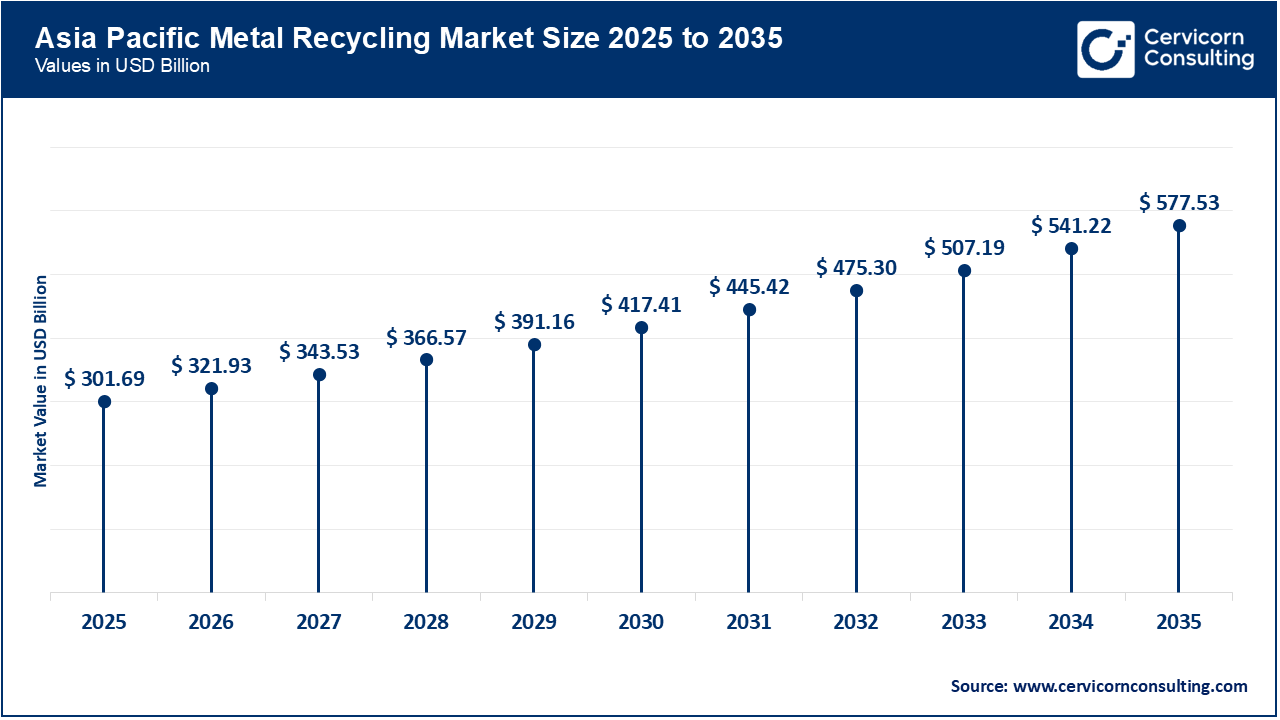
The Asia-Pacific metal recycling market size was estimated at USD 301.69 billion in 2025 and is projected to surpass around USD 577.53 billion by 2035. The Asia-Pacific region has emerged as the largest and fastest-growing market, primarily due to rapid industrialization and urbanization. The increasing demand for metals in construction and manufacturing sectors has significantly contributed to this growth. Recent estimates indicate that Asia-Pacific is responsible for approximately 40 to 50 percent of global metal recycling activity, a figure driven by high levels of scrap generation and robust consumption in major economies such as China and India. Additionally, government initiatives aimed at promoting recycling as part of circular economy and resource security strategies are further supporting the expansion of the market.
Cost advantages, abundant labor, and the ongoing expansion of infrastructure projects in the Asia-Pacific region are key factors that drive both the supply and demand for recycled metals. Furthermore, the rising trend of electrification, along with the growing adoption of electric vehicles and the expansion of renewable energy projects, is expected to further increase the demand for recycled non-ferrous metals, particularly copper and aluminum. These developments collectively indicate a strong outlook for the metal recycling market in the region.
China, India, Japan: Key Growth Engines
China — Global Recycling Powerhouse
- Targets approximately 15 million tons of recycled aluminum production by 2027.
- Largest producer and consumer of recycled metals globally.
- Strong push toward circular economy and green manufacturing.
- High demand from EV, construction, and infrastructure sectors.
India - Fastest Emerging Market
- Vehicle scrappage policy expected to generate millions of tons of scrap annually.
- Secondary metal production has increased, with aluminum growing by about 30% and copper by approximately 25% in recent years.
- Increasing formalization of recycling sector.
Japan & South Korea — Technology Leaders
- Advanced recycling in electronics, rare metals, and battery materials.
- Strong investments in urban mining and high-efficiency recovery technologies.
Why has the North America established a strong presence in the metal recycling market?
The North America metal recycling market size was reached at USD 136.05 billion in 2025 and is predicted to hit around USD 260.45 billion by 2035. North America has established a strong presence in the metal recycling market. This is mainly attributed to its advanced recycling infrastructure, high availability of scrap materials, and the widespread use of electric arc furnace (EAF)-based steel production. Over time, the region has shifted from being mainly a scrap exporter to becoming a hub for value-added recycling. This transition is supported by the rising domestic demand for low-carbon metals. The United States, in particular, leads in both the generation and processing of scrap, which is driven by extensive industrial activity and well-developed recycling networks.
The region benefits from strong regulatory support and growing commitments to environmental, social, and governance (ESG) standards. Investments in the recovery of critical metals, especially copper, aluminum, and battery metals, are increasing as a result. There is also a greater focus on securing the supply chain and reducing dependence on imported raw materials. These factors are expected to further accelerate investments in domestic recycling facilities.
U.S. and Canada Metal Recycling Market: A Quantitative View
- The U.S. exports USD 6.4 billion worth of iron and steel scrap each year, making up approximately 15% of the global exports.
- Over 70% of U.S. steel is produced using recycled scrap via EAFs.
- Aurubis invested USD 800 million in a U.S. recycling plant with 180,000 tons/year capacity.
- The U.S. processes tens of millions of tons of scrap metal annually across industries.
- Canada is expanding recycling integration with sustainable mining and clean energy initiatives.
What are the driving factors of Europe metal recycling market?
The Europe metal recycling market size was estimated at USD 124.22 billion in 2025 and is expected to reach around USD 237.81 billion by 2035. The Europe is shaped by stringent environmental regulations, the implementation of circular economy policies, and ambitious decarbonization objectives. As the region aims to reduce its reliance on imported raw materials, there is a growing emphasis on increasing domestic recycling rates. Scrap materials are now being regarded as a strategic resource, particularly in the production of low-carbon steel and aluminum, which aligns with the region’s sustainability goals.
The European Union’s Green Deal, along with its sustainability targets, is encouraging industries to increase the adoption of recycled metals. Regulatory frameworks are being developed to support more structured and efficient recycling systems across the region. At the same time, the increase in scrap exports has raised concerns about the availability of raw materials for domestic industries, prompting the introduction of new policy measures to secure supplies.
Key Country Insights & Developments
Germany, France, Italy — Industrial Leaders
- Strong base in steel recycling and industrial scrap processing.
- Adoption of low-carbon steel technologies.
EU-Wide Initiatives
- Target to meet around 25% of critical mineral demand via recycling by 2030.
- Over EUR 3 billion invested in recycling and critical material projects.
- Proposal to restrict scrap exports to retain materials domestically.
Market Trend
- Aluminum scrap exports reached 1.2+ million tons, rising significantly in recent years.
- Increasing investment in battery and e-waste recycling.
Metal Recycling Market Share, By Region, 2025 (%)
| Region |
Revenue Share, 2025 (%) |
| Asia-Pacific |
51% |
| North America |
23% |
| Europe |
21% |
| LAMEA |
5% |
LAMEA is Expanding in Metal Recycling Market
The LAMEA metal recycling market was valued at USD 29.58 billion in 2025 and is anticipated to reach around USD 56.62 billion by 2035. The Latin America is expanding, driven by industrial growth and increasing integration with global trade, especially through exports to North America and Asia. While the region benefits from a large supply of scrap materials, the development of formal recycling infrastructure and regulatory systems is still in progress.
In the Middle East and Africa, the recycling market is experiencing significant growth as a result of infrastructure development, rapid urbanization, and government initiatives focused on sustainability. In this region, governments are key drivers of recycling adoption, providing policy support, investments, and setting national goals such as those outlined in Saudi Vision 2030.
Regional Highlights:
Brazil — Largest Market
- Strong steel recycling industry with significant domestic scrap usage
- Increasing investments in industrial recycling capacity
UAE & Saudi Arabia — Growth Leaders
- Investments in steel recycling plants and scrap processing facilities.
- Focus on circular economy and sustainable construction.
Market Trends
- Increasing demand from construction and infrastructure sectors.
- Growing government focus on waste management and recycling policies.
The metal recycling market is segmented into metal type, scrap source, end-use industry, and geography.
Metal Type Analysis
Ferrous metals, particularly iron and steel, play a leading role in the metal recycling market. This dominance is attributed to their extensive application in construction, infrastructure, and manufacturing sectors. Steel, in particular, constitutes the largest share of recycled metals worldwide, with hundreds of millions of tons processed each year. This is primarily due to its ability to be recycled repeatedly without any loss in quality. The prevalence of electric arc furnaces, which depend significantly on scrap steel as a raw material, further reinforces the central position of ferrous recycling within the industry.
Metal Recycling Market Share, By Metal Type, 2025 (%)
| Metal Type |
Revenue Share, 2025 (%) |
| Ferrous Metals |
72% |
| Non-ferrous Metals |
28% |
Non-ferrous metals, including aluminum, copper, and nickel, represent the fastest-growing segment. This growth is primarily driven by increasing demand from electric vehicles, renewable energy systems, and the electronics industry. These metals are characterized by their higher market value and significant energy savings during recycling, with aluminum recycling alone achieving up to 95% energy reduction compared to primary production. The ongoing trend toward electrification and the need for lightweight materials are expected to further accelerate the recycling rates of aluminum and copper.
Scrap Source Analysis
The industrial scrap segment holds a dominant position in the market, primarily because it is regularly produced during manufacturing activities and is generally clean and straightforward to recycle. This consistent generation of high-quality scrap provides recyclers with a reliable and predictable supply, which helps to lower processing costs and enhance operational efficiency. Key contributors to this steady supply include the automotive, machinery, and metal fabrication industries.
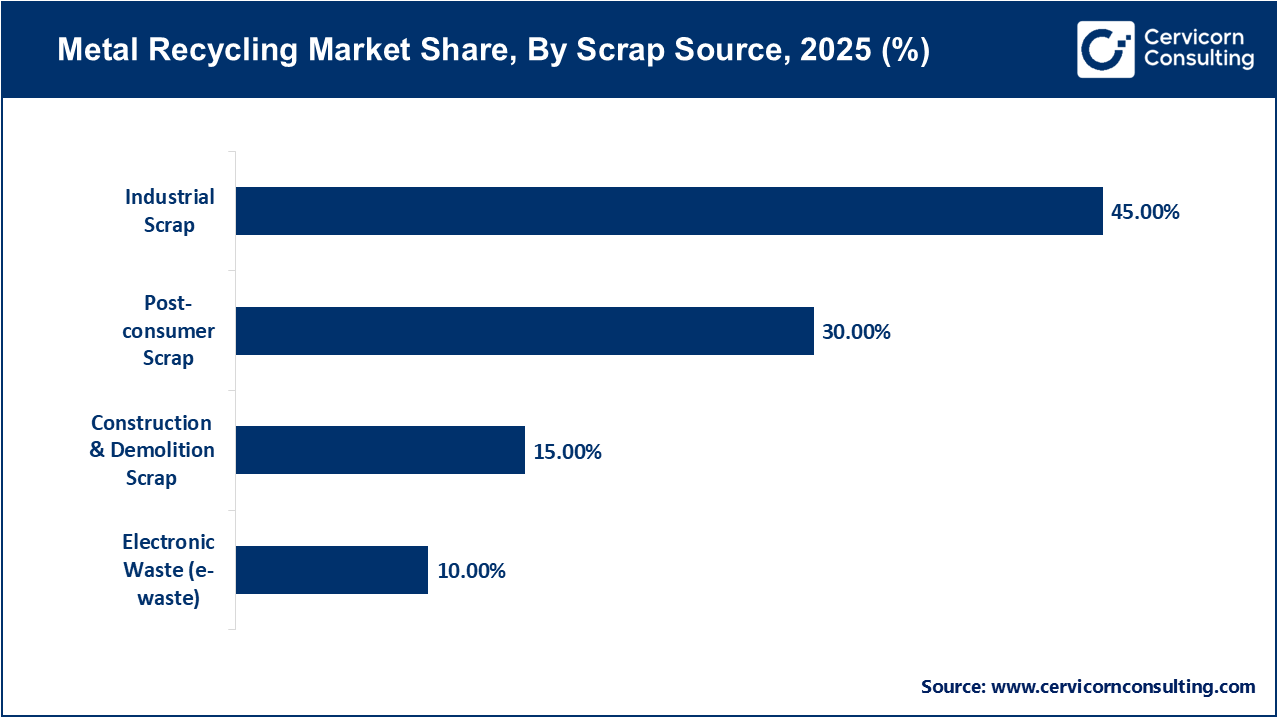
Currently, e-waste represents the fastest-growing segment in the market, driven by the rapid replacement of electronic devices and the ongoing trend of digitalization. Despite the fact that less than 20% of e-waste is formally recycled worldwide, this segment contains valuable metals such as gold, copper, and rare earth elements. Increasing awareness, regulatory initiatives, and technological advancements in recovery processes are expected to further accelerate the growth of e-waste recycling.
End-Use Industry Analysis
The construction and infrastructure sector represents the largest share of recycled metal consumption, driven by the high demand for steel and aluminum in buildings, transportation networks, and urban development. Recycled metals are increasingly used in these projects due to their cost advantages and reduced environmental footprint, particularly in large-scale infrastructure initiatives where material volumes are significant.
Metal Recycling Market, By End-Use Industry, 2025 (%)
| End-Use Industry |
Revenue Share, 2025 (%) |
| Construction & Infrastructure |
38% |
| Automotive |
18% |
| Manufacturing / Heavy Industry |
15% |
| Electrical & Electronics |
12% |
| Consumer Appliances |
7% |
| Packaging |
6% |
| Aerospace & Defense |
4% |
The electrical and electronics segment is experiencing the fastest growth in recycled metal usage, supported by rising electric vehicle production, expansion of renewable energy infrastructure, and growth in consumer electronics. These industries require large quantities of copper, aluminum, and specialty metals, leading to greater dependence on recycled materials. The increasing focus on sustainable manufacturing and resource efficiency is further driving demand for recycled metals within this segment.
Recent Developments
- In July 2025, Nucor Corporation announced plans to build a USD 400 million net-zero emissions recycled steel plant in Texas. The facility is designed to use scrap metal as its primary input and serve automotive and infrastructure sectors. This initiative reflects Nucor’s strategy to expand low-carbon steel production using recycled materials and strengthen its position in sustainable manufacturing.
- In September 2025, Aurubis AG started operations at its USD 800 million copper recycling plant in Georgia, USA. The facility can process up to 180,000 tons of complex scrap annually, including e-waste and cables, producing high-purity copper and other metals. This development highlights Aurubis’ focus on expanding advanced recycling capacity and reducing dependence on primary metal imports in North America.
Market Segmentation
By Metal Type
- Ferrous Metals
- Non-ferrous Metals
- Aluminum
- Copper
- Lead
- Zinc
- Nickel
By Scrap Source
- Industrial Scrap
- Post-consumer Scrap
- Construction & Demolition Scrap
- Electronic Waste (e-waste)
By End-Use Industry
- Construction & Infrastructure
- Automotive
- Aerospace & Defense
- Electrical & Electronics
- Manufacturing / Heavy Industry
- Consumer Appliances
- Packaging
By Geography
- North America
- Europe
- Asia-Pacific
- LAMEA