Maritime Market Size, Growth, Forecast 2026 to 2035
The global maritime market size was valued at USD 2,374 billion in 2025 and is expected to be worth around USD 3,618 billion by 2035, growing at a compound annual growth rate (CAGR) of 4.3% over the forecast period from 2026 to 2035. The maritime market is primarily driven by the continued expansion of global merchandise trade, industrial production, and cross-border supply chains.
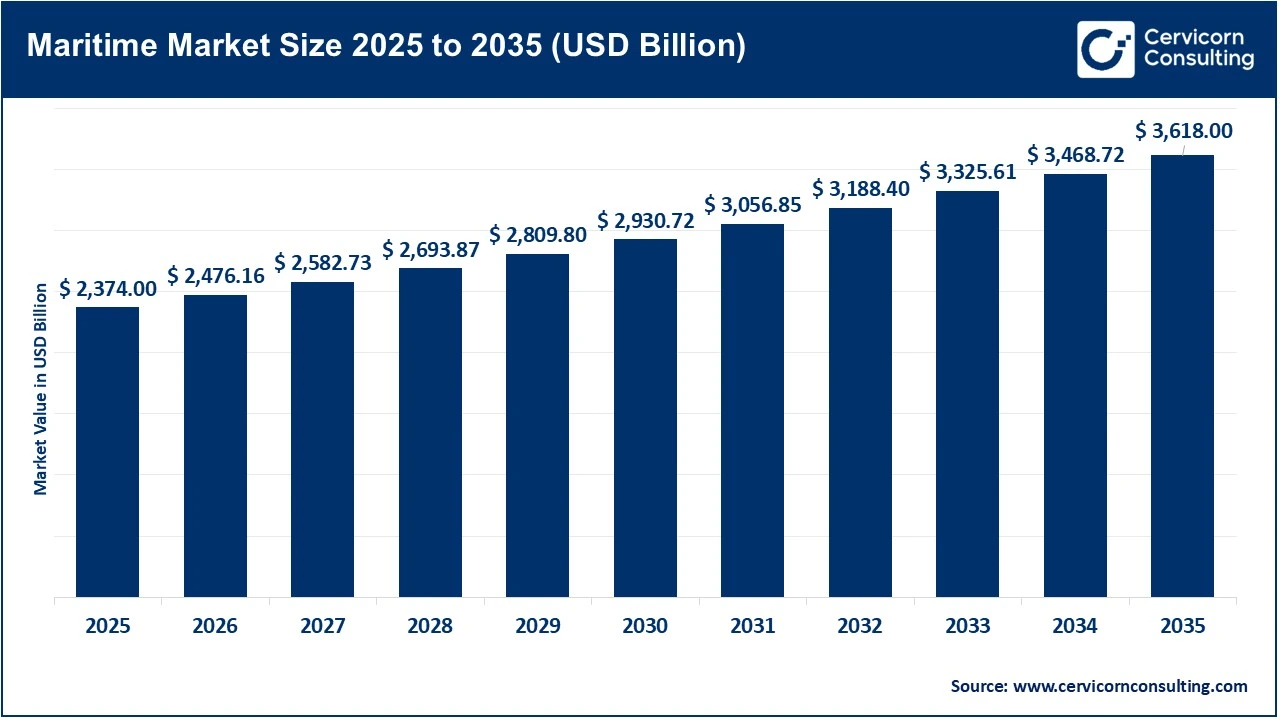
Maritime transport remains the backbone of international commerce, carrying around 80% of global trade by volume, making shipping, ports, freight forwarding, and marine logistics essential to the movement of energy, raw materials, manufactured goods, and food products. In 2024, international maritime trade handled roughly 12.1 billion metric tons of goods, up 3.9% from 2023, highlighting the underlying demand for vessel capacity, port infrastructure, and logistics services. Growth is further supported by rising containerized trade, expanding e-commerce fulfilment networks, increasing energy shipments, and stronger import-export activity across developing economies.
Another major growth factor is the industry’s shift toward greener and more technologically advanced maritime operations. Shipping companies, ports, and shipbuilders are investing in fuel-efficient vessels, LNG and methanol-powered ships, digital port systems, route-optimization platforms, autonomous navigation technologies, and predictive maintenance solutions. This transition is being accelerated by environmental regulations: the International Maritime Organization aims to reduce the carbon intensity of international shipping by at least 40% by 2030, while zero- or near-zero-emission fuels and technologies are targeted to account for at least 5%, with an ambition of 10%, of shipping energy use by 2030. These requirements are creating sustained demand for fleet modernization, alternative fuels, port electrificatinering services.
Report Highlights
- Asia-Pacific dominated the maritime market with 44.8% share, driven by strong shipbuilding, global trade, container traffic, and expanding port infrastructure.
- Europe accounted for 24.1% market share, supported by green shipping regulations, offshore wind investments, and advanced maritime technologies.
- Cargo Ships led the vessel type segment with 39.8% share, supported by growing containerized trade, bulk cargo transportation, and international commerce.
- Commercial Shipping dominated the application segment with 49.6% share, owing to rising seaborne trade, logistics demand, and expanding global supply chains.
- Conventional Fuel Propulsion held the largest 78.9% market share, supported by widespread fleet adoption, mature infrastructure, and lower operational transition costs.
- Commercial Shipping Companies accounted for 51.2% market share, driven by expanding cargo volumes, fleet expansion, and increasing international shipping activities.
What is Maritime?
The maritime sector encompasses all economic, commercial, defense, and transportation activities associated with oceans, seas, rivers, ports, and waterways. It includes commercial shipping, shipbuilding, offshore energy services, port operations, marine logistics, fishing, cruise tourism, and naval operations. The maritime industry forms the backbone of global trade by enabling the efficient movement of raw materials, energy products, manufactured goods, and consumer products between countries. It also plays a critical role in global supply chains, international commerce, energy security, and economic development while increasingly adopting digital technologies and low-carbon solutions to improve operational efficiency and environmental sustainability.
Recent Milestones
| Date |
Title |
Milestone |
| April 2025 |
IMO Approves Global Net-Zero Shipping Framework |
The International Maritime Organization (IMO) approved the world's first global framework combining mandatory marine fuel standards with GHG pricing. The regulations will apply to ships above 5,000 gross tonnage, which account for approximately 85% of international shipping CO₂ emissions, with implementation beginning in 2027. |
| 2025 |
Global Maritime Trade Remains the Backbone of Commerce |
Maritime transport continues to carry around 80% of global merchandise trade by volume, reinforcing its critical role in international supply chains, manufacturing, and energy transportation. |
| 2025 |
Alternative-Fuel Vessel Orders Accelerate |
Shipowners significantly increased investments in low-carbon fleets, with more than 50% of newly ordered ship tonnage designed to operate on alternative fuels such as LNG, methanol, ammonia, or hydrogen, although over 90% of the active fleet still relies on conventional fuels. |
| 2025 |
Port Digitalization and Smart Shipping Expand |
Ports worldwide accelerated deployment of AI, automation, digital documentation, and smart logistics systems to improve cargo handling efficiency. UNCTAD's Port Performance Scorecard now evaluates 76 ports across four continents using 26 operational performance indicators. |
| 2025 |
Longer Shipping Routes Increase Fleet Utilization |
Ongoing geopolitical disruptions forced vessels to use alternative trade routes, resulting in a nearly 6% increase in global ton-miles despite only modest growth in trade volumes, increasing fleet utilization and transportation costs. |
Maritime Market Dynamics
Market Drivers
1. Rising Global Seaborne Trade and Containerized Cargo Movement
The continued expansion of international trade remains one of the strongest drivers of the maritime market. Maritime transport carries over 80% of global merchandise trade by volume, making it indispensable for moving raw materials, energy products, agricultural commodities, and manufactured goods across continents. In 2024, global seaborne trade reached approximately 12.7 billion tons, reflecting resilient demand despite geopolitical uncertainties. The rapid growth of e-commerce, industrialization in emerging economies, and increasing cross-border trade continue to boost demand for cargo vessels, ports, logistics infrastructure, and maritime services.
2. Decarbonization and Fleet Modernization Initiatives
Stringent environmental regulations are accelerating investments in cleaner vessels and advanced maritime technologies. The International Maritime Organization's Net-Zero Framework is driving fleet renewal through adoption of LNG, methanol, ammonia, hydrogen, and other alternative fuels. More than 50% of newly ordered ship tonnage is now designed to operate on alternative fuels, compared with an active fleet where over 90% still relies on conventional fuels. This transition is stimulating demand for new shipbuilding, retrofitting, green ports, digital navigation systems, and energy-efficient marine equipment.
Market Restraints
1. Geopolitical Conflicts and Supply Chain Disruptions
Growing geopolitical tensions around key maritime chokepoints continue to restrain market growth by increasing operational risks and transportation costs. Disruptions in the Red Sea and Suez Canal have forced vessels to reroute around the Cape of Good Hope, increasing voyage duration, fuel consumption, and freight costs. By May 2025, cargo tonnage transiting the Suez Canal remained about 70% below 2023 levels, while longer voyages increased global ton-miles by nearly 6% in 2024, reducing shipping efficiency and supply chain reliability.
2. High Capital Requirements for Green Transition
The maritime industry's transition toward low-carbon operations requires enormous investments in vessel replacement, alternative fuels, and port infrastructure. Many shipowners face financial pressure due to uncertain fuel technologies and lengthy return-on-investment periods. Although alternative-fuel vessels account for over half of new ship orders, fleet-wide adoption remains limited because existing vessels have long operational lifespans and retrofit costs are substantial. These financial barriers particularly affect small and medium-sized shipping operators, slowing industry-wide modernization.
Market Opportunities
1. Growth of Smart Ports and Maritime Digitalization
Rapid digital transformation is creating significant opportunities across the maritime ecosystem. Ports are increasingly deploying artificial intelligence, IoT, blockchain, digital twins, and automated cargo handling systems to improve operational efficiency and reduce turnaround time. UNCTAD's Port Performance Scorecard now evaluates 76 ports using 26 operational performance indicators, reflecting the growing emphasis on digital performance benchmarking. These investments are expected to improve logistics visibility, enhance trade facilitation, and strengthen supply chain resilience worldwide.
2. Expansion of Alternative Marine Fuel Infrastructure
Growing regulatory pressure to reduce shipping emissions is creating substantial opportunities for alternative fuel production and bunkering infrastructure. Demand for LNG, green methanol, ammonia, hydrogen, and shore-power facilities is increasing as shipping companies prepare for future emission standards. Since over half of newly ordered vessel tonnage is designed for alternative fuels, governments, ports, and private investors are expanding fueling networks and supporting infrastructure, opening new revenue opportunities for marine energy suppliers, shipbuilders, and technology providers.
Market Challenges
1. Cybersecurity Risks from Digital Shipping Operations
As shipping companies and ports adopt cloud platforms, autonomous navigation, IoT sensors, and digital logistics systems, cybersecurity has emerged as a major industry challenge. Increasing digital connectivity improves operational efficiency but also expands vulnerability to ransomware, cyberattacks, and operational disruptions. With smart ports and automated shipping becoming mainstream, protecting digital maritime infrastructure requires continuous investment in cybersecurity solutions, workforce training, and regulatory compliance to ensure uninterrupted global trade operations.
2. Regulatory Complexity and Compliance Costs
The maritime industry faces increasing compliance burdens from evolving environmental and operational regulations introduced by international and regional authorities. Shipping companies must comply with greenhouse gas reduction targets, carbon pricing mechanisms, fuel standards, ballast water regulations, and regional emissions trading schemes. At the same time, shipping emissions increased by approximately 5% in 2024 due to longer rerouted voyages, highlighting the challenge of meeting sustainability targets while maintaining operational efficiency and profitability.
Maritime Market Regional Analysis
The maritime market is segmented by region into North America, Europe, Asia-Pacific, Latin America, and LAMEA. Here is a brief overview of each region:
What are the driving factors of North America maritime market?
The North America maritime market size was valued at USD 441.56 billion in 2025 and is forecasted to reach around USD 672.95 billion by 2035. North America drives the market owing to its extensive coastline, world-class port infrastructure, strong commercial shipping network, and significant investments in maritime modernization and digital transformation. The region benefits from high cargo throughput, growing containerized trade, advanced port automation, and increasing adoption of AI, IoT, autonomous vessels, and smart port technologies. Government initiatives supporting port infrastructure upgrades, supply chain resilience, offshore renewable energy, and maritime decarbonization further strengthen market growth. Continuous investments in LNG bunkering, alternative marine fuels, cybersecurity, and digital logistics platforms enable shipping companies and ports to improve operational efficiency, reduce emissions, and enhance global trade competitiveness, reinforcing North America's leadership in the global maritime market.
United States: Advanced Port Infrastructure, Maritime Trade Expansion, and Fleet Modernization Drive Market Growth
- According to the U.S. Army Corps of Engineers (2024), the United States' coastal ports handled approximately 2.3 billion short tons of domestic and international waterborne cargo annually, highlighting the country's critical role in global maritime logistics and supply chains.
- The U.S. Department of Transportation's Maritime Administration (MARAD) reports that the United States operates more than 25,000 miles of commercially navigable waterways and over 300 coastal and inland ports, providing one of the world's largest integrated maritime transportation systems.
Canada: Strategic Trade Corridors, Sustainable Ports, and Arctic Shipping Support Market Expansion
- According to Transport Canada, the country has more than 550 port facilities, including 17 Canada Port Authorities, which collectively handle the majority of Canada's international marine trade and support growing cargo volumes across global markets.
- The Port of Vancouver, Canada's largest port, handled approximately 158 million metric tonnes of cargo in 2024, serving as the nation's primary gateway for Asia-Pacific trade while expanding investments in digital cargo management, emissions reduction, and terminal automation.
Why is Asia-Pacific fastest-growing and largest maritime market?
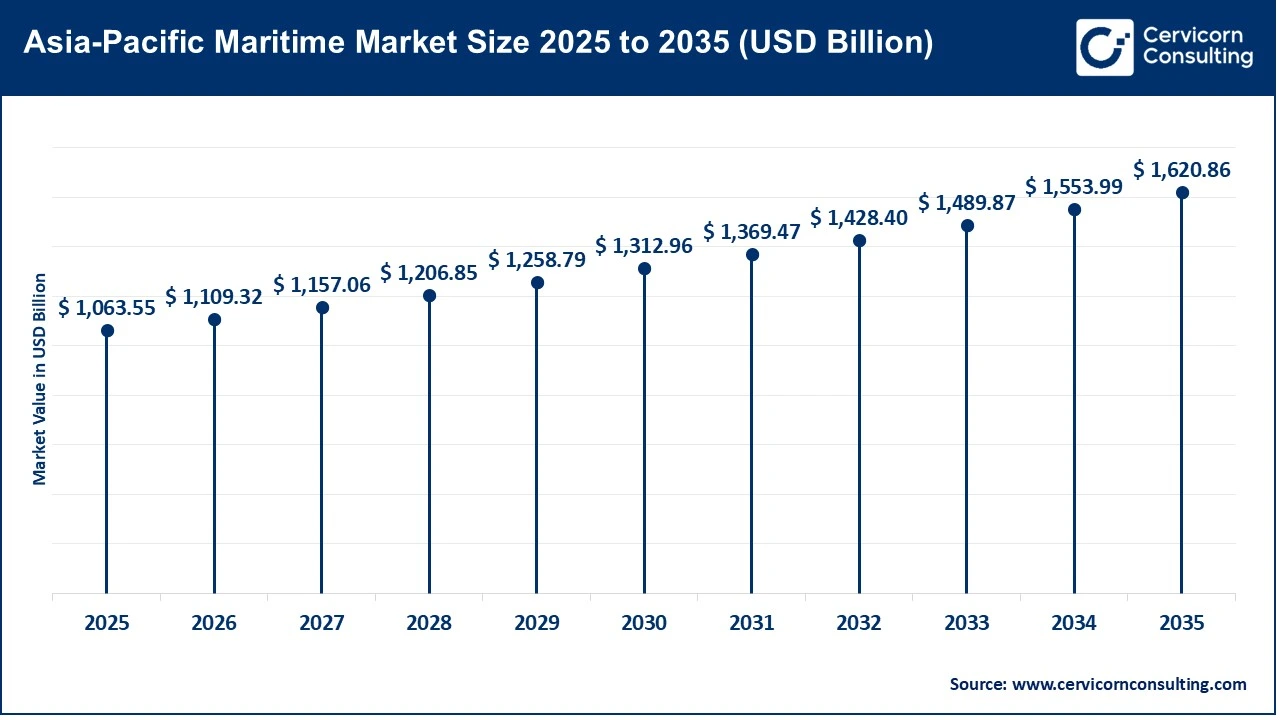
The Asia-Pacific maritime market size was accounted for USD 1,063.55 billion in 2025 and is expected to hit around USD 1,620.86 billion by 2035. Asia-Pacific is the fastest-growing and largest market globally, supported by its position as the world's manufacturing hub, extensive international trade networks, and the presence of leading shipping, shipbuilding, and port economies. The region benefits from rapidly expanding container traffic, significant investments in smart ports, digital logistics, and green shipping initiatives. Governments across China, Japan, South Korea, India, and Southeast Asia continue investing heavily in port expansion, maritime connectivity, offshore renewable energy, and fleet modernization. Growing adoption of AI-driven port operations, autonomous shipping technologies, alternative marine fuels, and integrated logistics corridors further strengthens Asia-Pacific's leadership in global maritime transportation and supply chain development.
China: World's Largest Port Network, Shipbuilding Leadership, and Maritime Trade Drive Market Growth
- According to the Ministry of Transport of China, Chinese ports handled approximately 17.6 billion tonnes of cargo and over 330 million TEUs of container throughput in 2024, maintaining the world's highest port cargo volumes.
- China is home to 7 of the world's 10 busiest container ports, including Shanghai, which processed approximately 51.5 million TEUs in 2024, retaining its position as the world's largest container port.
- According to Clarksons Research, Chinese shipyards secured more than 70% of global new shipbuilding orders by compensated gross tonnage (CGT) in 2024, reinforcing the country's leadership in commercial vessel construction.
India: Port Modernization, Sagarmala Programme, and Expanding Maritime Trade Accelerate Market Expansion
- According to the Ministry of Ports, Shipping and Waterways, India's major ports handled approximately 855 million tonnes of cargo during FY 2024–25, reflecting sustained growth in maritime trade and logistics activities.
- India possesses a coastline of over 7,500 kilometers, operates 13 major ports and more than 200 non-major ports, providing extensive maritime connectivity for domestic and international trade.
- The Sagarmala Programme includes more than 800 projects with an estimated investment exceeding INR 5.8 lakh crore, focused on port modernization, multimodal logistics, coastal economic zones, and port-led industrialization.
What factors are driving the Europe maritime market?
The Europe maritime market size was estimated at USD 572.13 billion in 2025 and is projected to surpass around USD 871.94 billion by 2035. Europe represents a leading market driven by its extensive commercial shipping network, world-class ports, stringent environmental regulations, and leadership in sustainable maritime technologies. The region is at the forefront of maritime decarbonization through investments in alternative marine fuels, smart ports, autonomous shipping, and digital logistics systems. Strong intra-European trade, growing offshore wind installations, and government support through the European Green Deal and FuelEU Maritime initiatives continue to accelerate market growth. Continuous investments in LNG, methanol, hydrogen-powered vessels, shore-side electrification, and AI-enabled port operations further reinforce Europe's position as a global leader in sustainable and technologically advanced maritime transportation.
Germany: Advanced Port Infrastructure, Green Shipping Technologies, and Maritime Manufacturing Drive Market Growth
- According to the Federal Statistical Office of Germany (Destatis), German seaports handled approximately 274 million tonnes of cargo in 2024, reflecting the country's importance as a gateway for European trade.
- The Port of Hamburg, one of Europe's largest seaports, processed approximately 7.8 million TEUs of container traffic in 2024, supported by continuous investments in terminal automation, digital logistics, and smart port technologies.
- Germany is a global leader in offshore wind development, with more than 9 GW of installed offshore wind capacity by the end of 2024, driving demand for offshore support vessels, specialized marine engineering services, and port infrastructure.
Netherlands: Rotterdam Port Leadership, Smart Logistics, and Energy Transition Support Market Expansion
The Netherlands continues to strengthen its maritime sector through its strategic location, world-leading port infrastructure, and leadership in logistics innovation and sustainable shipping.
The Port of Rotterdam, Europe's largest seaport, handled approximately 436 million tonnes of cargo and 13.8 million TEUs of container throughput in 2024, serving as a critical gateway for European imports and exports.
Maritime Market Share, By Region, 2025 (%)
| Region |
Revenue Share, 2025 (%) |
| Asia-Pacific |
44.8% |
| Europe |
24.1% |
| North America |
18.6% |
| LAMEA (Latin America, Middle East & Africa) |
12.5% |
LAMEA Maritime Market Trends
The LAMEA maritime market was valued at USD 296.75 billion in 2025 and is anticipated to reach around USD 452.25 billion by 2035. The LAMEA market is experiencing steady growth owing to expanding international trade, strategic maritime corridors, increasing investments in port modernization, and rising offshore energy activities. The region benefits from globally significant shipping routes such as the Suez Canal, Cape of Good Hope, and major Atlantic and Indian Ocean trade lanes that facilitate international cargo movement. Governments across Latin America, the Middle East, and Africa are investing in smart ports, logistics infrastructure, offshore oil & gas projects, and maritime digitalization to strengthen regional trade competitiveness. Growing demand for LNG exports, offshore renewable energy, and container handling capacity further supports maritime market expansion across LAMEA.
Saudi Arabia: Vision 2030, Port Modernization, and Red Sea Logistics Hub Drive Market Growth
- Saudi Arabia is rapidly transforming into a major maritime and logistics hub through large-scale investments under Vision 2030, aimed at strengthening international trade, port infrastructure, and multimodal transportation.
- According to the Saudi Ports Authority (Mawani), Saudi ports handled approximately 320 million tonnes of cargo and more than 13 million TEUs of container traffic in 2024, reflecting continued growth in maritime trade.
Brazil: Expanding Port Capacity, Agricultural Exports, and Offshore Energy Support Market Expansion
- According to ANTAQ (Brazil's National Waterway Transport Agency), Brazilian ports handled approximately 1.32 billion tonnes of cargo in 2024, driven primarily by iron ore, soybeans, crude oil, fertilizers, and containerized freight.
- Brazil has more than 170 public and private port terminals, with the Port of Santos remaining the country's largest port, handling approximately 180 million tonnes of cargo annually while serving as South America's leading container gateway.
Maritime Market Segmental Analysis
The maritime market is segmented into vessel type, application, propulsion type, end user, and geography.
Vessel Type Analysis
Cargo ships dominate the maritime market owing to their indispensable role in global trade and supply chain operations. Container ships, bulk carriers, and general cargo vessels transport the majority of internationally traded goods, including manufactured products, raw materials, agricultural commodities, and consumer goods. According to UNCTAD, maritime transport carries over 80% of global merchandise trade by volume, driving continuous demand for cargo vessels. The expansion of e-commerce, industrial production, and international trade agreements further strengthens the market position of cargo ships across global shipping networks.
Maritime Market Share, By Vessel Type, 2025 (%)
| Vessel Type |
Revenue Share, 2025 (%) |
| Cargo Ships |
39.8% |
| Tankers |
20.4% |
| Naval & Defense Vessels |
12.3% |
| Offshore Support Vessels (OSVs) |
9.2% |
| Passenger Ships & Cruise Vessels |
8.5% |
| Fishing Vessels |
6.1% |
| Others |
3.7% |
Offshore Support Vessels (OSVs) are expected to witness the fastest growth due to increasing investments in offshore wind farms, deepwater oil and gas exploration, and subsea infrastructure projects. Governments worldwide are accelerating renewable energy deployment, creating sustained demand for installation vessels, anchor handling tug supply vessels, and platform supply vessels. The rapid expansion of offshore wind capacity across Europe, Asia-Pacific, and North America, along with modernization of offshore energy infrastructure, is expected to significantly boost demand for specialized marine support vessels.
Application Analysis
Commercial shipping remains the dominant application segment because it forms the backbone of global merchandise transportation. The sector supports international trade through container shipping, dry bulk transportation, liquid bulk cargo, and roll-on/roll-off logistics. With more than 80% of global trade by volume transported via sea routes, commercial shipping continues to generate the highest vessel utilization and port activity. Rising globalization, expanding manufacturing output, and increasing trade among emerging economies continue to reinforce the leadership of this segment.
Maritime Market, By Application, 2025 (%)
| Application |
Revenue Share, 2025 (%) |
| Commercial Shipping |
49.6% |
| Offshore Oil & Gas |
15.3% |
| Naval & Defense |
12.8% |
| Marine Tourism & Cruise |
8.9% |
| Fisheries & Aquaculture |
6.7% |
| Renewable Energy Support (Offshore Wind) |
4.2% |
| Research & Survey |
2.5% |
Renewable energy support is projected to be the fastest-growing application as offshore wind installations expand worldwide. Specialized maritime services are increasingly required for turbine transportation, installation, maintenance, cable laying, and offshore logistics. Governments across Europe, China, the United States, and other regions continue investing heavily in offshore wind projects to achieve decarbonization targets. This growing renewable energy ecosystem is creating substantial demand for advanced marine engineering services and specialized offshore vessels throughout project lifecycles.
Propulsion Type Analysis
Conventional fuel propulsion continues to dominate the maritime market because the majority of the global commercial fleet still operates using diesel engines and heavy fuel oil. Existing shipping infrastructure, fuel availability, operational familiarity, and lower upfront investment have maintained widespread adoption across cargo ships, tankers, and fishing vessels. Despite increasing environmental regulations, conventional propulsion remains the primary choice for most existing fleets due to long vessel lifespans and the high capital costs associated with replacing or retrofitting ships.
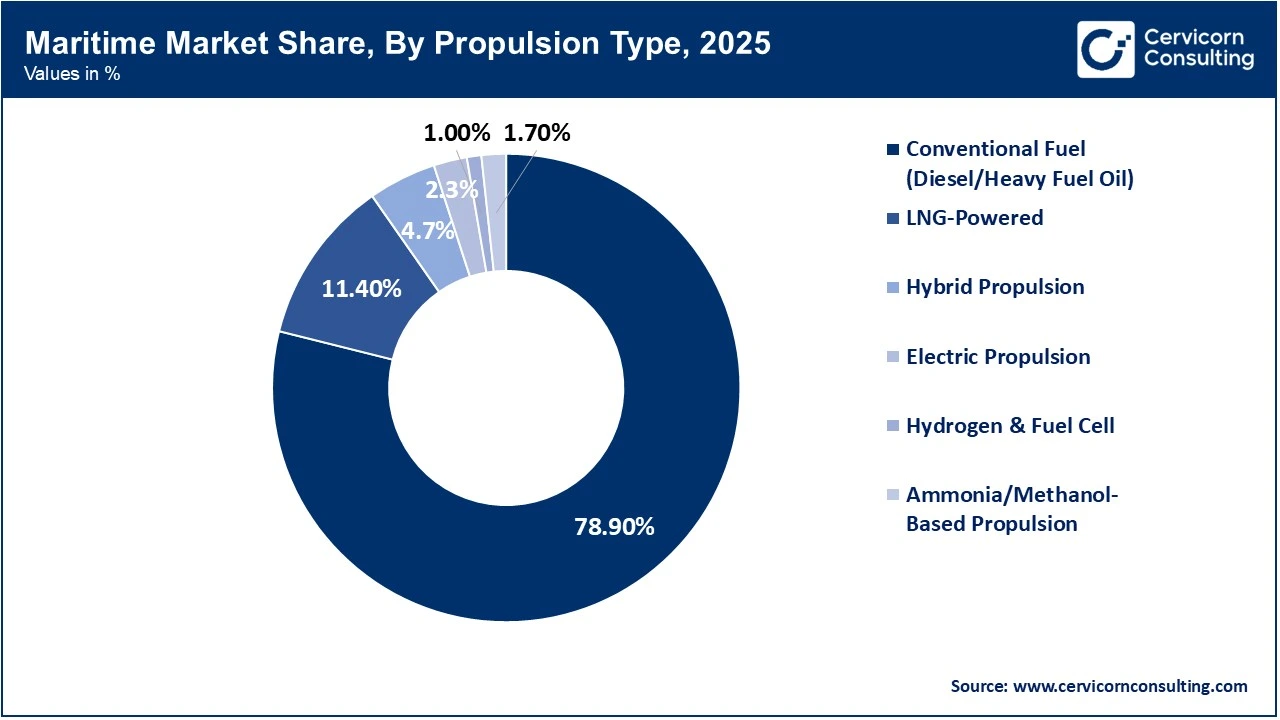
Ammonia and methanol-based propulsion is expected to register the fastest growth as shipping companies pursue carbon-neutral fuel alternatives. These fuels offer significant potential for reducing greenhouse gas emissions while complying with emerging international decarbonization regulations. Shipbuilders are increasingly receiving orders for methanol-ready and ammonia-ready vessels, supported by investments in global bunkering infrastructure. Growing industry collaboration among fuel suppliers, shipowners, and ports is expected to accelerate commercial adoption over the coming decade.
End User Analysis
Commercial shipping companies represent the largest end-user segment due to their extensive ownership and operation of container ships, bulk carriers, tankers, and general cargo fleets. These companies facilitate international trade across virtually every industrial sector, making them the primary consumers of maritime transportation services, fleet management solutions, and marine technologies. Rising import-export activities, expanding containerized cargo volumes, and continuous fleet modernization initiatives continue to strengthen their dominance within the global maritime market.
Maritime Market, By End User, 2025 (%)
| End User |
Revenue Share, 2025 (%) |
| Commercial Shipping Companies |
51.2% |
| Naval & Coast Guard Organizations |
16.1% |
| Offshore Energy Companies |
13.5% |
| Port Authorities |
8.4% |
| Cruise & Ferry Operators |
6.2% |
| Fishing Companies |
4.6% |
Port authorities are expected to emerge as the fastest-growing end-user segment due to increasing investments in smart ports, digital logistics infrastructure, automated cargo handling, and sustainability initiatives. Governments and private operators are modernizing ports to improve cargo throughput, reduce vessel turnaround times, and support alternative marine fuels. Growing international trade, combined with investments in AI-enabled terminal operations, electrification, and digital port management systems, is driving strong demand for advanced maritime infrastructure and port modernization projects.
Maritime Market Top Companies
Recent Developments
- In July 2026, A.P. Moller - Maersk A/S deployed next-generation connectivity technology across its global refrigerated container fleet, enabling real-time cargo monitoring, predictive maintenance, and enhanced cold-chain visibility. The initiative strengthens Maersk's digital logistics capabilities, improves supply chain transparency, and enhances operational efficiency for temperature-sensitive pharmaceutical, food, and agricultural shipments.
- In January 2026, CMA CGM Group resumed Suez Canal transit on its INDAMEX service following improved regional security conditions, reducing voyage times between India and the United States. The development strengthens network reliability, improves schedule efficiency, and enhances supply chain resilience across major East-West maritime trade routes.
- In February 2026, Hapag-Lloyd AG launched the first Gemini Cooperation service with Maersk through the Red Sea and Suez Canal, improving schedule reliability and transit efficiency across Asia-Europe trade routes. The collaboration enhances network resilience, optimizes fleet utilization, and strengthens end-to-end logistics performance for global customers.
Market Segmentation
By Vessel Type
- Cargo Ships
- Tankers
- Passenger Ships & Cruise Vessels
- Naval & Defense Vessels
- Offshore Support Vessels (OSVs)
- Fishing Vessels
- Others
By Application
- Commercial Shipping
- Naval & Defense
- Offshore Oil & Gas
- Fisheries & Aquaculture
- Marine Tourism & Cruise
- Renewable Energy Support (Offshore Wind)
- Research & Survey
By Propulsion Type
- Conventional Fuel (Diesel/Heavy Fuel Oil)
- LNG-Powered
- Hybrid Propulsion
- Electric Propulsion
- Hydrogen & Fuel Cell
- Ammonia/Methanol-Based Propulsion
By End User
- Commercial Shipping Companies
- Naval & Coast Guard Organizations
- Offshore Energy Companies
- Port Authorities
- Cruise & Ferry Operators
- Fishing Companies
By Geography
- North America
- Europe
- Asia-Pacific
- LAMEA