Liquid-cooled EV Charger Modules Market Size, Growth, Forecast 2026 to 2035
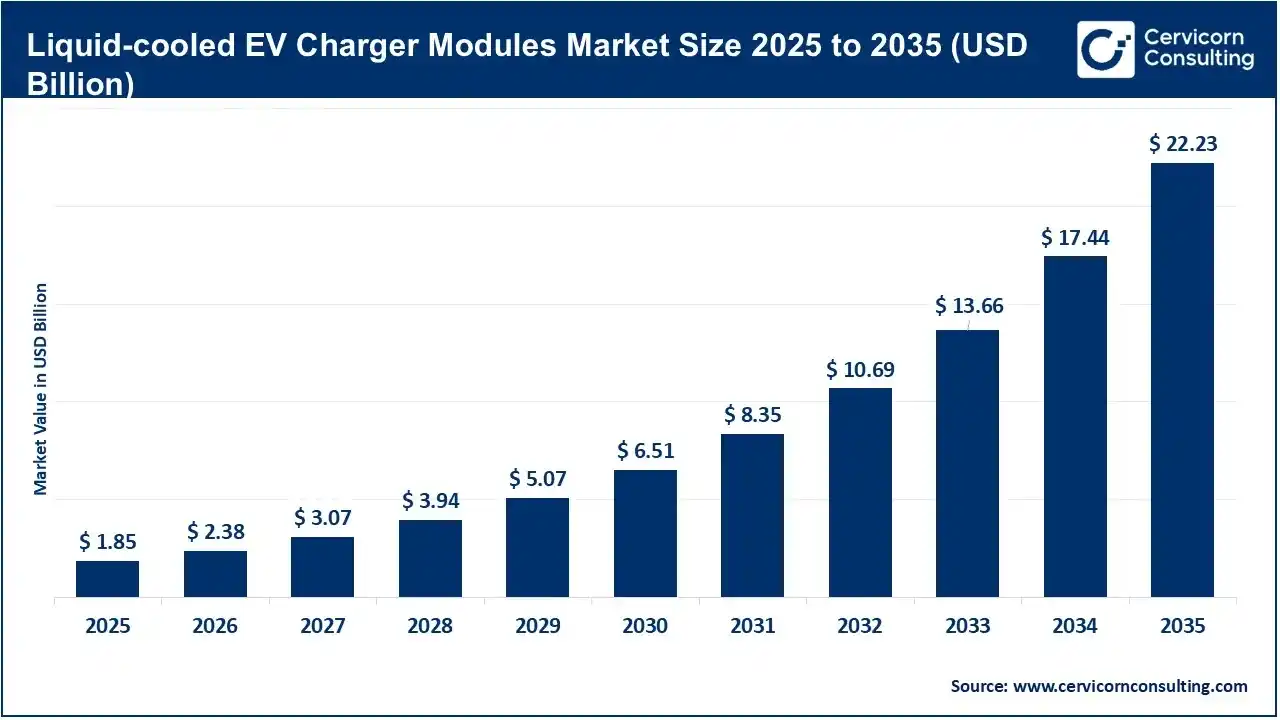
The global liquid-cooled EV charger modules market size was valued at USD 1.85 billion in 2025 and is projected to exceed USD 22.23 billion by 2035; growing at a CAGR of 28.2% during the forecast period from 2026 to 2035. The rapid shift toward high-power and ultra-fast EV charging is increasing demand for liquid-cooled charger modules because higher charging power generates greater thermal loads that require more efficient heat management. In 2025, global electric car sales exceeded 20 million units, representing 25% of total new-car sales, while the global stock of public charging points surpassed 7 million, with fast and ultra-fast charging infrastructure expanding faster than slower charging points.
Report Highlights
- By region, Asia-Pacific dominated the market with a 55% share in 2025, supported by rapid EV adoption, increasing investment in charging infrastructure, and the region’s growing focus on high-power charging technologies.
- By region, North America held the second-largest share of 20% in 2025, driven by rising demand for faster charging, expansion of charging corridors, and increasing deployment of high-output charging systems.
- By region, Middle East & Africa accounted for a 3% share in 2025 and is expected to register the fastest regional growth, supported by the early-stage development of EV ecosystems and increasing investments in modern charging infrastructure.
- By module type, the AC–DC segment dominated the market with a 64% share in 2025, owing to its essential role in converting incoming AC electricity into the DC power required by EV batteries.
- By module type, the integrated AC–DC/DC–DC segment is expected to register the fastest growth during the forecast period, driven by the growing preference for multifunctional modules that can improve charger efficiency, reduce system complexity, and optimize space utilization.
- By power rating, the 41–60 kW segment dominated the market with a 42% share in 2025, supported by its ability to meet the power requirements of a broad range of fast-charging applications while maintaining practical system economics.
- By power rating, the 21–40 kW segment held the second-largest share of 27% in 2025, owing to its suitability for mid-power charging applications across commercial, public, and destination charging locations.
- By charger architecture, the standalone architecture segment dominated the market with a 62% share in 2025, supported by its straightforward configuration, ease of integration, and suitability for dedicated charging installations.
- By charger architecture, the distributed charging architecture segment accounted for 38% of the market in 2025, driven by the ability to allocate power across multiple charging points and improve infrastructure utilization at multi-charger sites.
- By charging application, the public fast charging segment dominated the market with a 48% share in 2025, owing to the growing need to reduce EV charging times and support high utilization at public charging locations.
- By charging application, the commercial fleet charging segment held the second-largest share of 22.0% in 2025, driven by the increasing use of electric commercial vehicles and the need for dependable charging infrastructure to maintain fleet availability.
- By vehicle type, the passenger EVs segment dominated the market with a 68% share in 2025, supported by the expanding passenger EV population and the increasing rollout of fast-charging facilities designed for private vehicle users.
- By vehicle type, the commercial EVs segment held the second-largest share of 27% in 2025, owing to the growing electrification of buses, delivery vehicles, trucks, and other commercial fleets requiring frequent and efficient charging.
- By end user, the charger OEMs segment dominated the market with a 54% share in 2025, driven by their central role in sourcing, integrating, and deploying power modules within complete EV charging equipment.
- By end user, the charging infrastructure system integrators segment held the second-largest share of 16% in 2025, supported by the increasing number of large-scale charging projects requiring integrated power, charging, and energy-management solutions.
- By deployment stage, the OEM/new charger installation segment dominated the market with an 82% share in 2025, reflecting the strong expansion of newly installed charging capacity and the integration of liquid-cooled modules into new-generation charging equipment.
- By deployment stage, the charger upgrade/retrofit segment accounted for 13% of the market in 2025, supported by the modernization of existing charging infrastructure to accommodate higher power requirements and improve charging performance.
Liquid-cooled EV Charger Modules Market Overview & Scope
The liquid-cooled EV charger modules market includes dedicated power-conversion modules that utilize the liquid cooling technology of EV chargers to manage excess generated thermal energy. Product types such as AC-DC modules, DC-DC modules and integrated AC-DC/DC-DC modules have been included in the market.
Division has been made based on product power and charger architecture; high, medium and low and all one and two and in case of application, there has been dividing such as slow charging, fast, ultrafast charge on product type. The market addresses the module components that come as a part of a system to charger manufacturers and integrators.
Increased demand for power in infrastructure to manage higher and higher power density in EV charging systems as well as under high electric and thermal load for enhanced efficiency has been expected to drive the adoption of cooling system in the module component space.
According to the International Energy Agency, an EV light-duty vehicle has on average access to about 4.5 kW (around 1.2 kW on an earlier projection) of public charging power globally in 2025. Average speed of public charging point increased to about 15% year over year.
Why Are EV Chargers Moving from Air Cooling to Liquid Cooling?
- Higher charging power is increasing thermal loads: The global average power of public charging points rose from just over 40 kW in 2024 to nearly 50 kW in 2025, while next-generation ultra-fast chargers are increasingly exceeding 250 kW, creating greater heat-management requirements for power-conversion components.
- Ultra-fast charging is expanding rapidly: The global stock of public charging points surpassed 7 million in 2025, with nearly 1.8 million new points added during the year, while fast and ultra-fast charging capacity is expanding faster than slower charging infrastructure. This shift increases the need for thermal solutions capable of supporting higher continuous power.
- Megawatt charging is changing thermal requirements: BYD's Super e-Platform, launched in March 2025, introduced 1,000 kW charging and an all-liquid-cooled megawatt charging terminal with a maximum output of 1,360 kW, demonstrating how charging power is moving beyond the practical thermal envelope of conventional cooling approaches.
- Liquid cooling enables higher power density: As charger manufacturers attempt to deliver more power from smaller equipment, removing heat efficiently from densely packed power electronics becomes increasingly important; liquid cooling can transfer heat directly from high-temperature components through dedicated cooling plates and coolant circuits.
How Quickly Is SiC Adoption Increasing in High-power EV Chargers?
| Metric |
Statistical evidence |
What it indicates for high-power EV chargers |
| SiC adoption in ultra-fast chargers |
More than 45% of new ultra-fast charging stations above 150 kW reportedly incorporated SiC-based power modules by 2025 |
Indicates that SiC is moving beyond early adoption and becoming an important technology for high-power charging systems. |
| SiC charging-module efficiency advantage |
1-3% point higher efficiency for Infypower's 30 kW DC charging module using 1,200 V CoolSiC MOSFETs |
Demonstrates how SiC can improve module efficiency while supporting high power density. |
| Energy savings at 100 kW |
About 1 kWh of electricity saved for a 100 kW charging station under the cited operating comparison |
Shows that even relatively small efficiency improvements can translate into measurable energy savings when chargers operate at high utilization. |
| SiC voltage capability |
SiC MOSFETs can support blocking voltages up to 1,700 V, compared with generally below 900 V for silicon super-junction MOSFETs |
Makes SiC particularly suitable for emerging high-voltage and 800 V-class charging architectures. |
| 800 V charging architecture |
A 1,200 V SiC MOSFET can support an 800 V DC-link voltage |
Positions SiC as a key enabling semiconductor technology for next-generation high-voltage fast chargers. |
Market Dynamics
Driver
Rising Demand for High-power and Ultra-fast EV Charging
The increasing deployment of high-power EV chargers is driving demand for liquid-cooled charger modules because higher charging power generates greater heat within power-conversion components, making efficient thermal management essential for sustained operation. The shift toward 350 kW and higher charging systems is particularly important, as liquid cooling enables charger manufacturers to manage thermal loads while maintaining compact and high-power-density designs.
Restraint
Higher Cost and System Complexity
The higher upfront cost and greater technical complexity of liquid-cooled systems can limit adoption, particularly in cost-sensitive charging applications where air cooling remains technically adequate. Liquid-cooled architectures require additional components such as coolant circuits, pumps, cold plates, heat exchangers, sensors, and associated controls, increasing equipment, maintenance, and integration requirements compared with simpler air-cooled designs.
Opportunity
Growing Adoption of Megawatt and High-power Charging
As electric vehicle (EV) manufacturers move toward ultralow fast charging (ULFC) and megawatt (MW) charging standards, a growth in thermal challenges gives liquid-cooled charger modules suppliers an option to increase port and power capacity and thermal efficiency for passenger cars, fleet applications and commercial vehicles. Industry has shown an awareness of this. To start in August 2026, an India plant started producing high voltage AC and DC liquid-cooled power modules for the high power charging requirements initially supporting charging solutions of Tritium (TRI-FLEX and DC-FLEX) in North America and Europe.
How Are Governments Supporting High-power EV Charging Infrastructure?
| Country/Region |
Government support measure |
Relevance to high-power charging |
| United States |
National EV Infrastructure (NEVI) funding supports deployment of fast-charging stations along designated highway corridors. |
Highway-focused funding creates demand for higher-power chargers capable of supporting long-distance EV travel and commercial transportation. |
| European Union |
Alternative Fuels Infrastructure Regulation (AFIR) establishes minimum charging requirements along major transport corridors. |
Mandatory power and spacing requirements directly encourage deployment of fast and ultra-fast charging equipment, increasing demand for advanced thermal-management technologies. |
| China |
National charging-network expansion policies support large-scale deployment of public and high-speed charging infrastructure. |
Large-scale deployment and rapid growth of fast charging create one of the largest potential markets for high-power and liquid-cooled charger modules. |
| India |
The PM E-DRIVE scheme provides capital subsidies for public EV charging infrastructure, while government charging-infrastructure guidelines support network development and interoperability. |
Financial support for charging infrastructure and the expansion of fast-charging stations are creating opportunities for higher-power charger and power-module suppliers. |
| United Kingdom |
Government-backed charging infrastructure programs and continued investment support expansion of rapid and ultra-rapid public charging. |
Rapid network expansion increases opportunities for higher-output charging systems, particularly along major roads and high-utilization locations. |
Regional Analysis
How Is Asia-Pacific Becoming the Manufacturing Hub for Liquid-cooled Charging Modules?
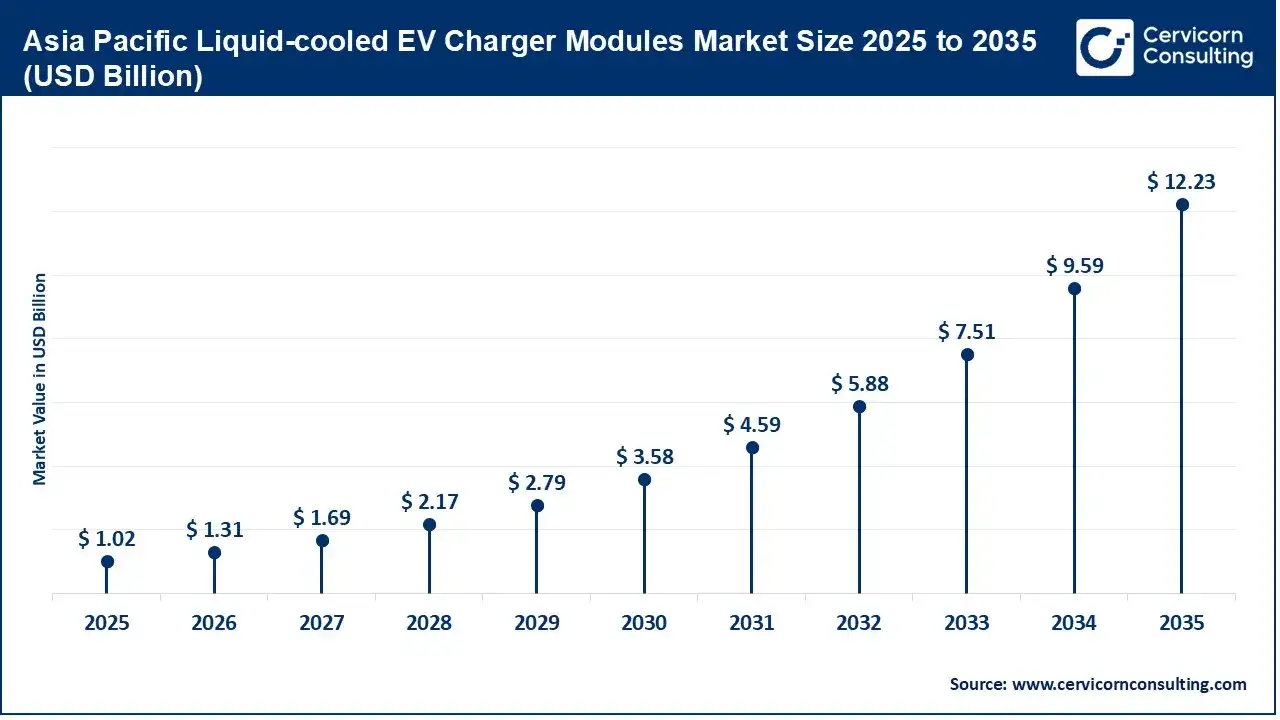
The Asia-Pacific liquid-cooled EV charger modules market size was estimated at USD 1.02 billion in 2025 and is expected to hit USD 12.23 billion by 2035. Asia-Pacific represented the largest regional market. Its strength has been largely driven by substantial numbers of EVs produced there, expansion of massive public charger networks, as well as its widespread established power electronics supply chains.
Fast charging infrastructure in a country often indicates a strong prospect for liquid-cooled charger modules because higher output of the charger generates a greater thermal load due to the charging power conversion components.
Additionally, some of the world's leading charger makers and power-electronics manufacturers are based there, which helps the modules to be made, designed, and integrated locally. China is the market driver of the Asia-Pacific region, whereas Japan, South Korea, and India are also moving ahead with EV development and charging systems.
- China: China is the leading country within Asia-Pacific, supported by its extensive EV manufacturing ecosystem, large public charging network, and rapid expansion of fast and ultra-fast charging infrastructure, creating substantial demand for high-power power-conversion modules.
- India: India represents a high-growth market within Asia-Pacific as rising EV adoption, government-supported charging infrastructure development, and increasing domestic manufacturing of EV and power-electronics equipment create opportunities for liquid-cooled charging technologies.
- Japan: Japan remains an important market due to its established automotive and electronics industries, technological capabilities in power electronics, and continued development of advanced EV charging solutions.
Why is Middle East & Africa Considered to be the Fastest Growing Marketplace?
Middle East & Africa only had a 3.0 percent market share of liquid-cooled EV charger module at a global level in 2025, standing as the least penetrated regional market and fastest growing segment within supplied forecast, with demand to take-off due to the young nature of the regional EV infrastructure system-opportunity mainly driven by construction demand, rather thanreplacement based demand. Investments and expansion from EV charging corridors, urban charging network construction, luxury EV expansion, electrification plan are driving the expansion of the need for more power charge hardware.
Further, climate conditions in region demand more effective thermal management strategy in the usage environments due to extreme ambient temperature exposure of stations. When regions transition toward high power charging based framework, from low speed EV charger charging system, effective liquid-cooling module for high power supply will therefore see much more demands.
- United Arab Emirates: The UAE is emerging as a leading market in the region due to rapid development of EV charging infrastructure, high EV adoption among premium vehicle users, and investments in smart and high-power charging networks.
- Saudi Arabia: Saudi Arabia is expected to become an important growth market as EV adoption increases alongside investments in charging infrastructure, electric mobility initiatives, and new transportation infrastructure.
- South Africa: South Africa represents a key African market, supported by growing interest in electric mobility, the development of public charging infrastructure, and increasing efforts by automotive and energy companies to establish an EV charging ecosystem.
Segmental Analysis
Module Type Analysis
The AC–DC segment accounted for 64.0% of the market in 2025, making it the largest module type, with revenue increasing from USD 1.526 billion in 2026 to USD 12.674 billion by 2035. Its leading position reflects the widespread use of AC–DC conversion as the first major power-conversion stage in charging systems, particularly as charging infrastructure expands toward higher output levels.
As charger power increases, the ability to efficiently manage losses generated during AC-to-DC conversion becomes increasingly important, creating a stronger role for liquid-cooled power modules in high-utilization charging equipment.
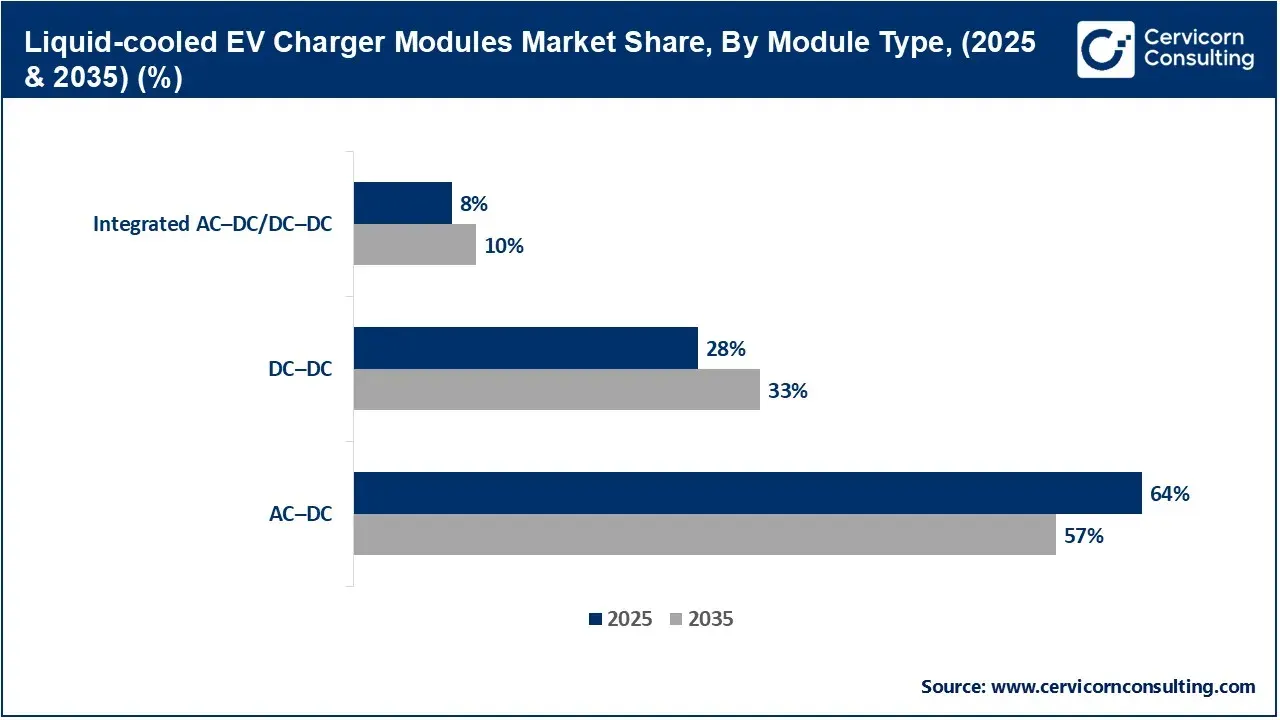
The integrated AC–DC/DC–DC segment is projected to be the fastest-growing module category, with its share increasing from 8.0% in 2025 to 10.0% by 2035 and revenue reaching approximately USD 2.22 billion by 2035. The segment's implied CAGR of 31.12% indicates increasing interest in combining multiple conversion functions within a consolidated module architecture.
Such integration can reduce interconnections between individual power-conversion stages, simplify charger design, and support more compact equipment. The trend is particularly relevant for high-power chargers where manufacturers are seeking greater power density without proportionally increasing equipment size.
Power Rating Analysis
The 41-60 kW power-rating segment (42.0% of the market share in 2025) is the largest in the market, its largest segment share indicates that modules in this power rating will be a significant part of the overall demand for such power modules in 2025 for designs needing high power capabilities greater than traditionally low power-level modules. This category allows charger providers with additional degrees of freedom to arrange them in accordance to needed level of power output where two or more power modules can be paralleled and be part of the larger platform.
Liquid-cooled EV Charger Modules Market Share, By Power Rating, 2025 (%)
| Power Rating |
Revenue Share, 2025 (%) |
| ≤20 kW |
4% |
| 21–40 kW |
27% |
| 41–60 kW |
42% |
| 61–100 kW |
12% |
| 101–200 kW |
8% |
| >200 kW |
7% |
The 21–40 kW segment represented 27.0% of the market in 2025, making it the second-largest category. The combined share of the 21–40 kW and 41–60 kW segments reached 69.0%, indicating that power modules in these ranges account for the majority of current market demand. This concentration reflects the importance of modular power-conversion configurations that can be scaled according to charger capacity, site requirements, and vehicle charging needs.
Charger Architecture Analysis
The standalone architecture segment held a 62.0% share in 2025, compared with 38.0% for distributed charging architecture. The dominance of standalone systems is driven by the continues acceptance of systems which power-conversion equipment is packaged closely to an electric charger. System setup becomes straight forward using standalone architectures which enables installation of charging devices as discrete units as required by individual sites.
Liquid-cooled EV Charger Modules Market Share, By Charger Architecture, 2025 (%)
| Charger Architecture |
Revenue Share, 2025 (%) |
| Standalone Architecture |
62% |
| Distributed Charging Architecture |
38% |
In 2025, distributed charging architectures are accounted to 38% of the charging station architecture market. The share of the distributed architecture in future is driven by large number of charging sites comprising number of charging dispensers. The power-conversion equipment will be isolated from electric chargers which can assign power to multiple electric chargers. This form will become the most relevant choice for charging hub which charge multiple vehicles.
Charger Applications Analysis
Public fast charging represented 48% of the market in 2025, making it the largest application segment. The segment's leading position reflects the growing deployment of charging infrastructure designed to deliver substantial amounts of energy within short charging periods. High utilization at public charging locations also increases the importance of maintaining stable operating temperatures across power-conversion components, particularly when chargers experience repeated charging cycles throughout the day.
Liquid-cooled EV Charger Modules Market Share, By Charging Application, 2025 (%)
| Charging Application |
Revenue Share, 2025 (%) |
| Public Fast Charging |
48% |
| Commercial Fleet Charging |
22% |
| Heavy-Duty / Megawatt Charging |
12% |
| Workplace & Destination Charging |
10% |
| Other Specialized Charging |
8% |
Commercial fleet charging accounted for 22% of the market in 2025, ranking as the second-largest application. Fleet charging differs from many private-use applications because vehicles can follow scheduled operating cycles and return to charging facilities frequently, increasing the utilization rate of charging equipment. This operating pattern creates demand for charging systems capable of delivering consistent power while limiting thermal-related interruptions, supporting the adoption potential of liquid-cooled modules in fleet-oriented infrastructure.
Vehicle Type Analysis
Passenger EVs captured 68% of the market in 2025. This segment is bolstered by the mass growth in passenger EV adoption, alongside the accompanying expansion of public and private charging infrastructure. Growing numbers of high-speed charging solutions for passenger vehicles also add a dimension to the addressable market application of power modules that operate at higher electrical loads.
Liquid-cooled EV Charger Modules Market Share, By Vehicle Type, 2025 (%)
| Vehicle Type |
Revenue Share, 2025 (%) |
| Passenger EVs |
68% |
| Commercial EVs |
27% |
| Specialty / Off-Highway EVs |
5% |
Commercial vehicles represented 27% of the market in 2025, making it the second largest vehicle segment. Even with a smaller base of vehicles than passenger EVs, commercial EVs can present demanding charging applications for vehicle classes such as delivery vans, buses, or commercial trucks operating under significant utilization schedules. Maximizing utilization of these vehicles necessitates the opportunity to perform rapid charging solutions over short charging cycles.
End User Analysis
Charger OEMs accounted for 54% of market demand in 2025, making them the dominant end-user group. Their position reflects their role in selecting and integrating power-conversion components into complete charging equipment. For module suppliers, relationships with charger OEMs can therefore influence technology specifications, including efficiency, operating temperature, power density, reliability, compatibility, and lifecycle performance.
Liquid-cooled EV Charger Modules Market Share, By End User, 2025 (%)
| End User |
Revenue Share, 2025 (%) |
| Charger OEMs |
54% |
| Charging Infrastructure System Integrators |
16% |
| Charging Network Operators |
10% |
| Fleet Operators |
9% |
| Utilities / Energy Companies |
6% |
| Aftermarket / Service Providers |
3% |
| Other Buyers |
2% |
Charging infrastructure system integrators held a 16% share in 2025, ranking second among end users. Their importance stems from their involvement in large charging deployments where charger hardware must be coordinated with electrical distribution, grid connections, energy-management systems, and site infrastructure. As charging projects become larger and more technically integrated, system integrators can influence the selection of power modules based on project-level performance and reliability requirements.
Deployment Stage Analysis
OEM/new charger installation accounted for 82% of the market in 2025, making it the dominant deployment stage by a substantial margin. The share indicates that most current demand is generated when liquid-cooled modules are incorporated into newly manufactured charging equipment rather than through the replacement of components in existing systems. This structure reflects the relatively early development of liquid-cooled charging technology and the continued expansion of new high-power charging capacity.
Liquid-cooled EV Charger Modules Market Share, By Deployment Stage, 2025 (%)
| Deployment Stage |
Revenue Share, 2025 (%) |
| OEM / New Charger Installation |
82% |
| Charger Upgrade / Retrofit |
13% |
| Replacement / Aftermarket |
5% |
Charger upgrade/retrofit represented 13% of the market in 2025, indicating an emerging secondary demand channel. Retrofit activity can arise when operators seek to increase the output of installed charging equipment, improve thermal performance, or extend the functional capabilities of existing infrastructure without undertaking a complete site replacement. Module-level improvements can provide manufacturers and operators with an intermediate pathway between maintaining existing systems and installing entirely new chargers.
Liquid-cooled EV Charger Module Market Key Players?
Recent Industry Developments and Product Launches
- August 2026: Exicom began manufacturing liquid-cooled power modules at its Hyderabad Smart Manufacturing Facility, initially targeting international markets including North America and Europe and supporting Tritium's TRI-FLEX and DC-FLEX charging systems.
- January 2026: Infypower introduced its LRG1K0200G, a 62.5 kW, 1,000 V liquid-cooled AC–DC charging module designed for high-power charging and megawatt charging system applications. The module offers a peak efficiency of ≥97.5%, full-load efficiency of ≥97%, operation from −40°C to +65°C without power derating, and supports up to 62.5 kVar of reactive-power compensation.
Segments Covered
By Module Type
- AC–DC Modules
- DC–DC Modules
- Integrated AC–DC/DC–DC Modules
By Power Rating
- ≤20 kW
- 21–40 kW
- 41–60 kW
- 61–100 kW
- 101–200 kW
- 200 kW
By Charger Architecture
- Standalone Architecture
- Distributed Charging Architecture
By Charging Application
- Public Fast Charging
- Commercial Fleet Charging
- Heavy-Duty / Megawatt Charging
- Workplace & Destination Charging
- Other Specialized Charging
By Vehicle Type
- Passenger EVs
- Commercial EVs
- Specialty / Off-Highway EVs
By End User
- Charger OEMs
- Charging Infrastructure System Integrators
- Charging Network Operators
- Fleet Operators
- Utilities / Energy Companies
- Aftermarket / Service Providers
- Other Buyers
By Deployment Stage
- OEM / New Charger Installation
- Charger Upgrade / Retrofit
- Replacement / Aftermarket
By Region
- North America
- Europe
- Asia-Pacific
- Latin America
- Middle East & Africa