Industry 5.0 Market Size, Growth, Forecast 2026 to 2035
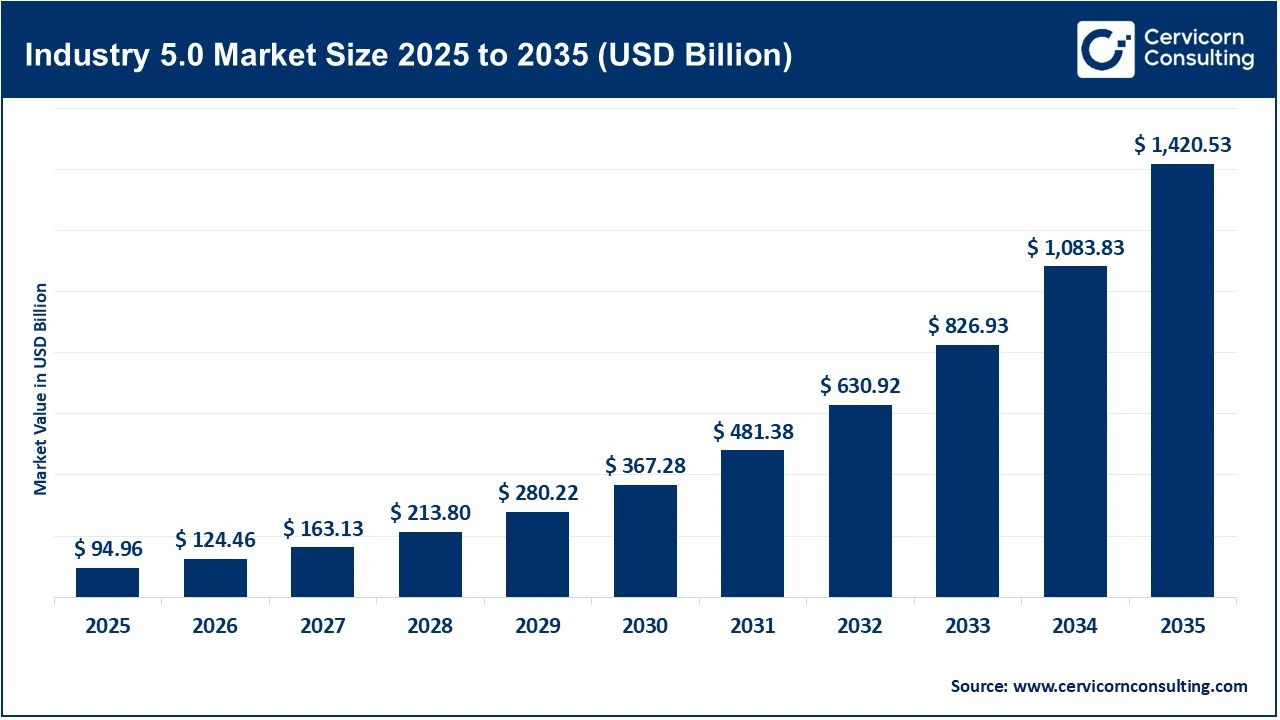
The global Industry 5.0 market is forecast to grow from USD 94.96 billion in 2025 to around USD 1,420.53 billion by 2035, accelerating at a CAGR of 31.2% during the period 2026-2035. Industry 5.0 market growth is driven by a shift from the machine-centric focus of previous industrial revolutions to prioritising human well-being and environmental sustainability. This shift reflects a strategic realignment in which technology is designed to address the needs and diversity of human workers, ensuring that industrial transformation drives inclusive growth and social integrity. Furthermore, integrating sustainability into corporate strategy is no longer optional. For example, an organisation improves performance by implementing a corporate sustainability strategy (CSS), which mediates the positive influence of innovation outcomes on environmental performance. Moreover, firms applying circular economy principles within the Industry 5.0 paradigm have reduced raw material costs by 15%. This highlights that sustainability not only delivers environmental benefits but also creates measurable economic value, making it a key driver of industrial transformation.
Technological resilience and supply chain capabilities in a volatile, uncertain, complex, and ambiguous (VUCA) environment are crucial drivers of growth in the Industry 5.0 market. This growth factor focuses on developing "self-healing" supply chains and sovereign manufacturing capabilities to withstand enduring global disruption, such as geopolitical uncertainty or public health emergencies. The era of supply chain management in Industry 5.0 will require logistics managers to have an eclectic competency profile, drawing on 21st-century change drivers such as Industry 4.0 and post-COVID-19 demands for responsiveness. Additionally, firms adopting digital maturity and environmental innovations rely on the business environment and geographic footprint to influence pace. Larger firms are often able to leverage R&D infrastructures to deploy complex resilience frameworks.
Report Highlights
- By Region, North America dominates the regional segment, capturing 35% share of the global Industry 5.0 market, primarily due to strong technological infrastructure, high investment in AI and automation, and early adoption of advanced manufacturing practices.
- By organization size, the large enterprises segment dominates, accounting for 68% share, driven by higher capital investment, advanced infrastructure, and early adoption of Industry 5.0 technologies.
- By organization size, the small and medium enterprises (SMEs) are the fastest-growing segment, holding 32% share, supported by increasing access to cloud-based solutions and digital transformation initiatives.
- By technology, the artificial intelligence (AI) dominates the market, with 30% share, due to its critical role in enabling smart decision-making, automation, and human-machine collaboration.
- By technology, the robotics is the fastest-growing segment, capturing 25% share, driven by the rapid adoption of collaborative robots for efficiency and productivity gains.
- By end-use industry, the automotive dominates the market, accounting for 31% share, due to extensive use of automation, robotics, and smart manufacturing processes.
- By end-use industry, the healthcare is the fastest-growing segment, with 15% share, fueled by rising demand for personalized care, real-time monitoring, and AI-driven diagnostics.
What is Industry 5.0?
Industry 5.0, often called the Fifth Industrial Revolution, represents the next evolution in manufacturing and industrial processes, building on the advancements of Industry 4.0. While Industry 4.0 introduced “smart” technologies such as artificial intelligence (AI), cloud computing, and real-time data analytics to manufacturing and supply chains, its primary focus was on efficiency, productivity, and automation through cyber-physical systems.
By contrast, Industry 5.0 emphazises the synergy between human intelligence and smart technologies. This new era prioritizes human-centric solutions, sustainability, and resilient manufacturing systems. The integration of human creativity with the precision of automation leads to smarter, more adaptive manufacturing processes that meet the growing demand for personalized products and sustainable practices.
Growth of Collaborative Cyber-Physical Systems in Industry 5.0 Market
The rapid growth of collaborative cyber-physical systems (CCPS), along with advanced digital twin technologies, represents a major trend of Industry 5.0. Unlike earlier industrial models, modern digital twins incorporate human behaviour and interaction within the production environment, enabling virtual commissioning to validate production capacity and safety issues before commissioning. This proactive approach minimises errors and improves overall system efficiency. In Industry 5.0 environments utilizing digital twins, operational downtime has been reduced by nearly 25%, providing a viable economic reason to proceed.
By 2025, Global Tech Summit indicated that global investment in CCPS is expected to increase by up to USD 50 billion over the next three years. This growth reflects a broader industry effort to reduce risks associated with automation and to enhance system resilience. This trend is reinforced by the growing utilization of the Internet of Things (IoT) and big data, supporting circularity and sustainability throughout various stages of manufacturing.
Top 5 Trends and Technologies
- Circular Economy Integration through Post-Consumer Recycled Plastic: The market for high-performance PCR resins is growing, as beverage brands have set goals of at least 50% reclaimed content in PET bottles by 2030.
- Compostable & Biodegradable Packaging: The market for compostable packaging is growing by 15% annually across food service and other sectors.
- Refillable & Reusable Packaging System Growth: Refill-at-home concepts and standardised reusable containers are expected to account for 10% of the packaging market by 2030 as brands seek to eliminate disposable waste.
- Increased Use of Intelligent Packaging: Digital product passports using QR codes and RFID tags are forecast to grow by 20% annually to improve transparency.
- Carbon-neutral Production Technologies: Many manufacturers are using renewable energy and electrification in production to reduce Scope 3 emissions associated with package conversion.
Industry 5.0 Market Statistics: Adoption, Production and Investment (2025-2026)
- Number of industrial IoT devices within smart factories across the globe reached over 19 billion in 2025 enabling greater visibility of supply chains and connectivity with machines.
- Usage of AM in industrial production reaches 32% of manufacturing facilities worldwide in 2025.
- Nearly 40% of all automotive production lines now uses AI-powered robotic systems for welding, assembly, and quality control.
- Smart warehouse automation adoption grew by 28% YoY in 2025 due to growth of AMRs and AI-based inventory systems.
- Over 72% of global manufacturers have incorporated Human-Machine collaboration technologies into production lines by 2025 indicating the shift from automation-focused Industry 4.0 to human-centric Industry 5.0 standards.
- Nearly 68% of industrial organizations have increased their investment in cobots since 2023 for enhancing worker productivity and promoting flexible manufacturing.
- The number of industrial robot installations grew past 620,000 units globally in 2025 with more than 38% of all new robot installations now include cobots intended to work along humans.
- Over 55% of smart factories globally utilize AI-enabled predictive maintenance solutions that lead to nearly 30% machine downtime reduction.
- Adoption of digital twin in manufacturing now stands at 43% for large enterprises in 2025 that improves manufacturing productivity between 15-20%.
- More than 61% of manufacturers use AI-enabled quality inspection systems resulting in nearly 25% product defect reduction.
Report Scope
| Area of Focus |
Details |
| Market Size in 2026 |
USD 124.46 Billion |
| Market Size in 2035 |
USD 1,420.53 Billion |
| CAGR from 2026 to 2035 |
31.20% |
| Dominant region |
North America |
| Key Segments |
Organization Size, Technology, End-Use Industry, Region |
| Key Companies |
Siemens AG, ABB Ltd., Rockwell Automation, Schneider Electric, Honeywell International Inc., Emerson Electric Co., FANUC Corporation, Yaskawa Electric Corporation, KUKA AG, Cisco Systems, Inc., IBM Corporation, General Electric (GE), Mitsubishi Electric Corporation, Stratasys Ltd., 3D Systems Corporation |
Recent Major Milestones
1. Strategic Corporate Research and Development Breakthroughs
Strategic corporate research and development (R&D) is a major driver of growth in the Industry 5.0 market. A major driver is the launch of the first fully "5.0-compliant" smart factory, which will open in Singapore in 2025 by a global electronics leader. This factory represents a significant shift towards a human-machine collaborative model, where AI handles complex logistics and repetitive work, while over 500 human workers focus on high-end customisation and creativity. The factory has achieved 35% higher throughput than a traditional Industry 4.0 plant, providing real evidence that a human-centric model does not improve speed or water efficiency in industry. The development will serve as a worldwide example of human creativity combined with robotic accuracy. Additionally, with the update to ISO/TS 15066 regulatory compliance at the end of 2024, humans and heavy-duty robots can interact more closely and safely, eliminating the permanent barricades of collaborative work.
2 Government Policy Frameworks and National Industrial Programs
Governmental initiatives are playing an essential role in the transition to Industry 5.0. The European Union is currently developing its "Industry 5.0 Funding Framework" (2024-2025), which makes available USD 1.5 billion in specialised funding to help small and medium-sized enterprises (SMEs) transition to human-centric, environmentally sustainable manufacturing models. To date, over 2,000 companies in Europe have accessed these grants, and collectively, the sectors involved have reported an average energy efficiency improvement of 12%. Similarly, the US government introduced an initiative called "Sovereign Manufacturing" in 2025 that provides tax incentives for reshoring production. These policy frameworks highlight the growing importance of national strategies in fostering innovation, sustainability, and industrial resilience.
3. Recent Corporate Investments and Funding for the Emerging Market
Corporate investments and funding are major milestones shaping the evolution of the Industry 5.0 market. In China, the evolution of Industry 5.0 has been marked by the emergence of AI pilot zones. These zones are designed to stimulate innovation and the development of the AI zone ecosystem through policies that include government subsidies and investments in sorely needed infrastructure, while simultaneously reducing market concentration and enabling new entrants. As a result, this funding model appears to accelerate the diffusion of technology, so that the advantages of AI and related technologies will no longer benefit a small group of firms.
4. Global Collaboration and Standardization Milestones
Global collaboration and standardisation efforts are another significant milestone in the Industry 5.0 market. The combination of technology and human innovation requires robust frameworks that protect digital assets and build trust between human operators and autonomous systems. Recent efforts have focused on developing a thematic 14-chapter scheme to address the multifaceted security challenges in a 5.0 environment. Additionally, the emerging concept of "Agriculture 5.0" reflects a global trend towards adopting sustainable, technology-driven practices. This approach integrates green energy solutions with advanced automation, demonstrating how standardisation can support innovation across diverse sectors.
Industry 5.0 Market Segmental Analysis
The Industry 5.0 Market is segmented into organization size, technology, end-use industry, and region.
Organization Size Analysis
Large enterprises hold the dominant share of the Industry 5.0 market by organization size, primarily due to their substantial financial resources and established infrastructure that can support the high costs of initial adoption. Large organizations can implement comprehensive digital transformation strategies, including IoT-connected machines for predictive maintenance and the automation of quality control. Furthermore, these organizations can manage the inherent complexities of cybersecurity and ethics in an industrial IoT ecosystem.
Industry 5.0 Market Share, By Organization Size, 2025 (%)
| Organization Size |
Revenue Share, 2025 (%) |
| Large Enterprise |
68% |
| Small and Medium Enterprise |
32% |
Small and Medium Enterprises (SMEs) represent the fastest-growing segment due to their inherent agility and the availability of modular, affordable technology options. Government-backed initiatives and innovation ecosystems, such as "living laboratories," are expanding access to high-tech tools. Moreover, the adoption of cloud-based AI and "Robotics-as-a-Service" models allows them to overcome the heavy capital costs of traditional industrial upgrades.
Technology Analysis
Artificial Intelligence (AI) is the leading technology segment in the Industry 5.0 market because it serves as the core engine for real-time human-machine collaboration and predictive analytics. AI is not only a tool for automation but also enables decision-making and enhanced economic resiliency through early detection of fluctuations, such as inflation spikes or supply chain issues. Within Industry 5.0, advanced technologies such as AI are used to create decision support systems that integrate with the cloud to organize large amounts of data for improved credit-risk scoring and optimized logistics routing.
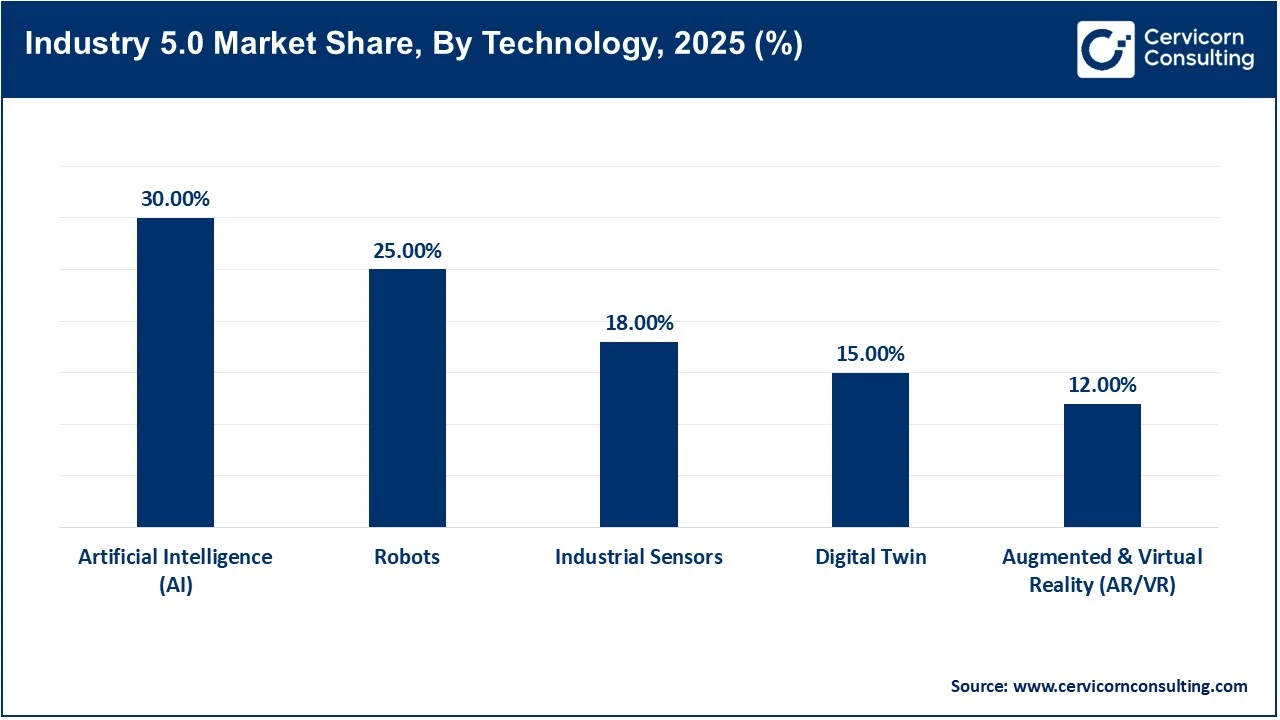
Robotics is the fastest-growing technology segment in the market, mainly due to rapid advances in collaborative robots designed to work safely alongside humans. Compared with earlier industrial robots that operated in isolation, modern robots are technologically superior. In the era of Industry 5.0, robots are outfitted with advanced sensors and AI-enabled capabilities to learn and adapt to human movement and intention. In addition, the increasing demand for "hyper-customization" is driving the development of flexible robotic systems that can be easily reprogrammed for small-batch production.
End-Use Industry Analysis
The automotive sector is the dominant segment in the Industry 5.0 market, supported by its strong foundation in automation and its ongoing transformation towards electric and autonomous mobility. The automotive industry is where vehicle ownership will shift towards new shared and connected transportation systems, enabled only by the deep integration of AI, cloud computing, and data-driven mobility services. As a result, the automotive sector is set to fundamentally alter transport systems and operations, while requiring a high baseline of technology readiness to implement mass personalization.
Industry 5.0 Market Share, By End-Use Industry, 2025 (%)
| End-Use Industry |
Revenue Share, 2025 (%) |
| Automotive |
31% |
| Semiconductor & Electronics |
20% |
| Healthcare |
15% |
| Aerospace |
12% |
| Metals & Mining |
10% |
| Others |
12% |
Healthcare is the fastest-growing end-use industry in the market, primarily driven by the increasing adoption of personalised treatment models, often referred to as the "factory-of-one" approach. The healthcare sector is increasingly focusing on personalised care by leveraging digital technologies that enable real-time monitoring, data-driven diagnostics, and precision-based treatment solutions. Moreover, one-fifth of expert-identified IoT applications associated with the transition to Industry 5.0 are characterised as professional and expert applications in healthcare, aimed at automating processes and supporting data-informed decision-making.
Industry 5.0 Market Regional Analysis
The industry 5.0 market is segmented into various regions, including North America, Europe, Asia-Pacific, and LAMEA. Here is a brief overview of each region:
Why is Asia-Pacific witnessing fastest growth in the Industry 5.0 market?
The Asia-Pacific Industry 5.0 market size was valued at USD 24.69 billion in 2025 and is expected to be worth around USD 369.34 billion by 2035. The Asia-Pacific is driven by the rapid digitisation of agricultural and industrial processes. In this region, technological innovation is a crucial factor in increasing productivity and sustainability, with artificial intelligence and process automation at the centre of the technologies enabling this movement. The Industrial Internet of Things (IoT) allows manufacturers to connect physical assets with digital intelligence, providing real-time data and predictive maintenance. In addition, the region is seeing increased use of Unmanned Aerial Vehicles (UAVs) for industrial purposes and monitoring, owing to the high degree of spatial accuracy UAVs can deliver.
China to Lead Global Output through Massive Scale Automation and State-Led Integration
China's implementation of Industry 5.0 is distinguished by its ability to combine large-scale production with state-led initiatives, effectively aligning its industrial policies with advanced technological innovation and enabling rapid transformation across sectors. Bibliometric analysis highlights China as a global leader in research output, particularly in areas such as the digitisation of production and smart agriculture. China is rapidly moving from "Made in China" to "Created in China" by implementing Industry 5.0 features to dominate the high-tech space for electric vehicles and renewables. Though China faces considerable challenges in human capital and basic R&D, the country’s unmatched ability to deploy technologies at scale continues to set it apart as a global leader.
- More than 290,000 industrial robots were installed in China in 2025, comprising of almost 47% global installations.
- Government driven industrial digitization efforts provided more than $45 bn in AI manufacturing investments.
- More than 58% large factories across China have already implemented AI driven production processes.
- China is the leader in manufacturing of industrial AI hardware and sensors across the world.
India to Leverage Demographics Dividends and Digital India for Industrial Resilience
India is emerging as a key player in the global hub for resilient manufacturing, supported by initiatives such as Digital India and a large, youthful workforce. India is also increasingly adopting precision technologies, such as UAVs for monitoring and herbicide application, to overcome traditional labour or productivity constraints. India's preparedness for this industrial revolution is currently moderate, particularly in the application and operation of technology. By focusing on job augmentation rather than replacement, India seeks to convert its demographic dividend into a high-skill manufacturing competitor.
Why does North America dominates in the Industry 5.0 market?
The North America Industry 5.0 market size was valued at USD 33.24 billion in 2025 and is projected to surpass around USD 497.19 billion by 2035.
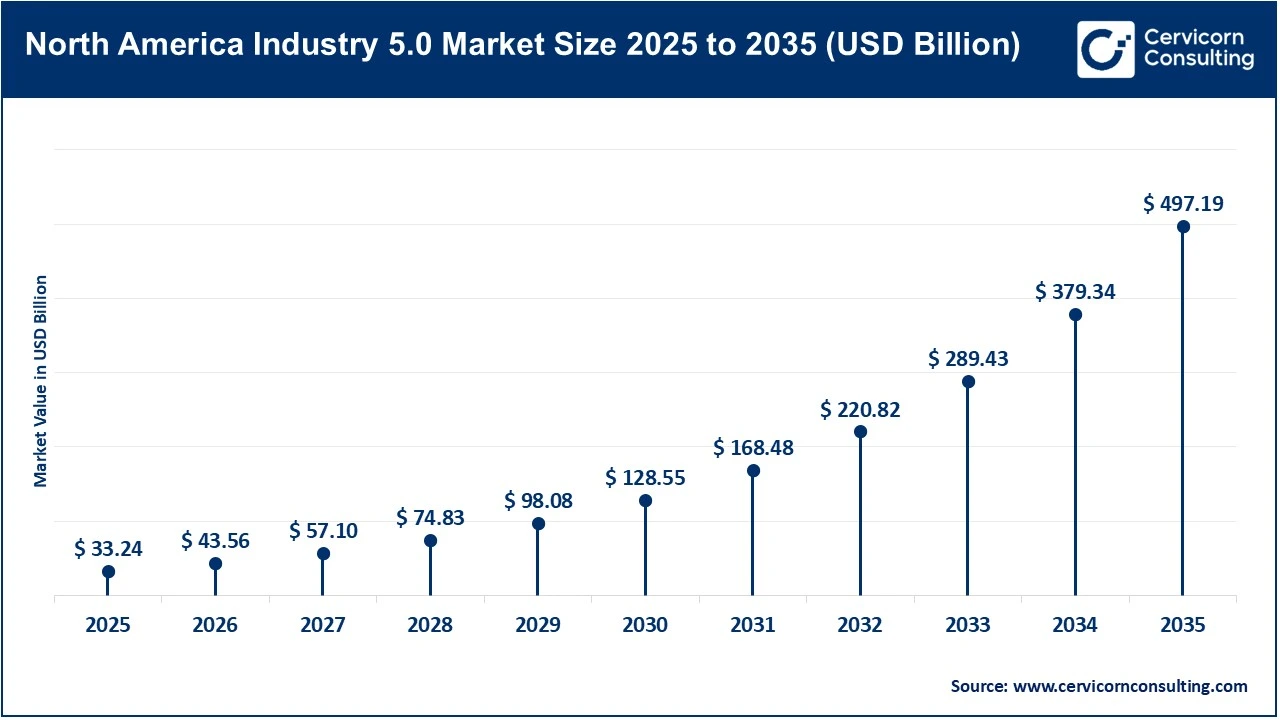
North America is marked by significant investment in research and development and by early adoption of computing technologies. The region is increasingly integrating Generative AI into industrial workflows to enhance Environmental, Social, and Governance (ESG) readiness. Across the United States and Canada, many leading technology companies are developing more advanced actuators and power electronics to support high-precision operations. This region is also heavily influenced by efforts to address labour shortages associated with "human-in-the-loop" systems, where AI-driven decision support complements human engineers in complex tasks.
United States:
- Over $65 billion were invested in smart manufacturing and AI-driven industrial automation in the U.S in 2025.
- The adoption of cobots across the U.S. factories stands at more than 37% in the United States.
- The U.S. is leading in digital twin implementations, with 29% of the global industrial digital twin investments being accounted by the U.S.
United States: Strategy for Leadership in High-Tech Manufacturing and AI-Human Turn Collaboration
The United States remains a major driver of the Industry 5.0 market by integrating aerospace and defense with cognitive AI, enabling advanced, intelligent, and high-precision industrial solutions.
- Centrality in Innovation: The US shows very high centrality in international collaboration networks for smart technology research
- Bionic Robotics: Focus on a strategy for Aerospace Bionic Robotics (ABR) to advance autonomy and adaptability in extreme environments.
- Investment: Considerable investment in actuators and power electronics to advance automation
Canada: Sustainable Management of Resources and AI-Driven Logistics Optimization
Canada’s Industry 5.0 strategy focuses on sustainably managing and optimizing its abundant natural resources, leveraging advanced technologies to improve efficiency and long-term environmental resilience.
- Green Innovation: The adoption of AI-based tools to respond to changing environmental regulations is high.
- Circular Economy: Digital twins are being used to monitor product cycles and minimize industrial waste.
- Workforce Readiness: There is considerable investment in upskilling programs to get the workforce ready for working with robots in collaborative settings.
What factors are driving significant growth for Europe Industry 5.0 Market?
The Europe Industry 5.0 market size was reached at USD 26.59 billion in 2025 and is forecasted to grow around USD 397.75 billion by 2035. Europe plays an essential role as the regulatory leader in the Industry 5.0 market, which is shifting towards the "Twin Transition" of digital and green objectives. While policy networks are often collaborative, Europe also has some of the most active collaborative networks, which highlight the importance of policies for technological transfer, resilient systems, and sustainable innovation. European manufacturers are increasingly focused on complying with strict environmental regulations while ensuring economic sustainability through digital technology designs. However, this transition can also raise concerns about investment capital and the need for highly qualified employees to better manage cyber-physical systems.
United Kingdom: Precision Engineering Legacy and Implementing Smart Factories
The UK is leveraging its strong heritage in precision engineering for Industry 5.0 practices, enhancing innovation and efficiency in high-value manufacturing sectors.
- Collaborative Networks: Active participation in Europe-wide research networks supporting sustainable innovation
- Legal & Ethical Technology: Explore the role of digital technologies in supporting economic-environmental sustainability as it adheres to legal and corporate governance frameworks.
- Focus on Resilience: Creating a focus on supply chain transparency through block chain and IoT enablement.
Germany
- The largest Industry 5.0 market in Europe Germany stands at more than 62% adoption by the manufacturers across industries. Germany is a leader in human-centric industrial robots and precise automation engineering.
- The German industrial energy efficiency initiatives were responsible for a 19% reduction in manufacturing emission levels in 2025.
- The large German automotive industry is the major driver of cobot implementation.
Germany: Re-engineering to Industrial Excellence through Cyber-Physical Systems
Germany is transforming its industrial framework to align with Industry 5.0 by emphasizing human-centric innovation and sustainable, green manufacturing practices.
- Investment Obstacles: Obstacles still exist in terms of investment capital and securing data transfer protocols.
- SME Investment: Focus on providing "Readiness Indices" to support medium-sized enterprises transforming to 5.0 protocols in preparation to move away from 4.0 strategies.
- Sustainable Power: Germany has focused on heavy investment in power electronics to improve energy efficiency in heavy industry.
Industry 5.0 Market Share, By Region, 2025 (%)
| Region |
Revenue Share, 2025 (%) |
| North America |
35% |
| Europe |
28% |
| Asia Pacific |
26% |
| LAMEA |
11% |
What are the Industry 5.0 market trends in the LAMEA region?
The LAMEA Industry 5.0 market was valued at USD 10.45 billion in 2025 and is anticipated to hit around USD 156.26 billion by 2035. In the LAMEA region, Industry 5.0 serves as a catalyst for infrastructure modernization and economic diversification. Emerging economies in this region are also strengthening their position through strategic partnerships and cross-sector collaboration. Government policies increasingly focus on enhancing social stability and protecting resources, which is essential for productive processes with less waste. In Middle Eastern nations, Industry 5.0 is a direct path towards knowledge-based economies, while Latin American markets apply smart solutions to modernise their resource-intensive industries.
Brazil: Modernizing Agricultural and Industrial Connections with Smart Technologies
Brazil is adopting Industry 5.0 to connect its strong agricultural sector with urban industrial centers, enabling more integrated, efficient, and technology-driven production systems.
- Generative AIs are moderating the effects of increasing Brazil's ESG preparedness in response to climate change.
- The significant adoption of precision agriculture tools has improved productivity and compliance with environmental regulations.
- Regenerative AI is being used to shift the relationship between green innovation and economic performance upwards.
United Arab Emirates: Visionary Smart Cities and Diversifying Knowledge Economies
The UAE is a leader in the LAMEA region in transitioning away from oil-based dependency.
- There is a focus on "twenty-first century competencies" to prepare the workforce to adapt effectively to emerging 5.0 technologies.
- The UAE has introduced pro-environmental policy frameworks that provide economic development opportunities while remaining compliant with national and international regulations.
- The UAE is deploying IIoT and AI tools to monitor urban resource use and industrial zones more efficiently.
Industry 5.0 Market Top Companies
Recent Developments
- In July 2025, ABB Ltd. launched new robot families (Lite+, PoWa, IRB1200) targeting mid-sized manufacturers in China, enhancing accessibility to automation and supporting rapid deployment with AI-enabled ease of use.
- In January 2025, Stratasys Ltd. launched its TrueDent solution in Europe, enabling advanced digital denture production and expanding its presence in healthcare-focused additive manufacturing.
- In January 2025, Siemens AG introduced Industrial Edge AI solutions, enabling predictive maintenance and reducing unplanned downtime by up to 40%, improving operational efficiency in smart factories.
Market Segmentation
By Organization Size
- Large Enterprise
- Small and Medium Enterprise
By Technology
- Artificial Intelligence (AI)
- Robots
- Industrial Sensors
- Digital Twin
- Augmented & Virtual Reality (AR/VR)
By End-Use Industry
- Automotive
- Semiconductor & Electronics
- Healthcare
- Aerospace
- Metals & Mining
- Others
By Region
- North America
- APAC
- Europe
- LAMEA