India Perovskite Solar Cell Market Size and Growth 2026 to 2035
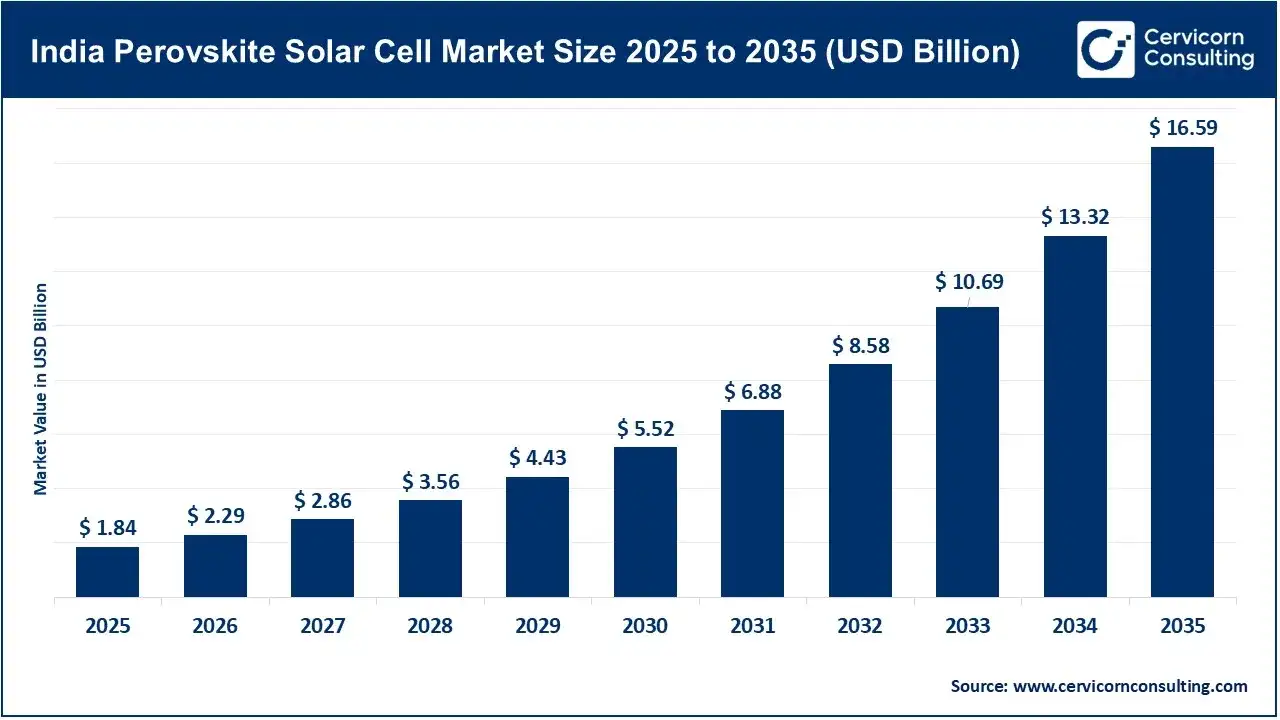
The India perovskite solar cell market size was valued at USD 1.84 billion in 2025 and is expected to exceed USD 16.59 billion by 2035, growing at a CAGR of 24.6% during the forecast period of 2026-2035. Nowadays, India is seeking to develop an independent supply chain, fueling the overall market growth. Alongside this, perovskite cells offer greater efficiency, and a rise in local R&D and pilot commercialisation drives the upcoming advances across the market.
Report Highlights
- By region, West India dominated the market in 2025, propelled by well-developed solar energy infrastructure, substantial renewable energy investments, and solar manufacturing activity.
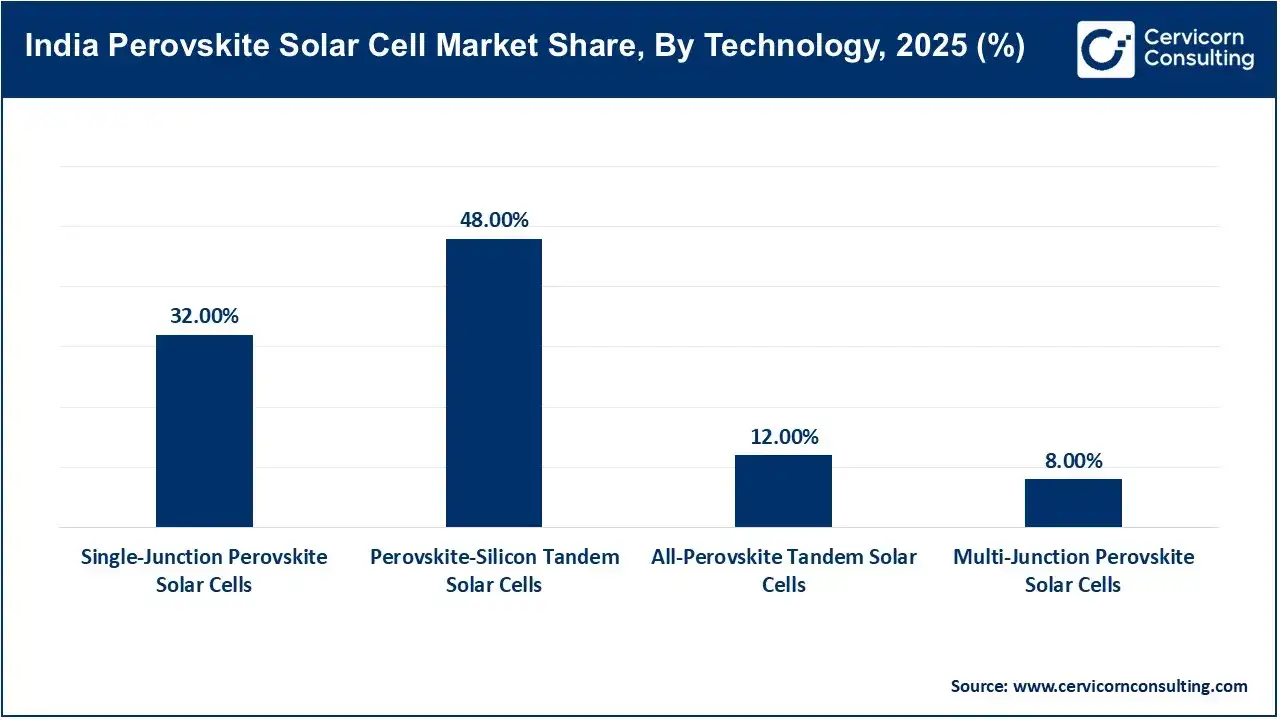
- By technology, perovskite-silicon tandem solar cells led the market in 2025 with revenue share of 48%, due to surging interest in enhancing the efficiency of traditional silicon-based photovoltaic technology.
- By product type, rigid perovskite solar cells registered dominance in the market with revenue share of 59%, driven by their suitability for conventional solar module configurations.
- By application, solar panels and power generation were dominant in the market in 2025 with revenue share of 46%, motivated by India's advancing solar energy infrastructure and increasing demand for higher-efficiency photovoltaic modules.
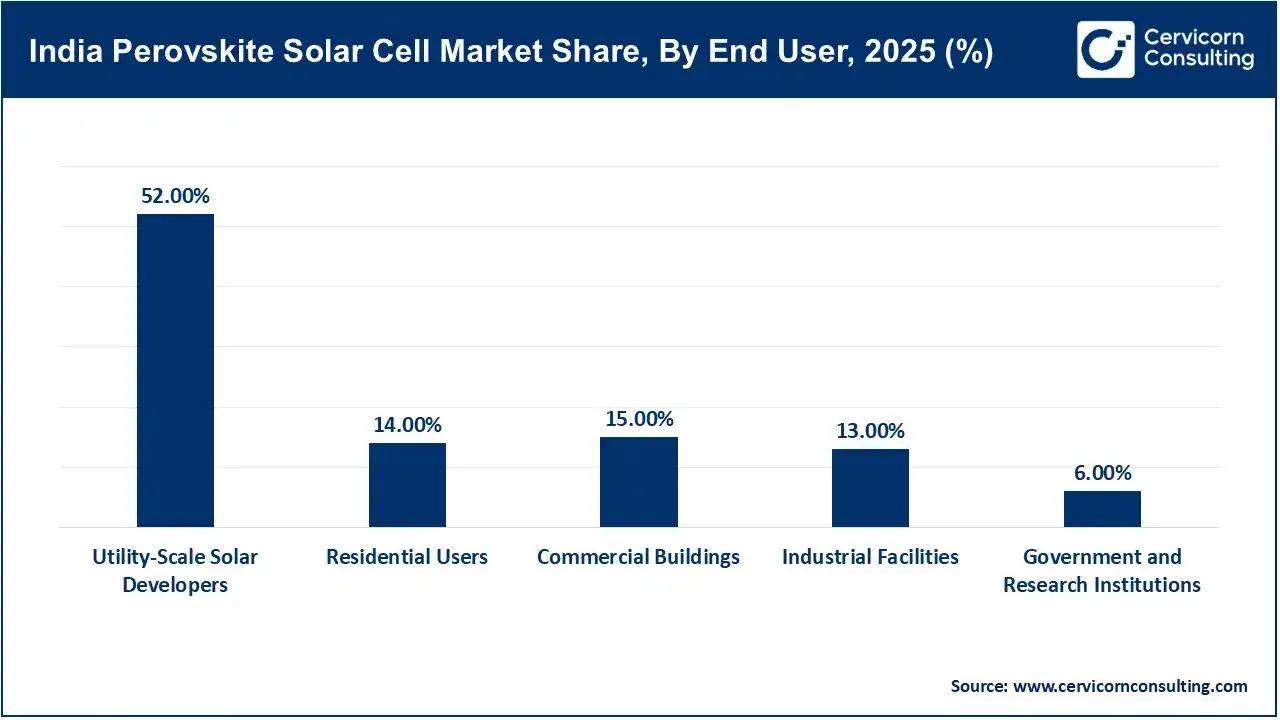
- By end user, utility-scale solar developers dominated the market in 2025 with revenue share of 52%, because of the importance of large-scale solar power generation in India's renewable energy sector.
What is the India Perovskite Solar Cell Market?
Firstly, the use of a thin-film solar cell that leverages a perovskite-structured material, as its light-absorbing active layer to convert sunlight into electricity, is defined as a perovskite solar cell. Indian industry expansion is mainly led by raising focus on reducing major import dependence, compressing factory initial expenses, and enhancing solar efficiency in hot environments. By overcoming upstream limitations, the market is emphasising solution-processed perovskites on glass, steel, or plastic, which fuels early adoption in Building Integrated Photovoltaics (BIPV), smart glass, portable power, and low-light areas.
| Investor / Organization |
Investment / Funding |
Year |
Project / Focus |
| Ministry of New and Renewable Energy (MNRE) |
Over ₹200 crore |
2025 (cumulative support over 15 years) |
R&D and education support for IIT Bombay's National Centre for Photovoltaic Research and Education (NCPRE), including perovskite and silicon-perovskite tandem solar cell research. |
| MNRE / IIT Bombay |
₹3 crore |
2024 |
Scale-up of perovskite tandem solar cells under Phase I of the solar R&D programme. |
| MNRE / IIT Bombay |
₹40 lakh |
2024 |
Development of flexible perovskite solar cells and intermediate modules. |
| Government of India / ART-PV India |
₹83 crore grant |
2025 |
Support for scaling up indigenous silicon-perovskite tandem photovoltaic technology and commercial development. |
| Reliance Industries |
20% equity stake; investment value not disclosed here |
2022 |
Investment in U.S.-based Caelux for perovskite solar technology development and commercialization. |
| P3C, IIT BHU-incubated startup |
USD 250,000 raised, with a further USD 3 million commitment subject to successful trials |
2023 |
Development and demonstration of flexible perovskite solar cells. |
| Waaree Energies / IIT Bombay |
Financial value not disclosed |
2024 |
Strategic CSR collaboration supporting perovskite solar cell research and development. |
| Tata Chemicals / IITB-Monash Research Academy |
Financial value not disclosed |
2024 |
Research collaboration focused on perovskite materials and next-generation solar technologies. |
Latest Government Efforts
- November 2026: An evaluation by Indian Solar Manufacturers Association (ISMA) and P3C estimates perovskite technology could unlock ₹74,000 crore in India and recommends concentrated R&D and pilot funding through MNRE and the Anusandhan National Research Foundation (ANRF), with a two-tier ALMM framework.
- November 2026: The Bharat Renewable Energy Summit & Expo (BRESE) 2026 in New Delhi (organized with MNRE), a dedicated technical session on "Laboratory to Manufacturing: Building India's Commercialization Roadmap for Perovskite Solar Cells" assembled MNRE officials, researchers, and industry leaders to study scaling from lab research to commercial lines.
- July 2026: The Ministry of New and Renewable Energy allocated ₹200 crore (~$24 million) for a Perovskite PV Manufacturing Pilot Line and related projects under the Renewable Energy Research and Technology Development (RE-RTD) Programme for FY 2026–27 to FY 2030–31 (total programme outlay: ₹436.93 crore).
Market Dynamics
Growth Drivers
- Aiming at Domestic Supply Chain: In 2026, the market is increasingly looking to overcome imports of polysilicon, wafers, and solar manufacturing equipment, especially from China. As China enforces rigorous export controls on the latest photovoltaic and perovskite/tandem production technologies, India is establishing local perovskite IP and supply chains as a key goal.
- Broader Benefits of Perovskites: One of the major drivers of the market is the expansive advantages of perovskites that absorb sunlight highly with active layers only a few hundred nanometers thick. In addition, perovskite fabrication occurs below 200°C and demands lower material and production expenses than conventional high-temperature silicon processing.
Market Restraints
- Degradation Concerns: The adoption of perovskite materials carries the risk of degrading faster compared to traditional silicon when exposed to moisture, heat, or extended illumination, which requires massive encapsulation that increases expenditures and weight.
- Recycling & Lead-Related Issues: The widespread demand for perovskite cells usually depends on lead, which results in the creation of environmental and health challenges. However, recycling and safe recovery of these cells remain difficult, as global scientists are seeking sustainable extraction and lead-free solutions.
Key Opportunities
- Advancing TOPCon Infrastructure: Day by day, Indian developers are actively investing in Tunnel Oxide Passivated Contact (TOPCon) silicon cells, including layering a perovskite top cell onto a TOPCon bottom cell, developing a tandem architecture capable of surpassing 29% to 30% efficiency.
- Broadening Premium Applications: The implementation of building-integrated photovoltaics (BIPV) shows tailored perovskite layers adapting glass facades, windows, and urban infrastructures. Additionally, exploration of flexible and lightweight approaches indicates wider use in curved surfaces on vehicles, trains, metro rail, and portable gear.
Market Challenges
- Insufficient Spending: Across the industry, local Indian solar pioneers offer minimal revenue share on R&D compared with global companies, and this domain also requires well-qualified and trained engineers to boost line scale-up and improve processes.
- Restricted Growth: The maintenance of consistent films, compressed defect rates, and increased yields across vast commercial modules or tandem cells requires complex methods.
India Perovskite Solar Cell Market Segmentation Analysis
Technology Analysis
Perovskite-Silicon Tandem Solar Cells: The perovskite-silicon tandem solar cells segment led the market in 2025, supported by their exceptional power efficiency and their compatibility with current silicon production. Recent research studies from IIT Bombay and ART-PV India represented a combination of a near-infrared-transparent perovskite top layer with a conventional silicon cell, which enhanced thermal and dark stability.
All-Perovskite Tandem Solar Cells: The all-perovskite tandem solar cells segment is expected to grow rapidly, propelled by ongoing breakthroughs in high-efficiency photovoltaic architectures and next-generation cell research. Along with their tunable bandgaps & lightweight design, many Indian manufacturers have announced multi-gigawatt hybrid perovskite-silicon tandem strategies slated for 2028, like GREW Solar, Rayzon, and Navitas joining with Caelux.
Product Type Analysis
Rigid Perovskite Solar Cells: The rigid perovskite solar cells segment held a major share of the market in 2025, motivated by their pivotal role in conventional solar module configurations and higher tandem cell compatibility. Recently, NCPRE at IIT Bombay and groups at IIT Roorkee expanded 4-terminal and monolithic 2-terminal perovskite-on-silicon tandem structures on rigid substrates to spur past single-junction limits by pairing a wide-bandgap perovskite top cell with a traditional or heterojunction silicon bottom cell.
India Perovskite Solar Cell Market Share, By Product Type, 2025 (%)
| Product Type |
Revenue Share, 2025 (%) |
| Rigid Perovskite Solar Cells |
59% |
| Flexible Perovskite Solar Cells |
27% |
| Semi-Transparent Perovskite Solar Cells |
14% |
Flexible Perovskite Solar Cells: The flexible perovskite solar cells segment is anticipated to be the fastest-growing during the forecast period, driven by demand for lightweight, adaptable photovoltaic products. Along with their mechanical versatility, Perovskia Solar collaborated with Indian space startup AkashaLabdhi to examine perovskite cells for space applications, such as flexible cells focused on increased power-to-weight ratios.
Application Analysis
Solar Panels and Power Generation: The solar panels and power generation segment held a major share of the market in 2025, supported by the need to reduce solar power expenses and elevate panel efficiency beyond conventional silicon limits. Ongoing efforts have strengthened the scale-up of module prototypes, operating field validation test beds, and submitting modules for reliability testing at the National Institute of Solar Energy (NISE) by Indian developers.
India Perovskite Solar Cell Market Share, By Application, 2025 (%)
| Application |
Revenue Share, 2025 (%) |
| Solar Panels and Power Generation |
46% |
| Building-Integrated Photovoltaics (BIPV) |
22% |
| Smart Glass and Solar Windows |
14% |
| Consumer Electronics and Portable Devices |
12% |
| Aerospace and Defense |
6% |
Building-Integrated Photovoltaics (BIPV): The Building-Integrated Photovoltaics (BIPV) segment is projected to witness rapid expansion in the upcoming years, due to broadening interest in integrating solar generation into building facades, rooftops, and windows. At the latest Expo, researchers rolled out a promised BIPV portal for India, with viability assessment and design tools to study generation, expenditures, payback, and environmental impact.
End User Analysis
Utility-Scale Solar Developers: The utility-scale solar developers segment captured a major share of the market in 2025 because of growing land acquisition requirements and reduced BoS costs. Moreover, Indian perovskite manufacturer P3C Technology and Solutions advanced single-junction perovskite module development and reliability validation and advocated for local supply chains and pilot support.
Residential Users: The residential users segment is estimated to expand fastest in the coming years, motivated by rooftop solar adoption and demand for lightweight, space-efficient photovoltaic solutions. In this era, the market has been focusing on the rapid degradation of perovskite layers under heat, humidity, and moisture, rather than the 25-year lifespan anticipated on an Indian roof. Simultaneously, homeowners are installing rooftop solar that generally depends on well-established technologies, such as N-type TOPCon or Mono PERC panels with advanced warranties.
India Perovskite Solar Cell Market Regional Analysis
How did West India Dominate the Market in 2025?
West India held the largest share of the market in 2025, fueled by a well-developed solar energy system and higher investments in renewable energy. With academic and incubator dominance, key solar developers based in Gujarat expedited industrial R&D into perovskite integration. Meanwhile, Surat-based Rayzon Solar actively assessed perovskite-on-silicon tandem cell prototypes for broad adoption, whereas Mumbai- and Gujarat-headquartered Waaree Energies joined with ART-PV India for preferential licensing to commercialize tandem modules.
Why is South India Considered to Grow Fastest in the Market?
South India is projected to expand rapidly in the India perovskite solar cell market, propelled by surging renewable energy projects, research capabilities, and strengthening solar technology development. Recently, Bengaluru conducted the International Conference on Halide Perovskites that joined researchers working on hybrid and inorganic halide perovskites for solar cells, optoelectronics, and developing devices. At the same time, researchers at the International Advanced Research Centre for Powder Metallurgy and New Materials (ARCI) are boosting shelf-stable precursor inks and low-temperature flexible modules.
Recent Announcements
- November 2026: IB Solar introduced its IBHI Series (IB Energy) hybrid solar inverter at the Renewable Energy India (REI) Expo 2026 in Greater Noida.
- September 2026: The Delhi government slated a goal to facilitate free rooftop solar panels to more than 2.30 lakh families in the city in the first phase of ‘Pradhan Mantri Surya Ghar: Muft Bijli Yojana’.
- July 2026: West Bengal Chief Minister Suvendu Adhikari unveiled the PM Surya Ghar: Muft Bijli Yojana in the state and expected a target of covering 5 lakh households with rooftop solar installations by March 2027.
- July 2026: Navitas Solar Private Limited and Caelux Corporation made a strategic, five-year, 5 GW commercialization alliance to establish and produce next-generation high-efficiency hybrid Tandem solar modules in India.
Key Companies
Segments Covered
By Technology
- Single-Junction Perovskite Solar Cells
- Perovskite-Silicon Tandem Solar Cells
- All-Perovskite Tandem Solar Cells
- Multi-Junction Perovskite Solar Cells
By Product Type
- Rigid Perovskite Solar Cells
- Flexible Perovskite Solar Cells
- Semi-Transparent Perovskite Solar Cells
By Application
- Solar Panels and Power Generation
- Building-Integrated Photovoltaics (BIPV)
- Smart Glass and Solar Windows
- Consumer Electronics and Portable Devices
- Aerospace and Defense
By End User
- Utility-Scale Solar Developers
- Residential Users
- Commercial Buildings
- Industrial Facilities
- Government and Research Institutions
By Region
- North India
- South India
- West India
- East India
- Central India
