India AI Data Center Market Size and Growth 2026 to 2035
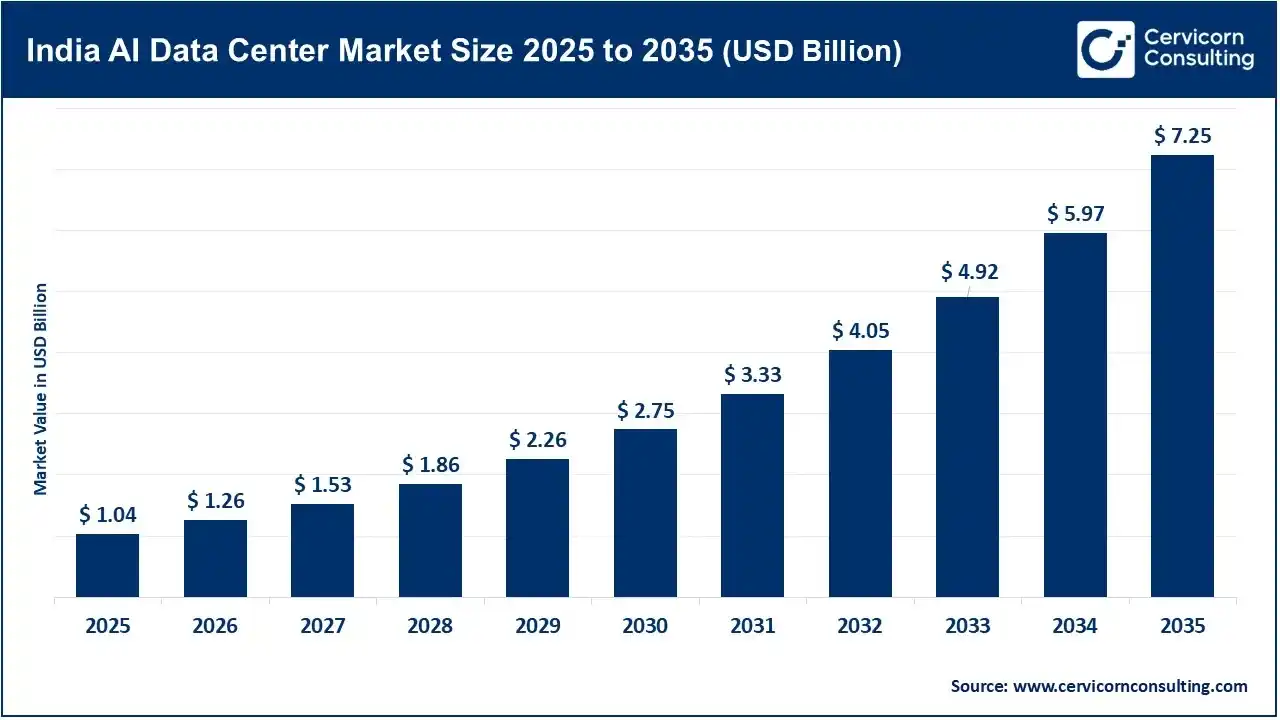
The India AI data center market size was valued at USD 1.04 billion in 2025 and is projected to grow from USD 1.26 billion in 2026 to nearly USD 7.25 billion by 2035, registering a CAGR of 21.5% over the forecast period from 2026 to 2035. The India AI data center market is growing as cloud computing, digital services, AI adoption, and the need for high performance computing all continue to grow nationwide. Businesses and data center operators are being encouraged to build AI-ready facilities with advanced computing, cooling, power, and networking capabilities due to growing investments in AI infrastructure, increased data generation, and the need for faster and more efficient computing. Market development is also being aided by the growth of colocation and hyperscale facilities. New prospects for AI data center infrastructure are also being created by India's growing digital economy and the growing emphasis on data localization.
In February 2026, Yotta Data Services announced plans to deploy 20,736 NVIDIA Blackwell Ultra GPUs at its Greater Noida data center, supported by an investment of more than $2 billion. The AI supercluster is designed to provide high-performance computing for enterprises, startups, and public institutions in India, while more than 10,000 GPUs are planned to support the IndiaAI Mission. This development highlights the growing demand for AI-ready data centers, advanced GPU infrastructure, and sovereign computing capabilities in India.
India represents a rapidly developing market for AI data centers, driven by the growing demand for high-performance computing infrastructure, growing adoption of AI, growing cloud computing, and growing digitalization. Large data center and technology companies are making investments in GPU infrastructure, sophisticated networking, AI-ready facilities, and effective cooling systems. The growth of the ecosystem is being aided by the IndiaAI Mission's expansion and the increasing accessibility of AI computing resources. Due to their connectivity, enterprise demand, and digital infrastructure, major data center hubs like Mumbai, Hyderabad, Chennai, Bengaluru, Delhi-NCR, and Pune are drawing investments. It is anticipated that rising demand from cloud service providers, businesses, AI developers, and startups will generate more chances for the nation's AI data centers to grow.
Indian Government Initiatives for AI Data Centers
- In February 2026, the Government of India announced plans to add 20,000 GPUs to the existing national AI computing infrastructure under the IndiaAI Mission, expanding access to high-performance computing for AI development in India.
- In March, the Government highlighted the Semicon India Programme alongside the IndiaAI Mission to strengthen India's semiconductor, high-performance computing, and AI infrastructure ecosystem. The initiatives support domestic technology capabilities required for advanced computing and AI applications.
- By June 2026, the IndiaAI Mission had expanded shared computing capacity to more than 45,000 GPUs, providing subsidized AI computing access to Indian researchers, startups, and innovators.
Report Highlights
- By data center type, hyperscale data centers led the market in 2025, driven by rising AI workloads and cloud adoption.
- By data center type, hyperscale data centers are expected to grow rapidly, supported by increasing generative AI and GPU-intensive workloads.
- By AI infrastructure component, GPU and AI accelerators led the market in 2025, owing to their critical role in AI training and inference.
- By AI infrastructure component, GPU and AI accelerators are expected to grow rapidly, supported by rising demand for high-performance AI computing.
- By GPU / accelerator type, NVIDIA GPUs led the market in 2025, supported by their widespread adoption across AI workloads.
- By GPU / accelerator type, custom / ASIC AI accelerators are expected to grow rapidly, driven by demand for specialized and energy-efficient AI computing.
- By AI workload, AI inference led the market in 2025, supported by the growing deployment of AI models in real-time applications.
- By AI workload, generative AI and AI model training are expected to grow rapidly, driven by increasingly complex AI models.
- By deployment model, cloud led the market in 2025, owing to the growing adoption of scalable cloud-based AI services.
- By deployment model, edge is expected to grow rapidly, supported by demand for low-latency AI processing.
- By cooling technology, air cooling led the market in 2025, supported by its established use across data center facilities.
- By cooling technology, direct-to-chip liquid cooling is expected to grow rapidly, driven by increasing server density and AI workloads.
- By power infrastructure, grid power led the market in 2025, owing to its established availability and reliability.
- By power infrastructure, renewable energy and battery storage are expected to grow rapidly, supported by sustainability and rising AI power requirements.
- By data center size, large data centers led the market in 2025, driven by demand for high-capacity AI computing infrastructure.
- By data center size, hyperscale / mega data centers are expected to grow rapidly, supported by increasing demand for large-scale AI infrastructure.
- By end user, cloud service providers led the market in 2025, owing to their extensive AI and cloud infrastructure deployment.
- By end user, AI model developers / enterprises are expected to grow rapidly, driven by increasing adoption of AI applications.
Statistics, Adoption & Consumption Data
- Data center capacity: India’s installed data center capacity reached approximately 1,575 MW in 2026, up from about 375 MW in 2020, reflecting the rapid expansion of digital and AI infrastructure.
- AI-led capacity expansion: India’s data center capacity is projected by JLL to increase from around 1.6 GW in mid-2026 to 6 GW by 2029, indicating substantial infrastructure requirements for AI and high-performance computing workloads.
- Investment commitments: India recorded approximately $173 billion in cumulative data center investment commitments between 2021 and H1 2026, including $38 billion announced during H1 2026 alone, according to CBRE.
- Future investment requirement: JLL estimates that India’s data center expansion to 6 GW by 2029 could require approximately $110 billion in investment, creating demand across power, cooling, construction, networking, and IT infrastructure.
- H1 2026 absorption: India recorded 101 MW of data center absorption in H1 2026, more than 20% above the three-year average, with hyperscale capacity accounting for 82% of total absorption.
- Development pipeline: India's data center development pipeline stood at approximately 3.9 GW in H1 2026, spanning projects under construction and planned facilities.
- Hyperscale expansion: 92% of data center operators surveyed by CBRE planned to add more than 100 MW of capacity over the following 24 months, highlighting the scale of planned infrastructure expansion.
- AI compute capacity: India’s IndiaAI Mission had expanded shared compute capacity to more than 45,000 GPUs by June 2026, providing access to AI computing resources for startups, researchers, academia, and innovators.
- Subsidized GPU consumption: By August 2026, 237 projects had accessed subsidized AI computing under the IndiaAI framework, consuming approximately 93.18 lakh GPU hours.
India AI Data Center Market Recent Trends
- Rapid AI Adoption: Growing AI applications are driving demand for advanced data center infrastructure.
- AI-Optimized Infrastructure: Data centers are adopting GPUs and high-performance computing systems for AI workloads.
- Cloud Expansion: Growing cloud usage is supporting the development of hyperscale data centers.
- Energy-Efficient Solutions: Operators are adopting efficient cooling and power technologies to manage AI workloads.
- Edge Data Centers: Growing demand for low-latency AI applications is driving the expansion of edge data centers.
- Growing Investments: Technology companies and data center operators are increasing investments in AI infrastructure.
Market Dynamics
Driver: AI Adoption and Digital Infrastructure Expansion
The growing use of AI, generative AI, cloud computing, and high-performance computing is driving the growth of the AI data center market in India. Businesses are being encouraged to build AI-ready facilities with cutting-edge computing, networking, power, and cooling infrastructure due to growing data generation and the need for faster processing. India's AI infrastructure ecosystem is also being strengthened by government initiatives that support domestic AI capabilities.
- On 14 October 2025, Adani Enterprises, through AdaniConneX, announced a partnership with Google to develop an AI data center campus in Visakhapatnam, Andhra Pradesh, supported by green energy infrastructure. The project is designed to expand computing capacity for AI workloads in India.
Restraint: High Energy and Infrastructure Requirements
The high energy consumption, cooling needs, infrastructure expenses, and power availability continue to be significant obstacles. AI workloads necessitate high-density computing systems, which produce a lot of heat and call for sophisticated cooling systems. Therefore, as the capacity of AI data centers increases, sustainable infrastructure and effective power management become more crucial.
Opportunity: Expansion of AI Infrastructure Opportunities
The development of AI-ready data centers, GPU infrastructure, hyperscale facilities, edge computing, and sustainable power solutions are some of the opportunities that India offers. Opportunities for scalable domestic AI infrastructure are being created by the growing demand from businesses, cloud providers, startups, and government agencies. Expanding into new data center locations can help AI computing services become more widely used throughout India.
Segmental Analysis
Data Center Type Analysis
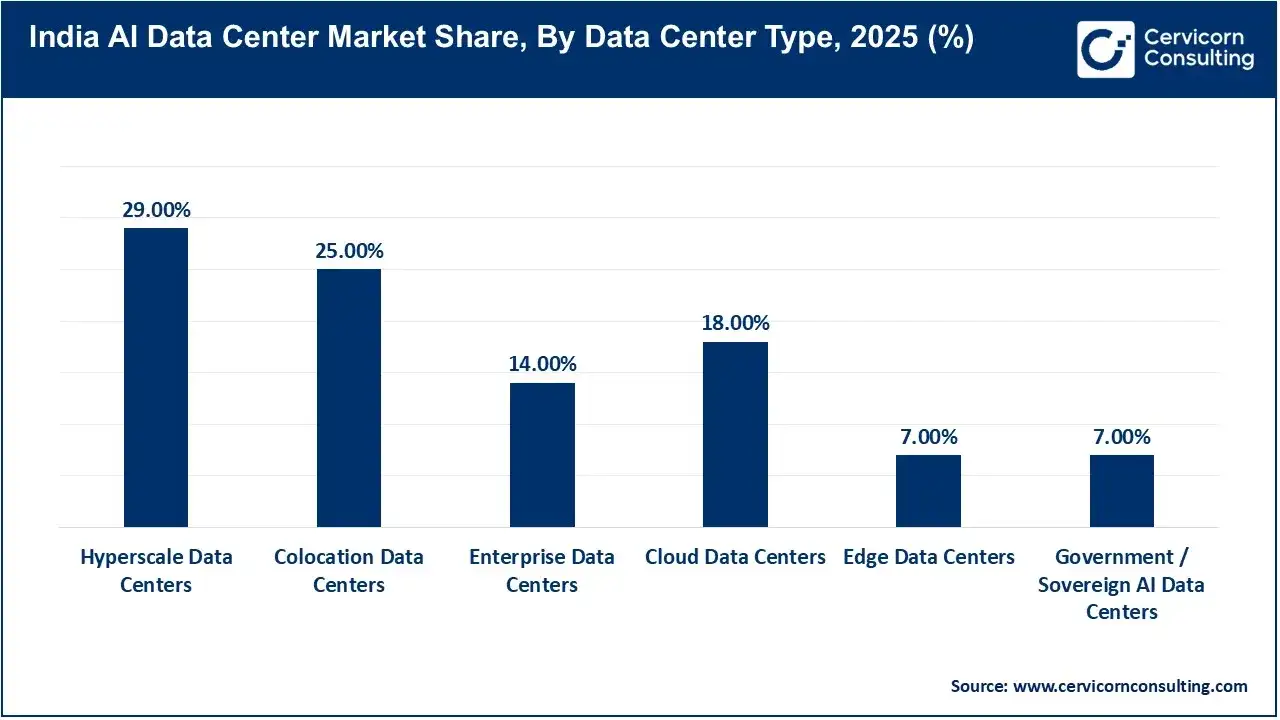
Hyperscale data centers dominated the India AI data center market in 2025 and are expected to remain the fastest-growing segment from 2026 to 2035. They are appropriate for demanding AI workloads due to their capacity for large-scale computing, sophisticated networking, and scalable infrastructure. The need for hyperscale facilities is rising as generative AI, cloud computing, and high-performance computing become more widely used. The construction of AI-ready hyperscale data centers throughout India is also being aided by rising investments from cloud service providers and tech firms.
AI Infrastructure Component Analysis
GPU & AI accelerators dominated the market in 2025 and are expected to remain the fastest-growing component through 2035. These technologies are critical to generative AI, inference, AI training, and other computationally demanding tasks. Demand for more processing power and specialized computer hardware is rising as large AI models are being deployed more frequently. The market is anticipated to grow even more with sustained investment in high-performance computing and AI-ready infrastructure.
GPU / Accelerator Type Analysis
NVIDIA GPUs dominated the market in 2025 because they are widely used in AI training, inference, and data center tasks. A wide range of AI applications are supported by their well-established hardware and software ecosystem. Segment dominance is a result of data center operators and tech companies deploying more GPU-based infrastructure. The demand for cutting-edge NVIDIA GPU solutions is still being supported by growing AI workloads.
Custom / ASIC AI accelerators are expected to be the fastest-growing segment from 2026 to 2035 as businesses look for specialized solutions for particular AI tasks. These accelerators can offer targeted applications, optimal performance, and energy efficiency. Their development is being aided by the growing need for workload-specific and economical AI processing. It is anticipated that expanding AI deployment at scale will open up more possibilities for custom accelerator technologies. For specialized AI applications, tech companies are increasingly investigating specialized chips. Adoption in AI data centers is anticipated to be supported by their potential to increase computing efficiency.
AI Workload Analysis
The AI Inference segment dominated the market in 2025 as companies began using trained AI models for real-time applications. Inference workloads are rising due to customer services, automation, analytics, recommendation systems, and intelligent applications. Investment in AI computing infrastructure is supported by the requirement for quick processing and quick response times. The need for inference is growing as more AI models enter production settings. The need for inference capacity is growing as AI-powered business applications are used more frequently. This workload segment is further supported by the increasing incorporation of AI into digital services.
Generative AI and AI model training are expected to be the fastest-growing workloads from 2026 to 2035, propelled by the creation of more intricate AI models and the expanding use of generative AI applications. Considerable processing, storage, networking, and GPU resources are needed for these workloads. Businesses, tech firms, and startups are increasingly utilizing generative AI in a variety of applications. The need for specialized training infrastructure is anticipated to rise as AI models continue to evolve.
Deployment Model Analysis
Cloud segment dominated the market in 2025, driven by the growing use of scalable computing infrastructure and cloud-based AI services. Cloud platforms give businesses access to cutting-edge computing resources without requiring them to build substantial internal infrastructure. The market is being supported by the growing use of cloud-based machine learning platforms and AI-as-a-Service. Cloud deployment is further strengthened by the ability to scale resources in accordance with shifting workload requirements. Businesses are being encouraged to use cloud-based AI solutions by the availability of on-demand computing resources.
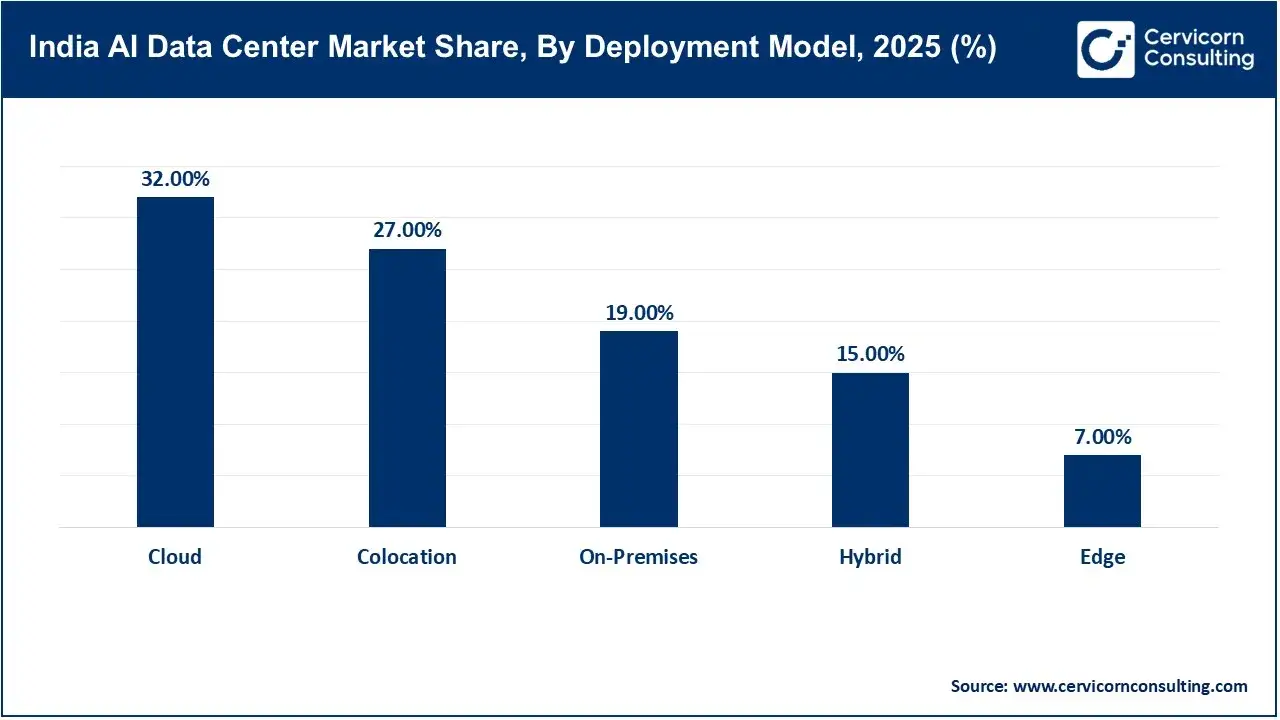
Edge segment is expected to be the fastest-growing deployment model from 2026 to 2035, driven by growing demand for low-latency and real-time AI processing. Edge infrastructure enables data to be processed closer to users and devices, reducing latency and supporting applications such as industrial automation, smart devices, autonomous systems, and real-time analytics.
Cooling Technology Analysis
Air cooling dominated the market in 2025, motivated by its compatibility with current infrastructure and well-established use across traditional data center facilities. Widespread adoption is supported by its operational familiarity, wide availability, and established maintenance ecosystem. Many common computing tasks can still be completed with air cooling. In many cases, the technology can be used in existing data centers without requiring major infrastructure changes. Its extensive use in conventional facilities is still supported by its established deployment base.
Direct-to-Chip liquid cooling is expected to be the fastest-growing cooling technology from 2026 to 2035, propelled by rising server densities and the production of heat from AI tasks. High-performance CPUs and GPUs can effectively remove heat thanks to the technology. Data center operators are being encouraged to use liquid-based cooling due to the increasing deployment of sophisticated AI servers. Adoption is anticipated to be further supported by a greater emphasis on thermal management and energy efficiency. Advanced cooling technologies are becoming more and more necessary as high-density GPU clusters proliferate.
Power Infrastructure Analysis
Grid power dominated the market in 2025, motivated by its proven availability and vital function in sustaining ongoing data center operations. AI servers, cooling systems, networking hardware, and other infrastructure all depend on dependable electricity. Stable grid connections are still essential for large-scale data center operations. Reliable power availability is becoming even more crucial as AI workloads increase. Reliable grid connectivity is becoming more and more important as data center capacity grows.
Renewable energy and battery storage are expected to be the fastest-growing power infrastructure segment from 2026 to 2035, fueled by a growing emphasis on dependable and sustainable energy solutions. In order to support sustainability goals and lessen reliance on conventional energy, data center operators are investigating renewable power sources. Battery storage can give AI-intensive facilities more power control and dependability. Adoption is anticipated to be further stimulated by the growing energy requirements of AI infrastructure. Increased investment in renewable energy and storage solutions is being supported by the need to manage growing power consumption in a sustainable manner.
Data Center Size Analysis
Large data centers dominated the market in 2025, driven by the growing need for infrastructure for high-capacity computing and storage. Large numbers of AI servers, GPUs, networking systems, and cooling equipment can be housed in these facilities. Large AI-ready facilities are being developed in response to growing demands from businesses and cloud providers. Their capacity to handle numerous workloads at scale keeps driving up demand. Large facility development is also aided by the increasing concentration of AI computing resources.
India AI Data Center Market Share, By Data Center Size, 2025 (%)
| Data Center Size |
Revenue Share, 2025 (%) |
| Small |
10% |
| Medium |
18% |
| Large |
32% |
| Hyperscale / Mega |
40% |
Hyperscale / mega data centers are expected to be the fastest-growing segment from 2026 to 2035, fueled by the growing need for cloud-based AI services, GPU infrastructure, and large-scale AI computing. High-density computing and large AI workloads can be supported by these facilities. Larger data center campuses are being developed as a result of increased investments in AI infrastructure. It is anticipated that the growth of India's digital and AI ecosystem will increase demand for hyperscale infrastructure. Operators are being encouraged to build larger campuses due to increasing demands for power, cooling, and computing capacity.
End User Analysis
Cloud service providers dominated the market in 2025, fueled by their widespread use of cloud infrastructure and AI computing. They offer developers, businesses, and users of AI applications scalable computer resources. Demand for advanced data center capacity is rising as cloud-based AI services become more widely used. Strong demand from this market is anticipated to continue as AI-enabled cloud platforms continue to grow. Data center utilization is further supported by their capacity to service numerous clients via shared infrastructure.
AI model developers and enterprises are expected to be the fastest-growing end-user segment from 2026 to 2035, propelled by the growing creation and use of AI-based applications. Automation, analytics, customer support, software development, and sector-specific AI solutions are all seeing an increase in demand. Businesses are incorporating AI more and more into digital platforms and business procedures. The demand for specialized computing, storage, and networking infrastructure is anticipated to rise as customized AI models and AI-powered applications are developed. Increased demand for specialized data center resources is anticipated as business investment in AI-based solutions rises.
Recent Developments
- In June 2026, Sify Technologies announced a partnership with IFC to develop two next-generation, AI-ready data centers in Navi Mumbai and Chennai. The facilities are designed to support growing demand for AI, cloud computing, and energy-efficient digital infrastructure in India.
- In June 2026, Meta announced an agreement with Reliance Industries to lease an AI-enabled data center in Jamnagar, Gujarat. The facility will expand AI infrastructure capacity in India and is being developed with renewable energy and advanced cooling capabilities.
- In July 2026, HCLTech announced plans to invest in AI data centers with the potential to scale capacity to 50 MW. The investment is intended to support its full-stack AI offering and address growing demand for AI-led services and infrastructure in India.
Key Companies
Segments Covered
By Data Center Type
- Hyperscale Data Centers
- Colocation Data Centers
- Enterprise Data Centers
- Cloud Data Centers
- Edge Data Centers
- Government / Sovereign AI Data Centers
By AI Infrastructure Component
- AI Servers
- GPU & AI Accelerators
- High-Speed Networking
- AI Storage Systems
- Power Infrastructure
- Cooling Infrastructure
- Racks & Enclosures
- Data Center Management & Monitoring
- Security Infrastructure
By GPU / Accelerator Type
- NVIDIA GPUs
- AMD GPUs
- Intel AI Accelerators
- Google TPUs
- AWS AI Accelerators
- Custom / ASIC AI Accelerators
- Other AI Accelerators
By AI Workload
- AI Model Training
- AI Inference
- Generative AI
- Large Language Models
- Computer Vision
- Machine Learning
- Deep Learning
- High-Performance Computing
- AI Analytics
- Edge AI
By Deployment Model
- Cloud
- Colocation
- On-Premises
- Hybrid
- Edge
By Cooling Technology
- Air Cooling
- Direct-to-Chip Liquid Cooling
- Immersion Cooling
- Rear-Door Heat Exchangers
- Hybrid Cooling
- Other Advanced Cooling Technologies
By Power Infrastructure
- Grid Power
- Renewable Energy
- Captive Power
- Backup Generators
- UPS Systems
- Battery Energy Storage Systems
- Microgrids
- Hybrid Power Systems
By Data Center Size
- Small
- Medium
- Large
- Hyperscale / Mega
By End User
- Cloud Service Providers
- AI Model Developers
- IT & Technology Companies
- BFSI
- Healthcare & Life Sciences
- Manufacturing
- Automotive
- Telecom
- Government & Public Sector
- Retail & E-commerce
- Media & Entertainment
- Research & Academia
- Startups