HVAC System Market Size and Growth 2026 to 2035
The global HVAC system market size reached at USD 297.83 billion in 2025 and is expected to hit around USD 540.14 billion by 2035, exhibiting a compound annual growth rate (CAGR) of 6.2% over the forecast period from 2026 to 2035. The HVAC system market is growing significantly due to the ongoing integration of populations into urban areas, especially in emerging economies in the Asia-Pacific and Africa. Rapid urbanization is leading to the development of high-rise residential buildings with integrated high-volume climate control systems to manage the "urban heat island" effect. According to urban development projections, more than 60% of Earth's population is expected to reside in urban areas by 2030. These urban developments have already led to a 12% increase in issued permits for HVAC installations across countries such as India and in Southeast Asia during 2024-2025. Additionally, strong demand in tropical environments that require cooling systems to support economic productivity and public health will continue to drive shipments of split-system and window air-conditioning units.
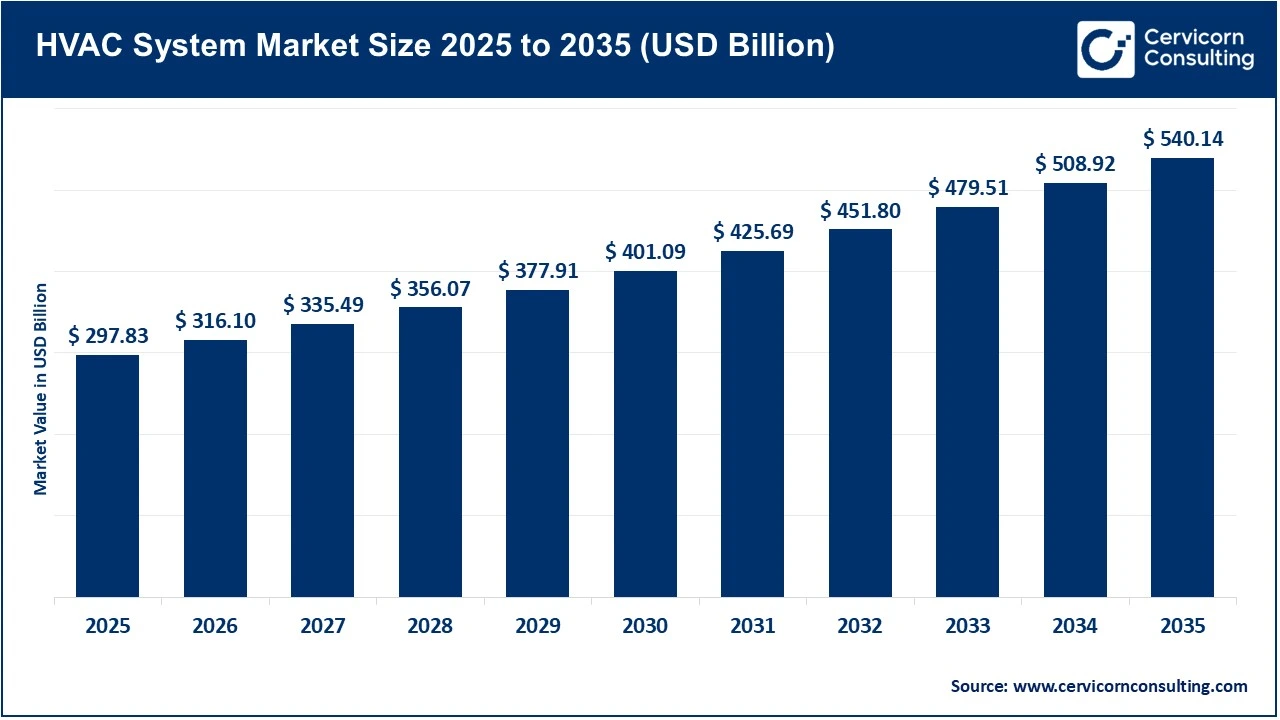
Another major factor supporting the growth of the HVAC system market is the implementation of stricter energy efficiency standards and environmental regulations. For instance, in January 2025, the introduction of the revised EPA SNAP regulations in the United States and updated Ecodesign rules in the European Union significantly increased the adoption of low-global-warming-potential refrigerants in the HVAC industry. To align with these stricter environmental standards and avoid regulatory penalties, major manufacturers shifted their product strategies, with nearly 75% of newly launched HVAC systems using R-32 or R-454B refrigerants. Moreover, governments across major economies are introducing policies aimed at reducing carbon emissions, improving energy performance, and phasing out refrigerants with high global warming potential (GWP).
Report Highlights
- By Region, Asia Pacific dominated the HVAC system market in 2025, accounting for 49% of the global share, driven by rapid urbanization and increasing cooling demand across China and India.
- By Heating Equipment, the heat pumps segment dominated the market with an estimated 42% share, due to their high energy efficiency and rising adoption in decarbonisation focused heating solutions.
- By Heating Equipment, the unitary heaters are projected to be the fastest-growing segment with 14% share, supported by increasing demand for cost-effective and easy-to-install heating systems in small commercial facilities.
- By Cooling Equipment, the unitary air conditioners led the market with 32% share, due to widespread adoption across residential and commercial buildings for affordable cooling solutions.
- By Cooling Equipment, the VRF systems are expected to witness the fastest growth with 20% share, driven by rising demand for energy-efficient HVAC systems in smart buildings and commercial complexes.
- By Ventilation Equipment, the air-handling units dominated the market with 30% share, as they are widely used in centralized HVAC systems to regulate airflow and maintain indoor air quality.
- By Ventilation Equipment, the air purifiers are the fastest-growing segment at 11% share, driven by increasing awareness regarding indoor air quality and rising concerns over airborne pollutants.
- By Installation, the new construction accounted for the largest market share at 58%, driven by expanding infrastructure development and large-scale residential and commercial construction activities globally.
- By Installation, the replacement segment is projected to grow at the fastest rate with 42% share, due to the rising need to replace aging HVAC systems with advanced energy-efficient alternatives.
- By End Use, the residential segment dominated the market with 41% share, supported by increasing household demand for air conditioning and heating systems.
- By End Use, the commercial segment is anticipated to be the fastest-growing with 37%, because of increasing HVAC adoption in offices, healthcare facilities, shopping malls, and hospitality infrastructure.
What are the Classification of HVAC systems?
The major classification of HVAC systems is central systems and decentralised or local systems. The type of system depends on whether the primary equipment is centralised, conditioning the entire building as a single unit, or decentralized, conditioning a specific zone separately within the building. Therefore, the air and water distribution system should be designed based on the system classification and the location of the primary equipment. The criteria mentioned above should also be applied when selecting between the two systems. The table compares central and local systems according to the selection criteria.
| Criteria |
Central system |
Decentralized system |
| Temperature, humidity, and space pressure requirements |
Fulfilling any or all of the design parameters |
Fulfilling any or all of the design parameters |
| Capacity requirements |
Considering HVAC diversity factors to reduce the installed equipment capacity |
Maximum capacity is required for each equipment |
| Redundancy |
Standby equipment is accommodated for troubleshooting and maintenance |
No backup or standby equipment |
| Special requirements |
An equipment room is located outside the conditioned area, or adjacent to or remote from the building |
Possible of no equipment room is needed |
| First cost |
High capital cost |
Affordable capital cost |
| Operating cost |
More significant energy efficient primary equipment |
Less energy efficient primary equipment |
| Maintenance cost |
Accessible to the equipment room for maintenance and saving equipment in excellent condition, which saves maintenance cost |
Accessible to equipment to be located in the basement or the living space. However, it is difficult for roof location due to bad weather |
| Reliability |
Central system equipment can be an attractive benefit when considering its long service life |
Reliable equipment, although the estimated equipment service life may be less |
| Flexibility |
Selecting standby equipment to provide an alternative source of HVAC or backup |
Placed in numerous locations to be more flexible |
Integration of Artificial Intelligence Technologies and IoT Interconnectivity in the HVAC Systems
The integration of artificial intelligence (AI) and IoT-enabled connectivity is emerging as a major trend in the HVAC market. These trends are shifting from reactive to proactive management. For example, by integrating AI sensors and machine learning algorithms into HVAC systems, manufacturers can now provide real-time monitoring of critical parameters such as temperature, pressure, and vibration. According to a facility management survey in 2025, AI-integrated systems have reduced emergency repair costs by 22% and extended the useful life of critical components such as compressors by almost 18%.
Moreover, this trend is especially significant in mission-critical environments such as data centres and healthcare, where even minor issues can lead to major operational disruptions and financial losses. As HVAC adoption increases, the industry is shifting towards a hybrid software-and-service business model, where providers offer subscription-based energy optimization and predictive maintenance services alongside equipment. This helps improve system efficiency, reduce downtime, and create revenue opportunities.
Top 5 Trends and Technologies
- Variable Refrigerant Flow Systems: VRF systems can deliver energy savings of up to 30% compared to traditional rooftop units.
- Internet of Things and Smart Thermostat Integration: The smart thermostat segment is expected to grow at a 15% CAGR through 2028 as adoption scales in homes, utilising real-time data and geofencing.
- Geothermal Heat Pumps: These pumps offer an exceptional coefficient of performance (COP) ranging from 3.0 to 6.0, resulting in a recent 20% increase in adoption among European residential consumers.
- AI-Driven Predictive Maintenance: Artificial Intelligence uses sensors to detect component failures before they occur, estimated to lower commercial maintenance costs by 20% while extending the lifespan of heavy-duty chillers.
Report Scope
| Area of Focus |
Details |
| Market Size in 2026 |
USD 316.10 Billion |
| Market Size in 2035 |
USD 540.14 Billion |
| CAGR 2026 to 2035 |
6.20% |
| Dominant Region |
Asia-Pacific |
| Key Segments |
By Heating Equipment, By Cooling Equipment, By Ventilation Equipment, By Installation, By End Use, By Region |
| Key Players |
Daikin Industries Ltd., Carrier Global Corporation, Johnson Controls International plc, Trane Technologies plc, LG Electronics Inc., Mitsubishi Electric Corporation, Lennox International Inc., Midea Group Co., Ltd., Samsung Electronics Co., Ltd., Gree Electric Appliances Inc., Fujitsu General Ltd., Panasonic Holdings Corporation, Robert Bosch GmbH, Honeywell International Inc., Rheem Manufacturing Company. |
Recent Major Milestones
1. Recent Corporate News and Merger Activity
Recent corporate developments and merger activities are playing an essential role in the market. For instance, in 2024, Carrier Global Corporation completed its acquisition of Viessmann Climate Solutions for USD 12 billion. This strategic move enables Carrier to offer fully integrated solutions in Europe, enabling units to provide heating, cooling, and domestic hot water through a single unified system on a single AI platform. As a result, market share increases by 12%, particularly in the DACH region, including Germany, Austria, and Switzerland, where high-efficiency residential HVAC systems are witnessing strong demand.
2. Government Policy Impacts and Sustainability Mandates
Government regulations and sustainability initiatives are the primary drivers of structural market shifts. In the United States, the Inflation Reduction Act (IRA) has introduced significant tax credits and rebates for adopting high-efficiency electric HVAC equipment. By 2025, more than 1.8 million U.S. households had claimed incentives for heat pump installations, a 25% year-over-year increase. Additionally, the European Union's "Fit for 55" initiative promotes the adoption of renewable energy and energy-efficient building retrofits, while the EU Taxonomy for Sustainable Activities is establishing more stringent transparency and efficiency requirements for large-scale HVAC projects.
3. Infrastructure Expansion and Large-Scale Project
The rapid development of infrastructure and large-scale projects is a significant growth driver for the market. The growth of hyperscale data centres in Europe, especially in the FLAPD markets (Frankfurt, London, Amsterdam, Paris, and Dublin), has set new standards for HVAC infrastructure. A major milestone was achieved in 2025 with the completion of the Google Hamina campus expansion in Finland, which implemented seawater cooling and waste heat recovery systems to heat local homes. This project serves as a prototype for "circular HVAC," where the by-product of industrial cooling becomes a resource for municipal heating to serve the local population. Such innovative infrastructure models are gaining momentum across Nordic and Southern European markets.
4. Innovations in Refrigerant Technology and Compliance
Innovation in refrigerant technology marks a major turning point in the market. The global phase-down of hydrofluorocarbons (HFCs) entered a critical enforcement phase in 2026 under the Kigali Amendment and the U.S. American Innovation and Manufacturing Act. These regulations require manufacturers to reduce HFC production and consumption by 40% relative to baseline levels. As a result, manufacturers are redesigning compressors to support mildly flammable A2L refrigerants with lower global warming potential (GWP). Among these, R-32 has emerged as the dominant global refrigerant for residential split systems, while R-1234yf is increasingly adopted in large-scale chillers.
HVAC System Market Regional Analysis
The HVAC system market is segmented by region into North America, Europe, Asia-Pacific, and LAMEA. Here is a brief overview of each region:
Asia-Pacific HVAC System Market: Driven by Urbanization and Infrastructure Expansion Drivers
The Asia-Pacific HVAC system market size was valued at USD 145.94 billion in 2025 and is expected to reach around USD 264.67 billion by 2035.
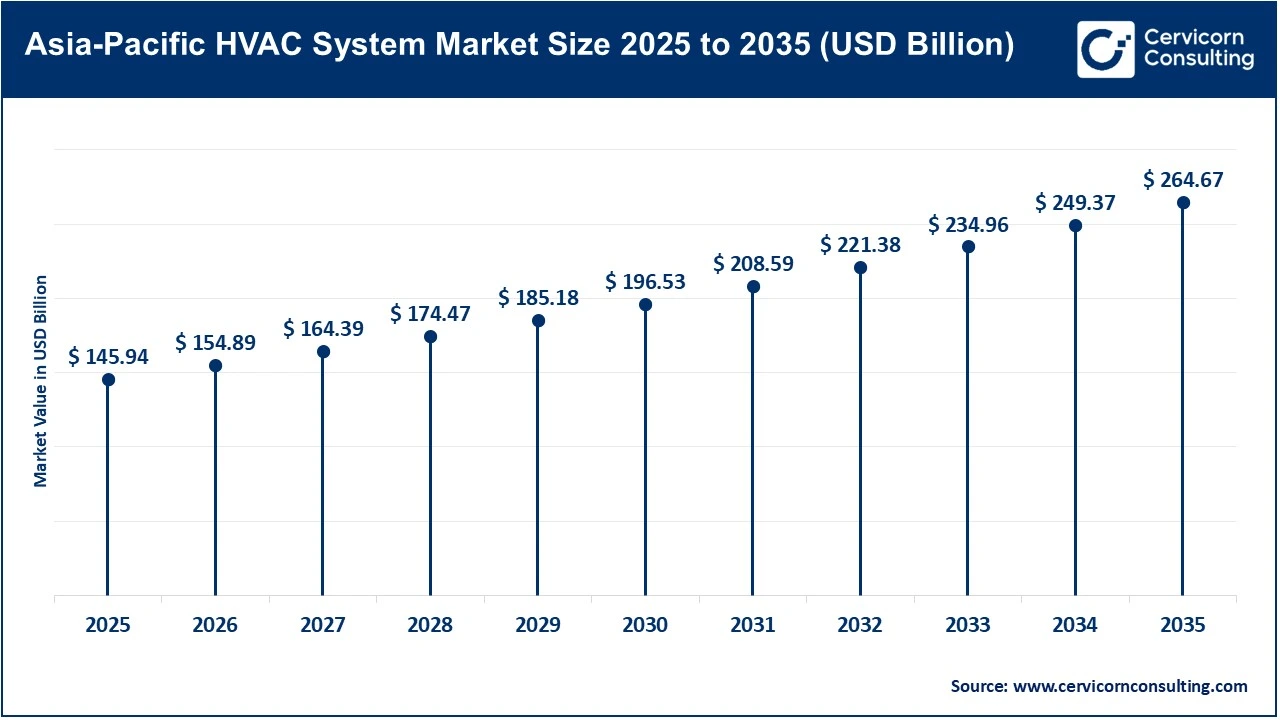
The Asia-Pacific region is the largest market, driven by rapid urbanisation and a growing middle-class population across emerging economies. Countries such as China, India, and those in Southeast Asia continue to grow, and the need for residential high-rises and commercial office spaces will require massive HVAC installations. Moreover, in countries such as China and India, nearly 1 billion cooling units are expected to be installed by 2050. Recently introduced "district cooling" projects in Southeast Asia are improving energy efficiency at the city scale in response to rising urban heat island effects, which are significantly increasing cooling loads in urban areas.
China: Dominance in Manufacturing and Smart Systems
China holds the largest share of the HVAC system market, as both the largest producer and consumer of cooling technologies, with smart-city integration as the focus.
- China produces over 80% of the world's room air conditioners, driven by massive economies of scale and integrated supply chains.
- The government's "14th Five-Year Plan" emphasises green building standards, which are responsible for a 12% annual increase in demand for high-efficiency VRF systems.
- China's heat pump exports to Europe have increased by 100% in recent years, driven by pricing advantages and rapid R&D.
India: Growth in Residential and Cooling Infrastructure
India has become the fastest-growing large market, where cooling is evolving from a luxury to a basic need for the growing middle class.
- The India Cooling Action Plan (ICAP) aims to reduce cooling demand by 20-25% through energy-efficient technologies by 2038.
- With household AC penetration below 10%, the market has a significant "greenfield" opportunity as disposable income increases.
- The Production Linked Incentive (PLI) scheme has attracted more than USD 600 million in investment from global players such as Daikin and Blue Star for local manufacturing.
North America HVAC System Market: Driven by Replacement Cycles and Efficiency Standards
The North America HVAC system market size was estimated at USD 59.57 billion in 2025 and is projected to hit around USD 108.03 billion by 2035. In North America, the market is well-established, driven primarily by replacement demand and the adoption of energy-efficient technologies, supported by regulatory incentives. For example, in the United States, the Inflation Reduction Act (IRA) offers tax credits of up to USD 2,000 for heat pump installations. Additionally, the ongoing trend towards building electrification is increasing the adoption of dual-fuel and all-electric heat pump systems, gradually replacing conventional gas furnaces. These factors are sustaining demand in North America and driving the region’s HVAC technology upgrades.
United States: Focus on Retrofitting and Green Building
The U.S. market is shifting from traditional forced-air gas systems to more advanced electrified heat pump solutions and very high-efficiency retrofitting.
- Federal tax credits and rebates are shortening the ROI period for homeowners and have led to a 15% increase in heat pump adoption.
- The implementation of AI and cloud computing is driving a 20% increase in the high-capacity chiller segment for thermal management in data centers.
Canada: Adoption of Cold Climate HVAC Technologies
Canada’s HVAC market is primarily driven by the need for high-performance heating in sub-zero temperatures, leading to innovations in cold-climate heat pumps.
- Adoption of "Cold Climate Air Source Heat Pumps" (ccASHPs) has increased because they operate efficiently down to -25 degrees Celsius.
- Rising federal carbon taxes have improved the economic competitiveness of electric heating relative to heating oil and propane in rural markets.
- Government programs have successfully incentivized more than 200,000 homeowners to complete energy audits and HVAC upgrades since 2021.
Europe HVAC System Market: Driven by Decarbonization and Regulatory Compliance Drivers
The Europe HVAC system market size reached at USD 71.48 billion in 2025 and is forecasted to grow around USD 129.63 billion by 2035. The European HVAC market is increasingly being driven by the region’s focus on decarbonization, energy independence, and sustainability initiatives, particularly under the framework of the European Green Deal. For example, the European Commission is introducing supportive measures to increase the adoption of individual heat pumps over the coming years as a replacement for gas-fired boilers. This policy is influencing the market, as seen in Germany and France, where heat pump sales increased by nearly 30% year over year as consumers continue to shift away from fossil-fuel-based heating systems.
United Kingdom: Transition to Low-Carbon Heating Solutions
The UK is advancing its Net Zero 2050 targets, with a strong focus on decarbonizing residential heating systems and phasing out gas boilers.
- The government is offering USD 7,500 grants for air-source heat pumps, with a target of 600,000 installations per year by 2028.
- New building code regulations make it difficult to install traditional gas boilers in new residential buildings.
Germany: The Intersection of Industrial Automation and Sustainability
Germany serves as the regulatory and strategic hub of Europe’s green HVAC transition, with growing emphasis on natural refrigerants and industrial heat recovery solutions.
- The Building Energy Act (GEG) requires that any new heating system be powered by at least 65% renewable energy.
- German manufacturers are at the forefront of global adoption of Propane (R290) as a refrigerant, driven by impending bans on F-gases across the EU.
- Rising energy costs are forcing German firms to invest in large-scale heat pumps that utilise waste heat generated during manufacturing.
HVAC System Market Share, By Region, 2025 (%)
| Region |
Revenue Share, 2025 (%) |
| Asia Pacific |
49% |
| Europe |
24% |
| North America |
20% |
| LAMEA |
7% |
LAMEA HVAC System Market: Driven by LAMEA: Industrialization and Climate Adaptation Drivers
The LAMEA HVAC system market was valued at USD 20.85 billion in 2025 and is anticipated to surpass around USD 37.81 billion by 2035. The LAMEA region is experiencing growth driven by industrialization and the need to adapt to climate conditions. In the Middle East, particularly the GCC states, HVAC systems are essential given the region’s harsh climatic conditions. Large-scale infrastructure developments and mega-projects in countries such as Saudi Arabia are generating substantial demand for advanced HVAC technologies, including large centrifugal chillers and smart cooling networks. In Latin America, countries such as Brazil and Mexico are creating demand for specialized HVAC systems in food processing and pharmaceuticals to support global supply chains.
Brazil: Market Expansion in Tropical Climate Solutions
Brazil’s HVAC market is recovering from recent economic challenges, driven mainly by the expansion of the commercial and logistics sectors.
- The growth of the "Cash & Carry" retail sector, along with logistics hubs, is driving demand for large rooftop units.
- The new labelling regulations have accelerated the transition from fixed-speed to inverter air-conditioning technology, enabling inverter technology to now dominate the residential market.
- Government spending on healthcare facilities is also boosting demand for specialised ventilation and filtration systems in large metropolitan areas.
United Arab Emirates: High-End District Cooling Demand
The UAE is a leader in HVAC engineering and luxury installations in high ambient-temperature districts, with a focus on district cooling.
- Over 40% of the cooling demand in major metropolitan cities, such as Dubai, is met by a district cooling plant that centralises cooling facilities, which is 50% more efficient than using a stand-alone unit.
- As a country devoted to sustainability, the UAE is beginning to implement solar-powered cooling and AI-managed building automation systems.
- The UAE is the global testing facility for HVAC equipment designed to perform in ambient temperatures above 50°C with high humidity.
HVAC System Market Segmental Analysis
The HVAC system market is segmented into heating equipment, cooling equipment, ventilation equipment, installation, end user, and region.
Heating Equipment Analysis
Heat pumps are the leading segment in the heating equipment market, largely due to their dual-purpose service in providing both heating and cooling, along with their ability to meet global electrification and carbon reduction targets. Heat pumps are much more efficient than traditional electric resistance or gas-fired systems because they can extract heat from the air or a ground source. Therefore, heat pumps have become a primary heating and cooling solution for both residential and commercial retrofits.
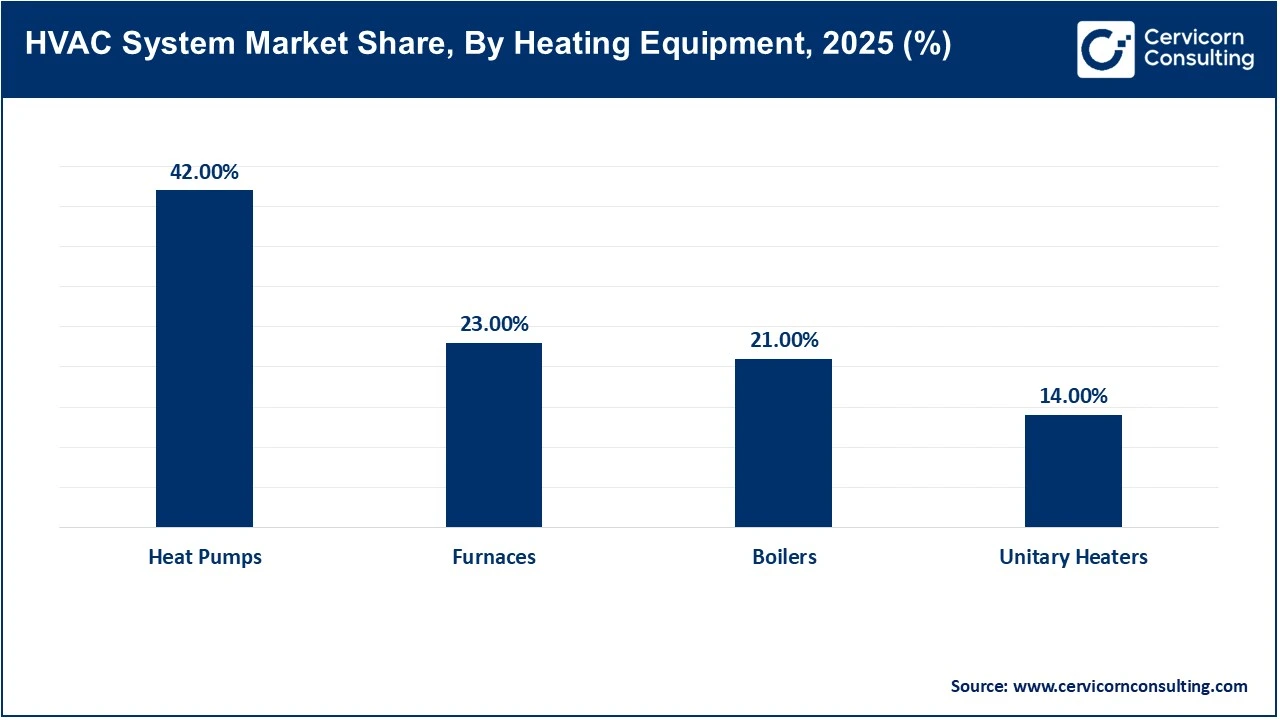
Unitary heaters are emerging as the fastest-growing segment in the market because of their low upfront cost and ease of installation. These systems are widely adopted as the primary heating solution to support rapid industrialization and the heating of large warehousing facilities, especially in rapidly developing economies. Unitary heaters can provide heating in large open spaces, which is often required for the growing e-commerce and manufacturing sectors in regions such as Southeast Asia and Latin America.
Cooling Equipment Analysis
Unitary air conditioners are the dominant segment in the market due to their standardized design, which facilitates high-volume manufacturing and installation. These systems consist of a central condensing unit and an indoor evaporator coil, making them the preferred choice for single-family homes in developed regions. Moreover, the HVAC supply chain is well-established, and technicians are familiar with the systems. As a result, manufacturers are updating systems with higher SEER ratings and low-GWP refrigerants to meet new regulations.
HVAC System Market Share, By Cooling Equipment, 2025 (%)
| Cooling Equipment |
Revenue Share, 2025 (%) |
| Unitary Air Conditioners |
32% |
| VRF Systems |
20% |
| Chillers |
16% |
| Room Air Conditioner |
14% |
| Coolers |
10% |
| Cooling Towers |
8% |
VRF systems are the fastest-growing segment, mainly because of their ability to provide simultaneous heating and cooling in different zones. This system can adjust the flow of refrigerant to multiple indoor units. Meanwhile, VRF technology offers unprecedented energy savings in both single-zone and multi-zone systems, especially in buildings with diverse thermal loads. As commercial real estate developers increasingly seek LEED certifications and lower operational costs, the demand for VRF systems is rapidly expanding in the cooling equipment segment.
Ventilation Equipment Analysis
Air-handling units (AHUs) account for the largest market share because they are essential to the operation of centralised HVAC systems. They are required for virtually every commercial or industrial project where air circulation and filtration are necessary. Whether in a hospital, a shopping mall, or a manufacturing facility, the air-handling unit (AHU) is the essential component responsible for conditioning, filtering, and distributing air throughout the facility, ensuring proper ventilation, indoor air quality, and temperature control across the entire building.
HVAC System Market Share, By Ventilation Equipment, 2025 (%)
| Ventilation Equipment |
Revenue Share, 2025 (%) |
| Air-Handling Units |
30% |
| Air Filters |
21% |
| Ventilation Fans |
16% |
| Dehumidifiers |
14% |
| Air Purifiers |
11% |
| Humidifiers |
8% |
Air purifiers are the fastest-growing segment in the market because of increasing global awareness of indoor air quality (IAQ) and the growing number of wildfire smoke events. Urban pollution drives strong sales among consumers and institutions. During the global pandemic, demand for higher-quality HEPA and UV-C filtration shifted HAIP requirements from optional to standard expectations in homes, schools, and offices. Moreover, the consumer priority for health and wellbeing has transformed air purifiers from an occasional appliance to an integral part of the modern indoor environment, creating high growth in this market.
Installation Analysis
New construction is the largest application in the market, driven by global growth in residential, commercial, and industrial infrastructure development. This growth in energy-intensive data centers requires the installation of new, high-capacity HVAC systems. Meanwhile, in developing markets, the construction of housing projects, data centres, cold storage facilities, and high-tech manufacturing requires advanced, large-scale climate control systems.
HVAC System Market Share, By Installation, 2025 (%)
| Installation |
Revenue Share, 2025 (%) |
| New Construction |
58% |
| Replacement |
42% |
Replacement is expected to witness the fastest growth in the installation segment, particularly in developed areas, where systems are replaced to meet new energy-efficiency standards and benefits. Government rebate programmes and regulatory incentives allow many homeowners and facility managers to replace systems that are more than 15 years old, which are no longer cost-effective, especially when new systems can deliver energy savings of 20% to 30%. In addition, environmental regulations are gradually banning the use of older refrigerants, which increases the replacement of outdated systems. As a result, replacement demand is growing faster than new construction installations across many mature economies.
End User Analysis
The residential segment is the dominant end user in the market, driven by the large number of global-scale individual housing units and the growing importance of climate control for comfort. Rising disposable incomes, expanding middle-class populations, and the continued influence of work-from-home lifestyles have significantly increased demand for residential HVAC systems. Consumers are placing greater focus on indoor air quality and energy efficiency, driving high-volume sales of split systems, room air conditioners, and heat pumps.
HVAC System Market Share, By End User, 2025 (%)
| End User |
Revenue Share, 2025 (%) |
| Residential |
41% |
| Commercial |
37% |
| Industrials |
22% |
The commercial segment is projected to witness the fastest growth in the market, primarily driven by the expansion of energy-intensive sectors such as data centers, healthcare, and hospitality. These environments require advanced HVAC system upgrades and higher-value climate control solutions. At the same time, commercial buildings are under pressure to reduce their carbon footprint and improve transparency in operational performance.
HVAC System Market Top Companies
Recent Developments
- In July 2024, Johnson Controls International plc signed an agreement to sell its residential and light commercial HVAC business to Bosch Group for USD 8.1 billion, enabling the company to focus more on smart commercial building solutions.
- In December 2024, Daikin Industries Ltd. partnered with Rechi Precision to establish Daikin-Rechi India Pvt. Ltd., aiming to manufacture rotary compressors locally and strengthen its residential HVAC business in India.
- In March 2025, LG Electronics Inc. introduced next-generation AI-powered HVAC systems with improved energy management features for residential and commercial applications.
Market Segmentation
By Heating Equipment
- Heat Pumps
- Furnaces
- Boilers
- Unitary Heaters
By Cooling Equipment
- Unitary Air Conditioners
- VRF Systems
- Chillers
- Room Air Conditioner
- Coolers
- Cooling Towers
By Ventilation Equipment
- Air-Handling Units
- Air Filters
- Ventilation Fans
- Dehumidifiers
- Air Purifiers
- Humidifiers
By Installation
- New construction
- Replacement
By End Use
- Residential
- Commercial
- Industrials
By Region
- North America
- APAC
- Europe
- LAMEA