EV Truck Battery Swapping Market Size, Growth, Forecast 2026 to 2035
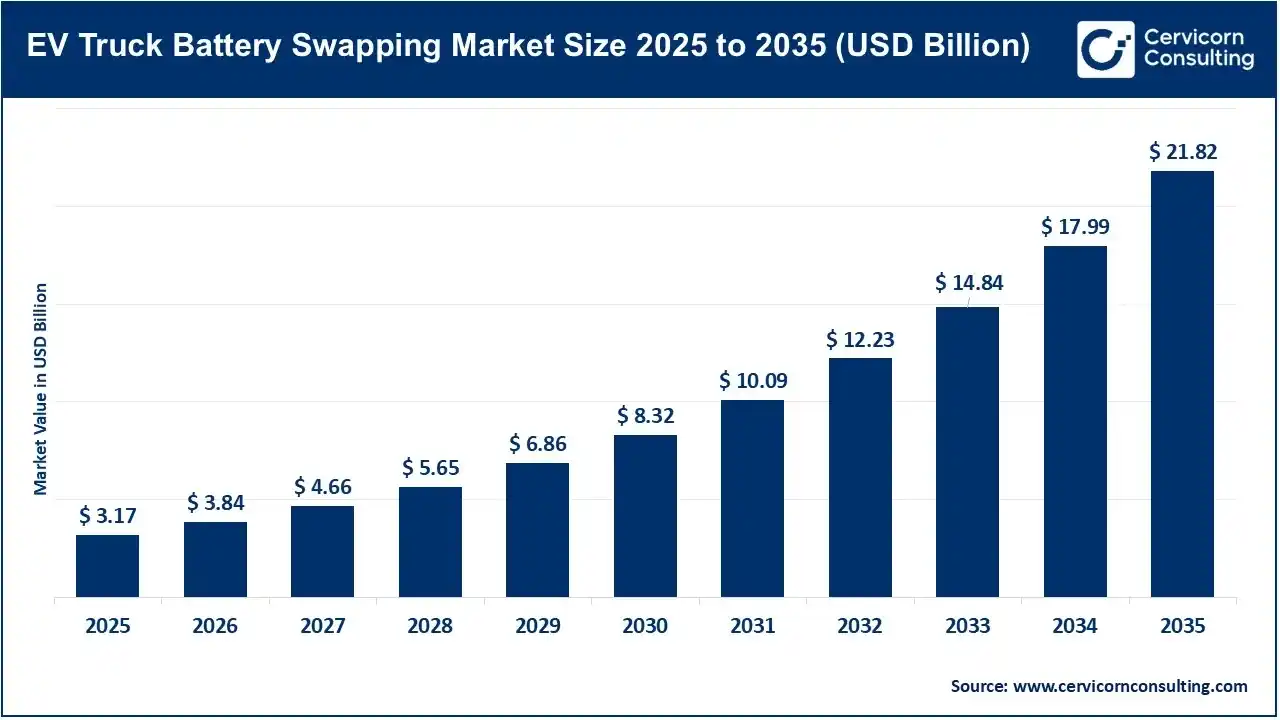
The global EV truck battery swapping market size was valued at USD 3.17 billion in 2025 and is expected to be worth around USD 21.82 billion by 2035, growing at a compound annual growth rate (CAGR) of 21.3% over the forecast period 2026 to 2035. Rapid electrification of heavy-duty trucks is creating strong demand for battery swapping solutions, particularly among high-utilization freight and logistics fleets.
Global electric truck and bus sales surpassed 500,000 units in 2025, nearly doubling from the previous year, while China accounted for the majority of this growth. In China, electric heavy-truck sales reached 82,000 units in 2024, increasing 140% year-on-year, with penetration exceeding 10%. Battery swapping is particularly attractive because trucks can replace depleted batteries within minutes rather than remaining idle for extended charging periods. On the Ningbo–Yiwu route, swapping can reportedly be completed in approximately 5 minutes, compared with around one hour for a 320-kW charging system.
Lower operating costs, fleet utilization, battery-as-a-service models, and supportive decarbonization policies are further accelerating adoption. CATL estimates that trucks using its swapping solution can save approximately CNY 0.62 per kilometer compared with diesel trucks, generating more than CNY 60,000 in annual savings for high-mileage operators. Battery swapping also reduces upfront vehicle costs by separating battery ownership from the truck and enabling battery leasing. China's swap-capable vehicle sales reached 29,569 units in 2024, representing 94% growth from 2023, while H1 2025 sales exceeded 25,400 units, up 134% year-on-year. The technology is gaining particular traction in mining, steel, port logistics, and fixed-route freight, where predictable routes and high vehicle utilization make swapping infrastructure economically attractive.
Report Highlights
- Asia-Pacific dominates the market with 63.8% share, supported by China's extensive battery-swapping ecosystem, electric heavy-truck adoption, and strong infrastructure investments.
- Heavy-Duty Electric Trucks lead by truck type with 38.7% share, driven by intensive utilization, high mileage, predictable routes, and strong demand for minimizing vehicle downtime.
- LFP batteries account for 57.8% share, benefiting from their thermal stability, long cycle life, safety characteristics, and suitability for frequent charging and swapping operations.
- 300–500 kWh batteries hold the largest capacity share at 34.9%, providing a balanced combination of driving range, payload efficiency, battery weight, and operational flexibility.
- Fully Automated/Robotic Swapping Stations represent 43.7% share, supported by faster battery replacement, lower labor requirements, improved safety, and suitability for high-throughput commercial fleets.
What is EV Truck Battery Swapping?
EV truck battery swapping is a system in which a depleted battery pack or standardized battery module in an electric truck is mechanically removed and replaced with a fully charged unit at a dedicated swapping station. Unlike conventional charging, which can keep trucks stationary for extended periods, swapping can restore usable energy within minutes, improving fleet uptime and making the technology particularly suitable for high-mileage freight, logistics, mining, ports, and fixed-route operations. CATL’s Qiji Energy system, for example, uses standardized battery modules and enables heavy trucks to exchange batteries in roughly five minutes.
Recent Milestones
| Date |
Company |
Milestone |
| May 2025 |
CATL |
CATL unveiled its 75# standardized battery swap block and announced plans for 300 heavy-truck swapping stations across 13 core regions in China. |
| December 2025 |
CATL / Qiji Energy |
CATL launched a 1,250-km heavy-duty truck battery-swapping route in China, with battery exchanges taking approximately five minutes. |
| 2025–2026 |
CATL / Qiji Energy |
The Qiji heavy-truck swapping network reached approximately 305 stations around the turn of 2025–26. |
| June 2026 |
China Government |
China announced a target for EVs to represent 40% of new heavy-truck sales by 2030, alongside plans for 3,000 charging and battery-swap stations. |
| July 2026 |
CATL / J&T Express |
J&T Express announced plans to deploy 5,000 CATL battery-swapping electric trucks, supporting large-scale logistics electrification. |
| July 2026 |
CATL / Octopus Energy |
CATL and Octopus Energy advanced plans for a European electric-lorry battery-swapping network through their Swaptopus joint venture. |
EV Truck Battery Swapping Market Dynamics
Market Drivers
1. Rising Electrification of Heavy-Duty Fleets
The rapid electrification of commercial trucking is expanding the addressable base for battery swapping, particularly in high-utilization logistics and freight operations. In China, battery-electric trucks captured 22% of heavy-duty vehicle sales during H1 2025, compared with 8.6% in H1 2024, demonstrating accelerating fleet conversion. Operators increasingly require energy replenishment solutions that minimize vehicle downtime while maintaining route schedules. Battery swapping addresses this requirement by separating battery charging from vehicle operation, making electric trucks more practical for continuous-duty applications such as freight, mining, ports, and distribution.
2. Lower Total Cost of Electric Truck Operations
Battery swapping is gaining traction because it can improve utilization while reducing some of the economic barriers associated with electric heavy trucks. Recent analysis indicates battery-electric heavy-duty vehicles can achieve 10–26% lower total cost of ownership than diesel alternatives, strengthening fleet economics. Battery-as-a-service models can further reduce upfront vehicle expenditure by separating battery ownership and enabling operators to pay for energy services rather than purchasing the complete battery pack. These advantages are particularly valuable for fleets operating predictable, high-mileage routes where frequent energy replenishment is required.
Market Restraints
1. High Infrastructure Investment Requirements
Battery-swapping networks require substantial investment in specialized stations, robotic equipment, spare batteries, electrical connections, land, and maintenance systems. Unlike conventional charging infrastructure, operators must maintain inventories of charged batteries to prevent service interruptions and accommodate peak demand. Station economics therefore depend heavily on sufficient truck traffic and utilization rates. Research on swapping-station planning highlights the need to optimize construction and operational costs, while battery scheduling must also account for limited charger capacity and battery availability. These financial requirements can delay deployment across markets with relatively low electric-truck adoption.
2. Battery and Vehicle Standardization Constraints
The absence of universal battery dimensions, mounting mechanisms, communication protocols, and swapping standards limits interoperability between different truck manufacturers and station networks. A swapping station designed around one battery architecture may not efficiently serve trucks using another system, reducing network utilization and increasing infrastructure complexity. Research specifically identifies standardization as a major barrier because manufacturers can employ substantially different battery designs and swapping protocols. This fragmentation makes cross-brand compatibility difficult and can discourage fleet operators from committing to infrastructure before industry standards become more established.
Market Opportunities
1. Expansion Across Emerging Trucking Markets
Battery swapping presents significant opportunities in emerging markets where rapidly increasing freight activity coincides with rising diesel costs and electrification efforts. China's heavy-electric-truck technology is increasingly being exported, while South Asian markets recorded particularly strong growth in Chinese heavy-truck shipments during 2026. Chinese heavy-truck exports to South and Southeast Asia accelerated sharply, with South Asian shipments increasing more than fivefold year-on-year during the four months following February 2026. This creates opportunities for localized swapping corridors serving freight-intensive routes and industrial clusters.
2. Development of Battery-as-a-Service Ecosystems
Battery swapping can evolve beyond energy replenishment into integrated Battery-as-a-Service ecosystems combining battery leasing, fleet financing, energy management, maintenance, and second-life battery applications. This model creates recurring revenue opportunities for battery manufacturers, energy companies, truck OEMs, and infrastructure operators while reducing capital barriers for fleet customers. In India, government guidelines issued in January 2025 allowed swapping-station operators to use existing electricity connections for charging swappable batteries, subject to applicable electricity-demand requirements. Such regulatory developments can simplify infrastructure deployment and support broader commercial adoption.
Market Challenges
1. Battery Degradation and Inventory Management
Battery-swapping operators must carefully manage battery health because frequent charging, cycling, temperature variation, and differences in usage patterns can accelerate degradation. Maintaining sufficient charged inventory without excessive idle batteries creates an operational balancing problem. Recent research using data from 1,002 commercial battery swaps demonstrated that intelligent charging scheduling could reduce charging-energy costs by approximately 50% compared with immediate charging, highlighting the importance of sophisticated energy-management systems. Operators therefore need advanced battery-health monitoring, predictive scheduling, and inventory optimization to maintain service reliability and profitability.
2. Grid Capacity and Power Infrastructure Limitations
Large battery-swapping stations can create significant electricity-demand requirements because multiple truck batteries may need simultaneous high-power charging after being returned. Grid congestion and insufficient distribution capacity can therefore constrain station deployment, particularly along freight corridors where electrical infrastructure is weaker. Research on electric heavy-truck infrastructure identifies grid congestion as a major challenge alongside vehicle costs. Integrating stationary energy storage, renewable generation, and intelligent charging can reduce grid dependence, but these solutions increase system complexity and require additional capital investment before achieving optimal operating economics.
Regional Analysis
The EV truck battery swapping market is segmented by region into North America, Europe, Asia-Pacific, Latin America, and LAMEA. Here is a brief overview of each region:
Asia-Pacific (APAC) EV Truck Battery Swapping Market: Driven by Rapid Electric Heavy-Truck Adoption, Battery-Swapping Infrastructure Expansion, Freight Electrification, and Strong Government Support
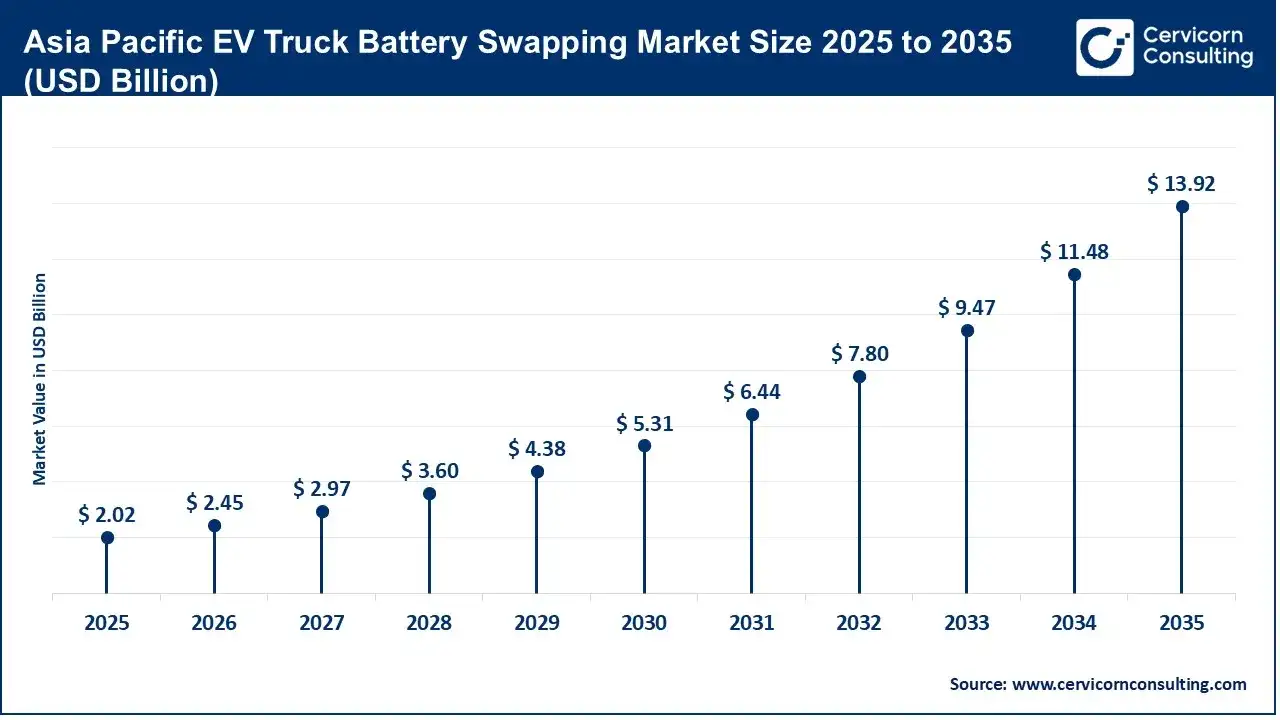
The Asia-Pacific EV truck battery swapping market size was estimated at USD 2.02 billion in 2025 and is predicted to surpass USD 13.92 billion by 2035. Asia-Pacific dominates the market, primarily because China has developed the region's most mature ecosystem for electric heavy trucks, standardized batteries, swapping stations, and battery-as-a-service models. China accounted for the majority of global electric commercial vehicle growth in 2025, while its swap-capable heavy-truck segment has become increasingly established. Beyond China, rapidly expanding electric-truck exports to South and Southeast Asia are creating new opportunities for battery-swapping ecosystems, particularly where high fuel prices and freight-intensive operations strengthen the economic case for electrification.
China: Large-Scale Heavy-Truck Electrification, Standardization, and Expanding Swap Corridors Drive Regional Leadership
- CATL has partnered with more than 10 truck manufacturers to introduce over 30 chassis-based battery-swapping heavy-truck models, strengthening interoperability and accelerating commercialization.
- The Ningbo–Yiwu freight corridor is developing four battery-swapping stations containing 100 swappable truck batteries, supporting the first market-oriented green heavy-truck operation line in China.
South & Southeast Asia: Rising Fuel Costs, Chinese E-Truck Exports, and Freight Electrification Create New Opportunities
- Chinese heavy electric-truck exports reached 16,823 vehicles during the four months following February 2026, more than doubling compared with the corresponding period a year earlier.
- Approximately half of China's heavy e-truck exports during this period went to South and Southeast Asia, highlighting the region's growing importance for commercial EV deployment.
North America EV Truck Battery Swapping Market: Driven by Zero-Emission Truck Deployment, Heavy-Duty Fleet Decarbonization, Expanding Charging Infrastructure, and Demand for High Vehicle Utilization
The North America EV truck battery swapping market size was valued at USD 0.59 billion in 2025 and is forecasted to surpass USD 4.08 billion by 2035. North America is emerging as an attractive market due to increasing zero-emission truck deployments, stringent emissions-reduction objectives, expanding commercial fleet electrification, and the need to minimize vehicle downtime. The United States recorded 72,309 cumulative zero-emission truck deployments by the end of 2025, with deployments accelerating substantially during the second half of the year. Battery swapping can complement conventional charging by enabling rapid energy replenishment for high-utilization fleets operating from logistics hubs, ports, distribution centers, and regional freight corridors. The region's large trucking ecosystem, extensive highway network, and growing investment in zero-emission transportation infrastructure provide favorable conditions for developing dedicated battery-swapping corridors.
United States: Accelerating Zero-Emission Truck Deployments, Fleet Electrification, and Demand for Reduced Downtime Support Market Development
- During H2 2025, zero-emission trucks represented 4.14% of all U.S. truck deployments, the highest six-month deployment share recorded to that point, indicating accelerating commercial-fleet electrification.
- California is becoming an important testing ground for battery-swapping solutions, with Janus Electric receiving orders for 67 additional diesel-to-electric truck conversions from four California fleets in 2026, including 77 swappable battery packs and four Charge & Change stations.
Canada: Large Medium- and Heavy-Duty Fleet, Government Incentives, and Zero-Emission Trucking Programs Create Long-Term Opportunities
- Canada had approximately 2.6 million medium- and heavy-duty trucks in operation in December 2024, providing a substantial addressable fleet for future electrification and alternative energy-replenishment solutions.
- Only around 0.26% of Canada's medium- and heavy-duty truck fleet was zero-emission in 2024, indicating significant untapped potential as fleet operators transition toward cleaner commercial transportation technologies.
Europe EV Truck Battery Swapping Market: Driven by Rapid Electric Truck Adoption, EU Decarbonization Regulations, Growing Zero-Emission Freight Corridors, and Demand for Faster Fleet Energy Replenishment
The Europe EV truck battery swapping market size was estimated at USD 0.39 billion in 2025 and is projected to hit around USD 2.71 billion by 2035. Europe is emerging as a promising market as freight operators accelerate fleet decarbonization and increasingly seek solutions that minimize charging downtime. Electric truck sales in Europe increased 40% year-on-year in 2025, reaching nearly 17,000 units, while electric trucks represented approximately 3% of total truck sales in the region. The EU's heavy-duty vehicle CO₂ standards, road-toll incentives, and national electrification programs are encouraging manufacturers and fleet operators to transition toward zero-emission trucks. Battery swapping could complement high-power charging by providing rapid energy replenishment for long-haul and high-utilization fleets, particularly along major freight corridors.
Germany: Strong Electric Truck Adoption, Infrastructure Investment, and Major Logistics Fleets Support Market Expansion
- Germany recorded approximately 4,400 electric truck sales in 2025, increasing nearly 30% year-on-year, making it Europe's largest electric truck market.
- The German government approved EUR 1.6 billion in funding for electric-truck charging infrastructure, strengthening the broader energy infrastructure required for commercial vehicle electrification.
United Kingdom: Rapid E-Truck Growth, Decarbonization Policies, and Expanding Freight Electrification Create Opportunities
- The United Kingdom recorded more than 3,000 electric truck sales in 2025, with sales increasing by over 55% year-on-year, making it one of Europe's fastest-growing electric truck markets.
- The UK's expanding zero-emission freight ecosystem is encouraging operators to evaluate solutions that can support high-mileage commercial vehicles without prolonged charging stops.
EV Truck Battery Swapping Market Share, By Region, 2025 (%)
| Region |
Revenue Share, 2025 (%) |
| Asia-Pacific |
63.8% |
| North America |
18.7% |
| Europe |
12.4% |
| LAMEA |
5.1% |
LAMEA (Latin America, Middle East & Africa) EV Truck Battery Swapping Market: Driven by Growing Freight Electrification, Rising Fuel Costs, Government Decarbonization Targets, and Emerging Battery-Swapping Infrastructure
The LAMEA EV truck battery swapping market was valued at USD 0.16 billion in 2025 and is forecasted to reach USD 1.11 billion by 2035. LAMEA represents an emerging opportunity as Latin America, the Middle East, and Africa gradually accelerate commercial-vehicle electrification. The region remains at an earlier stage than Asia-Pacific and Europe, creating significant headroom for future deployment. Battery swapping can be particularly attractive for high-utilization fleets, mining operations, ports, urban distribution, and predictable logistics routes where reducing charging downtime is important.
Latin America: Growing Electric Truck Adoption, Freight Decarbonization, and High Fuel-Cost Exposure Create Opportunities
- Latin America's electric truck market is projected to expand strongly, with Brazil expected to register the highest growth rate among regional markets, supported by increasing investment in electric commercial transportation and charging infrastructure.
- Brazil's zero-emission heavy-duty vehicle sales reached 1,265 units in 2025, representing a 48% increase from 2024, although zero-emission trucks still accounted for only 0.4% of total truck sales, leaving considerable room for future electrification.
Middle East & Africa: Government Decarbonization Strategies, Logistics Investment, and Emerging Battery-Swapping Ecosystems Support Market Development
- PwC estimates that under a government-accelerated scenario, electric trucks could account for 28.2% of new heavy-duty vehicle sales in the Middle East by 2035, compared with a considerably lower market-led trajectory.
- Saudi Arabia targets a 25% reduction in transport-sector CO₂ emissions by 2030, while Dubai's Commercial Transport Strategy targets a 30% reduction, encouraging fleet operators to evaluate zero-emission commercial vehicles and supporting infrastructure.
Segmental Analysis
The EV truck battery swapping market is segmented into truck type, battery type, battery capacity, swapping station type, and geography.
Truck Type Analysis
Heavy-duty electric trucks hold the leading position because their high mileage, payload requirements, and continuous utilization create strong demand for rapid energy replenishment. Battery swapping minimizes downtime compared with conventional charging, making it attractive for freight corridors, ports, mining, and industrial logistics. In China, swap-capable heavy trucks above 16 tonnes accounted for approximately 30% of heavy-truck sales in recent years, demonstrating strong adoption in commercial applications. Their predictable routes and centralized fleet operations further support battery-swapping economics.
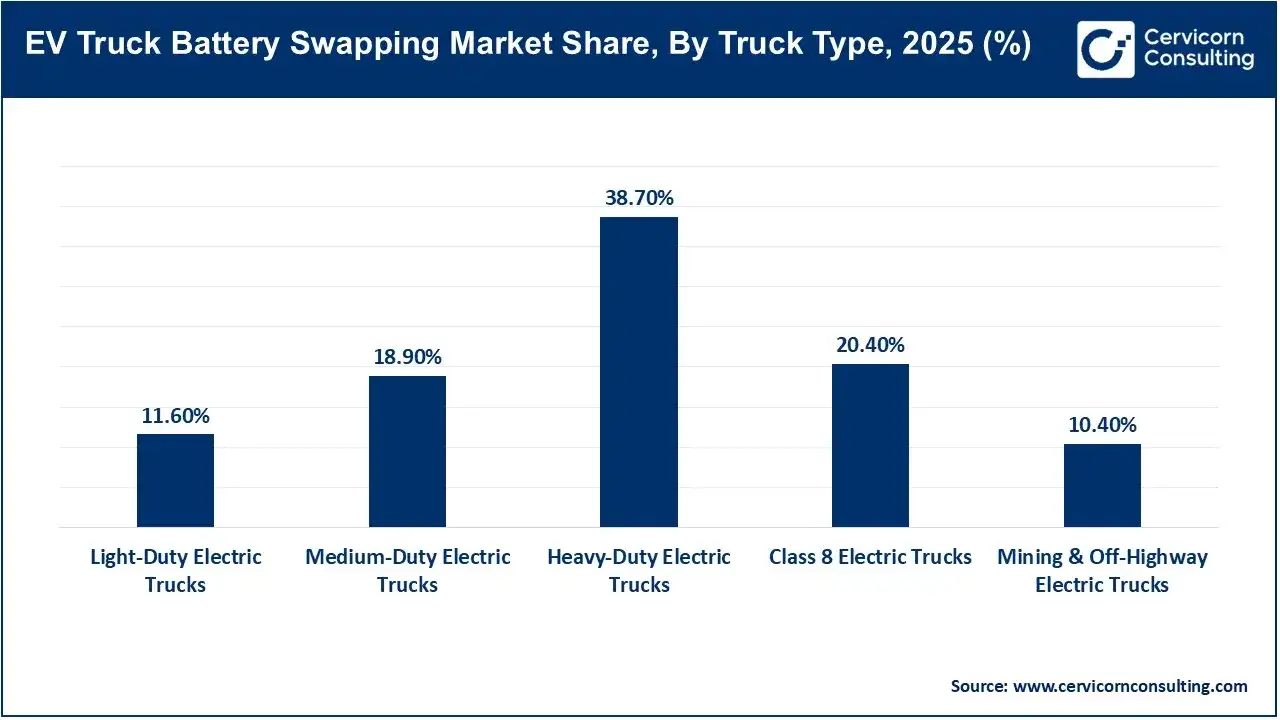
Light-duty electric trucks are expected to experience rapid growth as urban delivery, e-commerce, and last-mile logistics fleets increasingly transition toward zero-emission vehicles. China's new-energy light-duty truck sales reached 73,056 units during H1 2025, representing 111% year-on-year growth. Battery swapping can support delivery fleets requiring frequent daily operation by reducing charging-related downtime. Increasing demand for rapid urban deliveries, expanding low-emission zones, and development of compact swapping stations are expected to accelerate adoption of swapping-enabled light commercial trucks.
Battery Type Analysis
LFP batteries dominate because they offer favorable safety characteristics, long cycle life, thermal stability, and relatively low production costs. These characteristics are particularly important for battery-swapping applications involving frequent charging and discharging cycles. In China's heavy-truck market, LFP batteries represented the dominant battery chemistry in 2024, with commonly deployed battery configurations including approximately 282 kWh, 350 kWh, and 423 kWh. Their durability and lower cost make LFP particularly suitable for intensive commercial trucking operations.
EV Truck Battery Swapping Market, By Battery Type, 2025 (%)
| Battery Type |
Revenue Share, 2025 (%) |
| Lithium Iron Phosphate (LFP) |
57.8% |
| Nickel Manganese Cobalt (NMC) |
29.6% |
| Lithium Manganese Oxide (LMO) |
5.1% |
| Solid-State Batteries |
2.3% |
| Others |
5.2% |
Solid-state batteries represent the fastest-growing emerging chemistry because they potentially provide higher energy density, improved safety, and longer driving ranges than conventional lithium-ion technologies. These characteristics could become increasingly valuable for heavy trucks requiring greater payload capacity and longer operating distances. Although solid-state batteries currently have limited commercial deployment in truck swapping, continued investment in advanced battery manufacturing and commercialization is expected to accelerate adoption. Improvements in production scalability, charging performance, and battery durability could eventually make solid-state technology increasingly attractive for future swapping networks.
Battery Capacity Analysis
The 300–500 kWh battery-capacity segment currently dominates because it provides a practical balance between driving range, payload capacity, battery weight, and swapping requirements. Heavy trucks commonly require substantial onboard energy while avoiding excessive battery mass that reduces payload efficiency. China's 2024 heavy-truck market recorded strong adoption of configurations around 350 kWh and 423 kWh, reinforcing the importance of this capacity range. These batteries are particularly suitable for regional freight, fixed-route logistics, industrial transportation, and other applications where trucks require frequent but manageable energy replenishment.
EV Truck Battery Swapping Market Share, By Battery Capacity, 2025 (%)
| Battery Capacity |
Revenue Share, 2025 (%) |
| Below 100 kWh |
7.8% |
| 100–300 kWh |
24.7% |
| 300–500 kWh |
34.9% |
| 500–800 kWh |
22.1% |
| Above 800 kWh |
10.5% |
The 500–800 kWh segment is expected to grow rapidly as battery swapping expands toward longer-distance freight and higher-payload applications. Larger battery packs can provide greater operating range between swaps, reducing dependence on closely spaced swapping stations and improving route flexibility. Heavy-duty trucks increasingly require higher energy capacity as manufacturers target longer routes and demanding logistics applications. Battery-swapping infrastructure can make these larger packs more practical by eliminating lengthy charging periods. Improvements in battery energy density, pack integration, and automated handling systems are expected to further support this segment.
Swapping Station Type Analysis
Fully automated and robotic swapping stations dominate because they enable faster, standardized, and safer battery replacement while reducing dependence on manual labor. Automation is particularly valuable for commercial truck fleets operating continuously throughout the day. CATL's Qiji battery-swapping system demonstrates this advantage, with heavy trucks reportedly completing battery replacement in approximately five minutes. Automated systems can also integrate battery identification, health monitoring, charging management, and payment functions, improving operational efficiency and supporting higher station utilization across large logistics and freight networks.
EV Truck Battery Swapping Market, By Swapping Station Type, 2025 (%)
| Swapping Station Type |
Revenue Share, 2025 (%) |
| Manual Battery Swapping Stations |
10.8% |
| Semi-Automated Battery Swapping Stations |
22.6% |
| Fully Automated/Robotic Swapping Stations |
43.7% |
| Fixed Swapping Stations |
16.4% |
| Mobile Swapping Stations |
6.5% |
Mobile battery-swapping stations are expected to register rapid growth because they can provide flexible energy replenishment without requiring extensive permanent infrastructure. They are particularly attractive for mining, construction, ports, temporary logistics projects, and remote freight operations where vehicle routes or fleet locations can change frequently. Mobile systems can be deployed closer to operating sites and relocated as demand shifts, reducing infrastructure-development constraints. Growing electrification of off-highway and industrial trucks is expected to create additional opportunities for mobile swapping solutions where fixed stations may not provide sufficient economic justification.
EV Truck Battery Swapping Market Top Companies
Segments Covered
By Truck Type
- Light-Duty Electric Trucks
- Medium-Duty Electric Trucks
- Heavy-Duty Electric Trucks
- Class 8 Electric Trucks
- Mining & Off-Highway Electric Trucks
By Battery Type
- Lithium Iron Phosphate (LFP)
- Nickel Manganese Cobalt (NMC)
- Lithium Manganese Oxide (LMO)
- Solid-State Batteries
- Others
By Battery Capacity
- Below 100 kWh
- 100–300 kWh
- 300–500 kWh
- 500–800 kWh
- Above 800 kWh
By Swapping Station Type
- Manual Battery Swapping Stations
- Semi-Automated Battery Swapping Stations
- Fully Automated/Robotic Swapping Stations
- Fixed Swapping Stations
- Mobile Swapping Stations
By Geography
- North America
- Europe
- Asia-Pacific
- LAMEA