EV Power Electronics Market Size and Growth 2026 to 2035
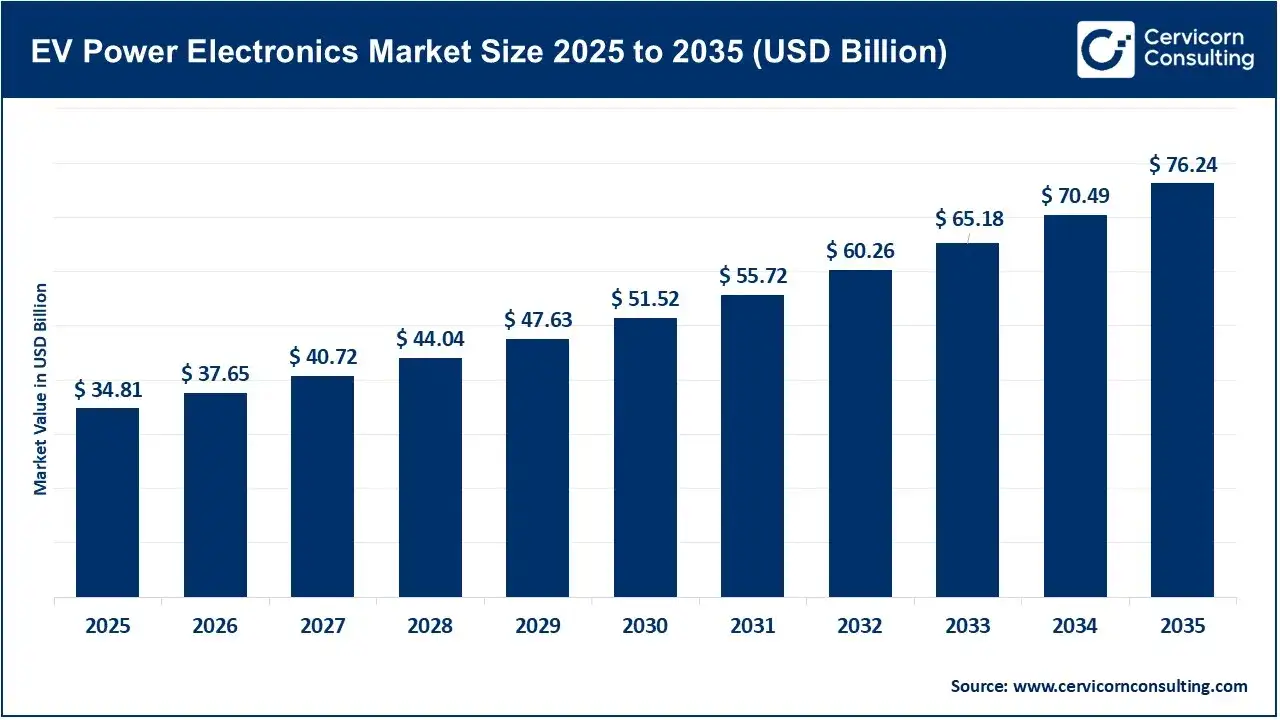
The global EV power electronics market size was valued at USD 34.81 billion in 2025 and is projected to grow from USD 37.65 billion in 2026 to nearly USD 76.24 billion by 2035, registering a CAGR of 8.2% over the forecast period 2026 to 2035. The EV power electronics market is expanding rapidly due to a number of factors, including the increased use of electric vehicles, the need for energy-efficient power management, improvements in semiconductor technology, and the expansion of fast-charging infrastructure. Inverters, converters, onboard chargers, and power modules are examples of power electronics components that are essential for enhancing vehicle performance, energy efficiency, and charging capabilities.
Report Highlights
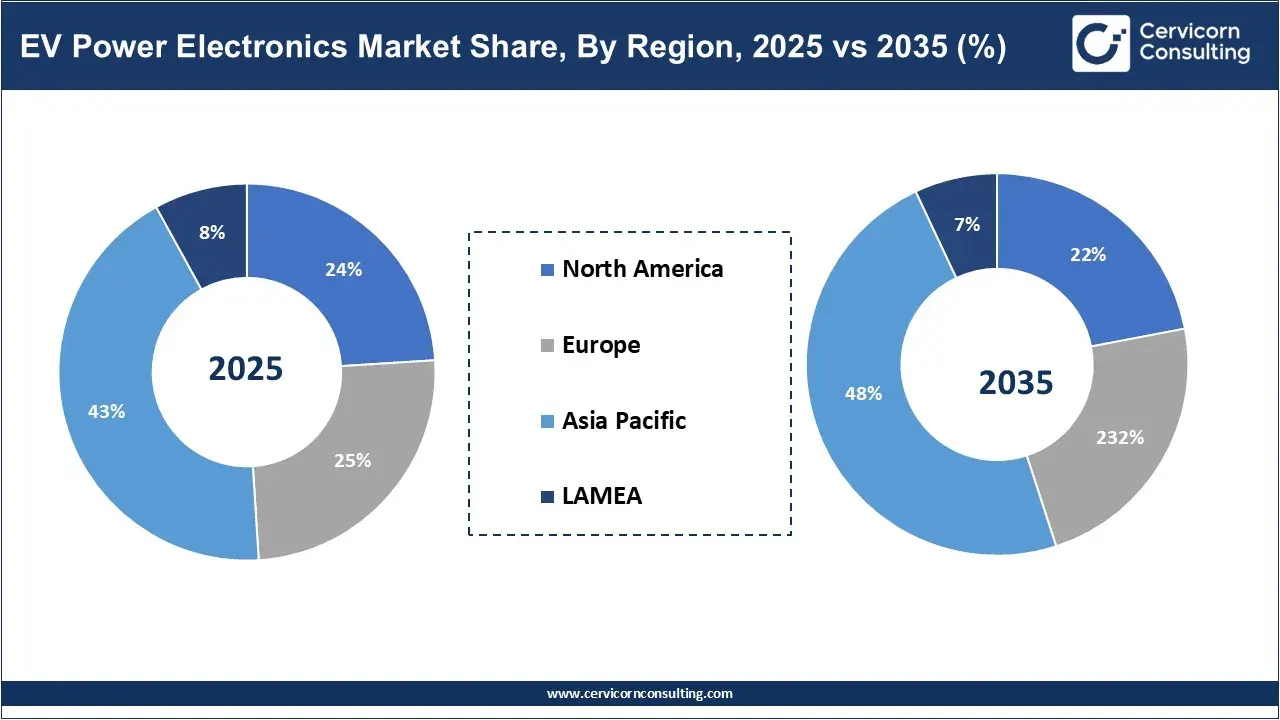
- By region, Asia Pacific dominated the market in 2025 (revenue share 43%), supported by strong EV production and expanding charging infrastructure.
- By region, North America is expected to register the fastest growth, driven by rising EV adoption and technology investments.
- By application, on-board power electronics dominated the market in 2025, supported by their role in power conversion and charging.
- By application, off-board power electronics are expected to register the fastest growth, driven by expanding fast-charging infrastructure.
- By vehicle type, BEVs dominated the market in 2025 (revenue share 63%), supported by growing demand for fully electric vehicles.
- By vehicle type, BEVs are expected to witness continued growth in the coming years, driven by rising EV adoption and increasing investments in electric vehicle manufacturing.
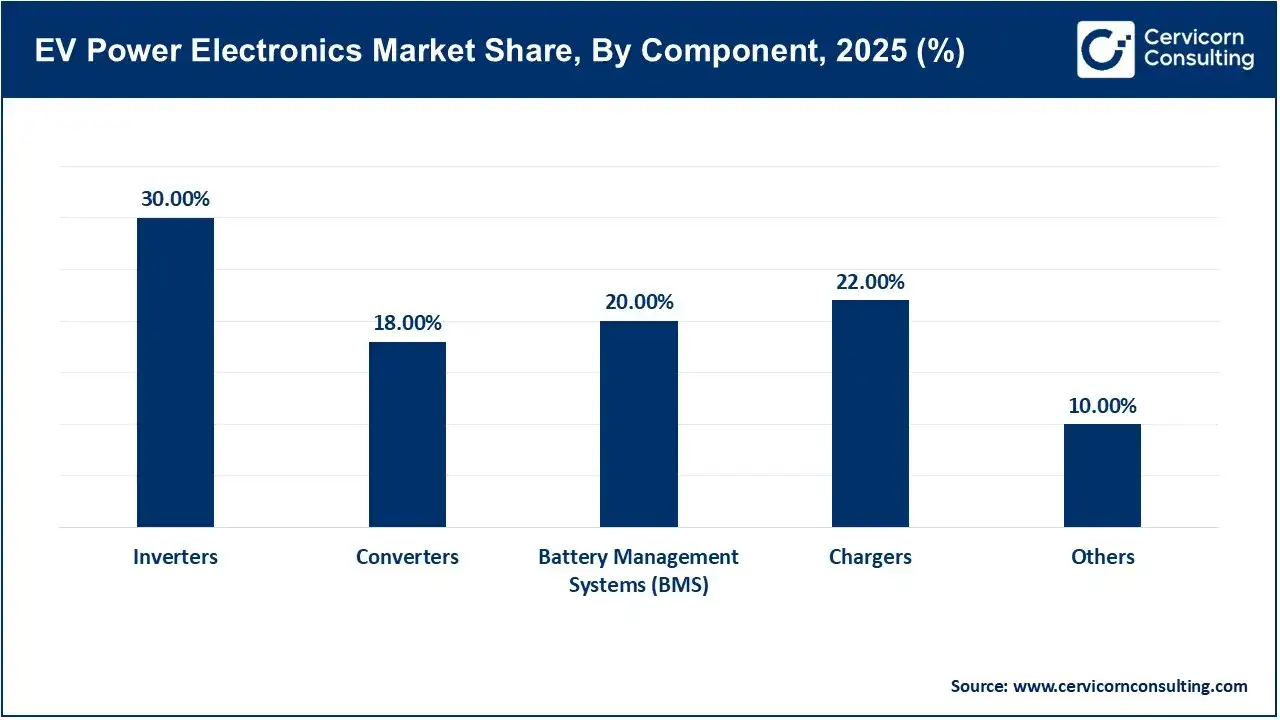
- By component, inverters dominated the market in 2025 (revenue share 30%), supported by their key role in EV powertrains.
- By component, converters are expected to register the fastest growth, driven by rising demand for efficient voltage conversion.
- By technology, silicon-based power electronics dominated the market in 2025 (revenue share 72%), supported by their established ecosystem and cost advantages.
- By technology, SiC power electronics are expected to register the fastest growth, driven by demand for efficient high-voltage systems.
- By power rating, medium power (50–150 kW) dominated the market in 2025, supported by its wide use in passenger EVs.
- By power rating, high power (above 150 kW) is expected to register the fastest growth, driven by high-performance EVs and fast charging.
Emerging Trends
- Rising Adoption of High-Voltage Systems: EV manufacturers are increasingly using high-voltage architectures to support faster charging and improve overall vehicle efficiency.
- Growing Use of SiC and GaN Semiconductors: Wide-bandgap technologies are gaining traction as they help reduce energy losses and deliver better thermal and power performance.
- Increasing Powertrain Integration: Integrated systems combining inverters, onboard chargers, and DC-DC converters are becoming more common to reduce weight, space, and system complexity.
- Growing Demand for Advanced Inverters: Next-generation inverters are being developed to improve motor efficiency, driving performance, and energy utilization.
- Expansion of Bidirectional Charging: V2G, V2H, and V2L technologies are gaining momentum, allowing EVs to transfer stored energy to homes, buildings, and power grids.
Market Dynamics
Driver
Rising Adoption of Electric Vehicles
The EV power electronics market is primarily driven by the growing shift from conventional vehicles toward electric mobility. Automakers require more efficient inverters, converters, onboard chargers, and other power-management components as EV production increases. The growing emphasis on longer driving ranges, faster charging, and improved vehicle efficiency is further increasing demand for advanced power electronics.
- In June 2026, Bosch introduced its third-generation silicon-carbide chips in India to support the growing EV market. The new SiC chips are designed to improve EV performance and efficiency, particularly through better energy control within power electronics systems and traction inverters. The development demonstrates how semiconductor advancements are responding to the evolving requirements of electric vehicles.
Restraint
High Cost and Technical Complexity
The adoption of advanced EV power electronics may be constrained by high costs and technical complexity. Specialized manufacturing, packaging, testing, and thermal-management processes are required for SiC- and GaN-based components, which can increase research and production costs. The design and integration of these systems are also more complex because manufacturers must meet stringent vehicle safety, reliability, and performance requirements.
- In July 2026, XPENG Motors highlighted the cost-efficiency challenge of advanced SiC technology through a hybrid silicon/SiC traction-inverter design. The company's work focuses on reducing semiconductor costs in EV traction inverters while maintaining high efficiency, reflecting industry efforts to overcome the cost barriers associated with full-SiC power electronics.
Market Opportunity
Expansion of Advanced Charging Infrastructure
The rapid expansion of EV charging infrastructure is creating significant opportunities for power electronics manufacturers. Advanced power modules, efficient converters, liquid-cooled systems, and bidirectional charging technologies are being developed in response to the growing demand for faster and more reliable charging. Companies offering EV charging and power-management systems can benefit from the expansion of charging networks beyond major cities and into emerging markets.
- In March 2026, Infineon Technologies partnered with Indian power-electronics company Zenergize to support the development of EV fast chargers and other high-performance power-electronics solutions. The partnership combines Infineon's wide-bandgap semiconductor technologies with Zenergize's domestic design and manufacturing capabilities, creating opportunities for locally developed EV charging systems in India.
Regional Analysis
Asia Pacific dominated the EV power electronics market
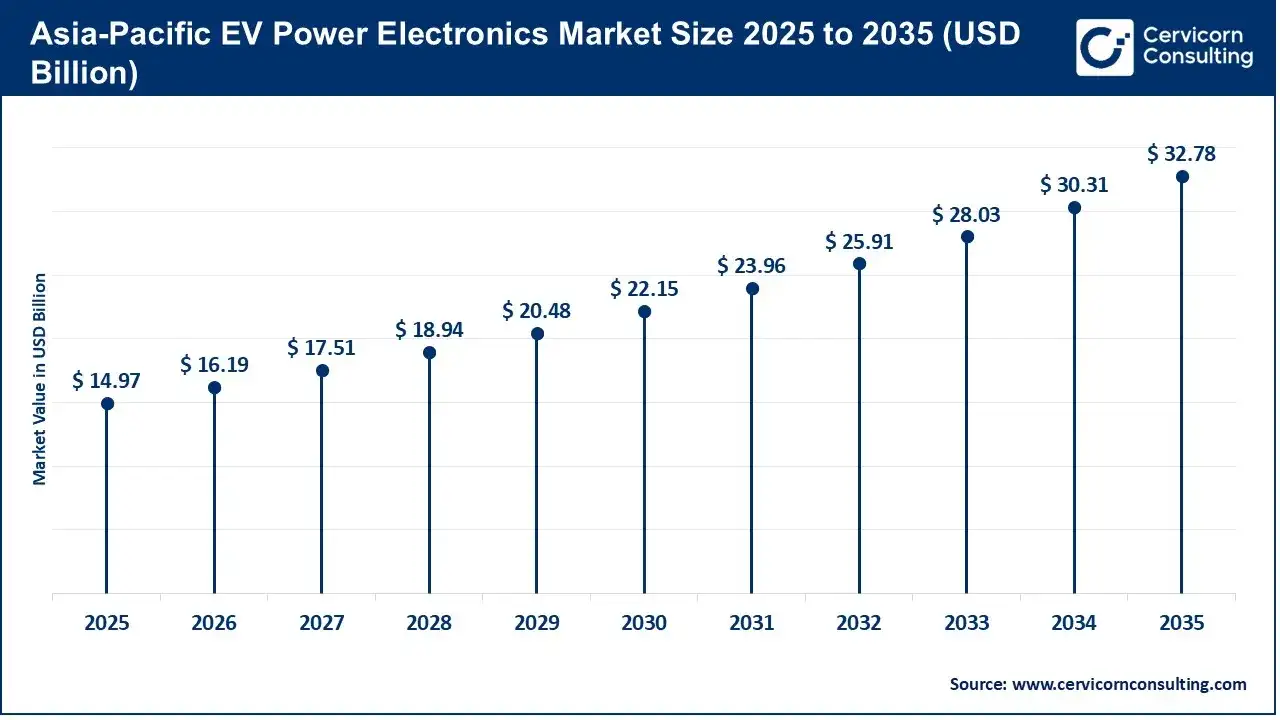
The Asia Pacific EV power electronics market size was valued at USD 14.97 billion in 2025 and is expected to surpass USD 32.78 billion by 2035. Asia Pacific dominated the market in 2025 due to robust EV production, extensive battery and semiconductor supply chains, and rapid EV adoption in major markets such as China, Japan, South Korea, and India. Significant investments in EV manufacturing, charging infrastructure, and advanced automotive electronics are supporting regional market growth. The presence of major automakers and electronics manufacturers further strengthens the regional market.
North America is expected to witness strong growth
The North America EV power electronics market size was estimated at USD 8.35 billion in 2025 and is expected to hit USD 18.30 billion by 2035. North America is expected to witness strong growth as EV adoption increases and automakers expand investments in EV production, battery facilities, charging infrastructure, and advanced powertrain technologies. The adoption of high-performance power electronics and the growing emphasis on domestic EV supply chains are creating new opportunities for component manufacturers. Rising demand for high-voltage systems, fast charging, and energy-efficient EV technologies is further supporting regional expansion.
Segmental Analysis
Application Analysis
The on-board power electronics segment dominated the EV power electronics market in 2025, supported by the increasing integration of energy conversion, battery charging, and powertrain management systems in electric vehicles. These systems are essential for controlling electrical energy, improving vehicle efficiency, and ensuring reliable power delivery to key vehicle components. Demand for on-board power electronics is further strengthened by the growing adoption of higher-performance EVs and sophisticated electric drivetrains.
The off-board power electronics segment is expected to register the fastest growth as EV charging infrastructure expands alongside the increasing adoption of electric vehicles. The expansion of fast-charging and high-power charging stations is creating a growing need for efficient power conversion and management technologies outside vehicles. The demand for shorter charging times and the development of advanced charging networks are expected to further support segment growth.
Vehicle Type Analysis
The BEV segment dominated the EV power electronics market in 2025 because of the growing number of fully electric vehicles and their increased reliance on advanced power electronics for energy conversion, battery management, propulsion, and charging. Power electronics are a crucial part of BEV architectures, which require sophisticated inverters, converters, and charging systems to efficiently manage power between the battery and electric motor.
EV Power Electronics Market Share, By Vehicle Type, 2025 (%)
| Vehicle Type |
Revenue Share, 2025 (%) |
| Battery Electric Vehicles (BEVs) |
63% |
| Plug-in Hybrid Electric Vehicles (PHEVs) |
19% |
| Hybrid Electric Vehicles (HEVs) |
18% |
BEVs are expected to witness continued growth in the coming years, driven by consumers increasingly shift toward zero-emission mobility and automakers expand their range of electric vehicle models. Rising investments in battery technology, charging infrastructure, and high-efficiency electric drivetrains are increasing the need for advanced power electronics. Demand for BEVs is further supported by the shift toward higher-voltage architectures and more efficient power conversion technologies.
Component Analysis
The inverter segment dominated the EV power electronics market in 2025 because inverters are essential for converting DC power from the vehicle battery into AC power required by the electric motor. They are a critical component of electric powertrains because of their role in controlling motor speed, torque, and overall vehicle performance. The growing demand for high-performance and energy-efficient EVs is encouraging automakers to adopt advanced inverter technologies.
The converter segment is expected to register rapid growth as EVs become increasingly dependent on efficient voltage conversion between different electrical systems. DC-DC converters help provide the appropriate voltage to auxiliary systems, while other conversion technologies support energy transfer between vehicle components and charging systems. The increasing use of high-voltage EV architectures and more complex electrical systems is creating opportunities for advanced converter technologies.
Technology Analysis
Silicon-based power electronics are expected to maintain a dominant position due to their widespread use in EV powertrain and charging applications, established manufacturing ecosystem, cost advantages, and reliability. Adoption of silicon-based semiconductor technologies continues to benefit from established automotive supply chains and extensive industry experience. These technologies remain particularly important for mass-market EV applications, where cost and proven performance are key considerations.
EV Power Electronics Market Share, By Technology, 2025 (%)
| Technology |
Revenue Share, 2025 (%) |
| Silicon-Based Power Electronics |
72% |
| Silicon Carbide (SiC) Power Electronics |
23% |
| Gallium Nitride (GaN) Power Electronics |
3% |
| Others |
2% |
Silicon carbide power electronics are expected to register the fastest growth as automakers increasingly focus on improving EV performance, driving range, and charging efficiency. SiC devices are well suited for inverters, onboard chargers, and other high-voltage applications because they support higher switching frequencies and improved power-conversion efficiency. The transition toward higher-voltage EV architectures is further increasing interest in SiC-based solutions.
Power Rating Analysis
The medium-power segment dominated the EV power electronics market in 2025 because it can be applied across a wide range of electric powertrain configurations and passenger EVs. Power systems within this range can provide a balance between efficiency, cost, and system complexity while supporting different vehicle performance requirements. Increasing adoption of electric passenger vehicles and advancements in powertrain technologies are supporting demand for medium-power electronics.
EV Power Electronics Market Share, By Power Rating, 2025 (%)
| Power Rating |
Revenue Share, 2025 (%) |
| Low Power — Up to 50 kW |
15% |
| Medium Power — 50–150 kW |
35% |
| High Power — Above 150 kW |
50% |
The high-power segment is expected to register the fastest growth as automakers increasingly introduce high-performance EVs, electric commercial vehicles, and higher-voltage powertrain architectures. High-power systems support greater vehicle performance, higher power output, and faster charging capabilities, increasing demand for advanced inverters, power modules, and semiconductor technologies. The growing deployment of high-power charging infrastructure is also expected to support segment expansion.
Recent Developments
- In June 2026, Vishay launched a new 200 A power module for 48 V EV systems, designed to reduce board space and conduction losses in vehicle powertrain applications. The integrated module supports more compact and efficient power architectures, addressing the growing demand for high-performance power electronics in electric vehicles.
- In September 2026, Tata Power expanded its EV charging infrastructure beyond major metropolitan areas into tier-2 and tier-3 cities and major highways. The expansion is increasing demand for charging equipment and supporting power-electronics technologies required for reliable and higher-capacity EV charging networks.
- In February 2026, Infineon expanded its focus on GaN power semiconductor technology, including high-voltage solutions designed for applications such as EV onboard chargers. The development supports smaller, more efficient, and higher-performance power conversion systems for next-generation electric vehicles.
Government Initiatives
- PM E-DRIVE Scheme: To promote EV adoption, charging infrastructure, and the development of the domestic EV manufacturing ecosystem, the Indian government launched the PM E-DRIVE program. The scheme also supports the development of public EV charging infrastructure and encourages domestic manufacturing of EV components, indirectly supporting demand for power electronics.
- PLI Scheme for Automobile and Auto Components: With a major focus on advanced automotive technologies and zero-emission vehicles, the PLI-Auto program encourages domestic manufacturing and investment in the automobile and auto-component sectors. EV power electronics and related technologies can benefit from increased investment and deeper localization of automotive components.
- PLI Scheme for Advanced Chemistry Cell Battery Storage: India's ACC battery PLI initiative supports domestic manufacturing of advanced battery technologies and strengthens the EV supply chain. Increased domestic battery production can support the development of EV power-management systems, converters, and other power electronics technologies.
- FAME India Scheme: The FAME India initiative played an important role in the earlier development of India's EV ecosystem by supporting the adoption of electric and hybrid vehicles and encouraging charging infrastructure development. Its contribution to EV deployment helped establish demand for power electronics and other technologies used in electric mobility.
Top Players
Segments Covered
By Component
- Inverters
- Converters
- Battery Management Systems (BMS)
- Chargers
- Others
By Vehicle Type
- Battery Electric Vehicles (BEVs)
- Plug-in Hybrid Electric Vehicles (PHEVs)
- Hybrid Electric Vehicles (HEVs)
By Technology
- Silicon-Based Power Electronics
- Silicon Carbide (SiC) Power Electronics
- Gallium Nitride (GaN) Power Electronics
- Others
By Application
- On-Board Power Electronics
- Off-Board Power Electronics
- Power Distribution Systems
- Powertrain Management
- Energy Conversion
- Battery Charging
- AC-DC Conversion
- DC-DC Conversion
By Power Rating
- Low Power — Up to 50 kW
- Medium Power — 50–150 kW
- High Power — Above 150 kW
By Region
- North America
- Europe
- Asia Pacific
- Rest of the World
