Earth Observation Satellite Market Size and Growth 2026 to 2035
The global earth observation satellite market size was estimated at USD 7.01 billion in 2025 and is expected to be worth around USD 15.13 billion by 2035, exhibiting a compound annual growth rate (CAGR) of 8% over the forecast period from 2026 to 2035. The earth observation satellite market growth is mainly driven by the expansion of commercial data applications and consumer demand. Organizations across industries increasingly use satellite data to support decision-making, particularly in sustainability and compliance. Environmental, Social, and Governance (ESG) mandates are crucial in transforming satellite data into a valuable auditing tool for companies worldwide. For example, the rising need for high-resolution methane tracking and carbon sequestration verification is mainly fueled by international climate regulations and policies that demand transparent reporting throughout supply chains. Consequently, the "Green Satellite" sub-sector has experienced notable 18% growth and increased investment in private equity, with a focus on companies providing verified carbon credit data, as the voluntary carbon market is expected to reach USD 5 billion by 2028.
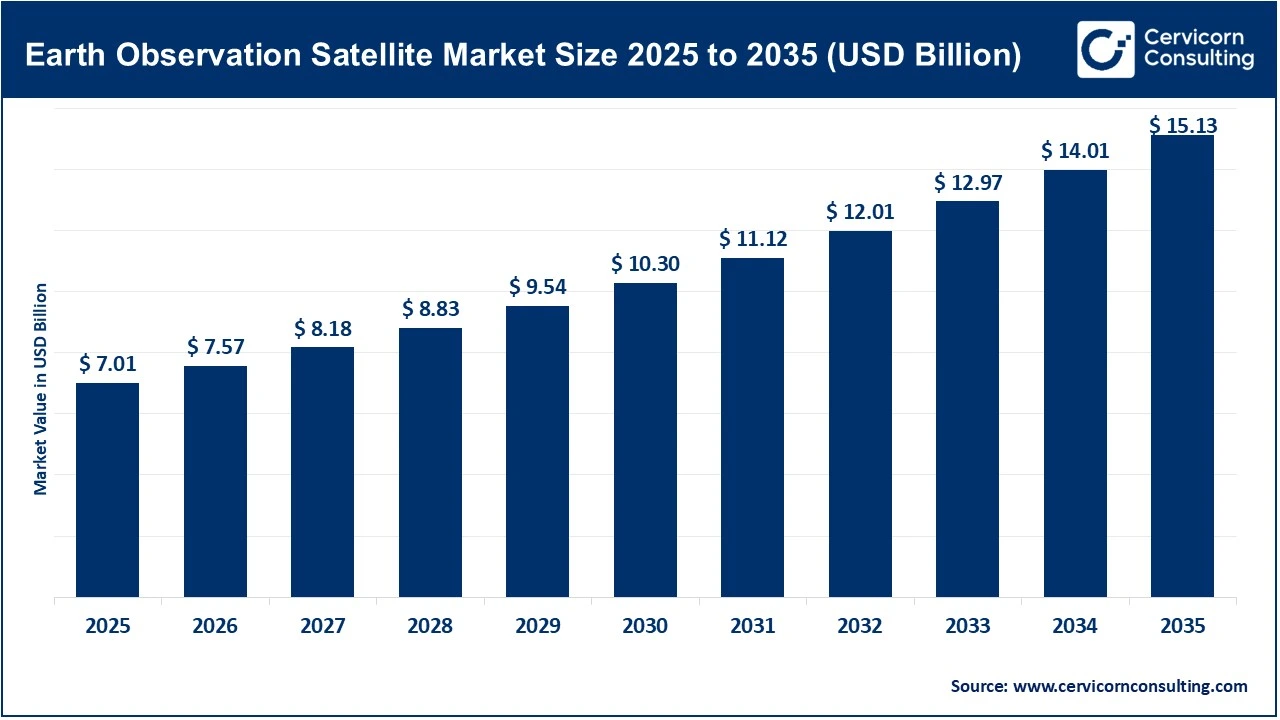
Strategic government investments and national security needs also significantly contribute to market growth. Governments around the world are shifting from intermittent monitoring to continuous real-time surveillance, which remains a core security element ensuring market stability. They are already allocating record funds to commercial satellite imagery for their sovereign capabilities. In early 2025, industry sources reported a 12% year-over-year increase in global defense spending on space-based reconnaissance as countries seek "unblinking” coverage of conflict zones amid rising geopolitical tensions and stricter national security demands.
Report Highlights
- By Region, the North America dominates the regional segment, with 38% share of the global earth observation satellite market, mainly due to strong defense spending and the presence of leading satellite companies.
- By Solution, the imagery data dominates the market, capturing around 65% share, mainly due to the increasing volume of satellite launches.
- By Solution, the imagery data analytical services is the fastest-growing segment, expanding at 35% share, driven by rising adoption of AI-powered analytics to convert raw satellite data into actionable insights.
- By Orbit Type, the low earth orbit (LEO) dominates the market, accounting for 70% share, primarily due to its ability to provide high-resolution imagery with frequent revisit capabilities.
- By Orbit Type, the geostationary orbit (GEO) is the fastest-growing segment at 20% share, driven by rising demand for continuous, real-time monitoring in weather forecasting and defense surveillance.
- By Technology, the optical imaging segment capturing over 56% share, mainly due to its extensive use in visual mapping, environmental monitoring, and urban planning.
- By Technology, the radar imaging is the fastest-growing segment, expanding at 27% share, driven by its capability to deliver all-weather, day-and-night imaging.
- By Application, the environmental monitoring segment dominates the market with 30% share, primarily due to increasing global focus on climate change, sustainability, and regulatory compliance.
Growth of Small Satellite Constellations and Cube Sat Launches Driving the Market Growth
The rapid development of Small Satellite Constellations, especially CubeSats, has significantly boosted growth in the earth observation satellite market. These small, affordable satellites enable more frequent data collection and better global coverage, making space-based insights more accessible. As a result, these insights are becoming more available, reliable, and scalable across various industries. The market is shifting from high-cost, one-time tasking orders to subscription-based APIs directly connected to traditional business intelligence platforms. By 2026, around 30% of participants in the emerging EO market will be non-aerospace companies, including retailers and insurers that use automated imagery to monitor store customer traffic and assess property damage. This market democratization has also reduced the average price per square kilometer of medium-resolution imagery by 25%.
Top 5 Trends and Technologies
- LiDAR Technology Growth: Technology such as LiDAR is driven by demand for high-precision 3D mapping, delivering elevation accuracy within 10–15 cm, which is critical for infrastructure and urban planning projects.
- Radio Frequency (RF) Sensing Emergence: RF sensing has capabilities to track over 90% of active maritime and aviation signals, enhancing surveillance and intelligence operations.
- AI-Integrated Geospatial Analytics Surge: AI-driven analytics are reducing data processing time by up to 60% and enabling near real-time decision-making across industries.
- Multispectral Imaging Stability: Multispectral imaging offers a cost-effective solution, with 5–10 spectral bands enabling up to 20% improvement in large-scale environmental monitoring efficiency.
- Thermal Imaging Utilization: Thermal imaging is being adopted increasingly in energy and climate applications, where it improves heat anomaly detection efficiency by up to 25%.
What is an Earth Observation Satellite, and how is the market growing?
Earth Observation satellites are high-tech platforms equipped with remote sensing instruments to monitor the planet's physical, chemical, and biological systems. EO systems operate by designing and collecting electromagnetic radiation reflected or emitted from the Earth's surface and atmosphere. The operational utility of an EO system is generally characterized by the sensors' spatial, spectral, and temporal resolutions, which determine what data can be collected and how often it can be acquired.
Moreover, modern EO architectures increasingly advocate for distributed networks or constellations of satellites that enable continuous monitoring of the Earth's surface, rather than the sporadic collection of snapshots. Advances in sensor capabilities are one of the primary factors driving the market’s growth. High-resolution optical satellites remain the standard for visual monitoring, as they capture a site's characteristics in visible and near-infrared (NIR) bands. However, their limitations—particularly in cloudy conditions or at night—have accelerated the adoption of alternative technologies, such as synthetic aperture radar (SAR) sensors. These sensors provide imaging day and night, in any weather, making them critical for disaster response and persistent military surveillance efforts.
Hyperspectral imaging is also emerging as an essential form of "molecular monitoring," breaking light into hundreds of narrow spectral bands to identify unique chemical signatures, such as leaking methane and crop health indicators. Meanwhile, next-generation innovations such as Rydberg-atom sensors are also being evaluated as emerging technologies for SI-traceable calibration in radiofrequency and microwave sensing.
Earth Observation Satellites Market Evolution (1957–2025)
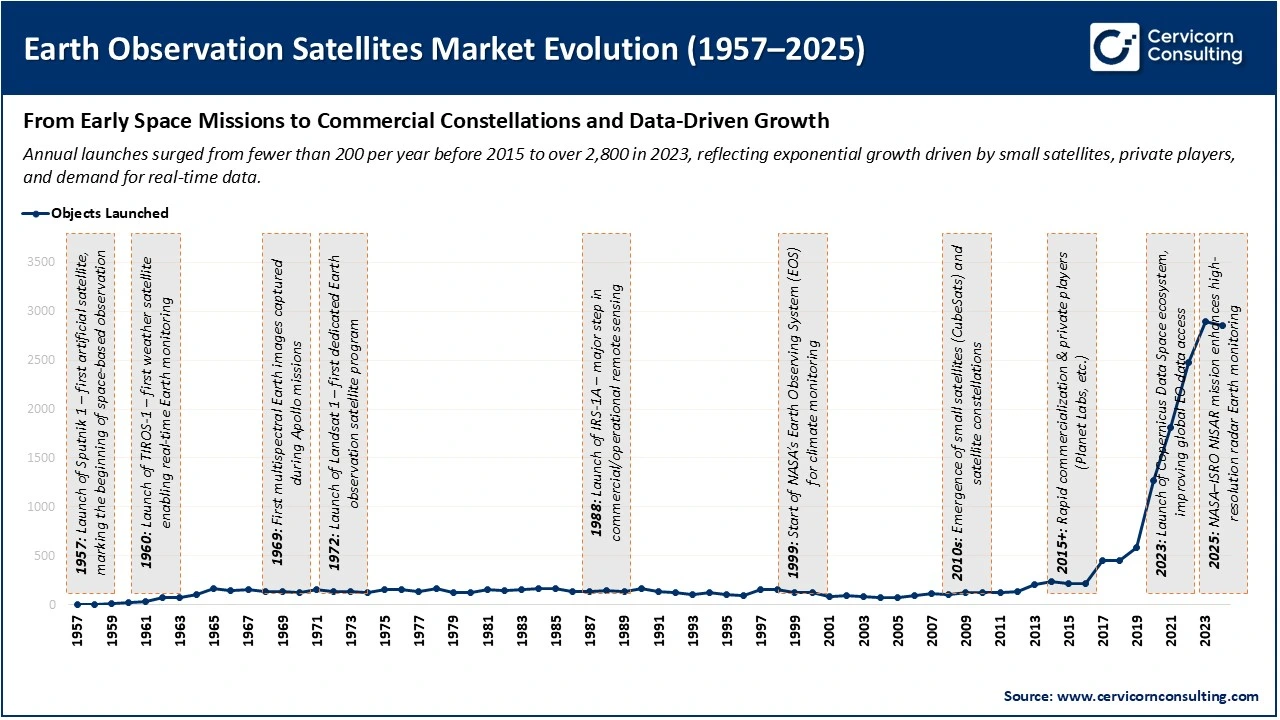
The chart tracks the progression of Earth observation satellite launches from 1957 to 2025. Early activity was limited and primarily government-led, with foundational missions such as Sputnik and Landsat setting the stage for future developments. Through the late 20th century, launch rates increased gradually. Since the mid-2010s, the sector has seen a marked rise in launches, largely due to the introduction of small satellites, CubeSat constellations, and greater private-sector involvement. This trend suggests a shift toward commercialization and scalable satellite networks, with growing demand for real-time data positioning Earth observation as an increasingly data-driven industry.
Report Scope
| Area of Focus |
Details |
| Market Size in 2026 |
USD 7.57 Billion |
| Market Size in 2035 |
USD 15.13 Billion |
| CAGR 2026 to 2035 |
8% |
| Dominant Region |
North America |
| Fastest Growing Region |
Asia-Pacific |
| Key Segments |
Solution, Orbit Type, Technology, Application, Region |
| Key Companies |
Airbus Defence and Space, Maxar Technologies, Planet Labs PBC, BlackSky Technology Inc., ICEYE, Spire Global Inc., Capella Space Inc., L3Harris Technologies Inc., ImageSat International N.V., GeoOptics Inc., MDA Space Ltd., Thales Alenia Space, Lockheed Martin Corporation, Northrop Grumman Corporation, OHB SE |
Recent Major Milestones
1. Corporate Accomplishment and Recent Launch Options
Corporate accomplishments and satellite launch activities act as major growth drivers for the earth observation satellite market. In 2024 and 2025, leading companies such as Maxar and Airbus successfully launched new generations of constellations, particularly in the WorldView Legion series. These advanced constellations allow for over 15 revisits per day for a specific area of interest, making a significant shift from daily updates to hourly monitoring capabilities. Additionally, launches showed a 30% increase in commercial revenue in the urban planning and logistics sectors, which rely on constant motion tracking for optimal operations, marking a transition of commercial EO into a high-cadence utility service.
2. Government Initiatives and Funding Paramounte
Government initiatives and funding programs continue to drive market growth. A key milestone was reached in mid-2025 when the U.S. National Reconnaissance Office (NRO) officially began using commercial data from providers like BlackSky and Planet as part of the main tactical flow to frontline commanders. This also led to a notable USD 4 billion budget approval over five years. The integration of commercial capabilities into national security marks the end of the “government-only” era for high-stakes intelligence operations. Furthermore, this cross-sector collaboration establishes a permanent, lucrative link between private tech firms and the national security framework, ensuring financial stability for the commercial sector and enhancing sovereign situational awareness.
3. Technological Milestones by High-Resolution Sensor Deployment
Advanced technology, especially in high-resolution sensing capabilities, marks a major milestone in the market. In 2025, the Carbon Mapper constellation was successfully launched, and international regulatory frameworks approved the use of data from Carbon Mapper in regulatory settings, showing a shifting path for environmental governance. This was the first time that violations and municipal fines were imposed on a large energy company for undisclosed methane leaks confirmed by satellite data, establishing a legal precedent for ground-based satellite evidence. News agencies reported a 40% rise in demand for independent "environmental auditing" satellite services, as companies sought to identify leaks early and avoid hefty fines from regulators.
4. Infrastructure Developments and Global Ground Station Expansion
Ongoing infrastructure development and ground station expansion are significant growth drivers of the market. In early 2026, a consortium of European space agencies successfully demonstrated the fusion of Optical, Synthetic Aperture Radar (SAR), and Thermal Imaging data within a single processing node in Low Earth Orbit (LEO). This milestone provided a "multi-modal" view of Earth, with heat signatures overlayed on high-resolution images, showcasing dynamic environments in real-time. Additionally, it was instrumental in improving search and rescue by 25% in maritime environments, highlighting the growing importance of advanced, integrated satellite infrastructure in real-world applications.
Earth Observation Satellite Market Regional Analysis
The Earth observation satellite market is segmented by region into North America, Europe, Asia-Pacific, and LAMEA. Here is a brief overview of each region:
Asia-Pacific Earth Observation Satellite Market: Driven by Infrastructure Development and Smart City Initiatives
The Asia-Pacific earth observation satellite market size was estimated at USD 1.75 billion in 2025 and is expected to surpass around USD 3.78 billion by 2035. The Asia Pacific is currently the fastest-growing region of the Earth Observation market, mainly due to large infrastructure projects and rapid development of smart cities. Governments are using satellite data to expand urban areas, monitor urban "Smart Cities," and reduce the impacts of frequent natural disasters with predictive flood models and rice crop tracking. The incorporation of geospatial data into national development plans, such as the Digital Silk Road, reflects the region's focus on leveraging space capabilities for nation-building and regional influence.
China: Expansion of State-Owned Constellations and Domestic Launch Capacity
China is a global leader in the Earth Observation market, mainly by integrating mandates with a growing commercial ecosystem that is developing in a manner similar to Western NewSpace.
- China currently has over 200 EO satellites in orbit and is leveraging its unmatched launch frequency with the Long March series of rockets to quickly replace satellite orbits.
- The Chinese government is actively deploying the "Guowang" mega-constellation, which uses thousands of satellites to support remote sensing and communication efforts.
- Employing advanced technology, such as the "Digital Silk Road," provides intelligence to partner nations to foster regional alliances.
India: Cost-Effective Missions and Liberalization of a Commercial Space Sector
India is the fastest user of satellite data, which is shifting its space sector from a government-centric business model to become a global hub for low-cost services.
- The Indian space economy is projected to reach USD 44 billion by 2033, with the EO sector identified as one of the top three growth areas.
- India has leveraged its low-cost engineering talents to develop affordable high-resolution sensors, significantly reducing costs compared to Western competitors.
North America Earth Observation Satellite Market: Driven by Private Sector Innovation and Commercial Space Investment
The North America earth observation satellite market size was valued at USD 2.66 billion in 2025 and is forecasted to grow around USD 5.75 billion by 2035.
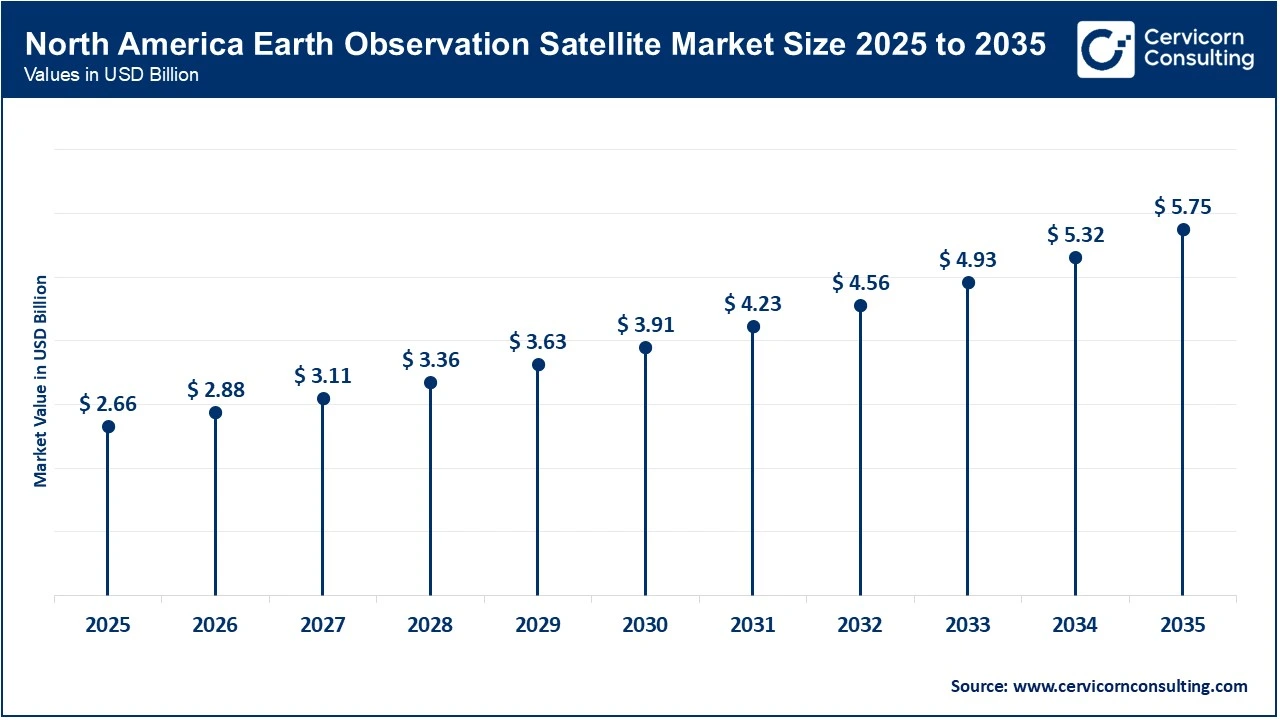
North America is the leading region in the EO market because it uniquely combines private sector innovation with government defense spending. The region is the hub of the "NewSpace" movement, where companies like SpaceX have transformed the industry by drastically cutting launch costs by over 90% compared to traditional methods. This cost efficiency has enabled startups to deploy large constellations of Smallsats, making space-based data more accessible than ever. In 2024, the US market will be further positively impacted by a major government initiative, including a multi-billion-dollar contract for commercial imagery, which has helped attract venture capital into high-resolution agencies like the National Reconnaissance Office, increasing investment in high-resolution optical and radar startups.
Canada: Specialized Remote Sensing for Resource Extraction and Arctic Sovereignty
Canada’s EO market is strong due to its geography, using Synthetic Aperture Radar (SAR) to monitor its vast northern lands, which are often covered in cloud.
- Canada is a global leader in using satellite data for wildfire detection and management, primarily due to its enormous forest cover.
- The Canadian space sector contributes more than USD 2.5 billion to the national GDP, with EO being Canada's most commercial sector.
- The RADARSAT Constellation Mission (RCM) is critical for ice tracking and monitoring patrol activities in the Northwest Passage.
United States: Leader in High-Resolution Commercial Imagery and Defense Contracts
The United States holds a dominant position in the EO market worldwide due to its regulatory leadership, financial strength, and substantial defense procurement.
- U.S. based companies currently command over 60 percent of the global commercial EO market in revenue, thanks to the "buy commercial" policy of the Department of Defense.
- The easing of restrictions on commercial licensing down to 0.25m resolution has led to U.S. dominance in high-end imagery.
- Strong emphasis on "Tactical IS," where commercial data is directly incorporated into military decision-making processes.
Europe Earth Observation Satellite Market: Driven by Collaborative Institutions and Copernicus Program Momentum
The Europe earth observation satellite market size reached at USD 1.96 billion in 2025 and is projected to reach around USD 4.24 billion by 2035. In Europe, the EO market is characterized by a highly developed institutional framework and a strong leadership position in the open-data ecosystem through the Copernicus program. Although Copernicus provides free and publicly accessible satellite data, it has successfully stimulated a thriving commercial market. Companies across the region are building value-added services on top of Sentinel satellite data, enabling advanced applications across multiple industries. The European space economy is projected to expand significantly in the coming years, and the downstream EO sector will support over 10,000 jobs and contribute billions of Gross Value Added to the EU economy by 2026.
United Kingdom: Focused on Downstream Applications and Small Satellite Innovation
The United Kingdom is the largest market, with strong capabilities in downstream applications and small satellite innovation. Specifically, regions such as Glasgow are recognised as leading centers for small satellite development and data-driven solutions, reinforcing the UK’s role as a key contributor to innovation in the global Earth Observation ecosystem.
- The UK space sector generates approximately USD 17.5 billion in revenue, with EO representing an important and expanding segment.
- The UK's "Net Zero Strategy" relies on EO as a key tool for tracking carbon emissions and driving the "Green Industrial Revolution".
Earth Observation Satellite Market Share, By Region, 2025 (%)
| Region |
Revenue Share, 2025 (%) |
| North America |
38% |
| Europe |
28% |
| Asia Pacific |
25% |
| LAMEA |
9% |
LAMEA (Latin America, Middle East & Africa) Earth Observation Satellite Market: Driven by Natural Resource Management and Agricultural Expansion
The LAMEA earth observation satellite market was valued at USD 0.63 billion in 2025 and is anticipated to hit around USD 1.36 billion by 2035. In the LAMEA region, EO satellites are mainly used by sovereign states as essential tools to manage their natural resources and promote agricultural development. For instance, in Brazil, satellite-based monitoring systems are crucial for tracking and preventing deforestation in the Amazon rainforest. Meanwhile, in the Middle East, EO satellite systems focus on managing rapid urban growth and water resources in arid areas. The United Arab Emirates (UAE) has gradually become a regional leader, investing over USD 6 billion through its space programs to reduce reliance on oil and enhance high-tech EO satellite services.
Brazil: Satellite Monitoring to Protect the Environment and Enhance Agribusiness
Brazil's EO market is driven by mission objectives, specifically to protect the Amazon rainforest and to effectively manage the country's extensive agricultural exports.
- Brazil is establishing itself as one of the largest, most advanced, and operational EO users in the world. The National Institute for Space Research (INPE) monitors over 5 million km2 of forest.
- Development of the Amazonia-series satellites to ensure an independent, sovereign capability to monitor the national territory.
- The DETER system provides real-time alerts for illegal logging and is the primary operational tool for environmental enforcement.
United Arab Emirates: Rapid Growth in Urban Planning and Regional Space Leadership
The UAE is gamifying Earth Observation to jump-start a "Knowledge Economy," where urban planning is a key focus for rapid urban growth and climate adaptation in the region.
- The USD 800 million Sarb radar satellite program via the UAE Space Agency is a key part of the country’s 2030 economic plan.
- The aim is to use thermal EO data to reduce Urban Heat Island effects and make Gulf cities cooler and more sustainable.
- Growing investments in satellite-based services to decrease national dependence on oil and gas revenues.
Earth Observation Satellite Market Segmental Analysis
The Earth observation satellite market is segmented into solution, orbit type, technology, application, and region.
Solution Analysis
Imagery data analytical service holds a dominant position in the market, primarily because raw satellite imagery offers limited value to most end-users without sophisticated processing and contextual interpretation. Businesses and governments are increasingly seeking "actionable intelligence," such as specific crop health indicators and urban growth rates, leading to a market in which the value of proprietary algorithms and domain expertise generates the greatest revenue.
Earth Observation Satellite Market Share, By Solution, 2025 (%)
| Solution |
Revenue Share, 2025 (%) |
| Imagery Data |
65% |
| Imagery Data Analytical Service |
35% |
The Imagery Data segment is emerging as the fastest-growing solution in the market, mainly due to the increase of "in-house" data science teams within large corporations and NGOs that need quality raw datasets to train machine learning models. With the commoditization of AI, there is a high demand for the underlying "fuel"—high-resolution raw datasets.
Orbit Type Analysis
The Low Earth Orbit (LEO) segment dominates the market mainly because it offers sub-meter resolution and low latency, which are essential for most commercial and military imaging applications. This segment also benefits from a well-established ecosystem of launch providers and satellite bus standards, making it the primary choice for most commercial EO startups.
Earth Observation Satellite Market Share, By Orbit Type, 2025 (%)
| Orbit Type |
Revenue Share, 2025 (%) |
| Low Earth Orbit (LEO) |
70% |
| Geostationary Orbit (GEO) |
20% |
| Medium Earth Orbit (MEO) |
10% |
The Geostationary Orbit (GEO) segment is experiencing the fastest growth, driven by the development of new flexible high-throughput satellites that provide 24/7 hemispheric coverage. These next-generation GEO satellites are increasingly used for continuous regional monitoring and real-time weather forecasting, addressing a critical gap in persistent surveillance that LEO constellations cannot fully cover.
Technology Analysis
Optical imaging holds the largest share of the market because it provides the most intuitive and high-resolution visual data, which aligns well with traditional mapping, urban planning, and human interpretation. Optical sensors are considered the most advanced technology in the EO space, having been developed over decades and offering a wide spectrum of bands crucial for assessing vegetation and land-use classification.
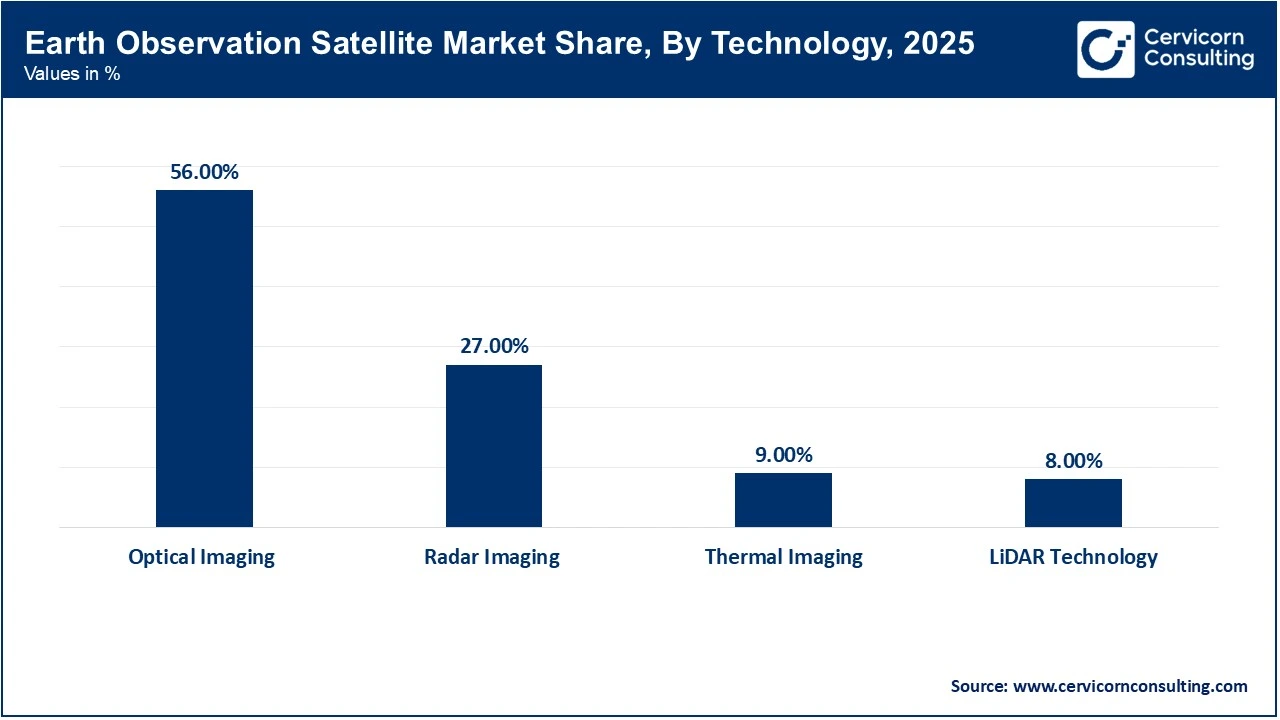
Radar imaging (SAR) is the fastest-growing segment of the market because it addresses a key limitation of optical sensors: the inability to capture images through clouds or at night. With the rising global demand for 24/7, all-weather monitoring—especially for disaster response, maritime security, and defense—the unique capability of SAR data to be used at any time, regardless of weather conditions, has driven increased investment and constellation deployment in this emerging technology area.
Application Analysis
Environmental monitoring holds a leading position in the market, mainly due to significant non-discretionary capital investments from government agencies and increasing regulatory oversight of corporate ESG (Environmental, Social, and Governance). This application is supported by established public programs, such as Copernicus and Landsat, which provide essential data for monitoring activities like deforestation, sea-level rise, and carbon emissions.
Earth Observation Satellite Market Share, By Application, 2025 (%)
| Application |
Revenue Share, 2025 (%) |
| Environmental Monitoring |
30% |
| Agriculture and Forestry |
18% |
| Urban Planning and Infrastructure |
14% |
| Disaster Management |
12% |
| Maritime Surveillance |
10% |
| Climate Change Research |
9% |
| Energy and Power Sector |
7% |
The agriculture and forestry segment is the fastest-growing market, driven by rising adoption of new precision farming techniques and the rapid expansion of the global carbon credit economy. Farmers utilise EO-derived indices to optimise fertilizer applications and forecast crop yields, while the forestry sector depends on EO for independent verification of biomass and reforestation efforts aimed at monetizing carbon credits.
Earth Observation Satellite Market Top Companies
Recent Developments
- In January 2025, ICEYE successfully launched and deployed four new SAR satellites aboard SpaceX’s Transporter-12 Rideshare mission, enhancing its capabilities in the Earth observation industry.
- In February 2025, Thales Alenia Space signed a significant contract with NIBE Space to supply a high-resolution optical satellite, marking the launch of India's first private Earth observation constellation.
- In July 2025, Planet Labs PBC secured a USD 280 million contract with the German government to provide Earth observation data for environmental monitoring and security purposes.
Market Segmentation
By Solution
- Imagery Data Analytical Service
- Imagery Data
By Orbit Type
- Low Earth Orbit (LEO)
- Geostationary Orbit (GEO)
- Medium Earth Orbit (MEO)
By Technology
- Optical Imaging
- Radar Imaging
- Thermal Imaging
- LiDAR Technology
By Application
- Environmental Monitoring
- Agriculture and Forestry
- Urban Planning and Infrastructure
- Disaster Management
- Maritime Surveillance
- Climate Change Research
- Energy and Power Sector
By Region
- North America
- APAC
- Europe
- LAMEA