Digital Twin in Agriculture Market Size, Growth, Forecast 2026 to 2035
The global digital twin in agriculture market size was valued at USD 2.23 billion in 2025 and is expected to be worth around USD 13.91 billion by 2035, exhibiting a compound annual growth rate (CAGR) of 20.1% over the forecast period 2026 to 2035.
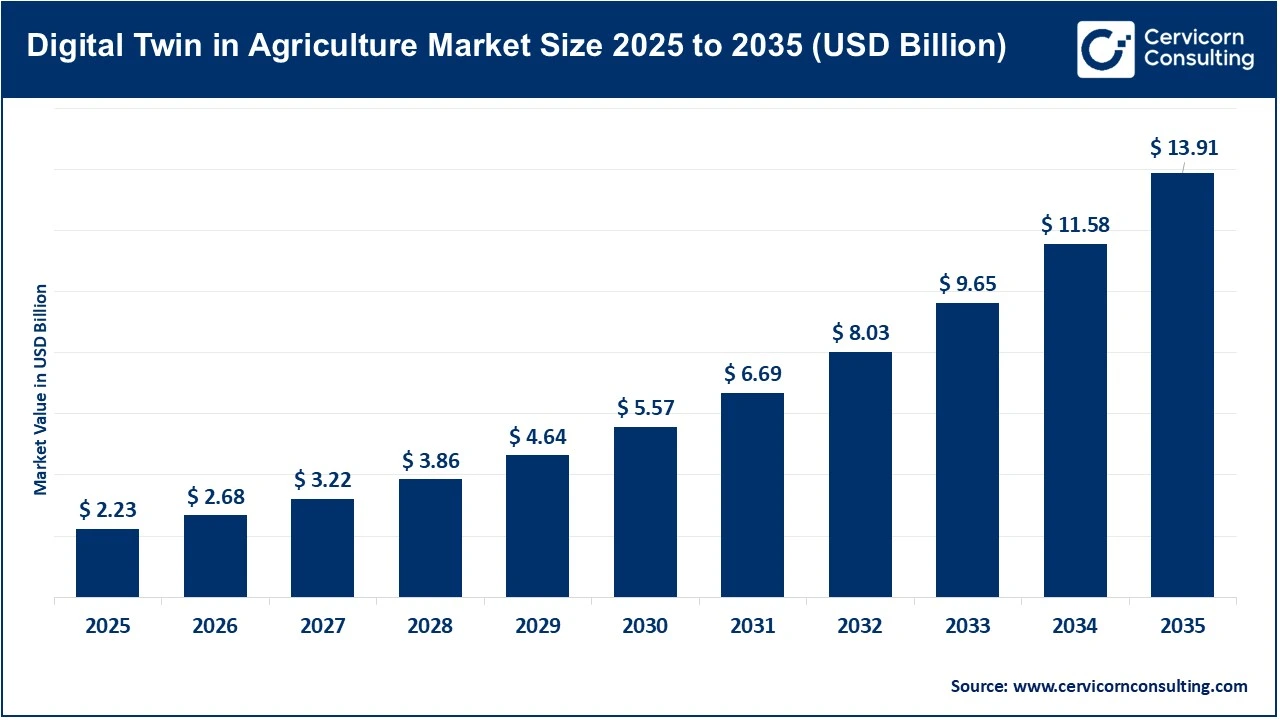
The digital twin in agriculture market is primarily driven by the rapid adoption of precision agriculture technologies, increasing integration of IoT sensors, AI, drones, satellite imagery, and connected farm machinery to improve productivity and optimize resource utilization. Digital twins enable farmers to simulate crop growth, irrigation schedules, fertilizer application, and machinery performance in virtual environments before implementing field operations, reducing operational risks and costs. According to the U.S. Department of Agriculture (USDA), 70% of large-scale U.S. crop farms used guidance autosteering systems in 2023, while 68% adopted yield monitors, yield maps, and soil mapping technologies, highlighting the growing digital infrastructure that supports digital twin deployment. In addition, a 2023 U.S. Government Accountability Office study found that 27% of U.S. farms and ranches already use precision agriculture practices, creating a strong foundation for advanced virtual farm modeling solutions.
Another major growth factor is the increasing need for climate-resilient farming, sustainable food production, and data-driven agricultural decision-making amid labor shortages and resource constraints. Digital twins allow continuous monitoring of soil conditions, weather patterns, crop health, livestock behavior, and irrigation systems, enabling predictive maintenance and optimized farm operations while minimizing water, fertilizer, and pesticide consumption. The Food and Agriculture Organization (FAO) identified 22 global case studies demonstrating that digitalization and automation improve farm efficiency, product quality, and sustainability, while its broader agricultural automation assessment analyzed 27 case studies confirming the potential of digital technologies to enhance resilience and environmental performance. Furthermore, academic research reviewing digital twin adoption in agriculture identified 28 practical use cases across crop production, livestock management, greenhouse operations, and farm automation, reflecting the technology's expanding commercial applicability across modern agriculture.
Report Highlights
- North America accounted for approximately 36.8% of the global Digital Twin in Agriculture market, driven by widespread precision farming adoption, advanced digital infrastructure, AI-enabled agriculture, and strong government support.
- By Type, the Product segment held the largest market share of 46.3%, supported by extensive deployment of digital twins for farm equipment, crops, livestock, irrigation systems, and connected agricultural assets.
- By Technology, IoT and Industrial IoT (IIoT) dominated with a 34.8% market share, serving as the core data collection infrastructure for real-time monitoring and digital twin simulation.
- Cloud-Based deployment led the market with a 71.2% share, owing to scalable data processing, remote accessibility, seamless IoT integration, and lower implementation costs for agricultural enterprises.
- Precision Farming represented the largest application segment with a 33.9% market share, fueled by increasing adoption of GPS-guided machinery, drones, AI analytics, and satellite-based crop monitoring solutions.
- Large Farms captured 67.4% of the market by farm size, reflecting higher investment capacity, greater adoption of precision agriculture technologies, and demand for integrated digital farm management platforms.
What is a Digital Twin in Agriculture?
A Digital Twin in Agriculture is a virtual, real-time digital representation of physical agricultural assets, processes, or entire farming ecosystems that integrates data from IoT sensors, drones, satellites, weather stations, farm machinery, and AI analytics. By continuously synchronizing with real-world conditions, digital twins enable farmers and agribusinesses to monitor crop growth, soil health, irrigation systems, livestock, and equipment performance, simulate different farming scenarios, predict outcomes, and optimize resource utilization. This technology supports precision agriculture by improving productivity, reducing operational costs, minimizing environmental impact, and enabling data-driven decision-making across the agricultural value chain.
Recent Milestones in the Digital Twin in Agriculture Market
| Date |
Company |
Milestone |
| January 2026 |
Microsoft |
Expanded Azure Digital Twins with enhanced AI and IoT capabilities for agriculture, supporting integration of billions of IoT signals and enabling real-time digital replicas of farms, equipment, and irrigation systems for predictive decision-making. |
| April 2026 |
Siemens |
Enhanced its Industrial Operations X portfolio with AI-powered digital twin technologies, helping agricultural enterprises simulate operations and optimize resource usage. The platform is designed to connect data across thousands of industrial and agricultural assets. |
| 2025 |
John Deere |
Expanded autonomous and precision agriculture technologies after reporting that its connected operations ecosystem now links more than 500,000 connected machines, providing the real-time operational data required for digital twin-enabled farm management. |
| 2025 |
U.S. Department of Agriculture (USDA) |
Reported that 70% of large-scale U.S. crop farms use guidance autosteering systems, while 68% utilize yield monitoring and soil mapping technologies, significantly strengthening the data infrastructure needed for digital twin deployment in agriculture. |
Digital Twin in Agriculture Market Dynamics
Market Drivers
1. Rising Adoption of Precision Agriculture and Smart Farming Technologies
- The growing adoption of precision agriculture is a major driver for the digital twin in agriculture market, as farmers increasingly rely on IoT sensors, GPS-guided machinery, drones, AI, and satellite imagery to optimize crop production and resource utilization. Digital twins integrate these technologies into virtual farm models for real-time monitoring and predictive decision-making. According to the USDA, 70% of large-scale U.S. crop farms used guidance autosteering systems in 2023, while 68% adopted yield monitors, yield maps, and soil mapping technologies, providing the data foundation required for digital twin implementation
2. Growing Demand for Sustainable and Climate-Resilient Agriculture
- Climate variability, water scarcity, and rising food demand are accelerating investment in digital technologies to improve agricultural sustainability. Digital twins help optimize irrigation, fertilizer application, machinery usage, and crop health monitoring while reducing waste and environmental impact. The FAO analyzed 22 global case studies demonstrating that digitalization and automation significantly improve productivity, resource efficiency, and sustainability. In addition, 27 automation case studies highlighted the importance of digital technologies in building climate-resilient agricultural systems, encouraging wider adoption of digital twin platforms.
Market Restraints
1. High Initial Investment and Integration Costs
- The deployment of digital twin solutions requires significant investment in IoT sensors, drones, cloud platforms, AI software, precision equipment, and high-speed connectivity, limiting adoption among small and medium-sized farms. A recent USDA Agricultural Research Service survey of 247 farmers found that 31% identified high costs relative to perceived benefits as the primary barrier to digital agriculture adoption, while 16% cited small farm size and 14% reported equipment incompatibility, slowing digital twin implementation.
2. Limited Digital Infrastructure and Technical Skills
- Digital twin systems depend on reliable internet connectivity, interoperable devices, and skilled users capable of interpreting complex agricultural data. Rural regions in many developing countries continue to face connectivity gaps and shortages of digital expertise. According to the FAO, findings from 22 international case studies show that inadequate rural internet infrastructure, limited electricity access, and insufficient technical knowledge remain major barriers to scaling digital agriculture solutions, including digital twins.
Market Opportunities
1. Expansion of AI, IoT, and Autonomous Farm Equipment
- Rapid advancements in artificial intelligence, cloud computing, autonomous tractors, agricultural robots, and IoT devices are creating significant opportunities for digital twin adoption. These technologies enable real-time simulation of crop growth, machinery performance, and field conditions, improving operational efficiency. According to the USDA, 93% of surveyed farmers already use at least one digital agriculture technology, with 55% using auto-guidance for over 10 years and 52% using yield mapping, indicating a mature technology base that supports next-generation digital twin platforms.
2. Increasing Government Support for Digital Agriculture
- Governments worldwide are investing in smart farming initiatives, digital infrastructure, and sustainable agriculture programs to strengthen food security and improve resource efficiency. These initiatives encourage the deployment of digital twins for farm planning and monitoring. A 2023 U.S. Government Accountability Office study reported that 27% of U.S. farms and ranches already use precision agriculture practices, while multiple national programs continue expanding rural digital infrastructure, creating favorable conditions for broader digital twin adoption.
Market Challenges
1. Data Interoperability and System Integration Complexity
- Digital twins require seamless integration of data from sensors, drones, weather stations, satellites, farm machinery, and enterprise software. However, incompatible data formats and proprietary platforms often prevent smooth information exchange, reducing operational efficiency. Research on Industry 4.0 digital twins in agriculture identifies interoperability as one of the most significant technical challenges limiting large-scale deployment, particularly across diverse agricultural ecosystems and equipment manufacturers.
2. Cybersecurity and Data Privacy Risks
- As farms become increasingly connected, digital twin platforms generate and store large volumes of operational and geospatial data in cloud environments, increasing exposure to cyber threats and unauthorized access. Concerns regarding data ownership, privacy, and secure information sharing continue to hinder adoption. Recent studies on digital agriculture identify cybersecurity, data governance, and trust in digital platforms among the key challenges influencing technology adoption, particularly for commercial farms managing sensitive operational data.
Digital Twin in Agriculture Market Regional Analysi
The digital twin in agriculture market is segmented by region into North America, Europe, Asia-Pacific, Latin America, and LAMEA. Here is a brief overview of each region:
Why does North America dominates in the digital twin in agriculture market?
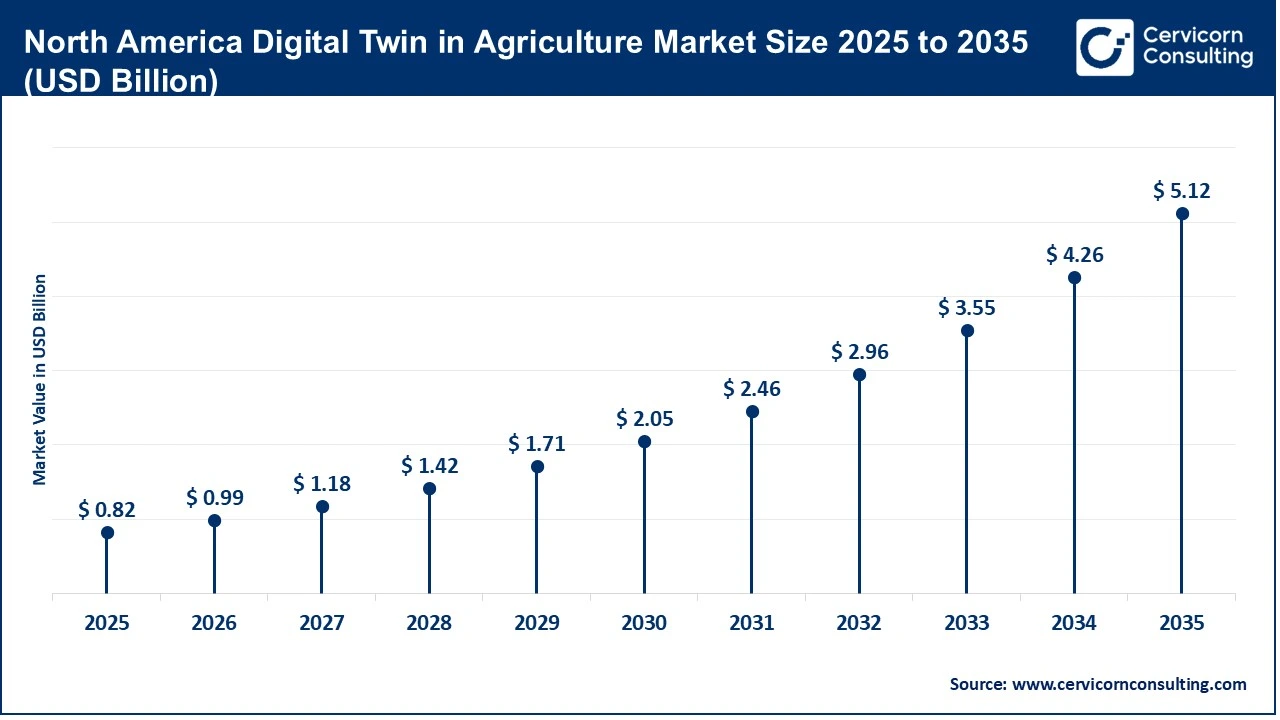
The North America digital twin in agriculture market size was valued at USD 0.82 billion in 2025 and is predicted to attain around USD 5.12 billion by 2035. North America dominates the market owing to its widespread adoption of precision farming technologies, advanced digital infrastructure, high penetration of connected agricultural equipment, and strong investments in smart farming innovation. The region leads in deploying IoT sensors, AI, drones, satellite imagery, autonomous machinery, and cloud-based farm management platforms, creating an ideal ecosystem for digital twin implementation. Government initiatives promoting sustainable agriculture, increasing demand for resource optimization, and the presence of leading technology providers further accelerate market growth. Continuous advancements in AI-powered analytics, digital farm simulations, autonomous tractors, and predictive crop management enable farmers to optimize productivity, reduce operational costs, and enhance climate resilience, reinforcing North America's leadership in the global digital twin in agriculture market.
United States: Precision Agriculture Leadership, Advanced Digital Technologies, and Strong R&D Investments Drive Market Growth
- More than 50% of U.S. corn, soybean, cotton, rice, sorghum, and winter wheat acreage is now managed using automated guidance technologies, demonstrating widespread adoption of precision agriculture across major crops.
- USDA estimates that expanding next-generation precision agriculture through improved rural connectivity could generate at least USD 47 billion annually for the U.S. economy, with USD 18 billion attributed directly to enhanced broadband-enabled digital farming technologies.
- Large commercial farms continue to lead digital transformation. Previous USDA studies found 73% of the largest corn farms, 82% of the largest winter wheat farms, 68% of the largest soybean farms, and 67% of the largest cotton farms had adopted auto-guidance technologies, supporting rapid implementation of digital twins.
Canada: Smart Farming Initiatives, Sustainable Agriculture, and Expanding Digital Infrastructure Support Market Expansion
- Canada is rapidly expanding digital agriculture through greater adoption of GPS-guided equipment, drones, satellite monitoring, remote sensing, and AI-powered farm management systems, creating favorable conditions for digital twin deployment.
- According to the 2021 Census of Agriculture, Canada has 189,874 farms covering approximately 153.7 million acres, providing a substantial agricultural base for precision farming and digital twin technologies.
- The Census also reported that farms using renewable energy more than doubled, increasing from 10,185 farms in 2016 to 22,576 farms in 2021, reflecting growing investment in smart and sustainable agricultural technologies that complement digital farming initiatives.
Why is Asia-Pacific witness the fastest growth in the digital twin in agriculture market?
The Asia-Pacific digital twin in agriculture market size was estimated at USD 0.55 billion in 2025 and is forecasted to hit around USD 3.44 billion by 2035. Asia-Pacific is expected to witness the fastest growth in the market due to its vast agricultural sector, increasing food security concerns, rapid digital transformation, and strong government support for smart farming technologies. Countries including China, India, Japan, South Korea, and Australia are investing heavily in AI, IoT, drones, robotics, satellite monitoring, and cloud-based farm management systems to improve productivity and climate resilience. Regional initiatives promoting digital agriculture, precision farming, and connected rural infrastructure are accelerating digital twin adoption across crop cultivation, greenhouse management, and livestock farming. The FAO's Digital Villages Initiative is currently supporting digital agriculture transformation across 12 Asia-Pacific countries, strengthening the region's smart farming ecosystem.
China: Government-Led Smart Agriculture Programs and Large-Scale Digitalization Drive Regional Leadership
- China is the largest Digital Twin in Agriculture market in Asia-Pacific, supported by large-scale investments in AI, IoT, agricultural robotics, satellite monitoring, and precision farming technologies.
- In 2024, China launched its 2024–2028 Smart Agriculture Action Plan, aiming to establish a national agricultural big data platform and comprehensive digital planting technology systems by 2028, accelerating digital twin deployment across farming, livestock, and fisheries.
- China's annual grain production is expected to exceed 700 million metric tons, increasing the need for AI-enabled digital twins to optimize yields, reduce production costs, and strengthen food security.
India: Expanding Agritech Ecosystem, Government Digital Initiatives, and AI Adoption Accelerate Market Growth
- India is emerging as one of the fastest-growing markets due to rapid expansion of agritech startups, AI-based advisory platforms, satellite-enabled farming, and government-backed digital agriculture programs.
- India has over 140 million hectares of cultivable land, creating enormous potential for digital twin deployment in precision farming, irrigation optimization, and crop monitoring.
- Approximately 86% of Indian farmers are smallholders, driving demand for affordable cloud-based digital twin platforms, AI-powered decision support, and mobile-enabled farm management solutions.
Why Europe holds a significant share of the global digital twin in agriculture market?
The Europe digital twin in agriculture market size reached at USD 0.63 billion in 2025 and is predicted to hit around USD 3.95 billion by 2035. Europe holds a significant share of the global market due to its strong focus on sustainable agriculture, precision farming, and digital transformation under the European Green Deal and Common Agricultural Policy (CAP). The region is rapidly adopting AI, IoT, satellite monitoring, autonomous machinery, and cloud-based farm management systems to improve productivity while reducing environmental impact. Government funding for smart farming, widespread use of precision agriculture technologies, and the presence of leading agricultural equipment and software providers continue to accelerate digital twin adoption. Increasing emphasis on carbon-neutral farming, water conservation, and data-driven agricultural practices further strengthens Europe's position in the global digital twin in agriculture market.
Germany: Smart Farming Leadership, Industry 4.0 Expertise, and Precision Agriculture Drive Market Growth
- Germany is Europe's largest market for digital agriculture, supported by advanced agricultural machinery manufacturers, Industry 4.0 expertise, and extensive adoption of AI, IoT, and automation technologies across farming operations.
- According to Eurostat, approximately 262,800 agricultural holdings operate in Germany, creating a substantial market for digital farm management and digital twin platforms.
France: Large Agricultural Economy, Government Digitalization Programs, and Sustainable Farming Support Market Expansion
- France has one of Europe's largest agricultural sectors, with approximately 389,000 farms according to the latest agricultural census, providing extensive opportunities for digital twin deployment across crop production, vineyards, and livestock farming.
- France accounts for around 17% of the European Union's total agricultural output, making digital transformation a strategic priority for improving productivity and sustainability.
- The French government continues investing in France 2030, allocating over EUR 2.3 billion to agricultural innovation, robotics, digital technologies, and climate-smart farming solutions that support digital twin implementation.
Digital Twin in Agriculture Market Share, By Region, 2025 (%)
| Region |
Revenue Share, 2025 (%) |
| North America |
36.8% |
| Europe |
28.4% |
| Asia-Pacific |
24.7% |
| LAMEA |
10.1% |
LAMEA Digital Twin in Agriculture Market Trends
The LAMEA digital twin in agriculture market was valued at USD 0.23 billion in 2025 and is anticipated to reach around USD 1.40 billion by 2035. The LAMEA digital twin in agriculture market is experiencing steady growth due to increasing adoption of precision agriculture, rising investments in smart irrigation, and growing demand for sustainable food production. Governments and agribusinesses across the region are adopting AI, IoT, drones, satellite imagery, and cloud-based farm management platforms to improve crop yields and optimize scarce resources, particularly water. Digital twin technologies are gaining momentum in commercial farming, greenhouse cultivation, and livestock management, supported by digital transformation initiatives, climate adaptation strategies, and expanding agricultural technology investments. Brazil, the UAE, Saudi Arabia, and South Africa are emerging as key markets driving regional adoption.
Brazil: Large Agricultural Economy, Precision Farming Adoption, and Agritech Innovation Drive Market Leadership
- Brazil is the largest Digital Twin in Agriculture market in LAMEA, supported by one of the world's largest commercial agricultural sectors and increasing adoption of precision farming technologies.
- According to IBGE (Brazilian Institute of Geography and Statistics), Brazil has more than 203 million hectares of agricultural land, creating enormous opportunities for digital twin deployment across grain, sugarcane, soybean, coffee, and livestock production.
- Brazil harvested a record 322.8 million metric tons of grains in the 2024/25 season, increasing demand for AI-powered crop monitoring, predictive analytics, and digital farm management systems.
United Arab Emirates (UAE): Smart Agriculture Investments, Water Conservation, and Controlled Environment Farming Support Market Growth
- The UAE is emerging as a leading Digital Twin in Agriculture market in the Middle East through substantial investments in smart farming, AI, vertical farming, and greenhouse technologies.
- Since less than 1% of the UAE's land is arable, digital twins are increasingly used to optimize greenhouse operations, hydroponics, irrigation efficiency, and climate-controlled agriculture.
- The UAE Government has invested over AED 1 billion through food security and agricultural innovation initiatives, promoting AI, robotics, IoT, and precision agriculture technologies.
Digital Twin in Agriculture Market Segmental Analysis
The digital twin in agriculture market is segmented into type, technology, deployment mode, application, farm size, and geography.
Type Analysis
The Product segment dominates the digital twin in agriculture market because it encompasses digital replicas of farm equipment, crops, livestock, irrigation systems, and other agricultural assets widely deployed in precision farming. Farmers increasingly use digital twin products to monitor field conditions, predict equipment failures, and optimize crop yields through real-time data integration. The growing adoption of connected tractors, drones, and IoT-enabled farming equipment has further strengthened the demand for product-based digital twin solutions across commercial agriculture.
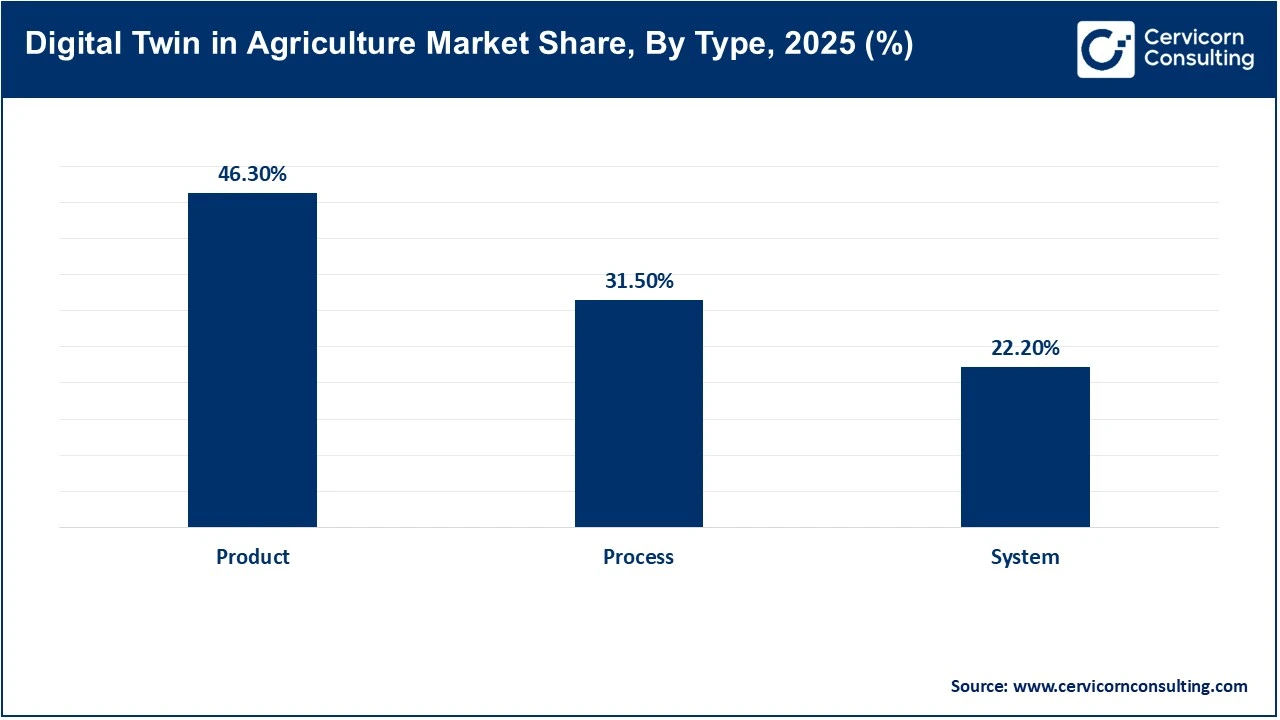
The System segment is expected to witness the fastest growth due to the rising demand for integrated digital ecosystems that connect farm machinery, weather stations, sensors, irrigation systems, and AI analytics into a unified digital twin platform. These comprehensive systems enable end-to-end farm optimization, predictive decision-making, and autonomous operations. Increasing investments in smart farming infrastructure and farm management platforms are accelerating the deployment of system-level digital twins, particularly among large commercial farms.
Technology Analysis
IoT and Industrial IoT (IIoT) dominate the market, as digital twins depend on continuous, real-time data collected by connected sensors, drones, GPS devices, weather stations, and agricultural machinery. IoT infrastructure enables accurate virtual representations of farm assets, improving operational efficiency and predictive maintenance. The widespread deployment of connected agricultural equipment and precision farming technologies has established IoT as the technological foundation for digital twin applications across modern agriculture.
Digital Twin in Agriculture Market, By Technology, 2025 (%)
| Technology |
Revenue Share, 2025 (%) |
| IoT and Industrial IoT (IIoT) |
34.8% |
| Artificial Intelligence and Machine Learning |
28.6% |
| Augmented Reality (AR) and Virtual Reality (VR) |
14.1% |
| Blockchain |
8.7% |
| Others |
13.8% |
Artificial Intelligence (AI) and Machine Learning (ML) are projected to be the fastest-growing technologies because they transform raw agricultural data into predictive insights for crop yield forecasting, disease detection, irrigation optimization, and autonomous decision-making. AI-powered digital twins continuously learn from historical and real-time data to improve simulation accuracy. The rapid adoption of generative AI, computer vision, and predictive analytics is significantly expanding the capabilities of digital twin platforms in agriculture.
Deployment Mode Analysis
The Cloud-Based segment holds the largest market share because it offers scalable computing resources, centralized data storage, remote accessibility, and seamless integration with IoT devices and AI platforms. Cloud deployment enables farmers to monitor digital twins from any location while supporting continuous software updates and real-time analytics. The increasing availability of cloud infrastructure and subscription-based digital agriculture platforms continues to drive widespread adoption among commercial farming operations.
Digital Twin in Agriculture Market, By Deployment Mode, 2025 (%)
| Deployment Mode |
Revenue Share, 2025 (%) |
| Cloud-Based |
71.2% |
| On-Premises |
28.8% |
The Cloud-Based segment is also expected to register the fastest growth owing to rising investments in cloud computing, edge analytics, and Software-as-a-Service (SaaS) farm management solutions. Cloud platforms enable rapid deployment, lower infrastructure costs, and easier integration with autonomous equipment and AI applications. Government initiatives promoting digital agriculture and expanding rural connectivity are further accelerating cloud adoption across both developed and emerging agricultural markets.
Application Analysis
Precision Farming dominates the application segment due to its extensive use of digital twins for leverage virtual farm models to improve productivity while minimizing input costs and environmental impact. The widespread adoption of GPS-guided machinery, drones, IoT sensors, and satellite imagery has made precision farming the largest application area for digital twin technologies in agriculture.
Digital Twin in Agriculture Market, By Application, 2025 (%)
| Application |
Revenue Share, 2025 (%) |
| Precision Farming |
33.9% |
| Crop Health Monitoring |
20.4% |
| Irrigation & Water Management |
16.3% |
| Livestock Monitoring & Management |
13.2% |
| Greenhouse Management |
8.5% |
| Others |
7.7% |
Crop Health Monitoring is expected to experience the fastest growth because digital twins combined with AI, drones, multispectral imaging, and satellite data enable early identification of diseases, nutrient deficiencies, pest infestations, and crop stress. Continuous monitoring improves yield prediction and reduces crop losses through timely interventions. Growing concerns over food security, climate change, and sustainable farming practices are accelerating investment in advanced crop monitoring solutions worldwide.
Farm Size Analysis
Large Farms account for the largest share of the digital twin in agriculture market due to their higher financial capacity, larger operational scale, and greater investment in precision agriculture technologies. These farms generate vast amounts of operational data, making digital twin platforms highly valuable for optimizing machinery utilization, irrigation management, labor planning, and crop production. Their established digital infrastructure and focus on maximizing productivity continue to support widespread adoption.
Digital Twin in Agriculture Market, By Farm Size, 2025 (%)
| Farm Size |
Revenue Share, 2025 (%) |
| Large Farms |
67.4% |
| Small and Medium Farms |
32.6% |
Small and Medium Farms are projected to witness the fastest growth as affordable cloud-based platforms, subscription-based digital agriculture services, government incentives, and low-cost IoT devices become increasingly accessible. Advancements in AI-powered farm management applications are reducing implementation costs and technical barriers, enabling smaller farms to adopt digital twins for improving productivity, resource efficiency, and climate resilience while remaining competitive in modern agricultural markets.
Digital Twin in Agriculture Market Top Companies
Recent Developments
- In February 2026, John Deere expanded its Startup Collaborator Program by partnering with agri-tech startups focused on artificial intelligence, robotics, advanced sensing, and digital connectivity to accelerate autonomous farming and connected equipment. The initiative strengthens the company's digital agriculture ecosystem and enhances digital twin capabilities for real-time farm monitoring, predictive analytics, and precision farming applications.
- In May 2026, AGCO Corporation enhanced its PTx FarmENGAGE platform by improving mixed-fleet connectivity, cloud-based farm management, and interoperability with John Deere Operations Center. The development enables seamless data exchange across agricultural machinery, supporting comprehensive digital twin creation, predictive farm operations, and optimized resource management.
- In April 2026, Siemens AG expanded its Industrial Operations X portfolio with advanced AI-powered digital twin capabilities that improve real-time asset monitoring, predictive maintenance, and operational simulation. The enhancement supports smart farming applications by enabling more efficient management of agricultural equipment, irrigation systems, and connected farming operations.
Market Segmentation
By Type
By Technology
- Artificial Intelligence and Machine Learning
- IoT and Industrial IoT (IIoT)
- Augmented Reality (AR) and Virtual Reality (VR)
- Blockchain
- Others
By Deployment Mode
By Application
- Precision Farming
- Livestock Monitoring & Management
- Greenhouse Management
- Irrigation & Water Management
- Crop Health Monitoring
- Others
By Farm Size
- Small and Medium Farms
- Large Farms
By Geography
- North America
- Europe
- Asia-Pacific
- LAMEA