Data Center PON Equipment Market Size and Growth Factors 2026 to 2035
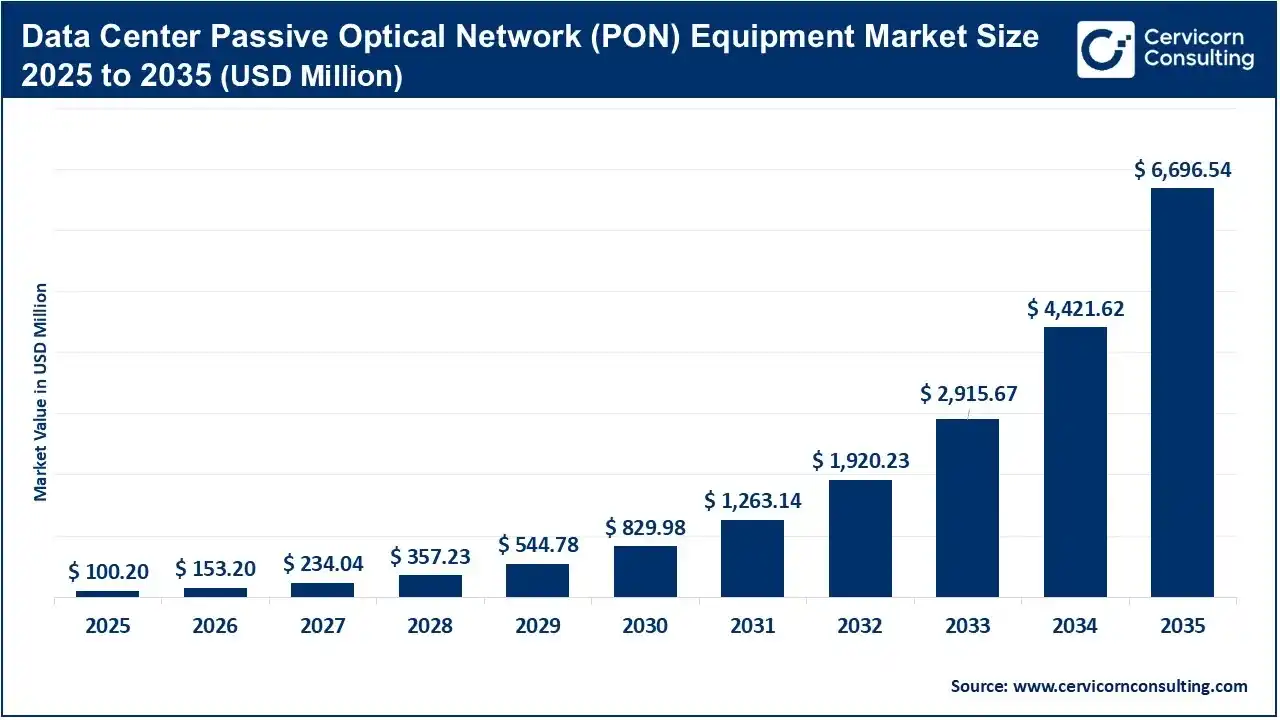
The global data center passive optical network (PON) equipment market size was valued at USD 100.20 million in 2025 and is projected to grow from USD 153.20 million in 2026 to nearly USD 6,696.54 million by 2035, registering a CAGR of 52.2% over the 2026 to 2035 period. The data center passive optical network (PON) equipment market is growing because of growing demand for cloud computing, AI workloads, energy-efficient networking, high-speed connectivity, and data center infrastructure. Data center operators are being encouraged to implement scalable optical networking solutions due to an increase in data traffic from digital services and linked applications. Market adoption is also aided by the requirement to lower network complexity, power consumption, and operating expenses.
On 16 March 2026, Nokia launched Aurelis for Data Centers, a PON-based out-of-band management solution designed for AI and cloud data centers. The solution uses passive optical networking to reduce active equipment, power consumption, and operational complexity, supporting the adoption of PON technology in modern data center infrastructure.
Market Overview & Projections
- Market Size (2026): USD 100.20 Million
- Market Size (2035): USD 6,696.54 Million
- Growth Rate (CAGR): 52.2%
- Leading Region: North America (55% share)
- Fastest-Growing Region: Asia Pacific
Report Highlights
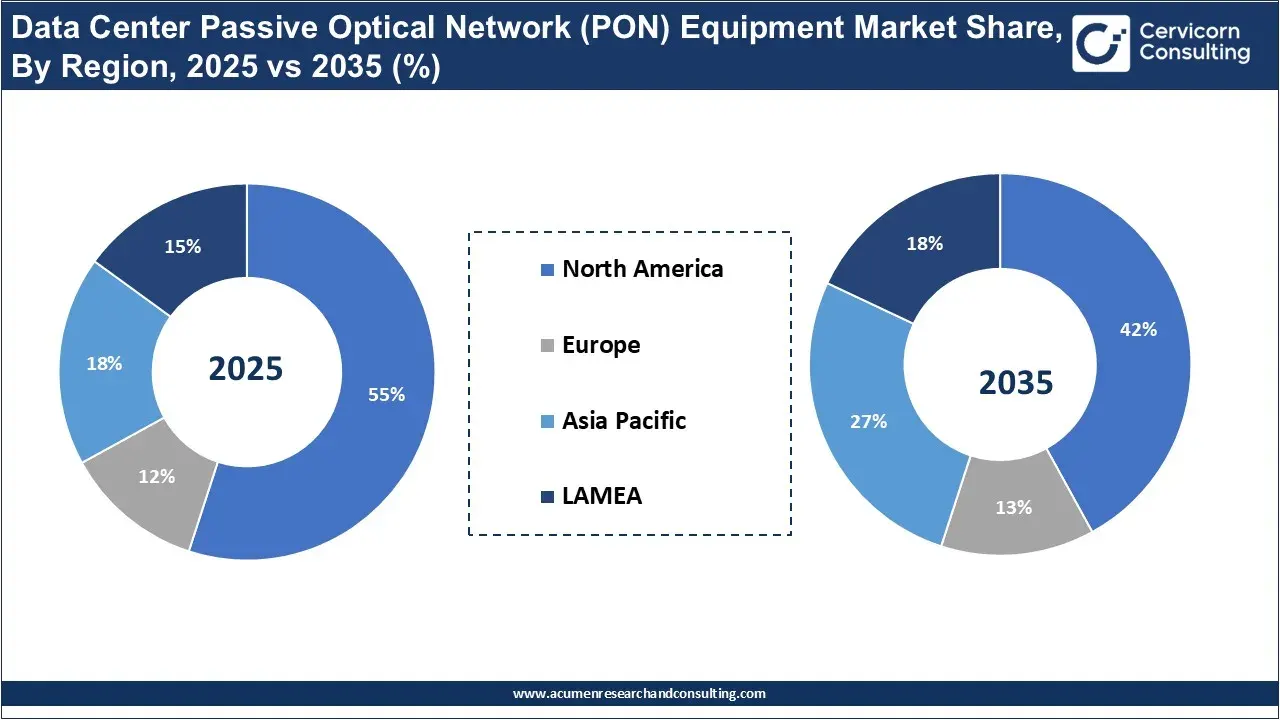
- By region, North America dominated the data center passive optical network equipment market with a 55% share in 2025, supported by mature data center infrastructure, hyperscale deployments, cloud adoption, and high-speed connectivity requirements.
- By region, Asia-Pacific is projected to reach a 27% market share by 2035, driven by rapid data center construction, fiber-optic deployment, digital infrastructure investment, and growing AI and cloud workloads.
- By equipment type, PON ONTs/ONUs and optical modems accounted for 55% of the market in 2025 and are projected to reach 62% by 2035, supported by increasing endpoint density, data traffic, bandwidth requirements, and fiber-based network deployments.
- By PON technology, XGS-PON dominated with a 55% share in 2025, supported by symmetrical high-speed connectivity, rising data traffic, cloud computing requirements, and increasing demand for scalable optical infrastructure.
- By PON technology, 25G-PON is projected to reach a 35% share by 2035, driven by higher bandwidth requirements associated with AI workloads, high-performance computing, cloud applications, and next-generation optical networks.
- By application, out-of-band management dominated with an 88% share in 2025, reflecting the importance of dedicated remote infrastructure management, simplified cabling, and reliable connectivity for critical data center equipment.
- By application, data center infrastructure management accounted for 10% of the market in 2025, supported by growing requirements for centralized monitoring, infrastructure visibility, automation, and management of increasingly complex facilities.
- By data center type, hyperscale data centers dominated with a 50% share in 2025, driven by large-scale cloud deployments, high server density, AI workloads, high-performance computing, and demand for scalable optical connectivity.
- By data center type, colocation data centers accounted for 30% of the market in 2025, supported by rising demand for shared infrastructure, flexible capacity, cloud services, multi-tenant connectivity, and scalable data center resources.
- By deployment architecture, dedicated PON OOBM led with a 65% share in 2025, supported by the need for dedicated management connectivity, simplified cabling, reliable infrastructure monitoring, and reduced dependence on active networking components.
- By deployment architecture, hybrid PON-Ethernet OOBM accounted for 25% of the market in 2025, driven by the need for flexible migration paths that allow operators to integrate PON with existing Ethernet infrastructure.
- By endpoint type, servers dominated with a 50% share in 2025, reflecting rising server density, expanding cloud and AI workloads, increasing server deployments, and the need for reliable management connectivity.
- By endpoint type, network equipment accounted for 25% of the market in 2025, supported by increasing switch and router deployments, rising network complexity, growing data traffic, and demand for reliable out-of-band management.
Country-wise Analysis
| Country |
Estimated PON Adoption Rate in Data Centers (%) |
Key Adoption Factors |
| United States |
38% |
Large hyperscale and AI data center deployments, growing demand for OOBM, and strong investment in scalable optical infrastructure are supporting adoption. |
| China |
31% |
Rapid data center construction, cloud and AI infrastructure expansion, and increasing fiber deployment are creating opportunities for PON-based management networks. |
| Japan |
29% |
High data center reliability requirements, advanced fiber infrastructure, and demand for energy-efficient network architectures are supporting PON adoption. |
| Germany |
25% |
Industrial digitization, enterprise data center modernization, and increasing emphasis on energy-efficient infrastructure are encouraging optical networking adoption. |
| India |
22% |
Rapid expansion of hyperscale and colocation facilities, cloud adoption, and AI infrastructure investment are creating emerging demand for PON-based OOBM. |
| United Kingdom |
21% |
Growth in cloud, colocation, and high-density data center infrastructure is supporting the deployment of fiber-based management architectures. |
| Canada |
19% |
Expansion of data center capacity and increasing cloud and AI workloads are creating opportunities for centralized optical management connectivity. |
Recent Trends
- AI-driven data centers: Growing AI workloads are increasing demand for high-bandwidth and low-latency optical connectivity.
- Energy-efficient networking: Data center operators are adopting PON solutions to reduce power consumption and simplify network infrastructure.
- Fiber-based connectivity: Increasing deployment of fiber-optic networks is supporting faster and more reliable data transmission.
- Cloud and edge expansion: The growth of cloud computing and edge data centers is creating demand for scalable optical networking solutions.
- Network automation: PON equipment is increasingly being integrated with automated network management to improve operational efficiency and reduce maintenance complexity.
- Higher bandwidth requirements: Increasing data traffic from AI, cloud services, and high-performance computing is driving demand for higher-capacity optical networks.
- Simplified infrastructure: Data center operators are exploring PON architectures to reduce cabling complexity and the number of active networking components.
- Growing 5G and IoT adoption: The expansion of 5G and connected devices is generating additional data traffic and supporting demand for advanced optical connectivity.
Market Dynamics
Growth Driver
The market for data center PON equipment is primarily driven by the fast growth of cloud computing, AI workloads, and hyperscale data centers, which raise the need for scalable, fast, and energy-efficient connectivity. Data center operators can better manage infrastructure by using PON architectures, which can streamline cabling and lower the number of active networking components. Market adoption is also being aided by the growing demand for increased bandwidth, dependable connectivity, and reduced power consumption.
- In February 2025, Huawei introduced its OptiXtrans DC908 optical transmission solution, designed to support high-speed and reliable connectivity in data center environments. The solution reflects the industry's shift toward optical networking technologies capable of handling growing data traffic from cloud computing and AI applications, supporting the broader adoption of optical infrastructure in data centers.
Key Restraint
The high initial cost of upgrading optical infrastructure and the difficulty of integrating PON technology with current active Ethernet networks may limit the uptake of PON equipment in data centers. Adoption among certain data center operators may also be slowed by limited knowledge of PON-based data center architectures, compatibility issues, and the availability of well-established networking technologies.
- In March 2025, Adtran launched its FSP 3000 IP OLS solution to address increasing AI-driven network demands. The solution focuses on simplifying optical infrastructure through automation, real-time monitoring, and scalable connectivity, highlighting the industry's efforts to address network complexity and operational challenges.
Key Opportunity
PON equipment providers have a lot of opportunities as AI-focused data centers, cloud infrastructure, edge computing, and hyperscale facilities proliferate. Demand for fiber-based PON solutions may rise as energy efficiency and streamlined network architectures gain more attention. Data center automation, high-density computing, and next-generation optical connectivity are examples of emerging applications that offer businesses the chance to create PON technologies that are more scalable and effective.
- In October 2025, Ciena highlighted the growing application of PON technology in data center out-of-band management, emphasizing its potential to support simpler, more energy-efficient, and scalable data center operations as AI and cloud workloads expand.
Key Challenge
A major challenge for the data center PON equipment market is the need to integrate PON architectures with existing Ethernet-based data center networks, which can increase deployment complexity and require compatibility with established infrastructure. Data center operators may also face concerns related to interoperability, network management, equipment migration, and the availability of skilled professionals familiar with PON technologies. In addition, hyperscale and high performance computing environments demand extremely low latency, high availability, and predictable performance, creating technical requirements that PON deployments must meet alongside conventional networking solutions.
Regional Analysis
North America Leads Data Center Passive Optical Network Equipment Adoption as AI Infrastructure Drives Fiber Connectivity
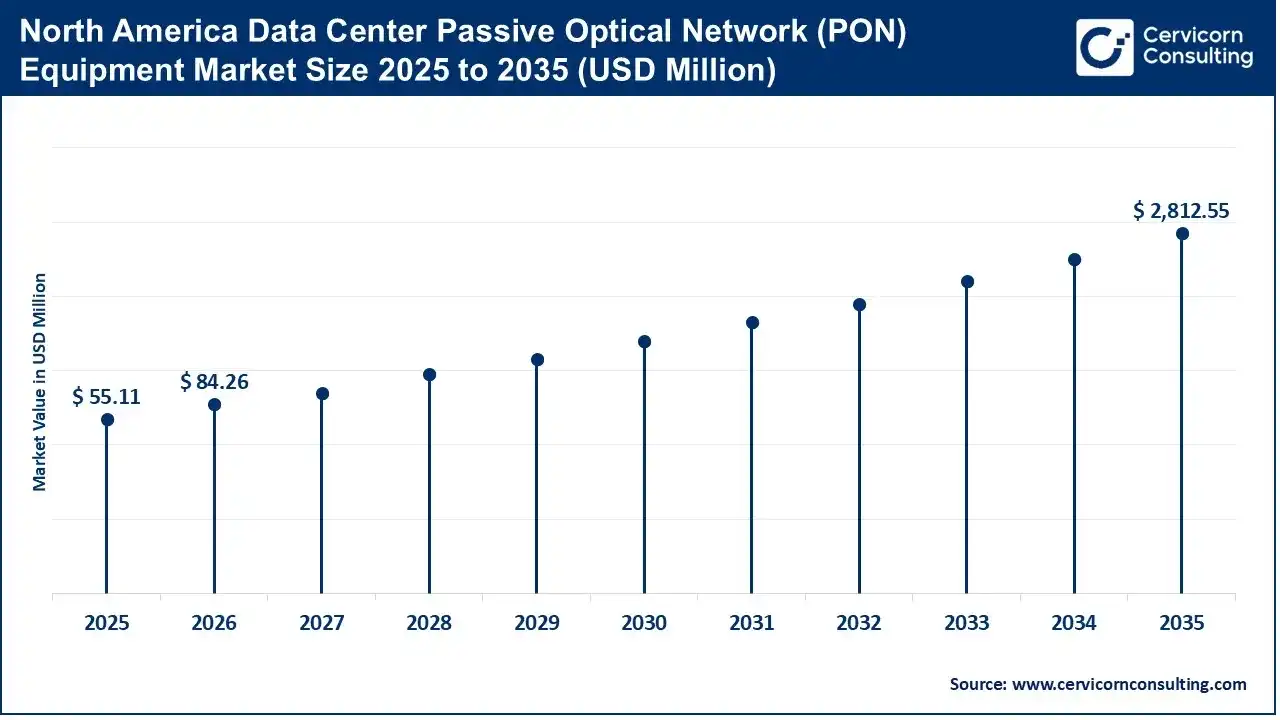
The North America data center passive optical network equipment market size was valued at USD 55.11 million in 2025 and is projected to hit USD 2,812.55 million by 2035. North America dominated the market with a market share of 55% in 2025, propelled by well-established data center infrastructure, robust cloud adoption, hyperscale deployments, and growing high-speed connectivity demand. Investments in high-performance computing infrastructure and AI-focused data centers are also being made in the area. PON equipment adoption is being aided by the increased focus on advanced fiber connectivity and energy-efficient networking.
- United States: The country's mature fiber-optic infrastructure and established data center ecosystem enable operators to evaluate PON alongside conventional Ethernet and other optical networking architectures for specific connectivity requirements.
- Canada: Canada's data center market is expanding alongside cloud computing, AI workloads, and digital services, particularly around established technology hubs such as Toronto, Montreal, and Vancouver.
Asia-Pacific Emerges as a High-Growth Data Center PON Equipment Market with Expanding Digital Infrastructure
The Asia-Pacific data center passive optical network equipment market size was estimated at USD 18.04 million in 2025 and is expected to reach USD 1,808.06 million by 2035. Asia-Pacific is growing rapidly with a market share of 27% by 2035, propelled by the quick growth of data centers, rising fiber-optic network deployment, growing investments in digital infrastructure, and growing adoption of AI and cloud computing. The region's growing hyperscale and colocation infrastructure is driving up demand for optical networking solutions. The deployment of cutting-edge PON technologies is being further supported by growing digitalization and data traffic.
- China: The continued development of computing infrastructure and data center clusters is increasing requirements for high-capacity fiber connectivity and energy-efficient networking technologies.
- Japan: Tokyo and Osaka remain important data center markets, supported by cloud adoption, enterprise digitization, telecommunications infrastructure, and demand for low-latency connectivity.
- India: Mumbai, Chennai, Hyderabad, Delhi-NCR, and Bengaluru are emerging as major data center hubs, creating opportunities for fiber-optic and PON equipment deployment.
Segmental Analysis
Equipment Type Analysis
PON ONTs/ONUs and optical modems dominated the data center passive optical network (PON) equipment market with a market share of 55% in 2025, driven by the need for scalable optical infrastructure, growing endpoint requirements, and expanding fiber-based connectivity deployment. These devices facilitate effective connectivity between data center endpoints and optical networks. The demand for ONTs, ONUs, and optical modems is being further supported by an increase in server and networking equipment deployments.
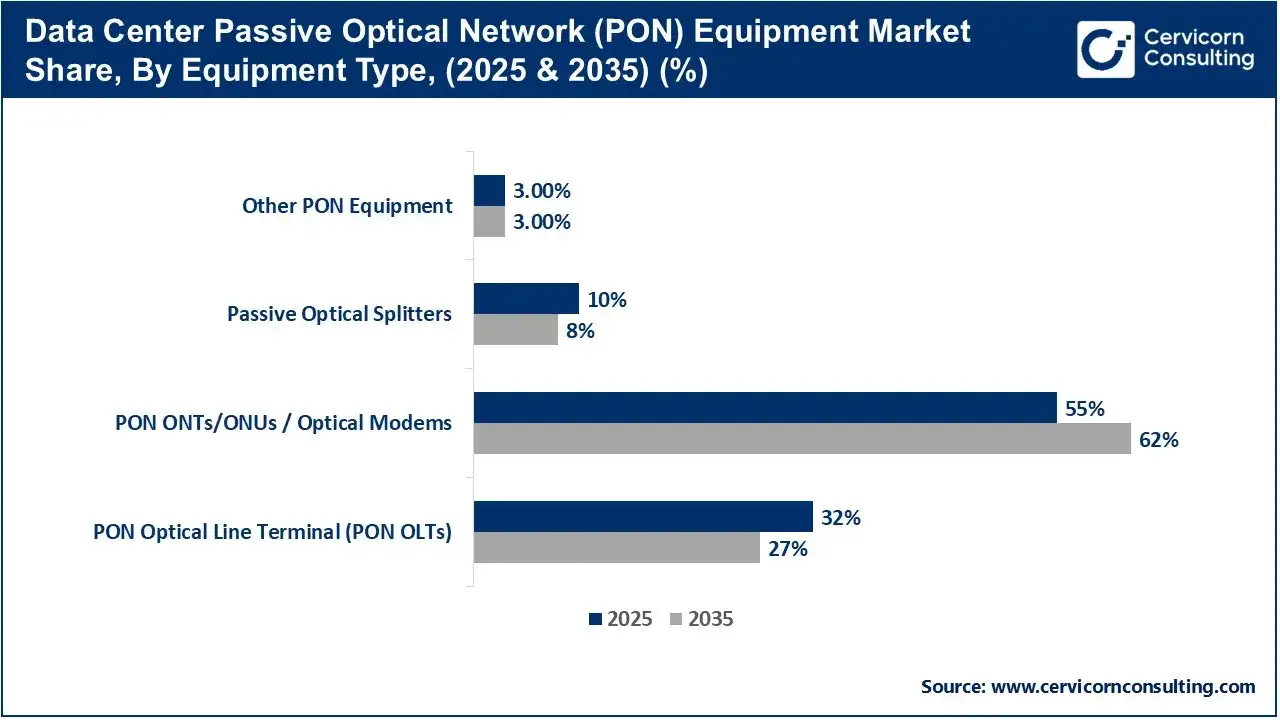
PON ONTs/ONUs and optical modems are growing rapidly with a market share of 62% by 2035, driven by an increase in data traffic, a need for more bandwidth, the growth of cloud and artificial intelligence workloads, and the shift to sophisticated fiber-based network designs. The need for dependable optical connectivity is rising along with the number of connected endpoints. The development of sophisticated endpoint equipment is also aided by the adoption of higher-capacity PON technologies.
PON Technology Analysis
XGS-PON dominated the data center passive optical network (PON) equipment market with a market share of 55% in 2025, motivated by its symmetrical high-speed connectivity, expanding data-intensive applications, rising data traffic, and expanding cloud computing needs. Its ability to work with fiber-based infrastructure facilitates effective network deployment. The use of XGS-PON in data center settings is being strengthened by the growing need for dependable and scalable connectivity.
25G-PON is growing rapidly with a market share of 35% by 2035, driven by the shift to next-generation optical networking infrastructure, high-performance computing, cloud applications, and growing bandwidth requirements from AI workloads. The technology offers more capacity to manage data traffic that is growing at a rapid pace. Higher-capacity optical technologies are becoming more and more necessary as AI-focused data centers are deployed more widely.
Application Analysis
Out-of-Band Management (OOBM) dominated the data center passive optical network (PON) equipment market with a market share of 88% in 2025, motivated by the requirement for dependable remote management, specialized connectivity, streamlined cabling, and effective administration of vital data center infrastructure. Operators can keep management access to infrastructure separate from production networks with OOBM. Dedicated management connectivity is becoming more and more necessary as data centers become more complex.
Data Center Infrastructure Management (DCIM) is growing rapidly with a market share of 10% in 2025, motivated by the need for better visibility across vital equipment, infrastructure automation, centralized monitoring, and growing data center complexity. Optical connectivity can enhance monitoring capabilities when integrated with management platforms. Effective infrastructure management is becoming more and more necessary as AI and high-density data centers grow.
Data Center Type Analysis
Hyperscale data centers dominated the data center passive optical network (PON) equipment market with a market share of 50% in 2025, driven by the need for scalable optical connectivity, growing server density, high-performance computing, AI workloads, and large-scale cloud deployments. Efficient networks that can accommodate a large number of connected devices are necessary for hyperscale facilities. PON equipment adoption is being further supported by ongoing investments in large-scale computing infrastructure.
Colocation data centers are growing rapidly with a market share of 30% in 2025, driven by the growing need for cloud services, flexible data center capacity, shared infrastructure, and scalable connectivity for numerous tenants. Colocation facilities are being used by businesses more and more to meet their flexible infrastructure needs. More opportunities for PON-based solutions are being created by the requirement for effective connectivity across multi-tenant environments.
Deployment Architecture Analysis
Dedicated PON OOBM dominated the data center passive optical network (PON) equipment market with a market share of 65% in 2025, motivated by the requirement for simplified cabling, dependable infrastructure monitoring, dedicated management connectivity, and less reliance on traditional active networking components. Critical infrastructure can have consistent management access thanks to dedicated architectures. Adoption is being aided by an increasing emphasis on data center network designs that are effective and straightforward.
Hybrid PON-Ethernet OOBM is growing rapidly with a market share of 25% in 2025, motivated by the need to provide more deployment flexibility, facilitate gradual network modernization, and integrate PON technology with the current Ethernet architecture. Without totally replacing current systems, this architecture can assist operators in modernizing network infrastructure. Interest in hybrid connectivity solutions is being boosted by the growing need for flexible migration routes.
Endpoint Type Analysis
Servers dominated the data center passive optical network (PON) equipment market with a market share of 50% in 2025, driven by growing server density, expanding cloud and AI workloads, expanding server deployments, and the requirement for dependable management connectivity. A significant part of the infrastructure of a modern data center is made up of servers. The growth of AI and high-performance computing applications is driving up demand for effective server connectivity.
Network equipment is growing rapidly with a market share of 25% in 2025, driven by the need for dependable management of vital networking infrastructure, rising data traffic, expanding network complexity, and expanding switch and router deployment. The number of connected networking devices is rising due to the growth of AI and cloud networks. The need for PON-based network equipment connectivity is being further supported by growing demands for effective monitoring and out-of-band management.
Government Initiatives
- In January 2025, The Government of India launched National Broadband Mission 2.0, focusing on expanding high-speed broadband and optical fiber connectivity across the country. The initiative supports the expansion of optical fiber infrastructure and improved digital connectivity, creating a favorable environment for fiber-based networking technologies.
- In November 2025, The UK Government introduced the AI Growth Zones program to support the development of large-scale AI data centers by addressing planning, energy, and investment barriers. The initiative is expected to encourage the expansion of AI-focused data center infrastructure and associated high-speed networking requirements.
- In March 2026, The UK Government proposed reforms to accelerate electricity connections for strategic demand projects, including data centers and AI Growth Zones. The measures aim to improve access to electricity network capacity for new data center projects, supporting continued digital infrastructure development.
- In September 2026, The European Commission announced measures focused on improving data center energy efficiency and sustainability. The initiative includes work on sustainability ratings and performance standards, encouraging data center operators to adopt more energy-efficient infrastructure and networking technologies.
Recent Developments
- In August 2026, Adtran announced that TOHKnet completed Japan’s first live-network trial of 50G PON, demonstrating the coexistence of 50G PON, XGS-PON, and EPON over a single fiber network. The development highlights the potential for phased PON upgrades while preserving existing fiber infrastructure. It also demonstrates how operators can increase network capacity without completely replacing existing fiber assets. The approach can support future data-intensive applications and evolving connectivity requirements.
- In March 2026, Kyocera developed a pluggable optoelectronic module supporting PCIe 6.0, designed to enable high-speed, power-efficient optical communication in AI data centers. The development supports the broader shift toward optical connectivity for high-performance computing infrastructure. The technology is aimed at addressing increasing bandwidth requirements in AI and data-intensive environments. It also reflects the industry's focus on improving energy efficiency alongside higher-speed data transmission.
- In March 2026, Huawei launched next-generation optical network products and solutions aimed at AI-centric all-optical networks, focusing on higher bandwidth, lower latency, and improved reliability for emerging AI applications. The solutions are designed to support the increasing connectivity requirements of AI computing infrastructure. This development highlights the growing role of optical networking in building scalable data center and computing networks.
- In March 2026, FiberHome highlighted the evolution toward 50G PON and 400G/800G all-optical networks, driven by growing data center interconnection and AI computing requirements. The company emphasized higher-capacity optical networking for supporting intelligent computing and cloud-native services. These developments reflect increasing demand for high-speed optical infrastructure across data-intensive applications. They also support the transition toward more scalable and efficient network architectures.
Market Companies
Segments Covered
By Equipment Type
- PON Optical Line Terminal (PON OLTs)
- PON ONTs/ONUs / Optical Modems
- Passive Optical Splitters
- Other PON Equipment
By PON Technology
- Gigabit PON (GPON)
- XG-PON
- XGS-PON
- 25G-PON
- 50G-PON
- Other PON Technologies
By Application
- Out-of-Band Management (OOBM)
- Data Center Infrastructure Management (DCIM)
- Others
By Data Center Type
- Hyperscale
- Colocation
- Enterprise
- Government/Defense
- Others
By Deployment Architecture
- Dedicated PON OOBM
- Hybrid PON-Ethernet OOBM
- PON-based DCIM
- Othes
By Endpoint Type
- Servers
- Network Equipment
- Storage Equipment
- Power & Cooling Equipment
- Others
By Region
- North America
- Europe
- Asia-Pacific
- Latin America
- Middle East & Africa