
Content
Why Is Physical AI the Hottest Investment Trend Right Now?


Software and robots carried a large chunk of news in last 5 years; now its physical AI. In the first quarter of 2026 alone, 27 physical AI startups raised more than $6.4 billion between them, and that was before June, when three companies building "world models" pulled in a combined $12.6 billion in just nine days. The world is already witnessing something structural happening in venture capital, and it isn't chatbots anymore.
What Exactly Is "Physical AI"?
The term covers any AI system built to sense, reason, and act in the physical world rather than just generate text or images. That means humanoid robots, warehouse automation, autonomous vehicles, industrial drones, and the chips and simulation tools that power all of it. Nvidia popularized the label, but investors have run with it because it captures something specific: intelligence is moving off the screen and into hardware that can pick things up, walk across a factory floor, or sort a package.
The Funding Numbers Are Getting Absurd
Know the Physical AI story by numbers narrative:
- $27.6 billion was raised by robotics and physical AI startups across roughly 1,000 deals in 2025, more than double the 2024 total.
- $6.4 billion went to 27 startups in Q1 2026 alone, with individual rounds routinely clearing $50 million.
- $12.6 billion was raised by just three "world model" companies in a single nine-day stretch in June 2026.
- Roughly 23 of 27 notable Q1 2026 deals went to US-based startups, with Europe picking up most of the rest.
- Capital split almost evenly between robotics (about $4 billion) and AI chips or inference hardware (about $2 billion) in that same quarter.
That last point matters. Investors aren't just betting on robot bodies, they're betting on the custom silicon that has to run inside them, because a data-center GPU is both too big and too power-hungry to bolt onto a robot arm.
Request your sample copy here and explore our offering@ https://www.cervicornconsulting.com/sample/2741
Who's Actually Winning the Round?
Here's how the biggest names stack up right now, based on their most recent disclosed rounds and valuations.
| Company | Key Highlight | Latest Fund Raised | Notable Supporter |
| Figure AI | General-purpose humanoids | $1B+ Series C | Nvidia, Microsoft, Brookfield, Parkway VC |
| Physical Intelligence | Foundation models for robots | $1B round in talks (Mar 2026) | Founders Fund, Thrive, Lux Capital |
| Skild AI | General-purpose "robot brain" | $1.4B | Nvidia, SoftBank |
| Apptronik | Industrial humanoids (Apollo) | $520M extension | Google, Mercedes-Benz |
| Mind Robotics | Industrial robotics platform | $500M | Eclipse and others |
| Odyssey | World models | $310M | - |
The American startup scene is only half the picture. China now runs its own parallel league of well-capitalized players, several of which have crossed the same "20 billion yuan club" valuation threshold as Western unicorns: Unitree, AgiBot, Galbot, and UBTech, backed by state-linked investors like CATL and municipal venture funds rather than Silicon Valley firms. This is where the story stops being just about companies and starts being about countries.
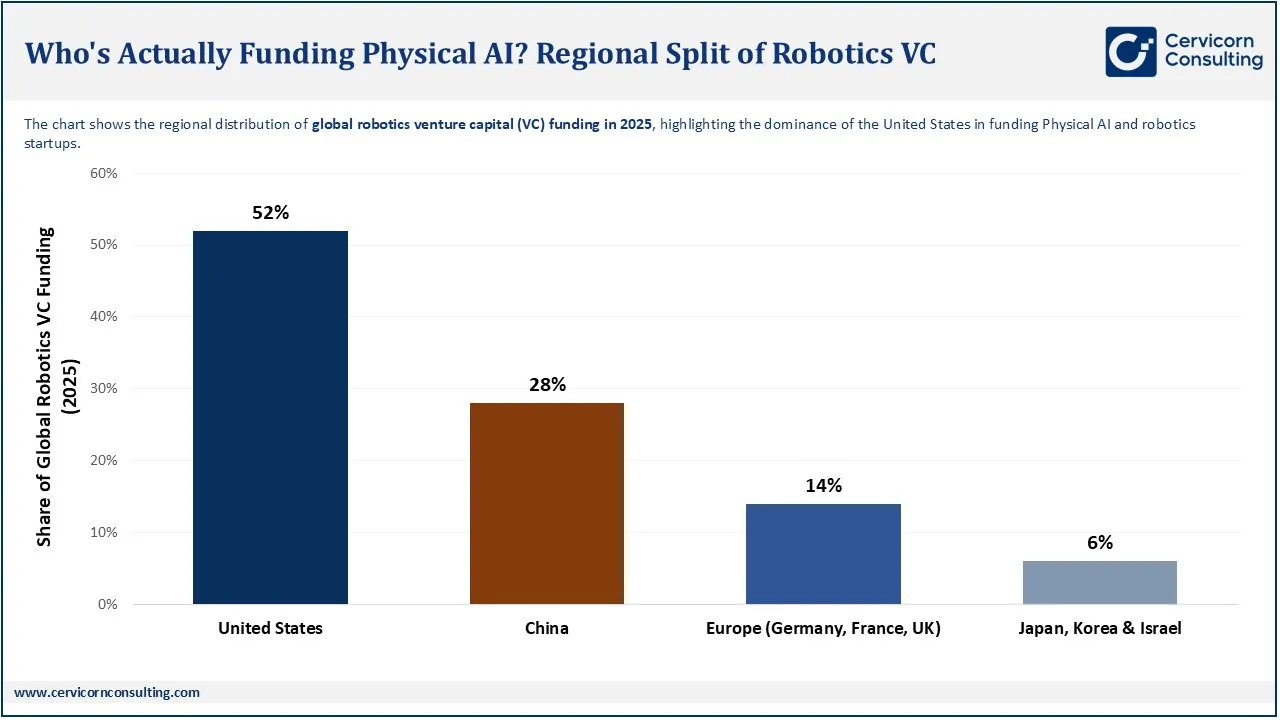
- The United States accounted for 52% of global robotics venture capital in 2025, down from 61% in 2023, a meaningful erosion of dominance.
- China's share rose to 28%, up from 24% in 2023, despite ongoing restrictions on cross-border investment in sensitive categories.
- Europe, led by Germany, France, and the UK, took 14%.
- Japan, South Korea, and Israel split the remaining 6%.
What Investors Need to Know About Physical AI in 2026
The distinguishing feature is no longer whether a company can deliver some exotic AI, but rather whether its AI can reliably create economic value. Firms with evidence of real deployments, existing recurring enterprise contracts, and proprietary, large, real-world datasets will attract far more investor attention than those demonstrating yet-to-be-scaled research prototypes. According to some industry experts, simulation tools, edge computing hardware, sensors, chips, robotics OS, and digital twins will all benefit as these are the key enablers of the physical AI economy.
The good news is the emergence of many more companies, beyond the traditional tech players, who will use physical AI in their operations. Many of the industries who will be among the earliest users, from manufacturers and healthcare organizations to warehouse operations, construction sites, and farms, are creating diversified, multi-billion dollar opportunities along the entire value chain.
Moreover, the declining cost of hardware, advances in AI chips and new robotics foundation models will create profitable opportunities to implement at scale. Those investors who invest based on these criteria- deployment, efficiency, and durable competitive advantage-are more likely to capture value than those fixated on hype.
The Global Government Race: Why Robots Are Now a National Security Line Item
- Shenzhen alone launched a dedicated 10 billion yuan (about $1.4 billion) AI and Robotics Industry Fund.
- A joint-ministry action plan targeting 100,000 humanoid robots deployed nationwide by 2027, a number that would exceed the rest of the world's combined humanoid installed base.
- Chinese firms shipped roughly 90% of the world's humanoid robot units in 2025, led by AgiBot, Unitree, and UBTech.
- China already operates about 2 million industrial robots, close to 4.5 times Japan's stock, and accounted for over 70% of new industrial robot installations worldwide in 2025, up from 52% in 2020.
The United States hasn't matched China's industrial subsidies dollar for dollar, but it has leaned hard on a different lever: controlling the chips that physical AI depends on. In January 2026, the Commerce Department shifted its export licensing policy for certain NVIDIA and AMD chips to case-by-case review, paired the same week with a 25% tariff on imported advanced AI chips not destined for the domestic supply chain.
Japan and South Korea are the newest entrants, and they moved almost in lockstep in June 2026. Japan's government committed up to $6.2 billion over five years to Noetra, a sovereign physical AI consortium backed by SoftBank, Sony, Honda, and roughly 44 companies, wrapped inside a wider 14-year, $2.3 trillion national strategy targeting 10 million AI-equipped robots deployed by 2040.
South Korea, in its "Three Mega Projects," set an explicit goal of capturing 20% of the global humanoid robot market, focusing its public R&D money on actuators, robot hands, and sensors rather than trying to out-fund China on foundation models directly.
Europe is playing a different game entirely; less about out-funding competitors, more about setting the rules everyone else eventually has to follow. The EU's AI Act and updated Machinery Regulation will require commercial humanoid operators to demonstrate systematic safety cases by the third quarter of 2027, with U.S. OSHA guidance on autonomous robot co-workers expected around the same time. That's a genuine headwind for companies that treated safety engineering as an afterthought, but a real advantage for the ones, often in Germany and France, that built compliance infrastructure early.
So Does Any of This Actually Pay Off? The ROI of Physical AI
This is where the hype runs into arithmetic. A few real numbers help ground the conversation.
- Figure's robots have logged 1,250+ runtime hours at BMW's Spartanburg plant, loading more than 90,000 parts across roughly 30,000 vehicles, a genuine industrial deployment rather than a demo reel.
- Figure now sells access through a Robot-as-a-Service model priced around $1,000 per robot per month, which lowers the upfront cost barrier for factories but also means the company needs enormous fleet volume before the economics work at scale.
- Globally, 542,000 industrial robots were installed in 2024 alone, pushing the total operational stock to roughly 4.66 million units, so traditional industrial robotics is already a mature, proven-ROI category. Humanoids are trying to ride that same demand curve, just with a much less proven cost basis.
- Current humanoid robot prices range from about $16,000 for a basic research platform up to $150,000+ for advanced industrial units, with Tesla targeting a $20,000–$30,000 price point at scale.
- Warehousing and logistics robotics deal value actually fell 28.5% in 2025 compared with 2024, even as defense robotics funding surged, a reminder that not every physical AI subsector is rising together.
What Does the Market Actually Look Like Ahead?
Forecasts for the humanoid segment vary wildly depending on who's building the model, which is itself a signal of how early this market still is. According to experts at Cervicorn Consulting, the global physical AI market was valued at USD 5.02 billion in 2025 and is projected to reach USD 82.79 billion by 2035, expanding at a remarkable CAGR of 32.8% from 2026 to 2035. This rapid growth reflects the increasing adoption of AI-powered robots, autonomous systems, and intelligent machines across manufacturing, healthcare, logistics, automotive, and consumer applications, making physical AI one of the fastest-growing technology markets over the next decade.
The broader momentum for industry trends can also be seen in shipping volumes: the global annual shipment of humanoids will exceed 250,000 in 2030, whereas only a few commercial deployments of humanoids have occurred in the past couple of years. Furthermore, the manufacturing cost for humanoids continues to decline, driven by components, scale, supply chains, which will cut the cost for main humanoid parts from about $250K to $150K, a drop that is imminent.
Three Things Worth Watching Through the Rest of 2026
- Independent benchmarking is coming. So far, most capability claims about robot foundation models are vendor-reported. When third-party evaluators publish real numbers on world-model systems, expect some valuations to compress hard.
- The first named enterprise deployment outside a pilot will reprice the category. Right now BMW, Foxconn, and a handful of logistics players are the closest thing to proof. The company that lands a large, disclosed production contract next will pull ahead meaningfully.
- Hardware moats are back in fashion. After a decade of software-only unicorns, investors are once again paying up for defensible manufacturing, custom chips, and vertically integrated production lines, betting that atoms are harder to copy than code.
Physical AI is no longer a research curiosity, it's one of the largest capital allocation stories in venture right now, with billions moving on foundation-model promises that have barely touched commercial revenue. Some of that money will fund the next Boston Dynamics. A good chunk of it will fund very expensive, very photogenic prototypes that never leave the lab. The founders and investors who separate themselves from the pack in the next 18 months will be the ones who can show a real customer, a real deployment, and a real number attached to the word "ROI," not just a valuation slide.
Our Physical AI Market report is ready for delivery. Message me directly for a preview and a custom quote tailored to your research needs. +91 8983225533 | sales@cervicornconsulting.com
Get Full Access of Report@ https://www.cervicornconsulting.com/buy-now/2741