
Content
Physical AI Intelligence Update | October 2026 Outlook: 15 Global Developments Shaping Robotics and Autonomous Machines


Key Takeaways for October 2026
- First-half 2026 funding for the sector ranges from $18.8 billion to $55.8 billion depending on how it is defined, and capital is concentrating in foundation models and defense autonomy.
- Public markets opened to humanoid makers in August, and Beijing is already tightening the listing gate.
- Regulation is now the main variable, with U.S. trade controls live since 28 July 2026 and EU machinery rules applying from 20 January 2027.
- The factory robot base stands at 5 million units, with 655,000 new installations forecast for 2026.
Physical AI Investment Trends: Where Capital Is Moving in October 2026
Development 1: Physical AI Funding Totals Differ Threefold by Definition
Reported first-half 2026 funding runs from $18.8 billion to $55.8 billion. A narrow robotics dataset records $18.8 billion. A physical AI dataset that adds autonomous vehicles, drones, aerospace and sensors records $47.4 billion across 521 deals, almost four times the $12 billion of the second half of 2025.
The broadest tracker, which includes defense platforms and AI-first companies, shows $55.8 billion through June. Anyone citing a funding number should state the definition, because the gap between datasets is larger than most year-on-year changes.
| Country | Installations | Change vs 2024 | Signal |
| China | 354,000 | +20% | 59% of global installations |
| United States | about 38,400 | +12% | Now second largest market |
| Japan | 36,219 | -19% | Fell from second to third |
| Germany | 24,842 | -8% | 41% of EU installations |
| India | about 10,500 | +15% | Sixth globally, 27% CAGR 2020 to 2025 |
We have this report at Cervicorn Consulting. For market sizing, segment forecasts and competitive benchmarks, see our coverage of the physical AI market.
Development 2: Capital Concentrates in Foundation Models and a Few Mega-Rounds
In the 12 months to July 2026, the five largest rounds by pure-play physical AI companies took 56.1% of disclosed capital, and the median round was $112.5 million. The largest single deal was 16 percent of the total. Robotic foundation models and general-purpose robots drew the most investor attention, and world-model companies that generate synthetic training data raised about $6 billion in the first quarter alone. The sector is financed like frontier AI infrastructure, with fewer and larger tickets.
Development 3: China Opens Mainland Public Markets to Humanoid Makers
In August 2026 the first pure-play humanoid maker listed on mainland China's A-share market after a 73-day approval review, and closed its first day up about 460 percent. Shares later fell roughly 45 percent from the peak. At least two dozen humanoid-related companies have filed to list in Hong Kong alone. Public listings bring disclosed financials into a sector that had relied on private valuation marks.
Development 4: Beijing Tightens Humanoid IPO Criteria
Reports on 29 September 2026 said the securities regulator is using informal window guidance to require three things: sustainable revenue backed by commercial orders, narrowing losses with a three-year forecast, and ownership of core technology such as robot brains or hands. One source said meeting two of the three may suffice. The longest-listed humanoid stock in Hong Kong has fallen more than 40% this year. With more than 150 Chinese humanoid companies in the market, only a handful may reach public markets under these tests.
Development 5: Defense Autonomy Becomes the Largest Demand Signal
The U.S. defense request for fiscal 2026 created the first dedicated autonomy line at $13.4 billion. The fiscal 2027 request asks for about $75 billion for drones and counter-drone systems, including $54.6 billion for one autonomous warfare office that received $225.9 million this year. Most of the increase sits in a proposed reconciliation package, so it remains a request. Defense tech venture funding reached $17.4 billion by mid-2026, above the $11.2 billion for all of 2025.
Explore Cervicorn Consulting’s U.S. Physical AI Market coverage for detailed market sizing, segment forecasts, and competitive analysis.
Development 6: Governments Replace Grants With National Funds
South Korea committed about 16 trillion won ($10.3 billion) in 2026 policy financing across six industries, including robotics, defense and semiconductors, and named AI data centers as one of three national megaprojects. Japan's physical AI model project carries 387.3 billion yen in its first year and up to about 1 trillion yen over five years, released in stages. Public money is structured as seed capital for private lenders. For the South Korea AI infrastructure market, compute, power and factory finance are now planned together.
Investment Signals Scorecard, 2026
| Investment | Latest figure | Period |
| Venture funding, narrow robotics scope | $18.8 billion | H1 2026 |
| Venture funding, physical AI scope | $47.4 billion, 521 deals | H1 2026 |
| Defense tech venture funding | $17.4 billion vs $11.2 billion | 2026 to mid-year vs 2025 |
| Capital concentration | Top 5 rounds = 56.1% | Aug 2025 to Jul 2026 |
| US defense drone and counter-drone request | About $75 billion | FY2027 request |
| South Korea policy financing | 16 trillion won ($10.3 billion) | 2026 |
| Japan national model project | 387.3 billion yen in year one | FY2026 to FY2030 |
Humanoid and Industrial Robot Production: Supply Chain and Scale
Development 7: Humanoid Output Scales from Thousands to Tens of Thousands
Estimates put 2025 humanoid shipments near 18,000 units, about five times the prior year, with 2026 projected above 50,000. Chinese producers hold an estimated 80 to 90 percent of volume. The 2025 deployed base was roughly 10,000 to 15,000 in China and in the hundreds in each of the United States and South Korea. These volumes are small beside factory robots, yet component makers are already planning capacity against them.
Development 8: Component Localization Becomes the Competitive Battleground
South Korea's 2.3 trillion won ($1.66 billion) humanoid plan through 2030 aims to raise domestic content in key components from 45% to 80%. Priority goes to actuators, robotic hands and sensors, plus AI chips and batteries, with 600 billion won proposed for 2027. Hands and brains are also the core-technology test in China's listing guidance. Ownership of these parts, more than final assembly, determines where margin sits.
Development 9: Factory Robot Base Passes 5 Million as Density Shows Where Demand Remains
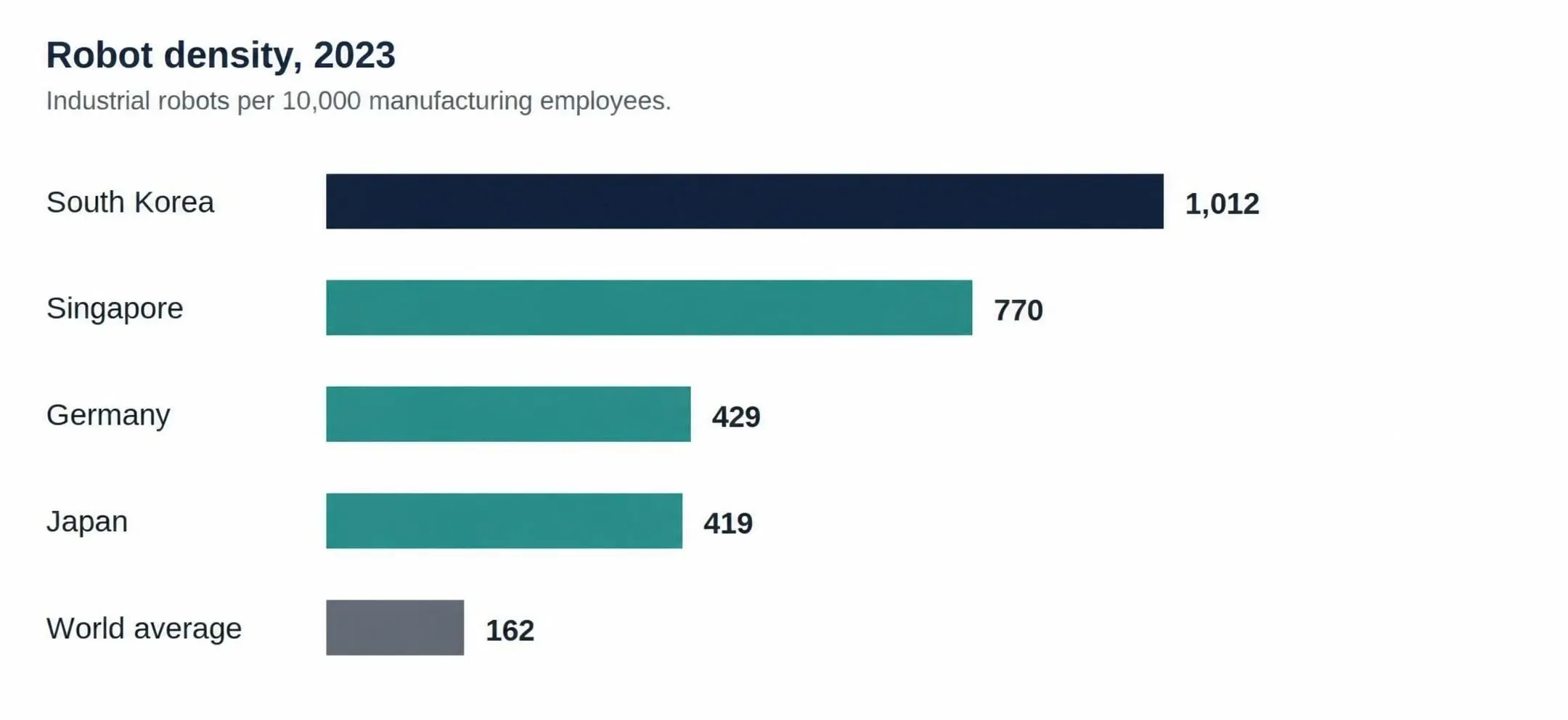
The operational stock of industrial robots rose 9% to 5 million in 2025. Installations grew 11 percent to above 600,000, with China taking 59 percent (354,000) and the United States ranking second at about 38,400. The forecast is 655,000 in 2026 and 806,000 in 2029. Density gives a different reading.
“The world average was 162 robots per 10,000 manufacturing employees in 2023, against 1,012 in South Korea, 770 in Singapore, 429 in Germany and 419 in Japan. Markets far below those levels hold the largest unserved demand.”
Robotics Regulation and Trade Policy: The Compliance Calendar
Development 10: U.S. Adds Foreign-Produced Advanced Robots to Its Covered List
On 28 July 2026 the Federal Communications Commission placed foreign-produced advanced robotic devices, covering autonomous mobile robots, humanoids and quadrupeds, on its Covered List. Drones were listed in December 2025 and routers in March 2026. New foreign-produced models need conditional approval from the Department of War to obtain equipment authorization, while previously authorized models can still be sold. Place of manufacture is now a market access variable for any robot sold into the United States.
Development 11: The EU Resets the Compliance Clock for Machinery and AI
Regulation (EU) 2026/1744 of 8 July 2026 routes AI safety requirements for machinery through the Machinery Regulation, which applies from 20 January 2027. Embedded high-risk obligations move to August 2028. AI Act enforcement began on 2 August 2026, Cyber Resilience Act reporting duties on 11 September 2026, and the Product Liability Directive must be transposed by 9 December 2026. Manufacturers face overlapping obligations on safety, cybersecurity and liability inside twelve months.
Development 12: Standards and Strategy Gaps Shape Both Sides
China's industry ministry set up a humanoid and embodied AI standards committee in 2025 and published an updated standards system in 2026 covering interfaces, safety and testing. In the United States there is still no national robotics strategy. A bipartisan bill proposes an 18-member National Commission on Robotics, and the Genesis Mission order directed a review of federal robotic laboratory capacity by 22 July 2026. A new part of the industrial mobile robot safety standard series also became available in September.
Physical AI Regulatory & Policy Calendar
| Date | Event | Area |
| 28 July 2026 | Foreign-produced advanced robots added to the Covered List | United States |
| 2 August 2026 | AI Act enforcement begins | European Union |
| 11 September 2026 | Cyber Resilience Act reporting duties start | European Union |
| Late September 2026 | Informal humanoid IPO criteria reported | China |
| 9 December 2026 | Product Liability Directive transposition deadline | European Union |
| End of 2026 | Target of 10,000+ commercial humanoids in 100+ use cases | China |
| 20 January 2027 | Machinery Regulation applies | European Union |
| August 2028 | Embedded high-risk AI obligations apply | European Union |
Autonomous Machines in Deployment: Demand, Mobility and the Proof Gap
Development 13: Robotaxi Operations Reach Commercial Scale
Operator-reported figures put the leading US driverless service at about 500,000 paid rides per week across roughly 4,000 vehicles in 14 metros in September 2026, with a goal of 1 million weekly rides by year end. A second operator began paid rides in a purpose-built vehicle in early September, and the federal vehicle safety regulator opened an audit query on 3 September. A leading Chinese operator reported 20 million cumulative rides by February 2026. Regulatory scrutiny now scales with fleet size.
Development 14: Labor Shortages and Emerging Markets Pull Automation Demand
Japan installed 36,219 industrial robots in 2025, down 19 percent, yet its March 2026 strategy targets 10 million AI-enabled robots across 18 sectors by 2040 to offset workforce shrinkage. Germany installed 24,842 units, down 8 percent. India installed almost 10,500, up 15 percent, with a 27 percent compound growth rate from 2020 to 2025, and Brazil installed almost 4,300, up 38 percent. Demand is moving toward markets with labor gaps and young installed bases.
Development 15: The Commercial Proof Gap Limits Humanoid Scale
A reported survey found only 23% of Chinese enterprise buyers satisfied with available humanoid products. Industry analysis names scarcity of physical training data as the main bottleneck for humanoid models. Buyers want full-shift endurance, workable unit economics and stable vendors before committing to multi-year procurement. Listing criteria and share price moves both point the same way: revenue evidence now matters more than demonstrations.
Physical AI Outlook for Q4 2026: What to Watch
- Listings: which humanoid filers in Hong Kong and on the mainland clear the revenue and loss tests.
- Production: China's year-end target of 10,000 commercial humanoids, and the 2026 forecast of 655,000 industrial installations.
- Defense: congressional treatment of the fiscal 2027 autonomy request.
- Trade: Department of War decisions on conditional approvals for foreign robot makers.
- Mobility: progress toward 1 million weekly robotaxi rides.
- Europe: the 9 December liability deadline and AI Act classification guidance expected by year end.
Research Methodology
- This article uses a combination of industry statistics, government and regulatory publications, company disclosures, funding databases, and reputable press reports to assess developments across the Physical AI landscape. Robot installation and density figures are based on World Robotics statistics released on September 24, 2026, and earlier editions where applicable.
- Policy and regulatory information is drawn from official government, legislative, and legal publications. Funding figures are compiled from venture-tracking datasets, whose coverage and inclusion criteria may vary across transactions. Defense-related figures refer to budget requests unless explicitly stated otherwise and should not be interpreted as enacted appropriations.
- Company, facility, and industry rankings or listings are based on publicly reported information, including press reports citing unnamed sources, where noted. Currency values are presented using exchange rates reported at the time of the relevant announcement.
- Operator- or company-reported figures have not been independently audited and are presented as disclosed. Because Physical AI spans robotics, industrial automation, autonomous systems, AI infrastructure, and other emerging technologies, definitions and reporting practices can vary by source; figures should therefore be interpreted within their stated source and period.
Frequently Asked Questions
What is physical AI?
- Physical AI is artificial intelligence that perceives, decides and acts in the physical world through robots, autonomous vehicles and intelligent machines.
Why do physical AI funding figures differ so widely?
- Trackers use different scopes. For the first half of 2026 the range is $18.8 billion to $55.8 billion, depending on whether vehicles, drones, defense platforms and AI-first companies are included.
Which regulations affect robot makers in 2026 and 2027?
- The US Covered List applies to new foreign-produced advanced robots from 28 July 2026. The EU Machinery Regulation applies from 20 January 2027.
How many industrial robots are in operation worldwide?
- A record 5 million in 2025, with 655,000 new installations forecast for 2026.