AI Vehicle Scanner Market Size and Growth 2026 to 2035
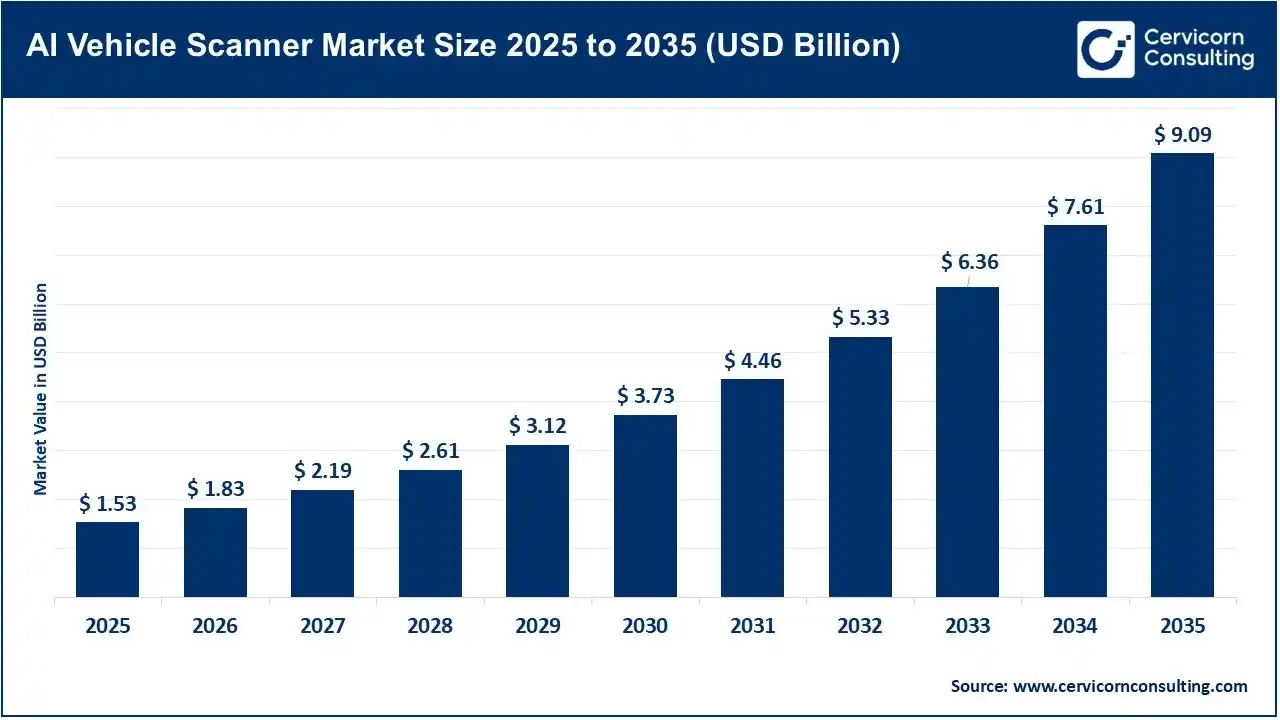
The global AI vehicle scanner market size was valued at USD 1.53 billion in 2025 and is expected to reach at USD 9.09 billion by 2035, growing at a CAGR of 19.5% during the forecast period from 2026 to 2035. As automotive businesses increasingly digitize the vehicle lifecycle from manufacturing and logistics to servicing, insurance, resale, and remarketing the addressable market for AI vehicle scanners is expected to broaden considerably.
Report Highlights
- By region, North America dominated the AI vehicle scanner market in 2025, supported by high AI adoption, a mature insurance ecosystem, extensive dealership networks, large commercial fleets, and a developed used-vehicle market. Asia Pacific is projected to be the fastest-growing region, driven by China's automotive and AI ecosystem, India's expanding vehicle market, increasing EV adoption, and growing investment in automated vehicle inspection infrastructure.
- By component, software dominated the market in 2025, owing to increasing adoption of AI-powered inspection platforms, automated damage detection, digital reporting, and cloud-based vehicle inspection solutions. Hardware is expected to register the fastest growth, supported by rising deployment of automated scanning portals, high-resolution cameras, sensors, and drive-through inspection systems.
- By technology, computer vision dominated the market in 2025, as it provides the core image-recognition capabilities required to identify dents, scratches, cracks, paint defects, and other vehicle abnormalities. Machine learning is projected to witness the fastest growth, driven by increasing availability of vehicle images, inspection records, and claims data for training advanced damage-recognition models.
- By application, damage detection dominated the market in 2025, due to its widespread use across dealerships, insurance companies, fleets, rental companies, auctions, and used-car marketplaces. Insurance claim assessment is expected to grow at the fastest pace, supported by increasing demand for automated claims processing, remote vehicle inspection, damage assessment, and fraud detection.
- By end user, insurance companies dominated the market in 2025, driven by the high volume of motor insurance claims and increasing adoption of automated claims-assessment technologies. Fleet operators are projected to register the fastest growth, owing to growing demand for automated vehicle-condition monitoring, damage documentation, maintenance assessment, and faster fleet turnaround.
AI Vehicle Scanner Market Overview
The AI vehicle scanner market landscape is transforming from manual physical inspection to intelligent automated condition assessment for vehicles. The AI vehicle scanning solution Integrates computer vision, artificial intelligence (AI), advanced ML capabilities, imaging sensors, LiDAR, sensors and cloud-based analytics to automate the assessment of exterior damages, tire’s and vehicle’s conditions, as well as documentation of vehicle status and providing digital inspection reports for vehicles. These AI-powered vehicle solutions have been deployed at Dealerships, Insurance companies, Fleet operators, Rental & Leasing companies, used car marketplaces, service shops and vehicle inspection centres.
The confluence of AI with the automated hardware scanner has also pushed towards the shift from an in-house traditional manual approach to a scalable standardized vehicle inspection approach. In this context, an instance that showcases the shift is the recent launch of the XENTRY Vehicle Scanner by Mercedes-Benz India at their Mumbai facility in August 2026.
AI Vehicle Scanner Regulatory Landscape
| Region / Market |
Key Regulatory Frameworks / Areas |
Market Implication |
| European Union |
EU AI Act, GDPR, EU vehicle type-approval framework, cybersecurity and software-related automotive regulations |
High compliance requirement, favoring vendors with strong data governance, explainability, cybersecurity, and documentation |
| United States |
Federal vehicle safety framework, NHTSA requirements, state-level inspection rules, data privacy laws, insurance regulations |
Market-specific compliance, with regulations varying by state and application |
| China |
Automotive inspection regulations, cybersecurity/data-security requirements, AI governance, vehicle and data regulations |
Strong opportunity but significant localization requirements |
| India |
Motor Vehicles Act and Central Motor Vehicle Rules, vehicle testing/inspection requirements, Digital Personal Data Protection Act, 2023, emerging AI governance framework |
Growing regulatory environment, creating opportunities for compliant automated inspection providers |
| Japan |
Road vehicle safety regulations, mandatory vehicle inspection system, APPI, automotive cybersecurity requirements |
Strong opportunity for highly accurate and standardized systems |
Major Industry Development Worth Noticing: Mercedes’ First AI-powered Vehicle Scanner in India
For the first time an AI-powered automated vehicle scanner is deployed by a carmaker, Mercedes-Benz India at its new Landmark Cars facility in Jogeshwari West, Mumbai, this August 2026. While that already sounds like some kind of future technology it's a critical move as that marks a transition in India from AI vehicle scanning to be the tool behind luxury auto after-sales operation.
The scanner has been installed at new 58,000sq ft premium service facility by the carmaker and the facility was launched as the Mercedes-Benz's largest luxury service center in the country. Featuring 16 preventive-maintenance and repair bay, nine body-and-paint bay along with nine supporting bays, it is set up like the high-volume situation in which operational benefits could really be realized through automated inspection technology.
Key Features of the System
1. It validates dealership and service-center demand
- The deployment demonstrates that AI scanning has practical applications beyond insurance claims and used-car marketplaces. Automotive after-sales service is emerging as another important commercial application.
2. It demonstrates the value of hardware & AI
- The system combines cameras, LiDAR, AI software, cloud connectivity and workshop integration, illustrating why the hardware segment is expected to experience strong growth as automated inspection becomes more sophisticated.
3. It improves inspection standardization
- Automated scanning can create a consistent inspection methodology rather than relying entirely on individual service-advisor judgment. This can be particularly valuable for premium automotive brands where transparent documentation of vehicle condition is important.
Market Dynamics
Driver
Growing Demand for Automated and Standardized Vehicle Inspection
The increasing need to reduce inspection time, improve assessment consistency, and minimize dependence on manual inspection is one of the primary drivers of the AI vehicle scanner market. Conventional vehicle inspections typically require trained personnel to visually examine the exterior, tires, underbody, and other components, photograph defects, document findings, and prepare inspection reports. This process can be time-consuming and subject to differences in inspector experience and judgment. AI vehicle scanners address these limitations by combining high-resolution cameras, computer vision, machine learning, LiDAR, and automated analytics to capture and evaluate vehicle conditions systematically. The technology can identify dents, scratches, cracks, paint defects, tire abnormalities, and other visible damage while automatically generating digital inspection records.
Restraint
Variability in Real-World Inspection Conditions
The accuracy of AI vehicle inspection systems can be affected by real-world environmental and operational conditions. Camera-based systems may perform differently depending on lighting, weather, vehicle cleanliness, camera positioning, image resolution, vehicle color, viewing angle, and the location or severity of damage. Minor scratches, dents, or damage in difficult-to-view areas may be particularly challenging for automated systems. Fixed scanners operating in controlled environments can reduce some of these challenges, but mobile and smartphone-based solutions may encounter greater variability. AI models also need to be trained using sufficiently diverse datasets covering different vehicle models, body styles, colors, geographic environments, and damage types. Maintaining consistent accuracy across these conditions is therefore an important technical challenge for market participants.
Opportunity
Growth of Mobile and Smartphone-Based AI Inspection
Mobile AI inspection represents an important opportunity to overcome the infrastructure and cost limitations associated with fixed scanning systems. Smartphone-based solutions can use the device's camera to capture standardized images or videos, which are then analyzed by cloud-based AI models. This approach can significantly reduce the need for dedicated scanning infrastructure and allow small dealerships, repair centers, insurers, fleet operators, rental companies, and independent inspectors to adopt AI inspection. Mobile solutions can also support remote insurance claims, vehicle handovers, pre-purchase inspections, and used-car assessments.
Regional Analysis
Why Is North America Leading the AI Vehicle Scanner Market?
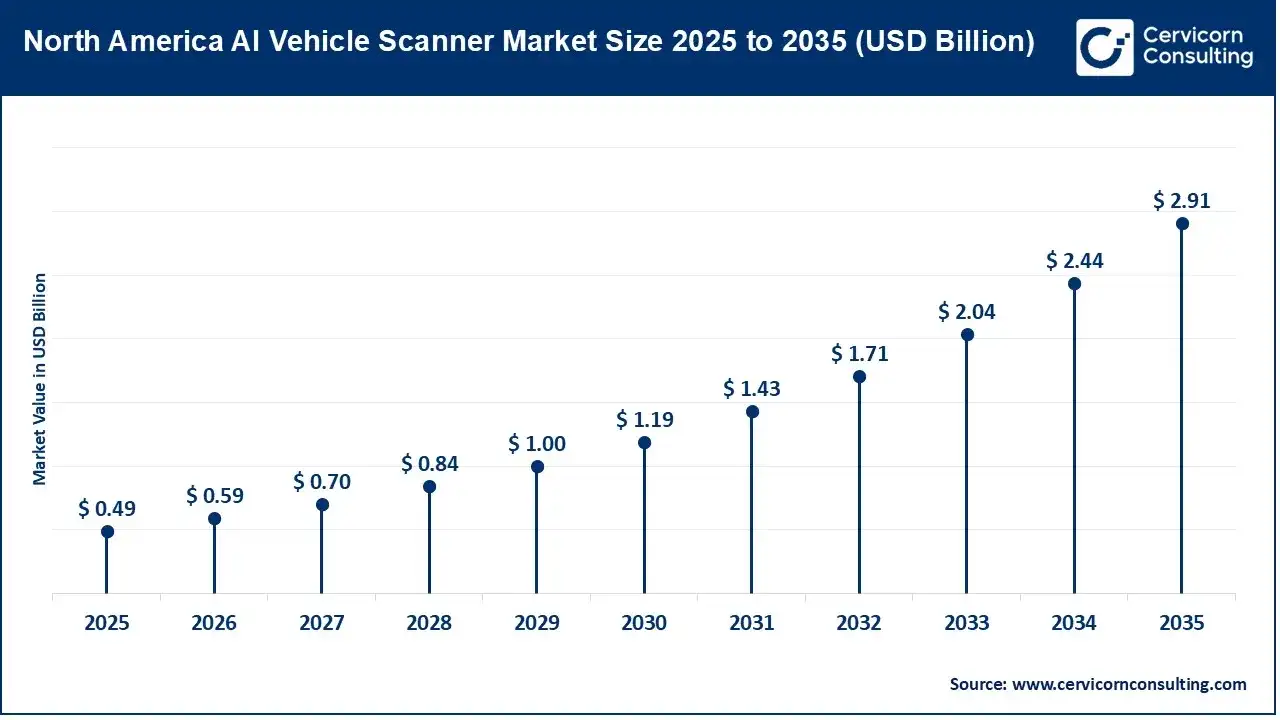
The North America AI vehicle scanner market size reached at USD 0.49 billion in 2025 and is anticipated to surpass USD 2.91 billion by 2035. North America captured most of the AI vehicle scanner market share in 2025 due to the widespread adoption of vehicle technology, advanced insurance infrastructure, established used vehicle segments, significant fleet size and high adoption of artificial intelligence and computer vision technology in vehicles.
North America is one of the leading geographical regions. United States’ huge potential for AI vehicle scanner market can be attributed to the large automotive ecosystem including vehicle population, auto dealers and repair services facilities and considerable use of various automotive technologies.
The insurance sector has a direct and prominent role in strengthening AI vehicle scanner demand in the region. The auto industry in North America comprises large network of technology companies in the fields of vehicle technology and artificial intelligence and various dealers. Auto repair and inspection facilities in North America are heavily adopting automated used car sales channels including huge market for used cars, which presents opportunities in acquiring AI vehicle scanners.
Top Countries to Adapt AI Vehicle Scanner by 2030
| Country |
Adoption Potential by 2030 |
Key Adoption Drivers |
| U.S. |
Very High |
Large vehicle parc, advanced insurance ecosystem, mature dealership networks, fleet digitization, and strong AI investment |
| China |
Very High |
Massive automotive market, EV leadership, government inspection infrastructure, AI ecosystem, and rapid automotive automation |
| India |
High |
Growing vehicle population, expanding used-car market, digital insurance, commercial fleets, and increasing automated vehicle-testing infrastructure |
| Germany |
High |
Strong automotive manufacturing base, industrial automation, machine vision capabilities, and stringent vehicle inspection requirements |
| Japan |
High |
Mature automotive industry, recurring vehicle inspection requirements, robotics expertise, and high technology adoption |
Asia Pacific AI Vehicle Scanner Market Trend
The Asia-Pacific AI vehicle scanner market size was estimated at USD 0.46 billion in 2025 and is projected to reach around USD 2.73 billion by 2035. Asia Pacific is expected to register the fastest growth in the AI vehicle scanner market during the forecast period, supported by its enormous automotive manufacturing base, expanding vehicle population, increasing used-vehicle transactions, rapid digitalization, and growing adoption of artificial intelligence. China has a massive automotive ecosystem and is rapidly expanding its use of AI, computer vision, autonomous technologies, and intelligent manufacturing. This creates opportunities for AI vehicle inspection across manufacturing, dealerships, insurance, fleet management, used-car marketplaces, and automotive service networks. Japan and South Korea have highly developed automotive industries and strong capabilities in robotics, computer vision, automation, and automotive electronics. These characteristics create favorable conditions for advanced automated inspection technologies.
India represents an increasingly attractive opportunity because of its expanding vehicle population, growing organized used-car market, increasing digital insurance adoption, large commercial vehicle ecosystem, and rapid expansion of automotive technology startups. Another major factor is the growth of electric vehicles throughout Asia Pacific. EV adoption is creating new inspection requirements related to battery enclosures, underbody damage, charging components, and accident-related vehicle assessment.
AI Vehicle Scanner Market Share, By Region, 2025 (%)
| Region |
Revenue Share, 2025 (%) |
| North America |
32% |
| Europe |
25% |
| Asia-Pacific |
30% |
| LAMEA |
13% |
Is China Becoming a Major AI Vehicle Inspection Hub?
China is increasingly emerging as a major hub for AI-powered vehicle inspection, supported by its enormous vehicle parc, large automotive manufacturing ecosystem, rapid adoption of computer vision and AI, expanding EV market, and strong domestic capabilities in cameras, sensors, machine vision, and automotive software. However, it is important to distinguish China’s strength in the broader AI automotive ecosystem from its still-developing market for dedicated AI vehicle inspection systems.
China's scale alone creates a significant opportunity. A recent market assessment estimates that the country has more than 340 million vehicles and more than 200 million annual inspection procedures, although its estimate that AI systems currently penetrate only 15–25% of formal inspection stations should be treated as a third-party market estimate rather than an official government statistic.
Segmental Analysis
Component Analysis
In 2025, the software segment held the largest market share and is likely to continue its dominance for global AI vehicle scanner market due to the fact that more and more image analysis functions involved for AI driven inspection rely on comprehensive software platforms for image processing, defect detection, damage classification, severity evaluation, inspection report generation and seamlessly integration of inspection result into the workflows of insurance, dealerships, fleet management and auto service.
On the contrast of traditional inspection tools, AI based vehicle scanning solutions extensively adopt computer vision algorithms, machine learning models, cloud based platform, analytical engines and automatic reporting features. Hence the software plays a critical role in an all-inclusive solution.
Hardware segment is estimated to grow the fastest across the forecast period as automotive players progressively adopt automated and high-speed vehicle scanning based inspection systems as replacement of their manual inspection tools.
Hardware refers to cameras, imaging systems, sensors, 3D imaging devices, lighting systems, scanning portals, edge computing devices and devices related to physical equipment that could generate vehicle-condition information by way of capturing vehicle images through high technology.
In particular, the rapid growth of demand driven by automated drive-through inspection is a key growth factor. Dealerships, vehicle auction house, fleet operations centers, car rental companies and logistics centers need automated scanning tools that could conduct car inspections quickly without requiring an inspector manually taking snapshots of every inch of the car, but by installing them inside fixed scanning system.
Technology Analysis
In the 2025 computer vision held dominance in the AI vehicle scanner market, as it provides the basis for automating the visual inspection process. The AI vehicle scanners rely on computer vision to analyze the video or images captured from the cameras and detect the anomalies associated with various parts of the vehicle, as per the reports on the 2025 AI vehicle scanner market.
The applications of computer vision algorithms is wide as they allow inspection to take place for any and all visible abnormalities in a vehicle, such as dent, scratch, crack, paint scratch, damaged or broken part, dent on bumper, broken windshield, wheel/rim and damage to the external elements.
Machine learning was projected to witness a rapid increase from all major AI techniques, as the demand for vehicle inspection platforms increase for models that learn from huge amounts of vehicle images as well as inspection outcomes. The machine learning based computer-vision models may improve to identifying the vehicle models, types and variety of damages along with various ambient parameters as well as severity level with more and more vehicles being processed, unlike traditional systems which only identify pre-defined pattern.
Application Analysis
In the AI vehicle scanner market in 2025, damage detection was the largest segment as physical vehicle damage detection continues to be the most established and monetizable use case for AI-powered inspection technology. An AI solution is able to detect various types of visible damages such as cracks, dent marks, paint scratches, windshield damages, broken headlights, bumper damages, broken lamps, windshield damages, wheel damages, and etc.
Damage detection solution provides value to the used-car value chain, comprising used car dealers, automotive marketplaces, car auctions, car financing firms, rental companies and fleet operators, etc., and enables these to acquire accurate information related to car condition before vehicles are transferred to others.
Insurance claim evaluation to emerge as a fastest-growing segment. The growing penetration of this segment will be driven by, as insurance companies already have a strong financial reason to automate vehicle damage assessment as well as expedite insurance claims processes.
Insurance claims for motor accidents traditionally need to incorporate physical inspections, visit by adjusting professionals, photos from vehicle and its damages, damage assessments done manually, repair costs calculation and communications between parties such as insurer, automobile owner, repair shops etc.AI based vehicle scanner help reduce these aspects of the value chain of insurance claims.
End User Analysis
Insurance companies represented the leading end-user segment in 2025 because vehicle inspection is deeply integrated into several insurance processes, including underwriting, claims assessment, damage verification, fraud detection, and vehicle risk evaluation. The insurance industry processes enormous volumes of vehicle-related claims. Consequently, even relatively small reductions in inspection costs or claims-processing time can produce significant operational benefits.
AI vehicle scanning enables insurers to move toward remote and automated claims assessment. Instead of requiring an adjuster to physically inspect every vehicle, insurers can use AI systems to analyze photographs or videos submitted by policyholders, repair facilities, or field inspectors.
Fleet operators are expected to register the fastest growth because large commercial fleets have a recurring need to inspect vehicles throughout their operating lifecycle. For large fleets, manual inspection can be time-consuming and expensive. AI scanners can automate vehicle-condition documentation and allow operators to inspect large numbers of vehicles more consistently.
AI Vehicle Scanner Market Competitive Landscape
- UVeye — Provides automated AI-powered vehicle inspection systems using high-resolution imaging and sensors to assess vehicle exteriors, tires and underbodies, with applications across dealerships, OEMs, fleets and rental companies.
- Tractable — Uses computer vision and AI to automate vehicle damage assessment, insurance claims and repair workflows from vehicle images, helping insurers accelerate claims processing and estimates.
- Ravin AI — Provides AI-based vehicle inspection solutions combining computer vision with automated inspection hardware for dealerships, rental companies, fleets and insurers.
- DeGould — Specializes in automated vehicle imaging and AI inspection for automotive OEMs and logistics operations, helping identify defects, damage and specification mismatches throughout vehicle production and distribution.
- Monk AI — Offers smartphone-based AI vehicle inspection that enables users to capture vehicle images and obtain automated damage detection and condition reports without requiring dedicated fixed scanning infrastructure.
- ProovStation — Develops automated vehicle inspection systems combining imaging, artificial intelligence and scanning infrastructure for automotive inspection and vehicle-condition assessment.
Recent Product Launches and Strategic Developments
- In June 2026: UVeye and CARFAX launched an integration combining automated vehicle inspection results with CARFAX service-history and recall information. Again, UVeye partnered with Jaguar Land Rover North America to deploy AI-powered vehicle inspection systems at major U.S. seaports.
- December 2025: Anyline announced that its AI-powered mobile technology had surpassed 100 million digital tire inspections worldwide during 2025. The milestone demonstrates the growing adoption of mobile computer vision for vehicle-condition assessment across dealerships, tire retailers, and automotive service centers.
Segments Covered
By Component
- Software
- Hardware
- Services
By Technology
- Computer Vision
- Machine Learning
- Deep Learning
- Image Processing
- Generative AI
- Other Technologies
By Application
- Damage Detection
- Insurance Claim Assessment
- Vehicle Condition Assessment
- Quality Control
- Safety Inspection
- Vehicle Valuation & Appraisal
- Predictive Maintenance
- Other Applications
By End User
- Automotive OEMs
- Automotive Dealerships
- Insurance Companies
- Fleet Operators
- Rental & Leasing Companies
- Used-Car Marketplaces & Auction Companies
- Automotive Service & Repair Centers
- Government Inspection Agencies
By Region
- North America
- Europe
- Asia Pacific
- Latin America
- Middle East and Africa