AI Optical Transceiver Market Size, Share, Growth 2026 to 2035
The global AI optical transceiver market size was estimated at USD 10.70 billion in 2025 and is projected to hit USD 130.62 billion by 2035, registering a CAGR of 28.4% over the forecast period 2026 to 2035.
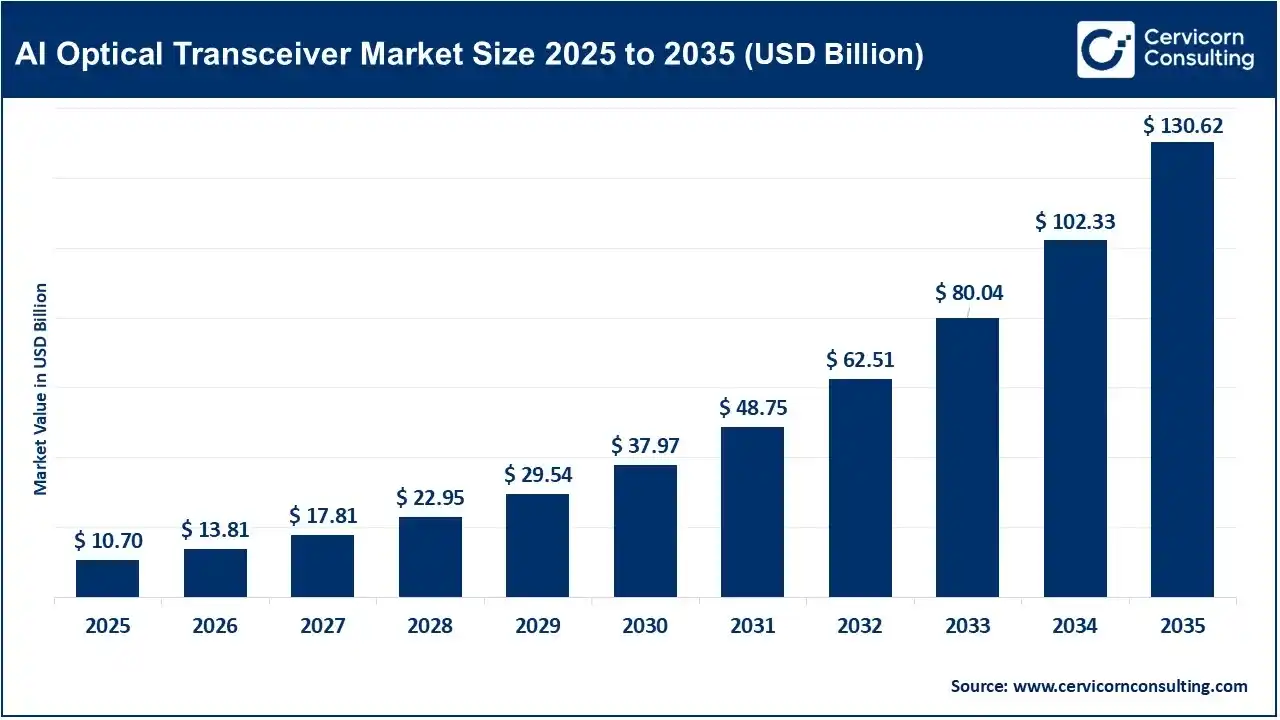
The AI optical transceivers market is growing as the demand for faster, higher-bandwidth, and low-latency data transmission in data centers rises due to the rapid expansion of AI workloads. The need for sophisticated optical transceivers that can effectively handle massive amounts of data is being driven by the expanding deployment of AI servers, GPUs, and high-performance computing infrastructure. Further bolstering market expansion are rising investments in AI data centers and the transition to energy-efficient networking technologies.
- In March 2026, NVIDIA announced a strategic partnership with Coherent to advance optical technologies for next-generation AI data center infrastructure. The collaboration focuses on expanding optical technology development and manufacturing capabilities, highlighting the increasing role of high-speed optical connectivity in scaling AI infrastructure.
Report Highlights
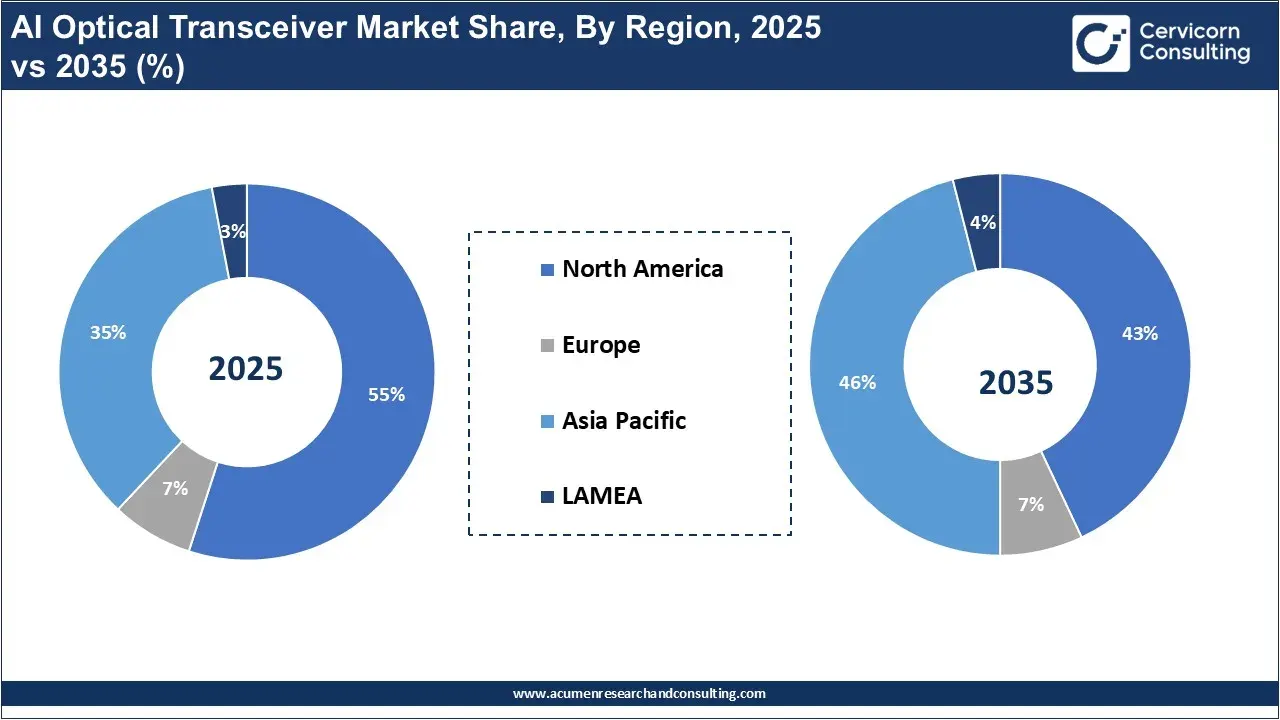
- By region, North America dominated the market in 2025, accounting for 55%, supported by the concentration of hyperscale AI infrastructure and data centers.
- By region, Asia-Pacific is expected to grow at the fastest rate, registering a CAGR of 32.3% during 2026–2035, driven by expanding AI infrastructure and data center investments.
- By data transfer rate, the 800G segment dominated the market in 2025, accounting for 57%, supported by rising bandwidth requirements across AI clusters and data centers.
- By application / network function, compute / AI fabric dominated the market in 2025, accounting for 70%, owing to high traffic between GPUs, accelerators, servers, and switches.
- By application / network function, data center interconnect (DCI) is expected to grow at the fastest rate of 32.7% CAGR, driven by expanding AI infrastructure across multiple data centers and campuses.
- By end user, hyperscale cloud service providers dominated the market in 2025, accounting for 58%, owing to the deployment of large AI training and inference clusters.
- By form factor, the OSFP-family segment dominated the market in 2025, accounting for 65%, supported by the adoption of 800G and 1.6T AI networking.
- By optical technology, EML-based technology dominated the market in 2025, accounting for 48%, supported by its established use in high-speed data center optical modules.
- By transmission reach, short reach (>100 m–2 km) dominated the market in 2025, accounting for 61%, owing to the concentration of AI clusters within data centers and nearby facilities.
Recent Trends
- Demand for Higher-Speed Connectivity: Growing AI workloads are increasing demand for high-bandwidth optical transceivers.
- Expansion of AI Data Centers: More AI-focused data centers are driving the adoption of advanced optical networking solutions.
- Focus on Energy Efficiency: Data centers are seeking high-performance transceivers with lower power consumption.
- Advancement in Optical Technologies: New optical solutions are being developed to support higher data volumes and faster transmission.
- Rising AI Infrastructure Investments: Increased spending on AI infrastructure is creating new opportunities for optical transceiver manufacturers.
- Growth of Cloud Infrastructure: Expanding cloud and hyperscale infrastructure is increasing demand for reliable optical connectivity.
- Need for Greater Network Capacity: Growing data traffic between GPUs, servers, and storage systems is driving demand for higher-capacity transceivers.
Market Dynamics
Driver: Rising Demand for High-Speed AI Connectivity
High-speed optical transceivers that can handle massive data volumes between GPUs, servers, and networking systems are becoming increasingly necessary as AI data centers are being deployed. In order to decrease bottlenecks and enhance network performance, data centers are shifting toward higher-bandwidth optical connectivity as AI workloads become more demanding. As 800G connectivity gives way to 1.6T connectivity, the need for cutting-edge optical technologies is growing.
- In March 2026, Marvell Technology announced an expanded 1.6T optical DSP platform portfolio designed to support next-generation AI data center connectivity. The announcement reflects the industry's shift toward higher-speed optical solutions as AI infrastructure continues to scale.
Restraint: High Complexity of Advanced Optical Components
DSPs, lasers, photonic technologies, and complex optical components are needed to develop high-speed optical transceivers. Growing transmission speeds can increase manufacturing and integration requirements as well as complicate transceiver design. These difficulties may have an impact on production scalability and raise the price of implementing next-generation optical solutions.
- In March 2026, Coherent announced demonstrations of next-generation 1.6T and 3.2T optical transceiver technologies, along with emerging architectures for 12.8T and beyond. The wide range of optical technologies and DSP solutions involved highlights the technical complexity associated with developing higher-speed transceivers.
Opportunity: Adoption of Silicon Photonics
Opportunities for faster and more effective optical connectivity in AI data centers are being created by the expanding use of silicon photonics. In increasingly dense AI infrastructure, silicon photonics can help address power and space requirements while supporting higher bandwidth. This is motivating businesses to create new transceiver architectures and optical engines for networks of the future.
- In March 2026, FIBERSTAMP Technology announced its 1.6T DR16-NPO silicon photonics engine and hybrid green interconnect technologies for AI-driven and hyperscale data center networks. The development highlights the growing opportunity for silicon photonics in next-generation AI optical connectivity.
Regional Analysis
Why did North America dominate the AI optical transceiver market?
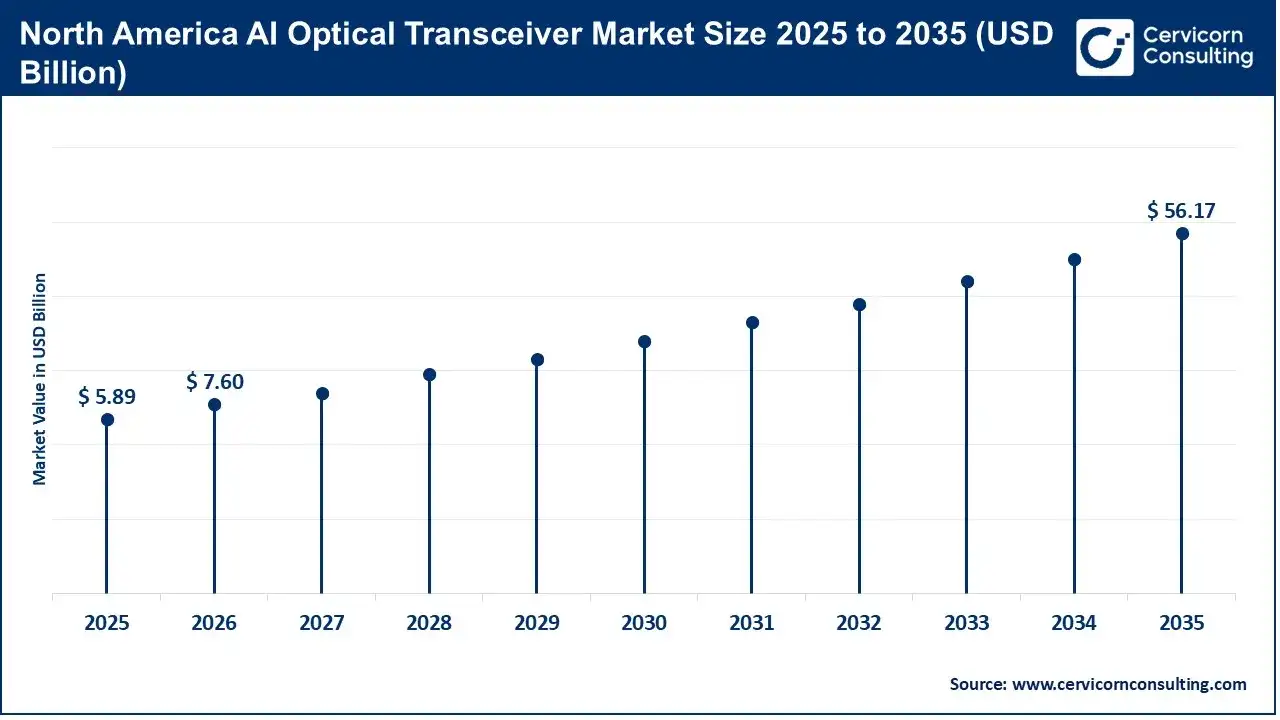
The North America AI optical transceiver market size was estimated at USD 5.89 billion in 2025 and is projected to hit USD 56.17 billion by 2035. North America dominated the market with a market share of 55% in 2025, supported by the region's high concentration of data centers and hyperscale AI infrastructure. Optical transceivers are in high demand due to significant AI and cloud infrastructure installations. The regional market is being supported by ongoing investment in AI data centers. Demand is anticipated to be sustained throughout the region by the expansion of AI computing infrastructure. The need for optical communication is still supported by widespread AI deployments.
Why is Asia-Pacific growing rapidly in the AI optical transceiver market?
The Asia-Pacific AI optical transceiver market size was valued at USD 3.75 billion in 2025 and is forecasted to reach USD 60.09 billion by 2035. Asia-Pacific is growing rapidly, registering a CAGR of 32.3% during 2026–2035, propelled by major domestic cloud providers and growing AI infrastructure. While South Korea, Taiwan, Japan, India, and Southeast Asia are also investing more in AI infrastructure, China is a key manufacturer of optical components. The need for optical communication is increasing due to the expansion of data centers. By 2035, the area is anticipated to hold a greater market share. This expansion is being aided by rising investments in AI computing facilities in key Asia-Pacific economies.
Segmental Analysis
Data Transfer Rate Analysis
The 800G segment dominated the market with a market share of 57% in 2025, with growth driven by increased data center and AI cluster bandwidth requirements. 800G transceivers are used to connect switches, servers, and GPUs. The need for high-speed optical connectivity is rising due to the expanding use of AI infrastructure. As AI workloads continue to grow, the segment is anticipated to continue to be used extensively. The use of 800G solutions is being further supported by increased data traffic within AI networks.
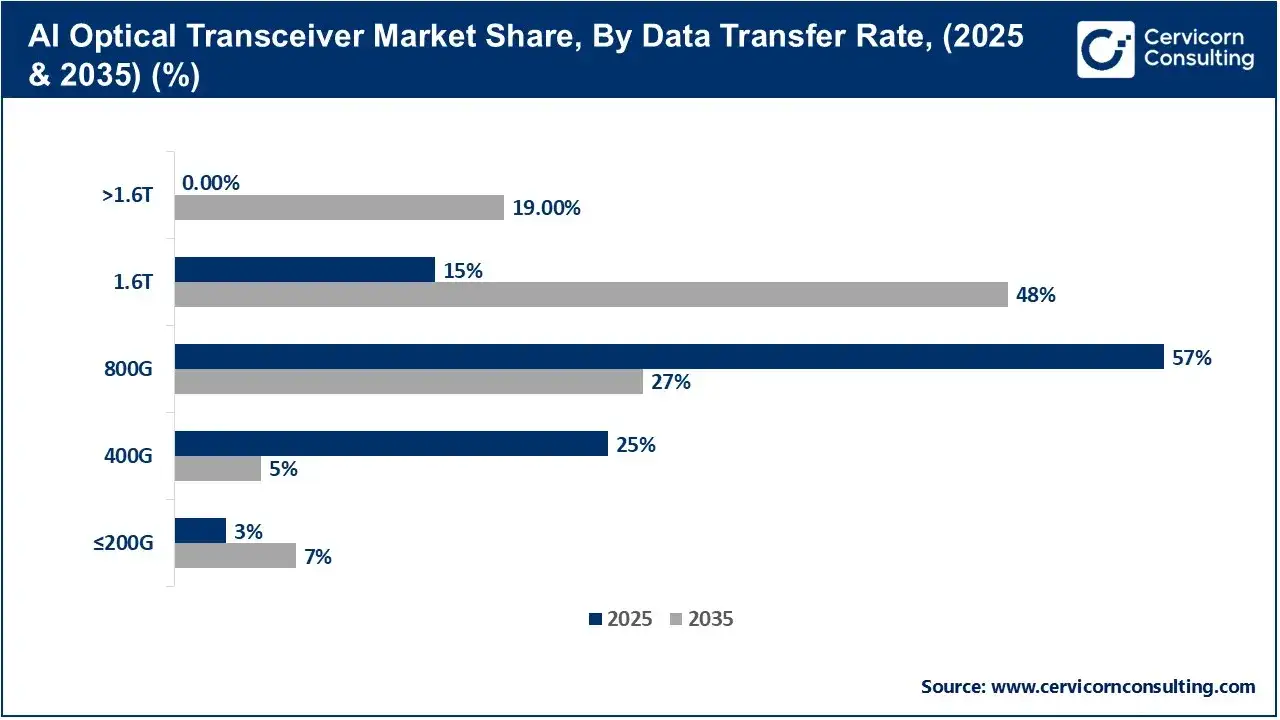
The 400G segment held second-largest share of 25% in 2025 in AI optical transceiver market. 400G transceivers provide a balance between data throughput, network scalability, power efficiency, and deployment cost, making them suitable for upgrading existing data center networks while supporting increasing AI workloads. The segment is also benefiting from the expansion of GPU clusters and the transition toward higher-speed data center interconnects, particularly where operators require greater capacity without immediately moving to 800G or higher-speed solutions.
Application / Network Function Analysis
The compute / AI fabric segment dominates the market with a market share of 70% in 2025, driven by a high volume of traffic flowing between servers, switches, and accelerators. High-speed optical connections are becoming increasingly necessary as the use of AI and machine learning grows. This segment is also supported by the implementation of 800G and 1.6T transceivers. Demand is anticipated to rise in response to growing AI computing requirements. Faster connections within AI fabrics are becoming increasingly necessary as GPU-based computing expands.
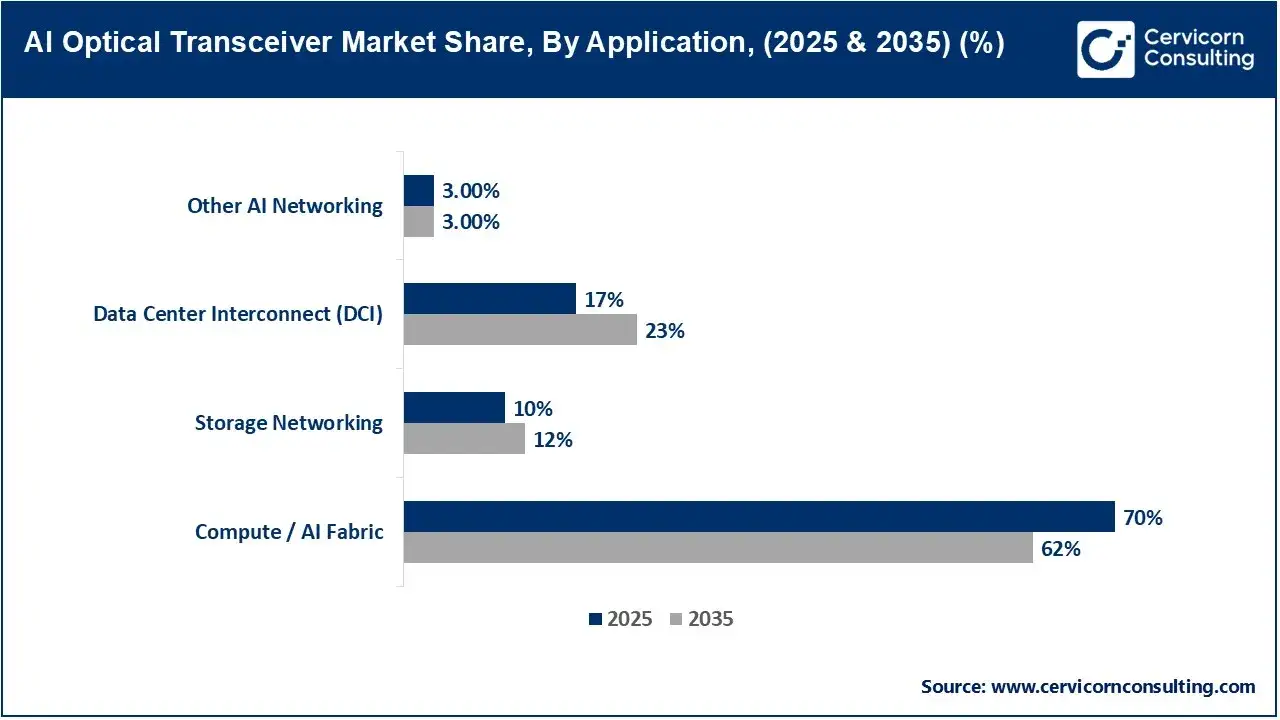
The data center interconnect (DCI) segment is growing rapidly, registering a CAGR of 32.7% during 2026–2035, driven by the growth of AI infrastructure across several campuses and data centers. Distributing AI infrastructure is being encouraged by grid constraints, land requirements, cooling requirements, and power availability. High-speed connections between facilities are becoming increasingly necessary as a result. The segment is anticipated to benefit from the growth of distributed AI infrastructure. More opportunities for DCI optical solutions are being created by improved connectivity between various AI facilities.
End User Analysis
The hyperscale cloud service providers segment dominates the market with a market share of 58% in 2025, propelled by the development of sizable AI training and inference clusters by major cloud platforms. High-speed optical connections between servers, GPUs, and networking equipment are necessary for these facilities. The demand from hyperscale providers is influenced by the growing deployment of AI computing capacity. This market is anticipated to be supported by additional growth in cloud-based AI infrastructure. The need for high-capacity data center networks is growing along with AI workloads on cloud platforms.
AI Optical Transceiver Market Share, By End User, 2025 (%)
| End User |
Revenue Share, 2025 (%) |
| Hyperscale Cloud Service Providers |
58% |
| AI Infrastructure / Neocloud Providers |
12% |
| Colocation / Data Center Operators |
11% |
| Enterprise |
9% |
| Government / Research |
4% |
| Telecom / Network Operators |
6% |
The AI infrastructure / neocloud providers segment is the second-largest segment with a market share of 12% in 2025, propelled by the growing usage of GPU clouds and specialized AI infrastructure providers. Renting GPU capacity is becoming more popular among businesses and AI developers as an alternative to creating their own clusters. Optical connectivity is becoming increasingly necessary as a result. The market is anticipated to be supported by the ongoing growth of specialized AI computing services. The demand from these providers is increasing as more businesses use external AI computing capacity.
Form Factor Analysis
The OSFP-family segment dominates the market with a market share of 65% in 2025, propelled by the transition to 1.6T AI networking and 800G. OSFP is frequently utilized in optical modules and high-speed AI switches. Its adoption is being aided by the requirement for high-density and high-power connectivity. The demand for OSFP-based products is anticipated to be supported by additional high-speed AI network deployment. This form factor is also being supported by the growing use of high-speed switches in AI data centers.
AI Optical Transceiver Market Share, By Form Factor, 2025 (%)
| Form Factor |
Revenue Share, 2025 (%) |
| SFP-family |
2%% |
| QSFP-family |
30% |
| OSFP-family |
65% |
| Other Pluggable |
1% |
| Embedded / Non-pluggable |
2% |
The QSFP-family segment is the second-largest segment with a market share of 30% in 2025, supported by the existing deployment base of QSFP-based data center optics. 400G QSFP-DD, 400G QSFP112, 800G QSFP-DD, and additional QSFP-based products are included in this section. Demand is being supported by the ongoing development of high-speed data center networks. Additionally, current infrastructure serves as a foundation for future deployment. Its market share is being supported by the ongoing adoption of QSFP-based equipment throughout data center networks.
Optical Technology
The EML-based segment dominates the market with a market share of 48% in 2025, supported by its proven application in optical modules for high-speed data centers. As the market shifts from 400G to 800G and 1.6T connectivity, EML technology is still in use. Its employment in high-speed applications is supported by its established technical basis, modulation performance, and reach. It is anticipated that the market will continue to be supported by demand for faster optical transmission. Large-scale data center deployments of EML technology are also supported by its maturity.
AI Optical Transceiver Market Share, By Optical Technology, 2025 (%)
| Optical Technology |
Revenue Share, 2025 (%) |
| VCSEL-based |
5% |
| EML-based |
48% |
| DML-based |
17% |
| Silicon Photonics-based |
27% |
| Coherent |
2% |
| Other / Emerging |
1% |
The silicon photonics-based segment is the second-largest segment with a market share of 27% in 2025, supported by its power efficiency, manufacturing scalability, and integration possibilities. High-density optical engines with 800G/1.6T connectivity employ silicon photonics. Additionally, the technology can be combined with cutting-edge packaging options. Its application is encouraged by the growing need for scalable and effective optical designs. More adoption prospects are being created by its use in next-generation AI networking.
Transmission Reach
The short reach (>100 m–2 km) segment dominates the market with a market share of 61% in 2025, supported by the significant concentration of AI clusters in adjacent facilities and data centers. These optical connections link accelerator pods, switches, racks, and GPU servers. The need for short-range communications is being met by the deployment of 800G and 1.6T optics. This market is anticipated to be supported by the ongoing growth of high-density AI data centers. Short-reach connections are still often utilized due to the concentration of computer equipment on data center campuses.
AI Optical Transceiver Market Share, By Transmission Reach, 2025 & 2035 (%)
| Transmission Reach |
Revenue Share, 2025 (%) |
Revenue Share, 2035 (%) |
| Very Short Reach (≤100 m) |
8% |
5% |
| Short Reach (>100 m–2 km) |
61% |
48% |
| Medium Reach (>2–10 km) |
17% |
19% |
| Long Reach (>10–80 km) |
13% |
22% |
| Extended Reach (>80 km) |
1% |
6% |
The medium reach (>2-10 km) segment held second largest share of 17% in 2025 in the AI optical transceiver market, supported by growing demand for reliable high-speed connectivity across distributed data center facilities, campus networks, and metropolitan-scale infrastructure. Medium-reach transceivers enable high-bandwidth data transmission over distances beyond standard intra-data-center links while maintaining the performance required for AI workloads, making them suitable for connecting separate buildings, data halls, and nearby computing facilities.
Government Initiatives
- In January 2025, Optical Transceiver Chipset for High-Bandwidth 6G Wireless Links: C-DOT and IIT Bombay signed an agreement to develop an optical transceiver chipset for high-bandwidth 6G wireless links. The initiative supports indigenous optical communication technology and future high-speed networks.
- In August 2026, End-to-End Optical Network Test Bed: C-DOT and the Department of Telecommunications signed an agreement to establish an end-to-end optical network test bed. It aims to support testing and commercialization of indigenous optical communication technologies.
- In May 2025, OPTINET Project: The European Innovation Council supported the OPTINET project to develop efficient optical networking technologies for data centers. The project supports higher-bandwidth and energy-efficient optical connectivity for next-generation data-center infrastructure.
Recent Developments
- In March 2026, Applied Optoelectronics announced that it received its first volume order for 1.6T data center transceivers from a major hyperscale customer to support growing AI workloads. The order reflects the increasing shift toward higher-speed optical connectivity as AI clusters expand.
- In March 2026, TE Connectivity announced its expanded optical infrastructure portfolio for next-generation AI data centers, including 1.6T high-speed cable assemblies, optical transceivers, and fiber-array technologies. The solutions are designed to support scalable and high-performance AI architectures.
- In March 2026, Credo Technology announced its second-generation 1.6T optical DSP family designed to address the bandwidth, scalability, and power requirements of AI data centers. The development supports the industry's move toward higher-speed and energy-efficient optical connectivity.
- In March 2026, Applied Optoelectronics announced demonstrations of its optical technologies ranging from 100G to 1.6T, along with a 6.4T on-board optics demonstration for AI networking. The company highlighted its expanding portfolio of optical interconnects for high-density AI infrastructure.
- In April 2026, Semtech announced its latest optical and active-copper interconnect technologies for AI data centers at OFC 2026, including demonstrations of 1.6T connectivity. The development highlights the growing need for high-bandwidth solutions in next-generation AI networks.
- In September 2026, Semtech announced a new 224G optical connectivity portfolio targeting near-packaged optics and co-packaged optics architectures for AI clusters and hyperscale data centers. The development supports higher-speed optical connectivity for increasingly demanding AI infrastructure.
Top Companies
Segments Covered
By Data Transfer Rate
- ≤200G
- 400G
- 800G
- 1.6T
- >1.6T
By Application / Network Function
- Compute / AI Fabric
- Storage Networking
- Data Center Interconnect (DCI)
- Others
By End User
- Hyperscale Cloud Service Providers
- AI Infrastructure / Neocloud Providers
- Colocation / Data Center Operators
- Enterprise
- Government / Research
- Telecom/Network Operators
By Form Factor
- SFP-family
- QSFP-family
- OSFP-family
- Other Pluggable
- Embedded / Non-pluggable
By Optical Technology
- VCSEL-based
- EML-based
- DML-based
- Silicon Photonics-based
- Coherent
- Others
By Transmission Reach
- Very Short Reach (≤100 m)
- Short Reach (>100 m–2 km)
- Medium Reach (>2–10 km)
- Long Reach (>10–80 km)
- Extended Reach (>80 km)
By Region
- North America
- Europe
- Asia-Pacific
- Latin America
- Middle East & Africa