AI Automation Market Size, Growth, Forecast 2026 To 2035
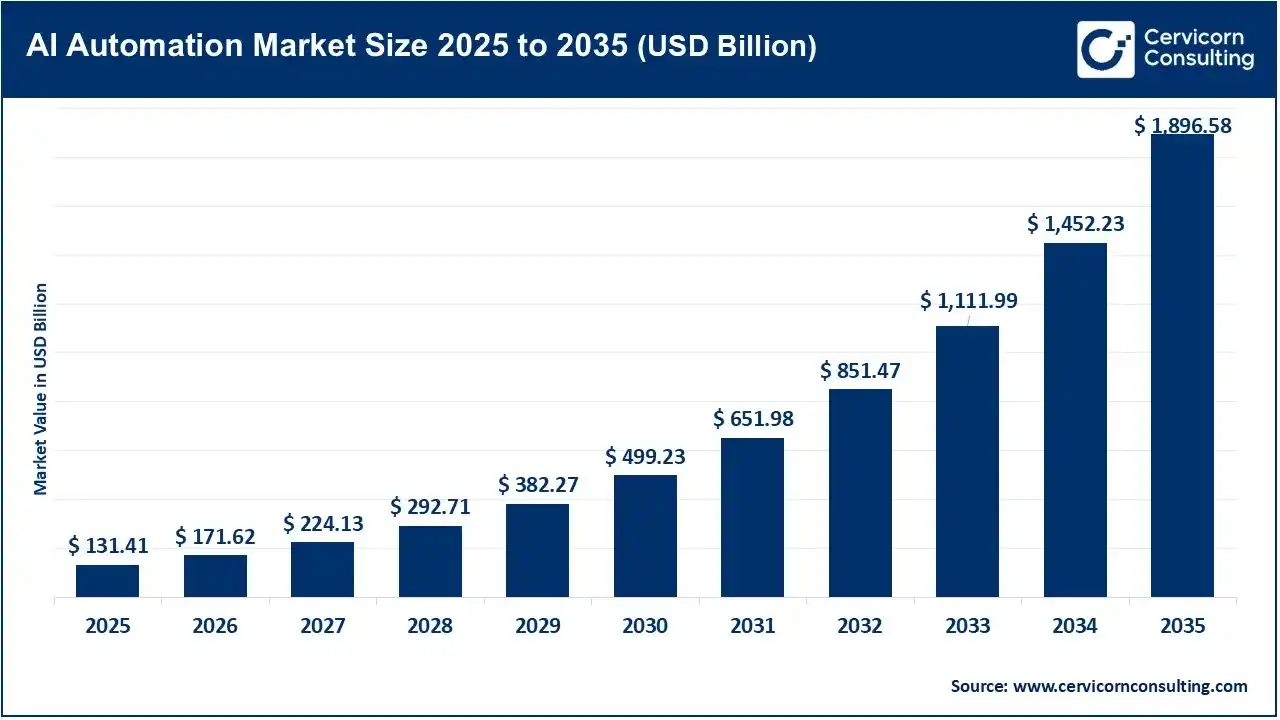
The global AI automation market size was valued at USD 131.41 billion in 2025 and is projected to exceed around USD 1,896.58 billion by 2035, growing at a compound annual growth rate (CAGR) of 30.6% over the forecast period from 2026 to 2035.
The AI automation market is driven by rapid enterprise adoption of artificial intelligence (AI), increasing pressure to reduce operating costs, and the need to improve workforce productivity. A recent 2025 survey found that 88% of organizations were using AI in at least one business function, up from 56% in 2021, while 79% reported using generative AI. AI automation is increasingly being applied to IT operations, customer service, document processing, finance, marketing, and business-process workflows, enabling organizations to automate repetitive tasks and accelerate decision-making. Cervicorns’ recent survey found that 42% of surveyed organizations identified the need to reduce costs and automate key processes as an important AI adoption driver, while 45% cited more accessible AI technologies.
Another major growth factor is the transition from conventional rule-based automation to intelligent and agentic automation, in which AI systems can understand context, make decisions, and execute multi-step workflows. Cervicorns reported in 2025 that 61% of surveyed CEOs said their organizations were actively adopting AI agents and preparing to implement them at scale, highlighting increasing enterprise interest in autonomous workflow execution. Meanwhile, recent reported that 44% of organizations were scaling AI across the enterprise in 2026, compared with 38% a year earlier, while AI use across three or more business functions increased from 51% to 56%. The growing availability of cloud AI platforms, embedded AI capabilities in enterprise software, improved data infrastructure, and increasing demand for 24/7 digital operations are therefore accelerating the adoption of AI-powered automation across industries.
Report Highlights
- North America represented approximately 34.6% market share, supported by advanced enterprise AI adoption and strong technology infrastructure.
- Intelligent Process Automation dominated the automation-type segment with a 29.4% market share, supported by widespread enterprise workflow automation.
- Machine Learning dominated the technology segment with a 17.2% market share, making it the largest technology category in AI automation.
- Cloud deployment dominated with a 56.8% market share, supported by scalability, flexibility, and lower infrastructure requirements.
- API-Based / Modular Integration led with a 43.7% market share, enabling flexible integration with existing enterprise software platforms.
- BFSI dominated industry adoption with a 20.8% market share, driven by fraud detection, compliance, customer service, and financial processing.
What is AI Automation?
AI automation refers to the use of artificial intelligence technologies such as machine learning, natural language processing (NLP), computer vision, generative AI, and AI agents to automate tasks, decisions, and end-to-end business workflows that traditionally require human intervention. Unlike conventional rule-based automation, AI automation can interpret unstructured data, understand context, make decisions, adapt to changing conditions, and execute multi-step processes across different systems. It is increasingly used for customer service, document processing, IT operations, finance, supply chain, HR, cybersecurity, and business process management.
AI Automation Market Recent Milestones
| Year |
Company |
Recent Milestone |
| 2025 |
UiPath |
Launched its enterprise-grade Platform for Agentic Automation, integrating AI agents, robots, and human workers into governed workflows. |
| 2025 |
UiPath |
Launched its enterprise-grade Platform for Agentic Automation, integrating AI agents, robots, and human workers into governed workflows. |
| 2025 |
ServiceNow |
Introduced new AI agent teams across CRM, HR, IT, and other functions through its Yokohama platform release. |
| 2025 |
ServiceNow |
Introduced new AI agent teams across CRM, HR, IT, and other functions through its Yokohama platform release. |
| 2026 |
IBM |
Introduced new AI agent teams across CRM, HR, IT, and other functions through its Yokohama platform release. |
AI Automation Market Dynamics
Market Drivers
1. Rising Enterprise Adoption of AI Agents
The increasing deployment of AI agents is a major driver for AI automation as enterprises move beyond simple chatbots toward autonomous, multi-step workflows. Recent industry research indicates that 79% of companies were already adopting AI agents, with 66% of adopters reporting measurable productivity improvements. Adoption is expanding across customer service, sales, IT, cybersecurity, finance, and software development, encouraging organizations to automate increasingly complex processes and integrate AI directly into day-to-day operations. This trend is accelerating demand for intelligent automation platforms.
2. Growing Demand for Workforce Productivity
Enterprises are increasingly using AI automation to augment employees, accelerate repetitive activities, and improve operational efficiency amid persistent productivity pressures. Recent enterprise research found that 75% of surveyed workers reported improved speed or quality of output, while users reported saving an average of 40–60 minutes per active working day. These measurable time savings encourage organizations to automate information retrieval, data analysis, coding, customer support, reporting, and administrative workflows, supporting broader adoption across multiple business functions and operational environments.
Market Restraints
1. Shortage of AI Skills and Expertise
A shortage of qualified AI professionals remains a significant constraint because organizations need specialized capabilities to design, integrate, monitor, and maintain automated systems. Industry research found that 33% of surveyed organizations identified limited AI skills and expertise as a major adoption barrier, while 16% reported difficulty finding new hires with required skills. The shortage increases implementation complexity and costs, particularly for SMEs, and can delay deployment as companies compete for data scientists, AI engineers, automation specialists, and employees capable of managing AI-enabled workflows.
2. Data Privacy and Trust Concerns
Concerns surrounding sensitive data, AI reliability, transparency, and uncontrolled automated decisions can restrict adoption, particularly in regulated industries. Research indicates that 57% of organizations identified data privacy as a major inhibitor to generative AI adoption, while 43% cited trust and transparency concerns. These issues become more significant when AI automation accesses customer records, financial information, healthcare data, or proprietary business systems. Organizations therefore require stronger security controls, explainability mechanisms, governance frameworks, and human oversight before deploying AI automation at scale.
Market Opportunities
1. Expansion of Agentic and Multi-Agent Automation
The transition from AI assistants toward autonomous and multi-agent systems presents substantial opportunities for vendors to automate complex, cross-functional workflows. Recent research found that 14% of organizations had already implemented AI agents at partial or full scale, while another 23% were running pilots. Multi-agent architectures can coordinate specialized AI systems across procurement, customer service, finance, and IT, creating opportunities for platforms that provide orchestration, monitoring, governance, and seamless integration with enterprise applications.
2. Rapid Adoption Across Emerging Markets
Emerging economies offer significant opportunities as businesses increasingly transition from AI experimentation toward operational deployment. Recent industry data indicates that more than 80% of Indian organizations were exploring autonomous AI agents, while 70% expressed strong interest in using generative AI for automation. The opportunity is particularly strong across customer service, financial services, manufacturing, healthcare, and IT services, where organizations can deploy cloud-based automation without extensive legacy infrastructure. Vendors offering localized language capabilities, affordable platforms, and industry-specific solutions can capture this expanding demand.
Market Challenges
1. Governance and Security of Autonomous Systems
As AI automation becomes more autonomous, organizations face challenges in controlling decisions, preventing hallucinations, managing permissions, and protecting systems from new attack vectors. Recent research found that 74% of surveyed organizations considered AI agents a new attack vector, while only 13% strongly agreed that they had appropriate governance structures in place. Consequently, enterprises must establish identity controls, audit trails, human-approval mechanisms, model monitoring, and security policies before allowing autonomous AI systems to execute sensitive business processes.
2. Difficulty Demonstrating Consistent ROI
Although AI automation can improve productivity, organizations continue to struggle with measuring financial returns across complex workflows and enterprise-wide deployments. Recent research found that 23% of business leaders did not know the return on their AI investments, despite substantial spending commitments, while the median positive return reported was only 10%. This creates pressure on AI automation providers to demonstrate measurable outcomes through clearly defined productivity, cost reduction, revenue, quality, and customer-experience metrics rather than relying solely on adoption or usage figures.
AI Automation Market Regional Analysis
The AI automation market is segmented by region into North America, Europe, Asia-Pacific, Latin America, and LAMEA. Here is a brief overview of each region:
North America AI Automation Market: Driven by Enterprise AI Adoption, Cloud Infrastructure, AI Agents, Workflow Modernization, and High Technology Investment
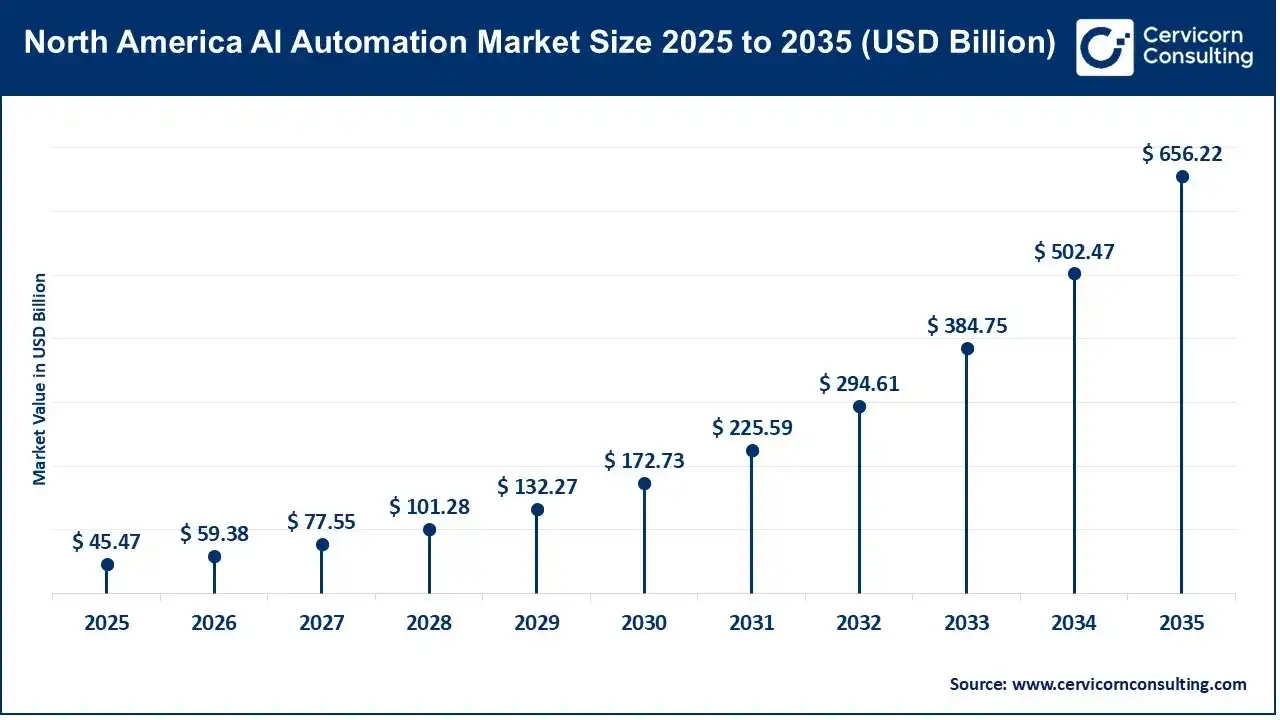
The North America AI automation market size was valued at USD 45.47 billion in 2025 and is expected to surge around USD 656.22 billion by 2035. North America is a leading and highly developed region, supported by widespread enterprise AI adoption, advanced cloud infrastructure, strong investment in AI technologies, and the presence of major technology providers. The U.S. represents the region's primary demand center, with Canada providing additional growth through digital transformation and AI adoption. Enterprises across BFSI, healthcare, retail, manufacturing, IT, and professional services are increasingly deploying AI automation for customer service, software development, business processes, cybersecurity, and decision-making. In 2025, 78% of U.S. organizations reported using AI, highlighting the region's strong readiness for AI-enabled automation.
United States: Enterprise AI Adoption, AI Agent Deployment, Cloud Infrastructure, and Automation Investment Drive Market Growth
- The United States accounted for approximately 57% of global private AI investment in 2025, demonstrating its exceptional concentration of capital and innovation in AI technologies.
- 88% of U.S. organizations reported using AI in at least one business function in 2025, creating a substantial installed base for AI automation applications.
Canada: Government AI Initiatives, Enterprise Digitalization, and Growing AI Infrastructure Support Market Expansion
- Canada's AI ecosystem benefits from substantial public and private investment, with the federal government committing CAD 2 billion through the Canadian Sovereign AI Compute Strategy to expand domestic AI computing capacity.
- Canadian organizations are increasingly implementing AI for customer service, document processing, cybersecurity, analytics, and operational automation, supporting demand across both public and private sectors.
Asia-Pacific (APAC) AI Automation Market: Driven by Rapid AI Adoption, Agentic Automation, Digital Transformation, Large Technology Ecosystems, and Expanding Enterprise AI Investment
The Asia-Pacific AI automation market size was estimated at USD 39.16 billion in 2025 and is forecasted to hit around USD 565.18 billion by 2035. Asia-Pacific is one of the fastest-evolving regions, supported by rapid enterprise digitization, expanding cloud infrastructure, strong technology ecosystems, and increasing adoption of generative and agentic AI. The region combines mature technology markets such as Japan, South Korea, Singapore, and Australia with high-growth economies including India, China, Indonesia, and Southeast Asia. In 2025, 78% of APAC employees reported using AI at work at least weekly, compared with 72% globally, while 70% of frontline employees regularly used AI.
China: Large Technology Ecosystem, Industrial AI, Enterprise Investment, and AI Commercialization Drive Market Growth
- China recorded a 75% GenAI adoption level in APAC research, placing it among the region's leading markets for enterprise and consumer AI adoption.
- 59% of Chinese organizations planned to increase their AI projects over the following 12 months, representing the highest proportion among several major APAC markets surveyed.
India: Rapid Enterprise Adoption, AI Agents, IT Services, and Digital Transformation Support Strong Market Expansion
- India recorded a 92% employee AI adoption rate, the highest among the APAC markets surveyed, highlighting exceptionally strong engagement with AI-enabled work.
- Indian enterprise AI investment increased 119% year over year, while AI currently represents 16.6% of average IT budgets, demonstrating rapidly increasing enterprise commitment.
- More than 50% of Indian companies are deploying AI agents, creating significant opportunities for autonomous customer service, software development, finance, healthcare, and business-process automation.
Europe AI Automation Market: Driven by Accelerating Enterprise AI Adoption, Industrial Digitalization, Regulatory Readiness, Cloud Transformation, and Intelligent Workflow Demand
The Europe AI automation market size was accounted for USD 32.46 billion in 2025 and is expected to surpass around USD 468.46 billion by 2035. Europe is a rapidly expanding market, supported by increasing enterprise AI adoption, digital transformation initiatives, advanced industrial capabilities, and growing demand for intelligent workflow automation. In 2025, 20.0% of EU enterprises with 10 or more employees used AI technologies, up from 13.5% in 2024, representing a 6.5-percentage-point increase. Adoption was particularly strong among large enterprises, reaching 55%, compared with 30.4% for medium-sized and 17% for small enterprises.
Germany: Industrial Automation, Manufacturing Digitization, Enterprise AI, and Advanced Engineering Support Market Expansion
- 26% of German enterprises used AI technologies in 2025, significantly above the EU average of approximately 20%, demonstrating strong enterprise readiness.
- Germany's manufacturing sector provides substantial opportunities for AI automation through predictive maintenance, quality inspection, robotics, production optimization, and intelligent supply-chain management.
- AI adoption in German manufacturing reached 24.4% in 2025, exceeding the EU manufacturing average of 17.3%, supporting strong demand for industrial AI automation.
United Kingdom: Financial Services, Cloud Adoption, Generative AI, and Digital Business Transformation Drive Demand
- The UK remains one of Europe's important AI markets, supported by strong financial services, technology, professional services, healthcare, and government digitalization.
- Over half of UK businesses reported using AI in at least one business function, demonstrating comparatively high enterprise experimentation and deployment.
AI Automation Market Share, By Region, 2025 (%)
| Region |
Revenue Share, 2025 (%) |
| North America |
34.6% |
| Asia-Pacific |
29.8% |
| Europe |
24.7% |
| LAMEA |
10.9% |
LAMEA AI Automation Market: Driven by Digital Transformation, AI Adoption, Cloud Infrastructure, Financial Technology, and Government-Led AI Initiatives
The LAMEA AI automation market was valued at USD 14.32 billion in 2025 and is anticipated to reach USD 206.73 billion by 2035. LAMEA represents an emerging and highly diverse market, with adoption being accelerated by digital transformation, expanding cloud infrastructure, fintech development, e-commerce, and government-backed AI strategies. Latin America is demonstrating strong consumer and enterprise interest, accounting for 14% of global visits to AI solutions while representing only 11% of global internet users. Meanwhile, Middle Eastern economies are investing heavily in AI infrastructure and national AI strategies, while Africa is gradually expanding AI adoption through fintech, telecommunications, healthcare, and public-sector digitalization.
Brazil: Strong AI Ecosystem, Enterprise Adoption, Fintech, and Digital Transformation Drive Latin American Demand
- Brazil is one of Latin America's AI leaders, with 17.1% AI adoption according to recent global adoption data, supported by its large digital economy and technology ecosystem.
- Brazil, Chile, and Uruguay are classified as AI pioneers, with scores above 60 in the 2025 Latin American Artificial Intelligence Index, reflecting comparatively strong infrastructure, talent, and innovation capabilities.
- Approximately 50% of Brazilian companies use AI, although only 15% are considered advanced adopters, indicating substantial room for expansion of enterprise automation.
Middle East: Government AI Strategies, Smart Cities, Cloud Infrastructure, and Digital Transformation Accelerate Market Growth
- Saudi Arabia recorded 26.2% AI adoption, according to recent global AI adoption data, demonstrating increasing penetration of AI technologies across organizations and users.
- The UAE and Saudi Arabia are investing heavily in AI infrastructure, national AI programs, smart-city initiatives, and digital government services.
- AI automation is increasingly relevant to banking, oil and gas, logistics, healthcare, government services, and customer experience, where organizations seek intelligent decision-making and operational efficiency.
AI Automation Market Segmental Analysis
The AI automation market is segmented into automation type, technology, deployment, integration mode, industry vertical, and geography.
Automation Type Analysis
Intelligent Process Automation (IPA) is expected to dominate the AI automation market, supported by its ability to combine AI, machine learning, workflow orchestration, and robotic process automation across enterprise processes. IPA is widely deployed for document processing, finance, customer operations, compliance, and back-office workflows, making it a mature entry point for enterprises. Its established RPA foundation and expanding agentic capabilities strengthen adoption across large organizations, while demand for end-to-end process optimization continues supporting its leading market position.
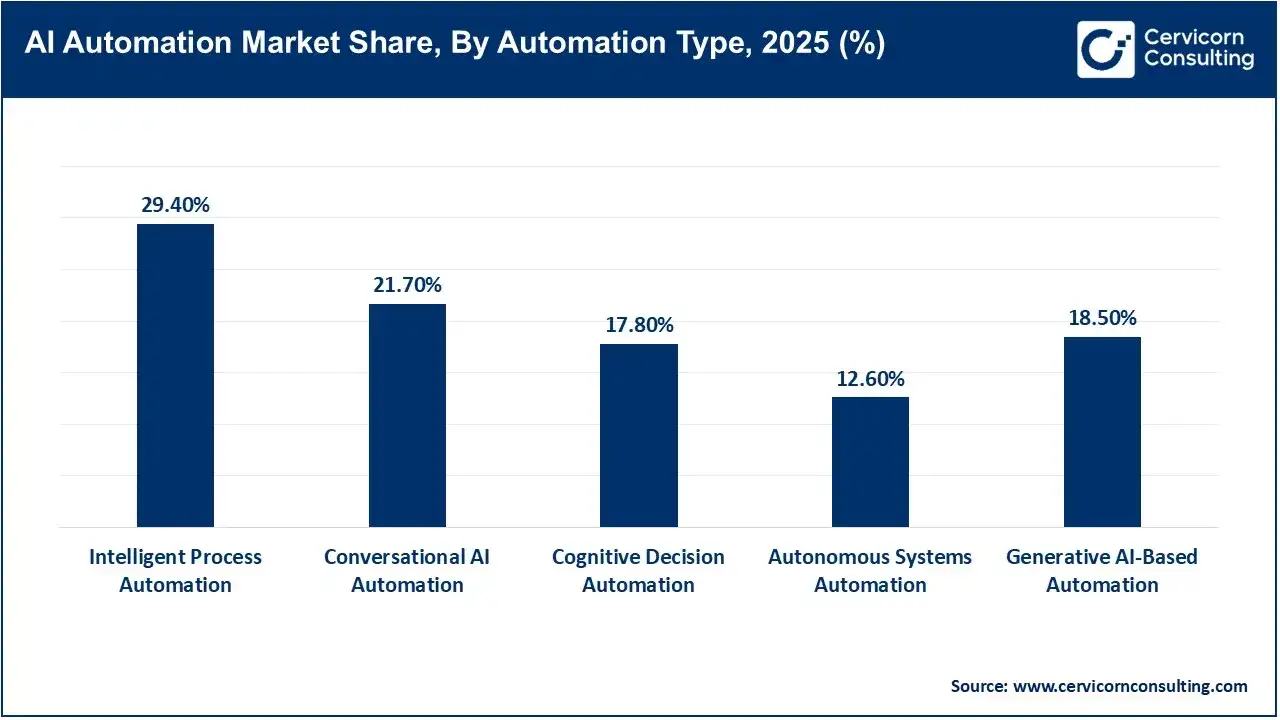
Generative AI-Based Automation is projected to be the fastest-growing automation type as enterprises increasingly use foundation models and AI agents to automate complex, knowledge-intensive workflows. Unlike conventional automation, generative AI can interpret natural-language instructions, generate content, summarize information, and coordinate multi-step activities. Generative AI platforms represented 31.84% of the generative AI in automation market in 2025, while agentic automation platforms are projected to expand rapidly through 2031, demonstrating strong momentum toward autonomous workflow execution.
Technology Analysis
Machine Learning (ML) dominated the technology segment with a 17.2% market share, supported by its extensive use in predictive analytics, intelligent decision-making, anomaly detection, recommendation systems, and automated workflow optimization. ML enables organizations to analyze large datasets, identify patterns, predict outcomes, and continuously improve automated processes without requiring explicit programming for every scenario. Its broad deployment across BFSI, healthcare, manufacturing, retail, IT, and telecommunications, combined with increasing availability of enterprise data and cloud-based ML platforms, continues to strengthen its position in the AI automation market.
AI Automation Market, By Technology, 2025 (%)
| Technology |
Revenue Share, 2025 (%) |
| Machine Learning |
17.2% |
| Natural Language Processing (NLP) |
13.6% |
| Computer Vision |
10.8% |
| Deep Learning |
9.4% |
| Reinforcement Learning |
4.8% |
| Generative AI |
15.7% |
| Predictive Analytics |
11.2% |
| Robotic Process Automation (RPA) |
12.5% |
| Others |
4.8% |
Generative AI is expected to be the fastest-growing technology segment as enterprises increasingly shift from task-based automation to intelligent systems that understand context and generate responses. Natural-language interfaces allow employees to create automated workflows with less technical expertise, while foundation-model APIs facilitate integration into existing applications. Increasing adoption of AI agents, document intelligence, content generation, and conversational automation is accelerating demand. This technology is also expanding automation into previously difficult-to-automate knowledge-intensive processes across multiple industries.
Deployment Analysis
Cloud deployment is expected to dominate the AI automation market because it provides scalable computing resources, flexible infrastructure, faster implementation, and easier access to continuously updated AI capabilities. Cloud platforms allow enterprises to deploy automation without significant investments in dedicated infrastructure while supporting rapid expansion across departments and locations. In the broader generative AI automation market, cloud deployment accounted for 56.8% of the market in 2025. Its scalability and integration with SaaS applications continue strengthening its position among enterprises.
AI Automation Market, By Deployment, 2025 (%)
| Deployment |
Revenue Share, 2025 (%) |
| Cloud |
56.8% |
| On-Premises |
24.3% |
| Hybrid |
18.9% |
Hybrid deployment is expected to register the fastest growth as organizations seek to balance cloud scalability with the security and control offered by on-premises infrastructure. Hybrid architectures are particularly attractive for enterprises handling sensitive financial, healthcare, government, and proprietary information while still requiring access to advanced cloud-based AI capabilities. Organizations can keep critical workloads within controlled environments while using cloud resources for scalable AI processing. Increasing data-sovereignty requirements and enterprise modernization are further supporting hybrid adoption across regulated industries.
Integration Mode Analysis
API-based, modular integration is expected to dominate the integration-mode segment, as enterprises increasingly prefer to connect AI automation capabilities to existing CRM, ERP, cloud, data, and workflow platforms rather than replace established systems. Modular APIs enable organizations to introduce AI capabilities incrementally while reducing implementation disruption and improving interoperability. The AI automation market currently identifies API-based/modular integration as the leading approach, reflecting growing demand for flexible architectures that enable enterprises to integrate AI models, automation tools, applications, and enterprise data.
AI Automation Market, By Integration Mode, 2025 (%)
| Integration Mode |
Revenue Share, 2025 (%) |
| API-Based / Modular Integration |
43.7% |
| Embedded AI Automation |
32.1% |
| Standalone Intelligent Platforms |
24.2% |
Embedded AI Automation is projected to be the fastest-growing integration mode as AI capabilities become increasingly incorporated directly into enterprise software and operational platforms. Rather than requiring separate automation environments, embedded solutions allow users to access AI-driven recommendations, content generation, decision support, and workflow execution within existing applications. This approach reduces user friction and supports faster adoption because organizations can activate AI capabilities within familiar systems. Increasing integration of AI agents into CRM, ERP, IT service management, and productivity platforms is accelerating this trend.
Industry Vertical Analysis
BFSI is expected to remain the dominant industry vertical because financial institutions have extensive repetitive processes, large volumes of structured and unstructured data, and strong requirements for speed, compliance, fraud prevention, and customer service. AI automation is being deployed across loan processing, fraud detection, risk assessment, customer support, compliance, reconciliation, and financial analysis. BFSI accounted for 20.8% of the AI automation market in 2025, and research on intelligent process automation also identifies it as the leading vertical.
AI Automation Market, By Industry Vertical, 2025 (%)
| Industry Vertical |
Revenue Share, 2025 (%) |
| Banking, Financial Services & Insurance (BFSI) |
20.8% |
| Healthcare & Life Sciences |
14.2% |
| Retail & E-Commerce |
13.1% |
| Manufacturing |
15.6% |
| IT & Telecom |
16.3% |
| Government & Public Sector |
7.4% |
| Energy & Utilities |
5.8% |
| Automotive |
4.3% |
| Others |
2.5% |
Manufacturing is projected to be the fastest-growing industry vertical as companies increasingly combine AI automation with connected production systems, predictive maintenance, quality inspection, robotics, supply-chain optimization, and autonomous decision-making. Manufacturers are adopting AI to reduce downtime, improve production efficiency, automate inspection, and optimize resource utilization. In the generative AI in automation market, manufacturing is projected to record approximately 31.2% CAGR through 2035, reflecting strong investment in intelligent production and AI-enabled industrial workflows.
AI Automation Market Top Companies
Segments Covered
By Automation Type
- Intelligent Process Automation
- Conversational AI Automation
- Cognitive Decision Automation
- Autonomous Systems Automation
- Generative AI-Based Automation
By Technology
- Machine Learning
- Natural Language Processing (NLP)
- Computer Vision
- Deep Learning
- Reinforcement Learning
- Generative AI
- Predictive Analytics
- Robotic Process Automation (RPA)
- Others
By Deployment
By Integration Mode
- API-Based / Modular Integration
- Embedded AI Automation
- Standalone Intelligent Platforms
By Industry Vertical
- Banking, Financial Services & Insurance (BFSI)
- Healthcare & Life Sciences
- Retail & E-Commerce
- Manufacturing
- IT & Telecom
- Government & Public Sector
- Energy & Utilities
- Automotive
- Others
By Geography
- North America
- Europe
- Asia-Pacific
- LAMEA