Agentic CPU Market Size, Growth, Forecast 2026 To 2035
The global agentic CPU market size was estimated at USD 3.20 billion in 2025 and is projected to surpass USD 1,088.48 billion by 2035; represents a remarkable CAGR of 79.1% during the forecast period from 2026 to 2035. This explosive growth is driven by the rapid scaling of AI-native computing workloads, where CPU utilization in agentic systems is increasing due to continuous inference, real-time decision loops, and autonomous task execution across enterprise environments. Additionally, next-generation data centers are deploying high-density AI compute clusters with up to 10,000+ accelerator-integrated CPU nodes per facility, significantly increasing hardware consumption and system-level demand for agentic processing architectures.
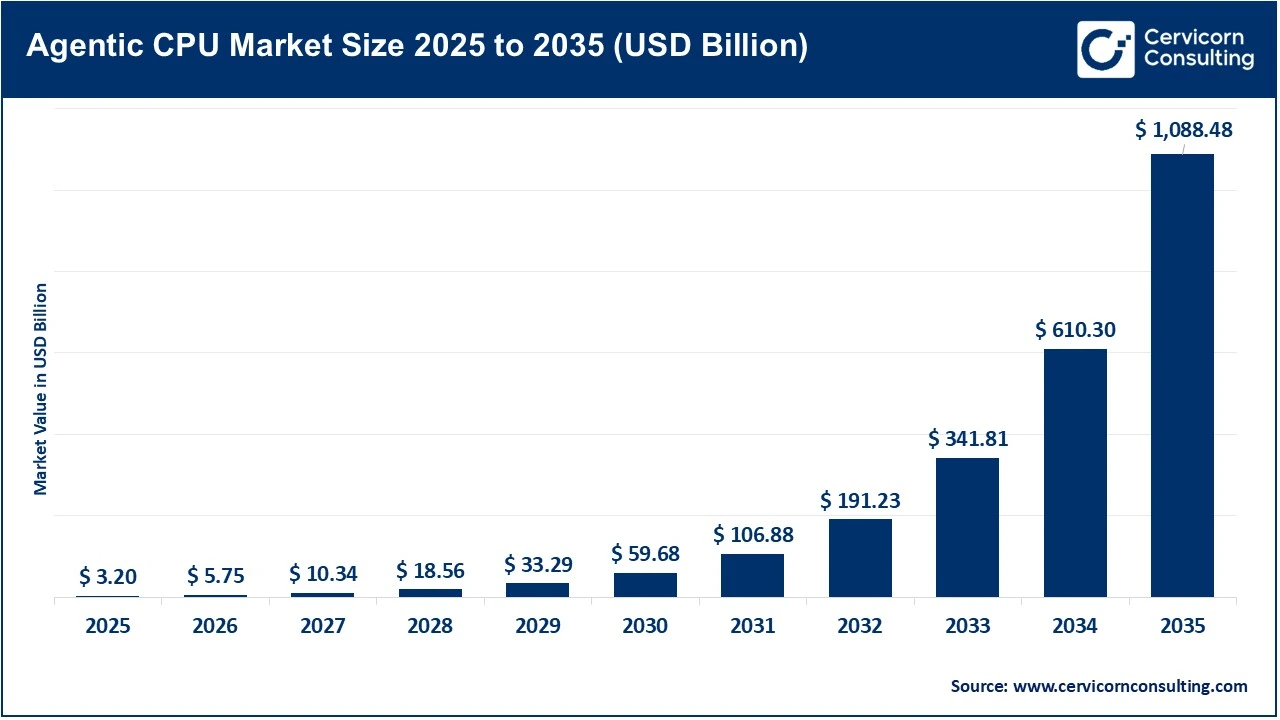
The agentic CPU market relates to the chip and compute technology landscape that aims to enable agentic artificial intelligence (AI) by offering CPUs tailor-made for those systems which can determine plans, decide on their next action, learn from previous actions, and then make the next action by autonomously executing with humans out of the equation.
The designs are geared towards constant AI inference, as well as high-speed data memory access, low-latency coordination, and distributing AI jobs to CPUs. That's why they have become an important element to AI factories, hyperscale and cloud, and also within enterprises who want autonomous jobs with CPUs as well as GPUs and system memory functioning together.
Report Highlights
- By region, North America accounted for the largest share of 46% in the market in 2025 attributed to its earlier large scale adoption of AI-native CPU architectures along with presence of significant leading hyperscale cloud ecosystems.
- By region, Asia Pacific is expected to witness the highest growth CAGR of 83.6% during the forecast period from 2026-2035, owing to the expansion of AI manufacturing ecosystem, government driven semiconductor initiative, and huge digital transformation initiatives.
- By CPU architecture, x86 processor segment dominated the market in 2025, accounting for a share of 68% as it possesses established ecosystem compatibility and offers optimized performance for enterprise AI workload.
- By CPU architecture, RISC-V processors segment is projected to grow at the fastest CAGR of 98.2% during 2026-2035, on account of the growing adoption for customization and standardization of processors for AI native computing.
- By deployment, cloud data centers segment captured the largest market share of 52% in 2025, due to high demand for concentrated AI compute and significant proliferation of hyperscale infrastructure to perform large scale AI model training.
- Based on deployment, hybrid cloud Infrastructure segment is expected to witness the largest CAGR of 91.5% during the forecast period due to increase in demand for distributed AI workloads on premise and public cloud infrastructure.
- By application, AI copilots and digital agents segment led the market in 2025 with a market share of 26% due to widespread adoption of AI driven tools for task automation and enhanced decision support.
- By application, RAG (Retrieval-Augmented Generation) segment held the second largest market share in 2025 with a market share of 18% as these applications require well-organized retrieval of information and are contextually dependent to produce better results.
- By end-user, hyperscale cloud provider's segment held the major market share of 38% in 2025 with large investment for massive compute resources in AI cloud computing to accelerate large scale model training.
- By end-user, enterprise segment held the second largest market share of 24% in 2025 owing to growing adoption of AI agents for tasks involving automated decision-making, analytics, workflow management and automation.
What are Major Applications of Agentic CPU?
- AI copilots and autonomous digital agents: AI copilots use agentic CPUs for timely, in-the-moment decisions and task automation, with the adoption of AI assistant workload on track for 35%-40% year over year global enterprise usage growth 2023-2026 driven by workforce productivity and automation needs.
- Hyperscale AI data centers and AI factories: These CPUs orchestrate massive GPU deployments found in AI factories, for modern large-scale AI facilities incorporating 10,000 to 25,000 GPU nodes each require a highly capable x86 CPU for workload scheduling, memory access control and in-bandference control.
- Cloud computing & distributed AI systems: Cloud platforms are leveraging these agentic CPUs to schedule workloads across distributed data centers in different regions, serving a vast user base. By 2027, it is anticipated that more than 60 percent of global compute resources will reside in hyperscale data centers, spurring high demand for these types of CPU in the cloud infrastructure ecosystem.
- Retrieval-Augmented Generation (RAG) systems: Agentic CPUs play an integral role within data- intensive RAG pipelines designed to ingest massive indexes and efficiently context retrieve from unstructured or semi-structured datasets; RAG-enabled enterprise AI systems are expected to grow by over 30% annually.
- Enterprise workflow automation: Businesses of all sizes increasingly implement agentic CPUs to automate their internal workflows and operations across departments like finance, human resources, and information technology. It is expected that 45% of large organizations will be utilizing enterprise workflow automation on a global scale in 2025.
- Edge AI and real-time decision systems: Edge devices ranging from those in manufacturing facilities to automotive systems, consumer electronics to public safety equipment are leveraging agentic CPUs for processing massive volumes of data in real-time; enabling decision speeds of under 10 milliseconds for critical functions and low-latency control systems.
Report Scope
| Area of Focus |
Details |
| Market Size in 2026 |
USD 5.75 Billion |
| Market Size in 2035 |
USD 1,088.48 Billion |
| CAGR 2026 to 2035 |
79.1% |
| Dominant Region |
North America |
| Fastest Growing Region |
Asia-Pacific |
| Key Segments |
CPU Architecture, Deployment Environment, Application, End User, Region |
| Key Companies |
NVIDIA Corporation, Intel Corporation, Advanced Micro Devices, Inc., Qualcomm Incorporated, Arm Holdings plc, Apple Inc., Amazon Web Services, Inc., Google LLC, Microsoft Corporation |
Market Dynamics
Driver
Rapid Scaling of AI Compute Infrastructure and CPU-Centric Orchestration Demand
It is the continued acceleration of AI compute infrastructure that is the fundamental engine of the agentic CPU market. As enterprises and providers are rapidly creating densified AI systems with always-on processing and dynamic interaction across multiple CPU, GPU and memory architectures, more and more organizations are finding their overall solution requires robust control over scheduling across diverse tasks.
The increasingly dense build-outs seen in hyper-scale AI locations and within a modern AI factory mean more and more infrastructure includes 10,000 or even 25,000 GPUs across a facility. These systems demand the very best levels of orchestration over and across CPUs so the data, the agents and resources can be routed, coordinated, and utilized at highest density, especially as AI compute is not intermittent in many workloads.
Restraint
High Design Complexity and Semiconductor Supply Constraints
Although agentic CPU has strong market growth prospects, the major restraint of agentic CPU is that the design of AI-native CPU architectures poses challenges as agentic-aware CPUs need high integration capabilities and specialized interconnection capabilities along with high computing power. In particular, it’s difficult to support high computing speed when CPU needs advanced semiconductor node technology and high bandwidth memory as it’s cost effective to incorporate.
Opportunity
Growth of AI-Native Computing Ecosystems and Edge Intelligence Expansion
Massive growth opportunity exists in the agentic CPU market, fueled by growing AI-native computing ecosystems where CPUs are being redefined to act as intelligent orchestrators for distributed AI applications. The proliferation of AI-intensive workloads on the edge will lead to significant demand for low-power and efficient agentic CPUs to make real-time decisions in autonomous systems, such as smart factories, automobiles and IoT devices.
Investment into AI infrastructure will further accelerate this growth, with total global hyperscaler capex expected to exceed $400 billion by 2025-2026, with a significant share in AI-specialized compute infrastructure. Hybrid AI architecture, integrating cloud, edge and on-premise AI, also enables new, complex use cases that require distributed intelligence across diverse systems, driving increased demand for agentic CPUs.
Regional Analysis
What Made North America Dominate Agentic CPU Market in 2025?
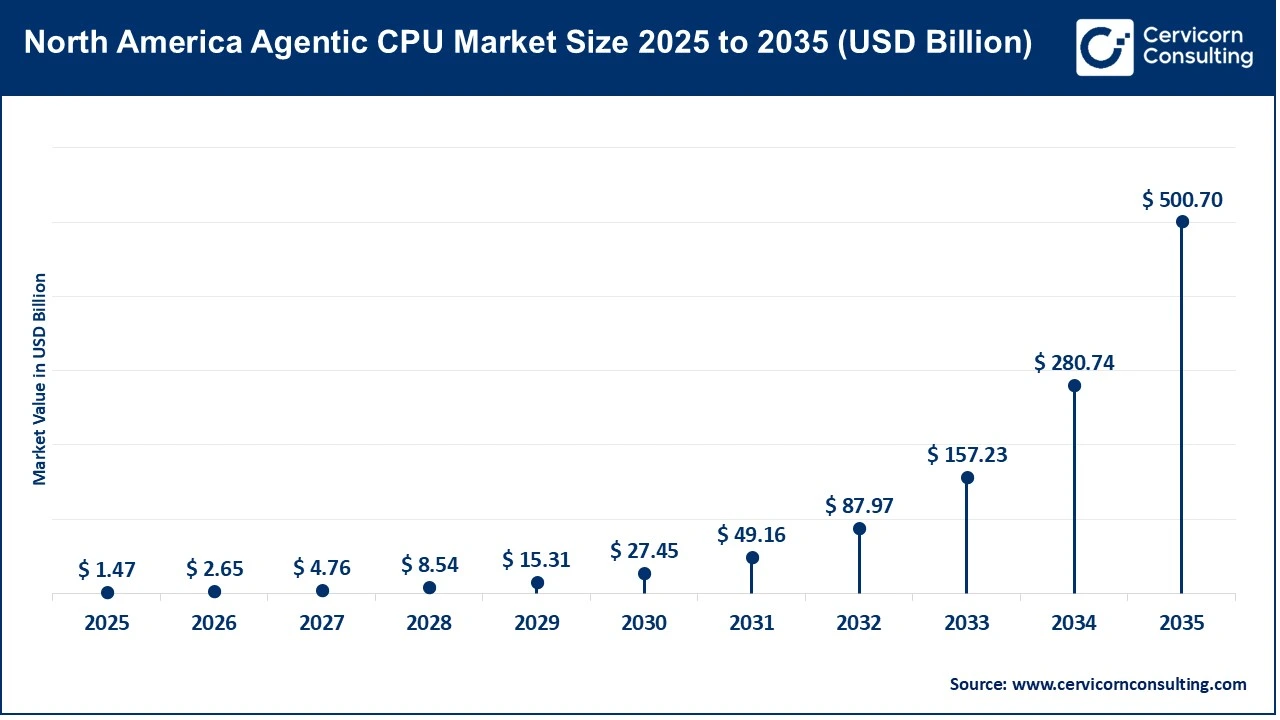
The North America agentic CPU market size is calculated at USD 2.65 billion in 2026 and is forecasted to reach USD 391.85 billion by 2035 at a CAGR of 74.2% from 2026 to 2035. North America’s leadership is driven by the region’s sophistication of its semiconductor ecosystem, robust hyperscale AI investments, and the speed with which it is adopting autonomous AI across the enterprise. The region is increasingly the global heart of AI-native computing with its mature digital infrastructure and readiness to deploy next-generation AI workloads.
This growth is being spurred largely due to a density of major semiconductor and AI infrastructure companies including NVIDIA Corporation, Intel Corporation, Advanced Micro Devices, Inc. And Microsoft Corporation to develop and scale AI -optimized processors, the world’s largest hyperscale cloud instances, GPU coordination tools.
U.S. Agentic CPU Market Analysis
- U.S. represents largest installed base led by nation's leadership position in semiconductor innovation, cloud infrastructure and enterprise adoption of AI. These key factors drive the U.S. agentic CPU market as a critical nucleus of agentic AI development.
- In addition to other factors, the presence of leading U.S. semiconductor vendors, Nvidia, Intel, Advanced Micro Devices and Qualcomm, the world largest cloud providers and highest enterprises adoption rate are to “spur significant growth in the U.S. agentic CPU market.
- Enterprise AI adoption in the U.S. is accelerating across sectors such as finance, healthcare, retail, and software development, where agentic CPUs are increasingly used for AI copilots, autonomous workflows, and real-time decision-making systems.
Agentic CPU Market Share, By Region, 2025 & 2035 (%)
| Region |
Revenue Share, 2025 (%) |
Revenue Share, 2035 (%) |
| North America |
46% |
36% |
| Europe |
16% |
15% |
| Asia-Pacific |
32% |
40% |
| LAMEA |
6% |
9% |
Why is Asia Pacific expected to witness the fastest rate of expansion in the agentic CPU market?
The Asia-Pacific agentic CPU market size is recorded at USD 1.84 billion in 2025 and is expected to hit USD 435.39 billion by 2035; reflecting a CAGR of 83.6% from 2026 to 2035. Several countries like Japan, South Korea, India, and China in Asia-Pacific are increasingly expanding their AI compute capacities by investing heavily in areas like semiconductors, AI infrastructure, robotics, and sovereign AI programs. The growing need for regional industrialization and deployment is propelling growth in the segment in Asia-Pacific.
China contributes greatly to the growth of the region’s agentic CPU market owing to its high concentration of chip manufacturing units and swift adoption of AI technology in cloud infrastructure.
With the rising implementation of high-tech manufacturing and robotics, Japan and South Korea are boosting the market’s growth across the region. Furthermore, India is steadily becoming the fast-evolving agentic CPU market across the Asia-Pacific region through investments in India's AI data centers and its cloud infrastructure.
Segmental Analysis
CPU Architecture Analysis
Which CPU Architecture Segment Dominated the Agentic CPU Market?
X86 processors segment dominated with a 68% market share in 2025, anticipated to expand at a healthy CAGR of 72.3% during the forecast period. Its mature software ecosystem, comprehensive compatibility with existing hardware, and ability to interface seamlessly with GPUs have contributed to x86’s leading market share.
Many of the large AI-enabled hyper-scale data centers and enterprise compute infrastructure are based on x86 deployments, supporting many forms of agentic AI including multi-agent orchestration, retrieval pipelines and sandboxed execution.
Agentic CPU Market Share, By CPU Architecture, 2025 & 2035 (%)
| CPU Architecture |
Revenue Share, 2025 (%) |
Revenue Share, 2035 (%) |
| x86 Processors |
68% |
48% |
| ARM-Based Processors |
22% |
35% |
| RISC-V Processors |
2% |
5% |
| Custom Proprietary Architectures |
8% |
12% |
The RISC-V processors segment is poised for tremendous growth, growing at a CAGR of 98.2% during the forecast period from 2026 to 2035. This growth is fueled by a growing need for an open source and customizability enabled CPU architectures suitable for AI-native computing. This allows chip makers and businesses to design chips for a highly specialized architecture that are effective for complex reasoning-intensive calculations, efficiently manage memory, and orchestrate real-time activities in autonomous AI solutions that make autonomous decisions and build agents that can carry on complex and intelligent behaviors without constant intervention or manual orchestration.
Deployment Analysis
Which Deployment Segment Led the Agentic CPU Market?
Cloud data centers segment captured market share of over 52% in 2025 and is expected to continue dominate the market through the forecast period at 76.2% CAGR, primarily due to significant increase in the hyperscale AI infrastructure and expansion of large scale AI models within cloud data center infrastructure. Cloud data centers are the main basis for building and running LLMs, autonomous AI Agents and advanced multi-hop reasoning systems. Agentic CPUs are integral to synchronizing the GPU compute tasks, memory usage, retrieval of context information, and the distributed execution.
Agentic CPU Market Share, By Deployment, 2025 & 2035 (%)
| Deployment |
Revenue Share, 2025 (%) |
Revenue Share, 2035 (%) |
| Cloud Data Centers |
52% |
45% |
| Enterprise Data Centers |
28% |
20% |
| Edge AI Infrastructure |
8% |
13% |
| Hybrid Cloud Infrastructure |
12% |
22% |
The hybrid cloud infrastructure segment is expected to register the fastest CAGR 91.5% from 2026 to 2035. This is driven by the ongoing rise in the business requirement for managing on- premise data security and cloud scalability. Agentic CPUs can be extensively useful here for orchestrating work streams, large scale reasoning and providing scale to the large, compute-hungry AI training workloads across health, financial, defense and industrial automation vertical.
Application Analysis
Which Application Segment Held the Largest Share in the Agentic CPU Market?
The AI copilots & digital agents segment captured 26% of the market in 2025 as the foremost commercial use cases. AI copilots represent one of the most common and accepted application of agentic AI in enterprises with functions ranging from coding assistance and customer service automation to knowledge retrieval, workflow automation, and task accomplishment. Agentic CPUs serve a crucial role in these systems powering continuous reasoning cycles, memory access, API interaction, and the tooling infrastructure for task execution.
Agentic CPU Market Share, By Application, 2025 & 2035 (%)
| Application |
Revenue Share, 2025 (%) |
| AI Agent Orchestration |
16% |
| Multi-Agent Systems |
10% |
| Retrieval-Augmented Generation (RAG) |
8% |
| AI Copilots & Digital Agents |
26% |
| Autonomous Software Development |
11% |
| Robotics & Physical AI |
7% |
| Research & Scientific Computing |
9% |
| Other Agentic Workflows |
3% |
The RAG (Retrieval-Augmented Generation) segment held the second largest market share of 18% in 2025, making it the second most prevalent application. RAG, which relies heavily on intensive data retrieval and compilation to perform effectively, continues to grow with the rise of Private Knowledge assistants, in house knowledge management and domain focused copilots.
End User Analysis
Which End-User Segment Dominated the Agentic CPU Market?
The hyperscale cloud provider segment comprised the largest share of the market at 38% in 2025. Heavy investments in the AI infrastructure, the large scale of its data centers, and the growing proliferation of the autonomous compute infrastructure were key contributors to this share. Hyperscale requires strong CPU orchestration of compute, memory, and workloads of thousands of GPUs and thousands of dispersed AI agents.
Because AI cloud service availability and growth are spreading globally, hyperscalers' agentic CPUs will play a critical part in the hyperscale AI factory ecosystem and will contribute to hyperscalers having largest segment shares.
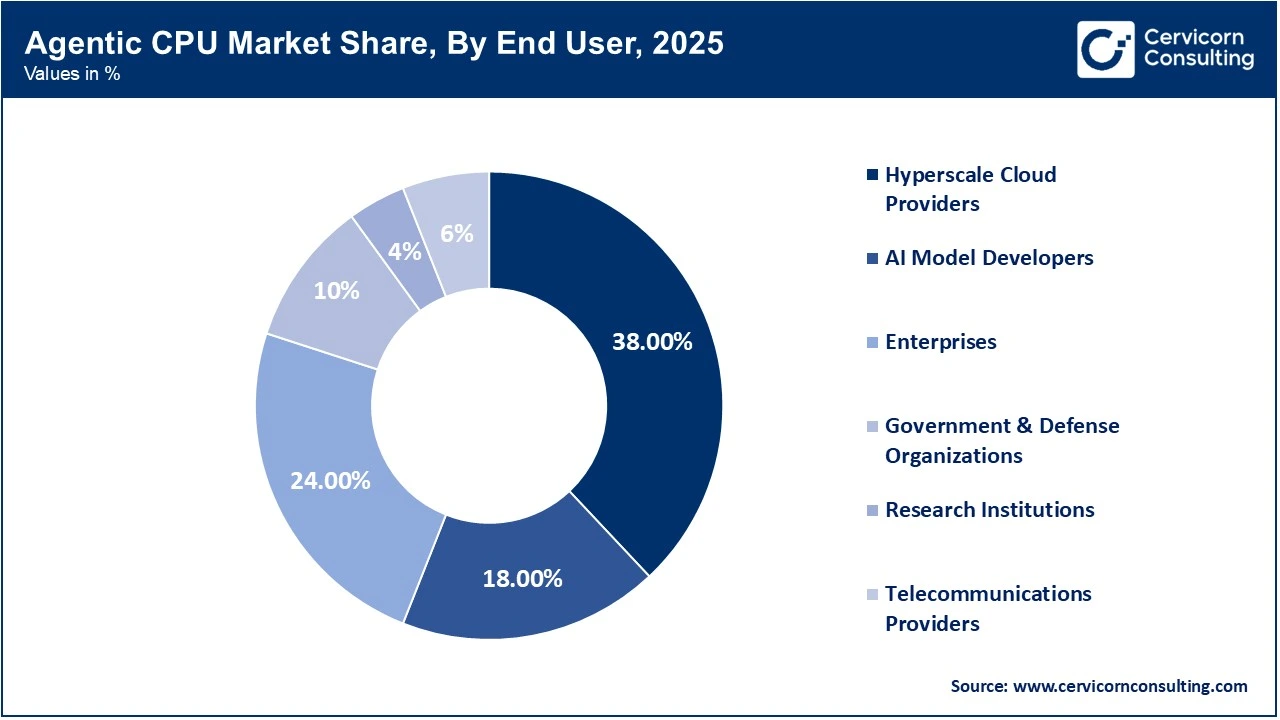
In 2025, enterprise segment comprised largest share of market at 24% in 2025. Organizations' deployment of AI agents in many different business areas including workflow automation, client servicing, and analysis has boosted the need for AI native computing solutions. Increased use of the enterprise AI platforms, workplace copilots, and autonomous decision-making systems are paving the way for enhanced integration of agentic CPUs in organizations' everyday use, as the usage of the agentic enterprise AI services expands.
Leading Companies
Recent Developments
- In March 2026, Arm announced AGI CPU, the first native production silicon developed from its “agentic AI orchestrator” AGI platform which Arm’s Neoverse V3 based processor supports and will occupy the size, heat and cost profile of 1U in a standard rack and drive agents at rack level. The shift takes Arm from an intellectual property only provider to a silicon vendor in the data center CPU marketplace. The revenue implications will be significant.
Market Segmentation
By CPU Architecture
- x86 Processors
- ARM-Based Processors
- RISC-V Processors
- Custom Proprietary Architectures
By Deployment Environment
- Cloud Data Centers
- Enterprise Data Centers
- Edge AI Infrastructure
- Hybrid Cloud Infrastructure
By Application
- AI Agent Orchestration
- Multi-Agent Systems
- Retrieval-Augmented Generation (RAG)
- AI Copilots & Digital Agents
- Autonomous Software Development
- Robotics & Physical AI
- Research & Scientific Computing
- Other Agentic Workflows
By End User
- Hyperscale Cloud Providers
- AI Model Developers
- Enterprises
- Government & Defense Organizations
- Research Institutions
- Telecommunications Providers
By Region
- North America
- Europe
- Asia-Pacific
- Latin America
- Middle East & Africa