Water 4.0 Market Size, Growth, Forecast 2026 to 2035
The global water 4.0 market size was valued at USD 21.74 billion in 2025 and is expected to reach around USD 96.35 billion by 2035, exhibiting a compound annual growth rate (CAGR) of 16.1% over the forecast period from 2026 to 2035. The water 4.0 market is experiencing strong growth due to rising global water stress, aging infrastructure, and increasing pressure on utilities and industries to improve operational efficiency. According to the OECD, global water demand is expected to increase by 55% by 2050, driven primarily by industrial production, energy generation, and urban consumption. Additionally, nearly half of the world’s population already experiences severe water scarcity for at least part of the year, creating an urgent need for intelligent water management systems, real-time monitoring, and predictive analytics. Governments and utilities are increasingly investing in smart metering, leak detection technologies, digital twins, and AI-enabled water networks to reduce water losses and improve resource utilization.
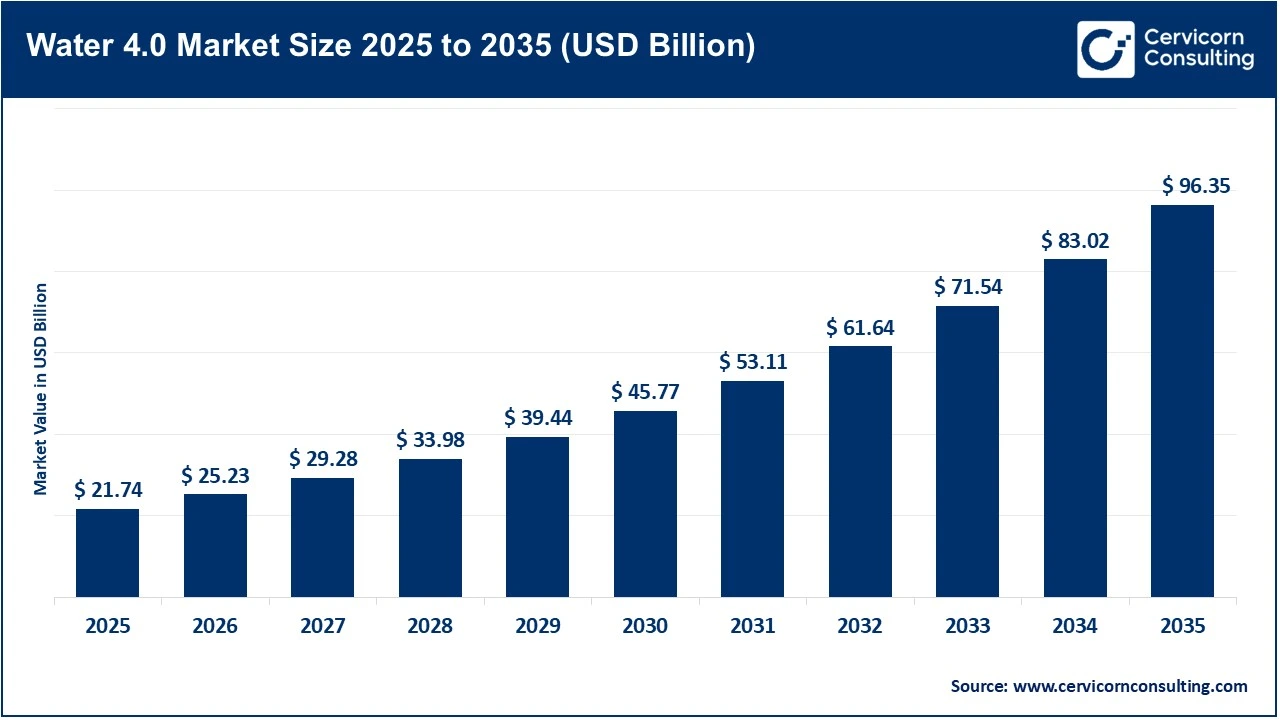
Another major growth driver is the accelerating adoption of digital technologies across water and wastewater infrastructure. The integration of IoT sensors, cloud platforms, automation systems, and AI-based predictive maintenance is helping utilities optimize treatment processes, reduce energy consumption, and improve asset performance. Environmental concerns are also strengthening demand, as 42% of global household wastewater was not safely treated in 2022, highlighting the need for smarter wastewater management solutions. At the same time, increasing climate-related events such as droughts, floods, and unpredictable rainfall patterns are pushing governments and enterprises toward resilient, data-driven water infrastructure capable of supporting long-term sustainability and water security objectives.
Report Highlights
- By region, North America held 34.4% of the global market share, driven by extensive utility modernization programs, smart metering deployments, and investments in digital water infrastructure.
- By solution type, the hardware segment dominated the market with a 47.8% share, owing to large-scale deployment of smart meters, sensors, controllers, and communication devices.
- By technology, the smart monitoring segment led the market with a 34.7% share, as utilities increasingly prioritize real-time monitoring and leak detection capabilities.
- By water cycle stage, the water distribution segment dominated the market with a 27.4% share, reflecting strong investment in network efficiency and loss reduction.
- By end user, the municipal & utility remained the largest segment with a 56.8% share, supported by significant public investments in water infrastructure modernization.
What is Water 4.0?
Water 4.0 refers to the digital transformation of the water sector through the integration of Industry 4.0 technologies such as the Internet of Things (IoT), Artificial Intelligence (AI), Big Data Analytics, Digital Twins, Cloud Computing, Automation, and Advanced Sensors into water infrastructure and operations.
The concept aims to transform traditional water systems into smart, connected, data-driven ecosystems that can monitor, analyze, predict, and optimize water-related processes in real time.
Evolution of the Water Industry
| Stage |
Description |
| Water 1.0 |
Manual water supply and basic infrastructure |
| Water 2.0 |
Mechanized treatment and distribution systems |
| Water 3.0 |
Automation and SCADA-based monitoring |
| Water 4.0 |
Intelligent, connected, AI-driven water ecosystems |
In simple terms, Water 4.0 is to the water industry what Industry 4.0 is to manufacturing: a shift from reactive and manual operations to smart, predictive, and autonomous water management systems across the entire water cycle, from source and treatment to distribution, consumption, wastewater treatment, and reuse.
Increasing Climate Change and Water Scarcity Driving Market Growth
Climate change and growing water scarcity are emerging as major catalysts for the adoption of water 4.0 solutions worldwide. Rising temperatures, changing precipitation patterns, prolonged droughts, and increasing flood events are placing unprecedented pressure on water resources and infrastructure. As utilities, industries, and governments seek to improve water security and operational resilience, investments in smart water technologies such as IoT-enabled monitoring, AI-driven analytics, digital twins, and predictive maintenance systems are accelerating. These technologies help optimize water usage, detect leaks in real time, improve distribution efficiency, and enhance the management of water treatment and reuse systems, making them essential tools for addressing climate-related water challenges.
Key Statistics
- Approximately 4 billion people experience severe water scarcity for at least one month each year.
- Global water demand is projected to increase by 20–30% by 2050.
- Climate change could reduce renewable water resources by more than 20% in some regions by 2050.
- Around 30% of the world's freshwater systems are already under significant stress from overexploitation and climate variability.
- Water utilities can reduce non-revenue water losses by up to 25–40% through smart monitoring and leak detection technologies.
- Extreme weather events related to climate change have increased by more than 80% since the 1980s, intensifying the need for resilient water infrastructure.
Recent Major Milestones
1. Maharashtra Launches India’s First “Water 7/12” Digital Water Governance System
In 2025, the Maharashtra government introduced India’s first “Water 7/12” system, a digital platform designed to scientifically record and monitor water availability, usage, inflows, outflows, and water balances at village and watershed levels. The initiative also incorporates digital water audits, water balance sheets, and an incentive-based “Aqua Credits” framework to encourage conservation. This milestone reflects the growing shift toward data-driven water governance and real-time resource management. By digitizing water records and enabling transparent monitoring, the initiative is expected to accelerate adoption of smart water analytics, IoT-based monitoring systems, and AI-powered decision-making tools across public water infrastructure.
2. Xylem Expands Digital Water Capabilities Through AI and Analytics Investments
In 2025, Xylem expanded its focus on advanced digital water technologies through its innovation and partnership programs supporting AI-powered leak detection, water reuse optimization, and intelligent monitoring solutions. The company also strengthened its digital ecosystem through its strategic investment in water data analytics provider Idrica, enhancing capabilities in predictive maintenance, digital twins, and utility intelligence. These developments are helping utilities move from reactive operations toward predictive and autonomous water management, increasing demand for cloud-based water platforms, AI analytics, and digital infrastructure solutions across the Water 4.0 value chain.
3. New Delhi Municipal Council (NDMC) Deploys Smart 24×7 Water Supply Infrastructure
The New Delhi Municipal Council launched a pilot project in 2025 to establish a continuous 24×7 water supply network using SCADA systems, IT-enabled automation, real-time monitoring, advanced instrumentation, and data analytics. The initiative focuses on leak detection, network optimization, and improved operational visibility within the water distribution system. Such projects demonstrate how municipalities are increasingly investing in intelligent infrastructure to reduce non-revenue water losses and improve service reliability. As similar modernization programs expand globally, they are expected to drive stronger demand for smart meters, automation systems, cloud platforms, and integrated water management software.
4. Large-Scale Investments in Smart Wastewater and River Rejuvenation Projects
Recent government-led infrastructure programs are increasingly integrating digital technologies into wastewater management and water treatment systems. In 2025, Maharashtra announced major investments including a INR 1,500 crore sewage treatment initiative aimed at improving river health and modernizing wastewater infrastructure. These projects are increasingly incorporating automation, AI-enabled monitoring, sensor networks, and advanced treatment technologies to improve efficiency and environmental compliance. The expansion of digitally connected wastewater systems is creating significant opportunities for water 4.0 vendors offering smart treatment solutions, predictive maintenance platforms, and intelligent asset management technologies.
Water 4.0 Market Regional Analysis
The Water 4.0 market is segmented by region into North America, Europe, Asia-Pacific, Latin America, and LAMEA. Here is a brief overview of each region:
North America Water 4.0 Market: Driven by Aging Water Infrastructure, Digital Utility Modernization, and Increasing Water Security Concerns
The North America water 4.0 market size was valued at USD 7.48 billion in 2025 and is projected to grow around USD 33.14 billion by 2035.
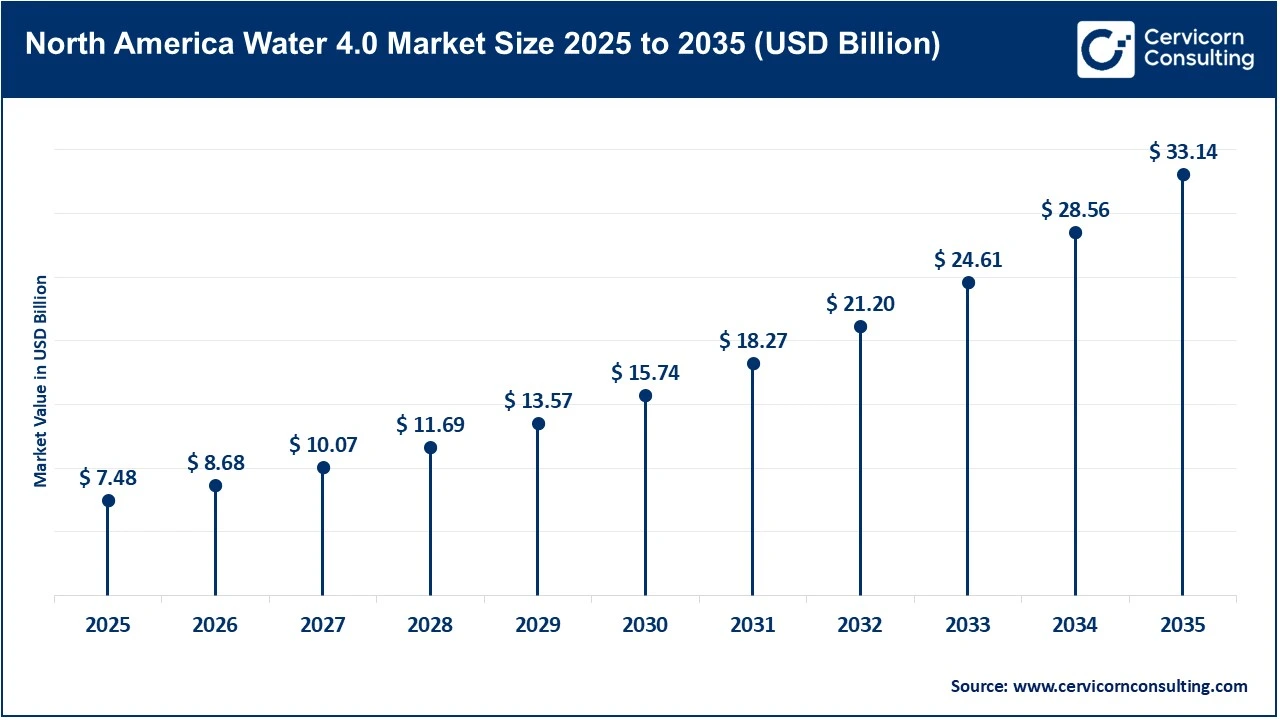
The North America market is witnessing robust growth, driven by aging water infrastructure, increasing water scarcity concerns, stringent environmental regulations, and rising investments in utility modernization. Water utilities across the region are accelerating the adoption of smart meters, IoT-enabled monitoring systems, AI-powered analytics, digital twins, and advanced automation technologies to improve operational efficiency and reduce non-revenue water losses. Growing climate-related challenges, including droughts, floods, and extreme weather events, are further encouraging utilities and industries to implement intelligent water management solutions. Additionally, government funding programs focused on infrastructure upgrades and sustainability initiatives are supporting the deployment of digital water technologies across municipal and industrial sectors.
United States: Utility Modernization, Smart Water Infrastructure Investments, and AI Adoption Driving Market Expansion
- The U.S. Environmental Protection Agency (EPA) estimates that more than USD 625 billion will be required for drinking water infrastructure improvements over the next two decades.
- Approximately 240,000 water main breaks occur annually across the United States, increasing demand for smart monitoring and predictive maintenance solutions.
- Smart water meter deployments continue expanding across major cities to improve water conservation and billing efficiency.
Canada: Sustainable Water Management Initiatives and Smart Utility Investments Supporting Market Growth
- Canada has over 160,000 kilometers of water distribution infrastructure, creating substantial opportunities for digital modernization.
- Municipal utilities are expanding investments in smart metering and real-time water monitoring systems.
- Provinces such as Ontario, British Columbia, and Alberta are implementing digital water initiatives to improve operational efficiency and water conservation.
Asia-Pacific (APAC) Water 4.0 Market: Driven by Rapid Urbanization, Water Scarcity Challenges, and Smart Infrastructure Investments
The Asia-Pacific water 4.0 market size was estimated at USD 5.50 billion in 2025 and is predicted to hit around USD 24.38 billion by 2035. The Asia-Pacific market is emerging as the fastest-growing regional market, supported by rapid urbanization, increasing industrialization, growing water stress, and significant government investments in smart water infrastructure. Countries across the region are facing mounting challenges related to water scarcity, aging infrastructure, pollution, and rising demand from expanding urban populations. As a result, utilities and industries are increasingly adopting smart meters, IoT-enabled monitoring systems, AI-powered analytics, digital twins, and automated water management platforms to improve efficiency and ensure sustainable water resource management.
China: Smart City Development, Water Security Initiatives, and Digital Utility Modernization Fuel Market Growth
- China is home to nearly 20% of the global population but possesses only about 6% of the world's freshwater resources, intensifying the need for efficient water management.
- More than 65% of China's population resides in urban areas, increasing pressure on water infrastructure and utilities.
- Smart city programs across hundreds of municipalities are accelerating deployment of digital water technologies.
India: Growing Water Stress, Smart City Missions, and Utility Digitization Supporting Market Expansion
- India is projected to have over 600 million people facing high to extreme water stress, creating significant demand for smart water management solutions.
- Non-revenue water losses in many Indian cities exceed 30–40%, driving investments in leak detection and network monitoring technologies.
- The Jal Jeevan Mission aims to provide piped drinking water connections to all rural households, requiring extensive modernization of water infrastructure.
Europe Water 4.0 Market: Driven by Stringent Environmental Regulations, Sustainability Goals, and Smart Utility Modernization
The Europe water 4.0 market size was accounted for USD 6.11 billion in 2025 and is forecasted to surpass around USD 27.07 billion by 2035. The Europe market is experiencing significant growth, supported by strict environmental regulations, ambitious sustainability targets, and increasing investments in smart water infrastructure. Utilities across the region are adopting advanced technologies such as smart meters, AI-powered analytics, digital twins, IoT-enabled monitoring systems, and automated water management platforms to improve operational efficiency and reduce water losses. Rising concerns over climate change, droughts, water pollution, and aging infrastructure are accelerating digital transformation across the water sector. Additionally, European Union initiatives promoting resource efficiency, circular water management, and infrastructure resilience are creating strong demand for water 4.0 solutions throughout municipal and industrial applications.
Germany: Industry 4.0 Leadership and Infrastructure Modernization Driving Market Expansion
- Germany is among Europe's leading adopters of Industry 4.0 technologies, supporting digital transformation across utility infrastructure.
- Utilities are investing heavily in smart monitoring and predictive maintenance solutions to improve operational efficiency.
- Growing industrial demand for water reuse and sustainability initiatives is driving adoption of advanced water analytics platforms.
United Kingdom: Smart Utility Investments and Leakage Reduction Initiatives Supporting Growth
- Water companies are investing billions in network modernization and leakage reduction programs.
- Smart meter deployments continue to expand across residential and commercial sectors.
- Digital twin and AI technologies are increasingly being utilized to improve infrastructure planning and asset management.
Water 4.0 Market Share, By Region, 2025 (%)
| Region |
Revenue Share, 2025 (%) |
| North America |
34.40% |
| Europe |
28.10% |
| Asia Pacific |
25.30% |
| LAMEA |
12.20% |
LAMEA Water 4.0 Market: Driven by Water Scarcity, Infrastructure Modernization, and Growing Investments in Sustainable Water Management
The LAMEA water 4.0 market was valued at USD 2.65 billion in 2025 and is anticipated to reach around USD 11.75 billion by 2035. The LAMEA market is witnessing strong growth due to increasing water scarcity, rapid urbanization, population growth, and rising investments in water infrastructure modernization. Governments and utilities across the region are increasingly adopting smart meters, IoT-enabled monitoring systems, AI-powered analytics, digital twins, and automated treatment technologies to improve water efficiency and address supply-demand imbalances. The growing need to reduce non-revenue water losses, enhance water security, and comply with environmental regulations is accelerating the deployment of intelligent water management solutions. Furthermore, large-scale desalination projects, wastewater reuse initiatives, and smart city developments are creating substantial opportunities for Water 4.0 technology providers.
Middle East: Water Scarcity, Desalination Investments, and Smart City Projects Driving Market Growth
- The Middle East contains some of the world's most water-stressed countries, with renewable freshwater availability among the lowest globally.
- Gulf countries account for a significant share of global desalination capacity, driving demand for advanced digital water technologies.
- Smart city projects such as NEOM in Saudi Arabia are integrating intelligent water management systems from the design stage.
Latin America: Utility Modernization and Non-Revenue Water Reduction Supporting Expansion
- Non-revenue water losses exceed 30–40% in many Latin American cities, creating strong demand for leak detection and smart monitoring technologies.
- Brazil and Mexico are leading regional investments in digital water infrastructure and utility modernization programs.
- Growing industrial activity is increasing demand for water reuse and process optimization solutions.
Water 4.0 Market Segmental Analysis
The Water 4.0 market is segmented into solution type, technology, water cycle stage, application, end user, and geography.
Solution Type Analysis
The Hardware segment dominates the Water 4.0 market due to the extensive deployment of smart meters, water quality sensors, flow meters, pressure sensors, controllers, and communication devices across water infrastructure. Utilities and industries require large-scale physical infrastructure upgrades to enable real-time monitoring and data collection, making hardware the foundation of digital water transformation. Growing investments in smart water networks, leak detection systems, and advanced monitoring equipment continue to support the segment's leading market position, particularly in municipal water distribution and wastewater management applications.
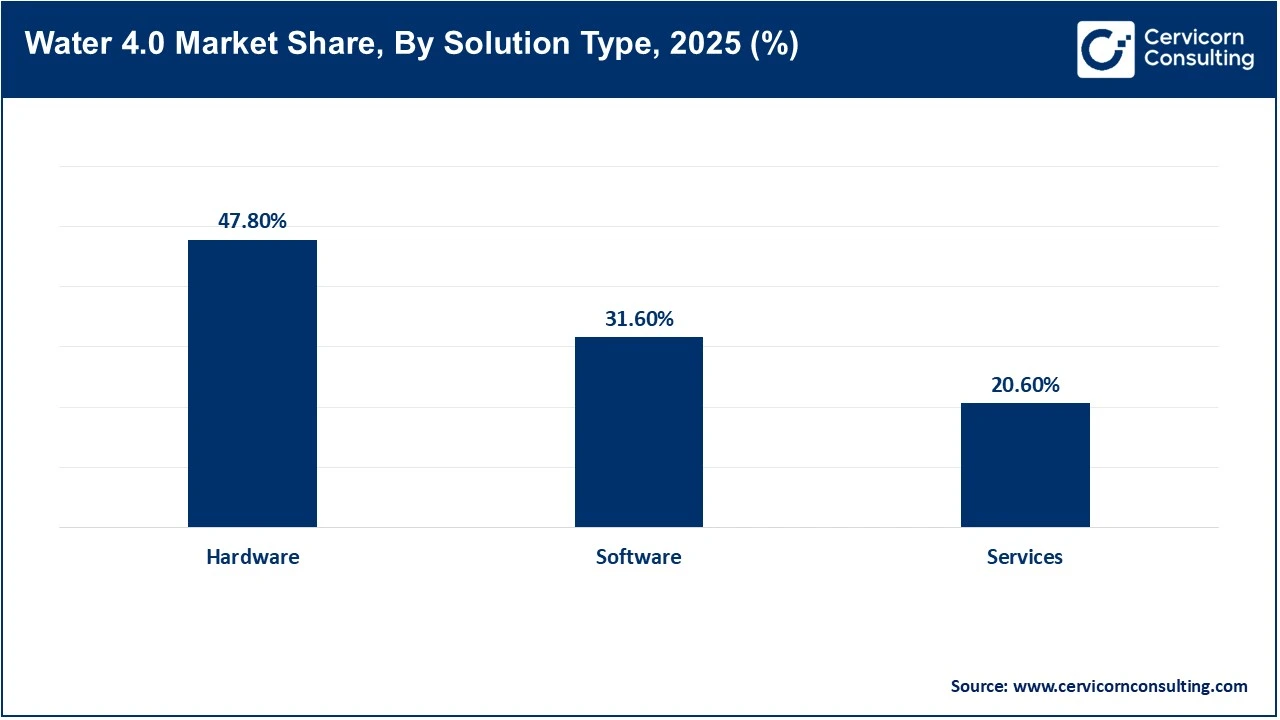
The software segment is expected to witness the fastest growth as utilities increasingly leverage AI, machine learning, predictive analytics, and digital twin technologies to optimize water operations. Software platforms enable advanced data analysis, asset management, demand forecasting, and operational intelligence, helping organizations improve efficiency while reducing costs. The growing shift toward cloud-based solutions and data-driven decision-making is accelerating software adoption, especially as utilities seek to maximize the value generated from existing sensor and monitoring infrastructure.
Technology Analysis
Smart Monitoring currently dominates the Water 4.0 market due to widespread adoption of smart meters, water quality sensors, and leak detection systems. These technologies provide the foundational data necessary for digital water management, enabling utilities to monitor water consumption, identify losses, and ensure regulatory compliance. Increasing concerns regarding non-revenue water, aging infrastructure, and water scarcity have driven significant investments in monitoring solutions. Since most Water 4.0 deployments begin with data collection and visibility improvements, smart monitoring remains the largest technology segment globally.
Water 4.0 Market, By Technology, 2025 (%)
| Technology |
Revenue Share, 2025 (%) |
| Smart Monitoring |
34.70% |
| Digital Platforms |
22.40% |
| Advanced Intelligence |
18.60% |
| Automation |
17.10% |
| Cybersecurity |
7.20% |
Advanced Intelligence is projected to be the fastest-growing technology segment as utilities increasingly adopt AI, machine learning, predictive analytics, and digital twins to improve operational performance. These technologies transform raw sensor data into actionable insights, enabling predictive maintenance, optimized treatment processes, and proactive infrastructure management. The growing complexity of water networks and rising demand for operational efficiency are encouraging utilities to move beyond monitoring toward intelligent decision-making. As digital transformation accelerates, advanced intelligence solutions are becoming a critical component of next-generation water management strategies.
Water Cycle Stage Analysis
Water Distribution dominates the Water 4.0 market owing to substantial investments aimed at reducing water losses, improving network efficiency, and ensuring reliable water delivery. Utilities worldwide face significant challenges related to aging pipelines, leakages, and non-revenue water, making distribution networks a primary focus for digital modernization. Smart meters, pressure monitoring systems, leak detection technologies, and network analytics are increasingly deployed throughout distribution systems. As water distribution directly impacts service quality and operational costs, it continues to attract the largest share of Water 4.0 investments.
Water 4.0 Market, By Water Cycle Stage, 2025 (%)
| Water Cycle Stage |
Revenue Share, 2025 (%) |
| Water Source Management |
8.10% |
| Water Treatment |
19.30% |
| Water Distribution |
27.40% |
| Wastewater Collection |
10.50% |
| Wastewater Treatment |
17.20% |
| Water Reuse & Recycling |
11.60% |
| Stormwater Management |
5.90% |
Water Reuse & Recycling is expected to be the fastest-growing segment due to increasing water scarcity, sustainability goals, and stricter environmental regulations. Governments and industries are investing heavily in advanced treatment technologies and digital monitoring systems to maximize water reuse and reduce dependence on freshwater sources. Water 4.0 technologies enable real-time process optimization, quality monitoring, and predictive control of reuse systems. As circular water management becomes a strategic priority worldwide, digital solutions supporting water recycling are experiencing rapid adoption.
Application Analysis
Smart Water Distribution represents the largest application segment due to the widespread need for efficient water delivery, leak reduction, and network optimization. Utilities are increasingly deploying smart meters, pressure sensors, and advanced analytics platforms to monitor distribution networks in real time. The growing focus on reducing non-revenue water and improving operational efficiency has driven substantial investments in distribution-focused technologies. Since water distribution systems account for a significant portion of infrastructure spending and operational challenges, this application continues to dominate Water 4.0 deployments globally.
Water 4.0 Market, By Application, 2025 (%)
| Application |
Revenue Share, 2025 (%) |
| Smart Water Distribution |
24.10% |
| Water Quality Monitoring |
18.20% |
| Asset Performance Management |
14.30% |
| Predictive Maintenance |
12.70% |
| Treatment Optimization |
13.60% |
| Energy Optimization |
6.40% |
| Smart Irrigation |
5.30% |
| Others |
5.40% |
Predictive Maintenance is anticipated to be the fastest-growing application as utilities seek to transition from reactive maintenance approaches to proactive asset management strategies. AI-driven analytics, machine learning algorithms, and digital twins enable early identification of equipment failures and infrastructure deterioration. By minimizing downtime, extending asset life, and reducing maintenance costs, predictive maintenance delivers substantial operational benefits. Growing pressure to improve infrastructure reliability while controlling expenditures is accelerating adoption across treatment facilities, distribution networks, and wastewater management systems.
End User Analysis
Municipal & Utility organizations account for the largest share of the Water 4.0 market due to their responsibility for managing public water supply, wastewater treatment, and distribution infrastructure. Governments and utilities are major investors in smart water technologies aimed at improving efficiency, reducing losses, and meeting regulatory requirements. Large-scale modernization initiatives involving smart metering, digital monitoring, and automated treatment systems continue to drive demand within this segment. The essential nature of public water services ensures sustained investment in digital water transformation projects.
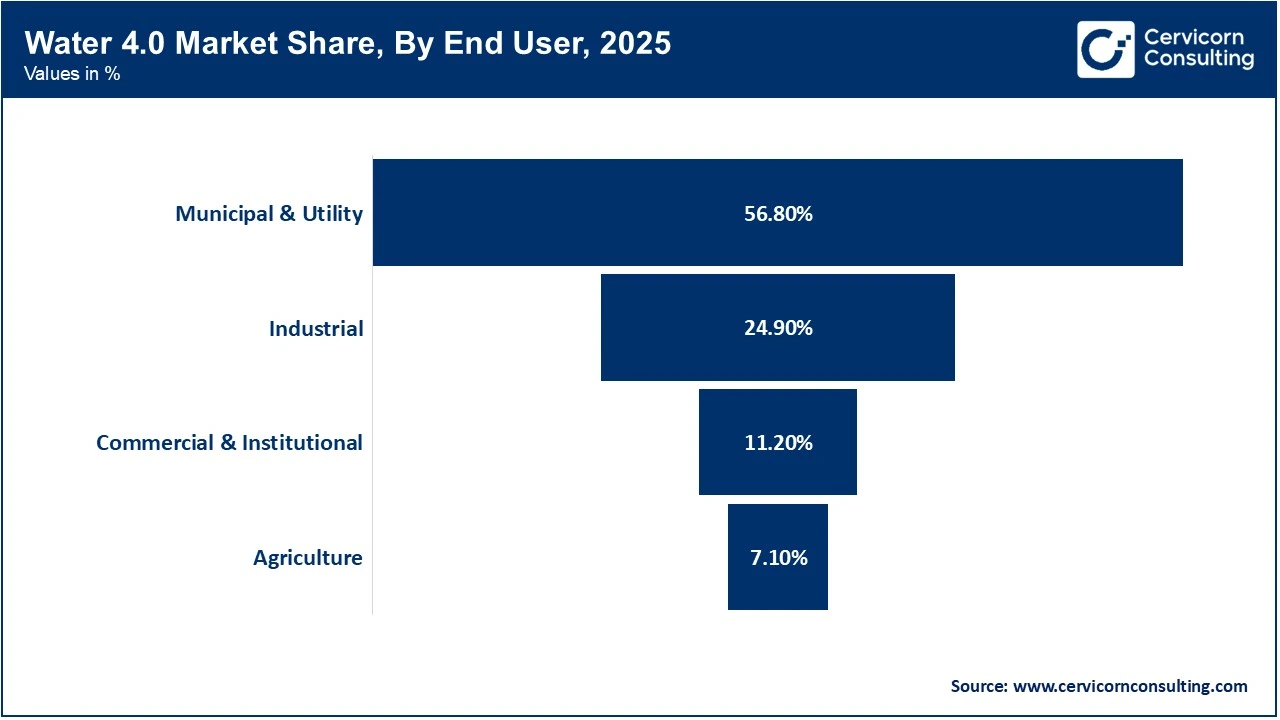
The Industrial segment is projected to register the fastest growth as manufacturers increasingly adopt Water 4.0 technologies to improve water efficiency, sustainability, and regulatory compliance. Industries such as food and beverage, pharmaceuticals, chemicals, mining, and power generation are deploying smart monitoring, predictive analytics, and water reuse systems to optimize operations and reduce water-related costs. Rising environmental pressures and corporate sustainability targets are encouraging greater investment in digital water management solutions, making industrial users one of the most dynamic growth areas in the market.
Water 4.0 Market Top Companies
Recent Developments
- In May 2025, Xylem Inc. announced new AI-powered water management innovations through its Xylem Innovation Labs program, including advanced leak detection, predictive analytics, and water reuse technologies. The initiative aims to help utilities improve operational efficiency, reduce water losses, and strengthen resilience against growing water scarcity challenges.
- In May 2025, Veolia Water Technologies acquired the remaining 30% stake in Water Technologies & Solutions (WTS) from CDPQ, gaining full ownership of the business. The acquisition enhances Veolia’s capabilities in digital water management, industrial water treatment, and smart infrastructure solutions while strengthening its position in the Water 4.0 market.
- In January 2025, SUEZ launched new digital asset management and predictive maintenance solutions for municipal water utilities, integrating AI, IoT, and real-time analytics. The development enables utilities to optimize infrastructure performance, improve operational visibility, and reduce maintenance costs.
Market Segmentation
By Solution Type
- Hardware
- Software
- Services
By Technology
- Smart Monitoring
- Smart Meters
- Water Quality Sensors
- Leak Detection Systems
- Digital Platforms
- IoT Platforms
- Cloud Platforms
- Edge Computing
- Advanced Intelligence
- Artificial Intelligence (AI)
- Machine Learning (ML)
- Predictive Analytics
- Digital Twins
- Automation
- SCADA
- Process Automation
- Robotics & Drones
- Cybersecurity
- OT Security
- Data Security
- Network Protection
By Water Cycle Stage
- Water Source Management
- Water Treatment
- Water Distribution
- Wastewater Collection
- Wastewater Treatment
- Water Reuse & Recycling
- Stormwater Management
By Application
- Smart Water Distribution
- Water Quality Monitoring
- Asset Performance Management
- Predictive Maintenance
- Treatment Optimization
- Energy Optimization
- Smart Irrigation
- Others
By End User
- Municipal & Utility
- Industrial
- Commercial & Institutional
- Agriculture
By Region
- North America
- Europe
- Asia-Pacific
- LAMEA