
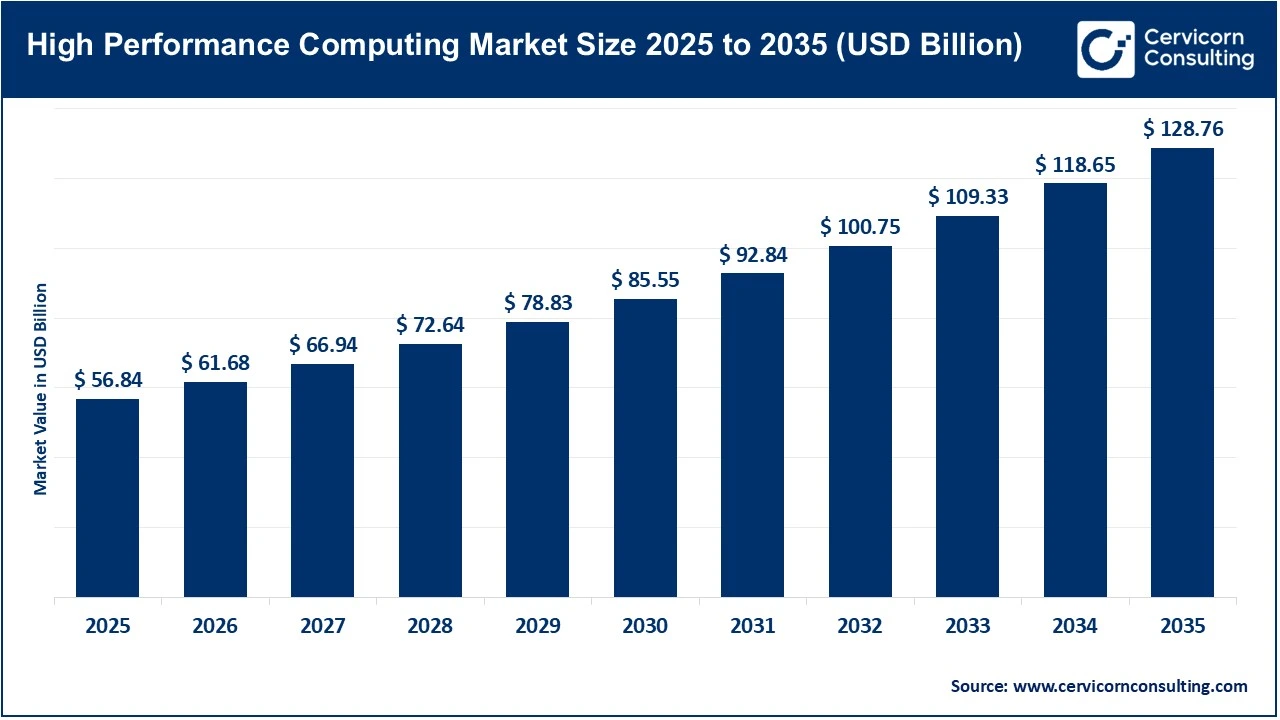
The global high performance computing market size was valued at USD 56.84 billion in 2025 and is expected to be worth around USD 128.76 billion by 2035, exhibiting a compound annual growth rate (CAGR) of 8.5% over the forecast period from 2026 to 2035. The growth of the high performance computing market is being strongly driven by the rapid expansion of artificial intelligence (AI), machine learning, and data-intensive workloads across industries. Organizations in healthcare, manufacturing, automotive, weather forecasting, and financial services increasingly rely on HPC systems to process massive datasets, run simulations, and train advanced AI models. The convergence of AI and HPC has accelerated demand for GPU-based supercomputing infrastructure, as large AI models require computational power comparable to supercomputers. Industry estimates indicate that cloud deployments accounted for more than 52% of HPC revenue share in 2025, reflecting the growing preference for scalable computing infrastructure to support intensive workloads.
Another major growth factor is rising government and enterprise investment in scientific research, defense, energy exploration, and digital engineering. HPC is increasingly used for climate modeling, genomics, semiconductor design, aerospace simulation, and digital twins to reduce R&D timelines and improve innovation outcomes. The increasing complexity of AI workloads is also reshaping data centre infrastructure. Many AI-enabled HPC server racks now consume 40 kW or more of power, with some experimental deployments exceeding 100 kW per rack, driving investments in advanced cooling, high-speed interconnects, and accelerator technologies. In addition, government-backed supercomputing initiatives and sovereign AI programs across regions are accelerating HPC adoption for strategic research and national competitiveness.
Explosion of AI & ML Training Workloads in U.S. Federal Labs and Tier-1 Cloud Providers
The rapid increase in AI and machine learning (ML) training workloads across U.S. federal laboratories and tier-1 cloud providers is significantly accelerating demand for High-Performance Computing (HPC) infrastructure. Federal institutions such as national laboratories are increasingly deploying exascale supercomputers for climate modeling, nuclear simulations, genomics, and foundation model training, while hyperscalers are expanding GPU-intensive data centers to support generative AI and large language models (LLMs). This surge in computational intensity is driving investments in advanced accelerators, high-bandwidth memory, liquid cooling, and ultra-fast networking, creating strong momentum for HPC system upgrades and capacity expansion. The convergence of scientific computing and AI training is also reshaping traditional HPC environments into AI-optimized architectures capable of handling massive parallel workloads.
Some of the key factors of this growth
Surging Demand for GPU-Accelerated Molecular Dynamics Driving High-Performance Computing Market Growth
The growing demand for GPU-accelerated molecular dynamics (MD) simulations is a major driver of growth in the HPC market, particularly in pharmaceuticals, biotechnology, materials science, and academic research. Molecular dynamics workloads require enormous computational power to model atomic and molecular interactions over time, making traditional CPU-based systems increasingly insufficient for complex simulations such as protein folding, drug-target binding, and biomolecular behavior analysis.
GPU acceleration enables researchers to run simulations significantly faster by processing thousands of parallel calculations simultaneously, reducing computation times from weeks to days or even hours. This capability has become especially important in drug discovery and precision medicine, where organizations rely on HPC clusters to screen millions of molecular compounds, optimize drug candidates, and accelerate R&D timelines. As demand for AI-assisted drug discovery and computational chemistry increases, research institutions and life sciences companies are investing heavily in GPU-rich HPC environments, advanced interconnects, and scalable cloud HPC platforms to support increasingly sophisticated molecular simulation workloads.
Report Scope
| Area of Focus | Details |
| Market Size in 2026 | USD 61.68 Billion |
| Market Size in 2035 | USD 128.76 Billion |
| CAGR 2026 to 2035 | 8.50% |
| Dominant Region | North America |
| Fastest Growing Region | Asia-Pacific |
| Key Segments | Component, Deployment Type, Application, Industry Vertical, Architecture Type, Region |
| Key Companies | IBM, Hewlett Packard Enterprise (HPE), Dell Technologies, NVIDIA, Intel, Advanced Micro Devices (AMD), Lenovo, Fujitsu, Atos, Microsoft, Amazon Web Services (AWS), NEC Corporation |
1. U.S. Department of Energy Expanding Exascale Supercomputing Programs
The U.S. government has significantly accelerated HPC adoption through large-scale exascale computing initiatives led by the Department of Energy (DOE). Following the deployment of systems such as Aurora, Frontier, and El Capitan, the DOE announced additional AI-focused supercomputers, including Discovery and Lux, to support nuclear security, energy research, medicine, and advanced manufacturing. These government investments are driving the HPC market by creating sustained demand for next-generation processors, GPU accelerators, liquid cooling systems, ultra-fast networking, and high-capacity storage infrastructure. The expansion of federally funded supercomputing ecosystems also encourages private-sector innovation and strengthens domestic semiconductor and server supply chains. The DOE currently manages three of the world’s most powerful supercomputers, reinforcing long-term infrastructure spending in HPC.
2. NVIDIA’s Expansion of AI Supercomputing and DGX Infrastructure
NVIDIA has accelerated HPC market growth through aggressive expansion of AI-supercomputing platforms and GPU cloud ecosystems. The company continues scaling its DGX systems and industrial AI infrastructure to support increasingly compute-intensive generative AI and scientific workloads. In 2025, NVIDIA announced a major industrial AI cloud initiative featuring 10,000 GPUs for manufacturing and simulation-heavy workloads, reflecting the growing convergence between AI and traditional HPC. This development drives the market by increasing enterprise demand for GPU-accelerated clusters, high-bandwidth networking, AI-optimized storage, and HPC-ready data centers designed for large-scale model training and simulation.
3. India’s National Supercomputing Mission (NSM) 2.0
India’s government has intensified investments in domestic HPC capabilities through the National Supercomputing Mission (NSM) 2.0, aimed at developing indigenous high-performance computing infrastructure and achieving pre-exascale systems by 2027–28. The initiative has already deployed 37 indigenous supercomputers with 39 petaflops of computing power, with additional systems under development using domestically designed servers. This milestone is driving the HPC market by stimulating demand for locally manufactured processors, advanced cooling technologies, scientific computing software, and research-grade compute infrastructure across academia, weather forecasting, healthcare, and defense applications.
4. HPE and AMD Partnership for Next-Generation AI Supercomputers
The strategic collaboration between HPE, AMD, and Oak Ridge National Laboratory to build next-generation AI supercomputers marks another major milestone in the HPC market. The recently announced Discovery and Lux systems are designed to deliver significantly higher AI and scientific computing performance by integrating advanced AMD GPUs and CPUs into HPE’s supercomputing architecture. This milestone is accelerating market growth by encouraging enterprises and research institutions to modernize legacy HPC environments with energy-efficient, AI-ready systems. It is also increasing demand for exascale software frameworks, specialized interconnects, and hybrid HPC-AI computing platforms optimized for large-scale simulation and AI inference workloads.
The high performance computing market is segmented by region into North America, Europe, Asia-Pacific, Latin America, and LAMEA. Here is a brief overview of each region:
The North America high performance computing market size was valued at USD 21.71 billion in 2025 and is expected to reach around USD 49.19 billion by 2035.
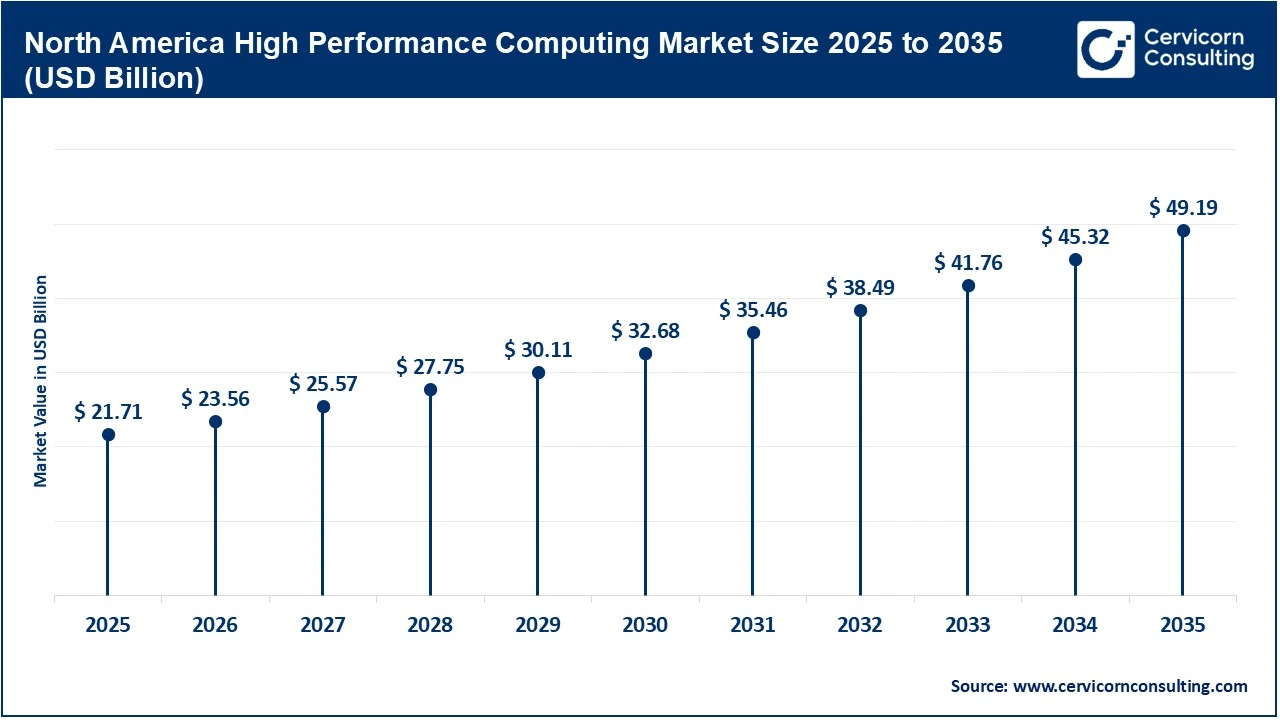
The North America market is highly advanced, supported by strong technological infrastructure, extensive investments in artificial intelligence (AI), and the presence of leading cloud providers, semiconductor companies, and supercomputing research institutions. The region benefits from significant government funding for exascale computing, national laboratories, and defense-oriented simulations, while private enterprises increasingly adopt HPC for AI training, drug discovery, digital twins, and advanced manufacturing. Rapid expansion of hyperscale data centers, rising deployment of GPU-accelerated systems, and increasing enterprise reliance on computational analytics further strengthen market growth.
United States: Strong federal investments in exascale computing, leadership in AI infrastructure, advanced semiconductor ecosystems, and expanding hyperscale cloud platforms continue driving market expansion.
Canada: Growing AI research capabilities, increasing cloud infrastructure investments, and government-backed scientific computing initiatives support market growth.
The Asia-Pacific high performance computing market size was estimated at USD 14.04 billion in 2025 and is predicted to surpass USD 128.76 billion by 2035. The Asia-Pacific market is experiencing strong growth, supported by increasing government investments in supercomputing, rapid industrial digitalization, and expanding artificial intelligence (AI) capabilities across major economies. The region benefits from strong semiconductor manufacturing ecosystems, rising adoption of HPC in automotive, electronics, healthcare, weather forecasting, and scientific research, and increasing deployment of AI-focused data centers. Countries across Asia-Pacific are heavily investing in sovereign computing capabilities to strengthen technological competitiveness, scientific advancement, and national security.
China: Strong government-backed supercomputing initiatives, semiconductor self-sufficiency efforts, and expanding AI research ecosystems drive market growth.
Japan: Advanced semiconductor expertise, strong scientific computing capabilities, and leadership in supercomputing innovation support market expansion.
The Europe high performance computing market size was accounted for USD 14.72 billion in 2025 and is forecasted to grow around USD 33.35 billion by 2035. The Europe market is expanding steadily, supported by strong government-backed supercomputing initiatives, increasing industrial automation, and rising investments in artificial intelligence (AI) and scientific research. The region benefits from advanced manufacturing ecosystems, strong automotive and aerospace industries, and extensive academic and climate research programs that require large-scale computational capabilities. European countries are actively investing in sovereign digital infrastructure to reduce dependence on external technologies and strengthen regional innovation.
Germany: Strong industrial manufacturing capabilities, automotive engineering leadership, and Industry 4.0 adoption drive market growth.
United Kingdom: Expanding AI innovation, advanced life sciences research, and government-backed digital transformation initiatives support market expansion.
High Performance Computing Market Share, By Region, 2025 (%)
| Region | Revenue Share, 2025 (%) |
| North America | 38.2% |
| Europe | 25.9% |
| Asia Pacific | 24.7% |
| LAMEA | 11.2% |
The LAMEA high performance computing market was valued at USD 6.37 billion in 2025 and is anticipated to reach around USD 14.42 billion by 2035. The LAMEA market is gradually expanding, supported by increasing digital transformation initiatives, rising investments in scientific research, and growing demand for advanced computational capabilities across energy, healthcare, defense, and academic sectors. The region is witnessing increasing adoption of HPC for oil and gas reservoir modeling, weather forecasting, genomic research, smart city planning, and industrial simulations. Governments and enterprises are also investing in AI, cloud computing, and national research infrastructure to strengthen digital competitiveness and reduce technological dependence. In addition, expanding hyperscale data center investments and increasing demand for GPU-based computing are creating new opportunities for HPC deployment across emerging economies.
Brazil: Growing scientific research capabilities, expanding industrial applications, and increasing cloud infrastructure investments support market growth.
Saudi Arabia: Strong government digitalization strategies, energy-sector simulations, and AI-focused investments drive market expansion.
The high-performance computing market is segmented into component, deployment type, application, industry vertical, architecture type, and geography.
The hardware segment dominates the high-performance computing (HPC) market due to substantial investments in servers, processors, GPUs, storage systems, and high-speed networking infrastructure required for computationally intensive workloads. Organizations across government, healthcare, manufacturing, and cloud computing continue investing heavily in advanced compute clusters to support simulations, AI model training, and scientific research. The growing deployment of exascale supercomputers and GPU-rich systems further strengthens hardware demand, as enterprises prioritize performance optimization, faster data processing, and enhanced computing efficiency for large-scale operations.
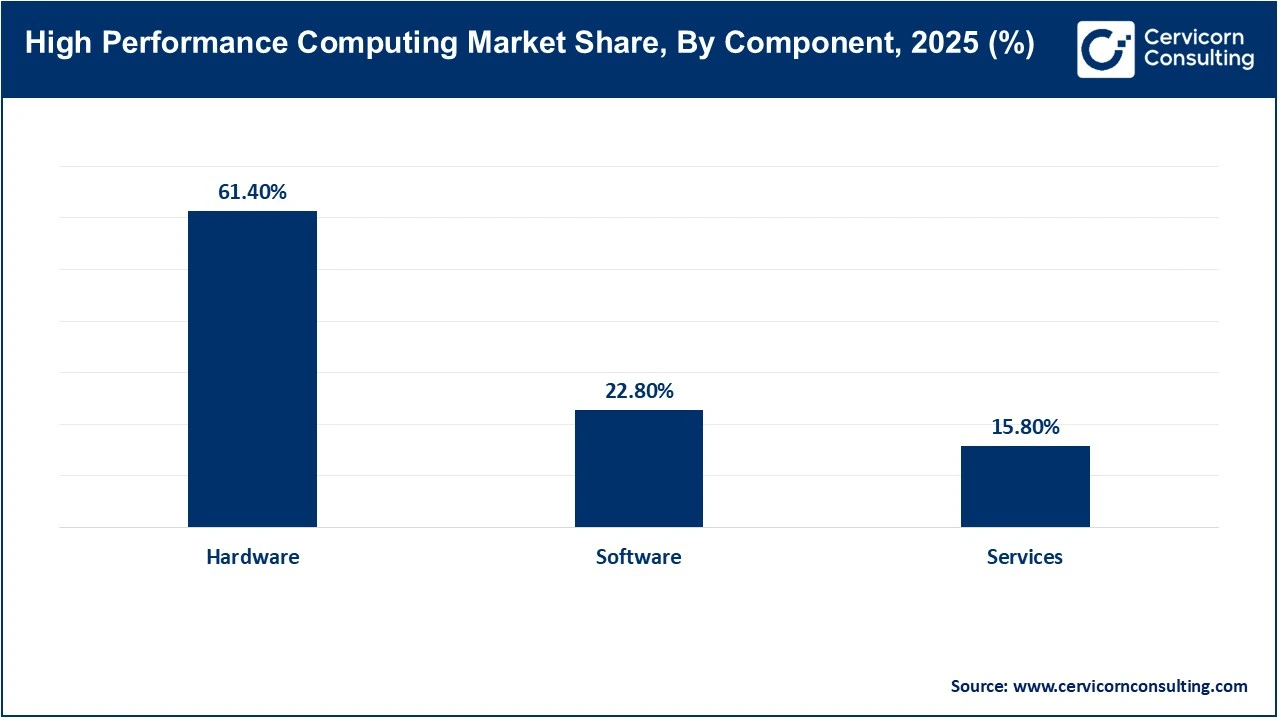
The services segment is witnessing the fastest growth in the HPC market as enterprises increasingly seek consulting, deployment, maintenance, and managed HPC solutions to optimize infrastructure utilization. Organizations lacking in-house expertise are outsourcing cluster management, performance tuning, and cloud-HPC integration to specialized providers. Rising adoption of HPC-as-a-Service (HPCaaS), particularly among small and medium enterprises and research institutions, is accelerating this segment’s expansion. Additionally, increasing complexity in AI and simulation workloads is driving demand for system integration and technical support services.
On-premises HPC remains the dominant deployment segment due to its strong suitability for organizations handling highly sensitive data, low-latency workloads, and mission-critical simulations. Government agencies, defense organizations, research laboratories, and financial institutions prefer on-premises infrastructure for enhanced data security, regulatory compliance, and full control over computing environments. High computational performance and dedicated infrastructure availability also make on-premises systems favorable for large-scale modeling, engineering simulations, and scientific computing applications requiring uninterrupted processing power.
High Performance Computing Market, By Deployment Type, 2025 (%)
| Deployment Type | Revenue Share, 2025 (%) |
| On-Premises HPC | 56.3% |
| Cloud-Based HPC | 29.4% |
| Hybrid HPC | 14.3% |
Cloud-based HPC is the fastest-growing deployment segment as enterprises increasingly demand scalable, cost-efficient, and flexible computing environments. Cloud HPC allows organizations to access high computational power without large upfront infrastructure investments, making it attractive for AI training, data analytics, and temporary simulation workloads. The ability to rapidly scale computing resources and pay based on usage has encouraged adoption among startups, universities, and enterprises. Additionally, hyperscale cloud providers are continuously expanding GPU infrastructure to support growing AI and HPC requirements.
Modeling and simulation dominate the HPC market owing to their widespread use across aerospace, automotive, healthcare, defense, and energy sectors for product testing, engineering design, and scientific experimentation. HPC systems enable organizations to simulate complex environments, reduce physical prototyping costs, and improve operational accuracy. Applications such as weather prediction, crash testing, seismic analysis, and fluid dynamics continue to generate strong demand for high computational power. The increasing use of digital twins and predictive modeling further reinforces segment dominance.
High Performance Computing Market, By Application, 2025 (%)
| Application | Revenue Share, 2025 (%) |
| Modeling & Simulation | 29.8% |
| Artificial Intelligence & Machine Learning (AI/ML) | 24.6% |
| Big Data Analytics | 15.2% |
| Scientific Research | 11.7% |
| Risk Modeling & Financial Analytics | 9.1% |
| Rendering & Visualization | 9.6% |
Artificial Intelligence and Machine Learning (AI/ML) represent the fastest-growing application segment due to surging demand for large-scale data processing and model training capabilities. Organizations increasingly rely on HPC systems to train foundation models, generative AI platforms, and advanced analytics tools requiring massive parallel processing power. GPU acceleration and specialized AI supercomputers have become critical for reducing training times and improving computational efficiency. Expanding enterprise AI adoption across healthcare, finance, autonomous mobility, and cybersecurity continues accelerating segment growth.
Government and defense dominate the HPC market due to large-scale investments in national security, weather forecasting, nuclear simulations, cryptography, and scientific research. Governments worldwide increasingly deploy advanced supercomputing systems to strengthen defense capabilities, support strategic decision-making, and improve disaster prediction models. National laboratories and defense agencies consistently allocate substantial budgets toward exascale computing infrastructure. Additionally, growing geopolitical concerns and sovereign AI initiatives continue increasing investments in secure, high-performance computational systems across public-sector institutions.
High Performance Computing Market, By Industry Vertical, 2025 (%)
| Industry Vertical | Revenue Share, 2025 (%) |
| Government & Defense | 24.3% |
| Healthcare & Life Sciences | 16.8% |
| Manufacturing | 15.4% |
| Energy & Utilities | 11.9% |
| BFSI (Banking, Financial Services & Insurance) | 10.3% |
| Education & Research | 9.5% |
| Media & Entertainment | 5.2% |
| Others | 6.6% |
Healthcare and life sciences are emerging as the fastest-growing vertical due to increasing demand for genomics, molecular modeling, precision medicine, and AI-assisted drug discovery. HPC enables researchers to process massive biological datasets, simulate molecular interactions, and accelerate clinical research timelines. The pharmaceutical industry increasingly depends on GPU-accelerated HPC systems to identify drug candidates faster and reduce development costs. Rising investments in personalized medicine, biomedical research, and pandemic preparedness continue supporting rapid segment expansion.
CPU-based HPC currently dominates the market due to its established presence across traditional scientific computing, enterprise simulations, and general-purpose workloads. CPUs offer strong flexibility for sequential processing tasks and remain widely deployed across government laboratories, universities, and enterprise data centers. Many existing HPC infrastructures continue operating on CPU-centric architectures due to compatibility with legacy applications and lower migration complexity. Their widespread use in engineering simulations, weather forecasting, and industrial modeling sustains strong market leadership.
High Performance Computing Market, By Architecture Type, 2025 (%)
| Architecture Type | Revenue Share, 2025 (%) |
| CPU-Based HPC | 42.7% |
| GPU-Based HPC | 31.5% |
| FPGA-Based HPC | 8.6% |
| Cluster Computing | 10.2% |
| Massively Parallel Processing (MPP) Systems | 7.0% |
GPU-based HPC is the fastest-growing architecture segment owing to its superior ability to handle massively parallel workloads required for AI, deep learning, and molecular simulations. GPUs significantly reduce computation times by processing thousands of simultaneous operations, making them increasingly preferred for scientific research and generative AI training. Technology companies, research institutions, and hyperscale cloud providers are rapidly expanding GPU clusters to support compute-intensive workloads. Rising adoption of accelerated computing is continuously strengthening growth prospects for this segment.
By Component
By Deployment Type
By Application
By Industry Vertical
By Architecture Type
By Geography
Chapter 1. Market Introduction and Overview
1.1 Market Definition and Scope
1.1.1 Overview of High Performance Computing
1.1.2 Scope of the Study
1.1.3 Research Timeframe
1.2 Research Methodology and Approach
1.2.1 Methodology Overview
1.2.2 Data Sources and Validation
1.2.3 Key Assumptions and Limitations
Chapter 2. Executive Summary
2.1 Market Highlights and Snapshot
2.2 Key Insights by Segments
2.2.1 By Component Overview
2.2.2 By Deployment Type Overview
2.2.3 By Application Overview
2.2.4 By Industry Vertical Overview
2.2.5 By Architecture Type Overview
2.3 Competitive Overview
Chapter 3. Global Impact Analysis
3.1 Russia-Ukraine Conflict: Global Market Implications
3.2 Regulatory and Policy Changes Impacting Global Markets
Chapter 4. Market Dynamics and Trends
4.1 Market Dynamics
4.1.1 Market Drivers
4.1.2 Market Restraints
4.1.3 Market Opportunities
4.1.4 Market Challenges
4.2 Market Trends
Chapter 5. Premium Insights and Analysis
5.1 Global High Performance Computing Market Dynamics, Impact Analysis
5.2 Porter’s Five Forces Analysis
5.2.1 Bargaining Power of Suppliers
5.2.2 Bargaining Power of Buyers
5.2.3 Threat of Substitute Products
5.2.4 Rivalry among Existing Firms
5.2.5 Threat of New Entrants
5.3 PESTEL Analysis
5.4 Value Chain Analysis
5.5 Product Pricing Analysis
5.6 Vendor Landscape
5.6.1 List of Buyers
5.6.2 List of Suppliers
Chapter 6. High Performance Computing Market, By Component
6.1 Global High Performance Computing Market Snapshot, By Component
6.1.1 Market Revenue (($Billion) and Growth Rate (%), 2022-2035
6.1.1.1 Hardware
6.1.1.2 Software
6.1.1.3 Services
Chapter 7. High Performance Computing Market, By Deployment Type
7.1 Global High Performance Computing Market Snapshot, By Deployment Type
7.1.1 Market Revenue (($Billion) and Growth Rate (%), 2022-2035
7.1.1.1 On-Premises HPC
7.1.1.2 Cloud-Based HPC
7.1.1.3 Hybrid HPC
Chapter 8. High Performance Computing Market, By Application
8.1 Global High Performance Computing Market Snapshot, By Application
8.1.1 Market Revenue (($Billion) and Growth Rate (%), 2022-2035
8.1.1.1 Modeling & Simulation
8.1.1.2 Artificial Intelligence & Machine Learning (AI/ML)
8.1.1.3 Big Data Analytics
8.1.1.4 Scientific Research
8.1.1.5 Risk Modeling & Financial Analytics
8.1.1.6 Rendering & Visualization
Chapter 9. High Performance Computing Market, By Industry Vertical
9.1 Global High Performance Computing Market Snapshot, By Industry Vertical
9.1.1 Market Revenue (($Billion) and Growth Rate (%), 2022-2035
9.1.1.1 Government & Defense
9.1.1.2 Healthcare & Life Sciences
9.1.1.3 Manufacturing
9.1.1.4 Energy & Utilities
9.1.1.5 BFSI (Banking, Financial Services & Insurance)
9.1.1.6 Education & Research
9.1.1.7 Media & Entertainment
9.1.1.8 Others
Chapter 10. High Performance Computing Market, By Architecture Type
10.1 Global High Performance Computing Market Snapshot, By Architecture Type
10.1.1 Market Revenue (($Billion) and Growth Rate (%), 2022-2035
10.1.1.1 CPU-Based HPC
10.1.1.2 GPU-Based HPC
10.1.1.3 FPGA-Based HPC
10.1.1.4 Cluster Computing
10.1.1.5 Massively Parallel Processing (MPP) Systems
Chapter 11. High Performance Computing Market, By Region
11.1 Overview
11.2 High Performance Computing Market Revenue Share, By Region 2024 (%)
11.3 Global High Performance Computing Market, By Region
11.3.1 Market Size and Forecast
11.4 North America
11.4.1 North America High Performance Computing Market Revenue, 2022-2035 ($Billion)
11.4.2 Market Size and Forecast
11.4.3 North America High Performance Computing Market, By Country
11.4.4 U.S.
11.4.4.1 U.S. High Performance Computing Market Revenue, 2022-2035 ($Billion)
11.4.4.2 Market Size and Forecast
11.4.4.3 U.S. Market Segmental Analysis
11.4.5 Canada
11.4.5.1 Canada High Performance Computing Market Revenue, 2022-2035 ($Billion)
11.4.5.2 Market Size and Forecast
11.4.5.3 Canada Market Segmental Analysis
11.4.6 Mexico
11.4.6.1 Mexico High Performance Computing Market Revenue, 2022-2035 ($Billion)
11.4.6.2 Market Size and Forecast
11.4.6.3 Mexico Market Segmental Analysis
11.5 Europe
11.5.1 Europe High Performance Computing Market Revenue, 2022-2035 ($Billion)
11.5.2 Market Size and Forecast
11.5.3 Europe High Performance Computing Market, By Country
11.5.4 UK
11.5.4.1 UK High Performance Computing Market Revenue, 2022-2035 ($Billion)
11.5.4.2 Market Size and Forecast
11.5.4.3 UK Market Segmental Analysis
11.5.5 France
11.5.5.1 France High Performance Computing Market Revenue, 2022-2035 ($Billion)
11.5.5.2 Market Size and Forecast
11.5.5.3 France Market Segmental Analysis
11.5.6 Germany
11.5.6.1 Germany High Performance Computing Market Revenue, 2022-2035 ($Billion)
11.5.6.2 Market Size and Forecast
11.5.6.3 Germany Market Segmental Analysis
11.5.7 Rest of Europe
11.5.7.1 Rest of Europe High Performance Computing Market Revenue, 2022-2035 ($Billion)
11.5.7.2 Market Size and Forecast
11.5.7.3 Rest of Europe Market Segmental Analysis
11.6 Asia Pacific
11.6.1 Asia Pacific High Performance Computing Market Revenue, 2022-2035 ($Billion)
11.6.2 Market Size and Forecast
11.6.3 Asia Pacific High Performance Computing Market, By Country
11.6.4 China
11.6.4.1 China High Performance Computing Market Revenue, 2022-2035 ($Billion)
11.6.4.2 Market Size and Forecast
11.6.4.3 China Market Segmental Analysis
11.6.5 Japan
11.6.5.1 Japan High Performance Computing Market Revenue, 2022-2035 ($Billion)
11.6.5.2 Market Size and Forecast
11.6.5.3 Japan Market Segmental Analysis
11.6.6 India
11.6.6.1 India High Performance Computing Market Revenue, 2022-2035 ($Billion)
11.6.6.2 Market Size and Forecast
11.6.6.3 India Market Segmental Analysis
11.6.7 Australia
11.6.7.1 Australia High Performance Computing Market Revenue, 2022-2035 ($Billion)
11.6.7.2 Market Size and Forecast
11.6.7.3 Australia Market Segmental Analysis
11.6.8 Rest of Asia Pacific
11.6.8.1 Rest of Asia Pacific High Performance Computing Market Revenue, 2022-2035 ($Billion)
11.6.8.2 Market Size and Forecast
11.6.8.3 Rest of Asia Pacific Market Segmental Analysis
11.7 LAMEA
11.7.1 LAMEA High Performance Computing Market Revenue, 2022-2035 ($Billion)
11.7.2 Market Size and Forecast
11.7.3 LAMEA High Performance Computing Market, By Country
11.7.4 GCC
11.7.4.1 GCC High Performance Computing Market Revenue, 2022-2035 ($Billion)
11.7.4.2 Market Size and Forecast
11.7.4.3 GCC Market Segmental Analysis
11.7.5 Africa
11.7.5.1 Africa High Performance Computing Market Revenue, 2022-2035 ($Billion)
11.7.5.2 Market Size and Forecast
11.7.5.3 Africa Market Segmental Analysis
11.7.6 Brazil
11.7.6.1 Brazil High Performance Computing Market Revenue, 2022-2035 ($Billion)
11.7.6.2 Market Size and Forecast
11.7.6.3 Brazil Market Segmental Analysis
11.7.7 Rest of LAMEA
11.7.7.1 Rest of LAMEA High Performance Computing Market Revenue, 2022-2035 ($Billion)
11.7.7.2 Market Size and Forecast
11.7.7.3 Rest of LAMEA Market Segmental Analysis
Chapter 12. Competitive Landscape
12.1 Competitor Strategic Analysis
12.1.1 Top Player Positioning/Market Share Analysis
12.1.2 Top Winning Strategies, By Company, 2022-2024
12.1.3 Competitive Analysis By Revenue, 2022-2024
12.2 Recent Developments by the Market Contributors (2024)
Chapter 13. Company Profiles
13.1 IBM
13.1.1 Company Snapshot
13.1.2 Company and Business Overview
13.1.3 Financial KPIs
13.1.4 Product/Service Portfolio
13.1.5 Strategic Growth
13.1.6 Global Footprints
13.1.7 Recent Development
13.1.8 SWOT Analysis
13.2 Hewlett Packard Enterprise (HPE)
13.3 Dell Technologies
13.4 NVIDIA
13.5 Intel
13.6 Advanced Micro Devices (AMD)
13.7 Lenovo
13.8 Fujitsu
13.9 Atos
13.10 Microsoft
13.11 Amazon Web Services (AWS)
13.12 NEC Corporation