
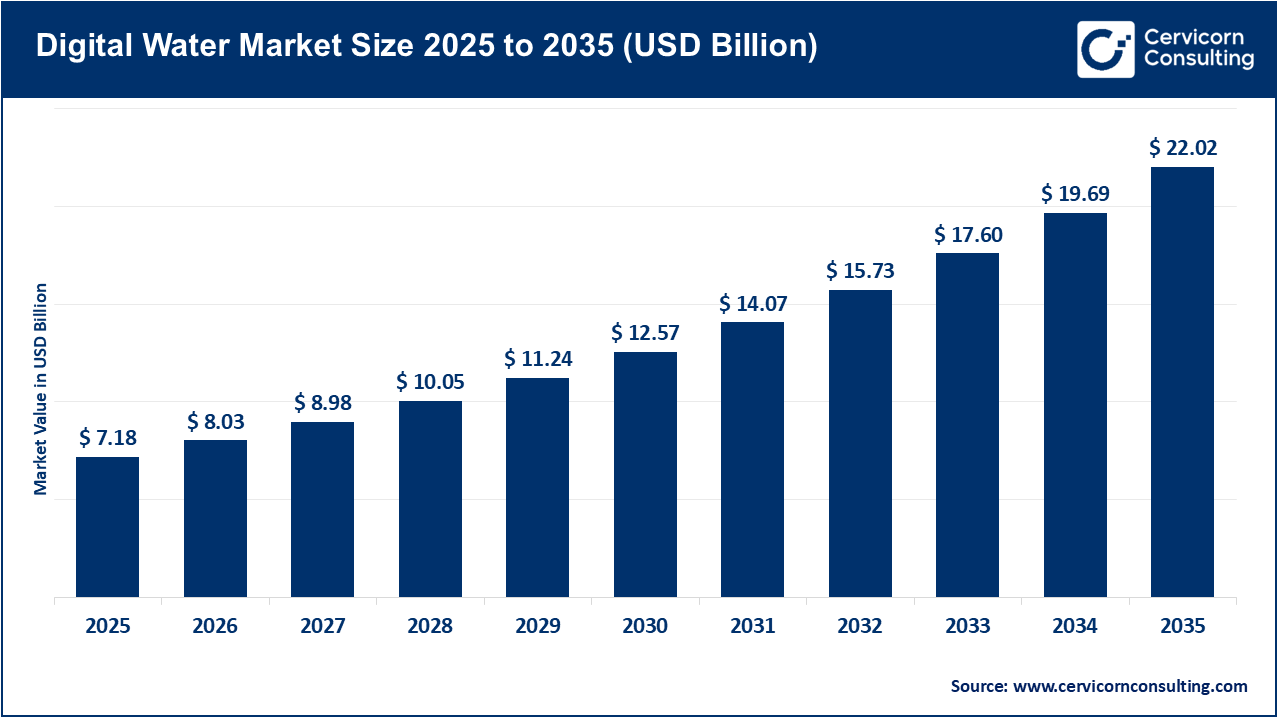
The global digital water market size was estimated at USD 7.18 billion in 2025 and is expected to be worth around USD 22.02 billion by 2035, exhibiting a compound annual growth rate (CAGR) of 11.9% over the forecast period from 2026 to 2035. The digital water market is growing rapidly, driven by the expanding implementation of environmental compliance regulations and sustainability mandates across municipal and industrial sectors. Regulatory frameworks such as the amended Urban Wastewater Treatment Directive introduced by the Council of the European Union and the Lead and Copper Rule Revision in the United States are requiring more frequent data reporting and digital inventory management, supporting the transition from manual to automated data processing. As regulatory authorities continue to demand real-time visibility into water quality and discharge levels, compliance-driven digital transformation is becoming essential for water utilities and industrial operators. In 2025, AI-enabled compliance frameworks are expected to play an important role in helping organizations meet the “zero pollution” goals established under global sustainability agreements.
Rapid urbanization is another major factor driving the growth of the digital water market, as cities increasingly adopt centralized data analytics as part of broader smart city initiatives. With 68% of the global population projected to live in urban areas by 2050, demand for resilient and efficient urban water systems is growing significantly. Smart city infrastructure integrates Internet of Things capabilities to connect water management systems with sectors such as energy and transportation, creating a unified ecosystem for sustainability and operational efficiency. This integrated approach is improving resource utilisation and enabling more intelligent management of urban infrastructure, which continues to support the adoption of digital water technologies.
Movement toward Real-Time Monitoring and Smart Utility Management
A significant trend in the digital water market is the shift from manual sampling to continuous, real-time monitoring via smart utility management platforms. This shift is driven by the rapid adoption of distributed sensors that generate large datasets to detect anomalies such as pressure fluctuations or contaminant spikes. At the same time, the growing adoption of cloud-connected IoT devices is expanding the "attack surface" for water systems, making cybersecurity a critical component of digital trust. Cybersecurity spending in the water sector is projected to exceed USD 2.5 billion by 2028, as organisations migrate from conventional security systems to a "Zero Trust" architecture for industrial control systems (ICS) to protect them from remote threats. This functional evolution is moving towards a computing environment where cloud, edge, and IoT technologies work together within an integrated infrastructure.
What is a digital water platform?
A digital water platform is a centralized software system that enables utilities and industries to monitor, manage, and optimize water operations using technologies such as the Internet of Things, artificial intelligence, cloud computing, and data analytics. It collects real-time data from smart meters, sensors, pumps, treatment plants, and distribution networks to improve operational efficiency, enable predictive maintenance, detect leaks, monitor water quality, and enhance decision-making. By integrating these functions into a single platform, digital water solutions help reduce water losses, lower operational costs, and improve the overall performance of water infrastructure.
Report Scope
| Area of Focus | Details |
| Market Size in 2026 | USD 8.03 Billion |
| Market Size in 2035 | USD 22.02 Billion |
| CAGR 2026 to 2035 | 11.90% |
| Dominant Region | North America |
| Fastest Growing Region | Asia-Pacific |
| Key Segments | Solution Type, Technology, End User, Region |
| Key Companies | Schneider Electric, Xylem Inc., Veolia, Siemens AG, ABB, Bentley Systems, Innovyze, Copperleaf Technologies, SUEZ, Itron Honeywell, General Electric, Autodesk, Tetra Tech, Jacobs Engineering Group |
1. Major Corporate Technological Developments and Product Launches
Corporate innovation and strategic technology integration are playing a crucial role in shaping the digital water market. In 2025, leading pump manufacturers consolidated hardware and software capabilities by acquiring specialised water data analytics firms. This marked a significant milestone towards achieving an "end-to-end" digital water ecosystem, aligned with physical assets and underpinned by cloud-based intelligence. Following mergers, deployment times for smart water networks were reduced by 30% as utilities increasingly adopted pre-integrated solutions rather than complex multi-vendor systems. In early 2026, the introduction of next-generation digital twin platforms enabled utilities to model extreme weather scenarios and predict their impact on their networks with up to 95% accuracy, thereby increasing urban resilience.
2. Government-Led Digital Transformation Initiatives and Policy Frameworks
Government policies and regulatory frameworks have become a major driver of digital transformation in the water sector. For example, in early 2025, the introduction of the International Water Data Standard (IWDS) mandated interoperability among hardware providers, increasing market growth rates by 18% in the following quarter. The framework addressed long-standing challenges related to vendor lock-in and enabled smaller technology providers to integrate seamlessly with existing municipal infrastructure. In addition, the 2026 mandate by the U.S. Environmental Protection Agency (EPA) for real-time digital monitoring of per- and polyfluoroalkyl substances (PFAS) significantly boosted demand for advanced digital sensors, resulting in an estimated USD 4 billion expansion in the sensor market. This shift marks a fundamental transition from periodic lab sampling to continuous digital monitoring of water quality.
3. Strategic Partnerships and Global Resource Management Milestones
Strategic partnerships are emerging as a significant milestone in addressing global water challenges, particularly in developing regions. In 2025, a global consortium of technology providers and international development banks launched a multi-billion-dollar initiative to deploy digital water solutions in 50 water-stressed countries. The initiative focuses on satellite-based leak detection and IoT-enabled irrigation systems to improve water security. The program aligns with broader climate-oriented goals, such as India’s path to net zero by 2070, which highlights and supports technological transitions. These milestones underscore that digital water solutions are no longer a luxury for affluent countries but are becoming essential for global climate adaptation.
4. Large-Scale Deployment Projects and Infrastructure Funding
Large-scale deployment projects and government funding programmes mark a significant milestone in the market. For example, the completion of the “Digital Thames” project in 2024 indicates the large-scale deployment of digital twin technology in a major metropolitan water system. This project provides a 100% real-time digital representation of the water cycle in London and has led to a 40% reduction in major pipe bursts, improving infrastructure reliability. As a result, a similar framework has been launched in five other major capitals worldwide. From 2024 to 2026, funding programmes such as the "Green Recovery" have supported these prospective projects and provided critical financial support. In many regions, these funds have subsidized up to 40% of upfront digital upgrade costs, enabling smaller municipal utilities to invest in advanced technologies.
The digital water market is segmented by region into North America, Europe, Asia-Pacific, and LAMEA. Here is a brief overview of each region:
In the Asia-Pacific region, the digital water market is driven by rapid urbanization and the expansion of smart city frameworks, especially in Southeast Asia and India. In these developing economies, digital infrastructure is playing a crucial role in supporting sustainable development by improving access to resources and easing the ease of doing business. A key economic driver for the region is the need to reduce Non-Revenue Water (NRW), which is currently estimated to cost USD 9 billion annually. As municipalities focus on addressing leakage and improving commercial recovery, smart meter installations across Tier-1 cities have increased by 15%.
China: Leading the Global Shift toward Integrated Water Resource Management
China is advancing integrated water infrastructure through robust manufacturing capabilities and government-led “Digital China” initiatives, supported by regulatory frameworks that promote sustainable development.
India: Scale infrastructure projects through the National Digital Water Missions
India is shifting from basic water infrastructure development to technology-driven management solutions to improve the long-term sustainability of rural and urban water programs.
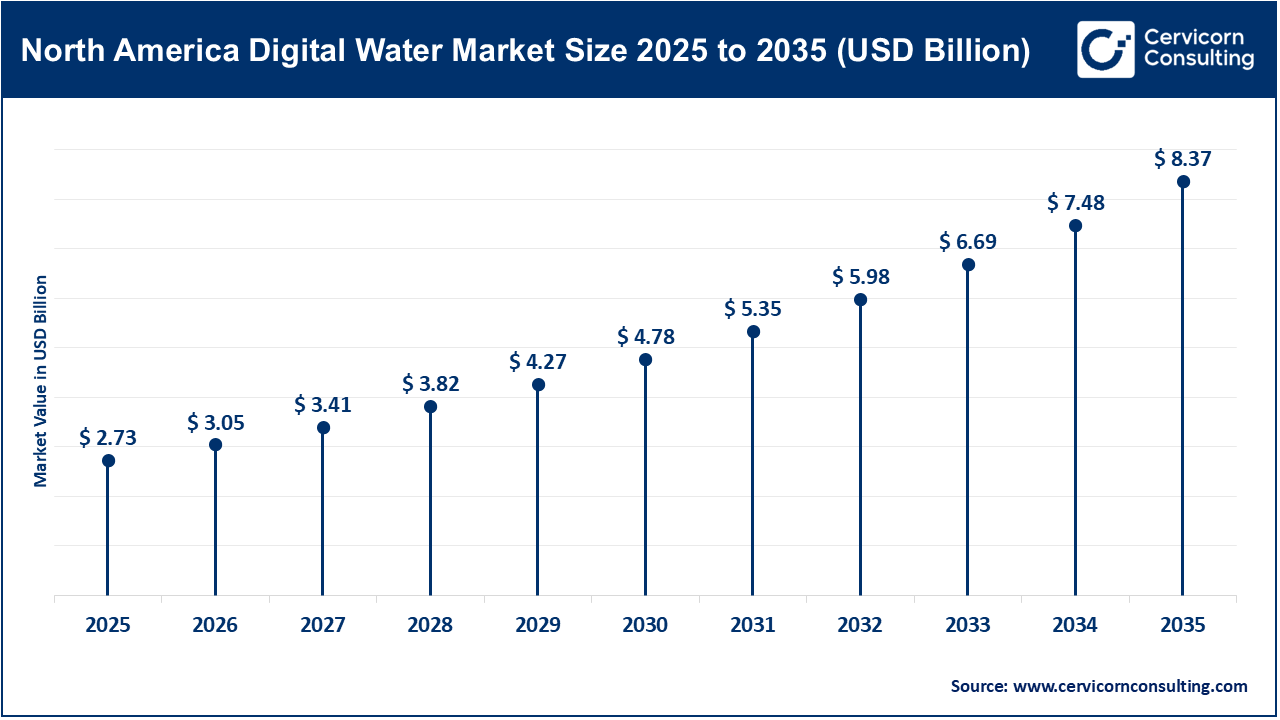
North America market is defined by the urgent need to modernize ageing infrastructure, much of which is over 100 years old. The market is increasingly focused on the spatiotemporal characteristics of contaminants such as per- and polyfluoroalkyl substances (PFAS), necessitating advanced monitoring networks around industrial and military facilities to protect human health. More than 20% of US water utilities have increased their adoption of digital twin technologies to reduce capital costs and extend the life of deteriorating pipe networks. In addition, federal funding support through initiatives such as the Infrastructure Investment and Jobs Act has contributed to a 12% year-on-year rise in the adoption of secure, cloud-based water management software.
United States: Upgrading legacy systems with access to real-time data and analytics
The U.S. market is moving towards proactive digital asset management and standardized long-term water-quality monitoring to improve infrastructure performance.
Canada: Leveraging IoT for Sustainable Governance of Northern Resources
Canada is implementing digital tools to manage extreme climate variability and to facilitate the decentralization of remote community water systems.
Europe market is strongly characterized by policies such as the European Green Deal and environmental regulations focused on energy neutrality and circular economy principles. The region is leading the integration of clean energy initiatives with smart water management systems to improve operational efficiency. Utilities in Germany and the Scandinavian countries have achieved energy savings of up to 30% through real-time pump optimization and aeration control. At the same time, Water-as-a-Service (WaaS) models are gaining momentum, with Western Europe reporting an 18% increase in SaaS-based monitoring subscriptions.
United Kingdom: Improve operational efficiency with Digital Twin deployment
In the United Kingdom, regulatory frameworks are driving water companies to adopt digital-first strategies to meet stringent leakage-reduction and pollution-control targets.
Germany: Advancing Industry 4.0 Standards in Wastewater Treatment
Germany is leveraging its legacy of industrial automation in the municipal water sector, placing greater emphasis on high-precision sensing and carbon neutrality.
Digital Water Market Share, By Region, 2025 (%)
| Region | Revenue Share, 2025 (%) |
| North America | 38% |
| Europe | 28% |
| Asia Pacific | 24% |
| LAMEA | 10% |
The LAMEA market is being driven by severe water scarcity and increasing reliance on high-tech desalination and water reuse technologies. Digitalization is being adopted to improve the efficiency of energy-intensive processes, while floating photovoltaic systems are emerging as a practical solution to reduce water evaporation and generate clean energy for treatment operations. In countries such as Saudi Arabia and the UAE, IoT sensors are integrated into 85% of new desalination capacity to predict membrane fouling and improve energy efficiency. In Latin America, privatization trends in countries such as Brazil are also supporting a 10% year-on-year growth in the adoption of digital asset management software.
Brazil: Achieving Urban Water Loss through Smart Metering
Brazil’s government regulatory framework is attracting private capital investment, with a growing focus on digital efficiency improvements across water infrastructure operations.
United Arab Emirates: Tactical Investments in Desalination and Smart Grids
The UAE considers water a strategic asset and capitalizes on the human capital aspects of energy and water, transitioning to achieve long-term stability.
The digital water market is segmented into solution type, technology, end user, and region.
The software segment of the solution type dominates the market, serving as the core of digital transformation by enabling utilities to visualize data, develop hydraulic models, and implement cybersecurity measures to protect operational information. This strong market is supported by the high level of recurring revenue generated through Software-as-a-Service (SaaS) models, which enable utilities to expand their digital capabilities without significant upfront hardware investments.
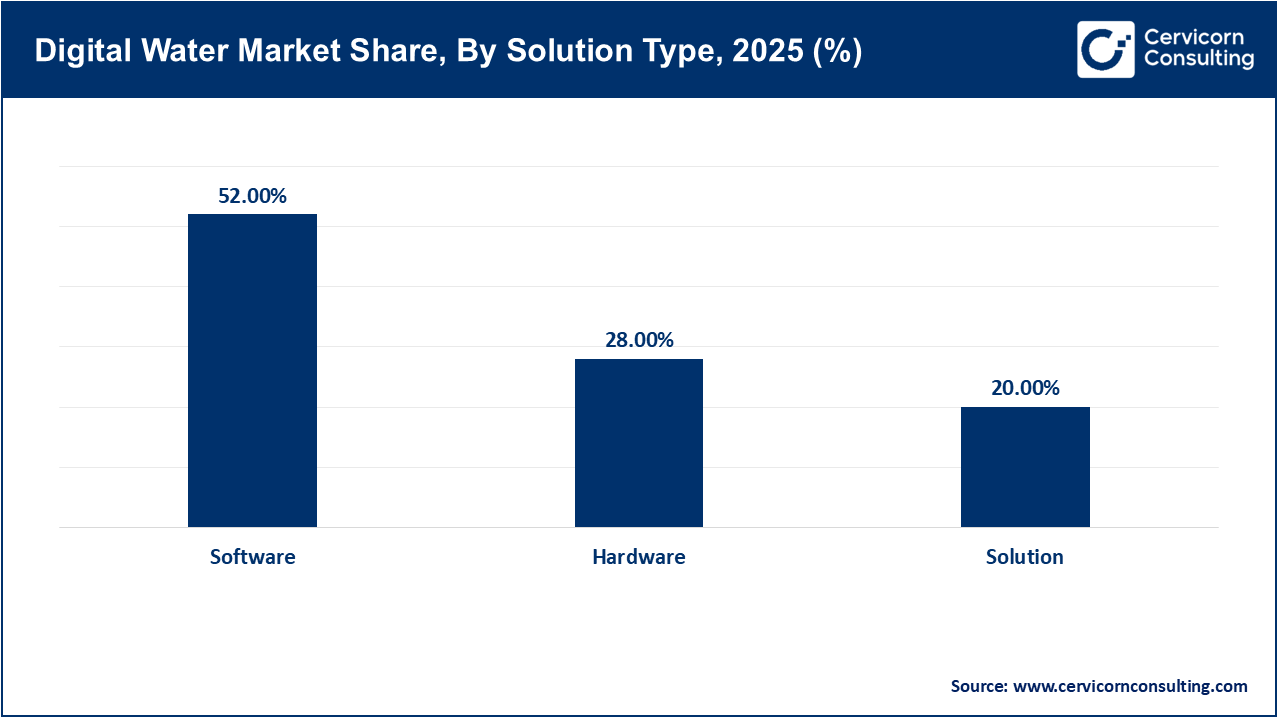
The services segment is experiencing the fastest growth in the market, primarily because many utilities lack the in-house expertise required to deploy and manage complex digital systems. This has increased demand for consulting, system integration, and managed services. Specialised service providers are helping utilities bridge the digital gap by ensuring that data collected from sensors is effectively converted into actionable operational insights.
The Internet of Things is the dominant technology segment in the market because it forms the essential foundation for connectivity and data collection across digital water systems. It enables the continuous flow of information from sensors and communication devices, supporting all higher-level digital functions. Without IoT infrastructure, advanced technologies such as analytics platforms and digital twins would lack the data needed to generate meaningful operational insights, making IoT the backbone of the digital water market.
Digital Water Market Share, By Technology, 2025 (%)
| Technology Segment | Revenue Share, 2025 (%) |
| Internet of Things | 34% |
| Smart Water Meters | 18% |
| Artificial Intelligence & Machine Learning | 16% |
| Digital Twin | 14% |
| Geographic Information Systems | 10% |
| Others | 8% |
The digital twin segment is the fastest-growing technology in the market due to its ability to support predictive simulation and operational planning. While IoT provides real-time visibility into system conditions, digital twins allow operators to run scenario-based simulations to evaluate the potential effects of operational adjustments or environmental pressures. This virtual testing capability reduces operational risk and supports informed decision-making, making digital twins an increasingly important investment for future-ready utilities.
The municipal water industries segment leads the digital water market due to the scale of public water infrastructure and the essential nature of the services it provides. These utilities manage the majority of global water distribution and wastewater collection systems, requiring substantial investment in both hardware and software to ensure public health standards and regulatory compliance. In addition, lean construction practices and integrated delivery models for large-scale infrastructure projects are increasingly being adopted in municipal water systems to improve operational efficiency and support long-term sustainability.
Digital Water Market Share, By End User, 2025 (%)
| End User | Revenue Share, 2025 (%) |
| Municipal Water Industries | 55% |
| Industrial | 35% |
| Others | 10% |
Industrial is the fastest-growing end user, owing to the direct link between water efficiency and corporate profitability, as well as intensifying ESG pressures. Industrial players, such as data centers, semiconductor fabs, and food production facilities, are increasingly adopting digital water technologies to manage rising water scarcity and improve operational efficiency. Private operators operate on a shorter ROI cycle than public utilities and can adopt the latest AI- and IoT-enabled solutions much more quickly. The growing implementation of "Zero Liquid Discharge" (ZLD) mandates by many authorities is requiring these facilities to recycle every drop of water, leading to rapid adoption of new digital sensors and automation.
By Solution Type
By Technology
By End User
By Region
Chapter 1. Market Introduction and Overview
1.1 Market Definition and Scope
1.1.1 Overview of Digital Water
1.1.2 Scope of the Study
1.1.3 Research Timeframe
1.2 Research Methodology and Approach
1.2.1 Methodology Overview
1.2.2 Data Sources and Validation
1.2.3 Key Assumptions and Limitations
Chapter 2. Executive Summary
2.1 Market Highlights and Snapshot
2.2 Key Insights by Segments
2.2.1 By Solution Type Overview
2.2.2 By Technology Overview
2.2.3 By End User Overview
2.3 Competitive Overview
Chapter 3. Global Impact Analysis
3.1 Russia-Ukraine Conflict: Global Market Implications
3.2 Regulatory and Policy Changes Impacting Global Markets
Chapter 4. Market Dynamics and Trends
4.1 Market Dynamics
4.1.1 Market Drivers
4.1.2 Market Restraints
4.1.3 Market Opportunities
4.1.4 Market Challenges
4.2 Market Trends
Chapter 5. Premium Insights and Analysis
5.1 Global Digital Water Market Dynamics, Impact Analysis
5.2 Porter’s Five Forces Analysis
5.2.1 Bargaining Power of Suppliers
5.2.2 Bargaining Power of Buyers
5.2.3 Threat of Substitute Products
5.2.4 Rivalry among Existing Firms
5.2.5 Threat of New Entrants
5.3 PESTEL Analysis
5.4 Value Chain Analysis
5.5 Product Pricing Analysis
5.6 Vendor Landscape
5.6.1 List of Buyers
5.6.2 List of Suppliers
Chapter 6. Digital Water Market, By Solution Type
6.1 Global Digital Water Market Snapshot, By Solution Type
6.1.1 Market Revenue (($Billion) and Growth Rate (%), 2022-2035
6.1.1.1 Software
6.1.1.2 Hardware
6.1.1.3 Solution
Chapter 7. Digital Water Market, By Technology
7.1 Global Digital Water Market Snapshot, By Technology
7.1.1 Market Revenue (($Billion) and Growth Rate (%), 2022-2035
7.1.1.1 Internet of Things
7.1.1.2 Smart Water Meters
7.1.1.3 Artificial Intelligence & Machine Learning
7.1.1.4 Digital Twin
7.1.1.5 Geographic Information Systems
7.1.1.6 Others
Chapter 8. Digital Water Market, By End User
8.1 Global Digital Water Market Snapshot, By End User
8.1.1 Market Revenue (($Billion) and Growth Rate (%), 2022-2035
8.1.1.1 Municipal Water Industries
8.1.1.2 Industrial
8.1.1.3 Others
Chapter 9. Digital Water Market, By Region
9.1 Overview
9.2 Digital Water Market Revenue Share, By Region 2024 (%)
9.3 Global Digital Water Market, By Region
9.3.1 Market Size and Forecast
9.4 North America
9.4.1 North America Digital Water Market Revenue, 2022-2035 ($Billion)
9.4.2 Market Size and Forecast
9.4.3 North America Digital Water Market, By Country
9.4.4 U.S.
9.4.4.1 U.S. Digital Water Market Revenue, 2022-2035 ($Billion)
9.4.4.2 Market Size and Forecast
9.4.4.3 U.S. Market Segmental Analysis
9.4.5 Canada
9.4.5.1 Canada Digital Water Market Revenue, 2022-2035 ($Billion)
9.4.5.2 Market Size and Forecast
9.4.5.3 Canada Market Segmental Analysis
9.4.6 Mexico
9.4.6.1 Mexico Digital Water Market Revenue, 2022-2035 ($Billion)
9.4.6.2 Market Size and Forecast
9.4.6.3 Mexico Market Segmental Analysis
9.5 Europe
9.5.1 Europe Digital Water Market Revenue, 2022-2035 ($Billion)
9.5.2 Market Size and Forecast
9.5.3 Europe Digital Water Market, By Country
9.5.4 UK
9.5.4.1 UK Digital Water Market Revenue, 2022-2035 ($Billion)
9.5.4.2 Market Size and Forecast
9.5.4.3 UK Market Segmental Analysis
9.5.5 France
9.5.5.1 France Digital Water Market Revenue, 2022-2035 ($Billion)
9.5.5.2 Market Size and Forecast
9.5.5.3 France Market Segmental Analysis
9.5.6 Germany
9.5.6.1 Germany Digital Water Market Revenue, 2022-2035 ($Billion)
9.5.6.2 Market Size and Forecast
9.5.6.3 Germany Market Segmental Analysis
9.5.7 Rest of Europe
9.5.7.1 Rest of Europe Digital Water Market Revenue, 2022-2035 ($Billion)
9.5.7.2 Market Size and Forecast
9.5.7.3 Rest of Europe Market Segmental Analysis
9.6 Asia Pacific
9.6.1 Asia Pacific Digital Water Market Revenue, 2022-2035 ($Billion)
9.6.2 Market Size and Forecast
9.6.3 Asia Pacific Digital Water Market, By Country
9.6.4 China
9.6.4.1 China Digital Water Market Revenue, 2022-2035 ($Billion)
9.6.4.2 Market Size and Forecast
9.6.4.3 China Market Segmental Analysis
9.6.5 Japan
9.6.5.1 Japan Digital Water Market Revenue, 2022-2035 ($Billion)
9.6.5.2 Market Size and Forecast
9.6.5.3 Japan Market Segmental Analysis
9.6.6 India
9.6.6.1 India Digital Water Market Revenue, 2022-2035 ($Billion)
9.6.6.2 Market Size and Forecast
9.6.6.3 India Market Segmental Analysis
9.6.7 Australia
9.6.7.1 Australia Digital Water Market Revenue, 2022-2035 ($Billion)
9.6.7.2 Market Size and Forecast
9.6.7.3 Australia Market Segmental Analysis
9.6.8 Rest of Asia Pacific
9.6.8.1 Rest of Asia Pacific Digital Water Market Revenue, 2022-2035 ($Billion)
9.6.8.2 Market Size and Forecast
9.6.8.3 Rest of Asia Pacific Market Segmental Analysis
9.7 LAMEA
9.7.1 LAMEA Digital Water Market Revenue, 2022-2035 ($Billion)
9.7.2 Market Size and Forecast
9.7.3 LAMEA Digital Water Market, By Country
9.7.4 GCC
9.7.4.1 GCC Digital Water Market Revenue, 2022-2035 ($Billion)
9.7.4.2 Market Size and Forecast
9.7.4.3 GCC Market Segmental Analysis
9.7.5 Africa
9.7.5.1 Africa Digital Water Market Revenue, 2022-2035 ($Billion)
9.7.5.2 Market Size and Forecast
9.7.5.3 Africa Market Segmental Analysis
9.7.6 Brazil
9.7.6.1 Brazil Digital Water Market Revenue, 2022-2035 ($Billion)
9.7.6.2 Market Size and Forecast
9.7.6.3 Brazil Market Segmental Analysis
9.7.7 Rest of LAMEA
9.7.7.1 Rest of LAMEA Digital Water Market Revenue, 2022-2035 ($Billion)
9.7.7.2 Market Size and Forecast
9.7.7.3 Rest of LAMEA Market Segmental Analysis
Chapter 10. Competitive Landscape
10.1 Competitor Strategic Analysis
10.1.1 Top Player Positioning/Market Share Analysis
10.1.2 Top Winning Strategies, By Company, 2022-2024
10.1.3 Competitive Analysis By Revenue, 2022-2024
10.2 Recent Developments by the Market Contributors (2024)
Chapter 11. Company Profiles
11.1 Schneider Electric
11.1.1 Company Snapshot
11.1.2 Company and Business Overview
11.1.3 Financial KPIs
11.1.4 Product/Service Portfolio
11.1.5 Strategic Growth
11.1.6 Global Footprints
11.1.7 Recent Development
11.1.8 SWOT Analysis
11.2 Xylem Inc.
11.3 Veolia
11.4 Siemens AG
11.5 ABB
11.6 Bentley Systems
11.7 Innovyze
11.8 Copperleaf Technologies
11.9 SUEZ
11.10 Itron
11.11 Honeywell
11.12 General Electric
11.13 Autodesk
11.14 Tetra Tech
11.15 Jacobs Engineering Group