
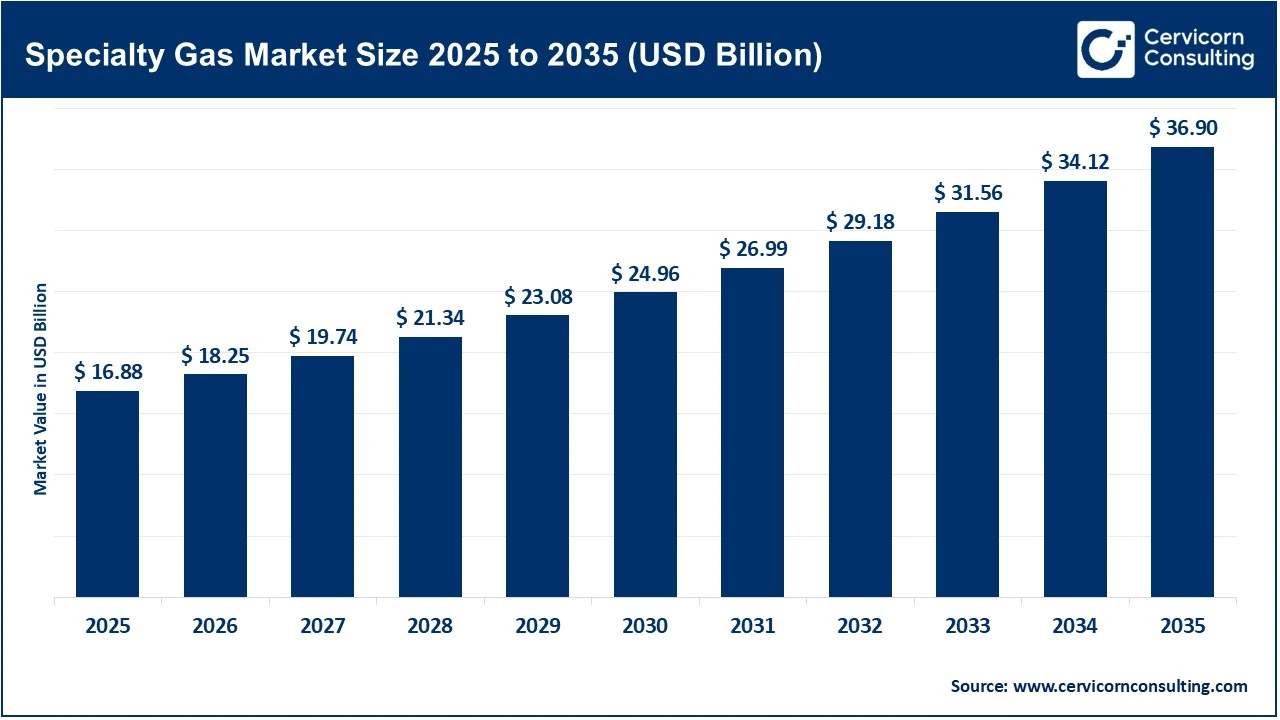
The global specialty gas market size was estimated at USD 16.88 billion in 2025 and is expected to be worth around USD 36.90 billion by 2035, with a compound annual growth rate (CAGR) of 8.2% over the forecast period from 2026 to 2035.
Industrial automation is a major driver of growth for the specialty gas market, mainly due to the rising use of laser-based technologies and welding mixtures in high-precision manufacturing. As industries progressively adopt automated systems, gases must remain consistently pure to safeguard sensitive equipment and ensure the quality of the final product. Demand for laser gas, used in robotic cutting and engraving, increased by 7.5% year over year through early 2025. Additionally, the emergence of smart factories, which utilize real-time monitoring of gas flow and usage via connected equipment, is significantly boosting the growth of laser gases. The advent of Industry 4.0 fosters the development of specialty gas mixtures that accelerate production while meeting the tight tolerances required for modern engineering.
Global industrialization and rapid urbanization are other growth factors of the market. Expanding urban centers are leading as hubs of innovation and technological services, increasing the demand for sophisticated gas infrastructure to support laboratories and research facilities. These environments rely heavily on specialty gases to support laboratories, healthcare facilities, and advanced research institutions. As a result, the ongoing development of industrial ecosystems and urban clusters is expected to maintain long-term demand for specialty gases across multiple high-value applications.
Electronics Miniaturization and Purity Demand Trends
The ongoing shift toward electronics miniaturization in the semiconductor industry is significantly changing the demand for specialty gases. As microchips move to 3nm and 2nm process nodes, the chemical impurity tolerances have become nearly nonexistent, requiring gases with levels of purity often exceeding 7N (99.99999%). This rising focus on purity is driving a 9.1% growth rate in electronics application segments, as they demand specialized chemistries for complex processes such as Atomic Layer Deposition (ALD) and Extreme Ultraviolet (EUV) lithography. Additionally, in 2025, the amount of specialty gases needed per wafer will increase by 15% compared to previous generations of technology, driven by the increased complexities of new transistor architectures.
What are the primary application areas in the specialty gas market?
1. Electronics and Semiconductor Manufacturing
The electronics sector frequently utilizes high-purity specialty gases in the production of semiconductors, display panels, and photovoltaic cells. Specialty gases are utilized in etching, cleaning, and chemical vapor deposition (CVD) processes that define the performance characteristics of modern hardware.
2. Healthcare and Medical Diagnostics
Medical specialty gases are vital for medical imaging, respiratory therapy, and life support systems in healthcare. The following products are produced to strict pharmaceutical standards to ensure therapeutic efficacy and patient safety.
3. Analytical Chemistry and Laboratory Research
Specialty gases are important and preferred materials in analytical laboratories for environmental monitoring, forensic analysis, and quality assurance. They offer a stable baseline and carrier medium for high-sensitivity instruments.
4. Industrial Manufacturing and Energy Production
In industrial and energy applications, specialty gases improve precision in manufacturing processes and increase energy extraction efficiency. They are commonly used in advanced laser technology, lighting, and environmental compliance monitoring.
Report Scope
| Area of Focus | Details |
| Market Size in 2026 | USD 18.25 Billion |
| Market Size in 2035 | USD 36.90 Billion |
| CAGR 2026 to 2035 | 8.20% |
| Dominant Region | Asia-Pacific |
| Key Segment | Product, Application, Region |
| Key Companies | Air Liquide, Linde plc, Air Products and Chemicals, Inc., Messer Group GmbH, Taiyo Nippon Sanso Corporation, Iwatani Corporation, SHOWA DENKO K.K., MESA Specialty Gases & Equipment, Coregas Pty Ltd., Norco Inc., ILMO Products Company, Mitsui Chemicals, Inc., Weldstar, Inc., Yingde Gases Group Company Limited, Matheson Tri-Gas, Inc. |
1. Expansion of Semiconductor-Driven Specialty Gas Infrastructure
The major milestone in the specialty gas market is the announcement of USD 500 million by leading industrial gas companies to expand purification facilities in the Southwestern United States in 2024. This expansion aligns with new semiconductor “mega-fabs” in regions such as Arizona and Texas, supported by funding under the CHIPS Act and Science Act. The facilities will provide on-site ultra-high purity nitrogen and argon, along with specific etching gases, to help stabilize supply constraints for the next generation of microchips. Additionally, this development will increase the regional production capacity of electronic specialty gases by 25% as of December 2026.
2. European Commission's USD Million Initiative for Specialty Gas Clusters
In 2025, the European Commission launched a USD 200 million program to develop clusters of high-purity hydrogen and specialty gases across Europe. The aim of this policy is to reduce the EU's reliance on foreign suppliers for essential materials in these industries while supporting the transition to a green economy. The program offers financial incentives for companies investing in low-carbon gas production technologies and the recycling of rare gases such as Neon and Krypton. Consequently, this government involvement has already started to drive several public-private partnerships forming "gas valleys" where production, research, and application are integrated into a single ecosystem. These initiatives could increase regional self-sufficiency in specialty gases by over 15-20% in the coming year.
3. Strategic Partnerships Supporting Sustainable Resource Development
Strategic partnerships between gas suppliers and technology companies are increasingly influencing the global specialty gas market. For example, collaborations related to critical minerals extraction in Indonesia, especially nickel and cobalt, which are vital for energy and gas-related technologies. These partnerships focus on value chain analysis, life cycle evaluations, and sustainable mining practices to ensure that the growth of the specialty gas industry aligns with worldwide sustainability objectives. With Indonesia contributing a major share of global nickel production, such initiatives are expected to support over 20% of future demand for gas-powered clean energy technologies, while promoting environmentally responsible sourcing.
4. Infrastructure Advancements Enabling Circular Gas Economy
The development of advanced infrastructure for small modular reactors (SMR) and new energy systems marks a significant milestone for the specialty gas market because they will require high-purity gases for cooling and monitoring. Additionally, the future evolution of municipal sewage sludge management into integrated biorefineries signals another step toward resource recovery, where the gases captured can be valorized for energy and nutrient value. These infrastructure milestones are essential to establishing a resilient and circular supply chain.
The specialty gas market is segmented into product, application, and region.
The carbon gases segment generates the largest revenue in the market, primarily because it provides a fundamental function across both industrial and consumer applications. These gases are essential in processes such as food and beverage carbonation, metal fabrication, and chemical manufacturing. The segment benefits greatly from the ongoing expansion of the global carbonated beverage industry and from rising demand for carbon dioxide in enhanced oil recovery operations.
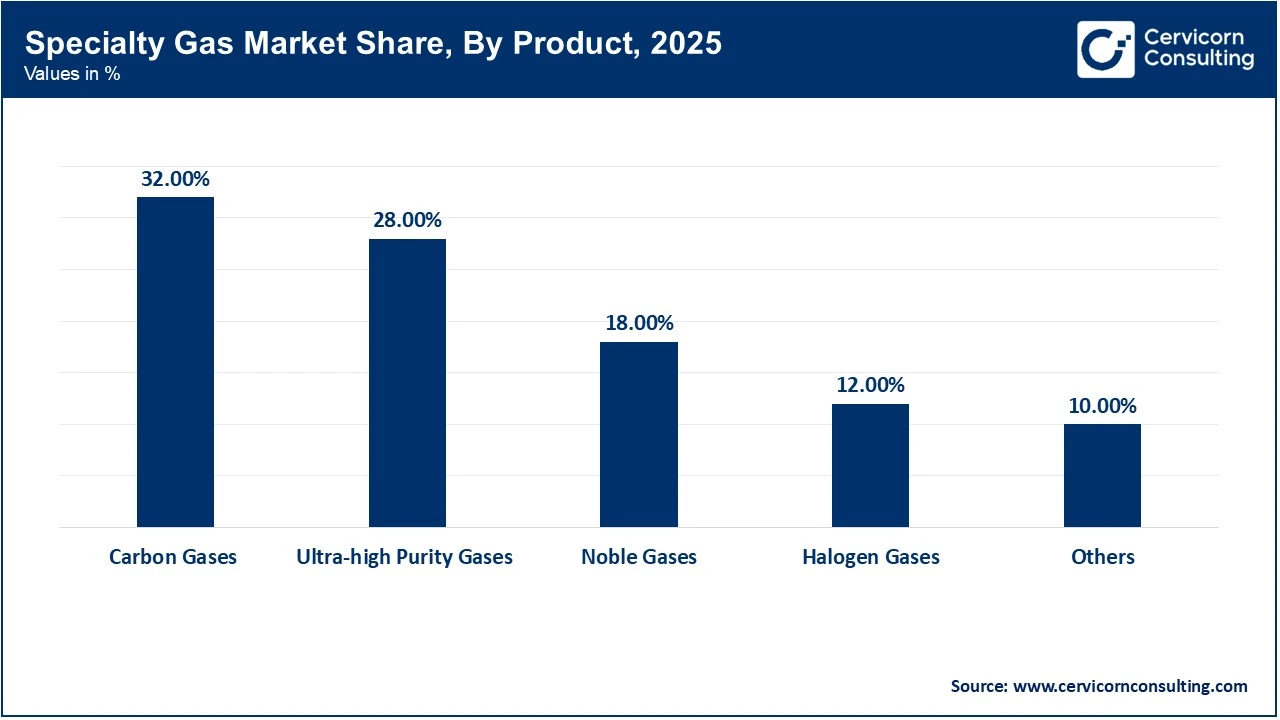
The Ultra-high Purity Gases segment is the fastest growing in the specialty gas market, mainly driven by the highly technical requirements of the modern semiconductor and fiber optic industries. As chipmakers transition to 3nm and 2nm nodes, impurity tolerances have become nearly nonexistent, and demand for gases with 6N and 7N purity levels has increased significantly. Furthermore, the rising demand for advanced electronics and the growing complexity of biotech research require high-purity nitrogen and argon to maintain sterile environments. Consequently, the UHP gases segment is expected to grow at a CAGR of approximately 9%, underscoring its vital role in next-generation technologies.
The healthcare segment remains the dominant application segment in the market because medical gases are essential and non-discretionary. These gases are widely used in hospitals, clinics, and diagnostic centres for respiratory therapy, anaesthesia, and imaging procedures such as MRI and cryosurgery. The vital role of medical gases in societal well-being sustains consistent demand and endures economic cycles. Furthermore, the essential function of medical gases in patient care and safety ensures a stable and recurring revenue stream, making this segment resilient to economic fluctuations.
Specialty Gas Market Share, By Application, 2025 (%)
| Application | Revenue Share, 2025 (%) |
| Healthcare | 30% |
| Electronics | 27% |
| Manufacturing | 20% |
| Institutions | 13% |
| Others | 10% |
The electronics segment is the fastest-growing part of the market due to the rapid expansion of technologies like AI computing, 5G infrastructure, and smart devices. The rising production of high-tech components, especially in regions like Taiwan, is driving strong demand for specialty gases. Gases such as fluorinated and hydride are used in specialized etching and deposition processes, leading to a projected annual growth rate that surpasses that of the healthcare segment by nearly 4%.
The specialty gas market is segmented into various regions, including North America, Europe, Asia-Pacific, and LAMEA. Here is a brief overview of each region:
The Aisa-Pacific specialty gas market size was valued at USD 6.75 billion in 2025 and is forecasted to grow around USD 14.76 billion by 2035.
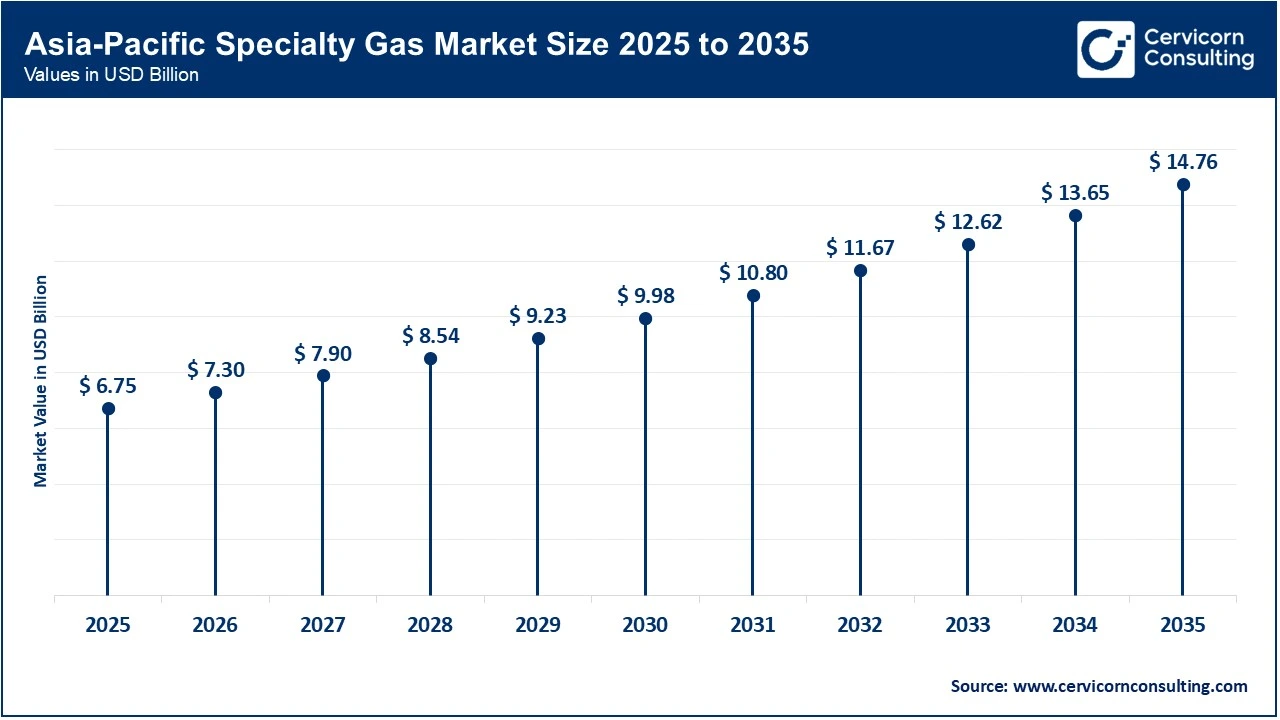
Asia Pacific continues to dominate the market due to strong momentum from new semiconductor sovereignty initiatives across China, Taiwan, and South Korea. Significant investments in new fabrication capacity (fabs) have fostered an ecosystem of electronic specialty gases (ESG), which has become a growth driver. East Asia will add over 25 new large fabrication plants with a projected CAGR of 12% in high-purity etchants, while the rapidly expanding auto and chemical sectors in Southeast Asia will diversify the demand for calibration and industrial specialty gases.
China: Dominating the Global Semiconductor Supply Chain
In China, the specialty gas market is actively working to localize the production of electronic specialty gas (ESG) to reduce the effects of export restrictions and achieve independence in their supply chain.
India: Accelerating Healthcare Infrastructure and Urbanization
In India, the market initiative and a post-COVID emphasis on medical resilience are propelling the country to become a leading global hub for medical and industrial specialty gases.
The North America specialty gas market size was estimated at USD 4.90 billion in 2025 and is forecasted to surpass around USD 10.70 billion by 2035. North America benefits from low-cost feedstock from the shale gas revolution, along with advanced capabilities in aerospace and defense. The infrastructure is well-developed for extracting specialty hydrocarbons and noble gases. Recent increases in U.S. aerospace budgets directly boost the supply of high-purity Xenon, which is widely used in satellite ion propulsion systems. Additionally, existing leading pharmaceutical R&D hubs will keep North America as the top consumer of high-purity medical gases and analytical standards.
United States: Leading Innovation in Aerospace and Defense R&D
The U.S. domestic manufacturing sector is witnessing a revival, driven by federal laws and the growth of private space exploration.
Canada: Optimizing Natural Resource Extraction and Clean Energy
Canada's market relies on its natural resources, with a growing focus on high-purity gases for clean energy and environmental monitoring.
The Europe specialty gas market size was estimated at USD 4.05 billion in 2025 and is projected to hit around USD 8.86 billion by 2035. In Europe, environmental regulations and sustainability initiatives are reshaping the specialty gas industry. Policies such as the "European Green Deal" and strict F-gas regulations are speeding up the shift towards low global-warming-potential (GWP) alternatives. The European Union aims to cut fluorinated gas emissions by two-thirds by 2030, which will drive an annual growth rate of 5.5% for eco-friendly gas mixtures. Additionally, the region is moving toward a "Hydrogen Economy," where high-purity specialty hydrogen is essential for fuel cell testing and green steel production. Precision engineering sectors in Germany and Switzerland have maintained higher average selling prices (ASPs) due to stringent purity requirements.
United Kingdom: Advancing Analytical Services and Laboratory Research
The UK market is characterized by its high concentration of world-class research-level universities and a sophisticated analytical services sector.
Germany: Champion for Automotive Excellence and Chemical Modernization
Germany is the European leader in specialty gases and is concentrating on applications for Industry 4.0 and the shift to a hydrogen-based economy.
Specialty Gas Market Share, By Region, 2025 (%)
| Region | Revenue Share, 2025 (%) |
| Asia Pacific | 40% |
| North America | 29% |
| Europe | 24% |
| LAMEA | 7% |
The LAMEA specialty gas market was valued at USD 1.18 billion in 2025 and is anticipated to reach around USD 2.58 billion by 2035. The LAMEA region is driven by infrastructure development and industrial diversification. In the Middle East, "Vision" schemes such as Saudi Vision 2030 have shifted focus toward downstream petrochemicals and advanced healthcare, contributing to the rising demand for specialty calibration gases. Meanwhile, countries like Brazil are expanding their healthcare sectors, and the United Arab Emirates continues to execute an industrial strategy. These factors are expected to propel the regional market growth beyond 6% until 2028. Additionally, there is increasing demand for specialty gases in analytical testing in Chile and South Africa as they boost the production of transition metals such as lithium and copper.
Brazil: Developing industrial diversification and agricultural processing
United Arab Emirates: Strategic energy diversification and petrochemical growth
By Product
By Application
By Region
Chapter 1. Market Introduction and Overview
1.1 Market Definition and Scope
1.1.1 Overview of Specialty Gas
1.1.2 Scope of the Study
1.1.3 Research Timeframe
1.2 Research Methodology and Approach
1.2.1 Methodology Overview
1.2.2 Data Sources and Validation
1.2.3 Key Assumptions and Limitations
Chapter 2. Executive Summary
2.1 Market Highlights and Snapshot
2.2 Key Insights by Segments
2.2.1 By Product Overview
2.2.2 By Application Overview
2.3 Competitive Overview
Chapter 3. Global Impact Analysis
3.1 Russia-Ukraine Conflict: Global Market Implications
3.2 Regulatory and Policy Changes Impacting Global Markets
Chapter 4. Market Dynamics and Trends
4.1 Market Dynamics
4.1.1 Market Drivers
4.1.2 Market Restraints
4.1.3 Market Opportunities
4.1.4 Market Challenges
4.2 Market Trends
Chapter 5. Premium Insights and Analysis
5.1 Global Specialty Gas Market Dynamics, Impact Analysis
5.2 Porter’s Five Forces Analysis
5.2.1 Bargaining Power of Suppliers
5.2.2 Bargaining Power of Buyers
5.2.3 Threat of Substitute Products
5.2.4 Rivalry among Existing Firms
5.2.5 Threat of New Entrants
5.3 PESTEL Analysis
5.4 Value Chain Analysis
5.5 Product Pricing Analysis
5.6 Vendor Landscape
5.6.1 List of Buyers
5.6.2 List of Suppliers
Chapter 6. Specialty Gas Market, By Product
6.1 Global Specialty Gas Market Snapshot, By Product
6.1.1 Market Revenue (($Billion) and Growth Rate (%), 2022-2035
6.1.1.1 Carbon Gases
6.1.1.2 Ultra-high Purity Gases
6.1.1.3 Noble Gases
6.1.1.4 Halogen Gases
6.1.1.5 Others
Chapter 7. Specialty Gas Market, By Application
7.1 Global Specialty Gas Market Snapshot, By Application
7.1.1 Market Revenue (($Billion) and Growth Rate (%), 2022-2035
7.1.1.1 Healthcare
7.1.1.2 Electronics
7.1.1.3 Manufacturing
7.1.1.4 Institutions
7.1.1.5 Others
Chapter 8. Specialty Gas Market, By Region
8.1 Overview
8.2 Specialty Gas Market Revenue Share, By Region 2024 (%)
8.3 Global Specialty Gas Market, By Region
8.3.1 Market Size and Forecast
8.4 North America
8.4.1 North America Specialty Gas Market Revenue, 2022-2035 ($Billion)
8.4.2 Market Size and Forecast
8.4.3 North America Specialty Gas Market, By Country
8.4.4 U.S.
8.4.4.1 U.S. Specialty Gas Market Revenue, 2022-2035 ($Billion)
8.4.4.2 Market Size and Forecast
8.4.4.3 U.S. Market Segmental Analysis
8.4.5 Canada
8.4.5.1 Canada Specialty Gas Market Revenue, 2022-2035 ($Billion)
8.4.5.2 Market Size and Forecast
8.4.5.3 Canada Market Segmental Analysis
8.4.6 Mexico
8.4.6.1 Mexico Specialty Gas Market Revenue, 2022-2035 ($Billion)
8.4.6.2 Market Size and Forecast
8.4.6.3 Mexico Market Segmental Analysis
8.5 Europe
8.5.1 Europe Specialty Gas Market Revenue, 2022-2035 ($Billion)
8.5.2 Market Size and Forecast
8.5.3 Europe Specialty Gas Market, By Country
8.5.4 UK
8.5.4.1 UK Specialty Gas Market Revenue, 2022-2035 ($Billion)
8.5.4.2 Market Size and Forecast
8.5.4.3 UK Market Segmental Analysis
8.5.5 France
8.5.5.1 France Specialty Gas Market Revenue, 2022-2035 ($Billion)
8.5.5.2 Market Size and Forecast
8.5.5.3 France Market Segmental Analysis
8.5.6 Germany
8.5.6.1 Germany Specialty Gas Market Revenue, 2022-2035 ($Billion)
8.5.6.2 Market Size and Forecast
8.5.6.3 Germany Market Segmental Analysis
8.5.7 Rest of Europe
8.5.7.1 Rest of Europe Specialty Gas Market Revenue, 2022-2035 ($Billion)
8.5.7.2 Market Size and Forecast
8.5.7.3 Rest of Europe Market Segmental Analysis
8.6 Asia Pacific
8.6.1 Asia Pacific Specialty Gas Market Revenue, 2022-2035 ($Billion)
8.6.2 Market Size and Forecast
8.6.3 Asia Pacific Specialty Gas Market, By Country
8.6.4 China
8.6.4.1 China Specialty Gas Market Revenue, 2022-2035 ($Billion)
8.6.4.2 Market Size and Forecast
8.6.4.3 China Market Segmental Analysis
8.6.5 Japan
8.6.5.1 Japan Specialty Gas Market Revenue, 2022-2035 ($Billion)
8.6.5.2 Market Size and Forecast
8.6.5.3 Japan Market Segmental Analysis
8.6.6 India
8.6.6.1 India Specialty Gas Market Revenue, 2022-2035 ($Billion)
8.6.6.2 Market Size and Forecast
8.6.6.3 India Market Segmental Analysis
8.6.7 Australia
8.6.7.1 Australia Specialty Gas Market Revenue, 2022-2035 ($Billion)
8.6.7.2 Market Size and Forecast
8.6.7.3 Australia Market Segmental Analysis
8.6.8 Rest of Asia Pacific
8.6.8.1 Rest of Asia Pacific Specialty Gas Market Revenue, 2022-2035 ($Billion)
8.6.8.2 Market Size and Forecast
8.6.8.3 Rest of Asia Pacific Market Segmental Analysis
8.7 LAMEA
8.7.1 LAMEA Specialty Gas Market Revenue, 2022-2035 ($Billion)
8.7.2 Market Size and Forecast
8.7.3 LAMEA Specialty Gas Market, By Country
8.7.4 GCC
8.7.4.1 GCC Specialty Gas Market Revenue, 2022-2035 ($Billion)
8.7.4.2 Market Size and Forecast
8.7.4.3 GCC Market Segmental Analysis
8.7.5 Africa
8.7.5.1 Africa Specialty Gas Market Revenue, 2022-2035 ($Billion)
8.7.5.2 Market Size and Forecast
8.7.5.3 Africa Market Segmental Analysis
8.7.6 Brazil
8.7.6.1 Brazil Specialty Gas Market Revenue, 2022-2035 ($Billion)
8.7.6.2 Market Size and Forecast
8.7.6.3 Brazil Market Segmental Analysis
8.7.7 Rest of LAMEA
8.7.7.1 Rest of LAMEA Specialty Gas Market Revenue, 2022-2035 ($Billion)
8.7.7.2 Market Size and Forecast
8.7.7.3 Rest of LAMEA Market Segmental Analysis
Chapter 9. Competitive Landscape
9.1 Competitor Strategic Analysis
9.1.1 Top Player Positioning/Market Share Analysis
9.1.2 Top Winning Strategies, By Company, 2022-2024
9.1.3 Competitive Analysis By Revenue, 2022-2024
9.2 Recent Developments by the Market Contributors (2024)
Chapter 10. Company Profiles
10.1 Air Liquide
10.1.1 Company Snapshot
10.1.2 Company and Business Overview
10.1.3 Financial KPIs
10.1.4 Product/Service Portfolio
10.1.5 Strategic Growth
10.1.6 Global Footprints
10.1.7 Recent Development
10.1.8 SWOT Analysis
10.2 Linde plc
10.3 Air Products and Chemicals, Inc.
10.4 Messer Group GmbH
10.5 Taiyo Nippon Sanso Corporation
10.6 Iwatani Corporation
10.7 SHOWA DENKO K.K.
10.8 MESA Specialty Gases & Equipment
10.9 Coregas Pty Ltd.
10.10 Norco Inc.
10.11 ILMO Products Company
10.12 Mitsui Chemicals, Inc.
10.13 Weldstar, Inc.
10.14 Yingde Gases Group Company Limited
10.15 Matheson Tri-Gas, Inc.