
The global software as a service (SaaS) market size was valued at USD 409.18 billion in 2025 and is expected to reach around USD 1486.23 billion by 2035, growing at a compound annual growth rate (CAGR) of 13.77% over the forecast period from 2026 to 2035. The rising shift from traditional platform-based software to cloud-based systems creates a strong potential for the software as a service market.
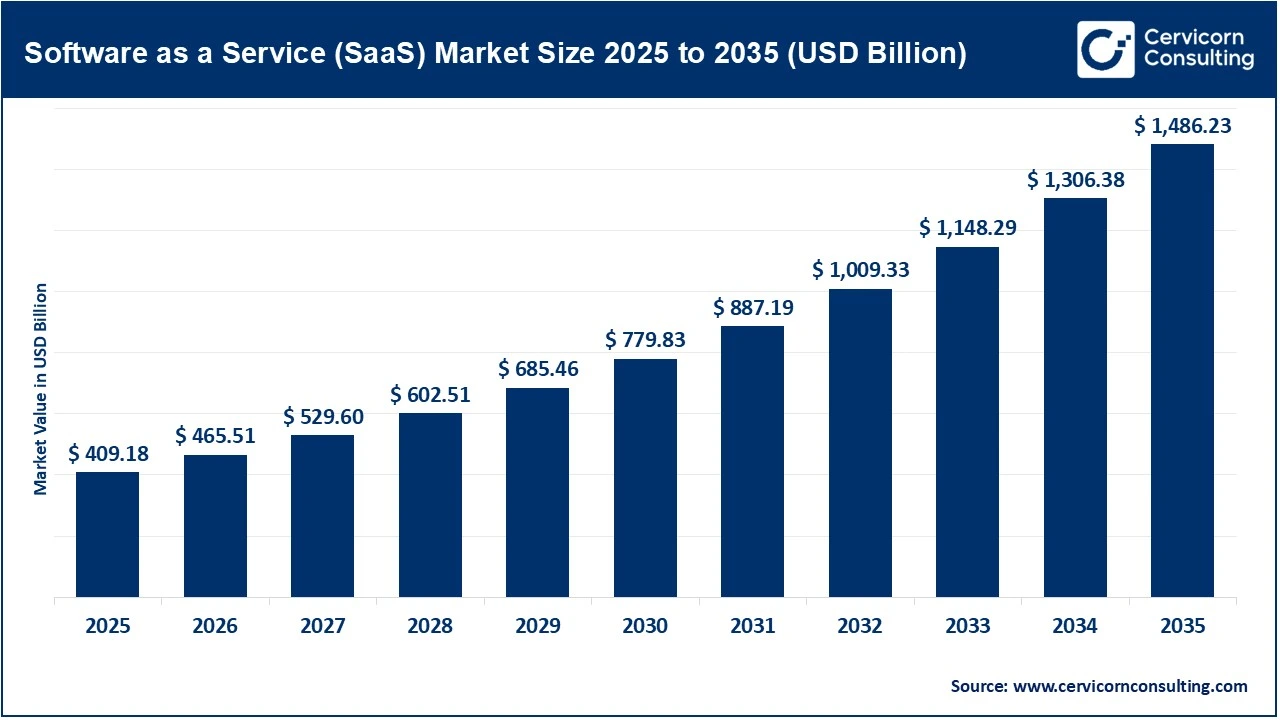
The SaaS (Software as a Service) marketplace consists of an entire ecosystem of cloud-based software solutions that provide users with access to software via the Internet rather than having to purchase individual pieces of software (as used to be the case) and install them on a local computer. Instead, the user accesses applications via the Internet using a web browser, while the service provider takes care of all management and maintenance of the infrastructure, security, updates, etc., for the application in question.
SaaS applications cover many different areas of business, such as customer relationship management, enterprise resource planning, human resources, collaboration tools, marketing automation, etc. As a result of this approach, organizations can scale use of applications according to what is needed by them; thus lowering the initial costs of IT. Additionally, with this approach, solutions can be deployed very quickly throughout multiple countries/regions, regardless of distance from one another.
Accelerating Demand for Cloud-Based Digital Transformation
The global trend of modernizing operations is accelerating, and SaaS is a critical element of this process. Organizations are moving away from legacy on-premises systems to more flexible, cloud-based platforms that promote real-time collaboration, enable remote access, and help organizations make data-driven decisions. Key factors contributing to this shift include the increased need for operational agility; companies are facing immense pressure to quickly adapt to changing market conditions, evolving customer expectations, and the competitive landscape.
SaaS allows organizations to deploy quickly and provide continuous updates to their applications, enabling companies to innovate without disruption. Furthermore, with the rise of remote and hybrid workplaces, SaaS is becoming increasingly important to organizations. Businesses are adopting cloud technologies for communication, project management, and customer engagement to enable their distributed teams to work productively together. As this transformation continues, we anticipate strong demand for SaaS solutions in all industries.
Data Security Concerns and Regulatory Complexities
While the software as a service market has some benefits, there are many issues related to data privacy, data security, and compliance that impact the SaaS industry. There is an increase in concern regarding data breaches, unauthorized access and cyber-attacks for organizations that are moving to cloud-based platforms and storing their confidential information such as customer and business related information in the cloud.
Compliance with regulations and the protection of data in industries with heavy regulations such as healthcare, financial services, and government is a major concern due to the fact that these companies require additional security measures, audits, and certifications in order to comply with the many different regulations they have to follow before they can begin using SaaS solutions. This can delay the adoption and increase costs for these businesses.
Integration of Artificial Intelligence and Automation
Integrating artificial intelligence (AI) and automation technologies into software as a service solutions has created tremendous potential for growth within the market. AI-powered SaaS products and services help bring traditional software to life with capabilities such as predictive analytics, intelligent automation, and customized user experiences. As more businesses utilize AI-powered SaaS applications to automate repetitive tasks and streamline their decision-making processes, as well as to improve their customer engagement, this integration provides additional opportunities for growth.
For example, using an AI-enhanced customer relationship management (CRM) platform allows businesses to make predictions about future behaviors; whereas, an automated marketing system can optimize its campaigns in real time based on data. Additionally, advances in generative artificial intelligence allow for the creation of content and code and provide advanced insights from datasets used within SaaS applications. This enhances the overall efficiency of an organization's operation and develops new revenue opportunities for SaaS companies.
The North America SaaS market size was valued at USD 184.13 billion in 2025 and is expected to hit around USD 668.80 billion by 2035.
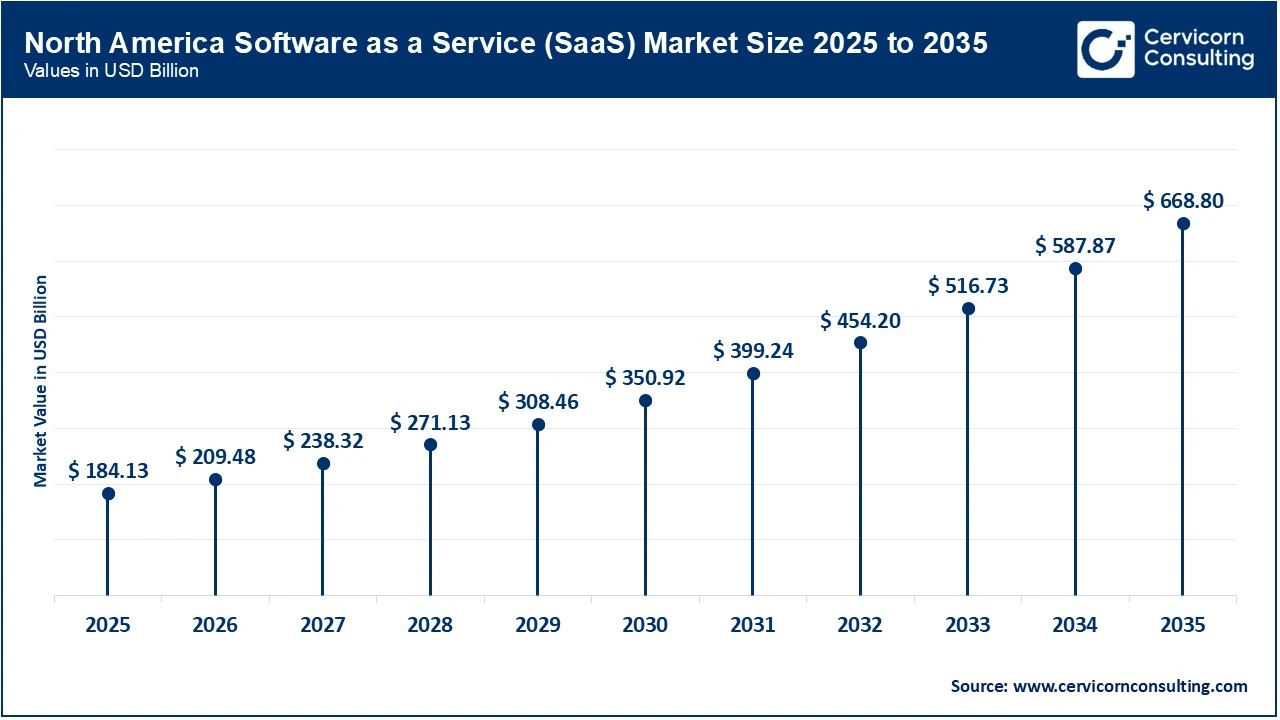
The SaaS model is most developed in the North American region due to its robust digital ecosystem, early technology adopters, and deep enterprise integration with cloud-based applications. The U.S. and Canada have become the epicentre of SaaS innovation. Companies within this region are quickly moving toward AI-enabled, cloud-native and subscription-based software models. The most notable driver of growth can now be attributed to the use of AI technology within SaaS solutions. Solutions that include AI-based capabilities, such as predictive analytical capabilities, automation, and intelligent decision support, will change the way that software applications function within companies.
“According to recent data, over 80% of all companies are currently implementing AI-related technologies, showing that there is a considerable reliance on intelligent SaaS solutions for operational efficiencies and for being innovative.”
The government is also making a significant impact on the growth of SaaS by accelerating the adoption of SaaS solutions. For example, the U.S. government has entered into a strategic partnership with several large cloud providers to increase access to AI-powered SaaS tools to federal government agencies. A recent federal initiative with Microsoft and various federal agencies is expected to save the U.S. government over USD 3 billion in costs while also improving operational efficiency through the use of automation and AI technologies on Cloud.
Top SaaS Providers in the U.S.
| Company | Key Role in the SaaS Industry |
| Microsoft | A dominant force with its cloud ecosystem, offering widely adopted SaaS tools like Microsoft 365 and Dynamics 365. |
| Salesforce | A global leader in CRM SaaS, known for driving customer-centric business models. Its AI-powered platform (Einstein) enhances sales, marketing, and service automation. |
| Adobe | A pioneer in creative and digital experience SaaS through Adobe Creative Cloud and Experience Cloud. It plays a crucial role in digital marketing and content ecosystems. |
| Oracle | Strong presence in enterprise SaaS applications including ERP, HCM, and database-driven cloud solutions. Known for serving large enterprises with mission-critical workloads. |
| ServiceNow | A leader in workflow automation and IT service management SaaS. Widely used for enterprise digital workflows and operational efficiency. |
| Workday | Specializes in HR and financial management SaaS solutions. Known for transforming workforce planning and enterprise financial operations. |
| Shopify | A major SaaS provider for e-commerce, empowering businesses to build and scale online stores with ease. Especially significant for SMEs and digital retail growth. |
The Asia-Pacific SaaS market size was valued at USD 85.93 billion in 2025 and is anticipated to hit around USD 312.11 billion by 2035. Software as a Service, or SaaS, is growing rapidly throughout the Asia Pacific region, partly because of rapid digital transformation; developing cloud infrastructure and large scale funded by governments; and the combined efforts of many countries in the region to change the way their economies operate with large-scale digital adoption and enterprise modernization. Businesses in Asia Pacific are moving towards cloud computing models, such as scalable workload relocations to improve scalability; reduce operational complexity; and enable real-time access to their business's data by moving existing workloads onto cloud-based platforms.
Recently, studies have shown that 93% of businesses located within the Asia Pacific region plan to increase their use of public cloud systems to store additional data, signifying a solid foundation for further expansion into SaaS applications. Furthermore, businesses across the region have also seen an increase in the adoption of hybrid-cloud and multi-cloud strategies whereby businesses have begun to leverage multiple cloud environments to maximize the performance of their business's cloud services while reducing the dependence of their business on a single cloud service provider.
Together, these trends demonstrate the continued trend of regional IT infrastructure maturation throughout Asia Pacific. As the pace of public cloud expenditures and the growth of its usage continue to increase due to enterprise-level modernization projects in various industries (e.g. financial institutions, telecommunication providers and government agencies), these industries have begun to use SaaS applications to provide innovative and creative solutions that enhance customer service; improve operational effectiveness; and facilitate rapid digital innovation.
The public segment dominated the software as a service market in 2025. The SaaS ecosystem predominantly uses the public cloud because of its exceptional scalability, cost efficiency and ease of deployment. Businesses of all types are continuously placing a high priority on operational flexibility to provide the ability to easily deploy SaaS solutions without requiring a significant investment in upfront infrastructure.
“According to the experts at Cervicorn Consulting, more than 60% of global enterprise workloads are now hosted in a public cloud environment, indicating a significant shift in IT infrastructure strategies. In addition, digital-first and start-up companies nearly exclusively choose a public cloud SaaS option because of how its pricing model aligns with operating lean budgets through its pay-as-you-go options.”
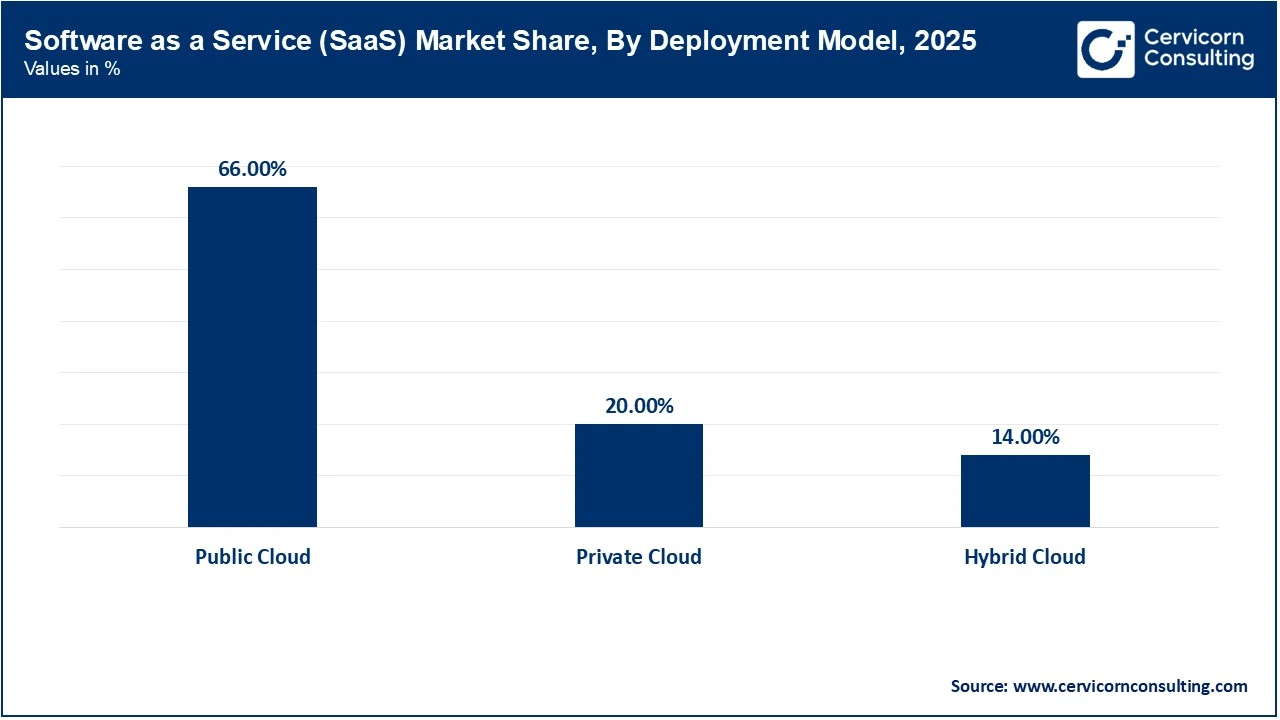
The private deployment segment is seen to grow at the fastest rate during the forecast period. Organizations are increasingly focused on secure data, compliant operations, and control of IT environments, leading to rapid growth in private cloud deployment. Sectors like the healthcare and financial industries as well as governments are major contributors to this trend due to their strict data governance standards. As the number of cyberattacks and breaches continues to rise, businesses have become warier of shared infrastructure environments. private cloud SaaS provides enterprises with increased potential for data isolation and customisation, which is necessary to handle sensitive workloads.
The large enterprises segment led the market in 2025. They have larger IT budgets; their operations are much more complex; early adopters of digital transformation. They rely upon SaaS platforms to manage global operations, manage customer data, and increase productivity across their workforce. The demand for integrated SaaS ecosystems is very strong within this market segment.
Enterprises are increasingly adopting end-to-end platforms to provide integration between CRM, ERP, analytics and collaboration tools. An example of the significance of this trend is that over 85% of large companies worldwide are using several SaaS applications.
SaaS Market Share, By User Type, 2025 (%)
| User Type | Revenue Share, 2025 (%) |
| Small & Medium Enterprises | 37% |
| Large Enterprises | 63% |
The small and medium enterprises (SMEs) segment is expected to grow at the fastest rate during the forecast period because there are now so many affordable and easily deployable digital options available to businesses. Software as a Service (SaaS) is another example of an option that these enterprises can utilize to be successful without the expense of hosting their own IT systems. Digital payments, the growth of e-commerce, and government-sponsored digitalization initiatives are also driving the use of SaaS by SMEs.
The customer relationship management (CRM) segment has continued to lead the pack since it's primarily responsible for generating revenue & retention of customers. Thus, organisations are placing considerable emphasis on driving customer focused strategies, resulting in CRM tools being an absolute necessity for companies. The incorporation of AI into CRM applications is driving a large portion of their continued growth. The addition of predictive analytics, customisation of marketing initiatives, and automation of customer service interactions are all contributing to organizations' ability to improve their customers' experience (CX) through increased engagement with their brands, as well as improving the efficiency at which they generate sales.
SaaS Market Share, By Application, 2025 (%)
| Application | Revenue Share, 2025 (%) |
| Customer Relationship Management | 28% |
| Enterprise Resource Planning | 23% |
| Human Resource Management | 16% |
| Collaboration and Communication | 20% |
| Marketing Automation | 13% |
Marketing automation is the fastest-growing application segment, fueled by the rising importance of data-driven marketing strategies. Businesses are leveraging automation tools to streamline campaigns, analyze customer behavior, and improve ROI.
The integration of generative AI is a key accelerator, enabling automated content creation, personalized messaging, and predictive campaign optimization. A strong instance supporting this growth is that companies using marketing automation report up to a 14% increase in sales productivity and a significant reduction in marketing overhead costs. Additionally, over 75% of marketers now rely on automation tools for campaign management and customer segmentation.
The retail segment dominated the software as a service market in 2025. The rise of SaaS usage in the retail industry is often attributed to an emphasis on customer data, omnichannel approaches, and digital commerce. These applications help retailers manage inventory, customer relationships, and supply chain more effectively. The growth of eCommerce and digital payment solutions has also contributed to the increase in SaaS adoption. Retailers are also utilizing AI-based analytics tools to gain insights into how customers behave and how to best set prices.
SaaS Market Share, By End-user, 2025 (%)
| End User | Revenue Share, 2025 (%) |
| Retail | 23% |
| Healthcare | 20% |
| Manufacturing | 17% |
| Education | 14% |
| Financial Services | 26% |
On the other hand, the healthcare segment is seen to grow at the fastest rate. This growth can be linked to the increased digitization of patient records the adoption of telehealth services; and regulatory compliance mandates. Some of the key reasons for the increased demand for SaaS in healthcare are EHRs, telehealth software/services, and AI-based diagnostic tools. A major factor affecting the growth of the SaaS sector will be businesses' need for secure, scalable, and compliant means of storing and managing data.
By Component
By Deployment Model
By User Type
By Application
By End User
By Region
Chapter 1. Market Introduction and Overview
1.1 Market Definition and Scope
1.1.1 Overview of Software as a Service
1.1.2 Scope of the Study
1.1.3 Research Timeframe
1.2 Research Methodology and Approach
1.2.1 Methodology Overview
1.2.2 Data Sources and Validation
1.2.3 Key Assumptions and Limitations
Chapter 2. Executive Summary
2.1 Market Highlights and Snapshot
2.2 Key Insights by Segments
2.2.1 By Component Overview
2.2.2 By Deployment Model Overview
2.2.3 By User Type Overview
2.2.4 By End User Overview
2.2.5 By Application Overview
2.3 Competitive Overview
Chapter 3. Global Impact Analysis
3.1 Russia-Ukraine Conflict: Global Market Implications
3.2 Regulatory and Policy Changes Impacting Global Markets
Chapter 4. Market Dynamics and Trends
4.1 Market Dynamics
4.1.1 Market Drivers
4.1.1.1 Accelerating Demand for Cloud-Based Digital Transformation
4.1.2 Market Restraints
4.1.2.1 Data Security Concerns and Regulatory Complexities
4.1.3 Market Opportunities
4.1.3.1 Integration of Artificial Intelligence and Automation
4.1.4 Market Challenges
4.2 Market Trends
Chapter 5. Premium Insights and Analysis
5.1 Global Software as a Service Market Dynamics, Impact Analysis
5.2 Porter’s Five Forces Analysis
5.2.1 Bargaining Power of Suppliers
5.2.2 Bargaining Power of Buyers
5.2.3 Threat of Substitute Products
5.2.4 Rivalry among Existing Firms
5.2.5 Threat of New Entrants
5.3 PESTEL Analysis
5.4 Value Chain Analysis
5.5 Product Pricing Analysis
5.6 Vendor Landscape
5.6.1 List of Buyers
5.6.2 List of Suppliers
Chapter 6. Software as a Service Market, By Component
6.1 Global Software as a Service Market Snapshot, By Component
6.1.1 Market Revenue (($Billion) and Growth Rate (%), 2022-2035
6.1.1.1 Software
6.1.1.2 Services
Chapter 7. Software as a Service Market, By Deployment Model
7.1 Global Software as a Service Market Snapshot, By Deployment Model
7.1.1 Market Revenue (($Billion) and Growth Rate (%), 2022-2035
7.1.1.1 Public Cloud
7.1.1.2 Private Cloud
7.1.1.3 Hybrid Cloud
Chapter 8. Software as a Service Market, By User Type
8.1 Global Software as a Service Market Snapshot, By User Type
8.1.1 Market Revenue (($Billion) and Growth Rate (%), 2022-2035
8.1.1.1 Small & Medium Enterprises
8.1.1.2 Large Enterprises
Chapter 9. Software as a Service Market, By End User
9.1 Global Software as a Service Market Snapshot, By End User
9.1.1 Market Revenue (($Billion) and Growth Rate (%), 2022-2035
9.1.1.1 Retail
9.1.1.2 Healthcare
9.1.1.3 Manufacturing
9.1.1.4 Education
9.1.1.5 Financial Services
Chapter 10. Software as a Service Market, By Application
10.1 Global Software as a Service Market Snapshot, By Application
10.1.1 Market Revenue (($Billion) and Growth Rate (%), 2022-2035
10.1.1.1 Customer Relationship Management
10.1.1.2 Enterprise Resource Planning
10.1.1.3 Human Resource Management
10.1.1.4 Collaboration and Communication
10.1.1.5 Marketing Automation
Chapter 11. Software as a Service Market, By Region
11.1 Overview
11.2 Software as a Service Market Revenue Share, By Region 2024 (%)
11.3 Global Software as a Service Market, By Region
11.3.1 Market Size and Forecast
11.4 North America
11.4.1 North America Software as a Service Market Revenue, 2022-2035 ($Billion)
11.4.2 Market Size and Forecast
11.4.3 North America Software as a Service Market, By Country
11.4.4 U.S.
11.4.4.1 U.S. Software as a Service Market Revenue, 2022-2035 ($Billion)
11.4.4.2 Market Size and Forecast
11.4.4.3 U.S. Market Segmental Analysis
11.4.5 Canada
11.4.5.1 Canada Software as a Service Market Revenue, 2022-2035 ($Billion)
11.4.5.2 Market Size and Forecast
11.4.5.3 Canada Market Segmental Analysis
11.4.6 Mexico
11.4.6.1 Mexico Software as a Service Market Revenue, 2022-2035 ($Billion)
11.4.6.2 Market Size and Forecast
11.4.6.3 Mexico Market Segmental Analysis
11.5 Europe
11.5.1 Europe Software as a Service Market Revenue, 2022-2035 ($Billion)
11.5.2 Market Size and Forecast
11.5.3 Europe Software as a Service Market, By Country
11.5.4 UK
11.5.4.1 UK Software as a Service Market Revenue, 2022-2035 ($Billion)
11.5.4.2 Market Size and Forecast
11.5.4.3 UK Market Segmental Analysis
11.5.5 France
11.5.5.1 France Software as a Service Market Revenue, 2022-2035 ($Billion)
11.5.5.2 Market Size and Forecast
11.5.5.3 France Market Segmental Analysis
11.5.6 Germany
11.5.6.1 Germany Software as a Service Market Revenue, 2022-2035 ($Billion)
11.5.6.2 Market Size and Forecast
11.5.6.3 Germany Market Segmental Analysis
11.5.7 Rest of Europe
11.5.7.1 Rest of Europe Software as a Service Market Revenue, 2022-2035 ($Billion)
11.5.7.2 Market Size and Forecast
11.5.7.3 Rest of Europe Market Segmental Analysis
11.6 Asia Pacific
11.6.1 Asia Pacific Software as a Service Market Revenue, 2022-2035 ($Billion)
11.6.2 Market Size and Forecast
11.6.3 Asia Pacific Software as a Service Market, By Country
11.6.4 China
11.6.4.1 China Software as a Service Market Revenue, 2022-2035 ($Billion)
11.6.4.2 Market Size and Forecast
11.6.4.3 China Market Segmental Analysis
11.6.5 Japan
11.6.5.1 Japan Software as a Service Market Revenue, 2022-2035 ($Billion)
11.6.5.2 Market Size and Forecast
11.6.5.3 Japan Market Segmental Analysis
11.6.6 India
11.6.6.1 India Software as a Service Market Revenue, 2022-2035 ($Billion)
11.6.6.2 Market Size and Forecast
11.6.6.3 India Market Segmental Analysis
11.6.7 Australia
11.6.7.1 Australia Software as a Service Market Revenue, 2022-2035 ($Billion)
11.6.7.2 Market Size and Forecast
11.6.7.3 Australia Market Segmental Analysis
11.6.8 Rest of Asia Pacific
11.6.8.1 Rest of Asia Pacific Software as a Service Market Revenue, 2022-2035 ($Billion)
11.6.8.2 Market Size and Forecast
11.6.8.3 Rest of Asia Pacific Market Segmental Analysis
11.7 LAMEA
11.7.1 LAMEA Software as a Service Market Revenue, 2022-2035 ($Billion)
11.7.2 Market Size and Forecast
11.7.3 LAMEA Software as a Service Market, By Country
11.7.4 GCC
11.7.4.1 GCC Software as a Service Market Revenue, 2022-2035 ($Billion)
11.7.4.2 Market Size and Forecast
11.7.4.3 GCC Market Segmental Analysis
11.7.5 Africa
11.7.5.1 Africa Software as a Service Market Revenue, 2022-2035 ($Billion)
11.7.5.2 Market Size and Forecast
11.7.5.3 Africa Market Segmental Analysis
11.7.6 Brazil
11.7.6.1 Brazil Software as a Service Market Revenue, 2022-2035 ($Billion)
11.7.6.2 Market Size and Forecast
11.7.6.3 Brazil Market Segmental Analysis
11.7.7 Rest of LAMEA
11.7.7.1 Rest of LAMEA Software as a Service Market Revenue, 2022-2035 ($Billion)
11.7.7.2 Market Size and Forecast
11.7.7.3 Rest of LAMEA Market Segmental Analysis
Chapter 12. Competitive Landscape
12.1 Competitor Strategic Analysis
12.1.1 Top Player Positioning/Market Share Analysis
12.1.2 Top Winning Strategies, By Company, 2022-2024
12.1.3 Competitive Analysis By Revenue, 2022-2024
12.2 Recent Developments by the Market Contributors (2024)
Chapter 13. Company Profiles
13.1 Microsoft
13.1.1 Company Snapshot
13.1.2 Company and Business Overview
13.1.3 Financial KPIs
13.1.4 Product/Service Portfolio
13.1.5 Strategic Growth
13.1.6 Global Footprints
13.1.7 Recent Development
13.1.8 SWOT Analysis
13.2 Salesforce
13.3 Oracle
13.4 Adobe
13.5 ServiceNow
13.6 Workday
13.7 Zoho Corporation
13.8 Freshworks
13.9 Xero
13.10 Huawei Cloud
13.11 Alibaba Cloud
13.12 SAP
13.13 Sage Group
13.14 Dassault Systèmes
13.15 SuperOffice
13.16 TeamViewer