
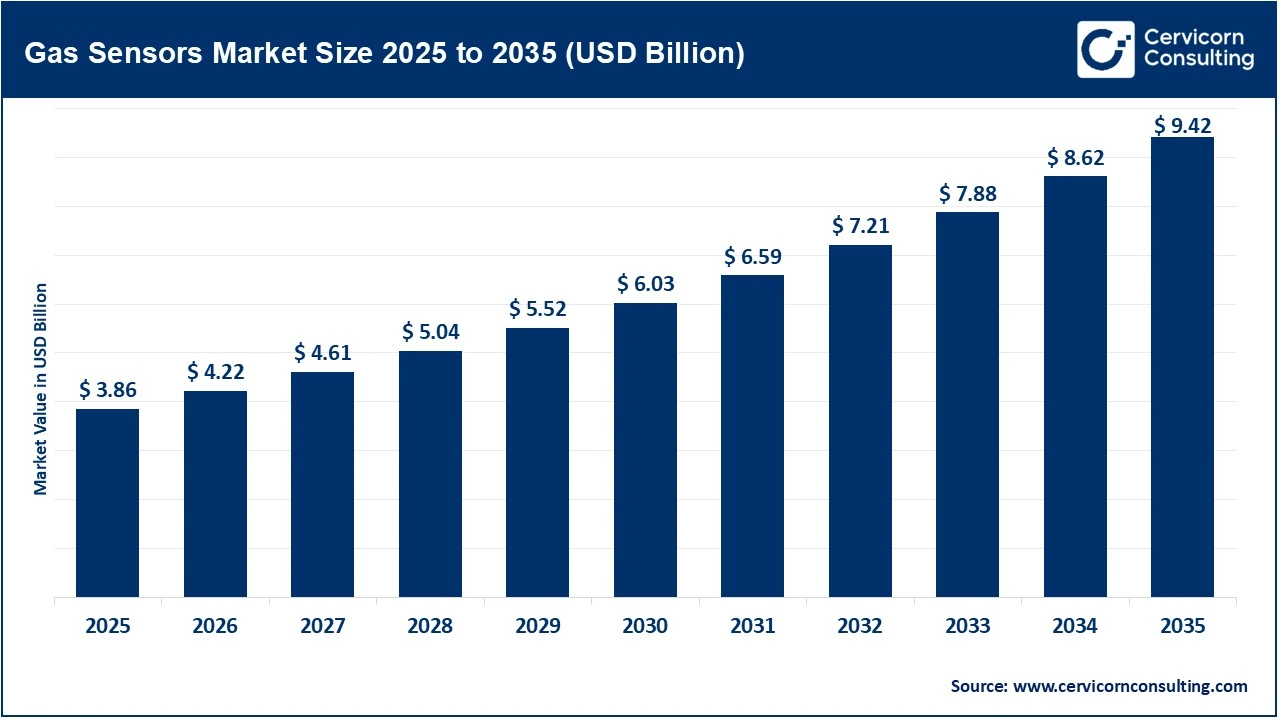
The global gas sensors market size was valued at USD 3.86 billion in 2025 and is expected to hit around USD 9.42 billion by 2035, growing at a compound annual growth rate (CAGR) of 9.33% over the forecast period from 2026 to 2035. The penetration of advanced technologies in industrial sensors holds the utmost potential for the gas sensors market to grow.
What are Gas Sensors & How is the Market Booming?
Gas sensors are devices that monitor the presence or concentration of gasses in the surrounding atmosphere. The various types of types of gas include Carbon Dioxide (CO2), Carbon Monoxide (CO), Nitrogen Oxides (NOX), Methane (CH4), and Volatile Organic Compounds (VOCs) which are all converted to an electrical signal that can be read by the monitoring system of a manufacturer or discloser. There are several sensing technologies used to manufacture gas sensors. The most common are electrochemical, infrared, and semiconductor catalysts. Electrochemical sensors are used most frequently for measuring toxic gasses at low levels, whereas infrared sensors are often used to measure carbon dioxide and hydrocarbon gasses due to their stability and accuracy.
The gas sensor market has been experiencing rapid growth due to regulatory, technological, and environmental drivers. The oil and gas, chemical, mining, and power generation industries are all expanding rapidly resulting in a high degree of gas sensors being required. The industries are often operating in hazardous areas and if a gas leak occurs there could be a considerable amount of danger. As a result of these factors many companies have begun to implement advanced gas detection technologies as preventive measures, and to remain in compliance with safety requirements.
Transition toward Smaller, Low Power Gas Sensor Technology
Increase in Use of Infrared/Optical Sensors for Gas Detection
Growth of Portable/Wearable Devices Used for Gas Detection
Integration of Gas Sensors with Industrial Internet of Things Platforms
The Need for Air Quality Monitoring and Safety in Industrial Settings
The rapid growth of demand for gas detectors is due in part to the heightened anxiety surrounding air pollution along with the increased requirements for safety in industrial workplaces. As governmental bodies and the regulates impose more stringent standards for air quality, gas detectors are being used in urban centres and at industrial sites on a large scale. With The world health organisation (WHO) estimates that 7 million people die prematurely from air pollution each year, there is a clear example of why continuous monitoring of toxic gas emissions is needed.
In industries such as oil & gas refining, chemical manufacturing and mining, gas detectors will continue to play (and already do play) a critical role in preventing the release of hazardous and combustible gases in the workplace and thus protecting workers. Also contributing to the demand for gas detectors and increasing the number of gas detectors needed is the growing trend toward building smarter and more energy efficient commercial buildings with reusable energy systems, (HVAC) heating, ventilation, air conditioning, and other mechanical systems that rely on the use of gas detectors to monitor the indoor air quality.
Calibration Requirements and Sensor Performance Limitations
The gas sensor industry is subject to restrictions, such as the requirement for continuous calibration and maintenance of the sensors for accurate measurements. Over time, the response of some gas sensors will become out of calibration because of external factors (temperature, humidity, other gases present in area), which will result in erroneous readings or false positives unless there is a process in place to maintain the sensors correctly. In an industrial environment, it is required to calibrate the gas sensor routinely; therefore, they also incur an expense related to operations and the cost to employ a skilled operator to conduct calibrations.
Furthermore, cross-sensitivity to other gases may impact gas sensor performance; therefore, achieving an accurate measurement of gas within an industrial environment will be difficult for operators. Restrictions associated with gas sensor calibration and performance will inhibit the use of gas sensors, which may have a greater impact on the usage of gas sensors in smaller and medium enterprises, as they typically have lower levels of technical expertise than larger businesses.
Expansion of Smart Infrastructure and Connected Sensor Networks
As smart cities, connected infrastructure, and Industrial Internet of Things technologies continue to grow, gas sensors will have an exciting growth opportunity. Gas sensors are being increasingly integrated into wireless networks and cloud-based platforms to enable real-time monitoring and analytics. Cities are deploying dense air quality monitoring systems to help them make improved environmental policy decisions; for instance, thousands of air monitoring stations operated by the U.S. Environmental Protection Agency utilize gas sensing technology.
The expansion of connected industrial systems has now enabled companies to use sensor data for predictive maintenance & optimization of operations. There is a growing demand for portable, inexpensive and, connected gas sensors which will lead to new innovation and significant scale opportunities for both developed and emerging market segments.
Top 5 Countries Investing in Gas Sensors: Private Entities, Government Initiatives & Key Highlights
| Country | Government Initiatives | Private Entities | Key Highlights |
| United States | Clean Air Act regulations and nationwide air monitoring programs led by the Environmental Protection Agency | Honeywell, Emerson Electric, General Electric | The U.S. operates thousands of air quality monitoring stations and enforces strict industrial emission standards. Industrial facilities and smart buildings widely deploy gas sensors for safety and compliance. |
| China | National air pollution control policies and smart city programs | Huawei, Hanwei Electronics | China has deployed over 1.8 million environmental monitoring devices across 200+ cities, supporting large-scale air quality tracking and industrial emission control |
| India | Smart Cities Mission and national air quality monitoring programs | Tata Consultancy Services, Honeywell India | Gas sensor-based monitoring has been implemented in 200+ cities, with deployment across traffic hubs, metro stations, and industrial clusters |
| Germany | European Green Deal and strict EU emission regulations | Siemens, Bosch | Environmental sensor adoption in Europe increased significantly, with a 33% rise in deployment in 2024 due to sustainability policies |
| Japan | National hydrogen strategy and smart infrastructure initiatives | Omron, Figaro Engineering | Over 80% of hydrogen fueling stations in Japan use advanced gas sensing technologies, supporting clean energy and safety systems |
The Asia-Pacific gas sensors market size was valued at USD 1.31 billion in 2025 and is expected to hit around USD 3.20 billion by 2035.
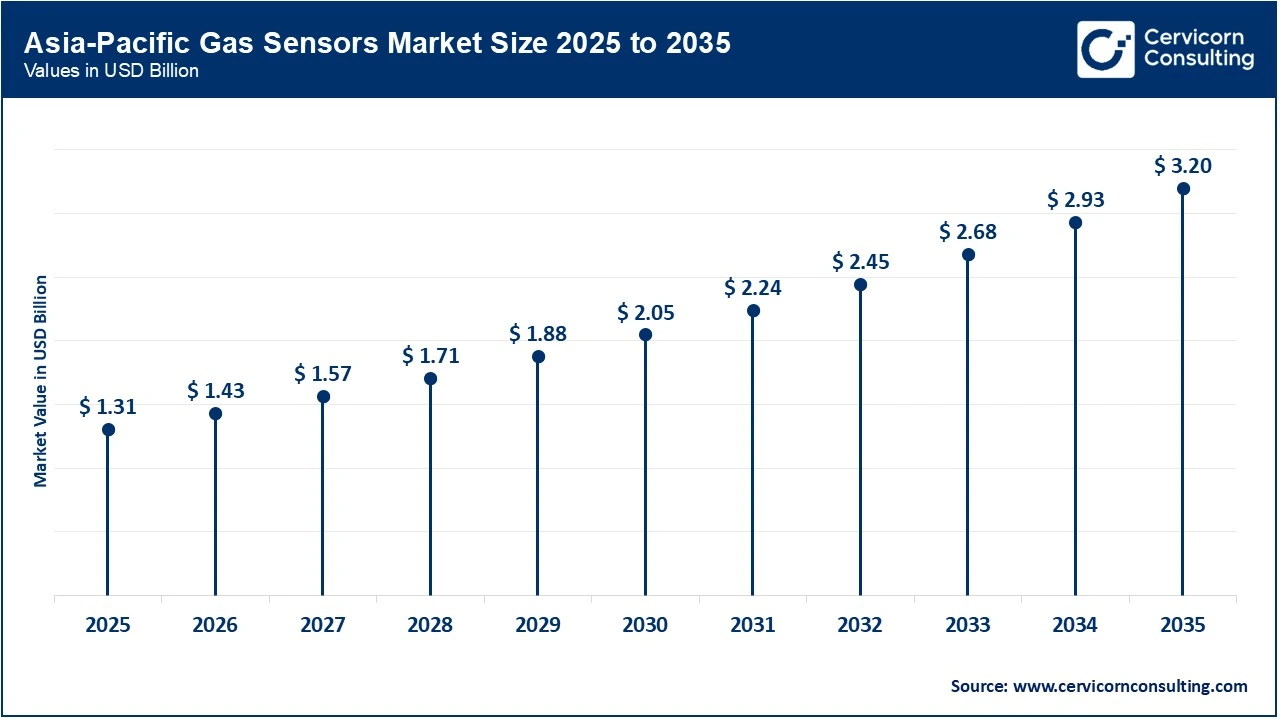
Asia Pacific dominated the gas sensors market in 2025. Asia Pacific has become a leader in industrial production due to its significant growth in this area over recent decades and this is contributing significantly to its ability to compete effectively in technology-driven sectors, like gas sensing.
“The UN Industrial Development Organization estimates that more than 57% of the added value of global manufacturing will come from Asia (in 2024), making it the world's largest manufacturing region. Asia is also responsible for nearly 50% of all exports of manufactured goods globally, which demonstrates how much this area plays a central role in global supply chains.”
China has experienced growth in industrial production in the recent past of more than 6% per year, which demonstrates that there is currently an increase in the level of manufacturing activities taking place in this area. With the continuing expansion of industrial production in Asia, the demand for gas sensors will also continue to grow, and this is especially true for gas sensors used within the very high-risk environments, including refineries, chemical plants, and large manufacturing facilities.
China focuses on its industrial strategy by improving their high technology, automating their production and converting their industry into a digital industry. Southeast Asia, many other countries are also building an industrial base. For instance, Indonesia has approximately 19 million workers in manufacturing and in Thailand, manufacturing accounts for nearly 27% of their GDP, demonstrating the size and volume of manufacturing in that region.
India’s Gas Sensors Market to Witness Boom
India is rapidly becoming a "powerhouse" of industrial growth within Asia and the growth of India's industry will be a key driver for growth in the Indian Gas Sensors market. The Government of India has enacted several initiatives which include "Production Linked Incentive" programs to develop investment of approximately $26 billion in multiple "key" Industries (i.e., Electronics, Auto, Pharma) which is designed to encourage domestic manufacturing and attract foreign direct investment into India.
With all of the global companies who are abandoning their factory production in China to move their production to other countries; new industrial corridors, smart manufacturing hubs, export-oriented production facilities will be created in India; thus, India stands to benefit significantly from their growth as manufacturers supply global companies and other countries.
Gas Sensors Market Share, By Region, 2025 (%)
| Region | Revenue Share, 2025 (%) |
| North America | 25% |
| Europe | 30% |
| Asia-Pacific | 34% |
| LAMEA | 11% |
The North America gas sensors market size was estimated at USD 0.97 billion in 2025 and is anticipated to reach around USD 2.36 billion by 2035. The North America is estimated to grow rapidly, owing to excellent infrastructural facilities for industries within North America, strong enforcement of regulations and early use of intelligent monitoring technologies by users. In addition, the gas sensors market will receive strong support from established oil and gas, chemical, power generation and manufacturing industries which have a solid foundation of compliance with regulations implemented via the use of gas detection devices; especially when protecting occupational health and safety and the environment.
The substantial upgrade of the usage of gas sensors is being accelerated by increased emphasis on environmental monitoring and control and the need for indoor air quality improvements as well as the urbanization of cities where the increased number of commercial buildings will necessitate using gas sensors to meet local government regulations.
The United States is primarily responsible for the demand driving growth of the gas sensors market in North America because of the size of its industrial and energy sectors. The U.S. is several times larger than any other nation or region with respect to producing oil and natural gas. With literally thousands of operating oil and gas facilities such as refineries, pipelines and processing plants. In these environments, there is a mandatory requirement for constant monitoring of gases due to the possibility that methane, H2S or other harmful gases can leak into the atmosphere.
The carbon dioxide (CO2) sensors segment held the largest share of gas sensors market in 2025 because of their extensive installation for indoor air-quality monitoring, smart buildings, and environmental monitoring systems. As well as controlling ventilation in buildings to prevent unsafe levels of CO2 in offices, hospitals, and governmental buildings, these types of sensors have been widely recognized for their importance in the area of indoor air-quality (IAQ) control, leading to greater use of these sensors. With the increase in knowledge regarding IAQ and new standards for the ventilation of buildings, the use of CO2 sensors has begun to grow at an accelerating rate.
For example through HVAC systems, the use of CO2 sensors is a large part of establishing IAQ in buildings. Most new building automation systems (BAS) will automatically control the ventilation of new buildings utilizing the CO2 readings detected by CO2 sensors to maintain healthy IAQ.
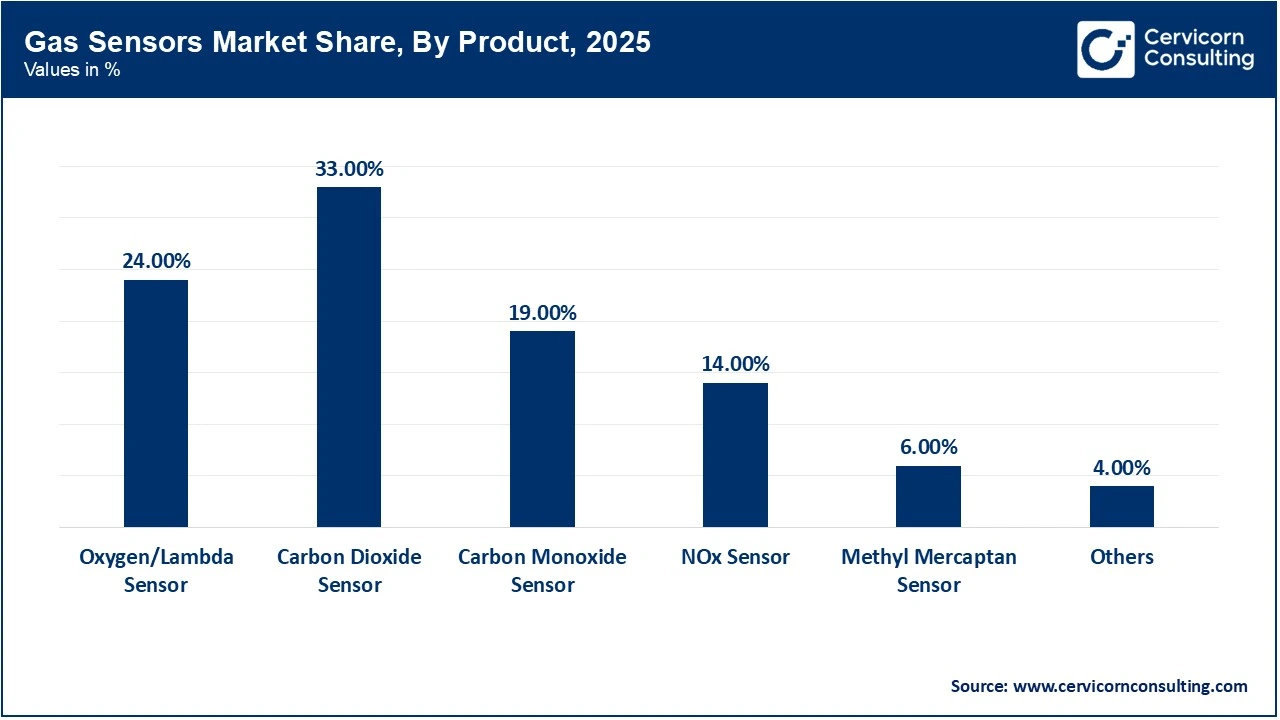
The NOx sensors (Nitrogen Oxides) is expected to grow rapidly as a result of the increased need for precise emission monitoring due to the growing concern for environmental law compliance and for monitoring the emissions of combustion-produced NOx gases and the associated ozone life expectancy impacts on air quality and human health. In order to comply with emission control systems such as selective catalytic reduction (SCR), automotive manufacturers are installing NOx sensors into diesel vehicles and heavy-duty diesel vehicle engines. Furthermore, industrial sites such as power generation facilities, refineries and industrial processing facilities are using NOx sensors in continuous emission monitoring systems (CEMS) to measure exhaust gas emissions to facilitate optimised combustion and reduced emissions.
The wired gas sensor market segment is one of the largest segments of this category. Wired gas sensors provide reliable, high-quality data transfer over long distances; making them well suited for continuous monitoring of environments that require 24/7/365 to support their use (e.g., Industrial Plants or Refineries). Gas sensors that utilize wired technology are very common among Fixed Sensor Installations; many of which are located within areas of Industrial Plant operations where there is an ongoing requirement to provide an uninterrupted power source and require constant monitoring of an Industrial Plant area.
Gas Sensors Market Share, By Type, 2025 (%)
| Type | Revenue Share, 2025 (%) |
| Wireless | 42% |
| Wired | 58% |
The rapid expansion of wireless gas sensors is primarily driven by the growth of industrial IoT, smart infrastructure and remote monitoring. Broadband networks allow for quickly deploying wireless gas sensors versus deploying complex cabling and difficulty to maintain in large industrial areas, remote monitoring locations, mobile safety. Industries deploy wireless gas sensors increasingly in oil and gas pipeline facilities, mining operations and large manufacturing plants to continuously monitor the levels of hazardous gases. Wireless Gas Sensors send the information they collect wirelessly to centralized control centers or cloud systems through wireless communication.
The electrochemical sensing technology segment dominated the gas sensors market as it is very sensitive, consumes very little power, and has a very high ability to detect very low concentrations of toxic gases. These types of sensors generate an electrical signal when a target gas reacts with an electrochemical sensor's electrode. Electrochemical sensors are used extensively to detect gases, including carbon monoxide, hydrogen sulfide, oxygen, and nitrogen oxides, in both industrial and environmental monitoring applications. The ability of electrochemical sensors to detect gases at parts per million (PPM) concentrations makes them ideally suited for use in safety monitoring systems in hazardous industrial environments. Electrochemical sensors are often integrated into portable gas detectors that workers use to monitor their exposures in real-time on industrial sites.
Gas Sensors Market Share, By Technology, 2025 (%)
| Technology | Revenue Share, 2025 (%) |
| Electrochemical | 26% |
| Semiconductor | 17% |
| Solid State/MOS | 14% |
| Photo-Ionization Detector | 7% |
| Catalytic | 11% |
| Infrared | 20% |
| Others | 5% |
As infrared gas sensing technology provides very accurate measurement of gases like CO2, CH4 and hydrocarbons without the need for direct chemical reactions, it is anticipated that it will experience rapid growth in the future. Infrared sensors utilize the principle of optical absorption, with specific gases absorbing infrared radiation at certain wavelengths, in order to detect the presence of those gases. Increasingly, they are used to monitor the environment (e.g., air quality, climate change), in smart buildings, and for industrial leak detection. Compared to chemical sensors, infrared sensors are very well suited for long-term monitoring due to their longevity and low maintenance requirements. They are commonly used in industrial facilities for the detection of combustible gases and the monitoring of greenhouse gas emissions, which helps protect the environment and comply with regulations.
The industrial segment dominated the gas sensors market as gas detection systems are essential in hazardous environments (such as oil and gas plants, chemical manufacturing facilities, and mining operations). Gas sensors provide a means for employers to protect their workers from hazardous or combustible gases, and also help prevent accidents, including explosions and gas leaks. Industrial companies deploy thousands of gas sensors to monitor for a variety of gases including methane, hydrogen sulfide (H2S), carbon monoxide (CO), and oxygen (O2) levels. Gas sensors are typically integrated into safety alarm systems, process control systems and environmental monitoring systems. In addition, many industries have regulatory safety requirements to continuously monitor for gas; therefore, the need for gas sensors in industrial companies will continue to increase globally.
Gas Sensors Market Share, By End Use, 2025 (%)
| End Use | Revenue Share, 2025 (%) |
| Medical | 10% |
| Environmental | 13% |
| Building Automation & Domestic Appliances | 17% |
| Petrochemical | 20% |
| Industrial | 28% |
| Agriculture | 7% |
| Others | 5% |
The environmental segment is seen to grow at the fastest rate during the forecast period. Governments and environmental agencies worldwide utilize large sensor networks to track air pollution and greenhouse gas emissions. Gas sensors, for example, are utilized by urban air quality stations to identify air pollutants, such as nitrogen oxides, carbon dioxide, and volatile organic compounds. Prior to now, several municipalities had established large environmental monitoring programs which continuously monitor air quality levels.
For example, several large urban areas maintain thousands of air quality monitoring stations that continuously collect real-time data about gas pollutants that are relevant to environmental policies and public health initiatives. Increasingly, portable environmental gas monitoring devices are also used in the field for commercial, academic, and nonprofit environmental assessment projects.
By Product
By Type
By Technology
By End Use
By Region
Chapter 1. Market Introduction and Overview
1.1 Market Definition and Scope
1.1.1 Overview of Gas Sensors
1.1.2 Scope of the Study
1.1.3 Research Timeframe
1.2 Research Methodology and Approach
1.2.1 Methodology Overview
1.2.2 Data Sources and Validation
1.2.3 Key Assumptions and Limitations
Chapter 2. Executive Summary
2.1 Market Highlights and Snapshot
2.2 Key Insights by Segments
2.2.1 By Product Overview
2.2.2 By Technology Overview
2.2.3 By Type Overview
2.2.4 By End Use Overview
2.3 Competitive Overview
Chapter 3. Global Impact Analysis
3.1 Russia-Ukraine Conflict: Global Market Implications
3.2 Regulatory and Policy Changes Impacting Global Markets
Chapter 4. Market Dynamics and Trends
4.1 Market Dynamics
4.1.1 Market Drivers
4.1.1.1 The Need for Air Quality Monitoring and Safety in Industrial Settings
4.1.2 Market Restraints
4.1.2.1 Calibration Requirements and Sensor Performance Limitations
4.1.3 Market Opportunities
4.1.3.1 Expansion of Smart Infrastructure and Connected Sensor Networks
4.1.4 Market Challenges
4.2 Market Trends
Chapter 5. Premium Insights and Analysis
5.1 Global Gas Sensors Market Dynamics, Impact Analysis
5.2 Porter’s Five Forces Analysis
5.2.1 Bargaining Power of Suppliers
5.2.2 Bargaining Power of Buyers
5.2.3 Threat of Substitute Products
5.2.4 Rivalry among Existing Firms
5.2.5 Threat of New Entrants
5.3 PESTEL Analysis
5.4 Value Chain Analysis
5.5 Product Pricing Analysis
5.6 Vendor Landscape
5.6.1 List of Buyers
5.6.2 List of Suppliers
Chapter 6. Gas Sensors Market, By Product
6.1 Global Gas Sensors Market Snapshot, By Product
6.1.1 Market Revenue (($Billion) and Growth Rate (%), 2022-2035
6.1.1.1 Oxygen/Lambda Sensor
6.1.1.2 Carbon Dioxide Sensor
6.1.1.3 Carbon Monoxide Sensor
6.1.1.4 NOx Sensor
6.1.1.5 Methyl Mercaptan Sensor
6.1.1.6 Others
Chapter 7. Gas Sensors Market, By Technology
7.1 Global Gas Sensors Market Snapshot, By Technology
7.1.1 Market Revenue (($Billion) and Growth Rate (%), 2022-2035
7.1.1.1 Electrochemical
7.1.1.2 Semiconductor
7.1.1.3 Solid State/MOS
7.1.1.4 Photo-Ionization Detector
7.1.1.5 Catalytic
7.1.1.6 Infrared
7.1.1.7 Others
Chapter 8. Gas Sensors Market, By Type
8.1 Global Gas Sensors Market Snapshot, By Type
8.1.1 Market Revenue (($Billion) and Growth Rate (%), 2022-2035
8.1.1.1 Wireless
8.1.1.2 Wired
Chapter 9. Gas Sensors Market, By End Use
9.1 Global Gas Sensors Market Snapshot, By End Use
9.1.1 Market Revenue (($Billion) and Growth Rate (%), 2022-2035
9.1.1.1 Medical
9.1.1.2 Environmental
9.1.1.3 Building Automation & Domestic Appliances
9.1.1.4 Petrochemical
9.1.1.5 Industrial
9.1.1.6 Agriculture
9.1.1.7 Others
Chapter 10. Gas Sensors Market, By Region
10.1 Overview
10.2 Gas Sensors Market Revenue Share, By Region 2024 (%)
10.3 Global Gas Sensors Market, By Region
10.3.1 Market Size and Forecast
10.4 North America
10.4.1 North America Gas Sensors Market Revenue, 2022-2035 ($Billion)
10.4.2 Market Size and Forecast
10.4.3 North America Gas Sensors Market, By Country
10.4.4 U.S.
10.4.4.1 U.S. Gas Sensors Market Revenue, 2022-2035 ($Billion)
10.4.4.2 Market Size and Forecast
10.4.4.3 U.S. Market Segmental Analysis
10.4.5 Canada
10.4.5.1 Canada Gas Sensors Market Revenue, 2022-2035 ($Billion)
10.4.5.2 Market Size and Forecast
10.4.5.3 Canada Market Segmental Analysis
10.4.6 Mexico
10.4.6.1 Mexico Gas Sensors Market Revenue, 2022-2035 ($Billion)
10.4.6.2 Market Size and Forecast
10.4.6.3 Mexico Market Segmental Analysis
10.5 Europe
10.5.1 Europe Gas Sensors Market Revenue, 2022-2035 ($Billion)
10.5.2 Market Size and Forecast
10.5.3 Europe Gas Sensors Market, By Country
10.5.4 UK
10.5.4.1 UK Gas Sensors Market Revenue, 2022-2035 ($Billion)
10.5.4.2 Market Size and Forecast
10.5.4.3 UK Market Segmental Analysis
10.5.5 France
10.5.5.1 France Gas Sensors Market Revenue, 2022-2035 ($Billion)
10.5.5.2 Market Size and Forecast
10.5.5.3 France Market Segmental Analysis
10.5.6 Germany
10.5.6.1 Germany Gas Sensors Market Revenue, 2022-2035 ($Billion)
10.5.6.2 Market Size and Forecast
10.5.6.3 Germany Market Segmental Analysis
10.5.7 Rest of Europe
10.5.7.1 Rest of Europe Gas Sensors Market Revenue, 2022-2035 ($Billion)
10.5.7.2 Market Size and Forecast
10.5.7.3 Rest of Europe Market Segmental Analysis
10.6 Asia Pacific
10.6.1 Asia Pacific Gas Sensors Market Revenue, 2022-2035 ($Billion)
10.6.2 Market Size and Forecast
10.6.3 Asia Pacific Gas Sensors Market, By Country
10.6.4 China
10.6.4.1 China Gas Sensors Market Revenue, 2022-2035 ($Billion)
10.6.4.2 Market Size and Forecast
10.6.4.3 China Market Segmental Analysis
10.6.5 Japan
10.6.5.1 Japan Gas Sensors Market Revenue, 2022-2035 ($Billion)
10.6.5.2 Market Size and Forecast
10.6.5.3 Japan Market Segmental Analysis
10.6.6 India
10.6.6.1 India Gas Sensors Market Revenue, 2022-2035 ($Billion)
10.6.6.2 Market Size and Forecast
10.6.6.3 India Market Segmental Analysis
10.6.7 Australia
10.6.7.1 Australia Gas Sensors Market Revenue, 2022-2035 ($Billion)
10.6.7.2 Market Size and Forecast
10.6.7.3 Australia Market Segmental Analysis
10.6.8 Rest of Asia Pacific
10.6.8.1 Rest of Asia Pacific Gas Sensors Market Revenue, 2022-2035 ($Billion)
10.6.8.2 Market Size and Forecast
10.6.8.3 Rest of Asia Pacific Market Segmental Analysis
10.7 LAMEA
10.7.1 LAMEA Gas Sensors Market Revenue, 2022-2035 ($Billion)
10.7.2 Market Size and Forecast
10.7.3 LAMEA Gas Sensors Market, By Country
10.7.4 GCC
10.7.4.1 GCC Gas Sensors Market Revenue, 2022-2035 ($Billion)
10.7.4.2 Market Size and Forecast
10.7.4.3 GCC Market Segmental Analysis
10.7.5 Africa
10.7.5.1 Africa Gas Sensors Market Revenue, 2022-2035 ($Billion)
10.7.5.2 Market Size and Forecast
10.7.5.3 Africa Market Segmental Analysis
10.7.6 Brazil
10.7.6.1 Brazil Gas Sensors Market Revenue, 2022-2035 ($Billion)
10.7.6.2 Market Size and Forecast
10.7.6.3 Brazil Market Segmental Analysis
10.7.7 Rest of LAMEA
10.7.7.1 Rest of LAMEA Gas Sensors Market Revenue, 2022-2035 ($Billion)
10.7.7.2 Market Size and Forecast
10.7.7.3 Rest of LAMEA Market Segmental Analysis
Chapter 11. Competitive Landscape
11.1 Competitor Strategic Analysis
11.1.1 Top Player Positioning/Market Share Analysis
11.1.2 Top Winning Strategies, By Company, 2022-2024
11.1.3 Competitive Analysis By Revenue, 2022-2024
11.2 Recent Developments by the Market Contributors (2024)
Chapter 12. Company Profiles
12.1 Honeywell International
12.1.1 Company Snapshot
12.1.2 Company and Business Overview
12.1.3 Financial KPIs
12.1.4 Product/Service Portfolio
12.1.5 Strategic Growth
12.1.6 Global Footprints
12.1.7 Recent Development
12.1.8 SWOT Analysis
12.2 MSA Safety
12.3 Amphenol Corporation
12.4 Emerson Electric
12.5 General Electric
12.6 Teledyne Technologies
12.7 Sensata Technologies
12.8 Figaro Engineering
12.9 Niterra Co., Ltd.
12.10 Renesas Electronics
12.11 Hanwei Electronics Group
12.12 Cubic Sensor and Instrument
12.13 Riken Keiki
12.14 NGK Insulators