
The global animal feed market size was valued at USD 637.15 billion in 2025 and is expected to be worth around USD 996.65 billion by 2035, exhibiting at a compound annual growth rate (CAGR) of 4.6% over the forecast period 2026 to 2035. The growth of the animal feed market is mainly driven by increasing global demand for animal-based products and the supply of feed and nutrients for livestock, poultry, and aquaculture. In 2023, global compound feed production surpassed 1.3 billion metric tons, showing steady growth fueled by expanding livestock and aquaculture sectors. This demand is expected to continue rising in developing countries through the mid-21st century. While population growth is significant, it also reflects a rise in disposable income, allowing consumers to add more protein-rich foods to their diets. To meet this demand, livestock populations need to grow and be optimized, which requires a more reliable and scalable feed system.
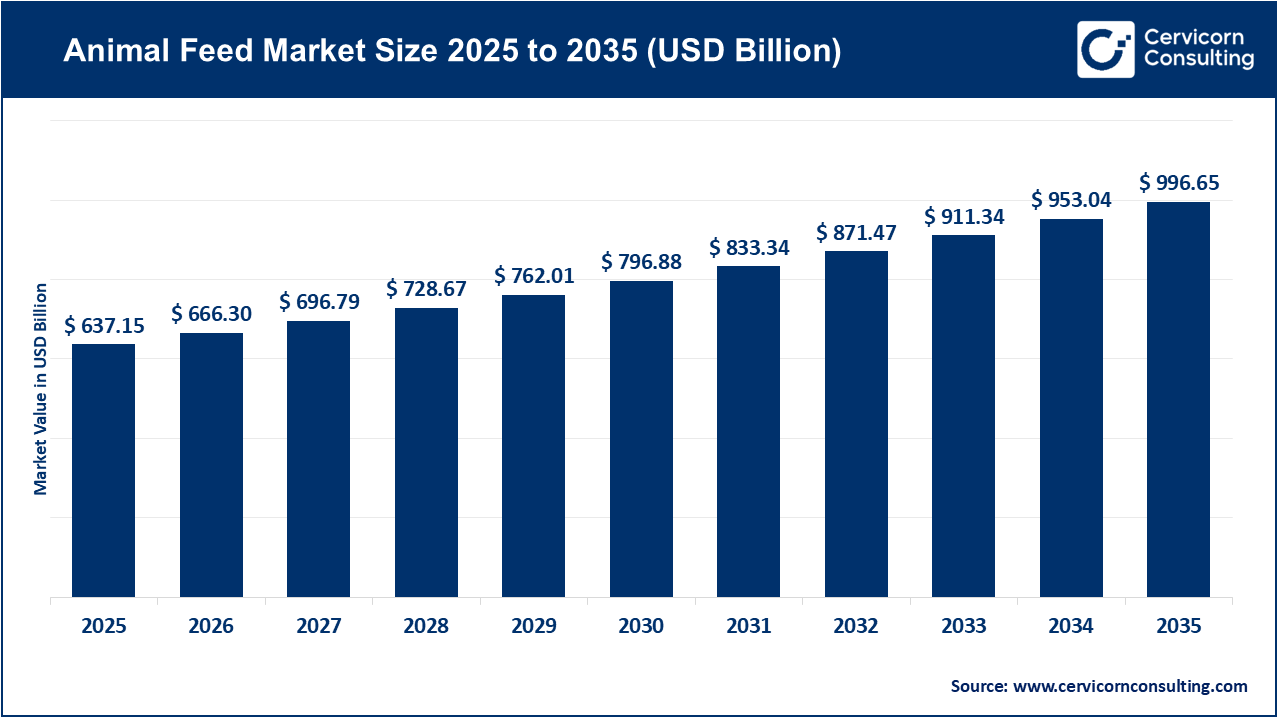
The livestock industry is expanding alongside global meat production, which is projected to reach nearly 370–380 million tons by 2030, with poultry expected to account for more than half of this increase due to its cost efficiency and shorter production cycles. Meanwhile, resource efficiency and sustainability are becoming strong drivers of innovation. Climate change, water scarcity, and land limitations are increasingly impacting traditional agricultural practices. Consequently, industries are seeking ways to manage output levels while maintaining productivity within environmental constraints, leading to increased innovation in feed formulations. Additionally, the industrial feed market continues to consolidate, with commercial feed production representing over 70% of total feed consumption in developed regions, compared to less than 50% in many developing economies, indicating substantial potential for market growth.
Precision Nutrition and Digital Feed Management Propel Animal Feed Market Growth
Precision nutrition represents the most significant transformative technological shift in the animal feed market. This shift involves utilizing digital tools and real-time data access to inform feed formulation. Furthermore, AI-driven software enables feed manufacturers to adjust feed recipes based on daily changes in feed costs. At the same time, digital feed management is a feed technology that is a nested series of integrated sensors and IoT devices to provide real-time monitoring of animal growth and overall health. In this case, precision utilization delivers nutrients in a precise and timely response. In addition, this approach effectively reduces environmental outputs from livestock production as much as possible by using feed.
Key Insights related to Precision Nutrition and Digital Feed Management
Global Animal Feed Production Landscape
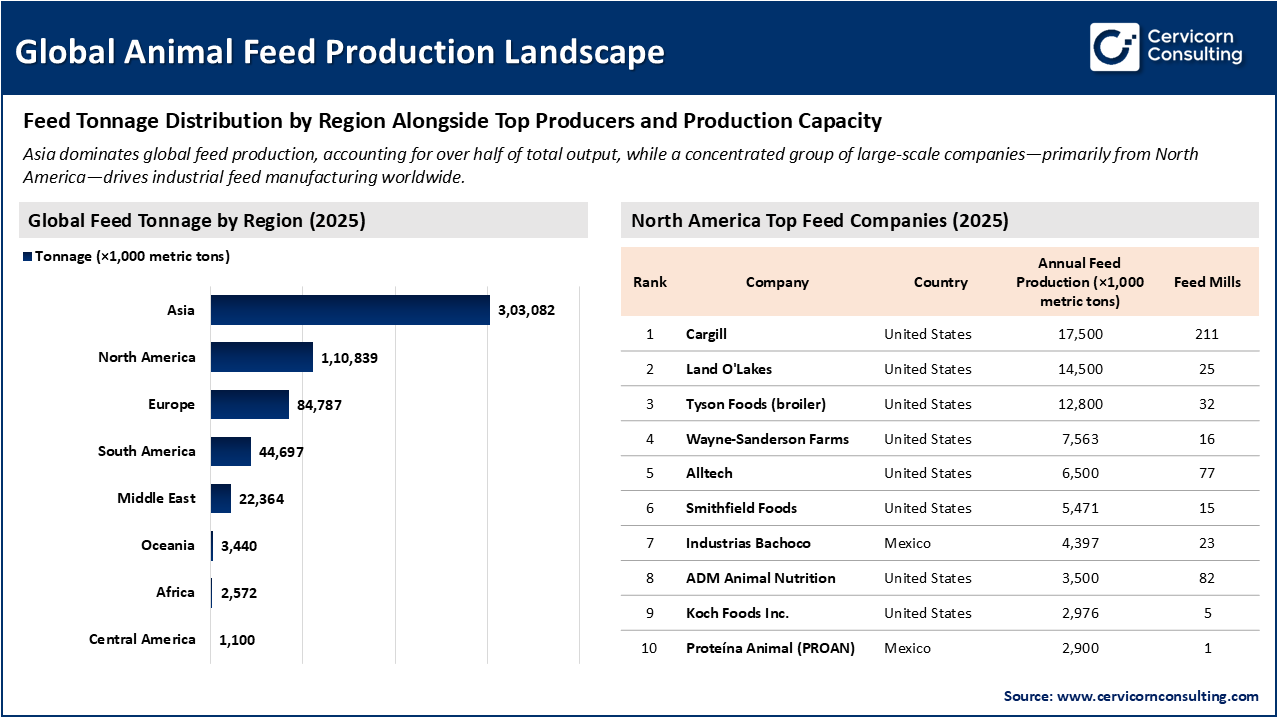
The global animal feed market is expected to reach around 572.9 million metric tons in 2025, with strong regional concentration and increasing industrial consolidation. Asia plays a significant role in the market, accounting for over 303 million metric tons, which is more than half of the global output. This growth is mainly fueled by the rising demand from large-scale livestock and aquaculture production in the region.
In North America, the animal feed market is highly consolidated, with a few major companies accounting for a significant share of total feed output. Leading players such as Cargill and Land O’Lakes have strengthened their positions through extensive feed mill networks and vertically integrated operations. The strong presence of U.S.-based firms among the top producers highlights the advanced industrial farming systems and the rapid adoption of new technologies in the region.
Report Scope
| Area of Focus | Details |
| Market Size in 2026 | USD 666.30 Billion |
| Market Size in 2035 | USD 996.65 Billion |
| CAGR 2026 to 2035 | 4.60% |
| Dominant Region | Asia-Pacific |
| Key Segments | Additives, From, Animal Type, Region |
| Key Companies | Land O'Lakes, Inc., ForFarmers N.V., Wen's Food Group, J.D. Heiskell & Co., Kemin Industries, Inc., Biomin Holding GmbH, Cargill, Inc., Archer Daniels Midland Company (ADM), Charoen Pokphand Group (CP Group), Nutreco N.V., New Hope Group, Alltech, Inc., Dabaco Group, De Heus Animal Nutrition, Ridley Corporation Limited |
1. Major Corporate Expansion and Production Milestones
The animal feed industry is undergoing substantial drives in corporate consolidation, with major companies expanding their new strategic investments. These leading companies are expanding their production capacity in high-growth regions like the Asia Pacific and Africa. As part of this expansion, 'smart mills' are often built, which employ automation and next-generation data analytics to ensure consistency and safety of the final product. Similarly, Production milestones are being achieved in the specialized feed sector, such as aquafeed and functional nutrition, as well.
2. Policy and Feed Safety Regulatory Milestones
Regulatory developments are a major driver of the animal feed industry. The significant impacts have come from global regulatory restriction to Antibiotic Growth Promoters (AGPs). Governments across China, the European Union, and the United States have imposed bans or limits on AGP usage in livestock production. This has required a total reformulation of feed, without access or approval to use AGP. The feed industry adopted "proactive biology" strategies, such as the use of probiotics, organic acids, and essential oils, to promote gut health and immunity. This regulatory environment has created a massive market for gut health additives, and it has also reshaped the entire growth trajectory for the additives segment of the sector to be focused on animal welfare, public health, and nutrition.
3. Strategic Investment Milestones Economic Data Points
Strategic investment within the animal feed market is increasingly focused on the software of the industry biotech and digital platforms. Venture capital and corporate investment are flowing into companies that develop attractive novel enzyme, microbial, and digital monitoring services. The largest indicator of this trend is that the future value of the industry is in enhancing biological efficiency rather than in its gross capacity to process grains. As more high-value ingredients will be included in feed to replace the feed formulation, this can reduce the cost of raw materials or antibiotics. The economic shift from "preventative chemistry" to "proactive biology" represents billions of dollars opportunity.
4. Global Logistics and Supply Chain Improvement Strategies
The fluctuations in global commodity markets have prompted the feed industry to improve supply chain management. Feed producers are investing in high-quality logistics and storage facilities to reduce supply risks, which include multi-modal transportation networks and blockchain technology to ensure all ingredients, are traceable. Buyers and regulators increasingly demand that raw materials such as soy or fishmeal be sourced without being grown from deforested areas or overfished regions. These supply chain improvements are essential for maintaining market access and reputational safety within the global protein space.
The animal feed market is segmented into North America, Europe, Asia-Pacific, and LAMEA. Here is a brief overview of each region:
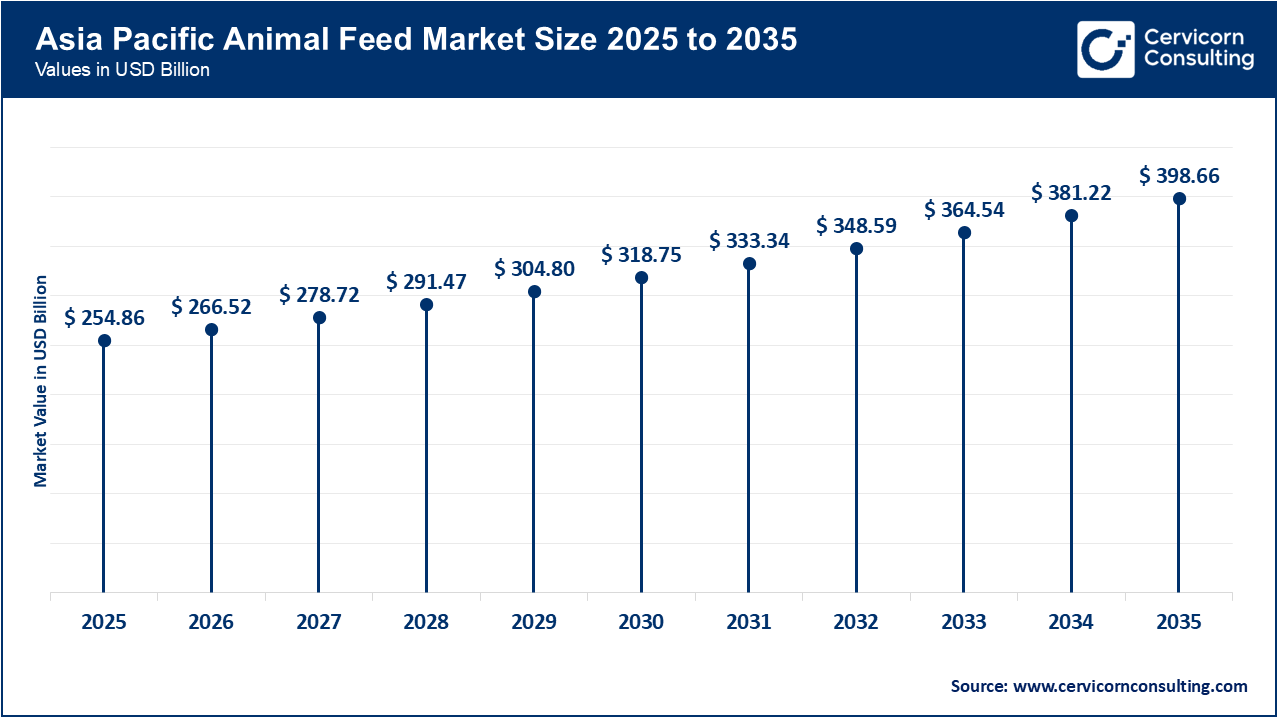
The Asia-Pacific animal feed market size was valued at USD 254.86 billion in 2025 and is expected to hit around USD 398.66 billion by 2035. The Asia Pacific market is the largest region of the global animal feed market due to the rapid urbanization, which is resulting in the emergence of a middle class. As more people migrate to urban centers, dietary changes move from carbohydrate-based staples to high-protein diets derived from animal products. This nutrition transition requires massive increases in livestock production, creating a demand for commercially manufactured feed that delivers consistent nutritional value.
India to Emerge as a High-Growth Market for Animal Feed
India’s animal feed sector is one of the fastest-growing markets globally, supported by strong demand from poultry and dairy industries.
The increasing shift toward organized farming and government initiatives supporting livestock productivity are further strengthening feed demand in India.
China to Act as a Global Production and Innovation Hub for Animal Feed
A significant portion of global feed production is concentrated in China, making it a central hub for both volume and innovation in the animal feed market.
China accounts for over 250 million metric tons of feed production annually, representing more than 20% of global output. The country has a highly industrialized livestock sector, particularly in swine and aquaculture, which are major consumers of compound feed.
Large-scale farming operations and vertically integrated supply chains dominate the Chinese market, requiring high-quality, performance-driven feed products. Additionally, the country is rapidly adopting precision nutrition technologies and alternative feed ingredients to improve efficiency and sustainability.
However, feed production in China is influenced by fluctuations in raw material prices such as corn and soybean meal, prompting manufacturers to explore cost-effective and sustainable alternatives.
Average Costing of Key Feed Ingredients in China
According to industry estimates (as of early 2026), approximate pricing trends for key feed inputs in China are as follows:
Rising input costs are encouraging feed producers to adopt alternative proteins, optimize formulations, and invest in precision feeding technologies to maintain margins while ensuring performance.
The North America animal feed market size was estimated at USD 165.66 billion in 2025 and is predicted to surpass around USD 259.13 billion by 2035. The North American animal feed market is defined by a high level of technological integration and the maturity of the industrial structure, which emphasizes efficiency and trade competitiveness. It utilizes advanced agricultural technologies, including precision nutrition, automated feeding systems, and big data analytics, which maintain systemic global competitiveness in livestock production. The use of IoT sensors to monitor animal feed management, animal health, and nutrient intake reduces waste and maximizes production costs.
United States to Lead Regional Feed Production and Innovation
The United States dominates the North American animal feed market due to its large-scale livestock production and advanced feed manufacturing capabilities.
The country is also at the forefront of adopting AI-based feed optimization and automated feeding systems to enhance productivity.
Canada to Emphasize Sustainable and Efficient Feed Solutions
Canada is witnessing steady growth in the animal feed market, supported by its strong dairy and swine industries.
The country’s emphasis on sustainability and export-oriented livestock production is expected to further support market growth.
The Europe animal feed market size was reached at USD 152.92 billion in 2025 and is forecasted to grow around USD 239.20 billion by 2035. The European animal feed market is increasingly affected by a strict regulatory environment and a strong societal push toward sustainability and animal welfare. The European Union's "Farm to Fork" strategy and other environmental mandates have led producers to move towards environmental solutions. Feed manufacturers are focusing on reducing greenhouse gas emissions, introducing methane-reducing feed additives for ruminants, or removing soy associated with deforestation from the feed supply chain.
Germany to Lead Feed Production in Europe
Germany is one of the largest animal feed producers in Europe, supported by its strong livestock sector.
Recent Developments:
Animal Feed Market Share, By Region, 2025 (%)
| Region | Revenue Share, 2025 (%) |
| Asia Pacific | 40% |
| North America | 26% |
| Europe | 24% |
| LAMEA | 10% |
The LAMEA animal feed market was valued at USD 63.72 billion in 2025 and is anticipated to reach around USD 99.67 billion by 2035. In the LAMEA (Latin America, the Middle East, and Africa) region, especially South America plays an essential engine for the global animal feed market as a central exporter of meat and feed ingredients. Brazil and Argentina are now recognized as global powers in poultry and beef production, facilitated by tremendous arable land and strong agricultural infrastructure. In South America, growth is closely related to the expansion of the international meat trade, where Latin American producers export to markets in Asia and Europe.
Recent Developments:
The animal feed market is segmented into additives, from, animal type, and region.
Amino acids accounted for the largest share of the feed additive market, primarily because they are the fundamental building blocks of protein, which are necessary for muscle synthesis and animal growth. The lysine, methionine, and threonine are the most commonly used supplemental amino acids in poultry and swine diets. Supplementing synthetic amino acids allows producers to reduce the overall diet's level of crude protein such as feeding less soybean meal, while still ensuring the animal's nutrition requirements. This practice reduces overall feed costs and improves feed efficiency.
Animal Feed Market Share, By Additives, 2025 (%)
| Additives | Revenue Share, 2025 (%) |
| Amino Acid | 34% |
| Feed Enzymes | 17% |
| Feed Acidifiers | 14% |
| Vitamins | 10% |
| Antioxidants | 8% |
| Antibiotics | 5% |
| Others | 12% |
Feed enzymes represent the fastest-growing segment of the animal feed market because they act as biocatalysts, breaking down anti-nutritional factors (ANF) in feed ingredients such as phytate and non-starch polysaccharides (NSP). ANF can limit the animal's ability to extract calories and nutrients from feed ingredients. By neutralizing ANFs, enzymes increase the calories and nutrients available from raw materials. In addition, during periods of corn and soy are expensive, as enzyme supplementation enables producers to easily access lower-cost grains like barley, wheat, or distillers' grains, without compromising animal performance.
Pellet feed dominates the form in the global animal feed market, mainly because of its use for livestock production in an industrialized system. The pelleting process refers to the compression of mash feed to produce small, cylindrical shapes using heat and pressure. This format offers several benefits in terms of physical characteristics and nutrition. From a physical standpoint, pellets prevent "sorting," where animals eat some ingredients and allow for more even nutrient consumption. Additionally, pellets offer a higher bulk density of approximately 3% to 5% than mash feed, leading to lower transportation costs, less dust in the barn, and less feed waste.
Animal Feed Market Share, By From, 2025 (%)
| From | Revenue Share, 2025 (%) |
| Pellet Feed | 55% |
| Mash Feed | 25% |
| Crumble Feed | 20% |
Crumble is the fastest-growing segment in the feed market, as it is essentially pellets broken into smaller, irregular bits. This format is specially designed for young animals, such as chicks and piglets, which do not have the capacity to swallow large pellets. Crumbles offer the ideal combination of particle size and nutrient density, promoting early-life feed intake and supporting gut development during critical growth stages. Thus, as farmers increasingly focus on maximizing each stage of the production cycle, the demand for crumbles will continue to rise.
Poultry remains the leading segment within the animal feed market, by a noticeable margin. This superiority can be attributed to several structural factors in poultry production. Poultry represents the livestock with the shortest production cycle, with broilers regularly reaching market weight in 6 to 8 weeks. This quick production cycle enables continuous feed producers to recover capital from their monetary and resource investments rapidly. Furthermore, poultry meat and eggs can be consumed year-round across global markets, consistently driving high demand.
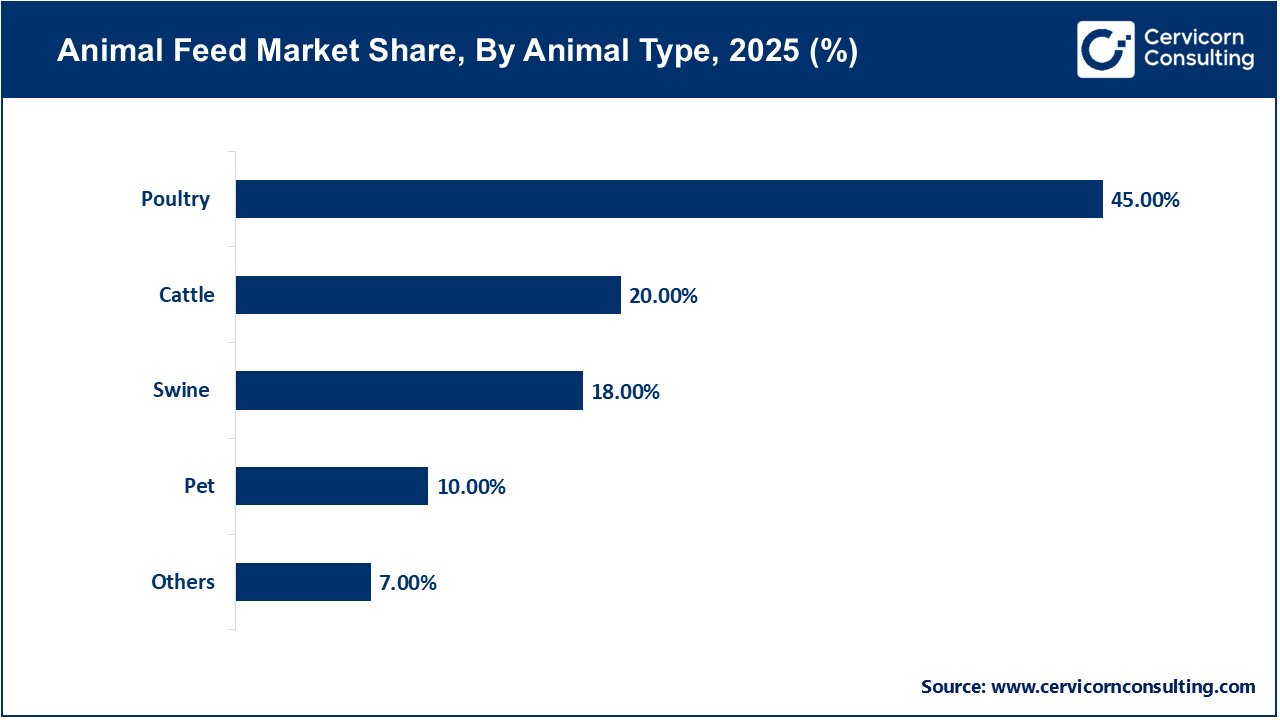
The swine segment is the fastest-growing area of the market, primarily driven by the "professionalization" and consolidation of the industry in Asia. Historically, many pigs were raised in small-scale or backyard settings, with limited commercial feed. However, following the outbreak of African Swine Fever (ASF), countries in China and Southeast Asia have rapidly transitioned into massive, high-tech "pig hotels". This professionalization is a growing focus on piglet health and sow productivity, which has increased demand for high-value specialized feeds and additives.
By Additives
By From
By Animal Type
By Region
Chapter 1. Market Introduction and Overview
1.1 Market Definition and Scope
1.1.1 Overview of Animal Feed
1.1.2 Scope of the Study
1.1.3 Research Timeframe
1.2 Research Methodology and Approach
1.2.1 Methodology Overview
1.2.2 Data Sources and Validation
1.2.3 Key Assumptions and Limitations
Chapter 2. Executive Summary
2.1 Market Highlights and Snapshot
2.2 Key Insights by Segments
2.2.1 By Additives Overview
2.2.2 By Form Overview
2.2.3 By Animal Type Overview
2.3 Competitive Overview
Chapter 3. Global Impact Analysis
3.1 Russia-Ukraine Conflict: Global Market Implications
3.2 Regulatory and Policy Changes Impacting Global Markets
Chapter 4. Market Dynamics and Trends
4.1 Market Dynamics
4.1.1 Market Drivers
4.1.2 Market Restraints
4.1.3 Market Opportunities
4.1.4 Market Challenges
4.2 Market Trends
Chapter 5. Premium Insights and Analysis
5.1 Global Animal Feed Market Dynamics, Impact Analysis
5.2 Porter’s Five Forces Analysis
5.2.1 Bargaining Power of Suppliers
5.2.2 Bargaining Power of Buyers
5.2.3 Threat of Substitute Products
5.2.4 Rivalry among Existing Firms
5.2.5 Threat of New Entrants
5.3 PESTEL Analysis
5.4 Value Chain Analysis
5.5 Product Pricing Analysis
5.6 Vendor Landscape
5.6.1 List of Buyers
5.6.2 List of Suppliers
Chapter 6. Animal Feed Market, By Additives
6.1 Global Animal Feed Market Snapshot, By Additives
6.1.1 Market Revenue (($Billion) and Growth Rate (%), 2022-2035
6.1.1.1 Amino Acid
6.1.1.2 Feed Enzymes
6.1.1.3 Feed Acidifiers
6.1.1.4 Vitamins
6.1.1.5 Antioxidants
6.1.1.6 Antibiotics
6.1.1.7 Others
Chapter 7. Animal Feed Market, By From
7.1 Global Animal Feed Market Snapshot, By From
7.1.1 Market Revenue (($Billion) and Growth Rate (%), 2022-2035
7.1.1.1 Pellet feed
7.1.1.2 Mash feed
7.1.1.3 Crumble feed
Chapter 8. Animal Feed Market, By Animal Type
8.1 Global Animal Feed Market Snapshot, By Animal Type
8.1.1 Market Revenue (($Billion) and Growth Rate (%), 2022-2035
8.1.1.1 Poultry
8.1.1.2 Cattle
8.1.1.3 Swine
8.1.1.4 Pet
8.1.1.5 Others
Chapter 9. Animal Feed Market, By Region
9.1 Overview
9.2 Animal Feed Market Revenue Share, By Region 2024 (%)
9.3 Global Animal Feed Market, By Region
9.3.1 Market Size and Forecast
9.4 North America
9.4.1 North America Animal Feed Market Revenue, 2022-2035 ($Billion)
9.4.2 Market Size and Forecast
9.4.3 North America Animal Feed Market, By Country
9.4.4 U.S.
9.4.4.1 U.S. Animal Feed Market Revenue, 2022-2035 ($Billion)
9.4.4.2 Market Size and Forecast
9.4.4.3 U.S. Market Segmental Analysis
9.4.5 Canada
9.4.5.1 Canada Animal Feed Market Revenue, 2022-2035 ($Billion)
9.4.5.2 Market Size and Forecast
9.4.5.3 Canada Market Segmental Analysis
9.4.6 Mexico
9.4.6.1 Mexico Animal Feed Market Revenue, 2022-2035 ($Billion)
9.4.6.2 Market Size and Forecast
9.4.6.3 Mexico Market Segmental Analysis
9.5 Europe
9.5.1 Europe Animal Feed Market Revenue, 2022-2035 ($Billion)
9.5.2 Market Size and Forecast
9.5.3 Europe Animal Feed Market, By Country
9.5.4 UK
9.5.4.1 UK Animal Feed Market Revenue, 2022-2035 ($Billion)
9.5.4.2 Market Size and Forecast
9.5.4.3 UK Market Segmental Analysis
9.5.5 France
9.5.5.1 France Animal Feed Market Revenue, 2022-2035 ($Billion)
9.5.5.2 Market Size and Forecast
9.5.5.3 France Market Segmental Analysis
9.5.6 Germany
9.5.6.1 Germany Animal Feed Market Revenue, 2022-2035 ($Billion)
9.5.6.2 Market Size and Forecast
9.5.6.3 Germany Market Segmental Analysis
9.5.7 Rest of Europe
9.5.7.1 Rest of Europe Animal Feed Market Revenue, 2022-2035 ($Billion)
9.5.7.2 Market Size and Forecast
9.5.7.3 Rest of Europe Market Segmental Analysis
9.6 Asia Pacific
9.6.1 Asia Pacific Animal Feed Market Revenue, 2022-2035 ($Billion)
9.6.2 Market Size and Forecast
9.6.3 Asia Pacific Animal Feed Market, By Country
9.6.4 China
9.6.4.1 China Animal Feed Market Revenue, 2022-2035 ($Billion)
9.6.4.2 Market Size and Forecast
9.6.4.3 China Market Segmental Analysis
9.6.5 Japan
9.6.5.1 Japan Animal Feed Market Revenue, 2022-2035 ($Billion)
9.6.5.2 Market Size and Forecast
9.6.5.3 Japan Market Segmental Analysis
9.6.6 India
9.6.6.1 India Animal Feed Market Revenue, 2022-2035 ($Billion)
9.6.6.2 Market Size and Forecast
9.6.6.3 India Market Segmental Analysis
9.6.7 Australia
9.6.7.1 Australia Animal Feed Market Revenue, 2022-2035 ($Billion)
9.6.7.2 Market Size and Forecast
9.6.7.3 Australia Market Segmental Analysis
9.6.8 Rest of Asia Pacific
9.6.8.1 Rest of Asia Pacific Animal Feed Market Revenue, 2022-2035 ($Billion)
9.6.8.2 Market Size and Forecast
9.6.8.3 Rest of Asia Pacific Market Segmental Analysis
9.7 LAMEA
9.7.1 LAMEA Animal Feed Market Revenue, 2022-2035 ($Billion)
9.7.2 Market Size and Forecast
9.7.3 LAMEA Animal Feed Market, By Country
9.7.4 GCC
9.7.4.1 GCC Animal Feed Market Revenue, 2022-2035 ($Billion)
9.7.4.2 Market Size and Forecast
9.7.4.3 GCC Market Segmental Analysis
9.7.5 Africa
9.7.5.1 Africa Animal Feed Market Revenue, 2022-2035 ($Billion)
9.7.5.2 Market Size and Forecast
9.7.5.3 Africa Market Segmental Analysis
9.7.6 Brazil
9.7.6.1 Brazil Animal Feed Market Revenue, 2022-2035 ($Billion)
9.7.6.2 Market Size and Forecast
9.7.6.3 Brazil Market Segmental Analysis
9.7.7 Rest of LAMEA
9.7.7.1 Rest of LAMEA Animal Feed Market Revenue, 2022-2035 ($Billion)
9.7.7.2 Market Size and Forecast
9.7.7.3 Rest of LAMEA Market Segmental Analysis
Chapter 10. Competitive Landscape
10.1 Competitor Strategic Analysis
10.1.1 Top Player Positioning/Market Share Analysis
10.1.2 Top Winning Strategies, By Company, 2022-2024
10.1.3 Competitive Analysis By Revenue, 2022-2024
10.2 Recent Developments by the Market Contributors (2024)
Chapter 11. Company Profiles
11.1 Land O'Lakes, Inc.
11.1.1 Company Snapshot
11.1.2 Company and Business Overview
11.1.3 Financial KPIs
11.1.4 Product/Service Portfolio
11.1.5 Strategic Growth
11.1.6 Global Footprints
11.1.7 Recent Development
11.1.8 SWOT Analysis
11.2 ForFarmers N.V.
11.3 Wen's Food Group
11.4 J.D. Heiskell & Co.
11.5 Kemin Industries, Inc.
11.6 Biomin Holding GmbH
11.7 Cargill, Inc.
11.8 Archer Daniels Midland Company (ADM)
11.9 Charoen Pokphand Group (CP Group)
11.10 Nutreco N.V.
11.11 New Hope Group
11.12 Alltech, Inc.
11.13 Dabaco Group
11.14 De Heus Animal Nutrition
11.15 Ridley Corporation Limited